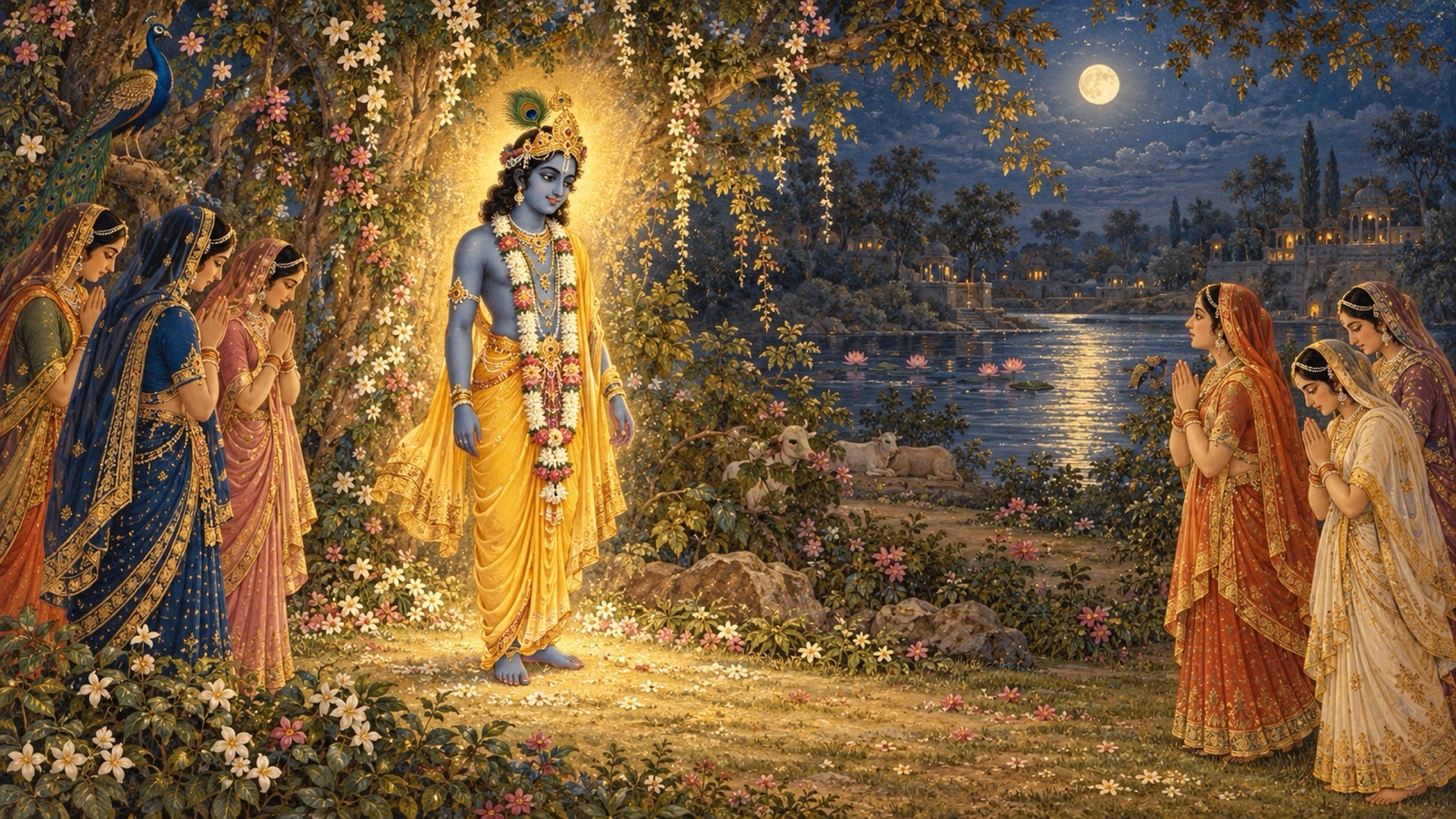
Out of the darkness of their longing He steps forward once more — smiling, garlanded, robed in yellow silk — and the weeping of Vraja turns in a single moment into wonder.
Om Namo Bhagavate Vasudevaya.
Om Namo Bhagavate Vasudevaya.
Om Namo Bhagavate Vasudevaya.
Welcome back to Srimad Bhagavatam Wisdom, our devotional journey through the sacred histories and teachings of the Srimad Bhagavat Mahapurana. In the thirty-second chapter of the Tenth Canto, Sukadeva Gosvami tells King Parikshit how Sri Krishna came back into the midst of the weeping cowherd women of Vraja, led them to the moonlit sands of the Kalindi, and there unfolded the three ways in which love is returned among living beings — and the hidden reason why He had chosen to remain unseen.
Chapter Information
- Scripture: Śrīmad Bhāgavata Mahāpurāṇa
- Canto: 10 (Book Ten, First Half)
- Chapter: 32 (Discourse 32)
- Chapter title: The Reunion
- Principal speaker: Sukadeva Gosvami (narrating to King Parikshit); within the chapter, Sri Krishna Himself
- Principal listener: King Parikshit; within the chapter, the gopis of Vraja
- Main setting: The moonlit sandy bank of the Kalindi (Yamuna) in Vrindavana
- Central subject: Krishna’s reappearance before the grieving cowherd women, their reviving joy, their question about love, and His teaching on the three kinds of love and on why He had withdrawn from their sight
- Principal verse range: Canto 10, Chapter 32, verses 1–22
- Primary edition: Gita Press Śrīmad Bhāgavata Mahāpurāṇa (Book Ten, First Half)
Context From the Previous Chapter
In the previous discourse the cowherd women of Vraja, searching the forest for their vanished Lord, lifted up together the song remembered ever since as the Gopi-gita, begging Him to set His feet upon their hearts and to revive them with the nectar of His speech.
The Lord Appears Among Them
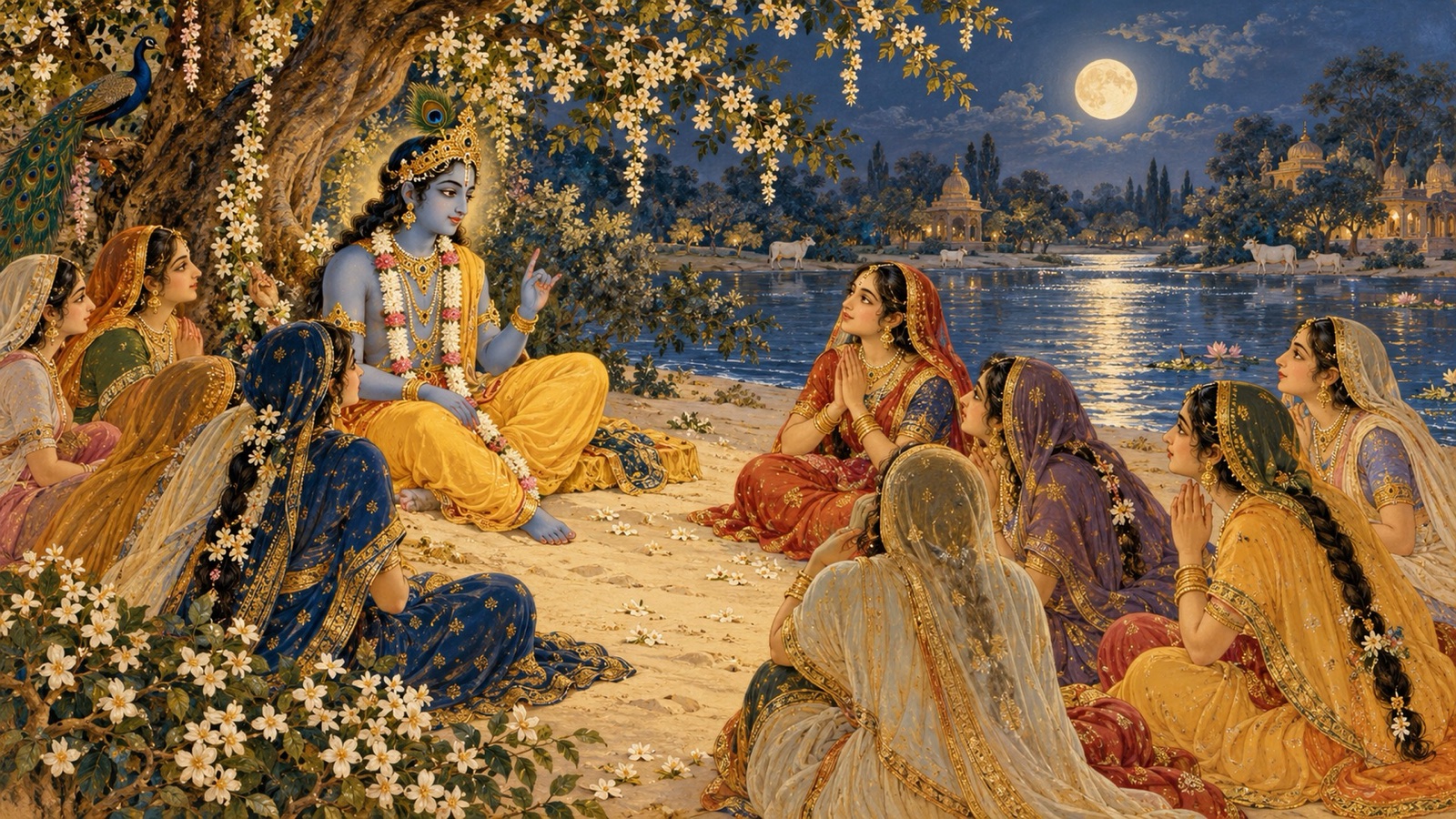
So they sang, Sukadeva told the king, and so they wept — crying out in a hundred ways, their voices breaking, their whole being bent upon one hunger: to behold Sri Krishna once again. And into the very middle of that grief He came. All at once He stood there among them, His lotus face lit with a quiet smile, a garland upon His breast, clad in yellow silk — He before whose beauty even Cupid, who bewilders the whole world, is himself bewildered.
तासामाविरभूच्छौरि: स्मयमानमुखाम्बुज: ।
पीताम्बरधर: स्रग्वी साक्षान्मन्मथमन्मथ: ॥ २ ॥
tāsām āvirabhūc chauriḥ smayamāna-mukhāmbujaḥ pītāmbara-dharaḥ sragvī sākṣān manmatha-manmathaḥ
Meaning: In their very midst Sri Krishna, the descendant of Sura, became visible — His lotus-like countenance wearing a smile, clad in yellow raiment and adorned with a garland, the enchanter of Cupid himself. (Canto 10, Chapter 32, verse 2)
Beholding their dearmost one returned to them, the women rose to their feet all together, their eyes blossoming wide with delight, just as the limbs of a body stir again when the life-breath comes back into it (Canto 10, Chapter 32, verse 3).
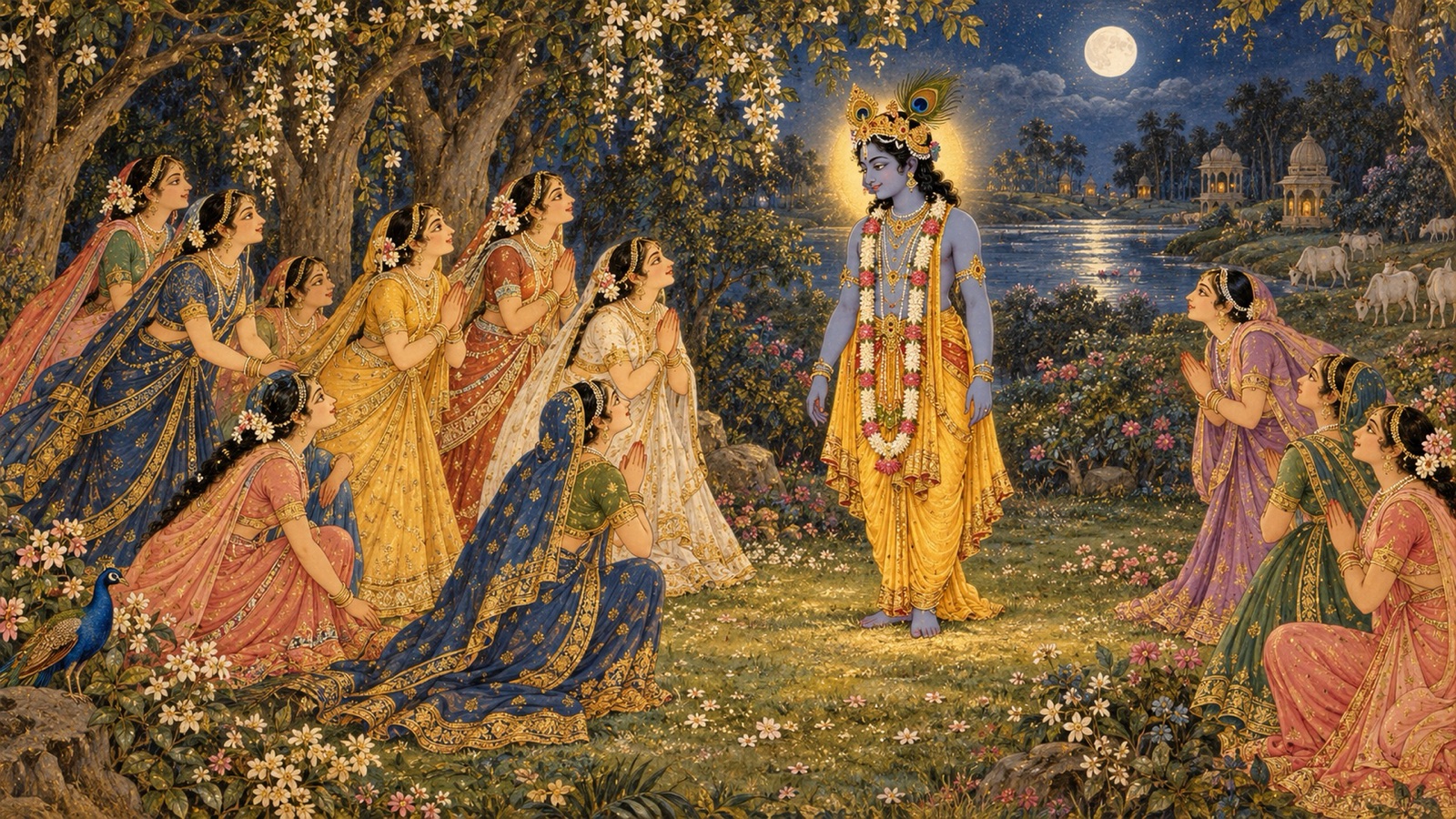
Then each heart answered Him in its own way. One clasped His lotus hand between her joined palms in gladness. Another received upon her shoulder His arm, fragrant with sandal paste. A slender one cupped her palms for the betel He had been chewing; another pressed His lotus feet to her heart, burning as she was with the fire of separation. One knitted her brows and bit her lip, agitated by the indignation only deep love can feel, and tormented Him, as it were, with volleys of sidelong glances. Another gazed unwinking upon His lotus countenance and was still not sated, as saints are never sated in contemplating His feet. And one drew Him in through the openings of her eyes, set Him within her heart, closed her eyes lest He slip away, and stood with every hair erect, embracing Him in her mind, immersed in bliss like a yogi united with the Lord (Canto 10, Chapter 32, verses 4–8).
With that one festival of beholding Him, the torment of separation fell away from them all, as grief leaves the heart of one who has met an enlightened soul. Encircled by those women now freed of sorrow, the infallible Lord shone the more radiantly, like the Supreme Person surrounded by His own divine energies (Canto 10, Chapter 32, verses 9–10).
To the Moonlit Bank of the Kalindi
Taking them all with Him, the almighty Lord came down to the lovely shore of the Kalindi. Breezes there carried the fragrance of full-blown jasmine and mandara blossoms and drew swarms of bees behind them; the flood of autumn moonlight had banished the darkness of that night; and the river, with waves for hands, had strewn the softest sand along the bank (Canto 10, Chapter 32, verses 11–12).

A Seat Made of Their Own Garments
The ache within them dissolved in the gladness of His darshan, and they came to the very end of all desiring, as the Vedic hymns reach their true purpose only on passing beyond fruitive aims into the knowledge of God. Then, for the friend of their souls, they spread upon the sand a seat made of their upper cloths.
तद्दर्शनाह्लादविधूतहृद्रुजो
मनोरथान्तं श्रुतयो यथा ययु: ।
स्वैरुत्तरीयै: कुचकुङ्कुमाङ्कितै-
रचीक्लृपन्नासनमात्मबन्धवे ॥ १३ ॥
tad-darśanāhlāda-vidhūta-hṛd-rujo manorathāntaṁ śrutayo yathā yayuḥ svair uttarīyaiḥ kuca-kuṅkumāṅkitair acīkḷpann āsanam ātma-bandhave
Meaning: The pain of their hearts washed away by the joy of seeing Him, they reached the fulfilment of their longing, just as the Vedic texts reach their final aim; and with their own upper garments, marked with kunkuma, they prepared a seat for Him, the true kinsman of their souls. (Canto 10, Chapter 32, verse 13)
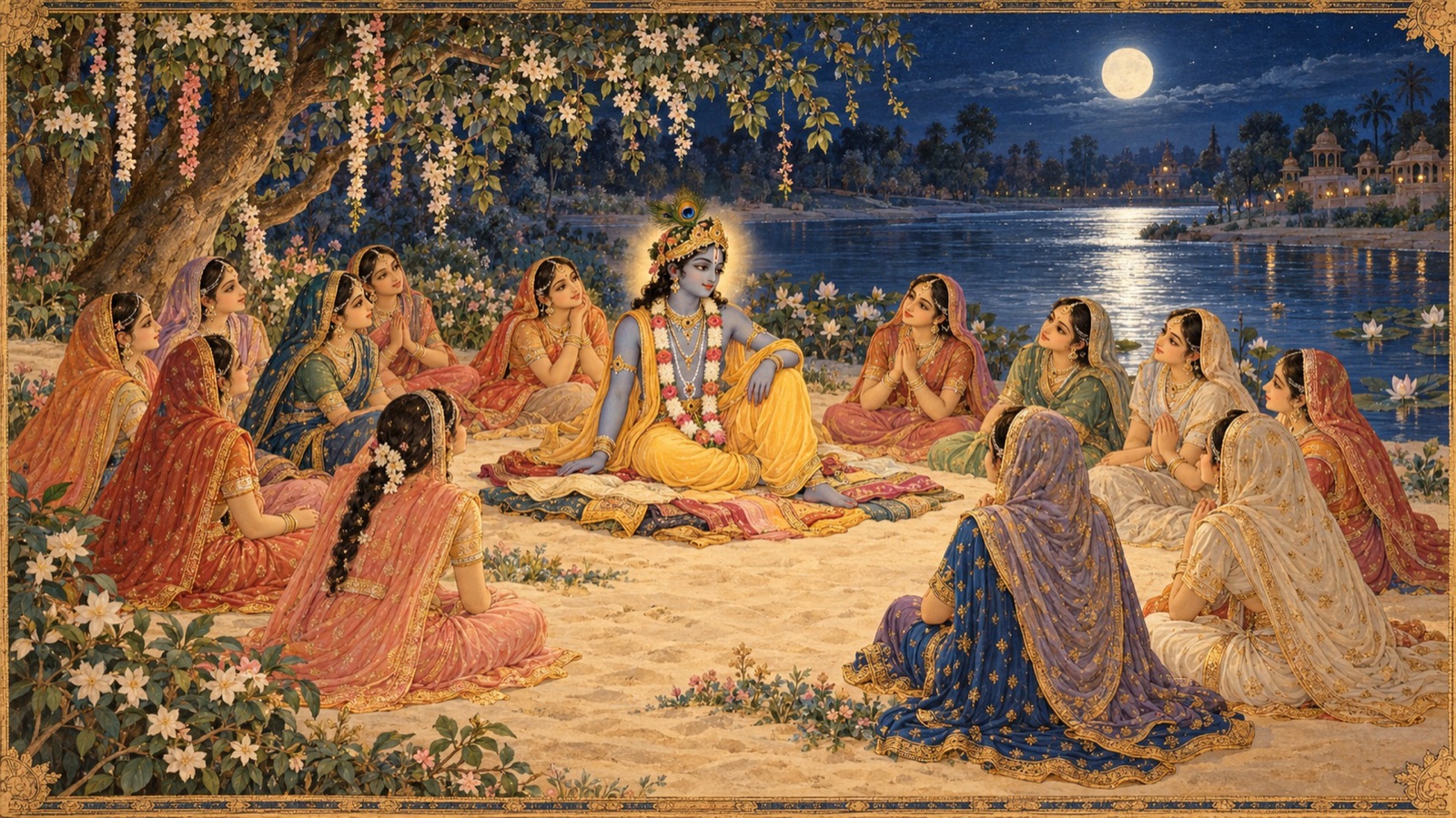
Seated there and honoured by them, the almighty Lord — for whom the masters of yoga prepare a seat within their own hearts — shone in that assembly of cowherd women, bearing the form in which all the loveliness of the three worlds has its one resting place (Canto 10, Chapter 32, verse 14). They welcomed Him with the play of their eyebrows and with smiling, sportive glances, praised Him warmly, and gently pressed the hands and feet they had placed upon their laps; then, still a little displeased, they began to speak (Canto 10, Chapter 32, verse 15).
The Question of the Gopis
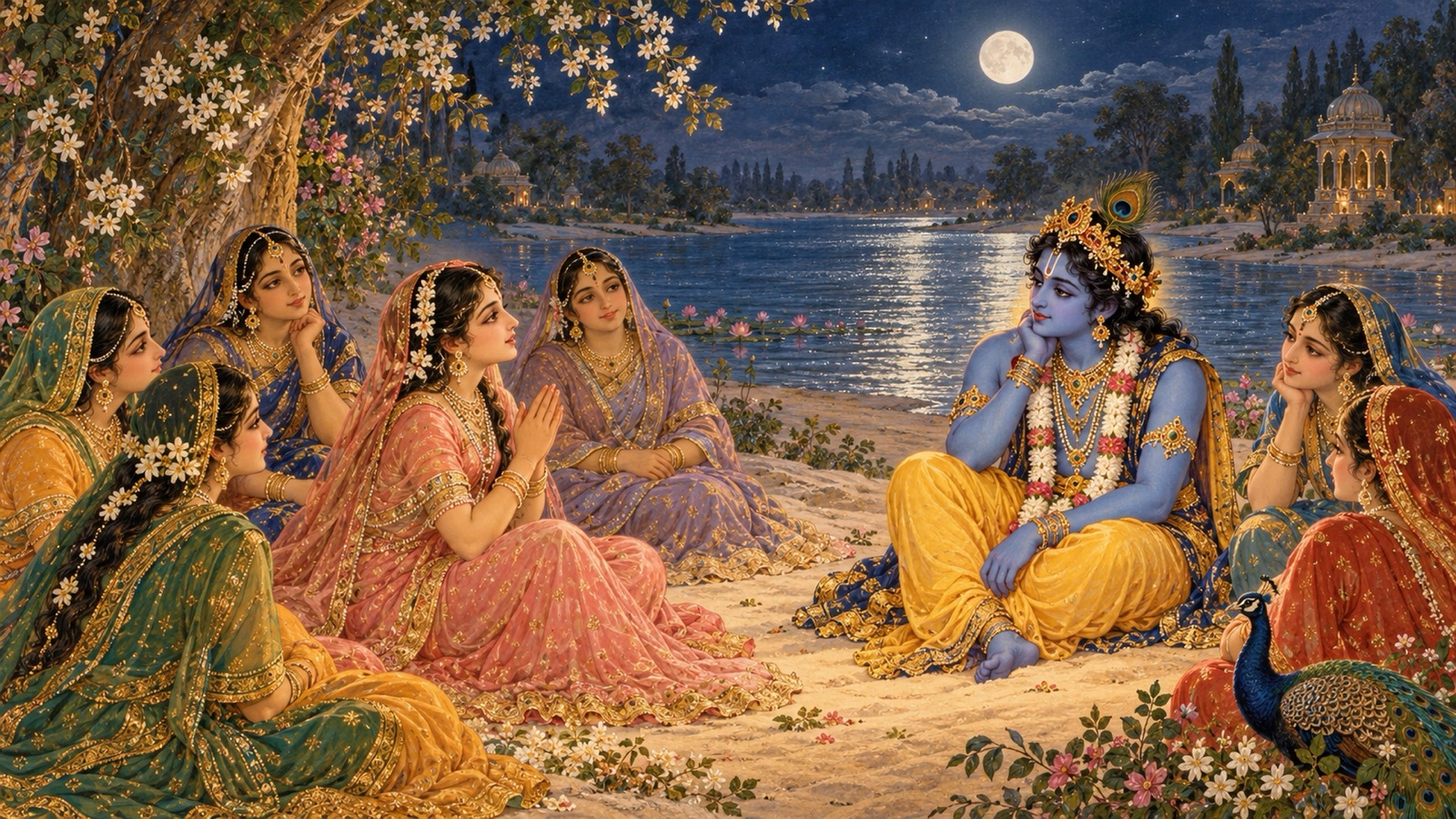
What came out of them was not a reproach but a question. Three kinds of people may be seen in this world, they said, and they begged the Lord to resolve for them which among these is true love.
श्रीगोप्य ऊचु:
भजतोऽनुभजन्त्येक एक एतद्विपर्ययम् ।
नोभयांश्च भजन्त्येक एतन्नो ब्रूहि साधु भो: ॥ १६ ॥
śrī-gopya ūcuḥ bhajato ’nubhajanty eka eka etad-viparyayam nobhayāṁś ca bhajanty eka etan no brūhi sādhu bhoḥ
Meaning: The gopis said: Some give love in return to those who love them; others do just the opposite of this; and still others love neither the one nor the other. Kindly explain this matter to us clearly, O Lord. (Canto 10, Chapter 32, verse 16)
The Three Kinds of Love
The Lord took up their three cases one by one. Those who give affection only where affection is returned, He said, O friends, are in truth labouring for themselves; such dealings hold neither genuine goodwill nor dharma, for the motive is self-interest and nothing besides (Canto 10, Chapter 32, verse 17).
Those, however, who bestow love even upon people who do not love them in return are merciful by nature, as a mother and father are merciful to their child; in them is friendship that is real and dharma against which no fault may be charged (Canto 10, Chapter 32, verse 18). And those who love neither sort are of four kinds: sages absorbed in the Self, those whose every desire is already fulfilled, the dull who cannot recognise a kindness done to them, and the ungrateful who bear enmity toward benefactors as good as their own fathers (Canto 10, Chapter 32, verse 19).
Why the Lord Hid Himself
Having answered their question about others, He turned at last to Himself, and to the one thing their hearts were waiting to hear.
नाहं तु सख्यो भजतोऽपि जन्तून्
भजाम्यमीषामनुवृत्तिवृत्तये ।
यथाधनो लब्धधने विनष्टे
तच्चिन्तयान्यन्निभृतो न वेद ॥ २० ॥
nāhaṁ tu sakhyo bhajato ’pi jantūn bhajāmy amīṣām anuvṛtti-vṛttaye yathādhano labdha-dhane vinaṣṭe tac-cintayānyan nibhṛto na veda
Meaning: But I, O friends, do not openly return the love even of those creatures who love Me — and this I do so that their devotion may grow unbroken, as a poor man who has found wealth and then lost it becomes so absorbed in thinking of that treasure that he is no longer aware of anything else. (Canto 10, Chapter 32, verse 20)
And this, He told them, was the whole secret of His disappearance. For His sake they had set aside the opinion of the world, the letter of the Vedic injunctions and even their own families; such love He would not leave half-awakened. So He had slipped out of sight — never out of love, for He was loving them all the while unseen — only that their hearts might become fixed upon Him without a break.
एवं मदर्थोज्झितलोकवेद-
स्वानां हि वो मय्यनुवृत्तयेऽबला: ।
मयापरोक्षं भजता तिरोहितं
मासूयितुं मार्हथ तत् प्रियं प्रिया: ॥ २१ ॥
evaṁ mad-arthojjhita-loka-veda svānām hi vo mayy anuvṛttaye ’balāḥ mayāparokṣaṁ bhajatā tirohitaṁ māsūyituṁ mārhatha tat priyāḥ
Meaning: In this way, O gentle ones, it was to deepen your unceasing attachment to Me that I — who was loving you invisibly all the while — hid Myself from you, who had given up society, scripture and your own kinsfolk for My sake. Therefore you ought not to find fault with Me, your beloved. (Canto 10, Chapter 32, verse 21)
Here the chapter opens its deepest door. The absence that felt to them like neglect was in truth the most intense reciprocation the Lord can offer. A beloved always within reach may be enjoyed in intervals, between other occupations; a Lord who withdraws becomes the single unbroken thought of the heart, and such continuous remembrance is itself the goal of all devotion. He likens that state to a penniless man who has found a treasure and lost it, who can afterwards attend to nothing else (verse 20). Separation, in His hands, is not the withholding of grace but grace at its hottest; He was loving them unseen through every moment of their searching (verse 21).
A Debt He Cannot Repay
Then He said the thing no one could have expected. These women had cut, for His sake, the household chain that almost no one can break, and had fixed their minds on Him without the least stain. Against such love, He said, even a god’s long lifetime would not suffice Him to clear His debt.
न पारयेऽहं निरवद्यसंयुजां
स्वसाधुकृत्यं विबुधायुषापि व: ।
या माभजन् दुर्जरगेहशृङ्खला:
संवृश्च्य तद् व: प्रतियातु साधुना ॥ २२ ॥
na pāraye ’haṁ niravadya-saṁyujāṁ sva-sādhu-kṛtyaṁ vibudhāyuṣāpi vaḥ yā mābhajan durjara-geha-śṛṅkhalāḥ saṁvṛścya tad vaḥ pratiyātu sādhunā
Meaning: I am not able, even with the lifespan of the gods, to repay what I owe to you, whose union with Me is free from every blemish, and who worshipped Me after severing the chains of home life that are so hard to break. Let your own saintly deeds, therefore, be your recompense. (Canto 10, Chapter 32, verse 22)
Principal Teachings of This Chapter
1. He never truly leaves those who call upon Him. The Lord becomes visible within the very grief that was crying out for Him (verse 2). Where longing is pure, His appearing is never far behind.
2. Love that is merely an exchange is self-interest in disguise. Affection offered for mutual benefit is service rendered to oneself, and the Lord withholds from it the names of friendship and dharma (Canto 10, Chapter 32, verse 17) — a searching measure to hold against our own relationships.
3. Love freely given, where nothing is owed, is the love of parents and of saints. Those who care for people able to give them nothing in return are merciful by nature, and in them dharma stands unblemished (Canto 10, Chapter 32, verse 18).
4. His hiding is itself His mercy. He stays out of sight so that remembrance of Him may grow continuous and undistracted (verses 20–21). What a devotee suffers as the dark night of separation is, from His side, love being intensified.
5. The Lord makes Himself the debtor of His devotees. He who owes nothing to anyone declares that He cannot repay the gopis even in a lifetime of the gods (verse 22). Pure devotion binds the unbindable.
A Devotional Reflection
Every devotee eventually lives through the moment this chapter holds. The gopis have been given all they asked for — He is before them, smiling, seated where their own hands prepared a place, letting them hold His feet — and still something in them must ask why He went away. That asking is not weakness; it is honesty, and the Lord honours it with His longest words to them. He never calls their pain imaginary or small. He tells them instead that He was present all along, loving them unseen, and that the emptiness they felt was the shape His love took so as to outgrow everything else in their lives. Perhaps the hardest faith asked of us is not faith in His presence but faith in His silence — keeping the lamp lit when the room seems dark, trusting that He who has gone from our eyes has not for one instant gone from us. Those who keep that lamp burning find, as the cowherd women found, that He comes back speaking of a debt He cannot repay.
A Daily Devotional Practice
Today, take the one experience you are most tempted to read as the Lord’s indifference — an unanswered prayer, a delay, a season of dryness in your devotion — and consciously offer it back to Him as His own arrangement to draw your remembrance closer. Sit quietly for a few minutes and hold the image of Him standing suddenly among those who were weeping for Him. Then let your mind rest, as the poor man’s mind rests upon his lost treasure, upon the holy name alone, chanting slowly: Om Namo Bhagavate Vasudevaya.
Conclusion
This chapter is the hour in which grief receives its answer. Sri Krishna, returning to the cowherd women of Vraja, revives them by His mere sight, and on the moonlit sands of the Kalindi He teaches how love is given and returned — disclosing at last that His vanishing was never abandonment, but the deepening of a devotion He was tending unseen all the while. May we hold His feet with such constancy that even His silences grow sweet to us.
May the divine wisdom of Srimad Bhagavatam awaken pure devotion within our hearts.
Om Namo Bhagavate Vasudevaya.
Jay Shree Madhav.
References and Attribution
- Primary edition: Gita Press, Śrīmad Bhāgavata Mahāpurāṇa (English), Book Ten (First Half), Discourse 32.
- Series: Srimad Bhagavatam Wisdom · Biswa Sanatan Dharma Seva Trust.
- Presented following the spiritual guidance and recommendation of Pandit Dr. Shri Kashinath Mishra.
This is an original, faithful retelling in the writer’s own words, with brief quoted verses shown in Devanāgarī and transliteration and their meanings given as summaries. It is not a reproduction of any single publisher’s continuous translation or commentary. No affiliation with or endorsement by any publisher is implied.
Jay Shree Madhav