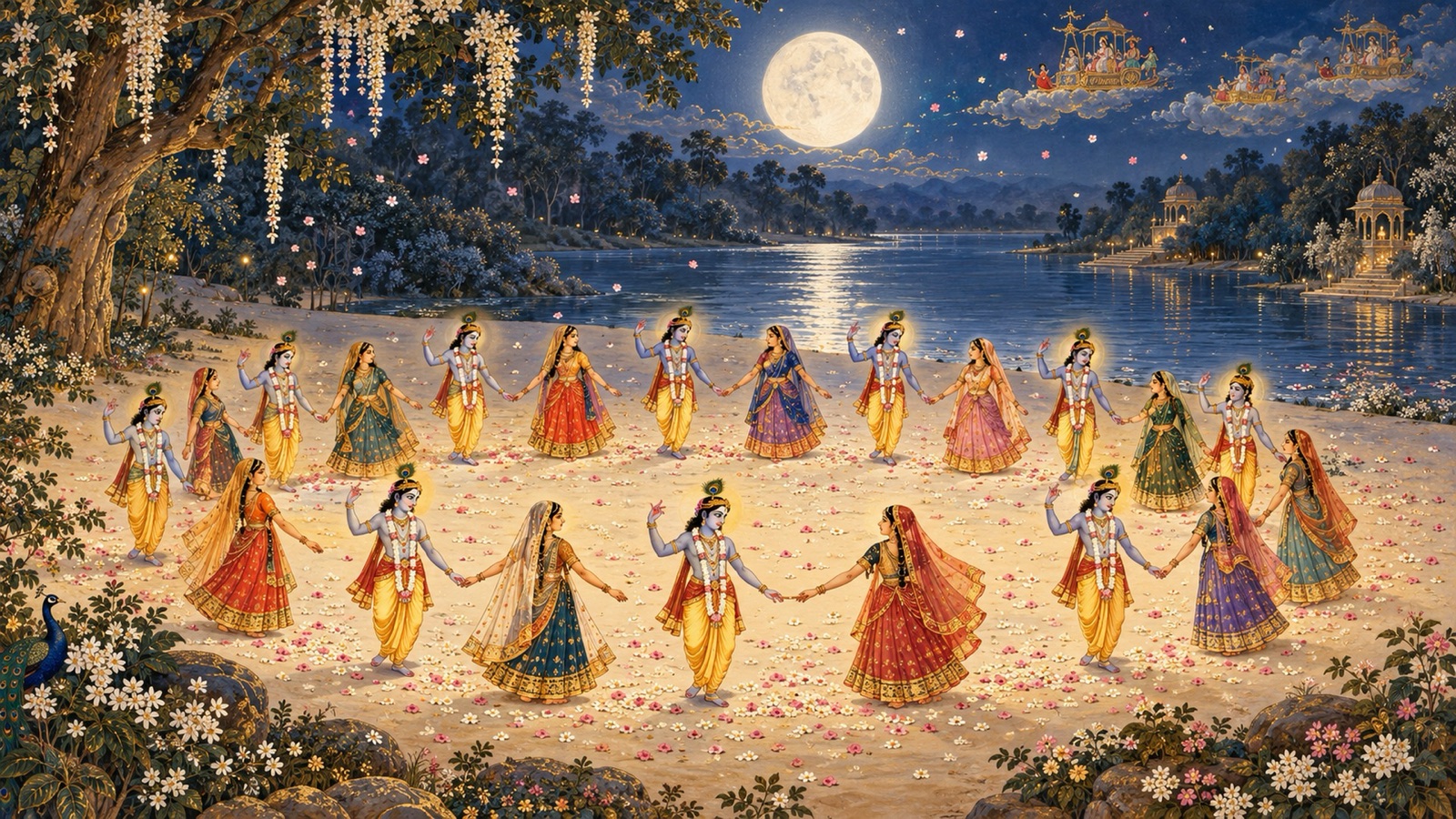
On an autumn night of unending moonlight the Master of Yoga stands between every two of the cowherd women of Vraja, so that each one believes Him to be beside her alone.
Om Namo Bhagavate Vasudevaya.
Om Namo Bhagavate Vasudevaya.
Om Namo Bhagavate Vasudevaya.
Welcome back to Srimad Bhagavatam Wisdom, our devotional journey through the sacred histories and teachings of the Srimad Bhagavat Mahapurana. The thirty-third discourse of the Tenth Canto is the rasa dance itself, told by Sukadeva Gosvami to King Parikshit — who then puts to the sage the one question such a night raises in a thoughtful heart.
Chapter Information
- Scripture: Śrīmad Bhāgavata Mahāpurāṇa
- Canto: 10 (Book Ten, First Half)
- Chapter: 33 (Discourse 33)
- Chapter title: The Rasa Dance
- Principal speaker: Sukadeva Gosvami (narrating to King Parikshit)
- Principal listener: King Parikshit
- Main setting: The sandy bank of the Yamuna in the forest of Vrindavana
- Central subject: The rasa dance of the Lord with the cowherd women of Vraja, the wonder of the gods, and Sukadeva’s reply to King Parikshit’s doubt concerning dharma
- Principal verse range: Canto 10, Chapter 33, verses 1–40
- Primary edition: Gita Press Śrīmad Bhāgavata Mahāpurāṇa
Context From the Previous Chapter
In the discourse just before this one, the Lord reappeared among the grieving cowherd women and answered their question about love returned and love withheld. He had hidden Himself, He told them, only to fix their remembrance wholly upon Him.
The Circle Forms on the Yamuna Sand
Hearing those gentle words, Sukadeva tells us, the cowherd women let fall the agony His absence had kindled in them, for His nearness had already granted all they ever asked. Then, upon that same sandy bank, the Lord began the pastime for which this night is remembered, the women standing in a ring with the arms of each linked to her companions on either side.
तत्रारभत गोविन्दो रासक्रीडामनुव्रतै: ।
स्त्रीरत्नैरन्वित: प्रीतैरन्योन्याबद्धबाहुभि: ॥ २ ॥
tatrārabhata govindo rāsa-krīḍām anuvrataiḥ strī-ratnair anvitaḥ prītair anyonyābaddha-bāhubhiḥ
Meaning: There Govinda began the rasa dance, accompanied by those jewels among women, devoted and affectionate towards Him, who stood with their arms joined one to another. (Canto 10, Chapter 33, verse 2)
One Lord Between Every Two
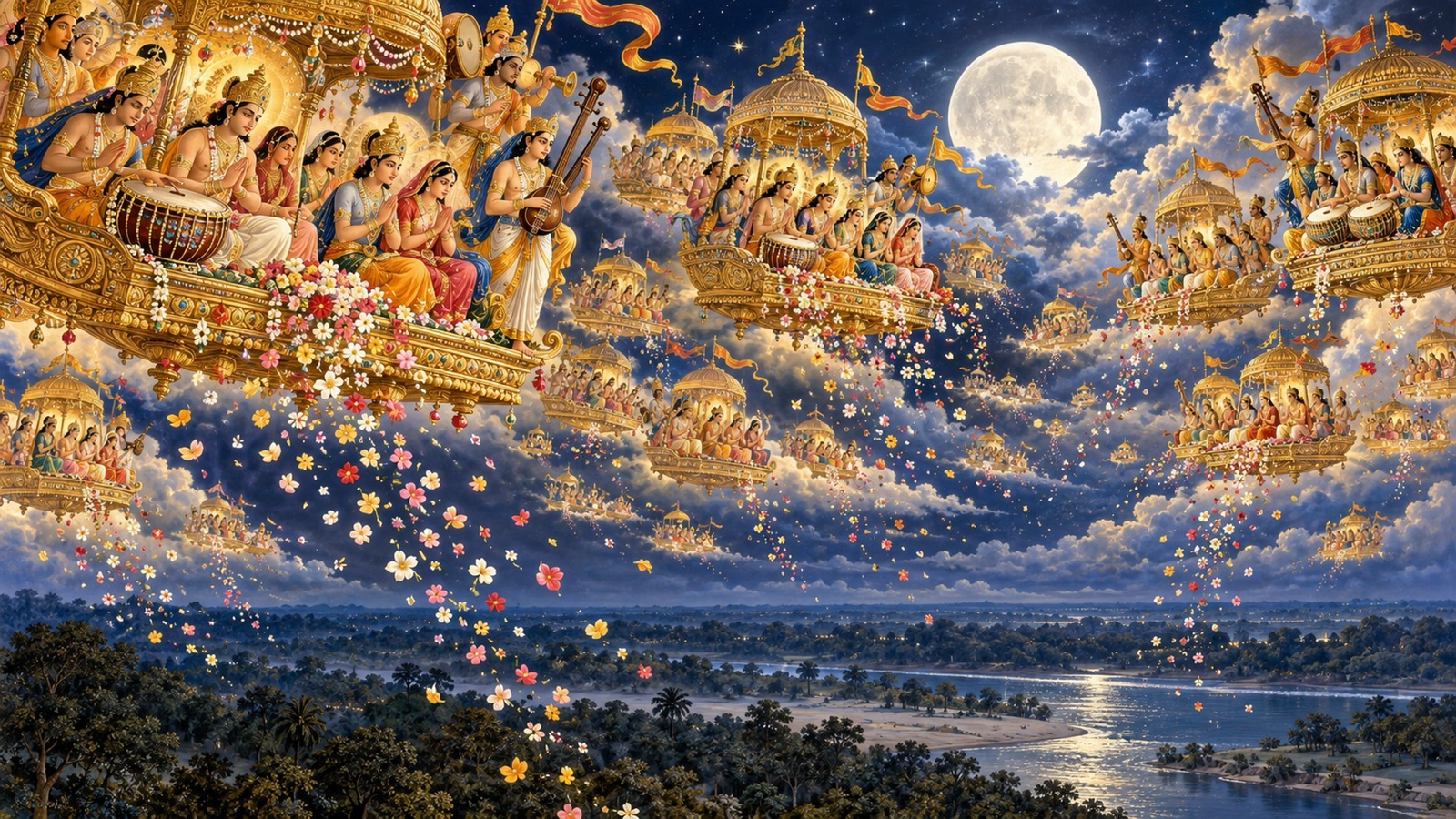
The festival of the rasa commenced, adorned by that ring of gopis. Krishna, the Master of Yoga, placed Himself between each two of them; and such was the wonder of it that every woman was certain the Lord stood at her own side and nowhere else. Above them the firmament filled with hundreds of celestial cars, for the dwellers of heaven had come with their consorts, their minds carried away by eagerness to behold Him.
Drums in the Sky and Flowers on the Sand
Kettledrums sounded from the heavens, showers of blossoms fell, and the chiefs of the Gandharvas with their wives sang His spotless glory. Within the ring another music arose: the mingled sound of bangles, anklets and the little bells at the waists of the cowherd women moving beside their beloved Lord.
An Emerald Among Beads of Gold
तत्रातिशुशुभे ताभिर्भगवान् देवकीसुत: ।
मध्ये मणीनां हैमानां महामरकतो यथा ॥ ७ ॥
tatrātiśuśubhe tābhir bhagavān devakī-sutaḥ madhye maṇīnāṁ haimānāṁ mahā-marakato yathā
Meaning: There among them the Lord, the son of Devaki, shone with surpassing beauty, like a great emerald set in the midst of golden beads. (Canto 10, Chapter 33, verse 7)
The Song of the Circle
With measured steps and graceful movements of their hands, with smiles and the play of their brows, the women of Vraja glowed around Him like flashes of lightning within a bank of clouds. They sang aloud, voices sweetened by love and delighting in devotion alone, and that singing filled this whole universe. One among them raised a melody of her own, distinct from His, and the Lord, much pleased, applauded her aloud — “Well sung! Well sung!” Another took up the same tune in the grave measure called dhruva, and He showed her abundant regard.
Worn out by the dance, one of them rested her hand upon His shoulder as He stood at her side, her bangles slipping and the jasmine loosening from her braid. Another breathed the sandal fragrance of His arm and received it reverently, the hair of her body standing on end for joy. To one whose face was lit by a swinging earring the Lord gave the betel from His own hand; and another, tired with singing, found rest in the cooling touch of His lotus palm.
A Night That Would Not End
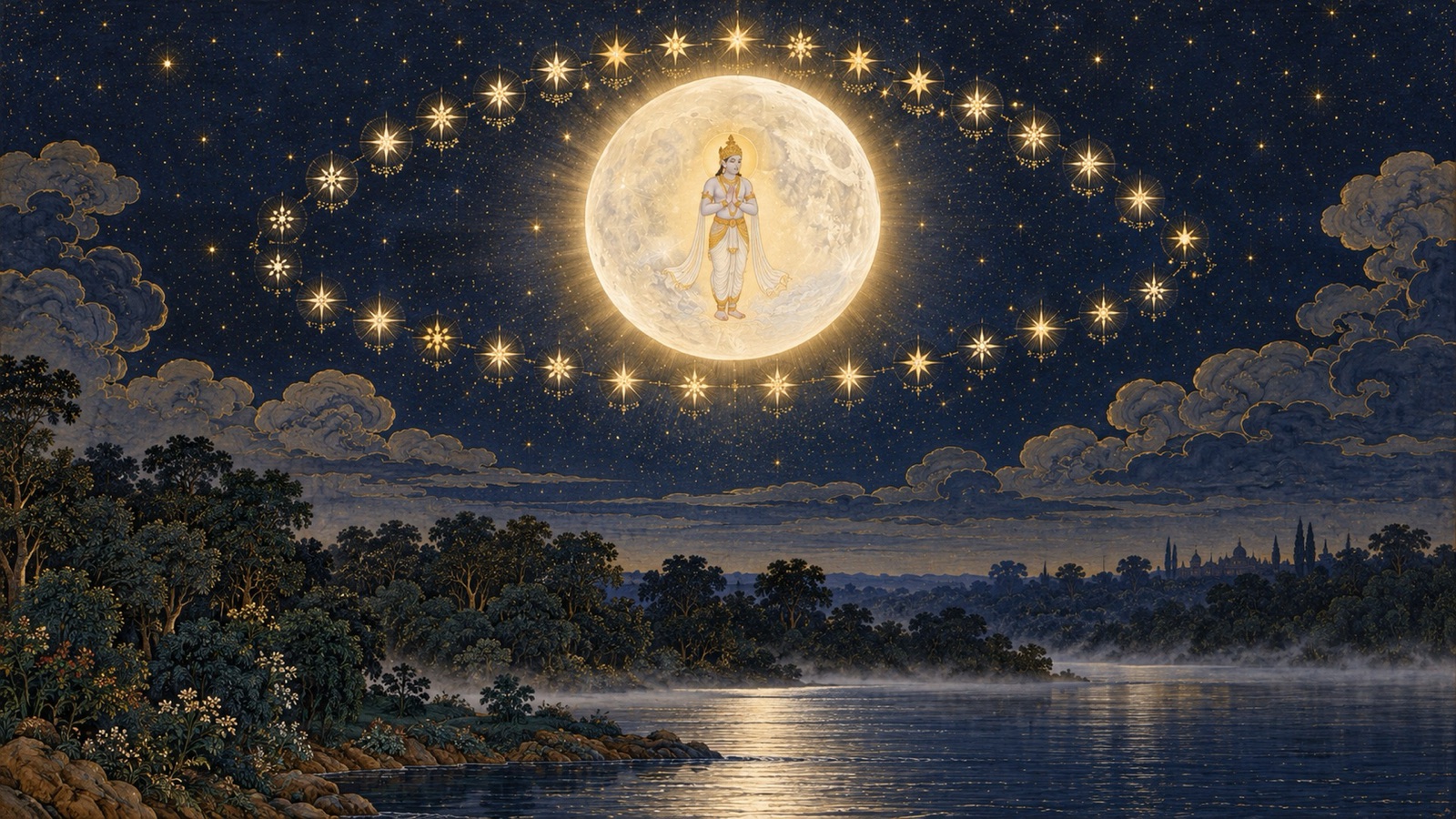
Having obtained as their own the Lord who is the sole beloved of Sri, they celebrated Him in song and moved with Him in the dance, their bangles, anklets and girdles the only instruments and the humming black bees the singers. With His loving glances, His gracious attention and His open laughter He delighted those pure-hearted women — and here Sukadeva adds the one word that holds the whole night in its true light: the Lord sported with them as a child plays with its own reflections. Their senses overwhelmed with gladness, they could no longer set their loosened hair and garments in order. The women of heaven were overcome; and the moon-god with all his host of stars stood amazed, so that the night itself stretched far beyond its measure.
As Many Forms as There Were Devotees
कृत्वा तावन्तमात्मानं यावतीर्गोपयोषित: ।
रेमे स भगवांस्ताभिरात्मारामोऽपि लीलया ॥ २० ॥
kṛtvā tāvantam ātmānaṁ yāvatīr gopa-yoṣitaḥ reme sa bhagavāṁs tābhir ātmārāmo ‘pi līlayā
Meaning: Making Himself into as many forms as there were cowherd women, the Lord passed that time with them, though He takes His delight in His own Self, playing thus out of His own sport. (Canto 10, Chapter 33, verse 20)
He who needs nothing from anyone then stooped to the weariness of His devotees: with His own most blissful hand the compassionate Lord wiped the faces of those girls, tired out by the long dancing. Honouring Him with the splendour of their cheeks and the nectar of their smiles, they sang the deeds that purify the world.
Beside the Water of the Yamuna
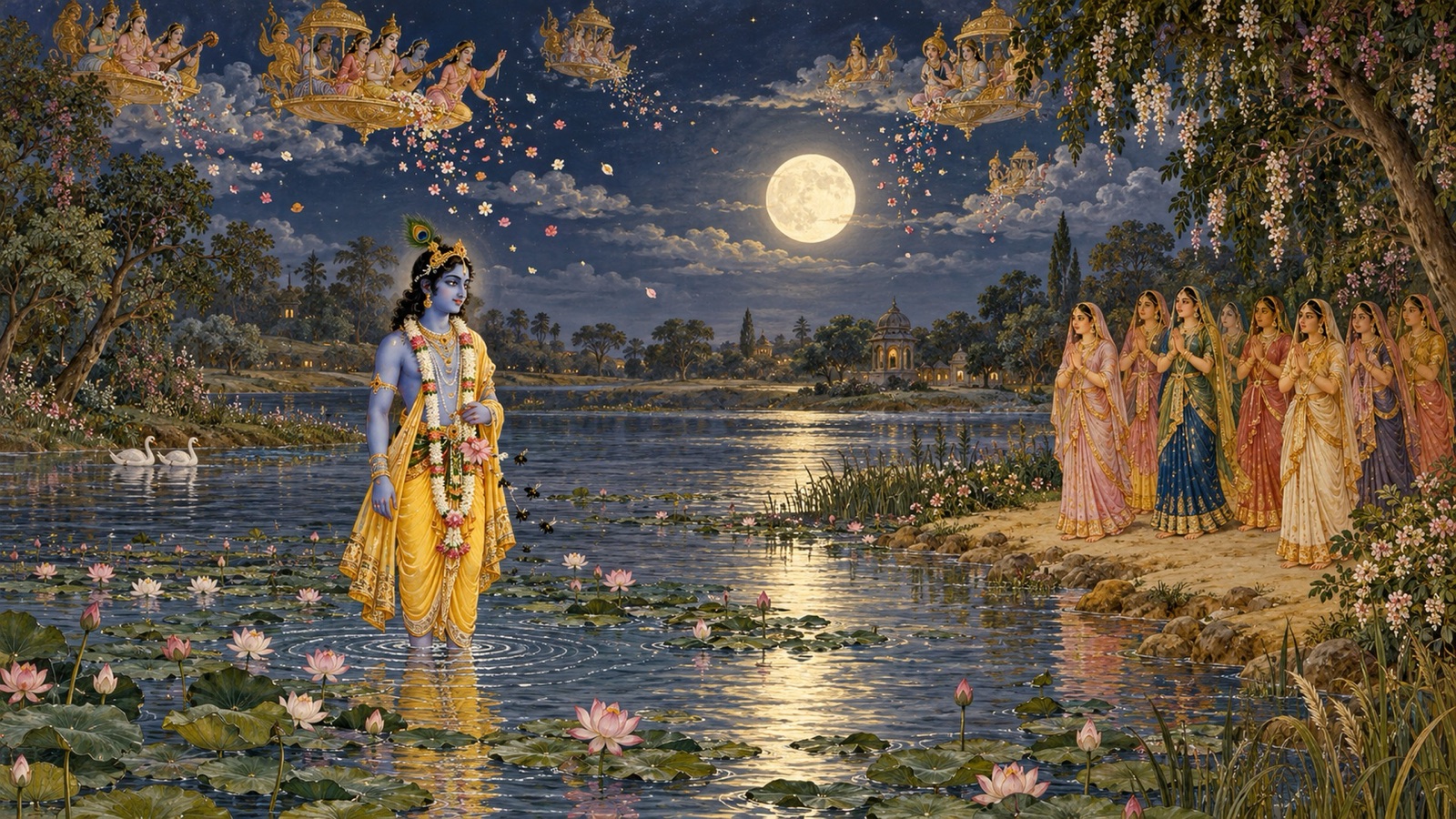
Weary at last, His garland crushed and stained with the saffron of their worship, the Lord entered the Yamuna to put off His fatigue, followed by black bees humming like leaders of the Gandharvas. There the young women sprinkled Him from every side, laughing and regarding Him with affection, while the gods in their aerial cars rained flowers and glorified Him; and He disported Himself among them like the leader of a herd of elephants, though His pleasure is in Himself alone. Afterwards He wandered with them in a grove upon the river bank, where a breeze carried the fragrance of flowers of land and water. So He passed those nights, bright with the full moon and holding every charm that poets have sung of autumn.
King Parikshit’s Question
Here the king raised his difficulty plainly. The Ruler of the universe, he said, had descended with His part, Balarama, to establish dharma and to quell what is contrary to it. How then could He who declares, institutes and guards the very bounds of right conduct act against them by approaching the wives of others? With what intention did the Lord of the Yadus, in whom no desire remains unfulfilled, do a deed the world must call repellent? “Cut away this doubt of ours, O sage of holy vows”.
Sukadeva’s Answer
Sukadeva met the question directly, beginning with a general principle.
धर्मव्यतिक्रमो दृष्ट ईश्वराणां च साहसम् ।
तेजीयसां न दोषाय वह्ने: सर्वभुजो यथा ॥ ३० ॥
dharma-vyatikramo dṛṣṭa īśvarāṇāṁ ca sāhasam tejīyasāṁ na doṣāya vahneḥ sarva-bhujo yathā
Meaning: A transgression of dharma, and boldness too, is sometimes seen on the part of the mighty; in those of surpassing power it brings no fault, as fire is unstained though it consumes all things. (Canto 10, Chapter 33, verse 30)
At once he shut the door a careless hearer might push open. One who is not himself the lord of such power must never attempt this, even in thought; whoever does so out of folly perishes, as anyone other than Rudra would perish on swallowing the poison churned from the ocean.
ईश्वराणां वच: सत्यं तथैवाचरितं क्वचित् ।
तेषां यत् स्ववचोयुक्तं बुद्धिमांस्तत् समाचरेत् ॥ ३२ ॥
īśvarāṇāṁ vacaḥ satyaṁ tathaivācaritaṁ kvacit teṣāṁ yat sva-vaco-yuktaṁ buddhimāṁs tat samācaret
Meaning: The word of the mighty is true; their conduct is to be copied only in certain cases. A man of understanding should therefore practise that part of their conduct which agrees with their own precept. (Canto 10, Chapter 33, verse 32)
For those free of ego there is nothing gained by virtuous action and no harm in its reverse. What virtue or sin, then, could bind the Ruler of all creatures — beasts, men and gods — when every one of them is subject to Him? Those satisfied with the pollen of His feet, those freed of karma by yoga, and those absorbed in the Supreme move freely and are never bound; whence bondage for Him who assumed a body of His own free will?
The Lord Who Dwells Within All
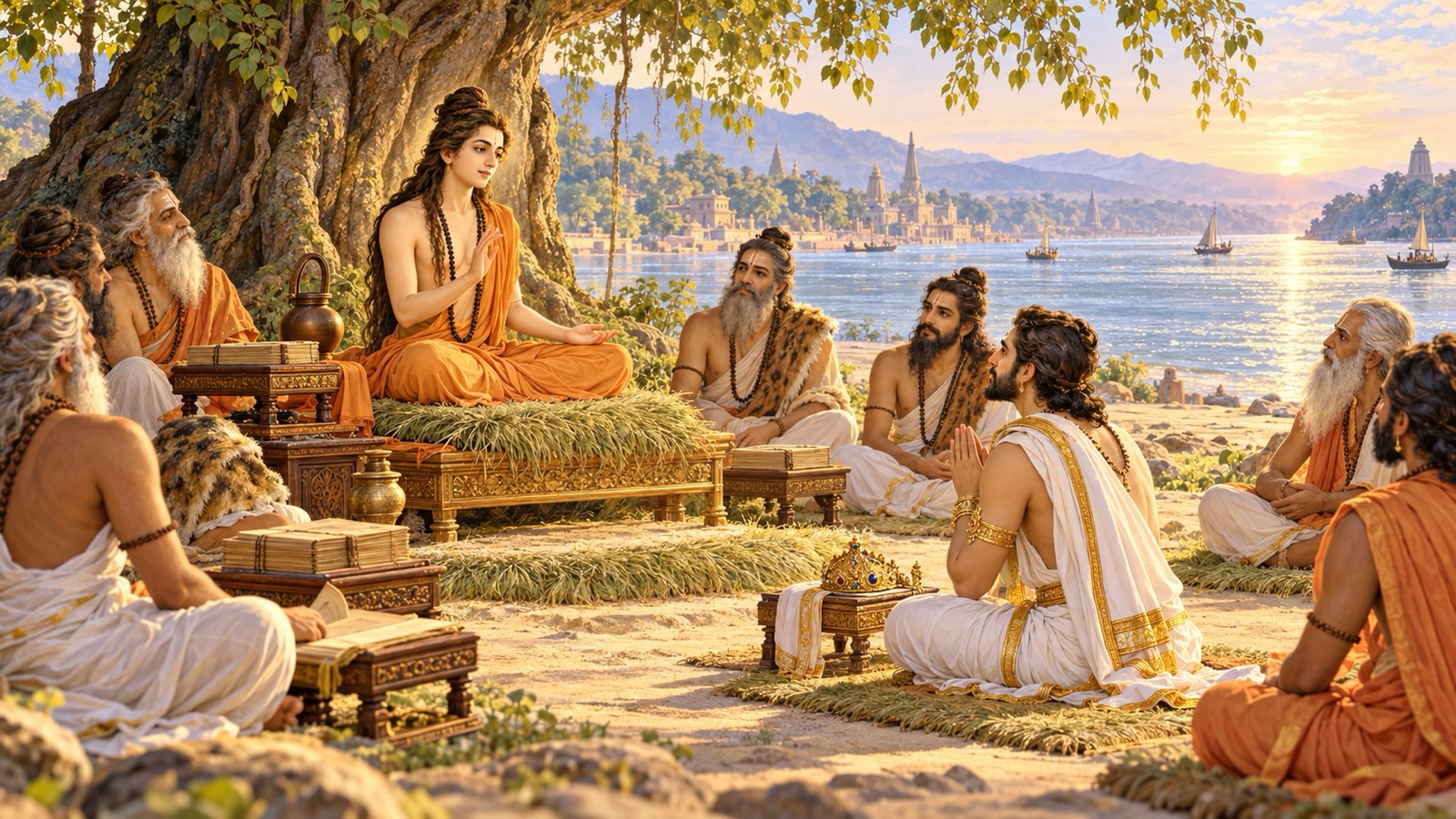
He who moves within the cowherd women, within their husbands, and within every embodied being as the Witness of all had sportively taken a body in this world.
अनुग्रहाय भूतानां मानुषं देहमास्थित: ।
भजते तादृशी: क्रीडा या: श्रुत्वा तत्परो भवेत् ॥ ३७ ॥
anugrahāya bhūtānāṁ mānuṣaṁ deham āsthitaḥ bhajate tādṛśīḥ krīḍā yāḥ śrutvā tat-paro bhavet
Meaning: Having assumed a human form to bestow His grace upon all beings, He engages in such pastimes as these, by hearing of which one becomes wholly devoted to Him. (Canto 10, Chapter 33, verse 37)
Upon these two verses the whole answer rests. The night cannot be weighed in the scales of household duty, because the One standing in that circle is already the indwelling Self of every woman there and of every husband in Vraja; there is no second party He could wrong, and no want in Him to satisfy, since the same narration calls Him self-delighted even while He plays (verse 20). Why, then, does He play at all? To bestow grace upon all beings, says the sage, so that those who hear of such pastimes may turn to Him with their whole heart. The rasa exists for the hearer, and its appointed fruit is not licence but purification.
The Return at Dawn
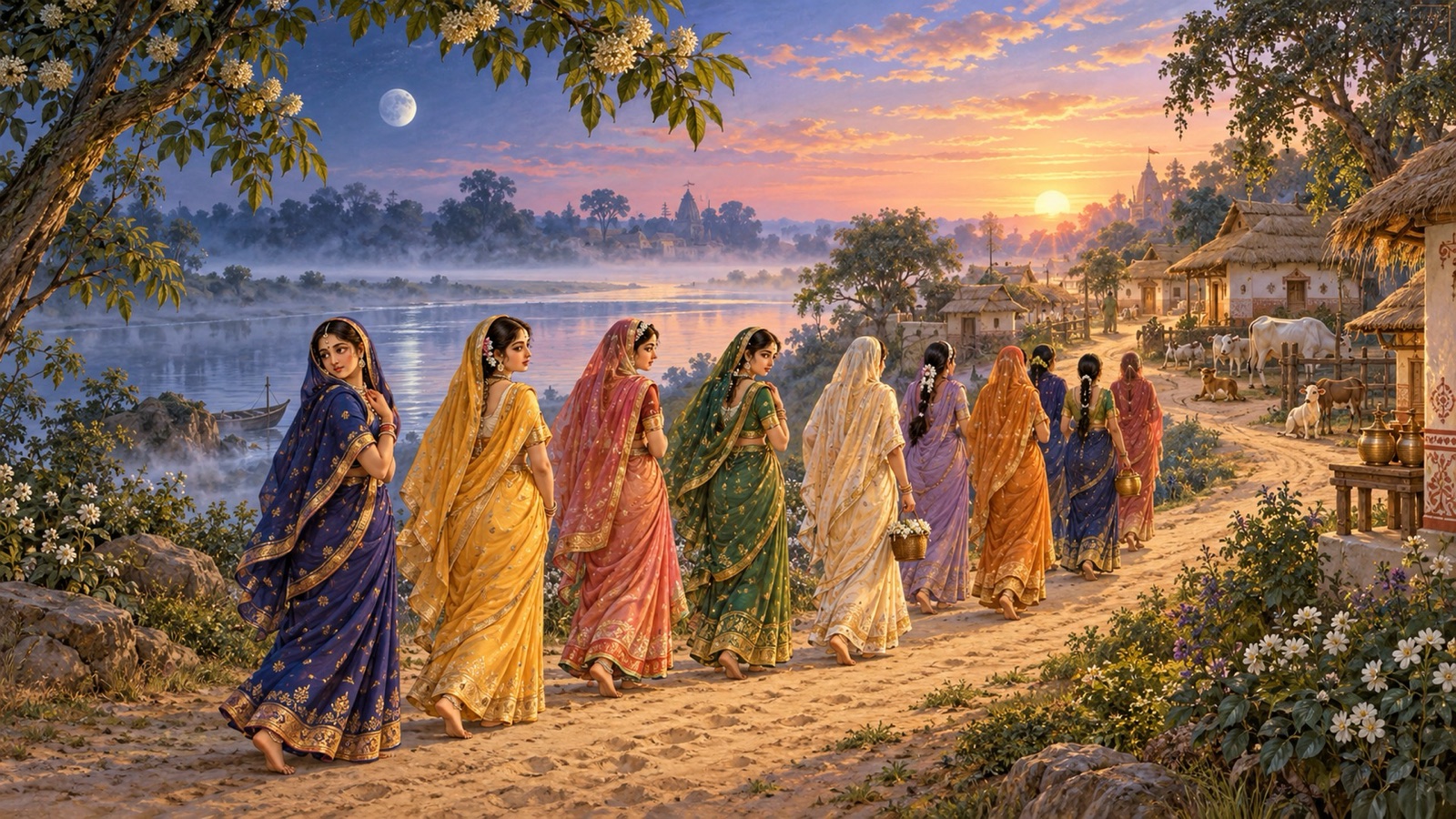
Bewildered by His Maya, the men of Vraja bore Krishna no jealousy, for each took his own wife to be at his side throughout that night. And when the long night of Brahma drew towards its close, the women so dear to the Lord returned to their homes with His approval, though they went unwillingly.
The Fruit of Hearing
Sukadeva ends not with the dancers but with the listener.
विक्रीडितं व्रजवधूभिरिदं च विष्णो: श्रद्धान्वितोऽनुशृणुयादथ वर्णयेद् य: ।
भक्तिं परां भगवति प्रतिलभ्य कामं हृद्रोगमाश्वपहिनोत्यचिरेण धीर: ॥ ४० ॥
vikrīḍitaṁ vraja-vadhūbhir idaṁ ca viṣṇoḥ śraddhānvito ‘nuśṛṇuyād atha varṇayed yaḥ bhaktiṁ parāṁ bhagavati pratilabhya kāmaṁ hṛd-rogam āśv apahinoty acireṇa dhīraḥ
Meaning: Whoever reverently hears, or recounts, this pastime of Lord Vishnu with the women of Vraja gains supreme devotion to the Lord and, growing steady of mind, swiftly casts off lust, the disease of the heart. (Canto 10, Chapter 33, verse 40)
Principal Teachings of This Chapter
1. The Lord is never divided among those who love Him. He becomes as many as His devotees are (verse 20). Whoever gives Him the whole heart receives not a portion of His attention but all of it.
2. Whatever is offered Him is received and honoured. A single voice raised in its own melody draws His open praise. He measures the love in an offering, not its skill.
3. The precept of the great is binding; their conduct is not a licence. Power excuses in the mighty what would destroy the weak, and a wise man imitates only what the great themselves teach. Admiration is never permission.
4. Nothing can bind the Lord, because nothing stands outside Him. He indwells every creature as the Witness, and His very body is assumed at will. Merit and transgression are categories for the ruled, not for the Ruler.
5. Hearing this pastime cures the disease of the heart. The appointed effect of listening with faith is supreme devotion and freedom from lust (verse 40).
A Devotional Reflection
Of all that happens on this night, what stays with a devotee is one quiet gesture: the Lord passing His hand over the tired faces of those who had danced for Him. He had multiplied Himself for their sake, stood beside each one as though she were the only soul in creation, praised their singing, and then tended their weariness Himself. So He treats a heart that keeps nothing back. And notice where Sukadeva finally points. He does not leave us gazing at the circle; he turns to the listener, promising that whoever hears this history with faith will lose the fever of desire — a startling thing to say about a story of love. Yet it is exactly right, for desire dies not when it is scolded but when something sweeter takes its place. The gopis had emptied their hearts of all but Him, and the Lord filled what they emptied.
A Daily Devotional Practice
Today, offer the Lord one thing you do only moderately well — a line of a bhajan sung softly, a simple prayer in your own words, a small service at home — and offer it without apology for its smallness. Remember the cowherd woman whose solitary melody drew His delighted praise, and trust that He receives the love and not the polish. Begin and end with the holy name: Om Namo Bhagavate Vasudevaya.
Conclusion
This discourse sets the rasa dance before us in its own words, and then, through King Parikshit’s honest question, gives it a settled meaning: the Self of all beings is bound by nothing, His conduct is never a licence for ours, and He enacts such pastimes to draw created beings to Himself. May we hear this sacred history with the reverence Sukadeva asks, and may the hearing accomplish in us what he promises — the quiet death of desire and the birth of love.
May the divine wisdom of Srimad Bhagavatam awaken pure devotion within our hearts.
Om Namo Bhagavate Vasudevaya.
Jay Shree Madhav.
References and Attribution
- Primary edition: Gita Press, Śrīmad Bhāgavata Mahāpurāṇa, Book Ten (First Half), Discourse 33.
- Series: Srimad Bhagavatam Wisdom · Biswa Sanatan Dharma Seva Trust.
- Presented following the spiritual guidance and recommendation of Pandit Dr. Shri Kashinath Mishra.
This is an original, faithful retelling in the writer’s own words, with brief quoted verses shown in Devanāgarī and transliteration and their meanings given as summaries. It is not a reproduction of any single publisher’s continuous translation or commentary. No affiliation with or endorsement by any publisher is implied.
Jay Shree Madhav