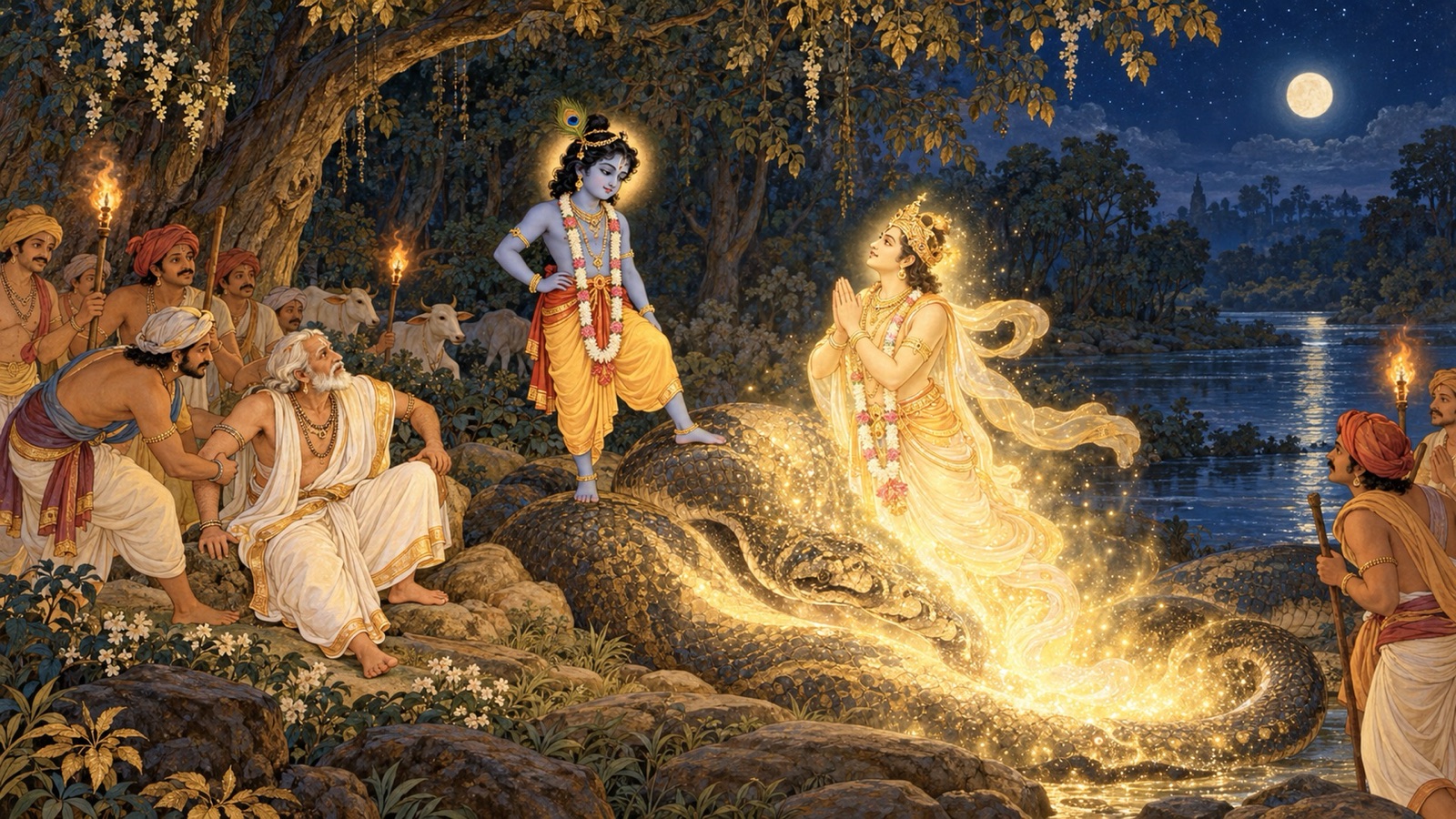
One touch of Krishna’s foot ends a long curse: the python that had seized Nanda rises up as a radiant Vidyadhara, and a father held in the jaws of death is handed back to his people.
Om Namo Bhagavate Vasudevaya.
Om Namo Bhagavate Vasudevaya.
Om Namo Bhagavate Vasudevaya.
Welcome back to Srimad Bhagavatam Wisdom, our devotional journey through the sacred histories and teachings of the Srimad Bhagavat Mahapurana. The thirty-fourth chapter of the Tenth Canto carries us out of Vrindavana on a pilgrimage and brings us home again with two deliverances. By the Sarasvati at Ambikavana a dreadful serpent takes hold of Nanda Maharaja in his sleep, and the foot of his own son both frees the father and lifts a cursed Vidyadhara out of a reptile’s body. Afterwards, on a moonlit night, a servant of Kubera carries off the women of Vraja, and the two Brothers who are the shelter of their hearts overtake him. Let us follow the chapter as Sukadeva Gosvami unfolded it to King Parikshit.
Chapter Information
- Scripture: Śrīmad Bhāgavata Mahāpurāṇa
- Canto: 10 (Book Ten, First Half)
- Chapter: 34 (Discourse 34)
- Chapter title: Nanda Maharaja Saved and Sankhachuda Slain
- Principal speaker: Sukadeva Gosvami (narrating to King Parikshit)
- Principal listener: King Parikshit
- Main setting: Ambikavana on the bank of the Sarasvati, and the forest of Vraja by night
- Central subject: Nanda’s rescue from the python; the liberation of the Vidyadhara Sudarshana by the touch of the Lord’s foot; the song of Krishna and Balarama in the moonlit forest; and the deliverance of the women of Vraja from Sankhachuda
- Principal verse range: Canto 10, Chapter 34, verses 1–32
- Primary edition: Gita Press Śrīmad Bhāgavata Mahāpurāṇa (Sanskrit-Hindi, Volume 2)
Context From the Previous Chapter
The preceding chapter completed the account of the Rasa-dance and Sukadeva’s explanation of why no fault can touch the Lord in His pastimes, since He is the indwelling Self of all. At daybreak the gopis returned home with His leave. Now the narration moves outward, to a journey the cowherds of Vraja undertook together.
The Pilgrimage to Ambikavana
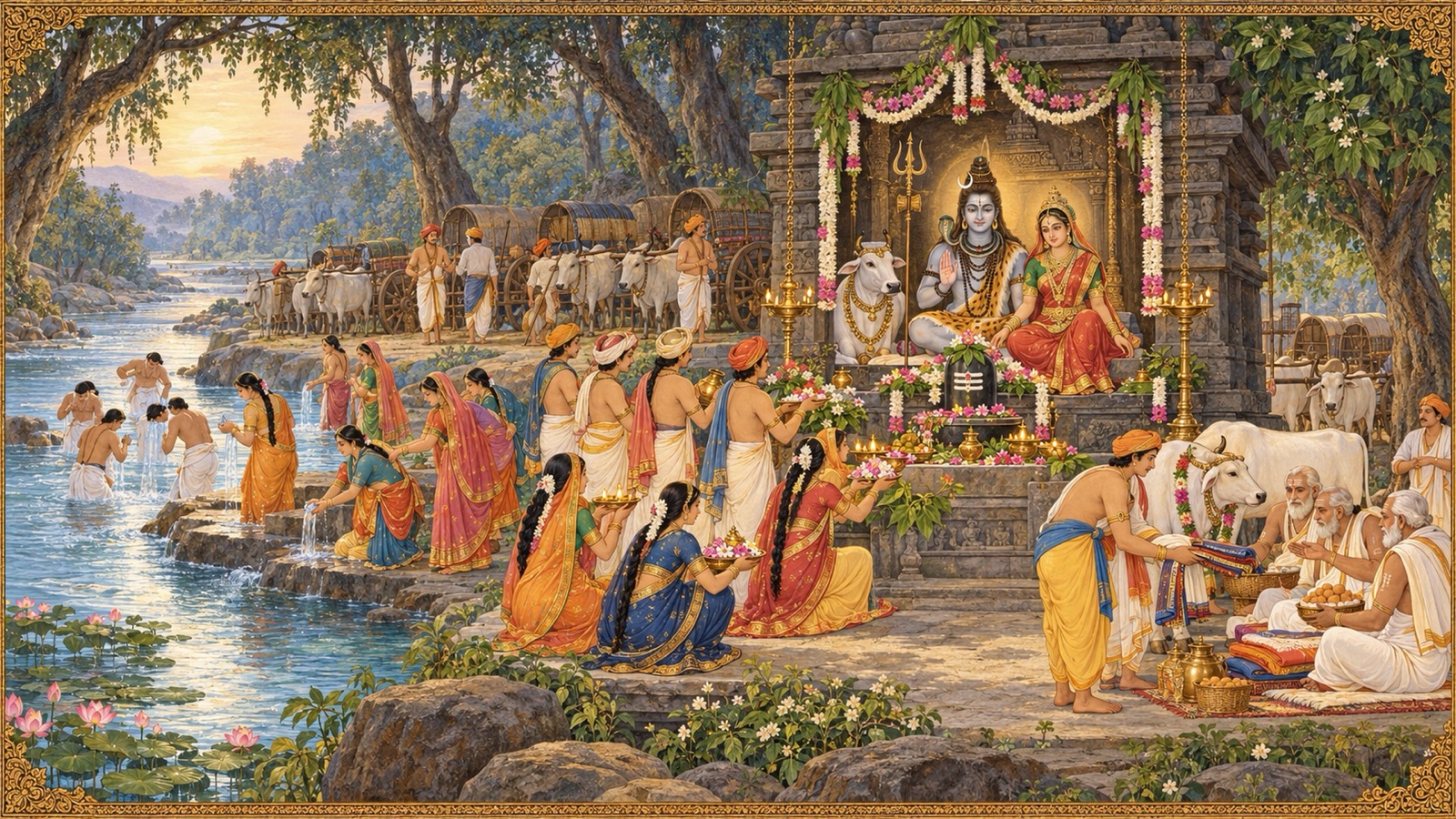
A longing arose one day among the cowherds of Vraja to travel to a holy place and worship there. Yoking their bullocks to their carts, they set out eagerly for Ambikavana, the forest sacred to the Mother of the universe. Reaching it, they bathed in the Sarasvati and worshipped with deep devotion the almighty Lord Pashupati and the Goddess Ambika with the prescribed articles of worship. With reverence they gave the brahmanas cows and gold, fine cloth, sweets and rice boiled with honey, praying simply, ‘May the Lord be pleased with us.’ Then, having taken sacred vows and tasting nothing but water all day, Nanda and Sunanda and the other blessed elders lay down to pass that night upon the river bank.
Nanda Seized in the Night
Into that forest, driven by hunger and by the will of Providence, came an enormous serpent. Creeping silently to where Nanda lay asleep, it began to swallow him. Waking in the grip of those coils, the gentle king of Vraja did not call for a weapon or for help from men — he called the name of his son.
स चुक्रोशाहिना ग्रस्त: कृष्ण कृष्ण महानयम् ।
सर्पो मां ग्रसते तात प्रपन्नं परिमोचय ॥ ६ ॥
sa cukrośāhinā grastaḥ kṛṣṇa kṛṣṇa mahān ayam sarpo māṁ grasate tāta prapannaṁ parimocaya
Meaning: Seized by the serpent he cried out, ‘Krishna, Krishna! This huge serpent is devouring me, my dear one. Set me free — I have taken refuge in You.’ (Canto 10, Chapter 34, verse 6)
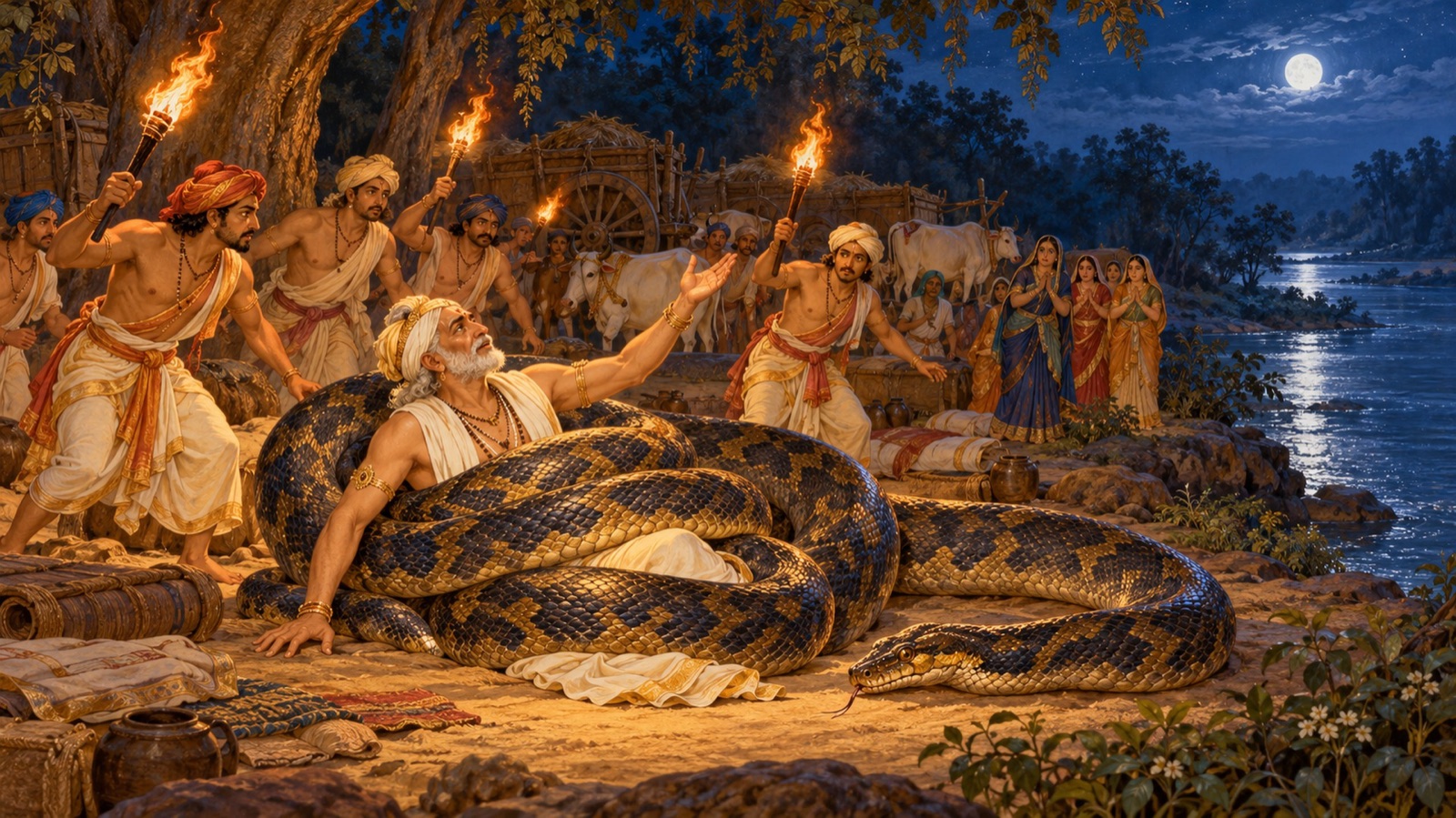
Hearing that cry, the cowherds sprang to their feet. Bewildered to see their chief caught in those great coils, they snatched up burning brands from the fire and struck at the creature again and again; yet though scorched by the flames, the serpent would not loosen its hold.
The Touch That Ended a Curse
Then the Lord of the Satvatas came near, and without haste or weapon simply set His foot upon the creature. At that touch the whole weight of its inauspicious karma fell away.
स वै भगवत: श्रीमत्पादस्पर्शहताशुभ: ।
भेजे सर्पवपुर्हित्वा रूपं विद्याधरार्चितम् ॥ ९ ॥
sa vai bhagavataḥ śrīmat pāda-sparśa-hatāśubhaḥ bheje sarpa-vapur hitvā rūpaṁ vidyādharārcitam
Meaning: All his sin destroyed by the touch of the Lord’s beautiful foot, he gave up the body of a serpent and assumed a form honoured among the Vidyadharas. (Canto 10, Chapter 34, verse 9)
A being of great splendour now stood beside Krishna, wearing a golden necklace, his body radiant, bowing low. The Lord of the senses asked him who he was, shining with such beauty and such a marvellous form, and how he had been helplessly thrown into so loathsome a species.
Sudarshana Tells His Story
‘I am a Vidyadhara named Sudarshana,’ he answered. Rich in splendour and famed for his beauty, he had once travelled the directions of the sky in his own aerial car. Intoxicated by his comeliness, he had laughed at certain sages of the line of Angira whose bodies were misshapen; and by that sin of his own making, those whom he had mocked cast him into the form of a python. Yet looking back now from the far side of the curse, he saw nothing in it but kindness.
शापो मेऽनुग्रहायैव कृतस्तै: करुणात्मभि: ।
यदहं लोकगुरुणा पदा स्पृष्टो हताशुभ: ॥ १४ ॥
śāpo me ’nugrahāyaiva kṛtas taiḥ karuṇātmabhiḥ yad ahaṁ loka-guruṇā padā spṛṣṭo hatāśubhaḥ
Meaning: That curse was pronounced upon me by those compassionate souls only for my benefit, since by it I have now been touched by the foot of the Teacher of all the worlds, and all my sin is destroyed. (Canto 10, Chapter 34, verse 14)
Here lies the heart of the whole episode. A proud celestial could not be reached by instruction while he still rode the sky admiring himself; so a chastisement that looked like ruin became the very road by which he was carried, century after century of crawling, to the one forest where the Lord’s foot would come down upon him. The sages who cursed him are called compassionate precisely because their severity emptied him of the pride that kept him far from grace. The Lord did not merely rescue Nanda that night; He arranged a hunger, a journey and a sleeping place so that a soul long sunk in a reptile’s body might be set free in the same moment. Nothing in the Lord’s dealings is accidental, and nothing that brings us to His feet is finally a misfortune.
Released now, Sudarshana begged leave to depart, addressing Krishna as the dispeller of sorrow, the great Yogi, the Supreme Person and the protector of the righteous, in whom those who fear rebirth find their refuge. And he spoke the wonder that was uppermost in him.
ब्रह्मदण्डाद्विमुक्तोऽहं सद्यस्तेऽच्युत दर्शनात् ।
यन्नाम गृह्णन्नखिलान् श्रोतृनात्मानमेव च ।
सद्य: पुनाति किं भूयस्तस्य स्पृष्ट: पदा हि ते ॥ १७ ॥
brahma-daṇḍād vimukto ’haṁ sadyas te ’cyuta darśanāt yan-nāma gṛhṇann akhilān śrotṝn ātmānam eva ca sadyaḥ punāti kiṁ bhūyas tasya spṛṣṭaḥ padā hi te
Meaning: O infallible Lord, I was freed from the brahmanas’ punishment the instant I saw You. One who utters Your name purifies at once both himself and all who hear him — how much more, then, one who has actually been touched by Your foot! (Canto 10, Chapter 34, verse 17)
Taking his leave, Sudarshana circled the Lord reverently, bowed to Him and rose to the heavenly regions; and Nanda was delivered out of that mortal danger. The people of Vraja, their minds struck with wonder at so singular a display of Krishna’s glory, completed the observances they had come to perform and returned home from that holy place, speaking of what they had seen with reverence all the way.
The Song of the Two Brothers
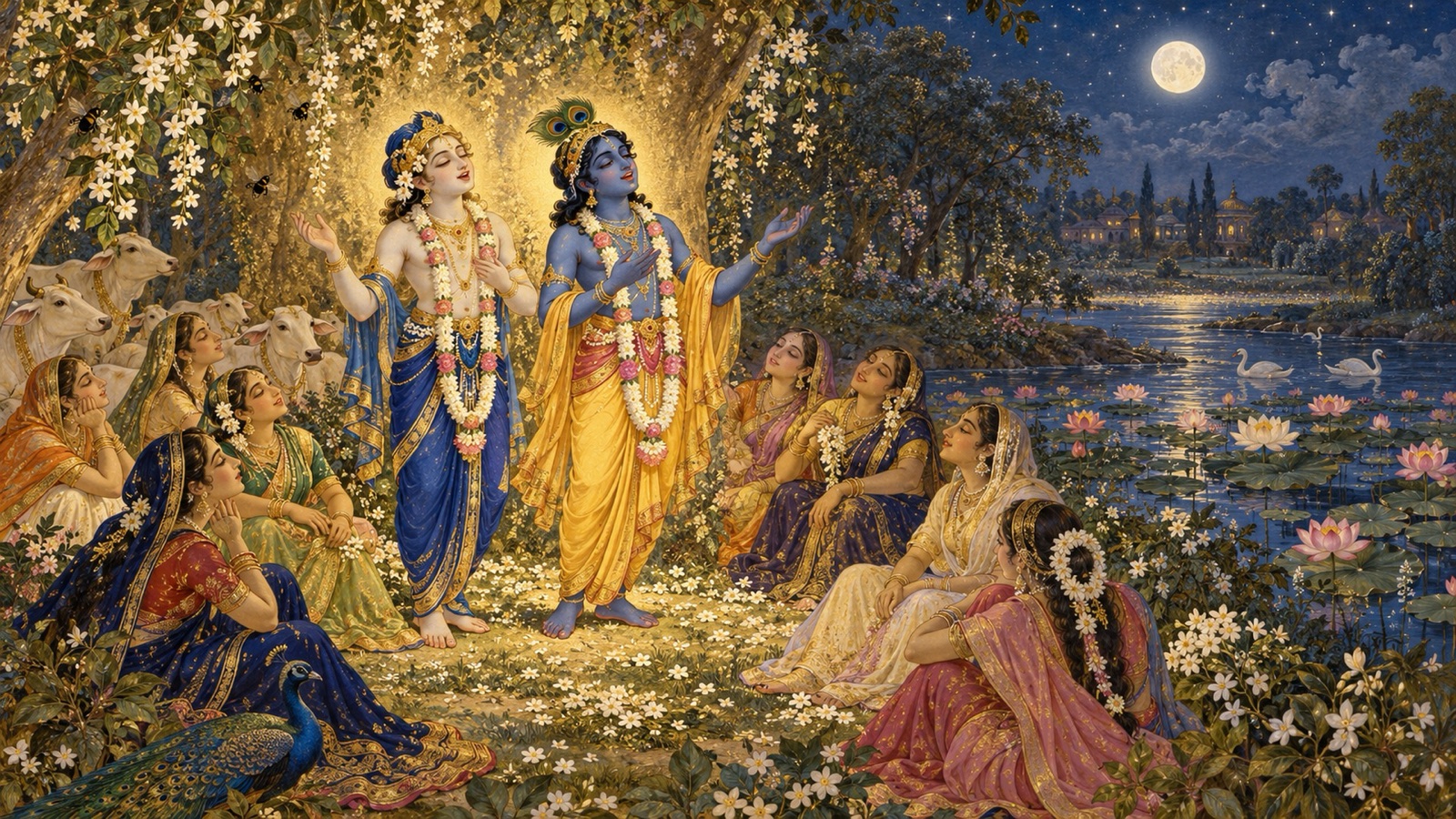
Some time afterwards, on a night in the forest, Krishna the protector of cows and Balarama of wonderful prowess sported in the midst of the women of Vraja. Those women, whose love was fastened upon Them, were beautifully adorned, their limbs fragrant with sandal-paste, wearing garlands and spotless garments, and they sang of the two Brothers melodiously. The night itself seemed to welcome Them: the moon had risen with the stars, black bees hovered drunk on the scent of jasmine, and a breeze carried the fragrance of water-lilies. Honouring such a night, Krishna and Balarama sang together, moving through the whole scale of musical notes with a measured rise and fall of sound, until the minds and ears of every creature were filled with delight. Hearing that song, the cowherd women fell into a trance so deep that they did not notice their garments slipping or the wreaths falling from their braids.
Sankhachuda Carries Off the Women of Vraja
While the two Brothers were thus revelling and singing without restraint, an attendant of Kubera the bestower of riches, Sankhachuda by name, came to that place. Fearing nothing, before Their very eyes he drove the terrified women away towards the north, though they were under Their protection. Seeing their own people crying ‘O Krishna! O Balarama!’ like cows carried off by a robber, the two Brothers ran in pursuit.
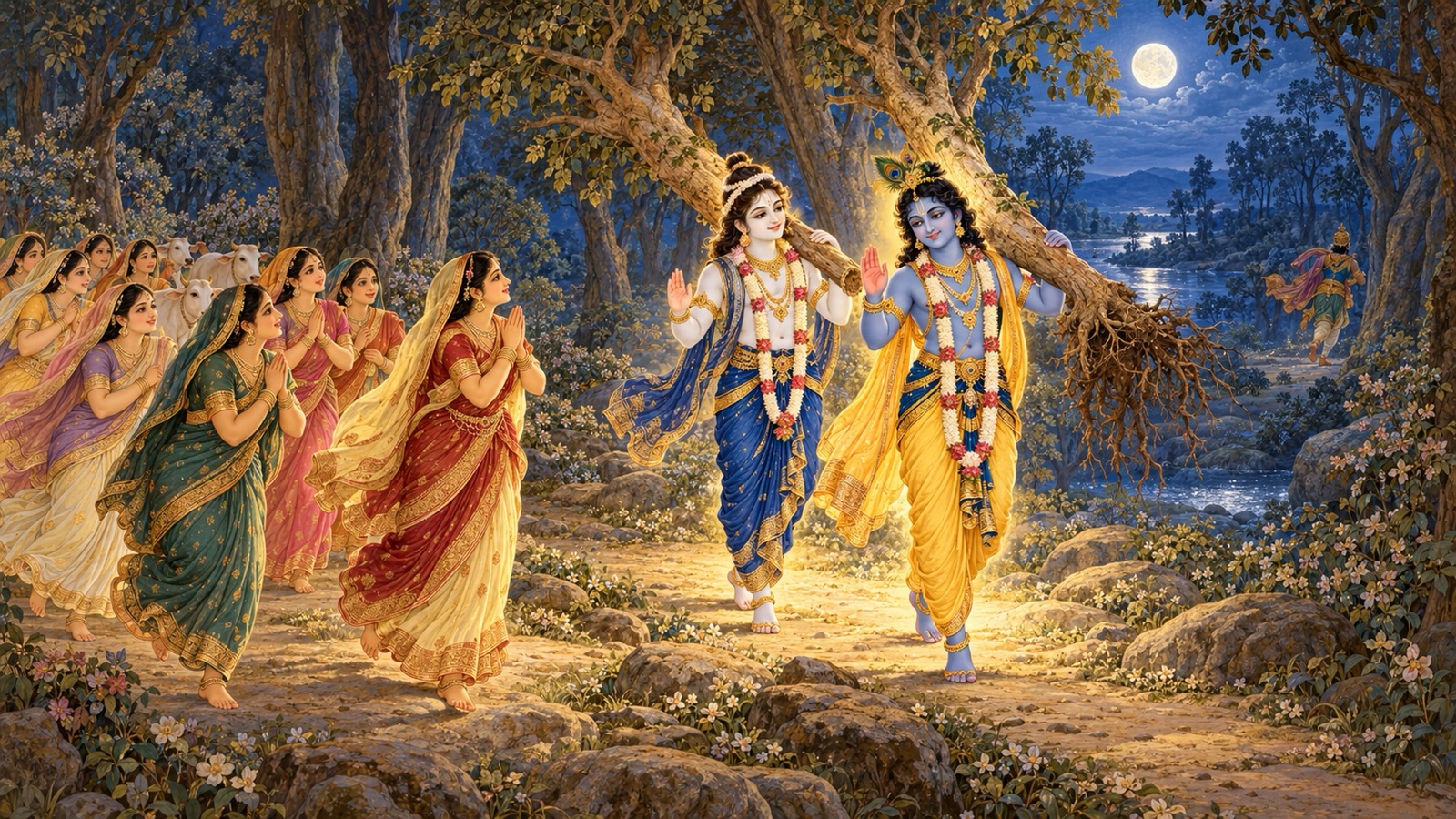
मा भैष्टेत्यभयारावौ शालहस्तौ तरस्विनौ ।
आसेदतुस्तं तरसा त्वरितं गुह्यकाधमम् ॥ २८ ॥
mā bhaiṣṭety abhayārāvau śāla-hastau tarasvinau āsedatus taṁ tarasā tvaritaṁ guhyakādhamam
Meaning: Crying out ‘Do not fear!’ to give them courage, the two swift Brothers, each with a sal tree in hand, rapidly overtook that lowest of Guhyakas. (Canto 10, Chapter 34, verse 28)
Seeing Them close upon him like Time and Death themselves, the foolish Yaksha shuddered, abandoned the women and fled headlong to save his life.
The Crest-Jewel Given to Balarama
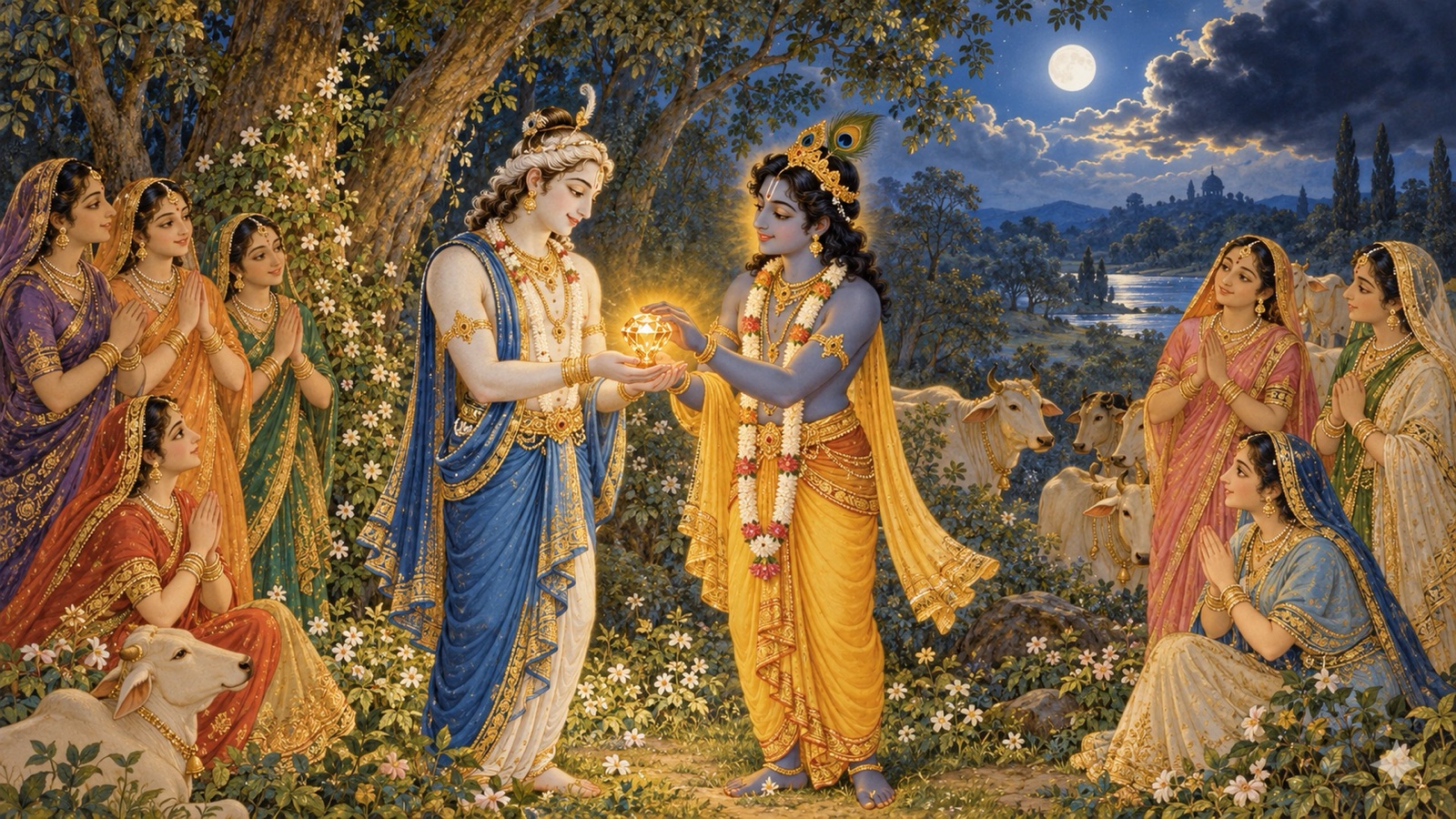
Krishna pursued him wherever he ran, intending to take the jewel that was set upon his head, while Balarama stood guarding the women. Coming upon him as though he were never far away, the almighty Lord took the head of that evil-minded one, crest-jewel and all, with a single stroke of His fist. Then He turned back to the forest with the gem shining in His hand.
शङ्खचूडं निहत्यैवं मणिमादाय भास्वरम् ।
अग्रजायाददात्प्रीत्या पश्यन्तीनां च योषिताम् ॥ ३२ ॥
śaṅkhacūḍaṁ nihatyaivaṁ maṇim ādāya bhāsvaram agrajāyādadāt prītyā paśyantīnāṁ ca yoṣitām
Meaning: Having thus slain Sankhachuda and taken his brilliant gem, the Lord lovingly presented it to His elder brother while the women stood looking on. (Canto 10, Chapter 34, verse 32)
Principal Teachings of This Chapter
1. The name of the Lord is the first cry of a devotee’s heart. Gripped by the serpent, Nanda does not reach for help but utters his son’s name and declares himself surrendered (verse 6). What a soul says in its most helpless moment reveals where it truly lives.
2. A chastisement sent by the compassionate is mercy in disguise. Sudarshana calls the sages who cursed him karuṇātmabhiḥ, kind-hearted (verse 14), because their punishment stripped away the vanity that no pleasant counsel could have removed.
3. The Lord’s name, sight and touch purify beyond measure. Even hearing His name spoken cleanses both speaker and listener at once (verse 17). The Vidyadhara’s centuries of bondage end in the space of a single footfall.
4. Protection belongs to those who call upon Him. ‘Do not fear’ is the Lord’s own word to the frightened (verse 28). He does not merely pity distress from a distance; He runs after it until it is overtaken.
5. The Lord delights in honouring His devotees. Having won the shining gem Himself, Krishna at once places it in Balarama’s hands out of love (verse 32). What He gains, He gives away to those He holds dear.
A Devotional Reflection
Two rescues fill this chapter, and both begin with a cry. Nanda cries out in the dark and is loosened from the coils; the women of Vraja cry out in the forest and are overtaken and brought home. Between them stands a third figure whom nobody thought to rescue at all — the serpent itself, the one everyone was beating with firebrands. The cowherds saw only a monster swallowing their chief; Krishna saw a Vidyadhara waiting out a long sentence, and freed them both with one gesture. How often the thing we fight hardest is a soul in difficulty, and how little we know of the histories folded inside the lives around us. There is comfort here, too, for our own dark passages. Sudarshana did not understand his curse while he crawled through it; he understood it only when the Lord’s foot came down and the whole shape of his suffering turned out to be a path. We are rarely given that clarity in the middle of a hard season. But the chapter quietly promises that the One who arranged a pilgrimage and a hunger and a night by the Sarasvati to free a single cursed soul has not forgotten ours.
A Daily Devotional Practice
Today, keep the holy name near enough to be the first sound you make. When something startles or frightens you — bad news, a sudden loss, a fear that wakes you at night — let ‘Krishna, Krishna’ come before the worry does, as it came to Nanda in the serpent’s grip. Whenever you remember, say it once aloud so that another may hear it too, trusting this chapter’s assurance that His name purifies both the one who speaks and the one who listens. Begin now, gently: Om Namo Bhagavate Vasudevaya.
Conclusion
This chapter sets two deliverances side by side and shows the same mercy working in each. At Ambikavana a father’s helpless cry is answered by a son whose foot is the end of all bondage, and the serpent that held him walks away a liberated Vidyadhara. In the moonlit forest a thief carries off those who have given their hearts to the two Brothers, and is overtaken before fear can settle in them. From first to last the Lord is shown as the shelter of the surrendered — reaching down to a cursed soul nobody pitied, and running after frightened women nobody else could save. May we learn from Nanda to call His name before anything else, and from Sudarshana to trust that even what wounds us may be the hand that brings us to His feet.
May the divine wisdom of Srimad Bhagavatam awaken pure devotion within our hearts.
Om Namo Bhagavate Vasudevaya.
Jay Shree Madhav.
References and Attribution
- Primary edition: Gita Press, Śrīmad Bhāgavata Mahāpurāṇa (Sanskrit-Hindi, Volume 2), Book Ten (First Half), Discourse 34.
- Series: Srimad Bhagavatam Wisdom · Biswa Sanatan Dharma Seva Trust.
- Presented following the spiritual guidance and recommendation of Pandit Dr. Shri Kashinath Mishra.
This is an original, faithful retelling in the writer’s own words, with brief quoted verses shown in Devanāgarī and transliteration and their meanings given as summaries. It is not a reproduction of any single publisher’s continuous translation or commentary. No affiliation with or endorsement by any publisher is implied.
Jay Shree Madhav