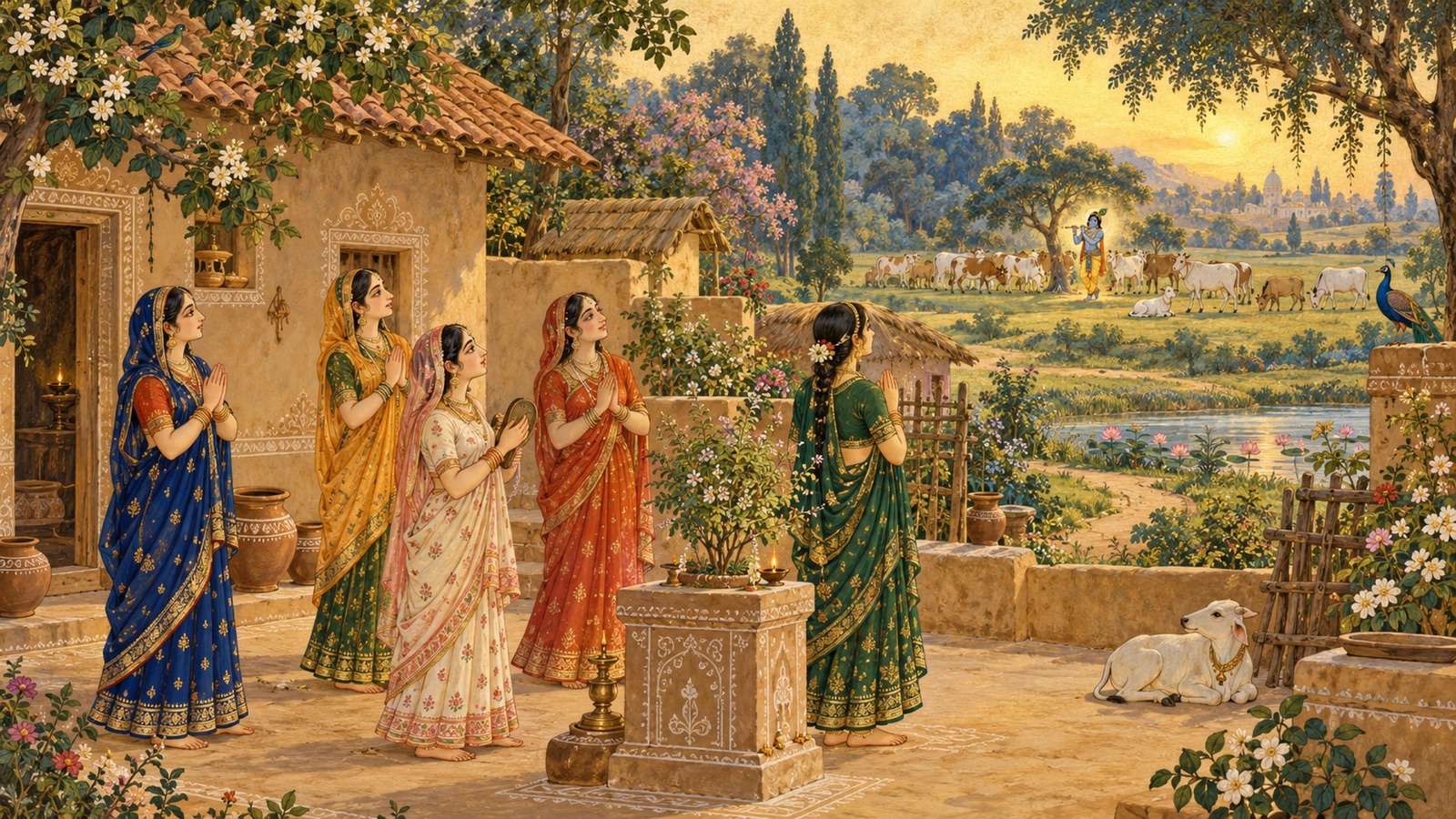
While Krishna walks the pastures of Vrindavana from dawn to dusk, the cowherd women of Vraja pass the daylight hours singing to one another of everything His flute is doing far away.
Om Namo Bhagavate Vasudevaya.
Om Namo Bhagavate Vasudevaya.
Om Namo Bhagavate Vasudevaya.
Welcome back to Srimad Bhagavatam Wisdom, our devotional journey through the sacred histories and teachings of the Srimad Bhagavat Mahapurana. This thirty-fifth chapter of the Tenth Canto is almost entirely one long song: Sukadeva Gosvami gives King Parikshit the very words the young women of Vraja sang while Krishna was away in the woods with His cattle.
Chapter Information
- Scripture: Śrīmad Bhāgavata Mahāpurāṇa
- Canto: 10 (Book Ten, First Half)
- Chapter: 35 (Discourse 35)
- Chapter title: The Gopis’ Song of Krishna in the Forest (Yugala-gita)
- Principal speaker: Sukadeva Gosvami to King Parikshit; within the chapter, the cowherd women of Vraja
- Principal listener: King Parikshit; within the chapter, the gopis themselves and Mother Yasoda
- Main setting: Vraja, and the forest, hills and riverbank of Vrindavana
- Central subject: The gopis’ song, in pairs of verses, on Krishna’s day in the forest and His homecoming
- Principal verse range: Canto 10, Chapter 35, verses 1–26
- Primary edition: Gita Press Śrīmad Bhāgavata Mahāpurāṇa (English, complete), Book Ten, First Half
Context From the Previous Chapter
In the previous discourse, Nanda Maharaja was swallowed by a great serpent and freed by the touch of Krishna’s foot, the creature rising as the Vidyadhara Sudarshana released from his curse; and when Kubera’s attendant Shankhachuda seized the women of Vraja by night, Krishna pursued him and took his crest-jewel. Now the telling turns to daylight.
The Long Days of the Gopis
Each morning, when Krishna set out with the cowherd boys and the cows, the hearts of the young women of Vraja ran after Him down the forest path, though their feet could not. Left in the lanes and courtyards with work in their hands and their minds nowhere near it, they did the only thing love can do at such a distance: they gathered and sang Him aloud, one voice taking up where another faltered, and so carried the heavy hours to sunset.
श्रीशुक उवाच
गोप्य: कृष्णे वनं याते तमनुद्रुतचेतस: ।
कृष्णलीला: प्रगायन्त्यो निन्युर्दु:खेन वासरान् ॥ १ ॥
śrī-śuka uvāca gopyaḥ kṛṣṇe vanaṁ yāte tam anudruta-cetasaḥ kṛṣṇa-līlāḥ pragāyantyo ninyur duḥkhena vāsarān
Meaning: Sukadeva Gosvami said: When Krishna had gone away to the forest, the gopis, whose minds ran after Him, spent their days in sorrow, singing aloud of His pastimes. (Canto 10, Chapter 35, verse 1)
The Flute Laid Upon His Lips
Their singing begins with the one sight they cannot stop seeing: Mukunda among the trees, left cheek inclined towards His left arm, eyebrows dancing, soft fingers moving over the stops of the flute pressed to His lip.
श्रीगोप्य ऊचु:
वामबाहुकृतवामकपोलो
वल्गितभ्रुरधरार्पितवेणुम् ।
कोमलाङ्गुलिभिराश्रितमार्गं
गोप्य ईरयति यत्र मुकुन्द: ॥ २ ॥
śrī-gopya ūcuḥ vāma-bāhu-kṛta-vāma-kapolo valgita-bhrur adharārpita-veṇum komalāṅgulibhir āśrita-mārgaṁ gopya īrayati yatra mukundaḥ
Meaning: The gopis said: O cowherd women, there, resting His left cheek upon His left arm, with dancing eyebrows and the flute placed upon His lip, Mukunda sounds the holes of the flute with His tender fingers. (Canto 10, Chapter 35, verse 2)
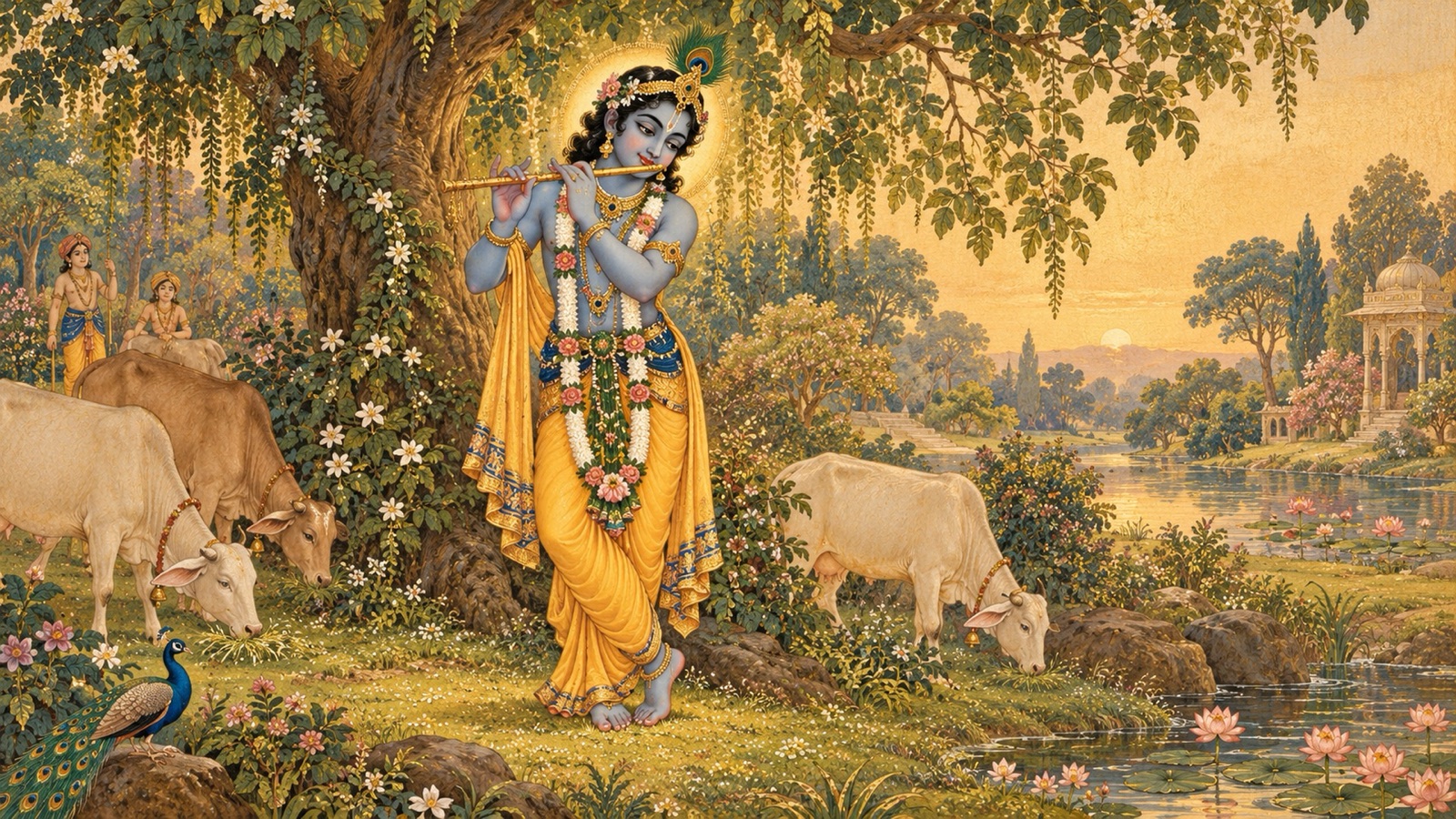
That music does not stay among the trees. It rises into the sky, where the consorts of the Siddhas travel with their husbands; hearing it, those celestial ladies are struck with wonder and then with shame, their minds made the target of love’s arrows, and they grow faint, unaware even of their loosened garments.
The Cattle Stand Still and the Rivers Halt
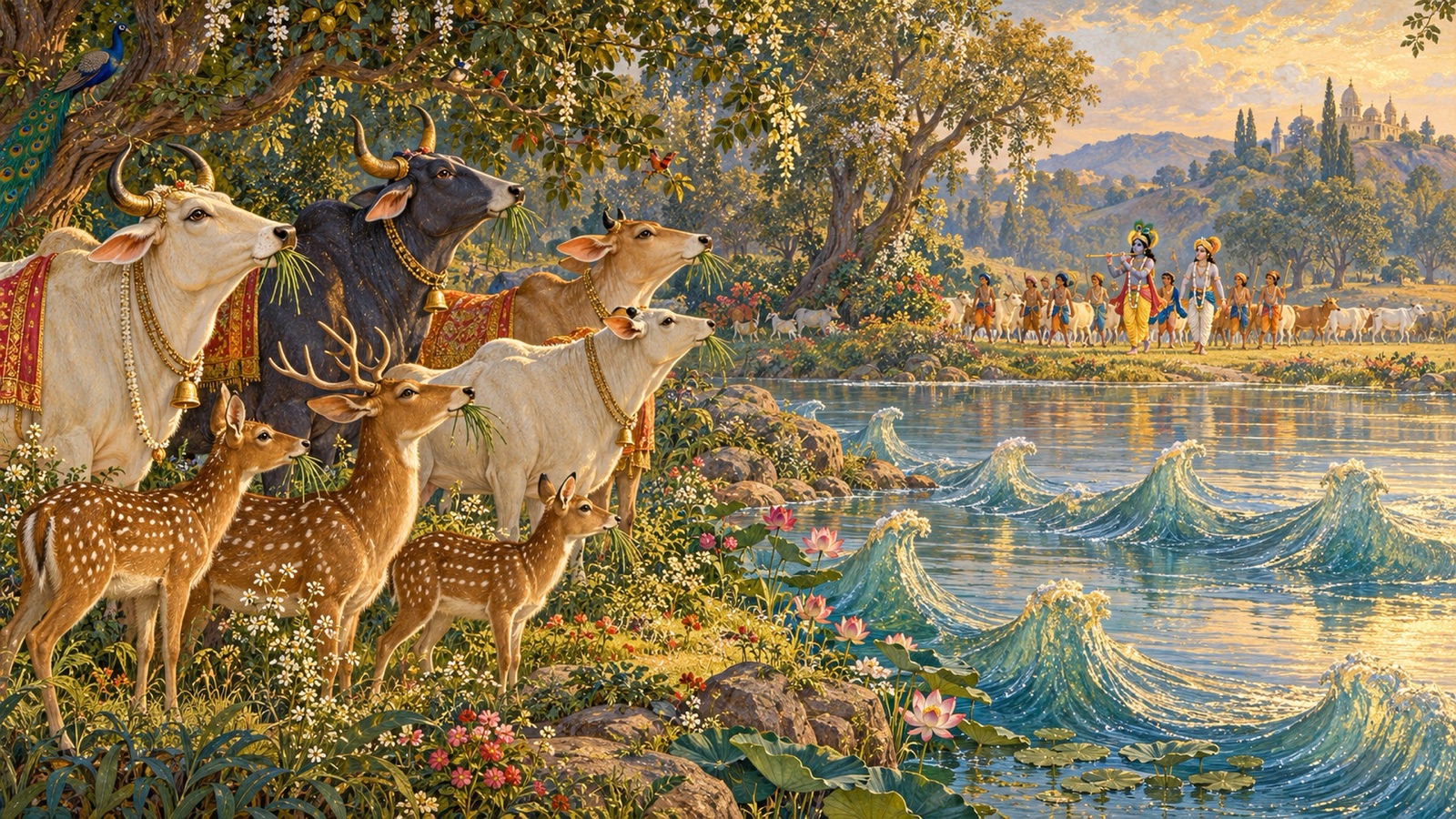
Hear this wonder, the gopis say to one another. When the son of Nanda — on whose chest the Goddess of Fortune shines like a motionless flash of lightning — sounds His flute to gladden all whom His absence pains, the bulls of Vraja and the deer and cows of the forest stop where they stand, ears erect, minds stolen by the distant notes, a mouthful of grass held fast between their teeth and never swallowed. They look like creatures asleep, or animals painted on a wall.
Sometimes, they sing, He puts on the costume of a wrestler, peacock plumes in His hair, tender leaves and mineral colours on His body, and with Balarama and the cowherd boys He calls the cows by name. Then the rivers break their course, their waves rising like arms that tremble with love, reaching after the dust of His feet on the breeze; and when it stays out of reach their waters stand still — poor in merit, the gopis add, as we are.
तर्हि भग्नगतय: सरितो वै
तत्पदाम्बुजरजोऽनिलनीतम् ।
स्पृहयतीर्वयमिवाबहुपुण्या:
प्रेमवेपितभुजा: स्तिमिताप: ॥ ७ ॥
tarhi bhagna-gatayaḥ sarito vai tat-padāmbuja-rajo ‘nila-nītam spṛhayatīr vayam ivābahu-puṇyāḥ prema-vepita-bhujāḥ stimitāpaḥ
Meaning: Then the rivers, their currents broken, their arm-like waves trembling with love, long for the dust of His lotus feet brought by the wind; and, possessed of little merit as we ourselves are, their waters become motionless. (Canto 10, Chapter 35, verse 7)
Trees That Rain Honey, Birds That Sit in Silence
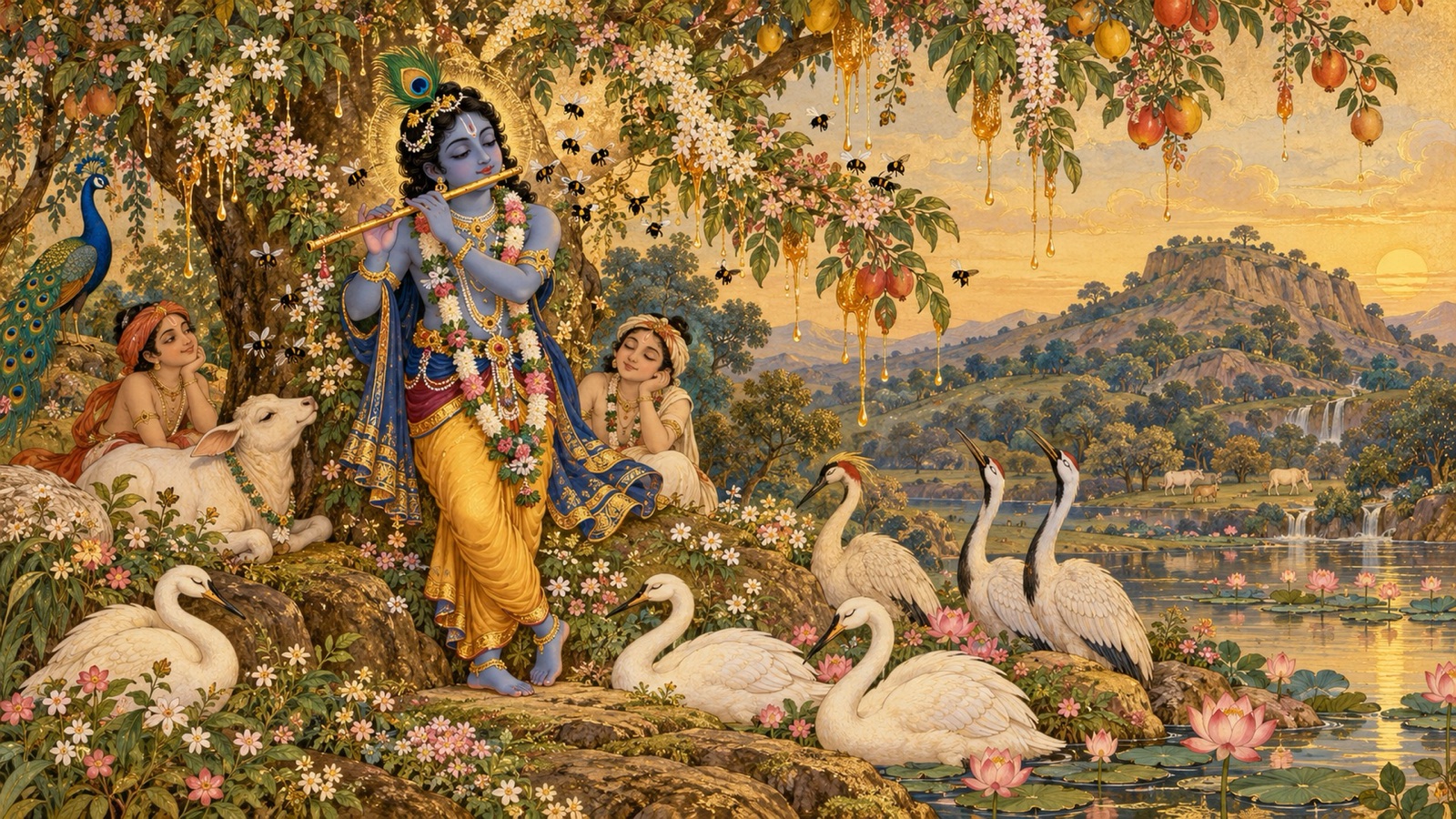
The song follows Him up onto the slopes. His companions walk behind recounting His deeds, and His fortune stands unshaken, like that of the Original Person. Wandering there, He calls with His flute to the cows grazing on the hillside; and the creepers and trees, heavy with flower and fruit, bow their branches low, their bodies thrilled with love, and pour out streams of honey — as though Vishnu, hidden within them, were showing Himself through their joy.
वनलतास्तरव आत्मनि विष्णुं
व्यञ्जयन्त्य इव पुष्पफलाढ्या: ।
प्रणतभारविटपा मधुधारा:
प्रेमहृष्टतनवो ववृषु: स्म ॥ ९ ॥
vana-latās tarava ātmani viṣṇuṁ vyañjayantya iva puṣpa-phalāḍhyāḥ praṇata-bhāra-viṭapā madhu-dhārāḥ prema-hṛṣṭa-tanavo vavṛṣuḥ sma
Meaning: The forest creepers and trees, rich with flowers and fruit, their boughs bowed low beneath that weight and their bodies thrilled with love, rained down streams of honey, as if revealing the Lord Vishnu present within themselves. (Canto 10, Chapter 35, verse 9)
A sacred mark is drawn on His forehead, and the tulasi in His garland breathes a fragrance not of this world, so that swarms of black bees, drunk on its honey, hum around Him; He listens with appreciation and answers on His flute. Hearing it, cranes and swans leave the lakes and settle beside Hari, minds collected, eyes shut and beaks silent, worshipping Him as sages worship.
The Cloud Spreads Its Shadow Like a Parasol
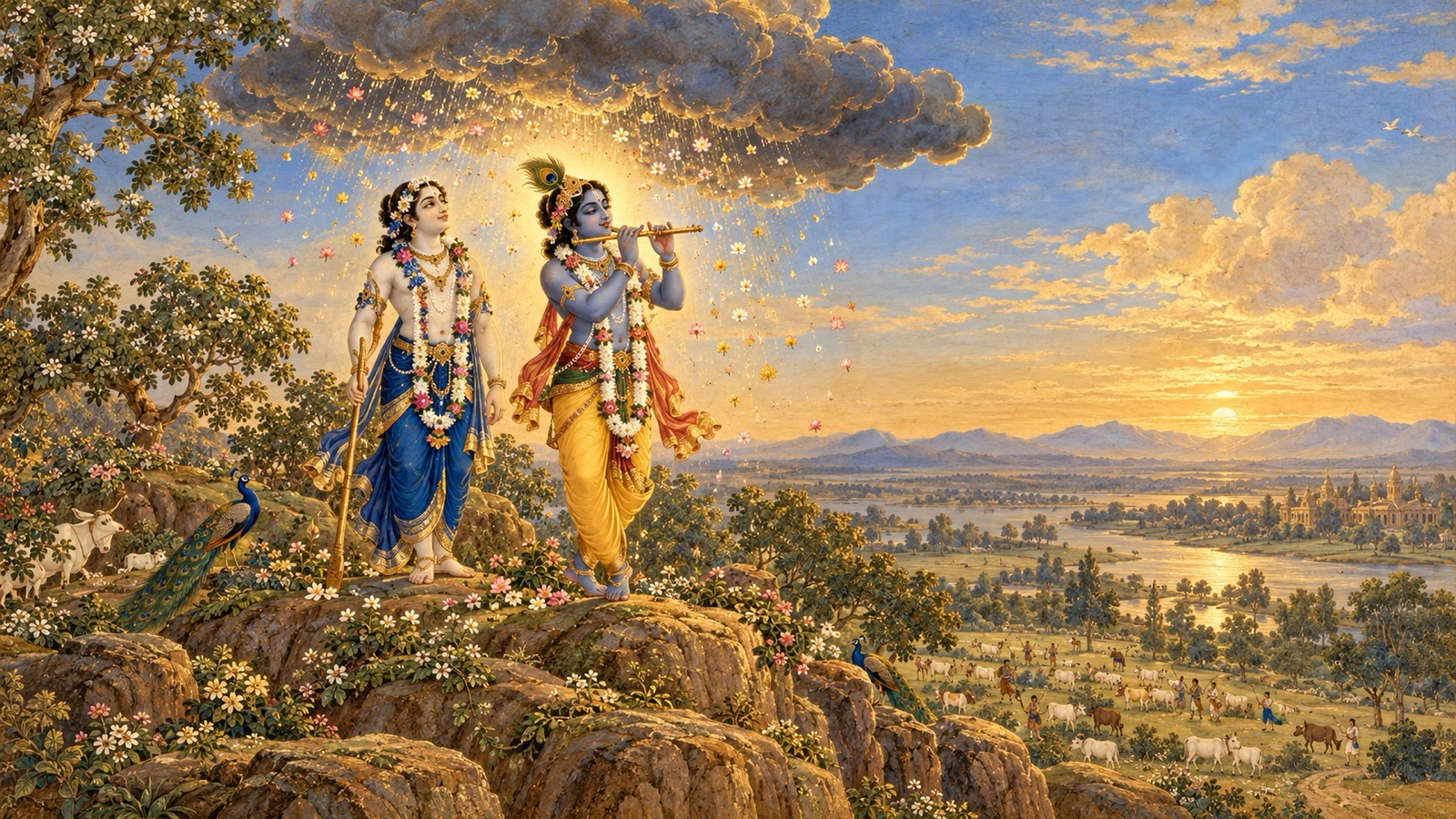
With Balarama beside Him, flowers for ornaments, standing on the ridges of the hill, He fills the world with His flute and is Himself filled with delight. The cloud above answers: afraid of offending so great a one, it will not thunder, but rumbles softly in time, showers its friend with flowers of spray, and spreads its shadow over Him as an umbrella.
A Music the Gods Could Not Measure
Now the singers turn to Mother Yasoda. O virtuous lady, they say, your son is master of every art the cowherds know, and when He sets the flute on His lip, red as a ripe bimba fruit, He draws out whole new scales of His own teaching. The rulers of the gods hear it hour upon hour — Indra, Lord Shiva and Brahma at their head — and those great knowers bend neck and mind towards the sound, unable to reach the truth of it, and fall into bewilderment.
सवनशस्तदुपधार्य सुरेशा:
शक्रशर्वपरमेष्ठिपुरोगा: ।
कवय आनतकन्धरचित्ता:
कश्मलं ययुरनिश्चिततत्त्वा: ॥ १५ ॥
savanaśas tad upadhārya sureśāḥ śakra-śarva-parameṣṭhi-purogāḥ kavaya ānata-kandhara-cittāḥ kaśmalaṁ yayur aniścita-tattvāḥ
Meaning: Hearing that music again and again, the lords of the gods, headed by Indra, Shiva and Brahma, learned though they are, bowed their necks and their minds towards it, and, unable to determine its truth, were overwhelmed. (Canto 10, Chapter 35, verse 15)
Here the song touches its deepest note. Brahma and Shiva, the greatest of knowers, bend their heads to that flute and cannot settle what it is; yet these village women, who called themselves creatures of little merit, describe it exactly, note by note, from a village away. The sweetness of the Lord does not yield to analysis. It surrenders to love — and the love given no outward object at all, the love of those left behind while He walks into the forest, is the love that sees Him most clearly. Their separation is therefore not emptiness: the day of sorrow becomes an hour-by-hour vision, and the singing makes it so.
Their Own Hearts, and the Does of the Forest
As He walks, they sing, the soles of His feet, soft as lotus petals and marked with flag, thunderbolt, lotus and goad, soothe the soil of Vraja wherever the hooves have bruised it; His gait is that of the lord of elephants, His flute sounding as He goes. And we who watch Him go, struck by those playful glances, stand as motionless as trees, no longer knowing our braid or our garment.
Sometimes, they continue, He wears a string of coloured beads and tells over the herds upon them, flings an arm across a companion’s shoulder, and sings, garlanded with the tulasi whose scent He loves. Then the does of the forest lose their hearts to the sounding flute and will not leave Krishna, that ocean of good qualities, once they have met Him — having given up, as we have, every hope of returning home.
Evening Beside the Yamuna
O sinless Yasoda, they say, your boy decks Himself playfully with jasmine garlands, and surrounded by the cowherd boys and the wealth of cattle He plays on the bank of the Yamuna, gladdening His companions. A gentle breeze blows in His favour, honouring Him with a touch cool as sandal-paste; and hosts of demigods, as court bards, gather round Him with instruments, song and offerings, delaying His return.
He Is Coming Home
Then the watching ends and the song becomes a cry of recognition. He is tender towards the cows of Vraja; for their sake He once held up a mountain; the oldest of the old bow to His feet on the road. At day’s close He gathers in the wealth of the herd, sounds His flute, and walks home while His companions sing His glory and the dust of the hooves powders His garland.
उत्सवं श्रमरुचापि दृशीना-
मुन्नयन् खुररजश्छुरितस्रक् ।
दित्सयैति सुहृदासिष एष
देवकीजठरभूरुडुराज: ॥ २३ ॥
utsavaṁ śrama-rucāpi dṛśīnām unnayan khura-rajaś-churita-srak ditsayaiti suhṛd-āsiṣa eṣa devakī-jaṭhara-bhūr uḍu-rājaḥ
Meaning: Raising a festival for our eyes even by the beauty of His weariness, His garland powdered with the dust of the hooves, here comes the moon born from the womb of Devaki, intending to grant the desires of those who love Him. (Canto 10, Chapter 35, verse 23)
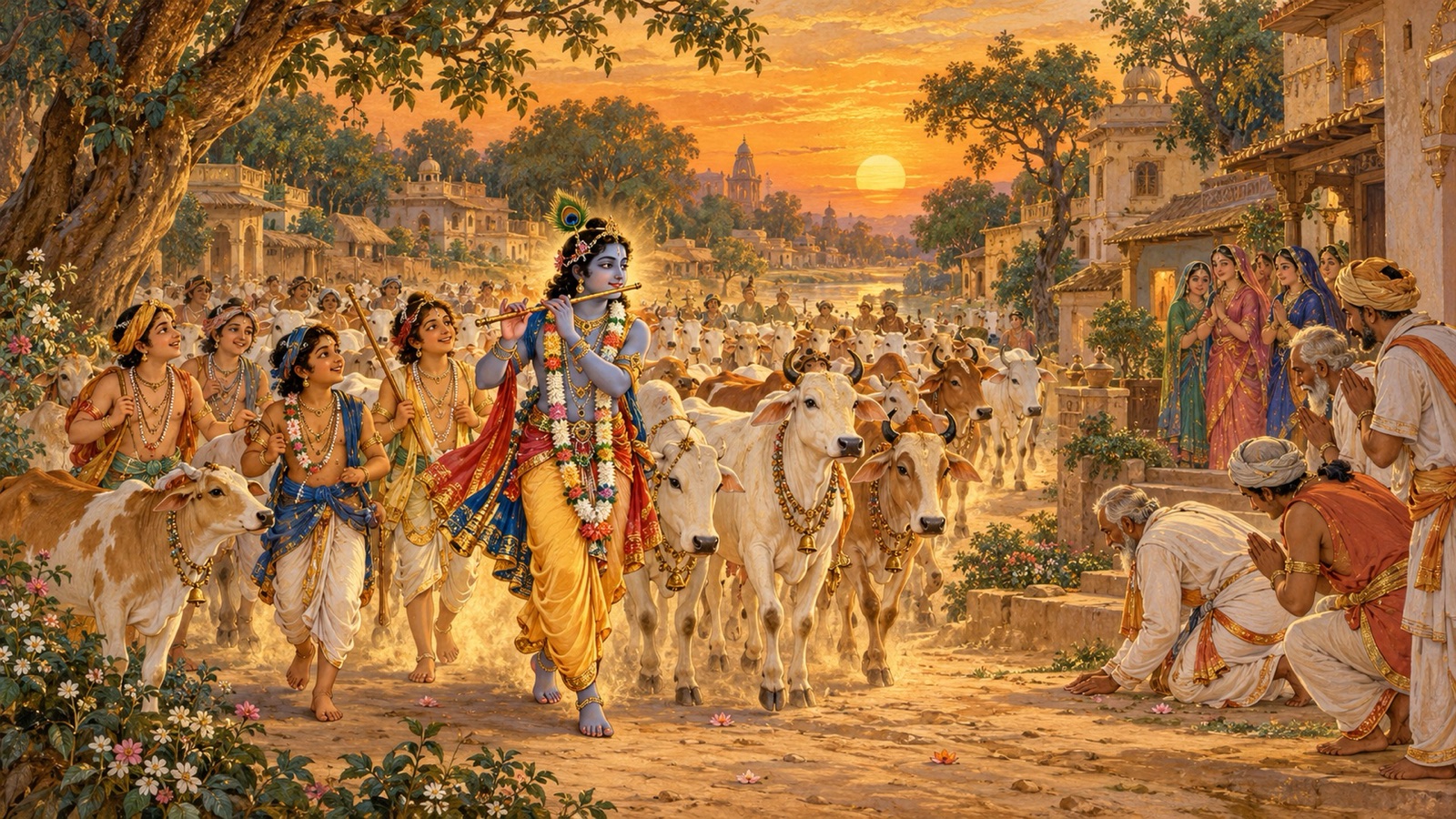
His eyes roll a little, as if with wine; His face has the pale gold of a ripening plum; His golden earrings light His soft cheeks; the forest garland hangs upon Him, and He honours each of His own as He passes. So the Lord of the Yadus comes at day’s end like the moon at the end of night, moving as the king of elephants moves, His face glad — and the endless daytime fever of the women of Vraja is cured.
Their Days Became a Festival
So Sukadeva closed the song he had been reciting. The women of Vraja, whose intelligence and mind had nowhere to go but into Krishna, passed their very days in delight, singing His pastimes over and over.
श्रीशुक उवाच
एवं व्रजस्त्रियो राजन् कृष्णलीलानुगायती: ।
रेमिरेऽह:सु तच्चित्तास्तन्मनस्का महोदया: ॥ २६ ॥
śrī-śuka uvāca evaṁ vraja-striyo rājan kṛṣṇa-līlānugāyatīḥ remire ‘haḥsu tac-cittās tan-manaskā mahodayāḥ
Meaning: Sukadeva Gosvami said: In this way, O King, the women of Vraja, singing continually of Krishna’s pastimes, with hearts and minds absorbed in Him and possessed of great good fortune, took delight even in the daytime. (Canto 10, Chapter 35, verse 26)
Principal Teachings of This Chapter
1. When love cannot follow, it sings. Unable to walk into the forest behind Him, the gopis made a song of Him instead. Kirtana is what devotion does with distance.
2. All creation is already listening. Rivers halt, trees rain honey, swans and does gather in. Devotion is no private emotion, but the note to which the whole world is quietly tuned.
3. His sweetness is not reached by scholarship. The greatest gods bend their minds to that flute and are bewildered. Learning measures; love listens.
4. Humility is the ornament of the gopis. Even while describing wonders they call themselves women of little merit. Those nearest Him never count themselves worthy, and that is their worthiness.
5. Remembrance turns waiting into festival. Hours that opened in anguish closed in rejoicing. Circumstances did not change; what filled them did.
A Devotional Reflection
There is something quietly astonishing here: nothing happens. No demon is killed, no mountain lifted, no river cleansed. Village women stand at ordinary work and speak of somebody who is not there — and out of that comes one of the most beautiful descriptions of the Lord in all of scripture.
We often imagine devotion needs His presence: a vision, a temple, some proof. Yet the heart that has truly received Him keeps seeing Him when He is nowhere in sight, and keeps seeing Him truly. Their eyes were in the village, their sight was in the forest — and it was no imagination, for Sukadeva repeats it to Parikshit as the plain truth of what was happening among the trees. When He seems far, that is the hour the song was made for.
A Daily Devotional Practice
Today, choose one stretch of time when the Lord feels distant — a long commute, an hour of unwanted work, a wait you cannot shorten — and do with it what the gopis did with theirs. Instead of distraction, fill it with Him: recall one detail of His beauty, the flute at His lips, the garland dusted by the hooves of the homecoming cows, and hold it there. Say it softly aloud, as a song, beginning with the holy name: Om Namo Bhagavate Vasudevaya.
Conclusion
This thirty-fifth chapter gives us a single day in Vrindavana through the eyes of those who loved Him most and could not go with Him. In paired verses the cowherd women follow His flute from the morning pastures to the hillside, to the lake where the swans fall silent, and home through the golden dust of evening. The song ends where it began, yet wholly changed — their days had become a celebration. May we learn that the Lord is never absent from a heart that goes on singing His praise.
May the divine wisdom of Srimad Bhagavatam awaken pure devotion within our hearts.
Om Namo Bhagavate Vasudevaya.
Jay Shree Madhav.
References and Attribution
- Primary edition: Gita Press, Śrīmad Bhāgavata Mahāpurāṇa (English, complete), Book Ten (First Half), Discourse 35, pages 1111–1114.
- Series: Srimad Bhagavatam Wisdom · Biswa Sanatan Dharma Seva Trust.
- Presented following the spiritual guidance and recommendation of Pandit Dr. Shri Kashinath Mishra.
This is an original, faithful retelling in the writer’s own words, with brief quoted verses shown in Devanāgarī and transliteration and their meanings given as summaries. It is not a reproduction of any single publisher’s continuous translation or commentary. No affiliation with or endorsement by any publisher is implied.
Jay Shree Madhav