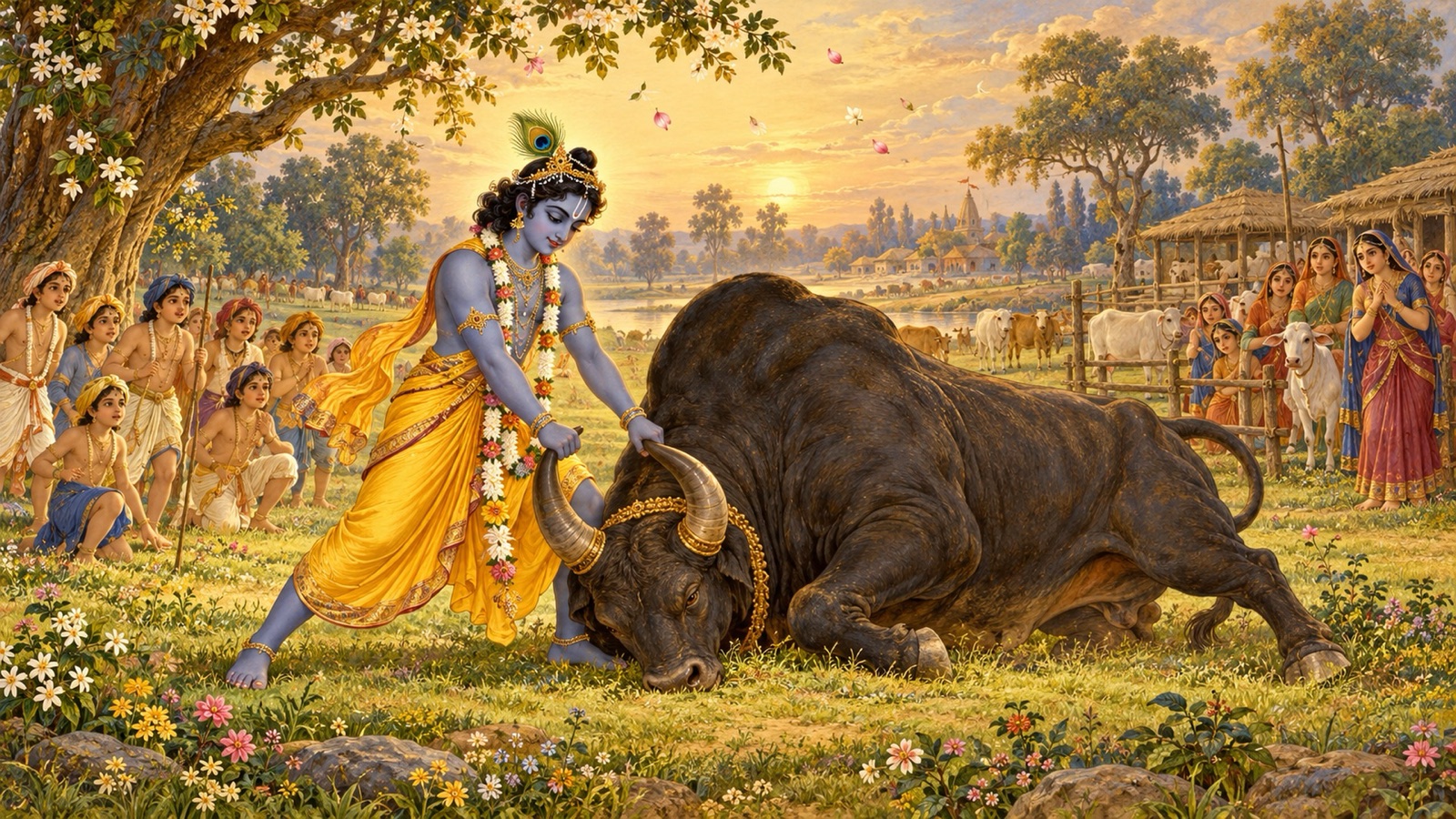
A demon in the shape of a monstrous bull storms into the peaceful pastures of Vraja, and the cowherd boy who had been playing among the cows stands forth as the punisher of the wicked.
Om Namo Bhagavate Vasudevaya.
Om Namo Bhagavate Vasudevaya.
Om Namo Bhagavate Vasudevaya.
Welcome back to Srimad Bhagavatam Wisdom, our devotional journey through the sacred histories and teachings of the Srimad Bhagavat Mahapurana. The thirty-sixth chapter of the Tenth Canto moves in a single sweep from the cow pastures of Vraja to the council hall of Mathura, where the shadow of Kamsa falls at last across the pastimes of Vrindavana.
Chapter Information
- Scripture: Śrīmad Bhāgavata Mahāpurāṇa
- Canto: 10 (Book Ten, First Half)
- Chapter: 36 (Discourse 36)
- Chapter title: The Slaying of Arishta, the Bull Demon
- Principal speaker: Sukadeva Gosvami (narrating to King Parikshit)
- Principal listener: King Parikshit
- Main setting: Nanda’s cowherd settlement in Vraja, and Kamsa’s court in Mathura
- Central subject: The fall of Arishta at Krishna’s hands; Narada’s disclosure to Kamsa; the orders to Keshi, the wrestlers and the elephant keeper; and the sending of Akrura to Vraja
- Principal verse range: Canto 10, Chapter 36, verses 1–40
- Primary edition: Gita Press Śrīmad Bhāgavata Mahāpurāṇa (English, Book Ten, First Half)
Context From the Previous Chapter
In the preceding chapter the young women of Vraja sang to one another, in paired verses, of Krishna moving through the forest with His flute and His cattle. Now He returns from that forest, and an enemy sent from Mathura is waiting.
A Bull of Terrible Shape Enters Vraja
Some time after Krishna’s return from the forest, Sukadeva said, there came into the cowherd settlement a demon named Arishta, wearing the form of a bull — vast of body, high of hump, making the very earth tremble as his hooves tore it open.
अथ तर्ह्यागतो गोष्ठमरिष्टो वृषभासुर: ।
महीं महाककुत्काय: कम्पयन्खुरविक्षताम् ॥ १ ॥
atha tarhy āgato goṣṭham ariṣṭo vṛṣabhāsuraḥ mahīṁ mahā-kakut-kāyaḥ kampayan khura-vikṣatām
Meaning: Then there came to the cowherd village the demon Arishta in the form of a bull, with an enormous body and a great hump, shaking the earth that he tore up with his hooves. (Canto 10, Chapter 36, verse 1)
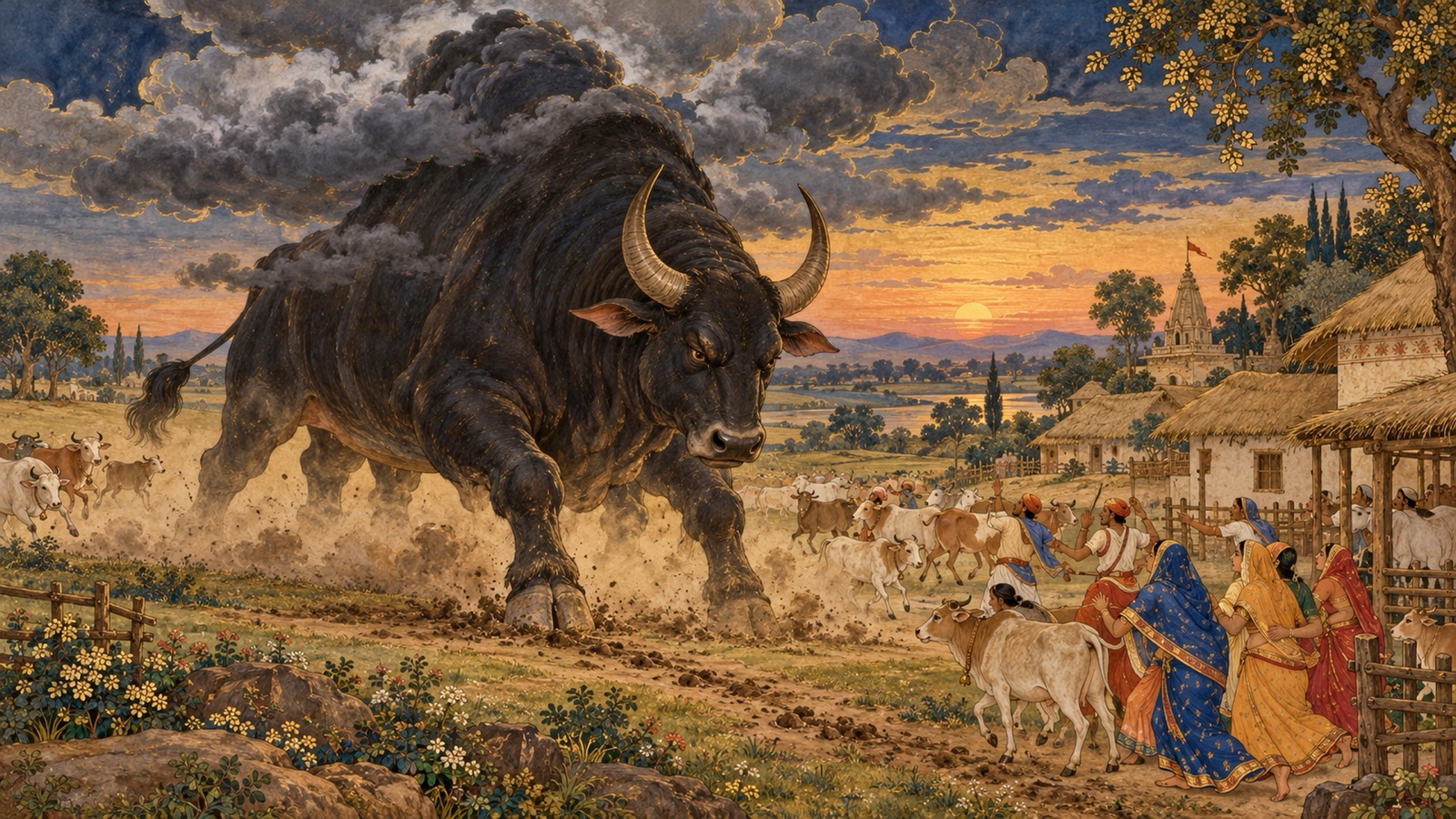
He bellowed harshly and dug the ground with his feet; lifting his tail he tossed up the raised embankments with the tips of his horns, dropping dung and urine a little at a time, staring with eyes that never blinked. At that thunderous noise cows and women of Vraja lost the young they carried, whether newly conceived or near their term; and clouds settled upon his hump, mistaking it for a hill. Seeing those sharp horns, the cowherd men and women were stricken, and the cattle fled far from the pastures. Crying out, “Krishna! O Enchanter of all!” the people ran to Govinda for shelter.
“Do Not Be Afraid” — The Lord Calls Out the Demon
The Lord saw Gokula scattered by terror. He steadied them with the words, “Do not be afraid,” and then called the bull demon to Himself and rebuked him.
गोपालै: पशुभिर्मन्द त्रासितै: किमसत्तम ।
मयि शास्तरि दुष्टानां त्वद्विधानां दुरात्मनाम् ॥ ७ ॥
gopālaiḥ paśubhir manda trāsitaiḥ kim asattama mayi śāstari duṣṭānāṁ tvad-vidhānāṁ durātmanām
Meaning: What do you gain, O dull one, O vilest of beings, by terrifying these cowherds and their cattle, when I am here as the chastiser of the wicked and the evil-minded such as you? (Canto 10, Chapter 36, verse 7)
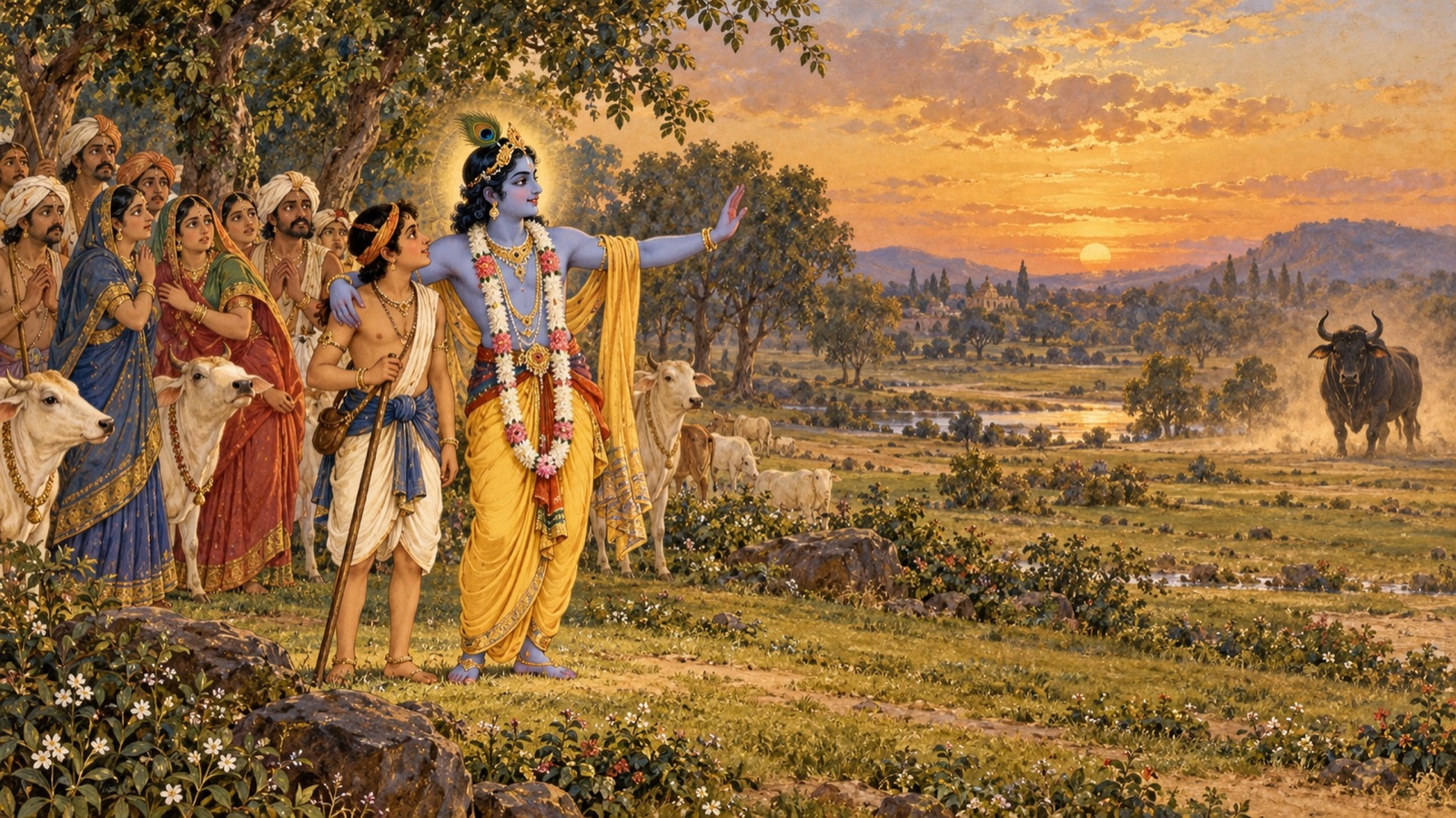
Then the immortal Lord slapped His arms, rousing the demon with the sound, and stood at His ease with one serpent-like arm laid across the shoulder of a cowherd friend. Stung to fury, Arishta charged, furrowing the ground with his hooves, his raised tail scattering the clouds as he came.
The Horns Seized, the Pride Broken
With the points of his horns thrust forward, his bloodshot eyes unblinking, the creature rushed upon Krishna like a thunderbolt hurled by Indra, threatening Him with sidelong glances. The Lord caught him by those horns and shoved him back a distance of eighteen steps, as one elephant drives off a rival elephant. Thrown down, the bull rose at once and came on again, drenched in sweat and breathing hard in his rage.
तमापतन्तं स निगृह्य शृङ्गयो:
पदा समाक्रम्य निपात्य भूतले ।
निष्पीडयामास यथार्द्रमम्बरं
कृत्वा विषाणेन जघान सोऽपतत् ॥ १३ ॥
tam āpatantaṁ sa nigṛhya śṛṅgayoḥ padā samākramya nipātya bhū-tale niṣpīḍayām āsa yathārdram ambaraṁ kṛtvā viṣāṇena jaghāna so ‘patat
Meaning: Seizing him by the horns as he rushed forward, the Lord pressed him down with His foot, threw him to the ground, and wrung him as one wrings a wet cloth; then, tearing out a horn, He struck him with it, and the demon fell. (Canto 10, Chapter 36, verse 13)
Vomiting blood, voiding dung and urine, flinging out his legs with his eyes rolling, the demon passed through great pain and went to the abode of death; and the gods above rained flowers upon Sri Hari and sang His praises. Having thus brought down the bull, and praised by His own kinsmen, Krishna — a festival for the eyes of the gopis — entered Vraja again with Balarama beside Him.
Narada Carries the Secret to Mathura
The fall of Arishta did not go unnoticed beyond Vraja. Narada, the holy sage gifted with divine vision, came to Kamsa and told him what had been hidden from him for years: that the infant girl who had slipped from his grasp was in truth the daughter of Yasoda; that Krishna was the son of Devaki; that Balarama was born of Rohini; and that the terrified Vasudeva had placed both boys in the care of his friend Nanda — and that it was these two who had been making short work of the agents sent against them.
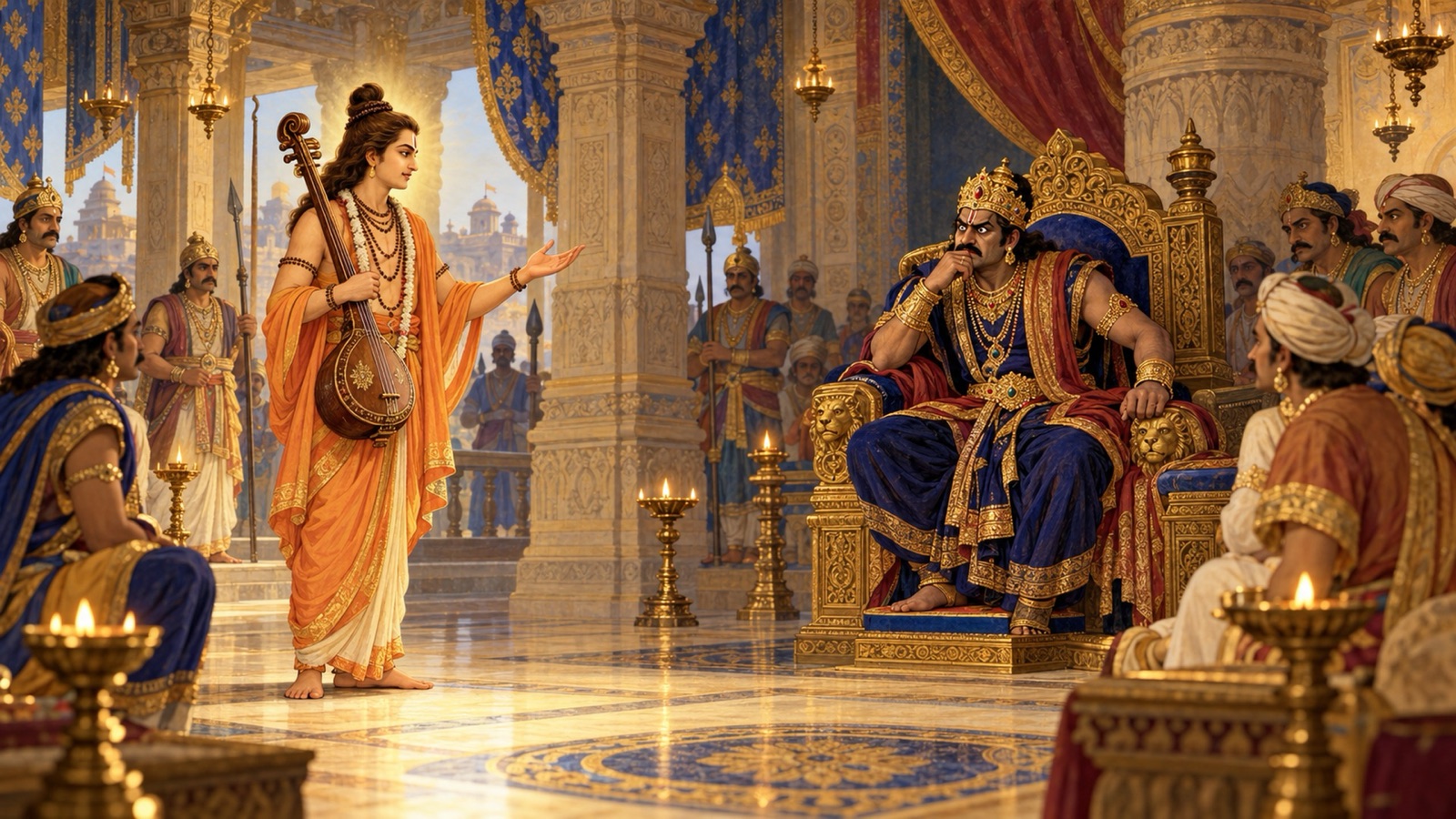
His senses shaking with anger at the revelation, Kamsa, chief of the Bhojas, snatched up a sharp sword to kill Vasudeva on the spot. Narada restrained him; and learning from the sage that the two sons of Vasudeva were ordained to be his death, he bound Vasudeva and Devaki once more in iron fetters.
The King Lays His Traps
When the celestial sage had departed, Kamsa called for Keshi and sent him to Vraja with a single order: let Balarama and Keshava be destroyed by you. He then summoned Mushtika, Chanura, Shala, Toshalaka and the other renowned wrestlers, with his ministers and his keepers of elephants, and set out his design before them.
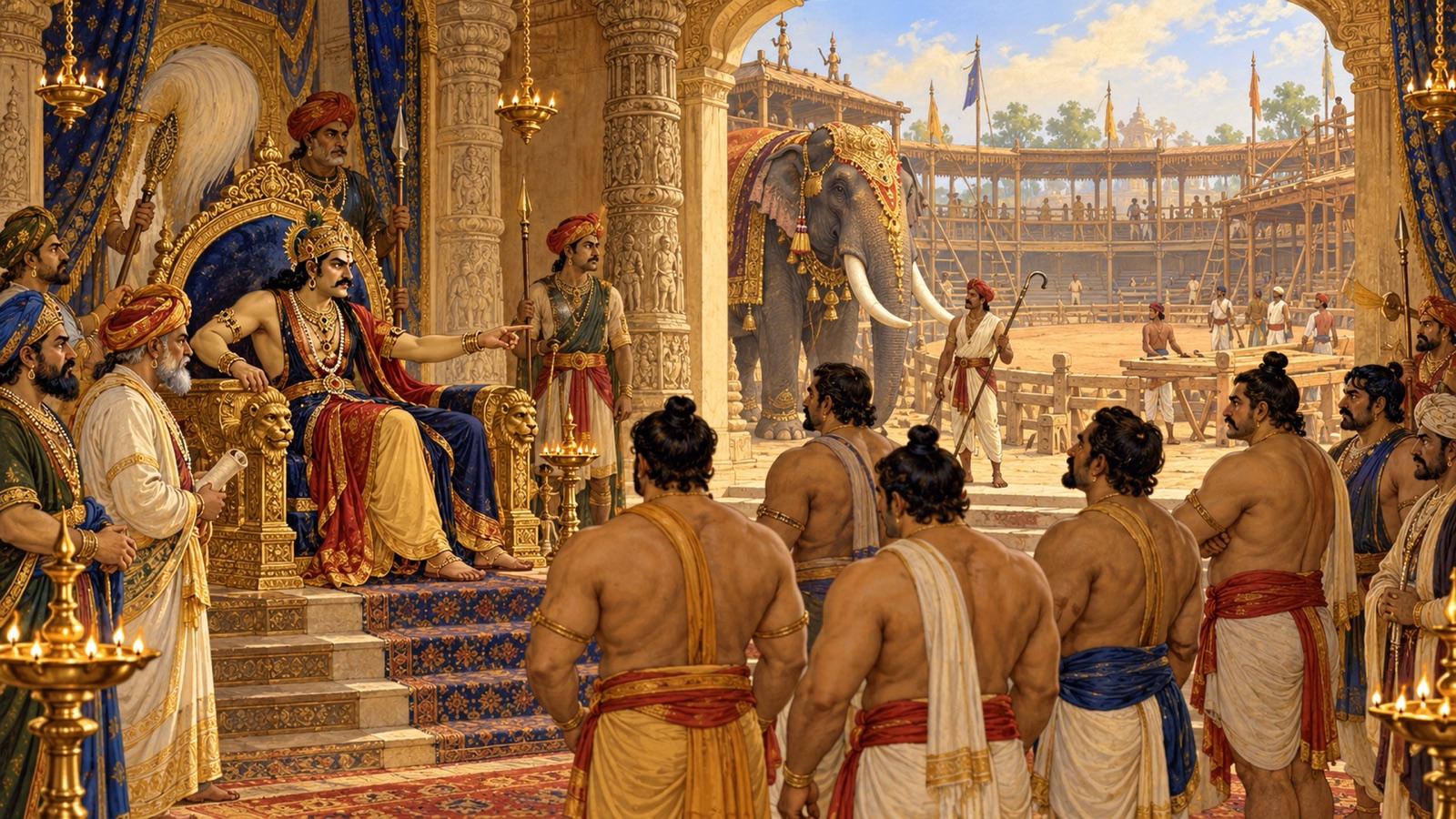
“I hear,” he said, “that the two sons of Anakadundubhi, Balarama and Krishna, are living in Nanda’s Vraja, and that my death has been decreed at their hands. Let the boys be killed by you in a wrestling match when they arrive. Let galleries of various designs be raised around the arena, and let the people of the city and of the kingdom watch the contest.” To his elephant keeper he said, “O blessed one, let the mighty Kuvalayapida be stationed at the entrance of the arena, and kill my two enemies by his means.” He further ordered a bow sacrifice to be begun with full ceremony on the coming fourteenth lunar day, the priests offering the animals fit for sacrifice to Lord Shiva, the giver of boons.
Kamsa Clasps the Hand of Akrura
Having instructed his servants, the king — well practised in getting his own ends served — sent for Akrura, foremost of the Yadus and a kinsman of Vasudeva. Taking Akrura’s hand in his own, he spoke sweetly: “O chief among the charitable, do me this act of friendship. In the whole race of the Bhojas and the Vrishnis none is more honoured by me, and none more my friend, than you.”
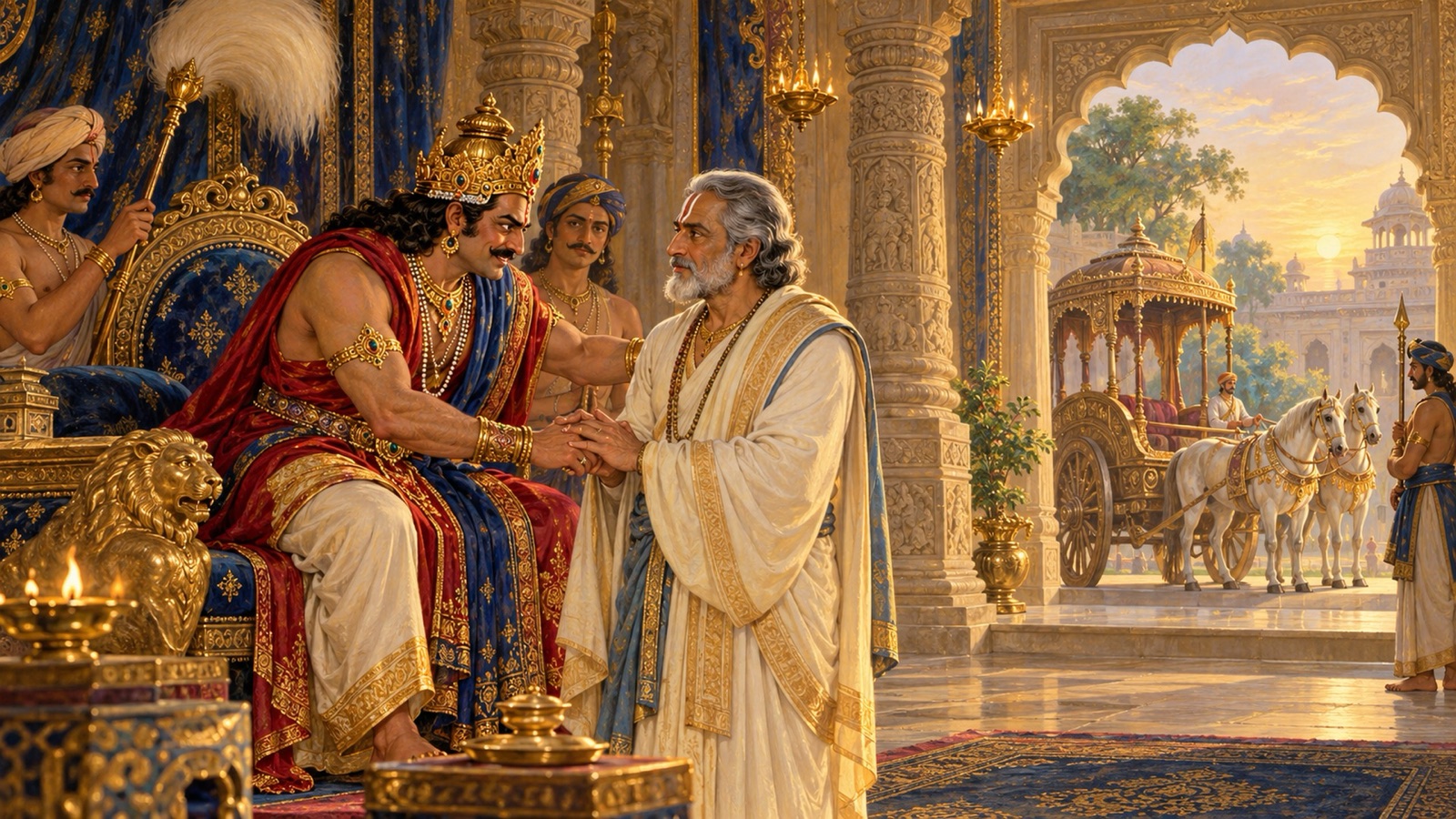
अतस्त्वामाश्रित: सौम्य कार्यगौरवसाधनम् ।
यथेन्द्रो विष्णुमाश्रित्य स्वार्थमध्यगमद् विभु: ॥ २९ ॥
atas tvām āśritaḥ saumya kārya-gaurava-sādhanam yathendro viṣṇum āśritya svārtham adhyagamad vibhuḥ
Meaning: Therefore, gentle one, I take shelter of you as the means of accomplishing a weighty purpose, just as the mighty Indra took shelter of Lord Vishnu and gained his own end. (Canto 10, Chapter 36, verse 29)
गच्छ नन्दव्रजं तत्र सुतावानकदुन्दुभे: ।
आसाते ताविहानेन रथेनानय मा चिरम् ॥ ३० ॥
gaccha nanda-vrajaṁ tatra sutāv ānakadundubheḥ āsāte tāv ihānena rathenānaya mā ciram
Meaning: Go to Nanda’s Vraja, where the two sons of Vasudeva are living, and bring them both here in this chariot without delay. (Canto 10, Chapter 36, verse 30)
His death, the king went on, had been ordained at the hands of the younger one by the gods, whose only refuge is Vishnu; so let them be brought with Nanda and the cowherds, bearing tribute of every kind. Once here, his elephant, who is death himself, would finish them, and if they escaped, wrestlers hard as thunderbolts would not. With the brothers gone he would destroy their grieving kinsmen — the Vrishnis, Bhojas and Dasharhas headed by Vasudeva — his aged father Ugrasena, who hoped to hold the throne again, Ugrasena’s brother Devaka, and every other enemy, until the earth was rid of its thorns. Jarasandha was as a father to him, Dvivida his dear friend, and Shambara, Naraka and Bana his allies; with their help he would overthrow the kings siding with the gods and rule the globe himself. “Knowing this, but saying nothing of it there, bring the two youngsters quickly — to see the bow sacrifice and the splendour of the Yadu capital”.
The Answer of Akrura
Akrura listened to the whole design and answered as a devotee answers a king whose heart he cannot change.
राजन् मनीषितं सध्र्यक् तव स्वावद्यमार्जनम् ।
सिद्ध्यसिद्ध्यो: समं कुर्याद्दैवं हि फलसाधनम् ॥ ३८ ॥
rājan manīṣitaṁ sadhryak tava svāvadya-mārjanam siddhy-asiddhyoḥ samaṁ kuryād daivaṁ hi phala-sādhanam
Meaning: O king, your plan for removing the evil that threatens you is well conceived. Yet one should keep an even mind in success and in failure, for it is providence that brings about the fruit of our efforts. (Canto 10, Chapter 36, verse 38)
Men raise their hopes high, he added, even when providence has already cut those hopes down, and so they are tossed between joy and sorrow; nevertheless, he said, I shall carry out your command.
Two hearts here receive the very same news and answer it in opposite ways. Narada tells the king plainly whose sons the boys are and whose death they are appointed to be; and the king, holding that knowledge, arms wrestlers, stations an elephant at a gateway, orders a sacrifice and lends out a chariot — the truth about the Lord turned into machinery against Him. Akrura hears the same plan and quietly sets providence above it, since the fruit of any endeavour is given and not seized. And the design is already overruled in the giving: the chariot sent to carry two boys to their death is the chariot that will bring the Lord into the city of the king who dreads Him.
एवमादिश्य चाक्रूरं मन्त्रिणश्च विसृज्य स: ।
प्रविवेश गृहं कंसस्तथाक्रूर: स्वमालयम् ॥ ४० ॥
evam ādiśya cākrūraṁ mantriṇaś ca visṛjya saḥ praviveśa gṛhaṁ kaṁsas tathākrūraḥ svam ālayam
Meaning: Having thus instructed Akrura and dismissed his counsellors, Kamsa withdrew into his inner apartments, and Akrura likewise returned to his own house. (Canto 10, Chapter 36, verse 40)
Principal Teachings of This Chapter
1. The cry comes first, the rescue follows. The people of Vraja had no weapon and no plan; they called His name and ran to Him. Shelter is not the last resort of the helpless but the surest movement of a loving heart.
2. The Lord is Himself the restrainer of the wicked. “I am here as the chastiser,” He tells the demon (verse 7). The hands that lift a flute also hold back cruelty: sheltering the gentle and curbing the violent are one work, not two.
3. Strength that bullies the weak is already broken. The bull who terrified cows and women was wrung out like a wet cloth (verse 13). Power without dharma has no standing before the Lord, however loudly it roars.
4. Hearing the truth is not the same as accepting it. Kamsa was told exactly who Krishna is, and used it only to sharpen his plots. News of the Lord becomes grace only when received with humility.
5. Act, and leave the fruit to Him. Akrura’s counsel of evenness in success and failure (verse 38) is the quiet centre of the chapter: the work is ours to do, the result rests in a higher hand.
A Devotional Reflection
It is worth standing for a moment where the cowherds stood — among frightened cattle, with something monstrous coming out of the dust, and nothing to rely on except a boy who says, “Do not be afraid.” That is the whole situation of the devotee. We are not strong, our defences are thin, and most of what alarms us is larger than we are; yet the Lord never asks us to be strong. He asks us to come to Him, and then He steps between us and the thing we fear. Mathura shows the other way to live. There a king holds more information about God than anyone in Vraja possesses, and it gives him no peace at all — only sleepless arithmetic, more guards, more allies. Truth held without surrender becomes dread; the same truth held in love becomes refuge. May we be found among those who run to Him rather than among those who calculate against Him.
A Daily Devotional Practice
Today, choose one duty — at work, at home, in service — and perform it with full care while letting go of its result, offering the outcome to the Lord as Akrura offered his errand. If something frightens you before the day is over, do what the cowherds did: call out the Name before you reach for a plan. Begin and end the day gently chanting: Om Namo Bhagavate Vasudevaya.
Conclusion
This chapter sets two pictures side by side: a demon bull broken by the hands of a boy who had been grazing cows, and a king in a jewelled hall arranging wrestlers, elephants and chariots against that same boy. One scene ends in showers of flowers from heaven, the other in a man retiring to his rooms with his fear intact. Between them stands Akrura, who knows that providence, not plotting, gives the fruit of every effort. May we learn from him to work without clutching at results, and from the people of Vraja to run straight to the Lord who says, “Do not be afraid.”
May the divine wisdom of Srimad Bhagavatam awaken pure devotion within our hearts.
Om Namo Bhagavate Vasudevaya.
Jay Shree Madhav.
References and Attribution
- Primary edition: Gita Press, Śrīmad Bhāgavata Mahāpurāṇa (English, complete volume), Book Ten (First Half), Discourse 36.
- Series: Srimad Bhagavatam Wisdom · Biswa Sanatan Dharma Seva Trust.
- Presented following the spiritual guidance and recommendation of Pandit Dr. Shri Kashinath Mishra.
This is an original, faithful retelling in the writer’s own words, with brief quoted verses shown in Devanāgarī and transliteration and their meanings given as summaries. It is not a reproduction of any single publisher’s continuous translation or commentary. No affiliation with or endorsement by any publisher is implied.
Jay Shree Madhav