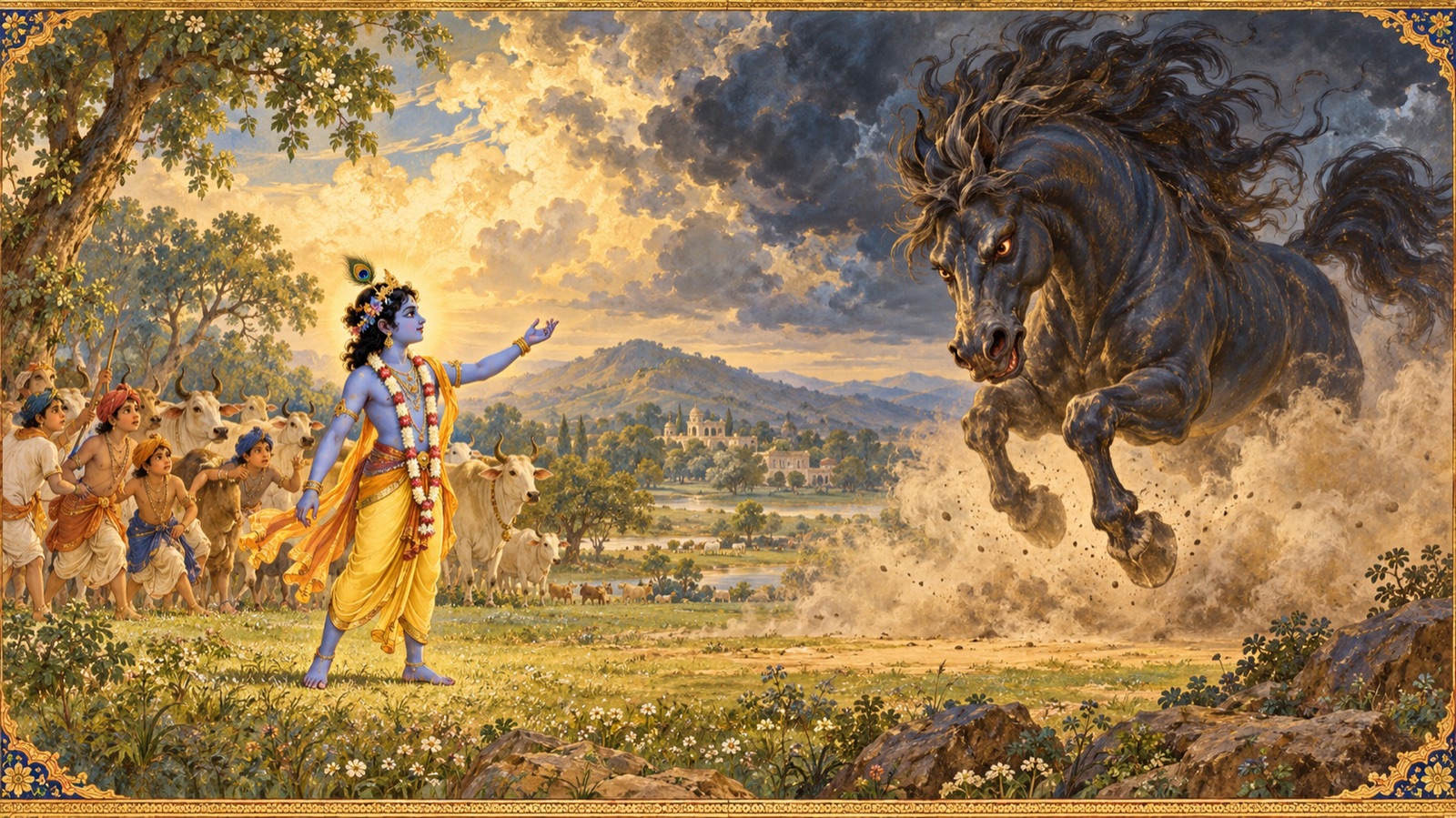
A demon shaped like a thundercloud horse comes galloping into the pastures to end two young lives — and the cowherd boy of Vraja steps quietly into its path.
Om Namo Bhagavate Vasudevaya.
Om Namo Bhagavate Vasudevaya.
Om Namo Bhagavate Vasudevaya.
Welcome back to Srimad Bhagavatam Wisdom, our devotional journey through the sacred histories and teachings of the Srimad Bhagavat Mahapurana. The thirty-seventh chapter of the Tenth Canto sets two servants of fear against one Lord at play: one comes openly, with thunder, from Kamsa’s court; the other comes hidden, in the dress of a friend, into a children’s game on the hills. Between them the celestial sage Narada draws near in private and names aloud the deeds still to come.
Chapter Information
- Scripture: Śrīmad Bhāgavata Mahāpurāṇa
- Canto: 10 (Book Ten, First Half)
- Chapter: 37 (Discourse 37)
- Chapter title: The Killing of the Demons Keshi and Vyoma
- Principal speaker: Sukadeva Gosvami (narrating to King Parikshit)
- Principal listener: King Parikshit
- Main setting: Nanda’s Vraja — its pastures and the nearby mountain slopes
- Central subject: The slaying of the horse-demon Keshi; the secret prayer and prophecy of Narada; the rescue of the cowherd boys from the conjurer Vyoma
- Principal verse range: Canto 10, Chapter 37, verses 1–33
- Primary edition: Gita Press Śrīmad Bhāgavata Mahāpurāṇa (English), Book Ten (First Half)
Context From the Previous Chapter
Kamsa, warned that the two sons of Vasudeva were his appointed death, had bound Vasudeva and Devaki in iron fetters, summoned his wrestlers, readied the elephant Kuvalayapida and the bow-sacrifice, and sent Akrura to fetch the brothers. Earlier in that council he had taken counsel with Keshi and sent him to the cowherd village with one command: make an end of Balarama and Kesava.
The Horse of Terror Enters Vraja
Dispatched in this way and eager to oblige his master, the evil-minded Keshi came to Nanda’s Vraja in the body of a gigantic horse — swift as the mind, with huge eyes, a mouth gaping like a cavern, a massive neck, and a colour like a great black raincloud. His hooves shook the earth; the tossing of his mane scattered the clouds and the chariots of the gods; and every creature that heard his neighing was struck with terror.
Those neighs were meant for the Lord’s own village, and the beast roamed the pastures seeking the duel it had been sent to fight. So Krishna placed Himself before His people and summoned it to combat, and the animal answered with a roar like a lion’s.
The Combat With Keshi
Catching sight of Him, that creature — hard to approach, dreadful in speed, impossible to withstand — wheeled about and ran at Him in fury, its mouth stretched wide as though to drink the sky, and struck at the lotus-eyed Lord with its hind legs. Krishna let the kick pass, seized the horse by those very legs, whirled it round, and tossed it away in disdain to the distance of a hundred bows, as Garuda tosses aside a serpent. Then He stood exactly as before, as though nothing had happened.
The horse recovered its senses, rose, and came at Him a second time with its jaws flung open.
स: लब्धसंज्ञ: पुनरुत्थितो रुषा
व्यादाय केशी तरसापतद्धरिम् ।
सोऽप्यस्य वक्त्रे भुजमुत्तरं स्मयन्
प्रवेशयामास यथोरगं बिले ॥ ५ ॥
saḥ labdha-saṁjñaḥ punar utthito ruṣā vyādāya keśī tarasāpatad dharim so ’py asya vaktre bhujam uttaraṁ smayan praveśayām āsa yathoragaṁ bile
Meaning: Regaining consciousness and rising again in rage, Keshi rushed with great speed upon Lord Hari with his mouth wide open; and He, smiling, slid His left arm within it, as a man puts a snake into a hole. (Canto 10, Chapter 37, verse 5)
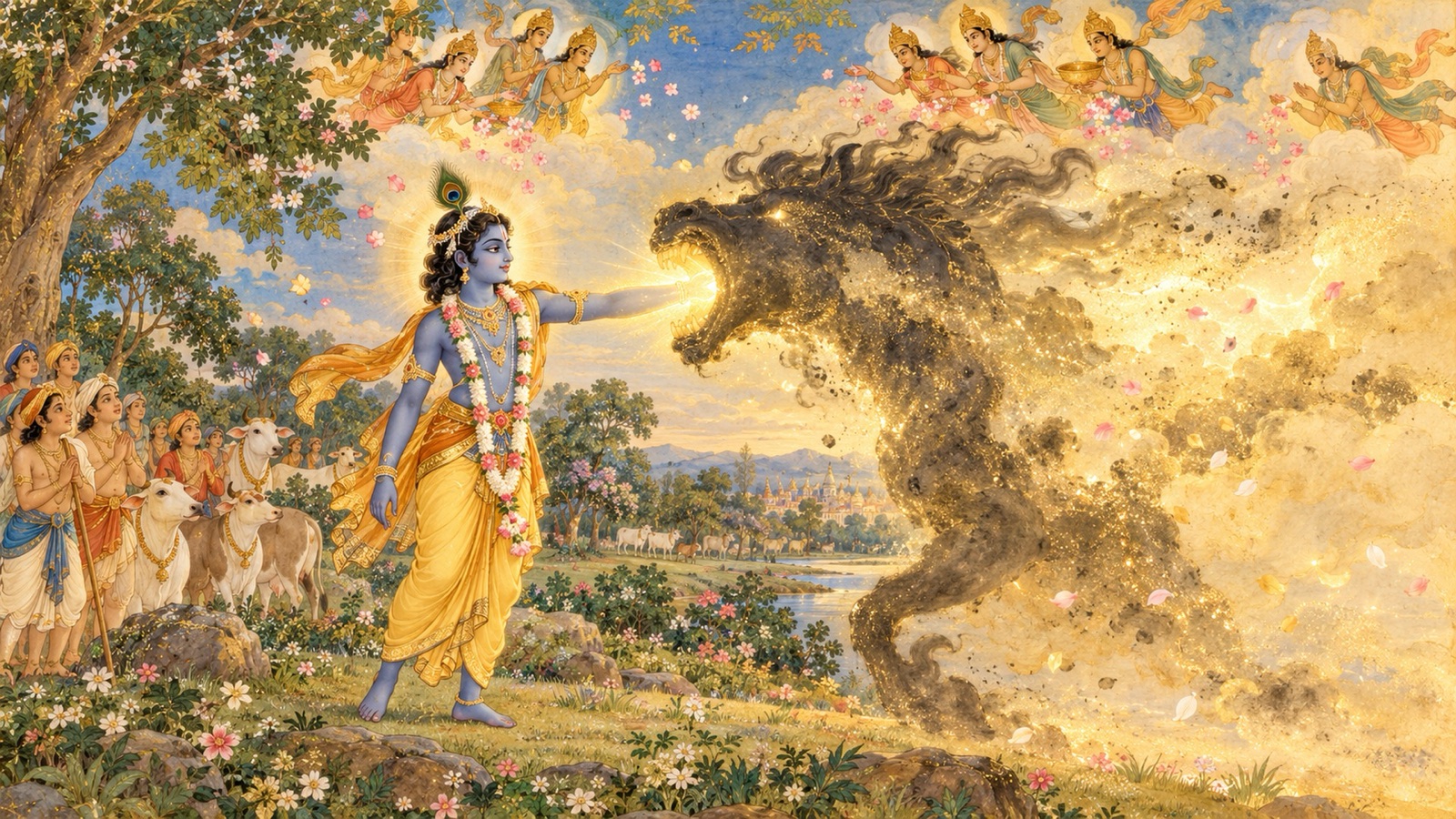
The teeth that closed upon that arm dropped away at once, as teeth would fall on striking a bar of red-hot iron. Within the body the Lord’s arm began to grow, swelling like an illness left untended. The demon’s breath was stopped, his eyes rolled, sweat broke over him, and he fell lifeless upon the ground. From that form, split open like an overripe cucumber, the mighty-armed Lord drew His arm out again. He had undone His enemy without the least effort, and stood wholly unelated, while the astonished residents of heaven rained down flowers and sang His glory.
Narada Comes to Krishna in Secret
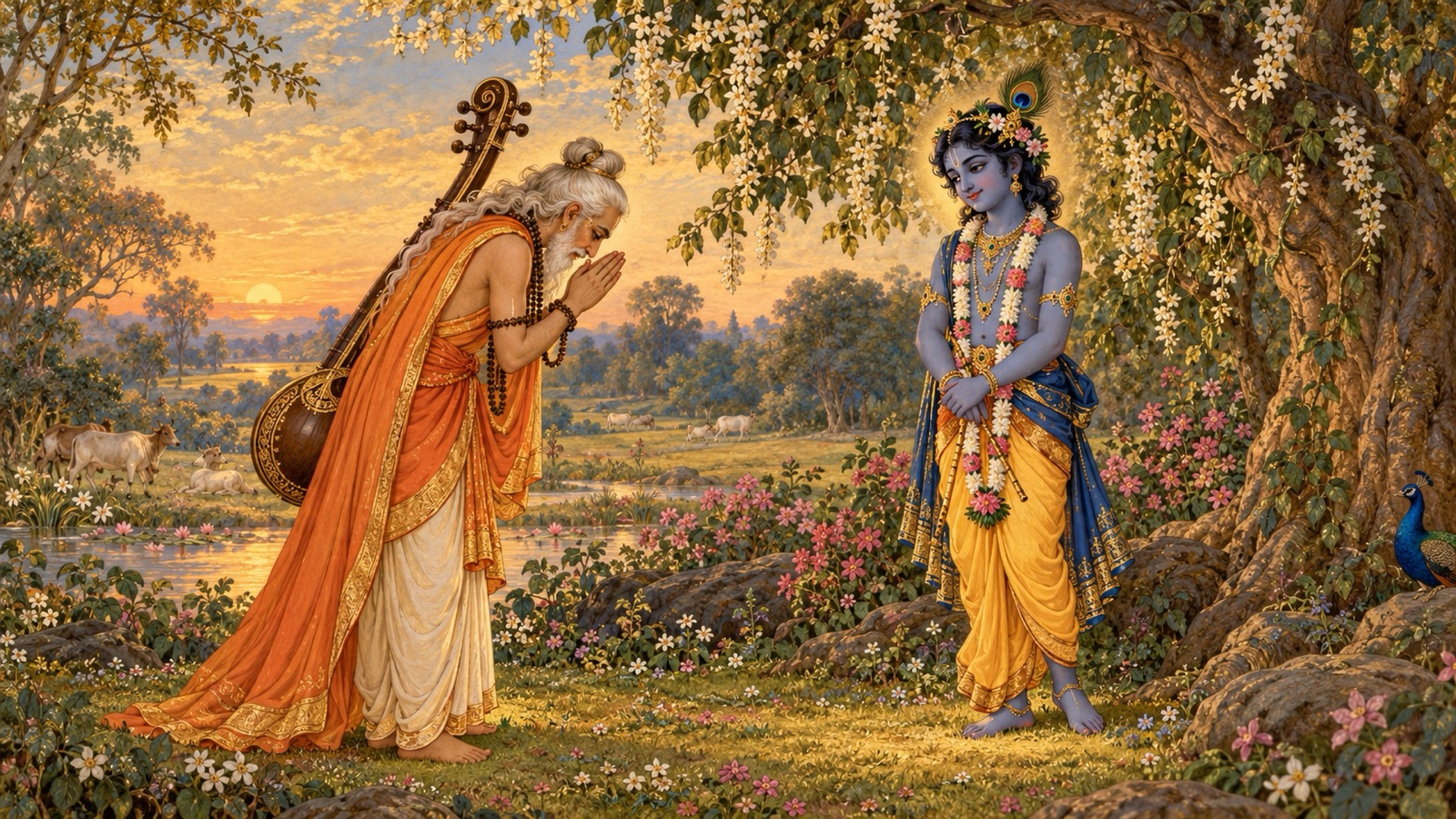
Then Devarshi Narada, foremost among the Lord’s devotees, came near to Krishna, whose actions cost Him no labour, and spoke where no one else could hear. “Krishna, O Krishna of immeasurable being, master of yoga, ruler of the worlds! O Vasudeva, dwelling-place of all that lives, best of the Satvatas, almighty Lord! You are the Self of every creature, hidden within them as fire lies hidden within firewood — lodged in the cave of the heart, the witness, the Supreme Person. Resting upon none but Yourself, You first brought forth the three gunas by Your own Maya, and through them You create this world, sustain it and withdraw it again, and Your will is never thwarted.”
स त्वं भूधरभूतानां दैत्यप्रमथरक्षसाम् ।
अवतीर्णो विनाशाय साधुनां रक्षणाय च ॥ १३ ॥
sa tvaṁ bhūdhara-bhūtānāṁ daitya-pramatha-rakṣasām avatīrṇo vināśāya sādhunāṁ rakṣaṇāya ca
Meaning: You, that very Lord, have descended for the destruction of the Daityas, Pramathas and Rakshasas who have been born as rulers of the earth, and for the protection of the virtuous. (Canto 10, Chapter 37, verse 13)
In that single line the sage lays bare the reason behind everything this chapter contains, and he states it as two works of one mercy. The Lord does not take birth because wickedness has outgrown Him, nor does He fight because He is threatened; He comes down because the earth is being crushed by cruelty wearing a crown, and because those who live simply and righteously have no other shelter. Both halves of that purpose are fulfilled here within one day of herding: Kamsa’s horse is removed, and a band of cowherd boys is carried out of a sealed cave. The same hand does both, and the devotee learns to see even the terrifying act as protection in another form. Narada therefore does not congratulate Krishna on a victory; he gives thanks for a kindness.
दिष्ट्या ते निहतो दैत्यो लीलयायं हयाकृति: ।
यस्य हेषितसन्त्रस्तास्त्यजन्त्यनिमिषा दिवम् ॥ १४ ॥
diṣṭyā te nihato daityo līlayāyaṁ hayākṛtiḥ yasya heṣita-santrastās tyajanty animiṣā divam
Meaning: By good fortune this demon in the shape of a horse has been slain by You in sport — he at whose neighing the unblinking gods fled from heaven in fright. (Canto 10, Chapter 37, verse 14)
What the Sage Already Beholds
Narada then spoke of things not yet done as calmly as a man describes what lies before his eyes. The day after tomorrow, he said, he would see Chanura and Mushtika and the other wrestlers, the elephant, and Kamsa himself struck down by the Lord. After that would come the end of Shankha, of the Yavana, of Mura and of Naraka; the carrying away of the parijata tree and the humbling of Indra; the winning of the daughters of heroes with valour as their only bride-price; the release of King Nriga from his curse at Dwaraka; the taking of the Syamantaka jewel with Jambavati; and a brahmana’s dead son restored from the Lord’s own abode. He would see the fall of Paundraka, the burning of Kashi, the death of Dantavaktra and of the king of Chedi at a great sacrifice, and those other Dwaraka deeds which the poets of the earth would sing. Last of all he would behold whole akshauhinis consumed by Him when He took the reins of Arjuna’s chariot and wore the form of Time bent upon dissolution.
Having seen so far ahead, the sage asked nothing for himself. He prayed instead to the Lord as pure consciousness, perfect in His own standing, whose every wish bears fruit, and from whose radiance the flood of the gunas born of Maya is forever turned back. Then he bowed.
त्वामीश्वरं स्वाश्रयमात्ममायया
विनिर्मिताशेषविशेषकल्पनम् ।
क्रीडार्थमद्यात्तमनुष्यविग्रहं
नतोऽस्मि धुर्यं यदुवृष्णिसात्वताम् ॥ २३ ॥
tvām īśvaraṁ svāśrayam ātma-māyayā vinirmitāśeṣa-viśeṣa-kalpanam krīḍārtham adyātta-manuṣya-vigrahaṁ nato ’smi dhuryaṁ yadu-vṛṣṇi-sātvatām
Meaning: I bow to You, the Lord who is His own support, by whose Maya every distinct thing has been fashioned, and who has now taken a human form for the sake of play as the foremost of the Yadus, Vrishnis and Satvatas. (Canto 10, Chapter 37, verse 23)
Thus bowing to Krishna, the chief of the Yadus, and receiving His leave, that best of devotees departed, carrying with him the festival of having seen Him. And the Lord, having finished with Keshi in open combat, went on tending the cattle as usual among the cowherd boys who loved Him, and all Vraja was glad.
A Game Upon the Hills
One day the boys were pasturing the animals on the slopes of the hill, and they fell to playing their old game of hiding and snatching, some taking the part of thieves and others of guards. A few among them played the sheep, and so they sported together without a shadow of fear.
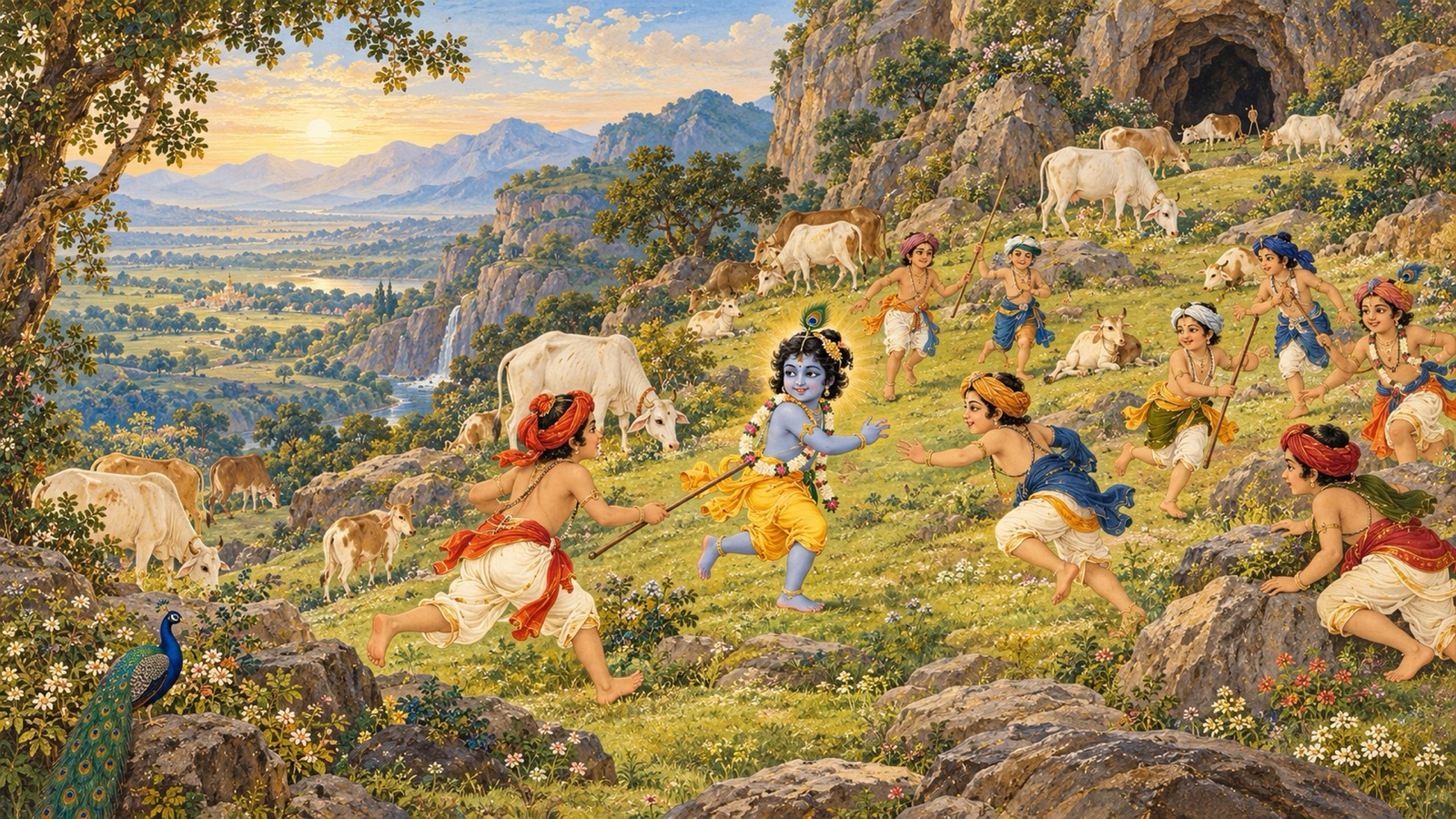
Into that game there slipped a stranger: Vyoma, the son of Maya, a master of vast conjuring tricks, who came among them wearing the shape of a cowherd boy and chose again and again to be one of the thieves.
मयपुत्रो महामायो व्योमो गोपालवेषधृक् ।
मेषायितानपोवाह प्रायश्चोरायितो बहून् ॥ २८ ॥
maya-putro mahā-māyo vyomo gopāla-veṣa-dhṛk meṣāyitān apovāha prāyaś corāyito bahūn
Meaning: Maya’s son Vyoma, the great conjurer, taking the dress of a cowherd boy and mostly acting the thief, carried away many of those who were playing the part of sheep. (Canto 10, Chapter 37, verse 28)
Each boy he stole he laid inside a cave in the hillside, sealing its mouth with a great slab of rock, until only four or five of the band were left outside.
The Rescue From the Cave
तस्य तत् कर्म विज्ञाय कृष्ण: शरणद: सताम् ।
गोपान् नयन्तं जग्राह वृकं हरिरिवौजसा ॥ ३० ॥
tasya tat karma vijñāya kṛṣṇaḥ śaraṇa-daḥ satām gopān nayantaṁ jagrāha vṛkaṁ harir ivaujasā
Meaning: Perceiving that deed of his, Krishna, the giver of shelter to the saintly, caught hold of him by force as he was leading the cowherds away, as a lion seizes a wolf. (Canto 10, Chapter 37, verse 30)
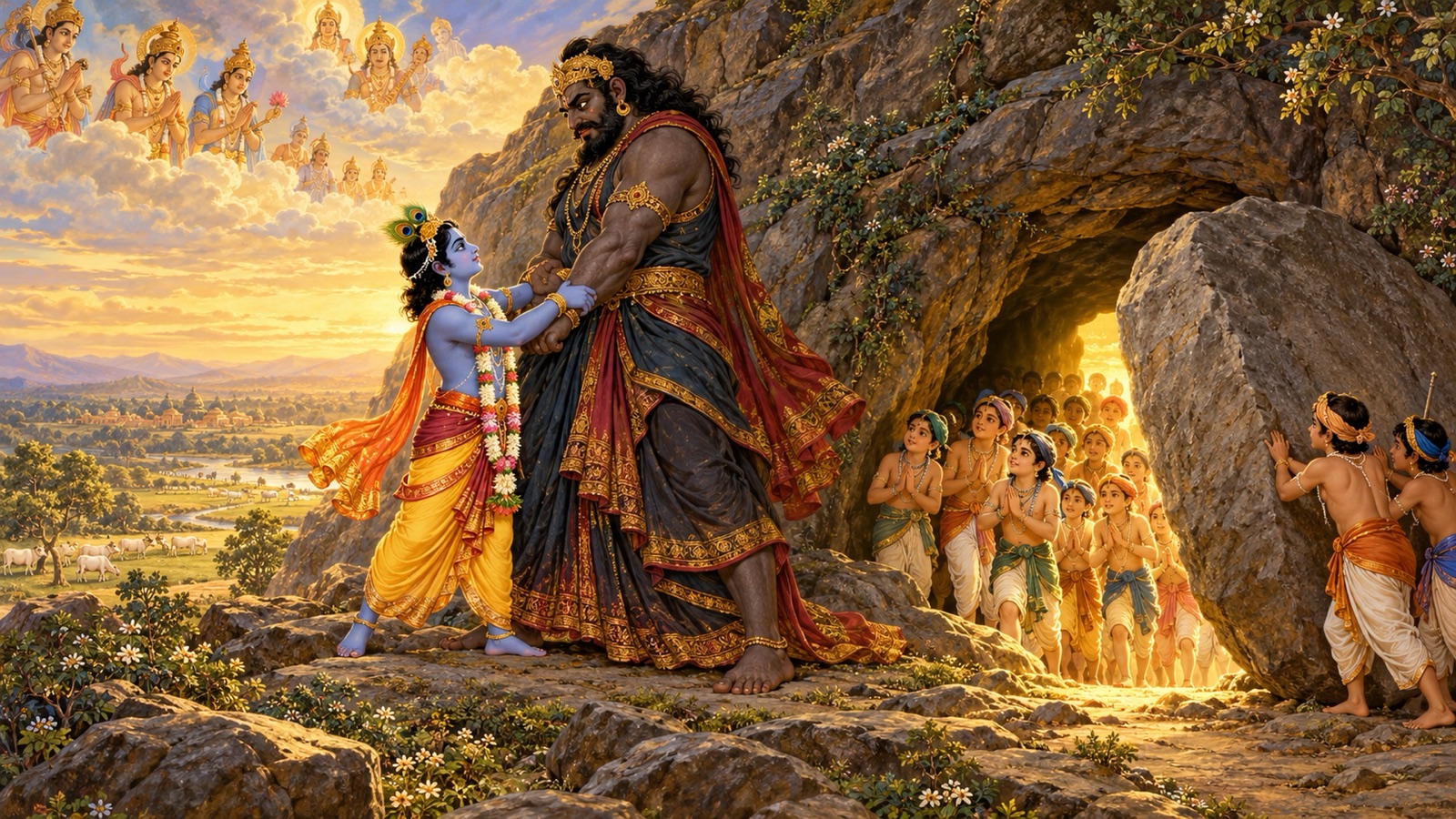
Held fast, the demon let his disguise fall and stood out in his own towering shape, like a mountain among the hills. For all his strength he wished only to get free, and could not. The Lord took him by the arms, brought him down upon the ground, and made an end of him while the gods watched from the sky. Then He broke apart the rock that stopped the cave and brought His friends out of the darkness in which they had been shut.
गुहापिधानं निर्भिद्य गोपान्नि:सार्य कृच्छ्रत: ।
स्तूयमान: सुरैर्गोपै: प्रविवेश स्वगोकुलम् ॥ ३३ ॥
guhā-pidhānaṁ nirbhidya gopān niḥsārya kṛcchrataḥ stūyamānaḥ surair gopaiḥ praviveśa sva-gokulam
Meaning: Having broken open the covering of the cave and brought the cowherds out of their painful plight, He entered His own Gokula, praised by the gods and by the cowherd boys together. (Canto 10, Chapter 37, verse 33)
Principal Teachings of This Chapter
1. One descent, two mercies. Narada names the purpose of the Lord’s coming as the ending of the demoniac and the safekeeping of the good, and both are performed here before nightfall. What looks like destruction from one side is shelter seen from the other.
2. The Lord is never on the defensive. Keshi is sent as an assassin, yet it is Krishna who steps forward and calls him to the duel. The devotee’s troubles may arrive uninvited, but they never arrive unmet.
3. A pure devotee’s joy is in the Lord’s glory. Narada, who could see the whole future, asked no boon from it. He wished only to witness what the Lord would do, and went away rich with the festival of His sight.
4. Disguise cannot deceive the Lord of the heart. Vyoma walked among the boys dressed as one of them, and the One seated within every creature knew his work at once. Nothing we hide from others is hidden from Him.
5. He opens the sealed cave. The boys could not break the slab, could not call out, could not help themselves at all; their whole deliverance came from outside. So it is with the soul shut in by its own bondage — rescue is His doing, not ours.
A Devotional Reflection
What stays with the heart here is not the size of the horse but the ease of the boy. Heaven itself had been emptied by that neighing, and Vraja is saved by a smile and one arm. That smile tells us that the One who protects us is not strained by what strains us. We measure dangers by how they loom over us; He measures nothing at all, because nothing stands outside Him.
The second pastime is quieter, and perhaps nearer to our own lives. No cosmic terror there — only children at play, a false friend among them, and darkness behind a stone. Many of us face no demon in the pasture; we are simply shut in somewhere, unable to move the weight at the mouth of our own cave. The promise of this chapter is that the Lord notices absences. He counted the boys missing from the game, and He will notice when we are missing too, and come and move the stone.
A Daily Devotional Practice
Today, bring the Lord one thing you cannot shift by yourself — a habit, a fear, a bitterness that has sealed some part of your heart in the dark. Do not plan how to move it. Sit quietly for a few minutes, place it before Him, and ask Him to open it in His own time. Then chant slowly, with attention and trust: Om Namo Bhagavate Vasudevaya.
Conclusion
Two dangers meet Krishna here — one roaring out of Kamsa’s palace, one creeping in through a children’s game — and both are answered by the same unhurried hand. Between them Narada kneels in private, names the Lord’s purpose as destruction of the cruel and protection of the good, and sees the long line of pastimes still to come. The boys shut in the hill are led back into the light, and Gokula receives its Lord with praise. May we hold fast to Him who is at once the ender of what threatens us and the shelter of all who are His own.
May the divine wisdom of Srimad Bhagavatam awaken pure devotion within our hearts.
Om Namo Bhagavate Vasudevaya.
Jay Shree Madhav.
References and Attribution
- Primary edition: Gita Press, Śrīmad Bhāgavata Mahāpurāṇa (English), Book Ten (First Half), Discourse 37.
- Series: Srimad Bhagavatam Wisdom · Biswa Sanatan Dharma Seva Trust.
- Presented following the spiritual guidance and recommendation of Pandit Dr. Shri Kashinath Mishra.
This is an original, faithful retelling in the writer’s own words, with brief quoted verses shown in Devanāgarī and transliteration and their meanings given as summaries. It is not a reproduction of any single publisher’s continuous translation or commentary. No affiliation with or endorsement by any publisher is implied.
Jay Shree Madhav