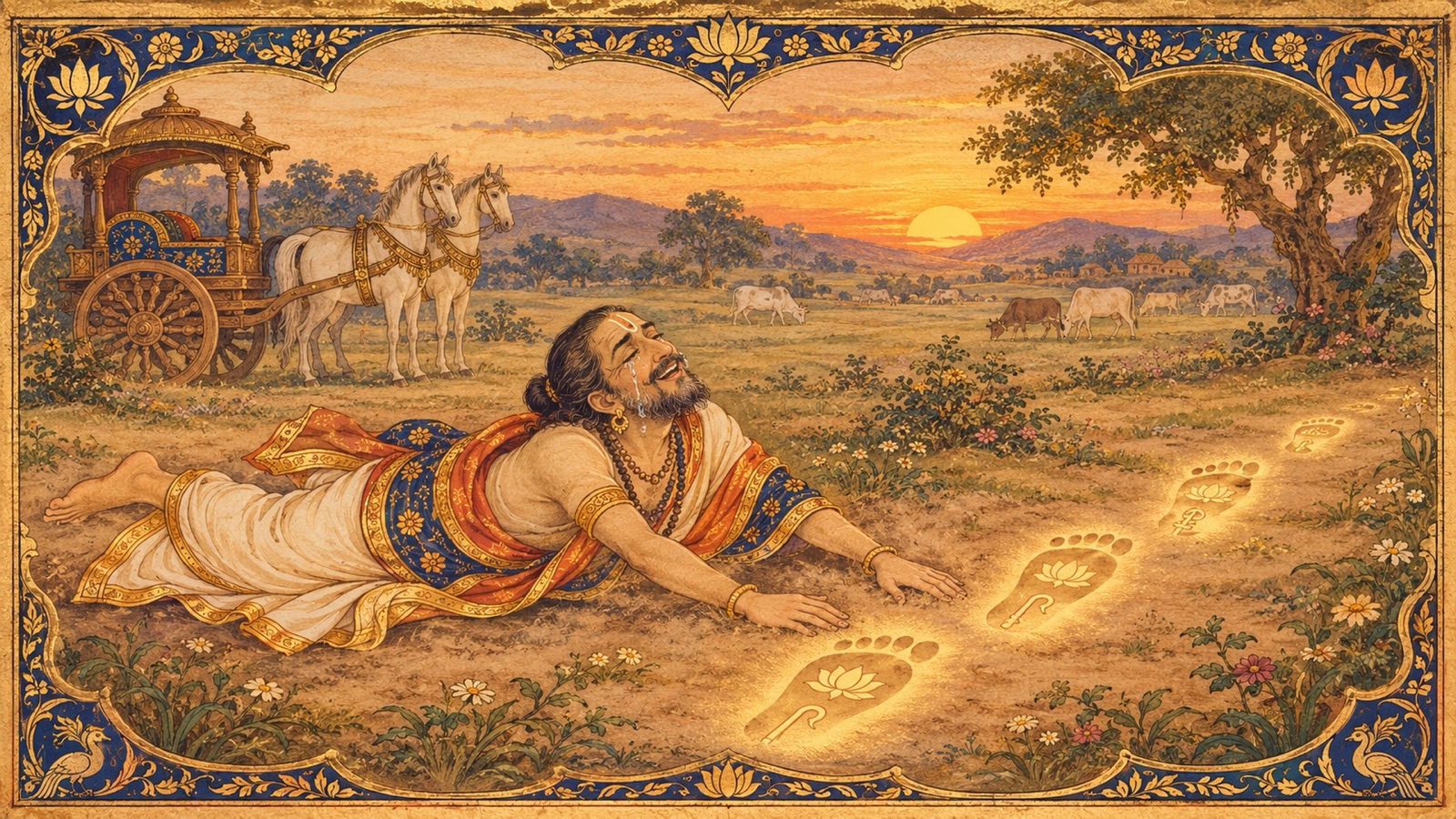
Riding out from Mathura on a tyrant’s orders, Akrura spends the whole day’s road in rapt remembrance — and at sunset finds the dust of Krishna’s feet printed in the earth of Vraja.
Om Namo Bhagavate Vasudevaya.
Om Namo Bhagavate Vasudevaya.
Om Namo Bhagavate Vasudevaya.
Welcome back to Srimad Bhagavatam Wisdom, our devotional journey through the sacred histories and teachings of the Srimad Bhagavat Mahapurana. This thirty-eighth chapter of the Tenth Canto is almost entirely the inner life of a single devotee. Akrura, charged by Kamsa with bringing the two Brothers to Mathura, travels all day debating whether one such as he may truly behold the Lord — and what he receives at journey’s end is the Bhagavatam’s portrait of longing meeting its object.
Chapter Information
- Scripture: Śrīmad Bhāgavata Mahāpurāṇa
- Canto: 10 (Book Ten, First Half)
- Chapter: 38 (Discourse 38)
- Chapter title: Akrura’s Arrival in Vrindavana
- Principal speaker: Sukadeva Gosvami (narrating to King Parikshit)
- Principal listener: King Parikshit
- Main setting: The road from Mathura to Nanda’s Gokula, and Vraja at evening
- Central subject: Akrura’s meditation on the road, the footprints of Krishna in the dust of Vraja, his first darshan and embrace, and Nanda’s hospitality
- Principal verse range: Canto 10, Chapter 38, verses 1–43
- Primary edition: Gita Press Śrīmad Bhāgavata Mahāpurāṇa (English, Book Ten)
Context From the Previous Chapter
In Chapter 37, Krishna destroyed the horse-demon Keshi, received the joyful prayers of the sage Narada, and overcame the conjuring demon Vyoma, freeing the cowherd boys shut in a mountain cave. Meanwhile Kamsa, in Mathura, had charged Akrura with fetching the two Brothers to his bow-sacrifice.
Akrura Sets Out for Vraja
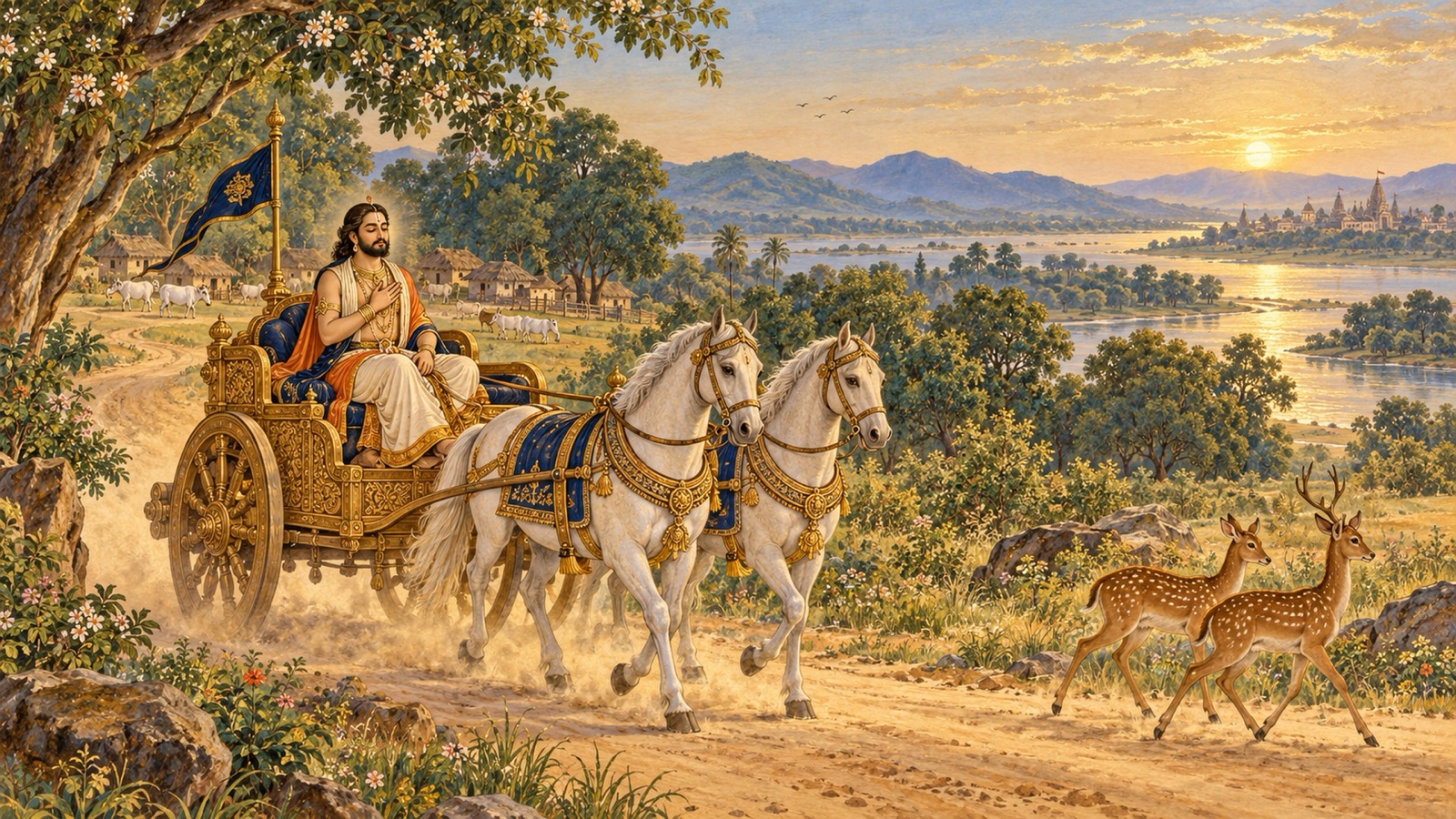
Having passed that night in Mathura, the city of Madhu, the high-minded Akrura mounted his chariot and drove out towards Nanda’s Gokula. He travelled on a king’s business, but his heart had business of its own. As the road unrolled before him, supreme devotion for the lotus-eyed Lord rose within him, and he began to reason with himself in wonder.
किं मयाचरितं भद्रं किं तप्तं परमं तप: ।
किं वाथाप्यर्हते दत्तं यद्द्रक्ष्याम्यद्य केशवम् ॥ ३ ॥
kiṁ mayācaritaṁ bhadraṁ kiṁ taptaṁ paramaṁ tapaḥ kiṁ vāthāpy arhate dattaṁ yad drakṣyāmy adya keśavam
Meaning: What auspicious deed have I performed, what supreme austerity have I undergone, or what charity have I given to a worthy person, that I shall see Keshava today? (Canto 10, Chapter 38, verse 3)
The Reasoning of a Longing Heart
He answered his own question severely. To a man whose mind ran after the pleasures of the senses, the sight of the Lord of sublime renown seemed as unattainable as the chanting of the Veda to one with no claim to it by birth. Then he caught himself. No, he must not think so: even to a wretch like him the sight of Achyuta may come, for a man swept down the river of Time is nevertheless carried, somehow, to its farther shore.
Today, he told himself, every inauspicious thing in him was destroyed and his birth had borne fruit, for he would bow at those lotus feet upon which the yogis meditate. Then came the thought that turned his errand upside down: Kamsa, of all people, had done him a great kindness. Sent by that tyrant, he would behold the lotus feet of Sri Hari descended among men — feet by whose nail-splendour men of old crossed a darkness impossible to cross, worshipped by Brahma and Shiva, by the goddess Sri and by sages; feet that walk the forest behind the cows and carry the kunkuma of the women of Vraja. He would see Mukunda’s face, framed in curling locks, its lotus eyes glancing with a smile; and even the deer crossing to his right agreed, for every omen since morning had been favourable.
He is the witness of cause and effect alike, Akrura reflected, untouched by any notion of “I”, yet letting Himself be approached by the very beings His creative power has fashioned. Words mingled with His deeds sanctify the world, while speech turned away from Him, however ornamented, is a well-dressed corpse. And that Lord, born among the Satvatas to guard the codes He Himself laid down, was dwelling in Vraja at that very hour.
What Akrura Hoped For at Those Feet
Mile after mile he rehearsed the meeting. He would step down and bow at the feet of the two foremost Persons, whom yogis hold only within the mind and never behold with their eyes, and with Them greet Their cowherd friends and the people of Vraja. Would the Lord, he wondered, lay upon his bowed head that lotus palm which grants fearlessness to men terrified by the serpent of Time — the palm that won the three worlds for Kaushika and for Bali, and whose saugandhika fragrance relieved the women of Vraja at the Rasa dance?
His errand troubled him only for a moment. Krishna witnesses every mind within and without with an unclouded eye, and would not hold Kamsa’s message against the messenger. Should He look upon him — fallen at His feet, palms joined, mind stilled — with a glance moist with compassion, every sin would drop away and a fearless joy stand in its place. Should those long arms fold him in, his body would become a place of pilgrimage and his bonds of karma fall loose. Then Krishna would call him by a single word, “uncle”, and his birth would be complete; for cursed is the birth of one the Lord does not claim as His own.
न तस्य कश्चिद् दयित: सुहृत्तमो
न चाप्रियो द्वेष्य उपेक्ष्य एव वा ।
तथापि भक्तान् भजते यथा तथा
सुरद्रुमो यद्वदुपाश्रितोऽर्थद: ॥ २२ ॥
na tasya kaścid dayitaḥ suhṛttamo na cāpriyo dveṣya upekṣya eva vā tathāpi bhaktān bhajate yathā tathā sura-drumo yadvad upāśrito ‘rtha-daḥ
Meaning: No one is His beloved or His dearest friend, and no one is unwelcome to Him, hateful, or fit to be ignored; and yet He gives Himself to His devotees in the very manner in which they come to Him, as the wish-yielding tree of the gods bestows its gifts upon whoever approaches it. (Canto 10, Chapter 38, verse 22)
Here Akrura touches the deepest truth of this chapter. The Lord is not partial; He has no favourite to reward and no enemy to punish, for no creature stands outside Him. And it is precisely because He is impartial that His answer is so exact: He gives Himself back to each soul in the measure of that soul’s approach, as the celestial tree yields fruit to whoever comes and asks. A messenger sent by an enemy on an enemy’s business is welcomed as a kinsman — not because the errand is overlooked, but because the Lord answers the love carried down the road with him.
One hope more he allowed himself: that the elder Brother, foremost of the Yadus, would smile and embrace him as he bowed, lead him indoors by his joined palms and, after every courtesy, ask how Kamsa had been treating His kinsfolk.
The Footprints in the Dust of Vraja
Thinking of Krishna in this way the whole journey, the son of Shvaphalka reached Gokula just as the sun touched the western hill. There in the pasture he saw the Lord’s footprints pressed into the soil of Vraja — feet whose dust the guardians of the worlds carry upon their crowns — marked with lotus, barleycorn and goad, so that the earth seemed to be wearing ornaments.
तद्दर्शनाह्लादविवृद्धसम्भ्रम:
प्रेम्णोर्ध्वरोमाश्रुकलाकुलेक्षण: ।
रथादवस्कन्द्य स तेष्वचेष्टत
प्रभोरमून्यङ्घ्रिरजांस्यहो इति ॥ २६ ॥
tad-darśanāhlāda-vivṛddha-sambhramaḥ premṇordhva-romāśru-kalākulekṣaṇaḥ rathād avaskandya sa teṣv aceṣṭata prabhor amūny aṅghri-rajāṁsy aho iti
Meaning: His eagerness swelling with the delight of that sight, the hair of his body standing erect with love and his eyes brimming with tears, he leapt down from the chariot and rolled about among those footprints, crying, “Ah, these are the dust-particles of my Lord’s feet!” (Canto 10, Chapter 38, verse 26)
Sukadeva then turns to his royal listener and makes that moment the measure of every human life.
देहंभृतामियानर्थो हित्वा दम्भं भियं शुचम् ।
सन्देशाद् यो हरेर्लिङ्गदर्शनश्रवणादिभि: ॥ २७ ॥
dehaṁ-bhṛtām iyān artho hitvā dambhaṁ bhiyaṁ śucam sandeśād yo harer liṅga- darśana-śravaṇādibhiḥ
Meaning: This much is the whole purpose of embodied beings: that, giving up pretence, fear and sorrow, they should cultivate, by seeing the sacred forms of Sri Hari and by hearing His glories and the rest, that very rapture which Akrura felt from the moment he received his commission. (Canto 10, Chapter 38, verse 27)
The Two Brothers at the Milking Place
Then, in Vraja, he saw Them at last — Krishna and Balarama, come to the yard where the cows were milked, clad in yellow and blue, their eyes like autumn lotuses.
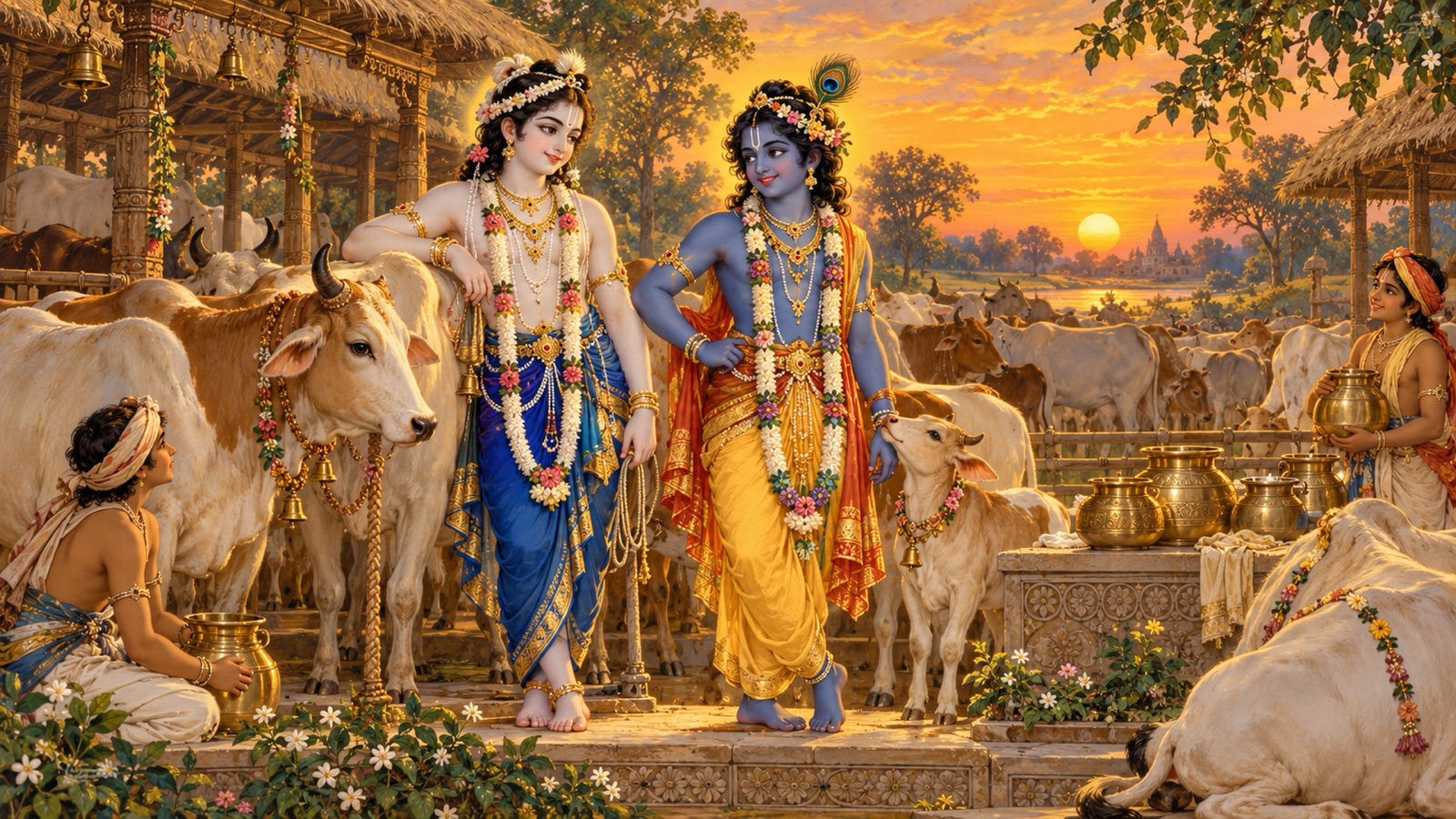
They were still boys, one dark-hued and one fair, long-armed and lovely of face, the dwelling places of grace, with the gallant strength of young elephants. Their feet, marked with flag, thunderbolt, goad and lotus, adorned the ground wherever they fell, and Their glances came with smiles full of compassion. Freshly bathed, in spotless garments, fragrant with sandal paste, wearing jewelled necklaces and garlands of forest flowers, They were absorbed in Their charming play. Yet these two boys, Sukadeva tells Parikshit, were the primeval Persons, the cause and the masters of the universe, descended as Balarama and Keshava — a mountain of emerald beside a mountain of silver overlaid with gold, driving the darkness from every quarter.
Prostration and Embrace
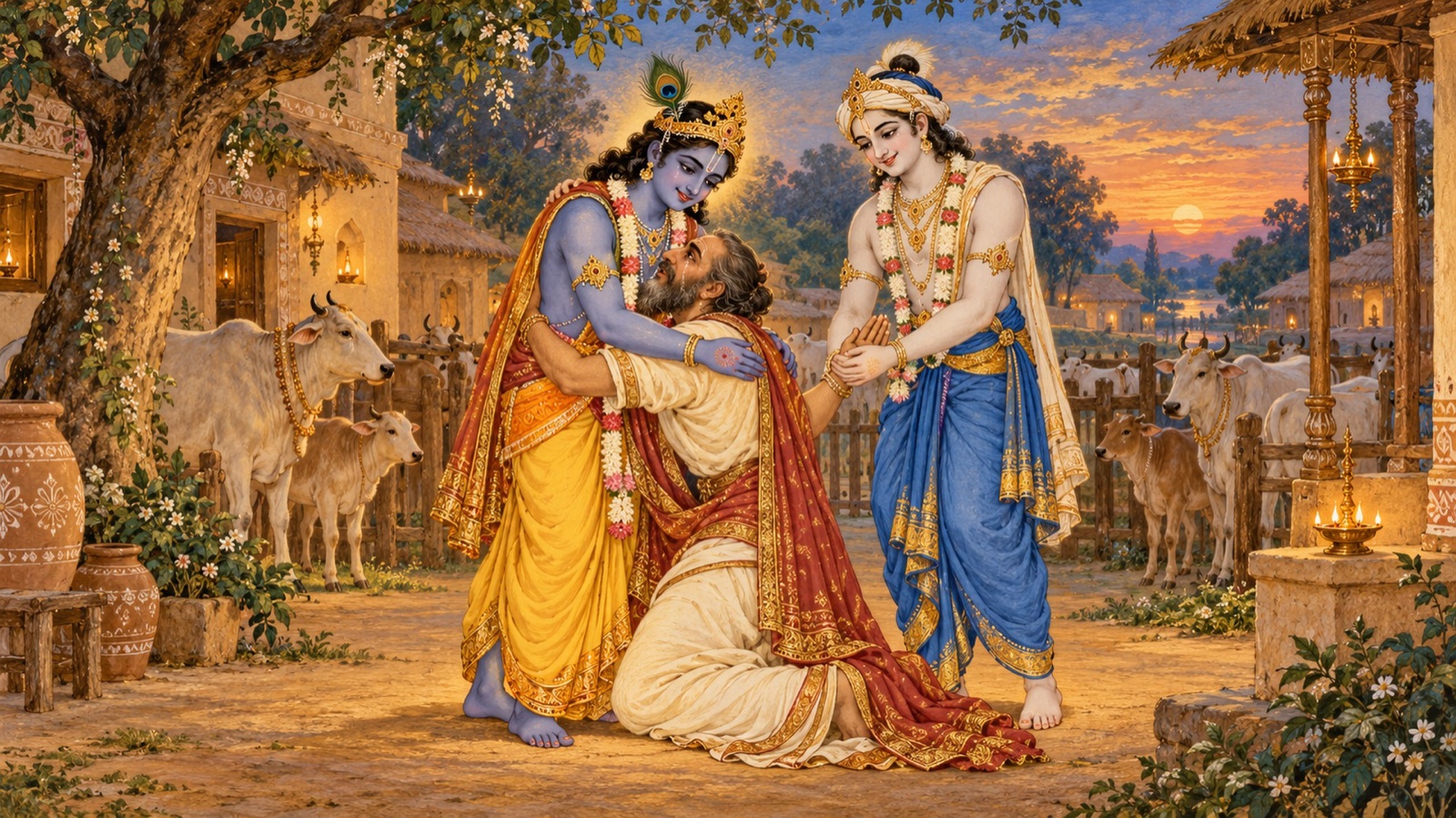
Akrura did not wait. Overwhelmed with affection, he sprang down from the chariot and fell like a staff at the feet of Balarama and Krishna. Tears of joy blinded him, his body bristled, and his throat closed so completely that he could not speak his own name. The Lord, tender towards all who bow before Him, knew him at once, drew him near with the hand that bears the mark of the discus, and embraced him with delight. Then great-hearted Sankarshana embraced the still-bowing guest in His turn, took the joined palms into His own, and led him home with His younger Brother.
Hospitality in the House of Nanda
Indoors, every courtesy of sacred custom was offered him. Balarama enquired after his journey, seated him on an excellent seat, washed his feet in the proper manner, and brought the madhuparka of honey, ghee and curd. A cow was presented, his tired limbs were massaged, and pure food of many fine qualities was set before him with reverence. When the meal was over, Balarama, who knows the highest dharma, gladdened him again with perfumes and garlands.
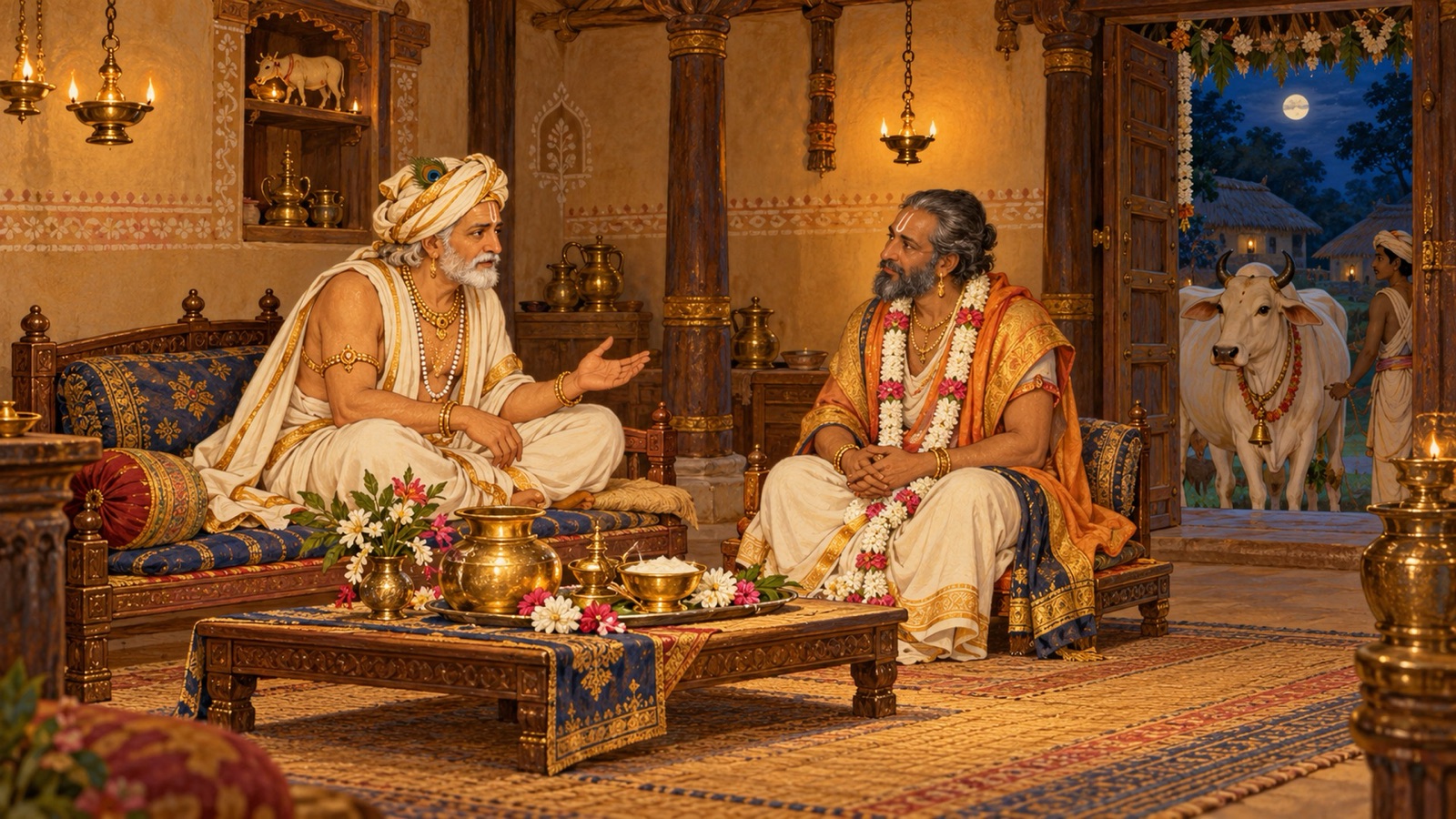
Only then did Nanda speak, and his first words were not of welcome but of anxiety for the Yadus living under Kamsa’s rule.
पप्रच्छ सत्कृतं नन्द: कथं स्थ निरनुग्रहे ।
कंसे जीवति दाशार्ह सौनपाला इवावय: ॥ ४१ ॥
papraccha sat-kṛtaṁ nandaḥ kathaṁ stha niranugrahe kaṁse jīvati dāśārha sauna-pālā ivāvayaḥ
Meaning: Nanda asked the honoured guest: How are you faring, O descendant of Dasharha, while the merciless Kamsa is still alive — like sheep kept in the care of a butcher? (Canto 10, Chapter 38, verse 41)
What safety, Nanda went on, can there be for the subjects of a man who slew the babes of his own wailing cousin, a wretch who lives only to feed himself? Nanda himself had already been asked after his welfare with the same gentle concern; and in that exchange of kindly words the weariness of the road left Akrura altogether.
Principal Teachings of This Chapter
1. The qualification for darshan is longing, not merit. Akrura searches his past for some good deed, austerity or charity that might explain the grace coming towards him, and finds nothing. What he has is a heart that cannot stop thinking of Krishna. Grace is never a wage paid for work done.
2. He is equal to all, and yet never impersonal. Because the Lord favours no one, His response to each soul is exactly proportionate: the heavenly tree withholds nothing, and still gives only into outstretched hands. Devotion is how we draw near to One already everywhere.
3. An unwanted errand can become the door of grace. Akrura blesses the very king whose order sent him down this road, because it is carrying him to the Lord’s feet. Circumstances we did not choose often bring us where our hearts most wished to go.
4. The dust of His feet is the devotee’s treasure. Finding the sacred marks printed in the earth of Vraja, Akrura does not pause to admire; he throws himself down and rolls in them. Reverence that stays dignified is not yet love.
5. Welcoming a guest is itself dharma. Balarama, knower of the highest dharma, washes His guest’s feet, offers madhuparka, gives a cow and serves food Himself. The Lord of the universe teaches hospitality by performing it.
A Devotional Reflection
What moves us most here is how much happens before anything happens. One man rides a chariot down an ordinary road, and we are given the inside of his mind for half a day. He doubts himself, corrects the doubt, remembers the feet he is going to see, and wonders whether his errand will be held against him. He has not yet arrived, and already the journey has become worship. Most of life is spent travelling rather than arriving, in the stretch between hearing of the Lord and beholding Him. Akrura shows what that stretch may be made of: he fills it with remembrance until remembrance itself turns radiant, so that when the footprints appear he cannot keep his feet, and when the Lord appears he cannot speak.
A Daily Devotional Practice
Today, take one ordinary journey — the walk to work, the ride home, the errand you would rather not run — and travel it as Akrura travelled his. Fill the way with the Lord: recall His form, dwell on one pastime you love, and tell Him what you hope to receive. Should doubt rise about your worthiness, answer it as Akrura did, trusting that His mercy is larger than your past. Begin by chanting gently: Om Namo Bhagavate Vasudevaya.
Conclusion
One truth stands above all others here: the Lord, who plays no favourites and holds no grudges, answers each heart exactly as that heart comes to Him. A messenger carrying a tyrant’s summons reaches Vraja at sunset, weeps in the dust of Krishna’s footprints, and is drawn into the arms of both Brothers as an honoured kinsman. Nothing in the errand earned this; everything in the longing invited it. May we learn from Akrura to fill our journeys with remembrance, so that whatever task carries us forward becomes the road to His feet.
May the divine wisdom of Srimad Bhagavatam awaken pure devotion within our hearts.
Om Namo Bhagavate Vasudevaya.
Jay Shree Madhav.
References and Attribution
- Primary edition: Gita Press, Śrīmad Bhāgavata Mahāpurāṇa (English, Complete), Book Ten (First Half), Discourse 38.
- Series: Srimad Bhagavatam Wisdom · Biswa Sanatan Dharma Seva Trust.
- Presented following the spiritual guidance and recommendation of Pandit Dr. Shri Kashinath Mishra.
This is an original, faithful retelling in the writer’s own words, with brief quoted verses shown in Devanāgarī and transliteration and their meanings given as summaries. It is not a reproduction of any single publisher’s continuous translation or commentary. No affiliation with or endorsement by any publisher is implied.
Jay Shree Madhav