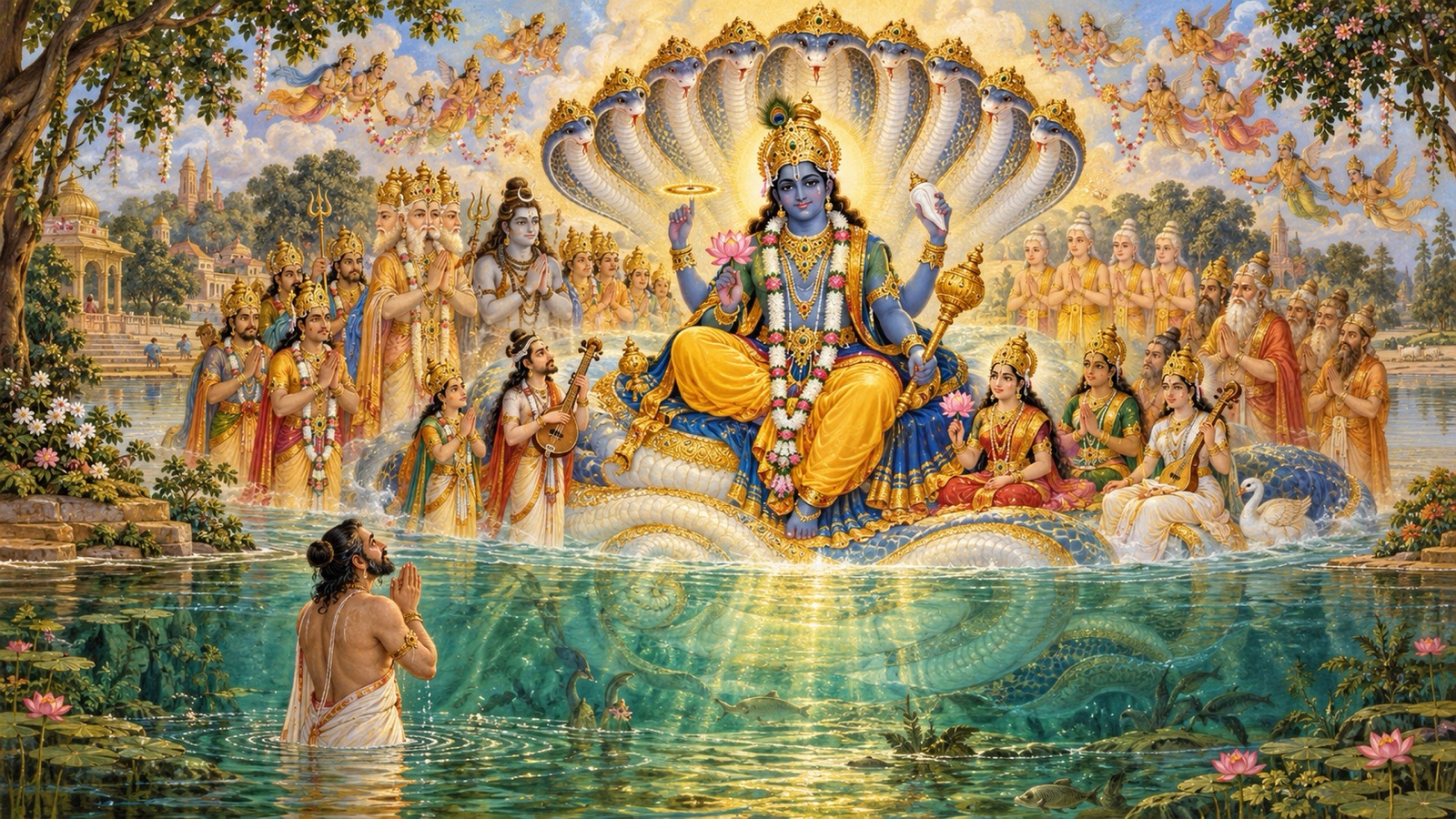
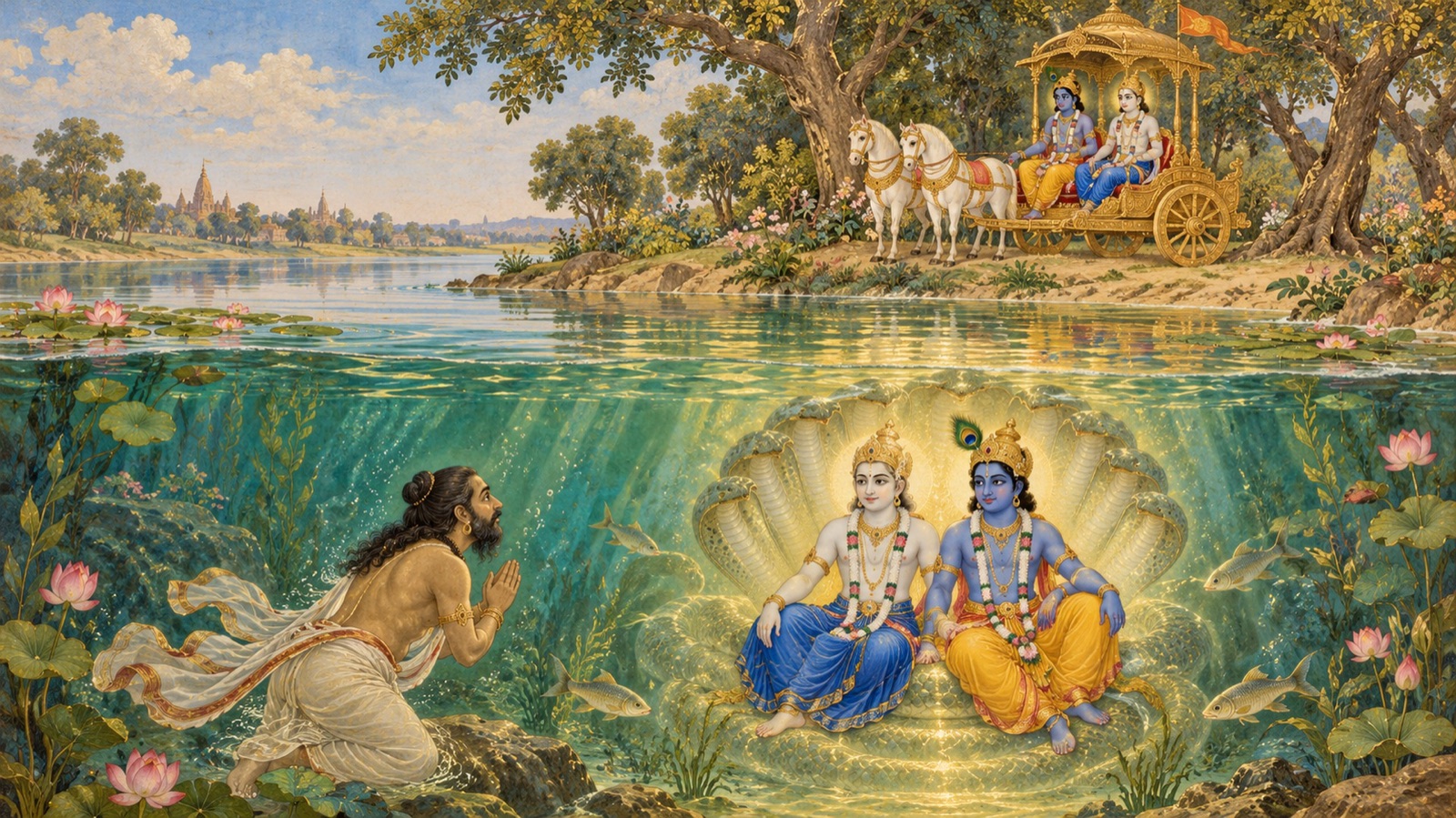
Standing waist-deep in the Kalindi at noon, Akrura closes his eyes upon a familiar prayer and opens them upon the Lord of all the worlds, serene upon the coils of thousand-hooded Ananta.
Om Namo Bhagavate Vasudevaya.
Om Namo Bhagavate Vasudevaya.
Om Namo Bhagavate Vasudevaya.
Welcome back to Srimad Bhagavatam Wisdom, our devotional journey through the sacred histories and teachings of the Srimad Bhagavat Mahapurana. The thirty-ninth chapter of the Tenth Canto carries us from Vraja to the bank of the Kalindi, telling how Nanda bade the cowherds make ready for Mathura, how the women of Vraja passed a sleepless night of grief, and how the devotee who drove the chariot away at sunrise was given, at midday in the river, a sight no king’s errand could purchase.
Chapter Information
- Scripture: Śrīmad Bhāgavata Mahāpurāṇa
- Canto: 10 (Book Ten, First Half)
- Chapter: 39 (Discourse 39)
- Chapter title: Akrura’s Vision
- Principal speaker: Sukadeva Gosvami (narrating to King Parikshit)
- Principal listener: King Parikshit
- Main setting: Vraja, the road to Mathura, and the pool of the Kalindi (Yamuna)
- Central subject: Vraja’s grief at the departure, and Akrura’s vision of the Lord upon Ananta Shesha
- Principal verse range: Canto 10, Chapter 39, verses 1–57
- Primary edition: Gita Press Śrīmad Bhāgavata Mahāpurāṇa
Context From the Previous Chapter
Sent by Kamsa to fetch the two brothers, Akrura had travelled from Mathura meditating all the way upon the joy of beholding Krishna. Reaching Gokula at evening, he fell at their feet, and Nanda welcomed him warmly.
Krishna’s Welcome and Akrura’s Errand
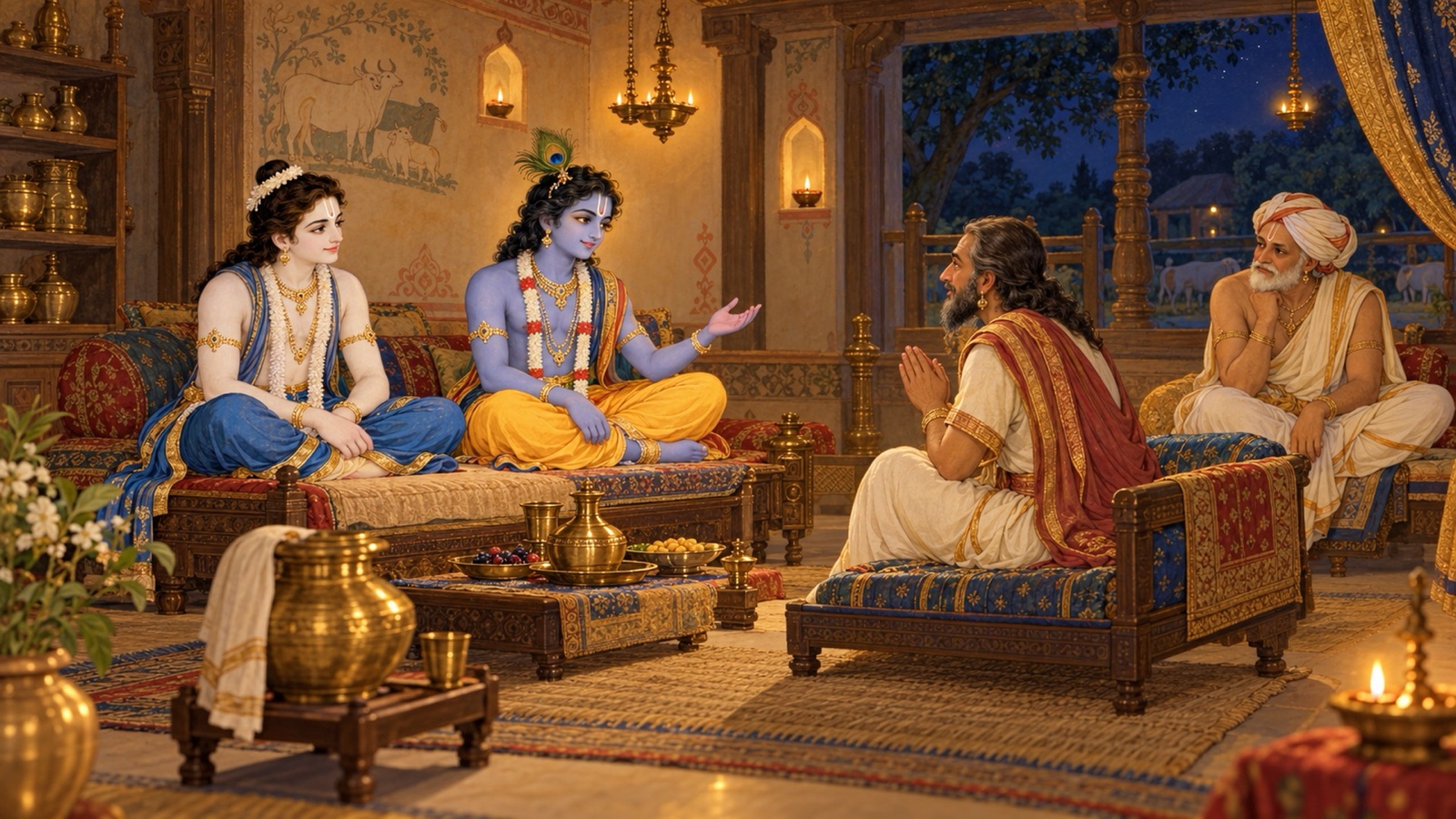
Seated at ease upon a couch and greatly honoured by Balarama and Krishna, Akrura found every hope he had cherished along the road fulfilled in one evening. Sukadeva tells King Parikshit what that means.
किमलभ्यं भगवति प्रसन्ने श्रीनिकेतने ।
तथापि तत्परा राजन्न हि वाञ्छन्ति किञ्चन ॥ २ ॥
kim alabhyaṁ bhagavati prasanne śrī-niketane tathāpi tat-parā rājan na hi vāñchanti kiñcana
Meaning: What is unattainable when the Lord, the abode of Sri, is pleased? And yet, O King, those who are devoted to Him alone desire nothing whatever. (Canto 10, Chapter 39, verse 2)
When the evening meal was over, Krishna, the son of Devaki, asked His guest how Kamsa was behaving toward their kinsmen and what further mischief he intended. With a nephew’s courtesy He hoped His uncle had travelled safely and that no harm had come to his people — yet while Kamsa thrives, who bears the name of maternal uncle and is a pestilence to our family, what use is such asking? Great has been the suffering of our noble parents for our sake: because of us their other sons were killed and they themselves accepted bondage. Today the long-desired sight of a kinsman is granted to us in you; now let the purpose of your coming be told.
Akrura then related everything — Kamsa’s settled enmity toward the Yadus, his attempt upon the life of Vasudeva, the mission on which he had been sent, and what Narada had disclosed to the king about the Lord’s birth from Anakadundubhi. The two brothers laughed heartily to hear it, and told Nanda what Kamsa had commanded.
Nanda’s Proclamation and the Sleepless Night of Vraja
Nanda at once instructed the cowherds: gather the yield of the cows, take presents along, make the bullock-carts ready. Tomorrow we go to Mathura, he said, to offer the king our milk and curds and ghee and to see the great festival of the bow-sacrifice, for the whole kingdom is going. His watchman proclaimed it through every quarter of Vraja.
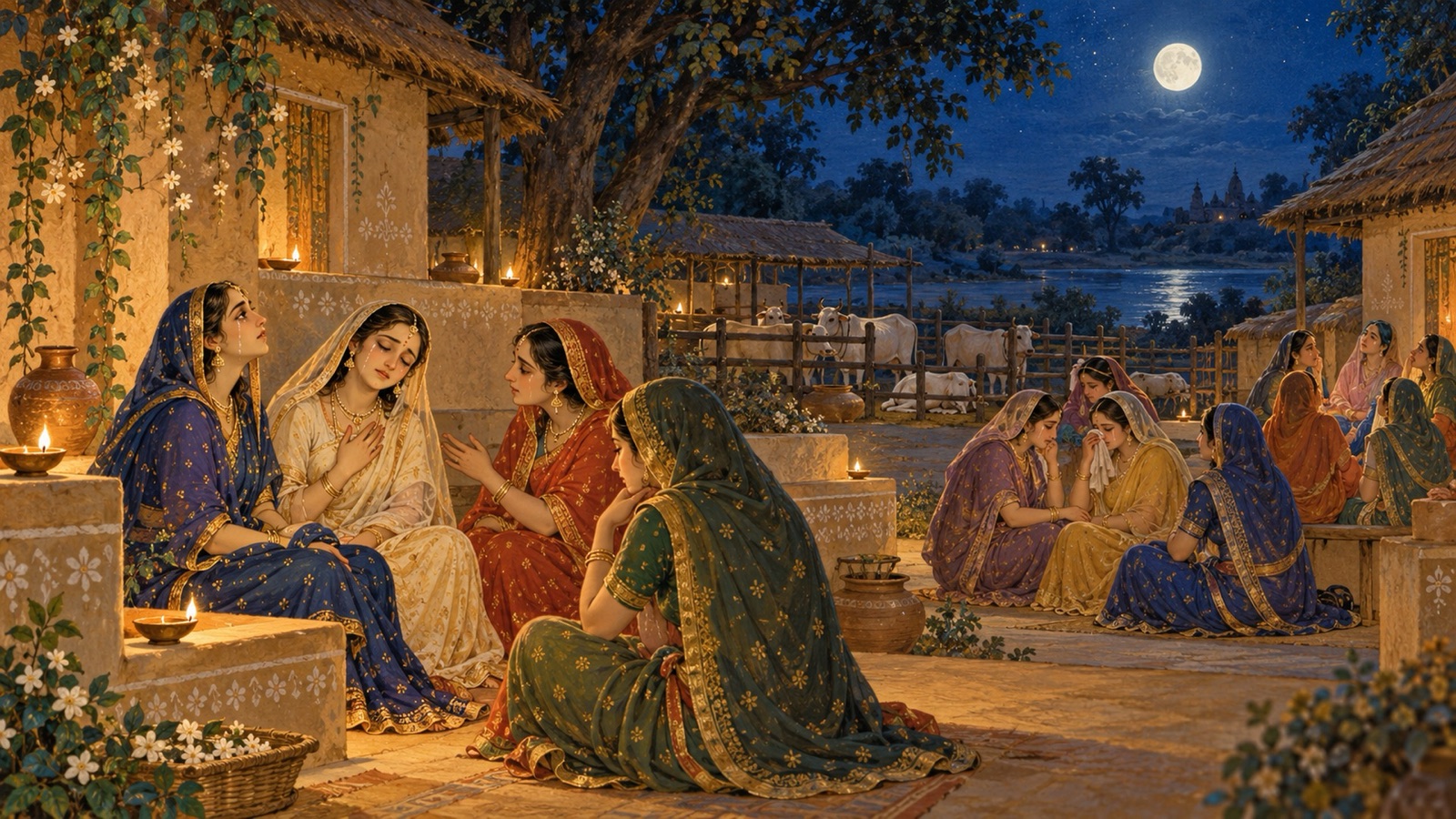
To the cowherd women that announcement fell like a blow. Hearing that Akrura had come to carry Rama and Krishna away, they were stricken to the heart. The beauty of some faded under the hot breath of their anguish; from others the scarves slipped, the bangles loosened, the braids came undone. Others, every sense withdrawn by unbroken meditation upon Him, no longer knew this world at all, as though they had passed into the realm of the spirit. Still others swooned as they remembered His words, uttered with smiles of love that touched the chords of their hearts. Recalling His graceful movements, His glances, His jests that drove away sorrow and His marvellous deeds, they gathered in little groups and talked the whole night with tears upon their faces.
The Lament of the Women of Vraja
गोप्य ऊचुः
अहो विधातस्तव न क्वचिद् दया संयोज्य मैत्र्या प्रणयेन देहिन: ।
तांश्चाकृतार्थान् वियुनङ्क्ष्यपार्थकं विक्रीडितं तेऽर्भकचेष्टितं यथा ॥ १९ ॥
aho vidhātas tava na kvacid dayā saṁyojya maitryā praṇayena dehinaḥ tāṁś cākṛtārthān viyunaṅkṣy apārthakaṁ vikrīḍitaṁ te ‘rbhaka-ceṣṭitaṁ yathā
Meaning: The gopis said: Alas, O Creator, there is no compassion in you anywhere, for having joined embodied beings together in friendship and affection, you part them while their hearts are still unfulfilled. Your doings are as purposeless as the play of a child. (Canto 10, Chapter 39, verse 19)
You once showed us the face of Mukunda, they went on — lovely cheeks, dark curling locks, a smile that dispels all grief — and now you screen it from our sight; this deed is far from good. Under the name Akrura, ‘the one who is not cruel’, you take away like an ignorant man the very eye you gave us, with which we beheld all your skill gathered into a single limb of Krishna.
Then their sorrow turned upon their beloved and upon themselves. He whose friendship lasts but a moment does not even look at us, they said — at us who left homes and kinsmen, sons and husbands to serve Him. Happy will the dawn be for the ladies of Mathura, who will gaze their fill on His face of nectarean smiles as He fearlessly enters their city; today the Dasarhas, Bhojas, Andhakas, Vrishnis and Satvatas, and all who see Him on the road, keep festival. How then shall He return to rustic women like us? One so hard-hearted should never have been called Akrura, they cried, who carries One dearer than life beyond the familiar path without a word of comfort. He sits already in the chariot, the cowherds urge haste, the elders look on unconcerned, and fate works against us. Let us go and gently stop Him. How shall we cross this separation — we with whom whole nights passed like an instant in the assembly of the Rasa — or live without Him who entered Vraja at dusk with Balarama and the cowherd boys, playing His flute, His curls grey with the dust of the cows’ hooves?
The Chariot Leaves for Mathura
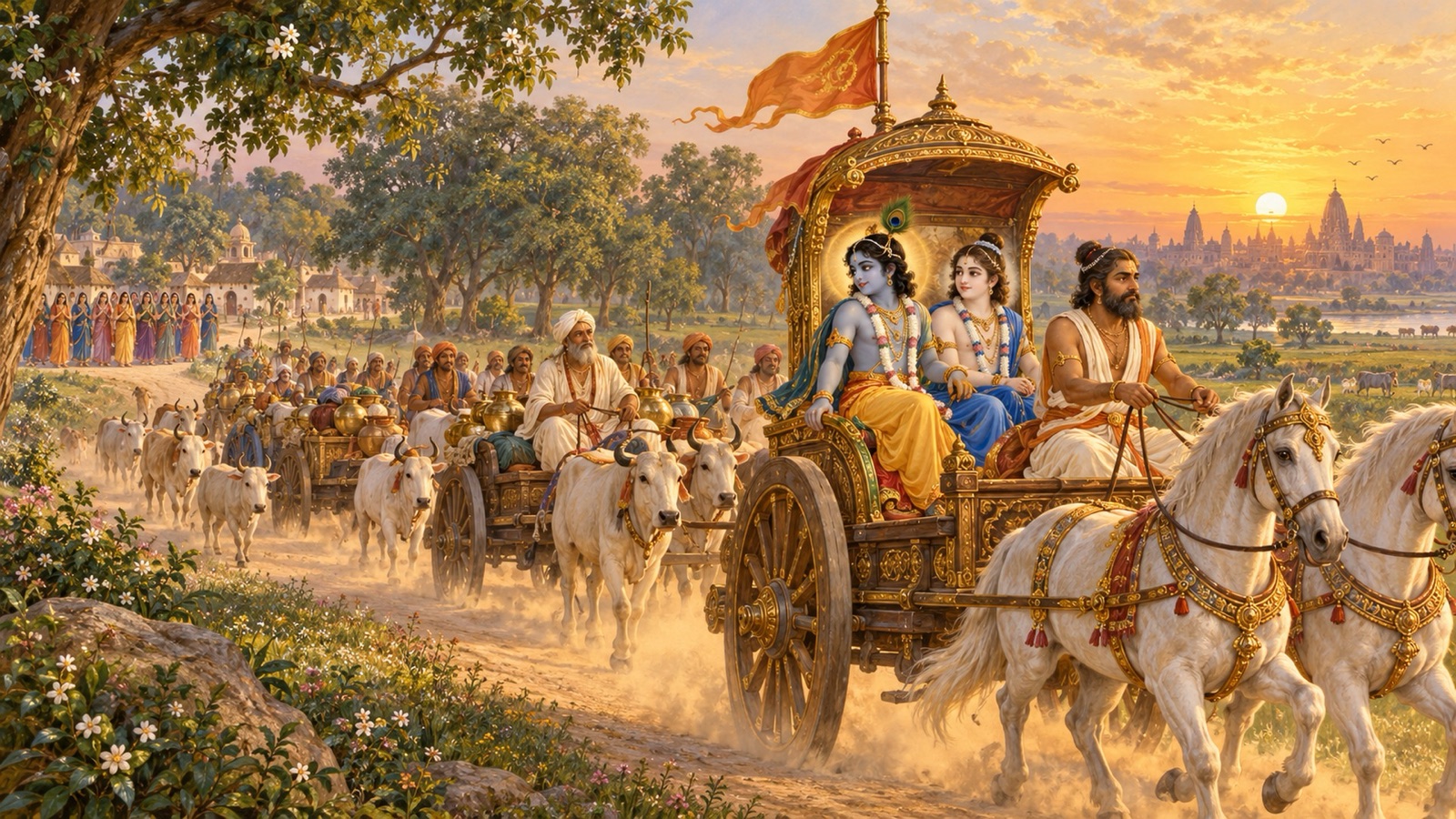
Speaking so and casting off all bashfulness, the women of Vraja wept aloud, crying ‘O protector of the cows! O Krishna! O Madhava!’ But the sun had risen, and Akrura, his morning devotions finished, drove his chariot out upon the Mathura road even while they wailed. Nanda and the cowherds followed in their carts with gifts and pitchers of milk and curds and ghee, and the gopis followed their beloved a little way, then stood still, waiting for some word from Him.
तास्तथा तप्यतीर्वीक्ष्य स्वप्रस्थाने यदूत्तम: ।
सान्त्वयामास सप्रेमैरायास्य इति दौत्यकै: ॥ ३५ ॥
tās tathā tapyatīr vīkṣya sva-prasthāne yadūttamaḥ sāntvayām āsa sa-premair āyāsya iti dautyakaiḥ
Meaning: Seeing them burning thus with grief at His setting out, the best of the Yadus consoled them through a messenger with loving words: ‘I shall come.’ (Canto 10, Chapter 39, verse 35)
So long as the chariot’s flag and its dust could be seen, they stood where they were, their minds sent on ahead, motionless as figures in a painting. Then, hopeless of Govinda’s return, they turned back; and comforted by His promise, they passed their days and nights singing of the deeds of their beloved Lord.
At the Kalindi
The chariot, swift as the wind, brought the Lord with Balarama and Akrura to the bank of the Kalindi, whose water washes away sin. Krishna washed His hands and feet there and drank of its sweet water, green as an emerald; then He walked to the cluster of trees where the chariot stood and took His seat again beside Balarama. Akrura settled the brothers there, took His leave, and went down to the pool of the Yamuna known as Ananta-tirtha for his midday ablutions with the prescribed rites.
निमज्ज्य तस्मिन् सलिले जपन् ब्रह्म सनातनम् ।
तावेव ददृशेऽक्रूरो रामकृष्णौ समन्वितौ ॥ ४१ ॥
nimajjya tasmin salile japan brahma sanātanam tāv eva dadṛśe ‘krūro rāma-kṛṣṇau samanvitau
Meaning: Plunging into that water and softly chanting the eternal Veda, the Gayatri, Akrura beheld those very two, Balarama and Krishna, seated there together. (Canto 10, Chapter 39, verse 41)
How can these two sons of Anakadundubhi, seated in the chariot, be here, he asked himself. He rose from the water and saw Them in the chariot exactly as before; then, wondering whether what he had seen below was false, he plunged in again.
The Lord upon Ananta Shesha
This time what met his eyes was greater still: the thousand-headed lord of serpents, praised with bowed necks by Siddhas, Charanas, Gandharvas and Asuras — a thousand hoods crowned with diadems, clad in blue, white as a lotus fibre, resting like silver Kailasa. Upon his coils he beheld the Supreme Person.
तस्योत्सङ्गे घनश्यामं पीतकौशेयवाससम् ।
पुरुषं चतुर्भुजं शान्तं पद्मपत्रारुणेक्षणम् ॥ ४६ ॥
tasyotsaṅge ghana-śyāmaṁ pīta-kauśeya-vāsasam puruṣaṁ catur-bhujaṁ śāntaṁ padma-patrāruṇekṣaṇam
Meaning: Upon the coils of that serpent he saw the Supreme Person, dark as a rain-cloud, clad in yellow silk, four-armed and tranquil, His eyes reddish like the petals of a lotus. (Canto 10, Chapter 39, verse 46)
Limb by limb Akrura drank in that beauty — the smiling gracious face, the long rounded arms, the breast that is the dwelling of Sri, the lotus feet radiant with the glow of their nails. The Lord shone with crown, armlets, bracelets, girdle, sacred thread, necklaces, earrings and anklets of priceless gems; He held the lotus, conch, discus and mace; the white curl of hair and the Kaustubha gem were at His breast, and a garland of woodland flowers hung upon Him. Sunanda, Nanda and His attendants glorified Him; Sanaka and his brothers stood behind Him, Brahma and Shiva with the chiefs of the gods at His right, the nine brahmanas led by Marichi at His left, Prahlada, Narada and the Vasu Uparichara before Him; and Sri, Pushti, Saraswati, Kanti, Kirti, Tushti, Ila, Urja, Vidya, Avidya, Shakti and Maya waited upon Him in living forms.
Akrura Bows and Begins to Praise
विलोक्य सुभृशं प्रीतो भक्त्या परमया युत: ।
हृष्यत्तनूरुहो भावपरिक्लिन्नात्मलोचन: ॥ ५६ ॥
गिरा गद्गदयास्तौषीत् सत्त्वमालम्ब्य सात्वत: ।
प्रणम्य मूर्ध्नावहित: कृताञ्जलिपुट: शनै: ॥ ५७ ॥
vilokya su-bhṛśaṁ prīto bhaktyā paramayā yutaḥ hṛṣyat-tanūruho bhāva- pariklinnātma-locanaḥ girā gadgadayāstauṣīt sattvam ālambya sātvataḥ praṇamya mūrdhnāvahitaḥ kṛtāñjali-puṭaḥ śanaiḥ
Meaning: Beholding Him, exceedingly delighted and filled with supreme devotion, the hair of his body standing on end and his eyes and mind moistened with loving emotion, Akrura of the Satvata clan gathered his composure, bowed his head low, joined his palms, and with a voice choked with feeling began slowly to offer praise. (Canto 10, Chapter 39, verses 56–57)
So the hymn began — haltingly, from a heart that had received far more than it had come for.
Principal Teachings of This Chapter
1. The pleased Lord withholds nothing, and His devotee asks for nothing. When the Lord, the abode of Sri, is satisfied, nothing remains beyond reach — yet those who are exclusively His desire nothing at all. Akrura received in one evening everything he had hoped for, and sought none of it.
2. Love proves itself in separation, and one word from the Lord is enough. The gopis reproach the Creator, the messenger, even their beloved; every reproach confesses that they cannot live apart from Him. He sends back no gift and no explanation, only the promise that He will come — and that one word turns mourners into singers.
3. The Lord of the chariot is the Lord of Ananta. At the very hour when Krishna seems no more than a traveller on the Mathura road, the river opens and shows Akrura those same two brothers upon the coils of the serpent of eternity — four-armed, worshipped by Brahma and Shiva, by Sanaka and Prahlada and Narada. Nothing has changed except Akrura’s eyes. The darshan is given precisely at the moment of departure, so that the devotee may know that the Darling of Nanda seated in a chariot and the Supreme Person reclining upon Ananta are one, and that such a Lord never truly goes away.
4. Daily discipline is the doorway. This revelation comes not in a shrine but in the middle of an ordinary midday bath, as Akrura murmurs the eternal mantra in midstream. Worship kept up with faith is where the Lord chooses to disclose Himself.
A Devotional Reflection
There are two kinds of seeing here, and both are born of love. The women of Vraja watch a chariot until its banner and even its dust have vanished, then stand upon the road like figures painted on a wall, beholding nothing and beholding only Him. Akrura steps into a river to say his prayers and finds there the Lord of all the worlds, attended by gods and sages. One is loss and the other revelation, yet at bottom they are the same: the heart has gone so entirely to Krishna that the eyes can do nothing but follow. We imagine that darshan means going somewhere — the right shrine, the right hour. Akrura corrects us gently: he was on duty for a tyrant, in the middle of an ordinary journey, when the water opened for him.
A Daily Devotional Practice
Today, take one act of worship you already perform — your bath, your lamp, your few quiet minutes of japa — and do it slowly, knowing the Lord is present in it. Remember Akrura standing in midstream in the Kalindi, and that the One who seemed seated far away was there in the water all the while. Then offer this prayer with folded palms: Om Namo Bhagavate Vasudevaya.
Conclusion
This discourse turns a parting into a darshan. Vraja wakes to the news that its two boys are to be taken away; its women pass a night of tears and a morning of stillness upon the road; and the man who drives the chariot away carries a devotion the king who sent him never suspected. At midday, in a bend of the Yamuna, that devotion is answered — not with a boon, but with the Lord Himself upon the thousand hoods of Ananta. May we keep our daily worship with such faith that the ordinary water of our lives begins to show us His form.
May the divine wisdom of Srimad Bhagavatam awaken pure devotion within our hearts.
Om Namo Bhagavate Vasudevaya.
Jay Shree Madhav.
References and Attribution
- Primary edition: Gita Press, Śrīmad Bhāgavata Mahāpurāṇa (English), Book Ten (First Half), Discourse 39.
- Series: Srimad Bhagavatam Wisdom · Biswa Sanatan Dharma Seva Trust.
- Presented following the spiritual guidance and recommendation of Pandit Dr. Shri Kashinath Mishra.
This is an original, faithful retelling in the writer’s own words, with brief quoted verses shown in Devanāgarī and transliteration and their meanings given as summaries. It is not a reproduction of any single publisher’s continuous translation or commentary. No affiliation with or endorsement by any publisher is implied.
Jay Shree Madhav