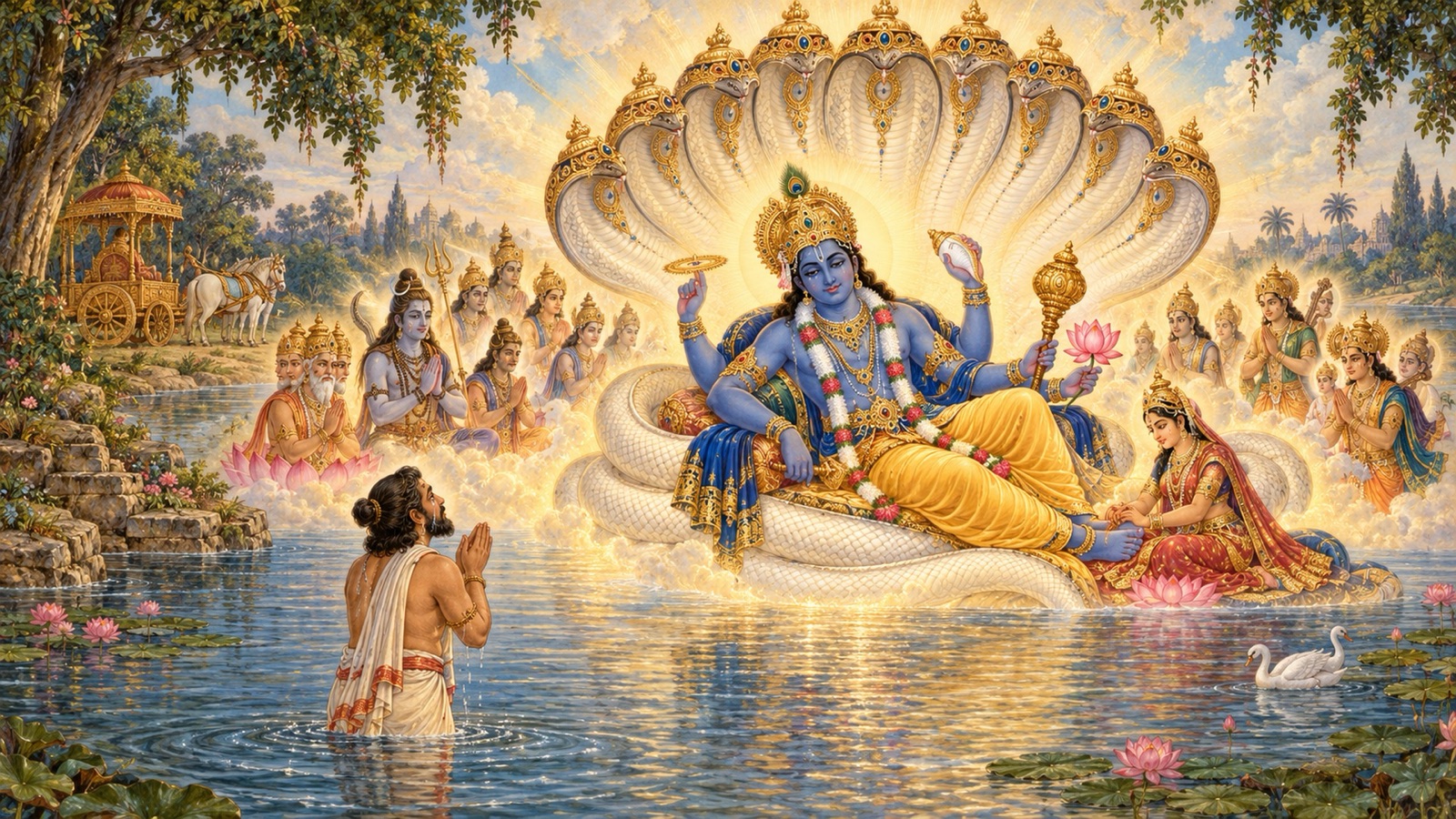
Standing in the waters of the Kalindi with joined palms, Akrura pours out a hymn that begins at the root of creation and ends at the feet of the Lord.
Om Namo Bhagavate Vasudevaya.
Om Namo Bhagavate Vasudevaya.
Om Namo Bhagavate Vasudevaya.
Welcome back to Srimad Bhagavatam Wisdom, our devotional journey through the sacred histories and teachings of the Srimad Bhagavat Mahapurana. The fortieth chapter of the Tenth Canto is unlike those on either side of it: no demon is faced here. One devotee stands in a river and speaks, and his words become one of the great hymns of the Bhagavata — the praise enormous, the confession unsparing, the end a plea for shelter.
Chapter Information
- Scripture: Śrīmad Bhāgavata Mahāpurāṇa
- Canto: 10 (Book Ten, First Half)
- Chapter: 40 (Discourse 40)
- Chapter title: The Prayers of Akrura
- Principal speaker: Akrura (within Sukadeva Gosvami’s narration)
- Principal listener: The Supreme Lord, revealed to Akrura within the water (narrated to King Parikshit)
- Main setting: The sacred pool of the Kalindi (Yamuna), on the road to Mathura
- Central subject: Akrura’s eulogy — the cause of all causes, the goal of every path of worship, and the one refuge of a helpless heart
- Principal verse range: Canto 10, Chapter 40, verses 1–30
- Primary edition: Gita Press Śrīmad Bhāgavata Mahāpurāṇa (English, complete edition), Book Ten
Context From the Previous Chapter
Carrying Krishna and Balarama toward Mathura, Akrura halted at noon beside the Kalindi and went down into the pool for his midday devotions. Plunging in and reciting the Gayatri, he saw both Brothers in the water; and then, upon the coils of Shesha, the four-armed Lord Himself, worshipped on every side. Overwhelmed, with joined palms, he began to speak.
The Cause of All Causes
Akrura’s first word is not a request but a bow. He addresses the Lord before him as Narayana, the primeval Person who never wears away, the cause behind every cause — the One from whose navel-lotus Brahma appeared, and from whom this world came forth.
अक्रूर उवाच
नतोऽस्म्यहं त्वाखिलहेतुहेतुं नारायणं पूरुषमाद्यमव्ययम् ।
यन्नाभिजातादरविन्दकोषाद् ब्रह्माविरासीद् यत एष लोक: ॥ १ ॥
akrūra uvāca nato ‘smy ahaṁ tvākhila-hetu-hetuṁ nārāyaṇaṁ pūruṣam ādyam avyayam yan-nābhi-jātād aravinda-koṣād brahmāvirāsīd yata eṣa lokaḥ
Meaning: Akrura prayed: I bow to You, Narayana, the primeval and imperishable Person, the cause behind every cause, from the lotus-cup born of whose navel Brahma arose, and from whom this entire world has come into being. (Canto 10, Chapter 40, verse 1)
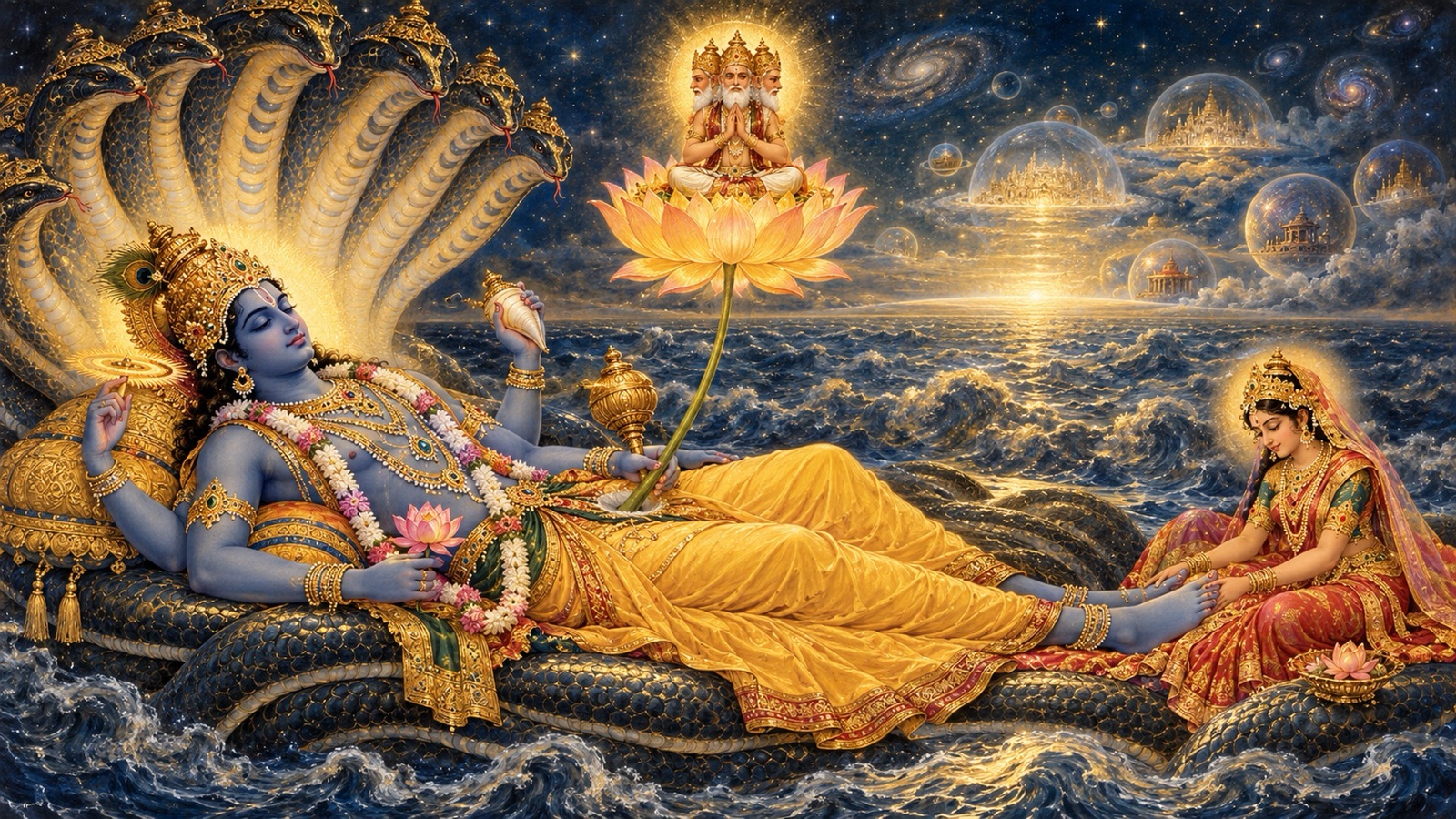
From that beginning he gathers up everything the universe is built of and sets it inside the Lord: earth, water, fire, air and ether, and the ego-principle from which the elements arise; cosmic intelligence; primordial matter and the Spirit beyond it; the mind, the senses, their objects, and the deities who preside over them. None of these stands on its own strength; all have issued from the Lord’s Person and are as limbs to Him. And then Akrura says the thing that keeps his hymn honest. These evolved causes cannot know His essential nature, for they are matter and He is Spirit; and even Brahma, tied to the three modes, does not know the reality beyond them.
Every Path of Worship Reaches Him
Having laid creation at the Lord’s feet, Akrura turns to the ways men seek Him. Saintly yogis worship Him directly as the Supreme Person and Ruler, dwelling in the limbs of the body, informing all material forms, and presiding over the gods. Brahmanas given to sacrifice worship that same Lord through the rites of the three Vedas, under the many names of the celestials. Men of wisdom who have renounced action and come to inner stillness worship Him as the embodiment of knowledge, through the sacrifice of spiritual understanding. Others, consecrated by initiation and absorbed in Him, adore Him in many forms or in one, by the procedure He Himself has taught.
The devotees of Shiva worship Him as Shiva, along the path Shiva has shown, with the variations their teachers have introduced. And even those attached to lesser deities, who look upon them as other than Him, worship Him alone, for He is the almighty Lord in whom all the gods abide. Then Akrura gives this sweeping thought a picture a child could carry.
यथाद्रिप्रभवा नद्य: पर्जन्यापूरिता: प्रभो ।
विशन्ति सर्वत: सिन्धुं तद्वत्त्वां गतयोऽन्तत: ॥ १० ॥
yathādri-prabhavā nadyaḥ parjanyāpūritāḥ prabho viśanti sarvataḥ sindhuṁ tadvat tvāṁ gatayo ‘ntataḥ
Meaning: As rivers that rise in the mountains and are swelled by the rain enter the ocean from every side, O Lord, so do all paths at last come to You alone. (Canto 10, Chapter 40, verse 10)

The Modes, the Witness, and the Worlds Within Him
Goodness, passion and ignorance, Akrura continues, are the modes of the Lord’s own nature, and every embodied creature — from the motionless tree to Brahma — is strung upon them. To the Lord he offers a salutation of another kind: the One whose gaze is never entangled, the Self of all, the witness of every mind. The flood of the modes, set going by ignorance, sweeps along those who take themselves to be gods, men or beasts; it never touches the Witness.
Then he recalls the vast form in which worshippers meditate upon Him. Fire is His mouth and the earth His feet; the sun His eye, the sky His navel, the quarters His ears; heaven the crown of His head, the gods His arms, the oceans His belly, the wind His breath and strength. Trees and herbs are His body-hair, clouds the locks of His head, the mountains His bones and nails; day and night the closing and opening of His eyes, Brahma His generative power, and rainfall His seed. Within that imperishable Person, Akrura says, all the worlds are set.
त्वय्यव्ययात्मन् पुरुषे प्रकल्पिता लोका: सपाला बहुजीवसङ्कुला: ।
यथा जले सञ्जिहते जलौकसोऽप्युदुम्बरे वा मशका मनोमये ॥ १५ ॥
tvayy avyayātman puruṣe prakalpitā lokāḥ sa-pālā bahu-jīva-saṅkulāḥ yathā jale sañjihate jalaukaso ‘py udumbare vā maśakā mano-maye
Meaning: In You, the imperishable Person who can only be grasped by the mind, the worlds with their guardians and their countless living beings are established — stirring within You as tiny creatures stir in water, or as gnats within an udumbara fruit. (Canto 10, Chapter 40, verse 15)

Salutations to the Lord’s Descents
From that immensity Akrura comes to something nearer. Whatever forms the Lord assumes for His own play, he says, grief is wiped from the hearts of those who remember them, and people sing His glory with delight. One by one, he bows to them.
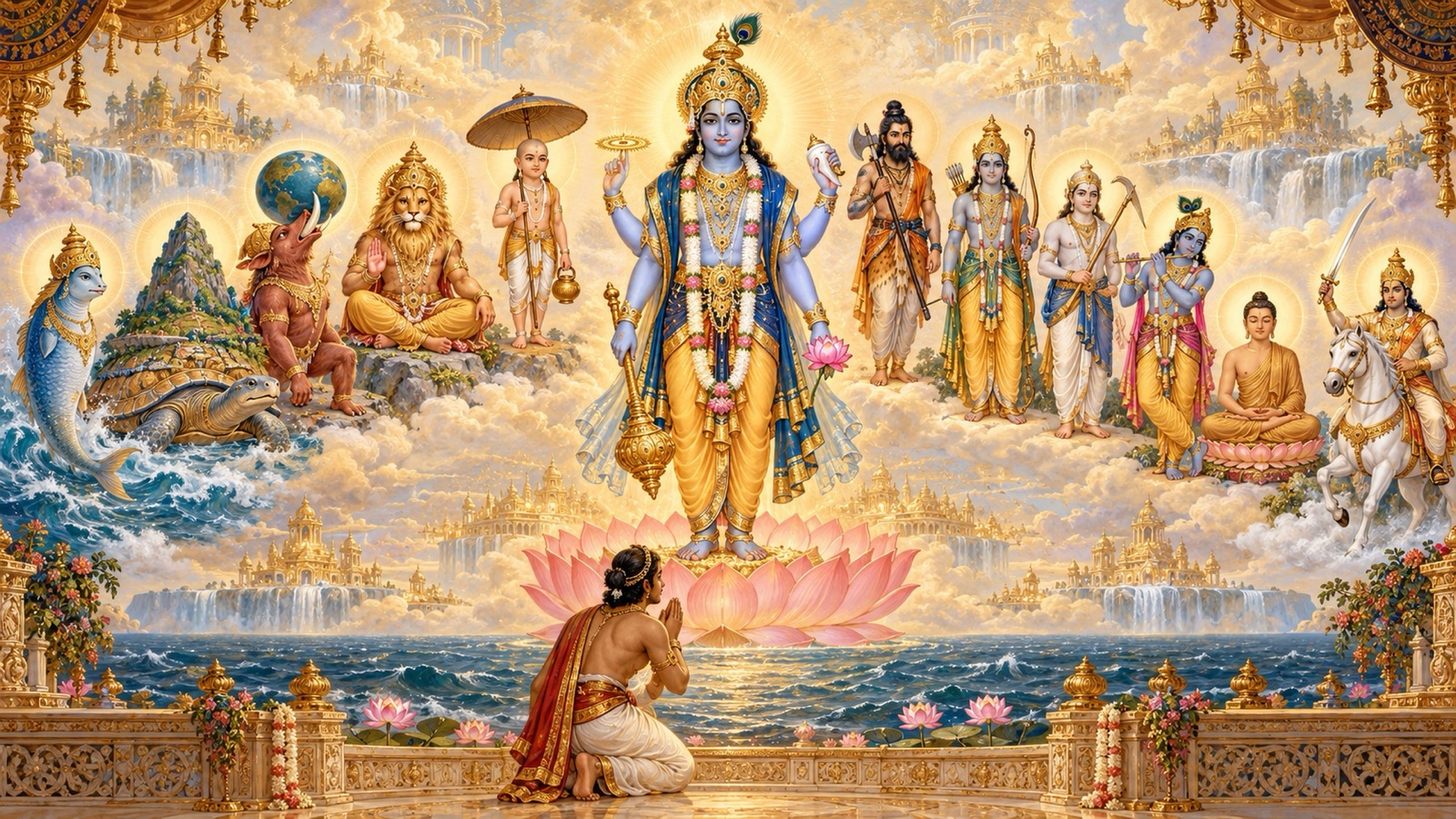
Obeisance to the divine Fish who moved upon the waters of dissolution; obeisance to the horse-necked Hayagriva, who put an end to Madhu and Kaitabha. Obeisance to the vast Tortoise who upheld Mount Mandara; obeisance to the Boar, whose sport was the lifting of the earth. Obeisance to the wondrous Lion-form who takes away the fears of the righteous; obeisance to the Dwarf who covered the three worlds. Obeisance to the lord of the Bhrgus, who cut down the forest of arrogant kshatriyas; obeisance to the best of the Raghus, who ended Ravana’s career. Obeisance to Vasudeva and Sankarshana, to Pradyumna and Aniruddha, protector of the Satvatas. And then Akrura bows to descents not yet come.
नमो बुद्धाय शुद्धाय दैत्यदानवमोहिने ।
म्लेच्छप्रायक्षत्रहन्त्रे नमस्ते कल्किरूपिणे ॥ २२ ॥
namo buddhāya śuddhāya daitya-dānava-mohine mleccha-prāya-kṣatra-hantre namas te kalki-rūpiṇe
Meaning: Obeisance to You as Lord Buddha, the faultless one, who bewildered the Daityas and the Danavas; and obeisance to You in the form of Lord Kalki, who will make an end of rulers fallen to the ways of the Mlecchas. (Canto 10, Chapter 40, verse 22)
What Akrura Says About Himself
Now, standing in that presence, Akrura begins to speak about himself, and nothing he says is flattering. This whole world of living beings, he admits, is bewildered by the Lord’s own power of illusion, clutching at “I” and “mine” where there is nothing solid to hold, and driven round upon the roads of action. He will not place himself outside that crowd: he too wanders among body and children, home and wife, wealth and kinsmen — dreamlike things he takes to be real — a fool, he calls himself, before the almighty Lord. He has had it all the wrong way round, treating what passes as lasting, what is not the self as the self, what is rooted in sorrow as joy; delighting in opposites, wrapped in darkness, he has failed to recognise the One dearest to him.
यथाबुधो जलं हित्वा प्रतिच्छन्नं तदुद्भवै: ।
अभ्येति मृगतृष्णां वै तद्वत्त्वाहं पराङ्मुख: ॥ २६ ॥
yathābudho jalaṁ hitvā praticchannaṁ tad-udbhavaiḥ abhyeti mṛga-tṛṣṇāṁ vai tadvat tvāhaṁ parāṅ-mukhaḥ
Meaning: As a man without understanding leaves behind real water because it is screened by the weeds grown upon it, and runs instead toward a mirage, so have I turned my face away from You. (Canto 10, Chapter 40, verse 26)
Nor will he claim the strength to mend it. His understanding is poor; his mind, spoiled by craving and ceaseless activity, is dragged about by unruly senses, and he cannot hold it still.
Refuge at His Feet
With nothing of his own left to offer, Akrura does the one thing a devotee can always do: he lays hold of the Lord’s feet — and at once refuses any credit for having reached them.
सोऽहं तवाङ्घ्र्युपगतोऽस्म्यसतां दुरापं तच्चाप्यहं भवदनुग्रह ईश मन्ये ।
पुंसो भवेद् यर्हि संसरणापवर्गस्त्वय्यब्जनाभ सदुपासनया मति: स्यात् ॥ २८ ॥
so ‘haṁ tavāṅghry-upagato ‘smy asatāṁ durāpaṁ tac cāpy ahaṁ bhavad-anugraha īśa manye puṁso bhaved yarhi saṁsaraṇāpavargas tvayy abja-nābha sad-upāsanayā matiḥ syāt
Meaning: Such as I am, I have come to Your feet, which the unrighteous can never reach; and even this I consider to be Your grace alone. For when a person’s wandering through birth and death is drawing to its end, then through the service of holy souls his mind turns to You, O Lord from whose navel the lotus springs. (Canto 10, Chapter 40, verse 28)
Two salutations remain. He bows to the Lord as pure consciousness, the source of all knowing, ruler of spirit and primordial matter alike, the Absolute of endless potencies. And he bows to His fourfold manifestation — Vasudeva presiding over the intellect, Sankarshana in whom all beings rest, Pradyumna and Aniruddha over reason and the mind. Then he asks for the only thing he wants.
नमस्ते वासुदेवाय सर्वभूतक्षयाय च ।
हृषीकेश नमस्तुभ्यं प्रपन्नं पाहि मां प्रभो ॥ ३० ॥
namas te vāsudevāya sarva-bhūta-kṣayāya ca hṛṣīkeśa namas tubhyaṁ prapannaṁ pāhi māṁ prabho
Meaning: Obeisance to You, Vasudeva, and to You in whom all created beings have their rest; obeisance to You, Hrishikesha, master of the senses — protect me, O Lord, for I have fallen at Your feet. (Canto 10, Chapter 40, verse 30)
Principal Teachings of This Chapter
1. Nothing in existence stands on its own. The elements, the mind, the senses and even the gods who preside over them are limbs of the one Person. A devotee who sees the world so stops negotiating with its many forces and speaks to their source.
2. The Lord is not reached by the instruments of this world. Matter cannot know Spirit, and even Brahma, bound by the modes, does not touch what lies beyond them. This is not despair but humility: He is known when He reveals Himself, not when we corner Him with our faculties.
3. All worship, however divided, arrives at one Lord. This is the chapter’s heart, and Akrura states it without softening. The yogi meditating within, the brahmana at his fire, the renunciate absorbed in knowledge, the initiate adoring the fourfold form, the follower of Shiva on the path Shiva taught, even the worshipper of a lesser deity who believes he addresses someone else — every one of them, he declares, adores the Supreme Lord alone, for there is no second Lord in whom the gods could abide. Rivers need not know the sea to reach it. What Akrura seeks is not a change of ritual but a change of sight: to worship knowingly the One we were worshipping all along.
4. The Lord’s descents heal our grief. He takes those forms freely, as play, and the sorrow of those who sing of them is wiped clean. Akrura’s roll of salutations is itself such a remembrance, reaching forward even to Kalki, whose descent is still to come.
5. Devotion itself is the Lord’s gift. Akrura does not present his arrival at those feet as an achievement. He calls it grace, and names the means by which grace works: the service of holy souls, when a soul’s long wandering nears its close.
A Devotional Reflection
What moves us here is the direction Akrura’s prayer travels. Granted a vision almost no one receives, he does not use it to describe his own good fortune. He uses it to say what the Lord is — and then, in the same voice, what he himself is: a man who mistakes a dream for a house, who runs toward shimmering sand with a river at his back. Yet it is that second half which makes the prayer true, and only after such honesty do his hands close on the Lord’s feet. There is comfort here for every devotee whose inner life is untidier than his worship. Akrura does not wait to be worthy before taking shelter; he takes shelter because he is not worthy, and calls even that a mercy given rather than a merit earned. Where our weakness is spoken plainly before Him, His grace has already begun its work.
A Daily Devotional Practice
Today, make one prayer in Akrura’s order. First praise: name aloud something of the Lord’s greatness — that He is the source of all that is, or that every path of worship ends in Him. Then be honest: name one attachment you know to be a mirage. Then ask for shelter in the simplest words you have, without bargaining, resting the prayer on His grace and not on your fitness. Close by chanting gently: Om Namo Bhagavate Vasudevaya.
Conclusion
This fortieth chapter of the Tenth Canto gives us a devotee’s whole heart in one hymn. Akrura bows to the cause behind all causes, places the elements and the gods within Him, declares that every stream of worship empties into that one ocean, and salutes His descents from the Fish to Kalki. Then he confesses his own bewilderment, and finds the feet he has reached were given by grace. May we learn from him to praise greatly, to speak truly of ourselves, and to end with the plea that the Lord protect those who fall at His feet.
May the divine wisdom of Srimad Bhagavatam awaken pure devotion within our hearts.
Om Namo Bhagavate Vasudevaya.
Jay Shree Madhav.
References and Attribution
- Primary edition: Gita Press, Śrīmad Bhāgavata Mahāpurāṇa (English, complete edition), Book Ten (First Half), Discourse 40, ‘Akrūra’s eulogy (of the Lord)’.
- Series: Srimad Bhagavatam Wisdom · Biswa Sanatan Dharma Seva Trust.
- Presented following the spiritual guidance and recommendation of Pandit Dr. Shri Kashinath Mishra.
This is an original, faithful retelling in the writer’s own words, with brief quoted verses shown in Devanāgarī and transliteration and their meanings given as summaries. It is not a reproduction of any single publisher’s continuous translation or commentary. No affiliation with or endorsement by any publisher is implied.
Jay Shree Madhav