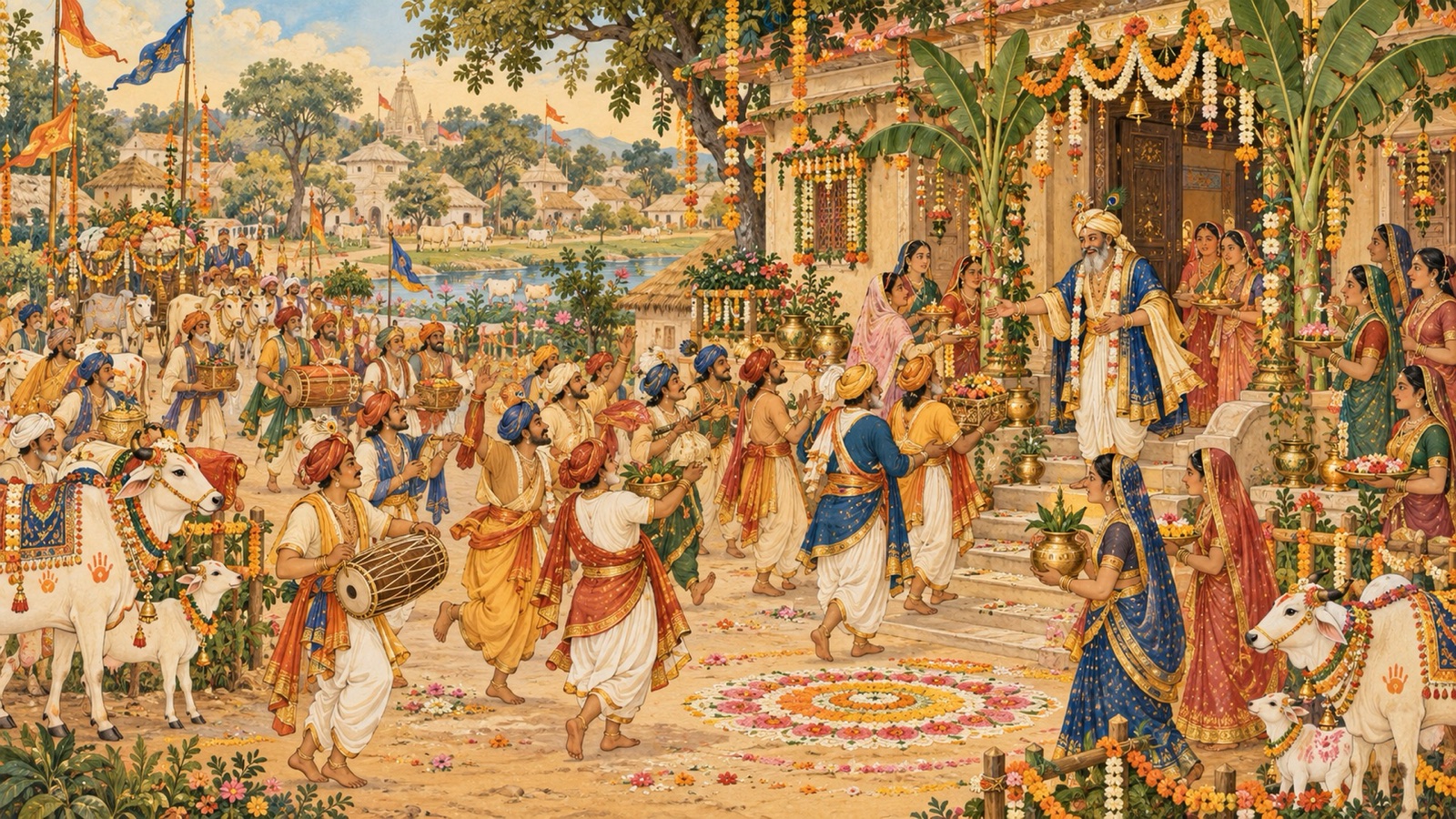
Gokula overflows with joy at the birth of a son to Nanda and Yasoda — cowherds and their wives sing, dance, and shower one another with butter and turmeric, not yet knowing that the Lord of the universe Himself has come to dwell among them.
Om Namo Bhagavate Vasudevaya.
Om Namo Bhagavate Vasudevaya.
Om Namo Bhagavate Vasudevaya.
Welcome back to Srimad Bhagavatam Wisdom, our devotional journey through the sacred histories and teachings of the Srimad Bhagavat Mahapurana. After the darkness of Kamsa’s prison and his cruel resolve, this fifth chapter opens into pure light and rejoicing. In Gokula, the cowherd chief Nanda celebrates the birth of his son with the sacred birth-rites, boundless charity, music, and festivity; the whole village of Vraja is adorned and the cowherd men and women overflow with delight. From that day Nanda’s Vraja becomes the very seat of prosperity, the playground of the Goddess of Fortune, for the Lord of the universe has come to dwell there. Later, when Nanda travels to Mathura to pay his yearly tribute, he is met by his dear friend Vasudeva, and the two share a tender conversation about their sons, the ways of destiny, and the quiet warning that sends Nanda hurrying home.
Chapter Information
- Scripture: Śrīmad Bhāgavata Mahāpurāṇa
- Canto: 10 (Book Ten, First Half)
- Chapter: 5 (Discourse 5)
- Chapter title: The Meeting of Nanda and Vasudeva
- Principal speaker: Sukadeva Gosvami (narrating to King Parikshit); related in turn by Suta Gosvami to the sages at Naimisharanya
- Principal listener: King Parikshit (within Sukadeva’s narration); the sages assembled at Naimisharanya
- Main setting: The cowherd village of Gokula in Vraja; and Nanda’s camp near Mathura
- Central subject: The birth festival of Lord Krishna at Gokula, the prosperity of Vraja, and the meeting of Nanda and Vasudeva
- Principal verse range: Canto 10, Chapter 5, verses 1–32
- Primary edition: Gita Press Śrīmad Bhāgavata Mahāpurāṇa
Context From the Previous Chapter
In Chapter 4 the divine girl slipped from Kamsa’s grasp and rose as an eight-armed goddess, declaring that his destroyer was already born. Struck with remorse, Kamsa freed Vasudeva and Devaki and even taught them of the eternal soul, but his demon counsellors soon turned him back to cruelty, and he loosed a persecution of the righteous. Meanwhile, unknown to Kamsa, the Lord rested safely in Gokula on the bed of Yasoda. This chapter turns fully to the joy of Vraja.
Nanda Performs the Sacred Birth-Rites
Overjoyed that a son had been born to him in his ripe old age, the high-souled Nanda bathed, purified himself, and put on fine adornments. He called in brahmanas well versed in the reading of fortunes, had them recite benedictory hymns, and had the Jatakarma — the sacred birth-ceremony — duly performed for the child, worshipping the forefathers and the gods according to precept.
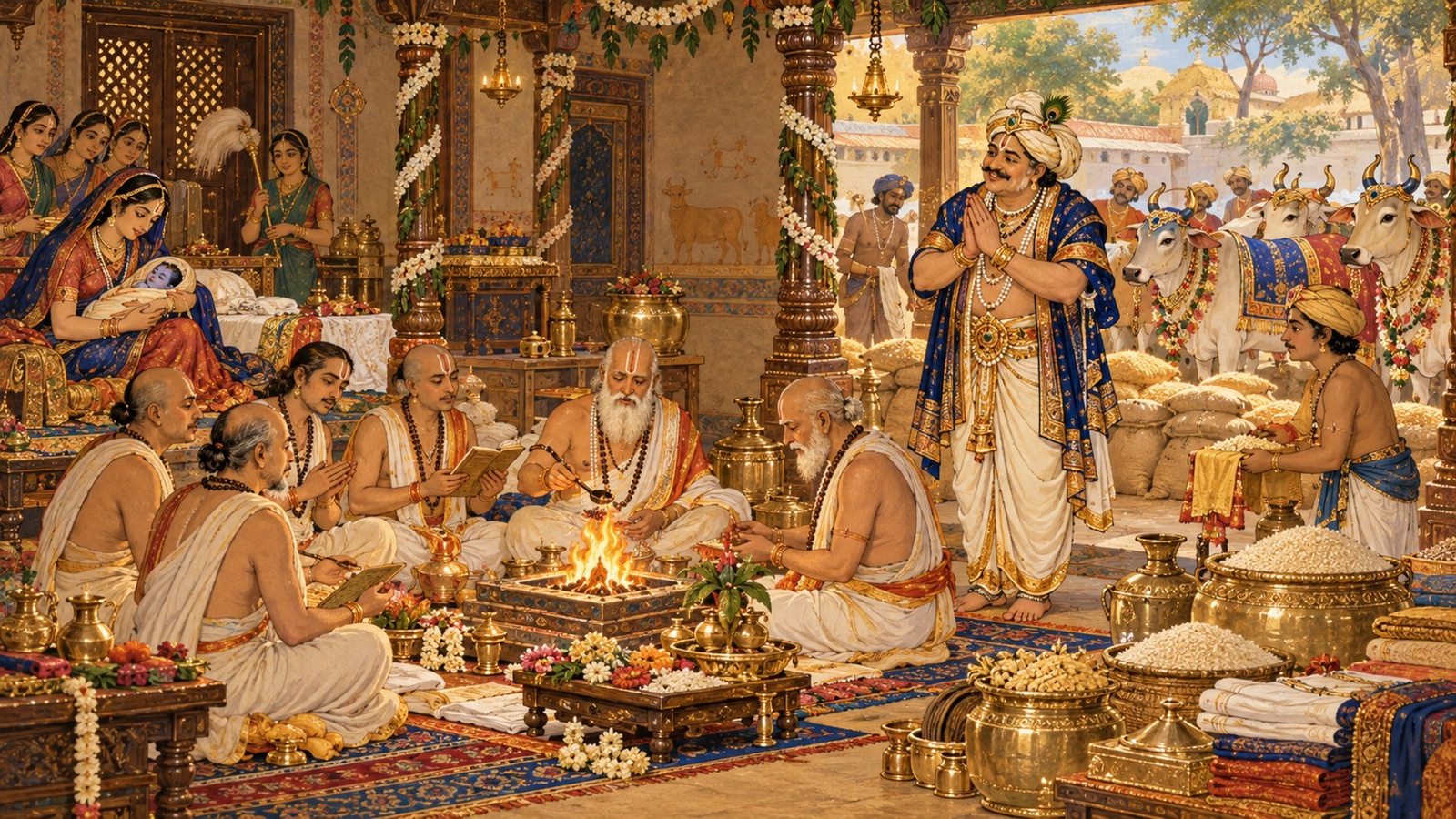
In his gratitude Nanda gave away to the brahmanas two hundred thousand richly adorned, newly calved cows, and seven mountain-like heaps of sesamum studded with precious stones and covered with cloth of gold. Sukadeva pauses here to teach a quiet truth about all such purification.
कालेन स्नानशौचाभ्यां संस्कारैस्तपसेज्यया । शुध्यन्ति दानै: सन्तुष्टया द्रव्याण्यात्मात्मविद्यया ॥ ४ ॥
kālena snāna-śaucābhyāṁ saṁskārais tapasejyayā śudhyanti dānaiḥ santuṣṭyā dravyāṇy ātmātma-vidyayā
Meaning: Material things are purified in due course by time, by bathing and cleansing, by sacraments, austerity, sacrifice, charity, and contentment; but the self is purified only through knowledge of the self. (Canto 10, Chapter 5, verse 4)
Brahmanas, bards, and minstrels uttered their blessings, singers sang, and kettledrums and great drums resounded again and again.
The Whole of Vraja Rejoices
The village made ready for the festival. Its doorways, courtyards, and houses were swept clean and sprinkled with water, decked with many-coloured flags and buntings and with arches of wreaths, cloth, and leaves. The cows, bulls, and grown calves were daubed with turmeric-mixed oil, painted with coloured minerals, and adorned with peacock plumes, garlands, cloth, and golden chains. The cowherds, dressed in costly garments and turbans and wearing precious jewels, thronged to Nanda’s house bearing gifts of every kind.
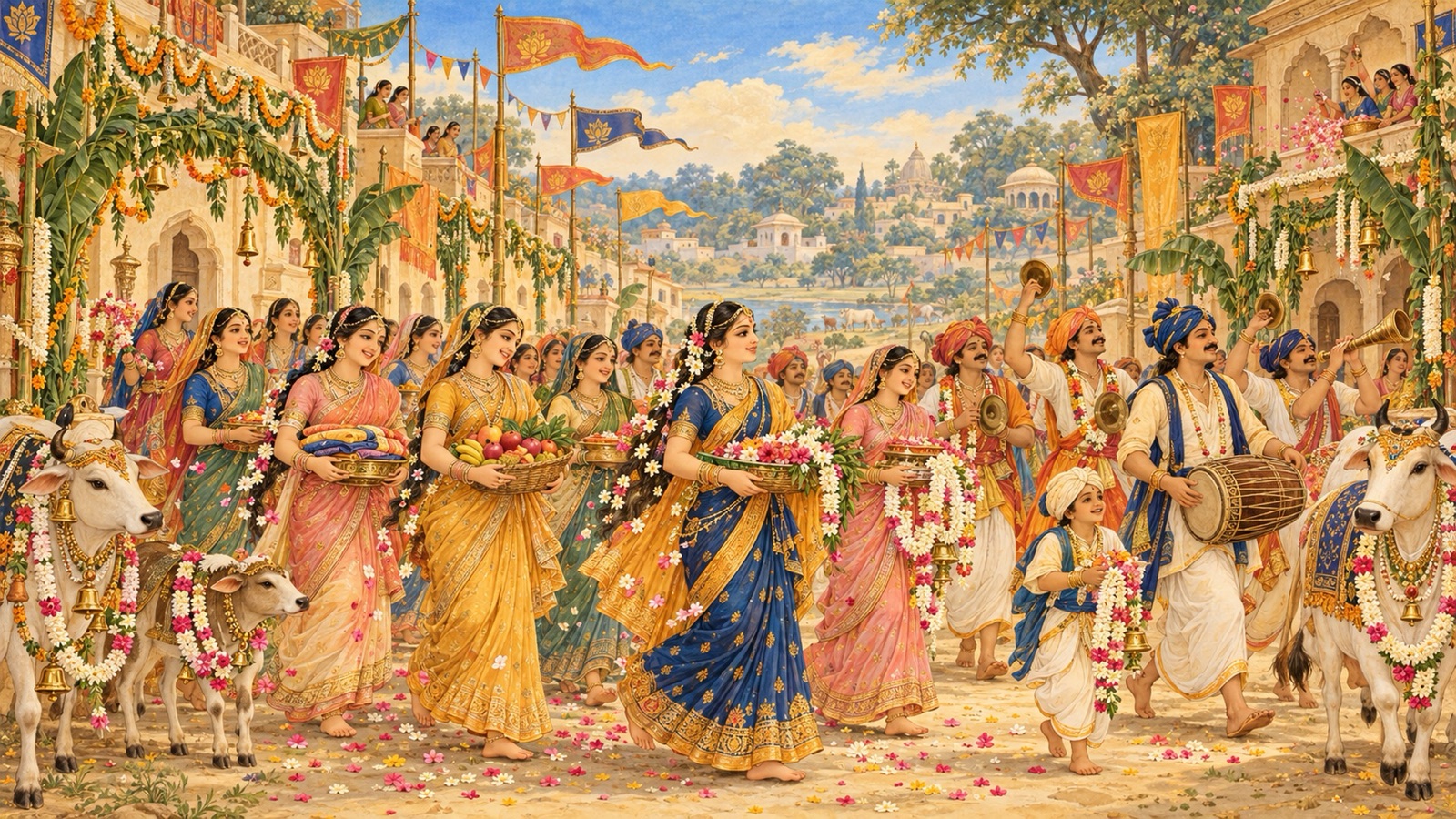
The cowherd women, rejoicing to hear that a son had been born to Yasoda, beautified themselves and hurried to Nanda’s house with their presents, their faces bright with fresh saffron, their ornaments swinging and flowers falling from their braids along the way. Invoking blessings on the child — “May the Lord protect the babe for long!” — and sprinkling one another with water mixed with turmeric and oil, they sang aloud in joy.
अवाद्यन्त विचित्राणि वादित्राणि महोत्सवे । कृष्णे विश्वेश्वरेऽनन्ते नन्दस्य व्रजमागते ॥ १३ ॥
avādyanta vicitrāṇi vāditrāṇi mahotsave kṛṣṇe viśveśvare ’nante nandasya vrajam āgate
Meaning: Now that the infinite Lord Krishna, the Ruler of the universe, had come to the Vraja of Nanda, all sorts of wonderful musical instruments were sounded at that great festival. (Canto 10, Chapter 5, verse 13)
In their merriment the cowherds sprayed one another with curds, milk, and clarified butter, smeared each other with handfuls of fresh butter, and tossed one another about in play. To please Lord Vishnu and for the welfare of his son, the generous Nanda bestowed garments, ornaments, and cattle-wealth upon the bards, minstrels, and all who lived by their arts, honouring each as he wished. Rohini too, felicitated by Nanda, moved about as the honoured mistress of his household, decked in fine clothes and garlands.
Vraja Becomes the Abode of Fortune
From that day forward, Sukadeva tells us, the character of Vraja itself was transformed by the presence of the Lord.
तत आरभ्य नन्दस्य व्रज: सर्वसमृद्धिमान् । हरेर्निवासात्मगुणै रमाक्रीडमभून्नृप ॥ १८ ॥
tata ārabhya nandasya vrajaḥ sarva-samṛddhimān harer nivāsātma-guṇai ramākrīḍam abhūn nṛpa
Meaning: From that time on, O King, the Vraja of Nanda, blessed with every kind of prosperity by the qualities natural to an abode of Lord Hari, became the very playground of Rama, the Goddess of Fortune. (Canto 10, Chapter 5, verse 18)
The Meeting of Nanda and Vasudeva
In time, having entrusted the protection of Gokula to the cowherds, Nanda travelled to Mathura to pay his yearly tribute to Kamsa. When Vasudeva learned that his friend had come and had paid his dues, he went to Nanda’s camp to see him and to ask after his sons. Overjoyed at the sight of his beloved friend, Nanda sprang to his feet — as a body revives when consciousness returns — and folded Vasudeva in his arms, overcome with affection. Welcomed and seated, Vasudeva, his heart drawn toward his hidden sons, began to speak.
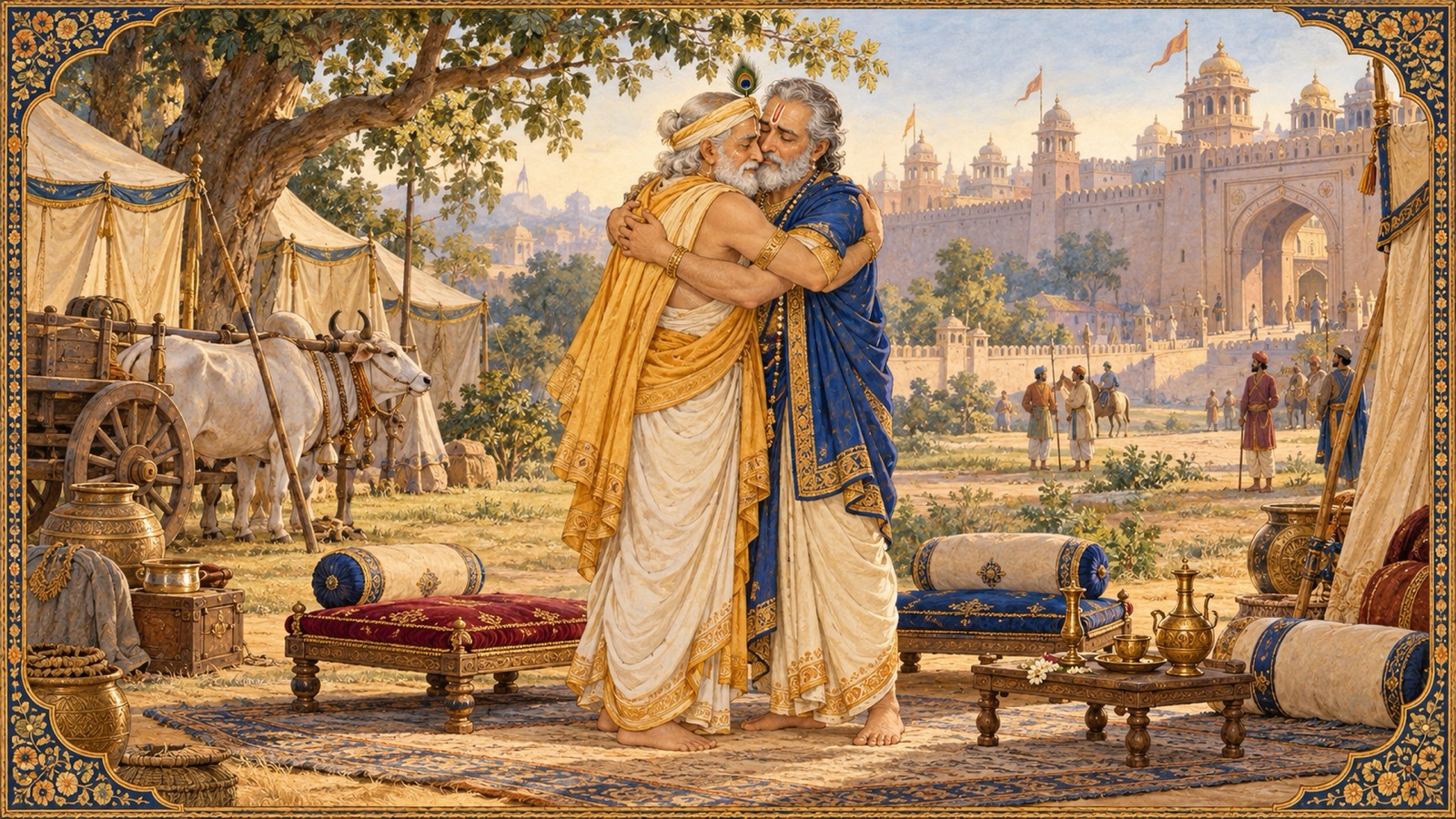
He congratulated Nanda that a child had at last been granted to him in his old age, when all hope of progeny seemed lost, and said that to see so dear a friend was like meeting one reborn, for the sight of a loved one is hard to obtain in this world. Friends engaged in their various duties, he reflected, cannot always remain together, any more than planks of wood swept along by a river’s current. He asked whether Gokula was healthy and well provided with water and grass, and whether his own son — Balarama, cherished by Nanda and Rohini — was thriving in their care. The threefold pursuit of religious merit, wealth, and enjoyment, he added, is worthwhile only when shared with one’s dear ones; when they suffer, such things bring no true happiness.
Nanda gently reminded his friend of all that Devaki had endured — that many of Vasudeva’s sons had been slain by Kamsa, and that the one daughter born last had risen to the heavens. Then he offered a word of quiet wisdom.
नूनं ह्यदृष्टनिष्ठोऽयमदृष्टपरमो जन: । अदृष्टमात्मनस्तत्त्वं यो वेद न स मुह्यति ॥ ३० ॥
nūnaṁ hy adṛṣṭa-niṣṭho ’yam adṛṣṭa-paramo janaḥ adṛṣṭam ātmanas tattvaṁ yo veda na sa muhyati
Meaning: Surely every person rests upon the unseen and is governed by the unseen; one who knows the unseen destiny to be the very truth of the self is never deluded. (Canto 10, Chapter 5, verse 30)
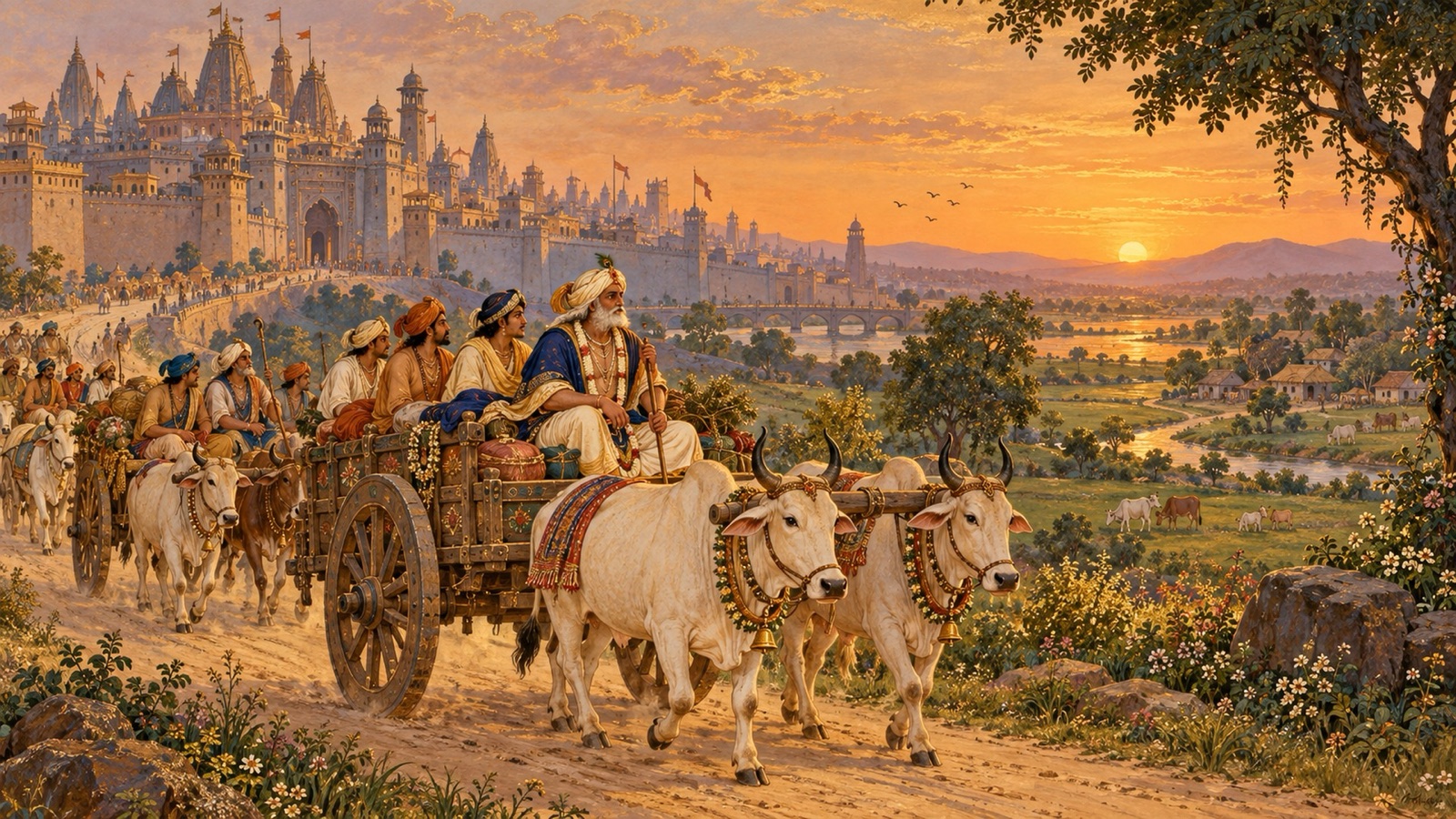
Vasudeva, sensing danger, urged his friend not to linger: the tribute was paid and they had met, but strange and alarming things were happening at Gokula, and Nanda should return without delay. Thus counselled, Nanda took his leave and, with the other cowherds, rode back home to Gokula upon their bullock carts.
Principal Teachings of This Chapter
1. The presence of the Lord transforms a place into an abode of fortune. From the day Krishna comes to Vraja, it becomes the playground of the Goddess of Fortune. Where the Lord is welcomed, true prosperity and auspiciousness follow (verse 18).
2. Outer purity is not the same as inner purity. Water, ritual, austerity, and charity cleanse material things, but the self is purified only by self-knowledge. Devotion and wisdom, not ceremony alone, purify the heart (verse 4).
3. Joy shared in community is a form of worship. The whole of Vraja rejoices together — men, women, cows, and children — offering their happiness to the Lord. Simple, wholehearted celebration can itself be an act of devotion (verses 5-16).
4. Love among devotees is precious and fleeting. Vasudeva’s tender words to Nanda remind us how rare and dear the company of loved ones is, and how gratefully it should be received while it lasts (verses 23-25).
5. Freedom from delusion comes through accepting the unseen hand of Providence. Nanda’s calm in the face of grief flows from his trust that all beings rest upon destiny. Knowing this, the wise are not overwhelmed by sorrow (verse 30).
A Devotional Reflection
There is a beautiful innocence in this chapter. All of Vraja dances and sings, splashing butter and turmeric, blessing a newborn child — and not one of them knows that they are celebrating the advent of the Lord of all the worlds. Their joy is not calculated; it is simply the overflowing gladness of simple hearts, and it is exactly this that the Lord chooses to be born into. Meanwhile, in Mathura, two aging friends embrace and speak softly of their children and their sorrows, carrying secrets they cannot share. The chapter holds both together: unshadowed festivity and quiet, hidden grief. Perhaps that is how the Lord most often enters our lives — not with thunder, but into the ordinary round of our celebrations and our partings, our gladness and our unspoken cares. To welcome Him there, in the simple joys and burdens of daily life, is the devotion this chapter gently teaches.
A Daily Devotional Practice
Today, let one ordinary joy become an offering. Whether it is a shared meal, a moment of music, or greeting someone you love, pause and silently dedicate that gladness to the Lord, as the cowherds of Vraja unknowingly dedicated their festival to Him. Let your happiness itself become a small worship. As you begin, chant: “Om Namo Bhagavate Vasudevaya.”
Conclusion
The fifth chapter of the Tenth Canto lifts us out of the shadows of Kamsa’s court into the sunlit joy of Gokula. Nanda performs the sacred birth-rites and pours out charity; the whole of Vraja is adorned and rejoices; and with the coming of the infinite Lord, Nanda’s village becomes the abode of all fortune. Travelling to Mathura, Nanda meets his dear friend Vasudeva, and their tender conversation weaves together love, longing, and the wisdom of accepting destiny, before Vasudeva quietly sends him home to guard against unseen dangers. Beneath all the festivity lies a deep secret known only to a few: the child of Gokula is God Himself. In the chapters to come, that hidden divinity will begin to shine forth through the wondrous pastimes of childhood.
May the divine wisdom of Srimad Bhagavatam awaken pure devotion within our hearts.
Om Namo Bhagavate Vasudevaya.
Jay Shree Madhav.
References and Attribution
- Primary edition: Gita Press, Śrīmad Bhāgavata Mahāpurāṇa (English, complete), Book Ten (First Half), Discourse 5.
- Series: Srimad Bhagavatam Wisdom · Biswa Sanatan Dharma Seva Trust.
- Presented following the spiritual guidance and recommendation of Pandit Dr. Shri Kashinath Mishra.
This is an original, faithful retelling in the writer’s own words, with brief quoted verses shown in Devanāgarī and transliteration and their meanings given as summaries. It is not a reproduction of any single publisher’s continuous translation or commentary. No affiliation with or endorsement by any publisher is implied.
Jay Shree Madhav