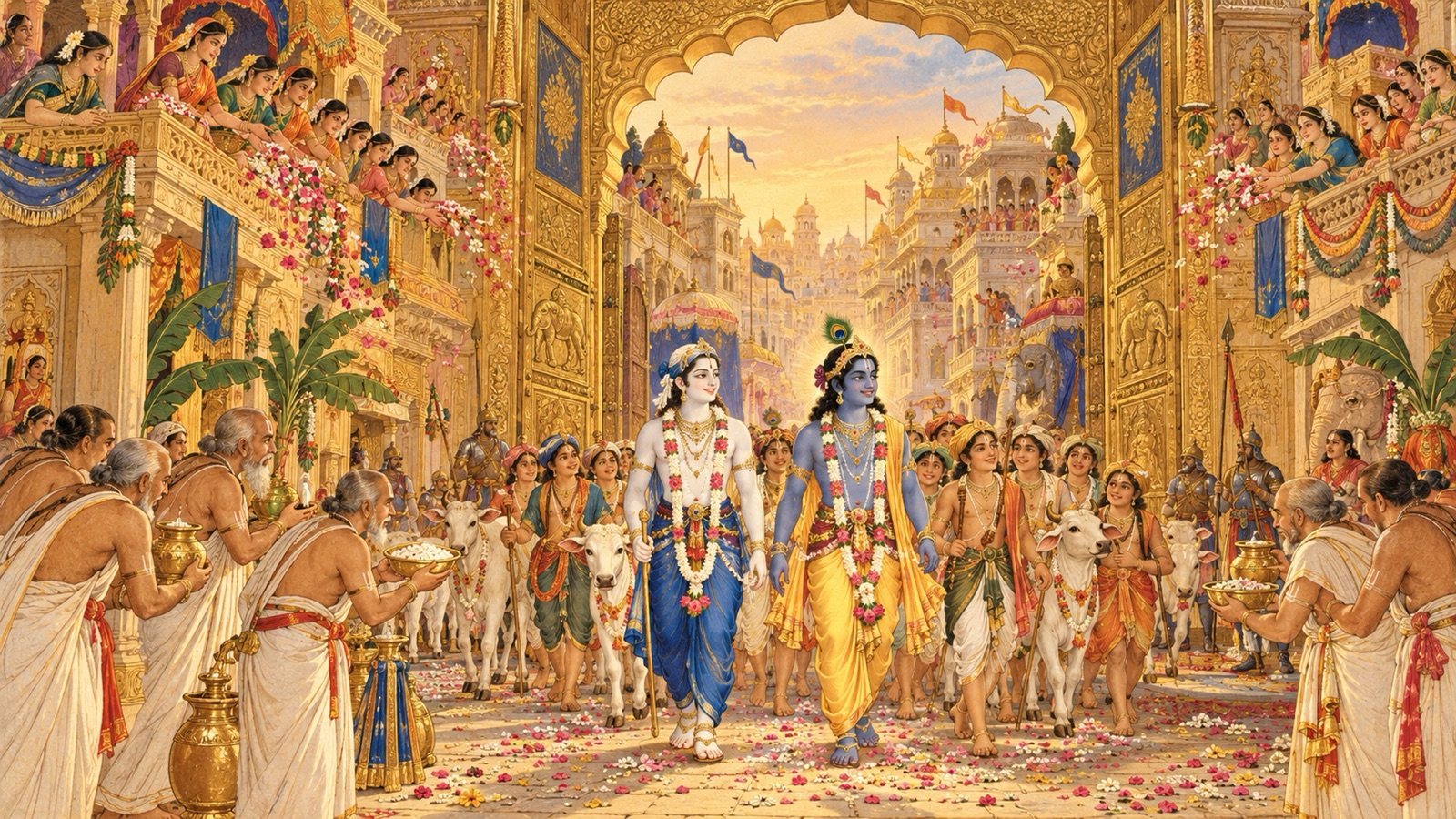
The long road from Vraja ends at a golden gateway, and the Lord of all worlds walks into Mathura on foot, to be clothed and garlanded by its poorest hands.
Om Namo Bhagavate Vasudevaya.
Om Namo Bhagavate Vasudevaya.
Om Namo Bhagavate Vasudevaya.
Welcome back to Srimad Bhagavatam Wisdom, our devotional journey through the Srimad Bhagavat Mahapurana. In this forty-first chapter of the Tenth Canto, the two Brothers walk through the gateways of Mathura and meet its people one by one — each receiving what his own heart holds out.
Chapter Information
- Scripture: Śrīmad Bhāgavata Mahāpurāṇa
- Canto: 10 (Book Ten, First Half)
- Chapter: 41 (Discourse 41)
- Chapter title: Krishna and Balarama Enter Mathura
- Principal speaker: Sukadeva Gosvami (narrating to King Parikshit)
- Principal listener: King Parikshit
- Main setting: The Yamuna bank, a garden outside Mathura, and the city streets
- Central subject: Akrura’s plea; the entry into Mathura; the washerman, the weaver and Sudama the garland-maker
- Principal verse range: Canto 10, Chapter 41, verses 1–52
- Primary edition: Gita Press Śrīmad Bhāgavata Mahāpurāṇa (English, Book Ten, First Half)
Context From the Previous Chapter
Bathing in the Yamuna on the road to Mathura, Akrura had seen within the water the four-armed Lord Narayana reclining upon Ananta, and had poured out a hymn of surrender at those feet. This chapter opens as that vision closes.
The Vision Withdrawn in the Water
While Akrura was still singing His praise, the Lord quietly drew that form back into Himself, like a player setting aside his part.
श्रीशुक उवाच
स्तुवतस्तस्य भगवान् दर्शयित्वा जले वपुः ।
भूयः समाहरत् कृष्णो नटो नाट्यमिवात्मनः ॥ १ ॥
śrī-śuka uvāca stuvatas tasya bhagavān darśayitvā jale vapuḥ bhūyaḥ samāharat kṛṣṇo naṭo nāṭyam ivātmanaḥ
Meaning: Sukadeva said: While Akrura was offering his prayer, the Lord Sri Krishna, having shown him that form within the water, withdrew it once more into Himself, as an actor winds up the part he has been playing. (Canto 10, Chapter 41, verse 1)
Finding the vision gone, Akrura rose from the river, hurriedly completed his observances and came back to the chariot wonder-struck. Krishna asked as though He knew nothing: what had he just seen on earth, in the heavens or in the water? His glistening eyes and glowing face showed that something unusual had been revealed.
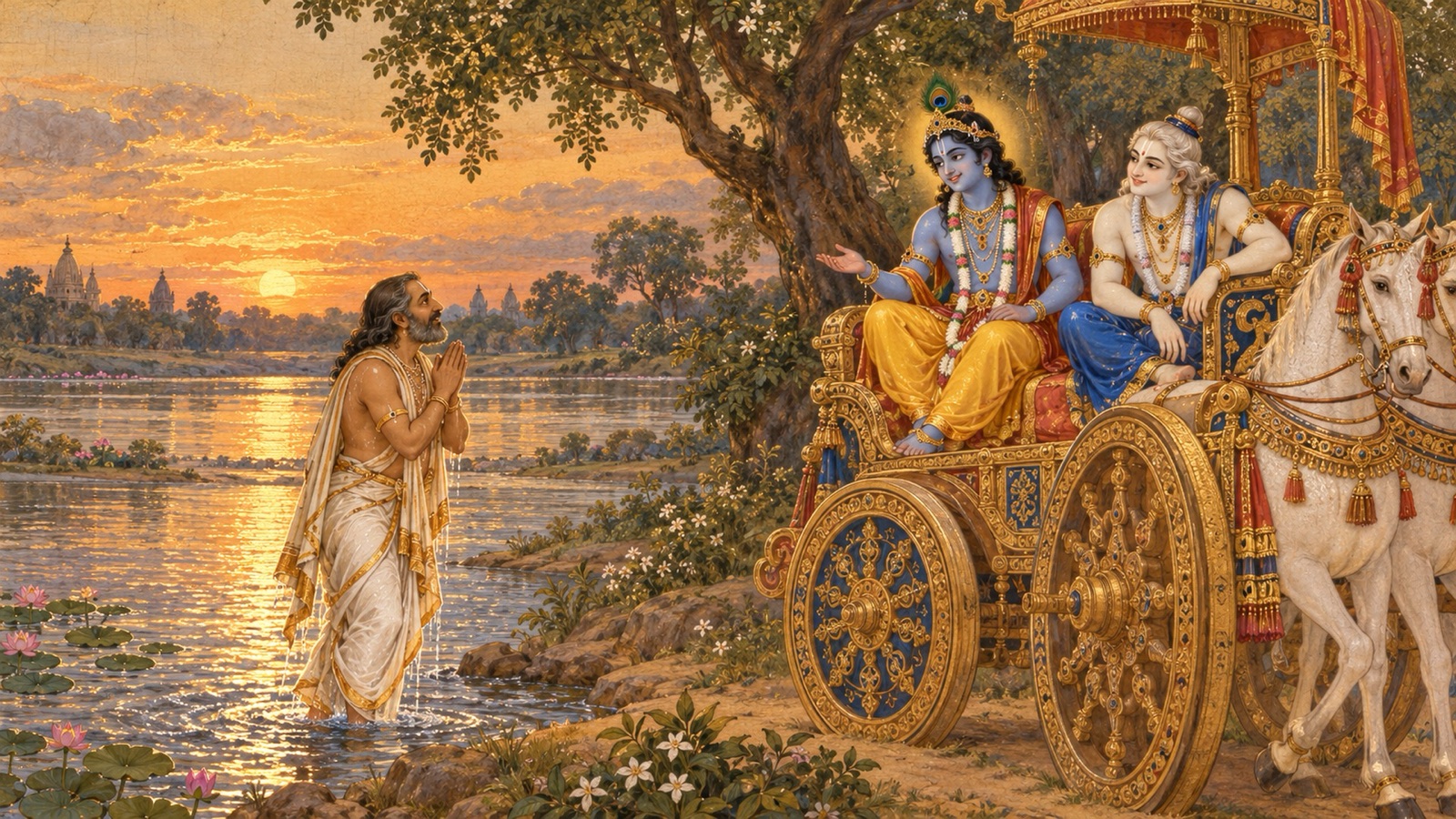
Akrura’s reply is one of the great confessions of the Bhagavatam: every marvel abides in the Lord, the Self of all, so what could remain unseen by one looking straight at Him?
यत्राद्भुतानि सर्वाणि भूमौ वियति वा जले ।
तं त्वानुपश्यतो ब्रह्मन् किं मे दृष्टमिहाद्भुतम् ॥ ५ ॥
yatrādbhutāni sarvāṇi bhūmau viyati vā jale taṁ tvānupaśyato brahman kiṁ me dṛṣṭam ihādbhutam
Meaning: O Brahman, when every wonder of earth, sky and water rests in You, and I am gazing directly upon You, what separate marvel could I have seen here? (Canto 10, Chapter 41, verse 5)
The Chariot Reaches the City
So speaking, the son of Gandini drove on and brought Balarama and Krishna to Mathura as the day declined. Country people crowded the road at every stage and, once they had seen the two sons of Vasudeva, could not take their eyes away. Nanda and the cowherds, who had taken a shorter route while Akrura lingered at the river, were waiting in a garden outside the walls. Joining them, Krishna clasped the hand of Akrura, who stood bowed before Him, and said laughingly that he should drive into the city and go home; They would rest here and follow.
Akrura Will Not Enter Without Them
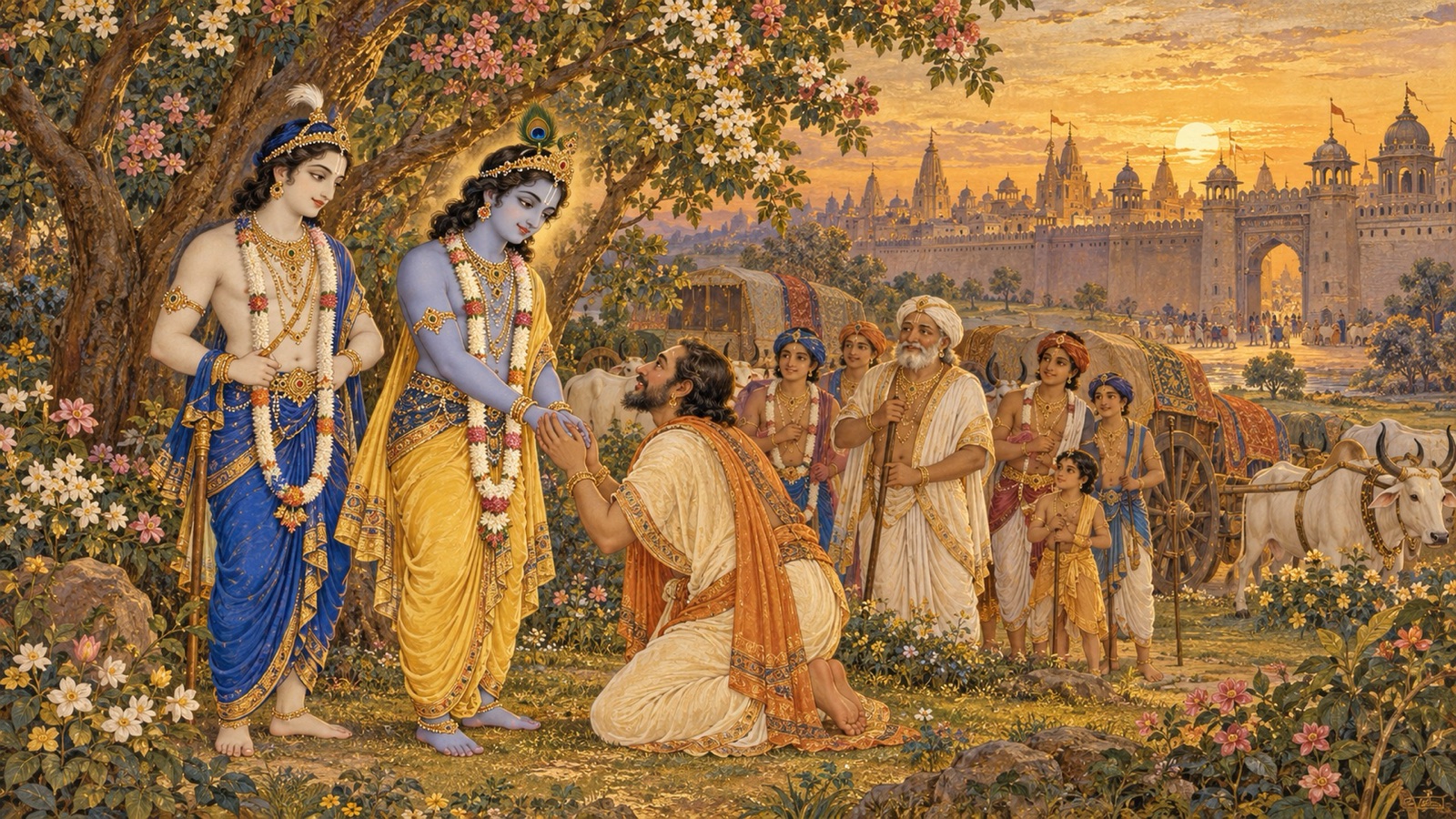
To go in alone, leaving Them outside the walls, was more than Akrura’s heart could bear.
अक्रूर उवाच
नाहं भवद्भ्यां रहितः प्रवेक्ष्ये मथुरां प्रभो ।
त्यक्तुं नार्हसि मां नाथ भक्तं ते भक्तवत्सल ॥ ११ ॥
akrūra uvāca nāhaṁ bhavadbhyāṁ rahitaḥ pravekṣye mathurāṁ prabho tyaktuṁ nārhasi māṁ nātha bhaktaṁ te bhakta-vatsala
Meaning: Akrura said: Without You two I shall not enter Mathura, O Lord. You should not abandon me, Your own devotee, O master who is affectionate to His devotees. (Canto 10, Chapter 41, verse 11)
Let the Lord come, he begged, with Balarama, His kinsmen and the cowherds, and sanctify a householder’s home with the dust of His feet. The water that bathes those feet gratifies the forefathers and the gods for ever; by washing them Bali won renown, unmatched power and the goal of the Lord’s exclusive devotees; flowing as the Ganga, it hallowed the three worlds, was borne on Shiva’s head, and raised the sons of Sagara to heaven. Saluting Him as the jewel of the Yadus and as Narayana, Akrura waited.
The Promise the Lord Gave
श्रीभगवानुवाच
आयास्ये भवतो गेहमहमार्यसमन्वितः ।
यदुचक्रद्रुहं हत्वा वितरिष्ये सुहृत्प्रियम् ॥ १७ ॥
śrī-bhagavān uvāca āyāsye bhavato geham aham ārya-samanvitaḥ yadu-cakra-druhaṁ hatvā vitariṣye suhṛt-priyam
Meaning: The glorious Lord said: I shall come to your house together with My elder brother once I have slain the enemy of the Yadu circle, and I shall bring joy to those who are dear to Me. (Canto 10, Chapter 41, verse 17)
The work first, then the visit. Carrying that promise, sad at heart to go in without Them, Akrura entered Mathura, told Kamsa what he had done, and withdrew to his house.
Entering Mathura
अथापराह्णे भगवान् कृष्णः सङ्कर्षणान्वितः ।
मथुरां प्राविशद् गोपैर्दिदृक्षुः परिवारितः ॥ १९ ॥
athāparāhṇe bhagavān kṛṣṇaḥ saṅkarṣaṇānvitaḥ mathurāṁ prāviśad gopair didṛkṣuḥ parivāritaḥ
Meaning: Then in the afternoon the Lord Sri Krishna, accompanied by Sankarshana and surrounded by the cowherds, eager to see the city, entered Mathura. (Canto 10, Chapter 41, verse 19)
He went in fearlessly, and the city was worth seeing: lofty gateways in the rampart, crystal portals with golden doors and arches, granaries of copper and brass, a guarding moat and gardens all about. Golden canopies rose at the crossroads among mansions, rest-houses and guild halls; pigeons and peacocks called from the house-sheds, and the pavements were inlaid with cat’s-eye, diamond, sapphire, coral, pearl and emerald. Sprinkled roads were strewn with flowers, barley sprouts and parched grain, and at every doorway stood a brimming water-pot smeared with curds and sandal-paste, ringed with flowers, crowned with lamps, with plantain trunks, fruit-laden areca palms and banners beside it.
The Women of Mathura
Eager to see the two sons of Vasudeva coming up the royal highway with Their companions, the women of the city hurried onto the mansions lining the road. They came as they were: garments and jewels awry, one of a pair of ornaments forgotten, an earring on one ear, an anklet on one foot, collyrium on one eye only. Some left their meals, some came oiled and unbathed, some sprang up from sleep at the noise, and nursing mothers set down their infants and ran.
Moving with the gait of a lordly elephant, the lotus-eyed Lord stole their minds with His playful smiles and glances and gave their eyes a festival. Sprinkled with the nectar of those unreserved smiles and penetrating looks, they drew that embodiment of bliss in through the gateway of their eyes and embraced Him within their hearts, thrilling all over, and the long ache of never having seen Him left them.
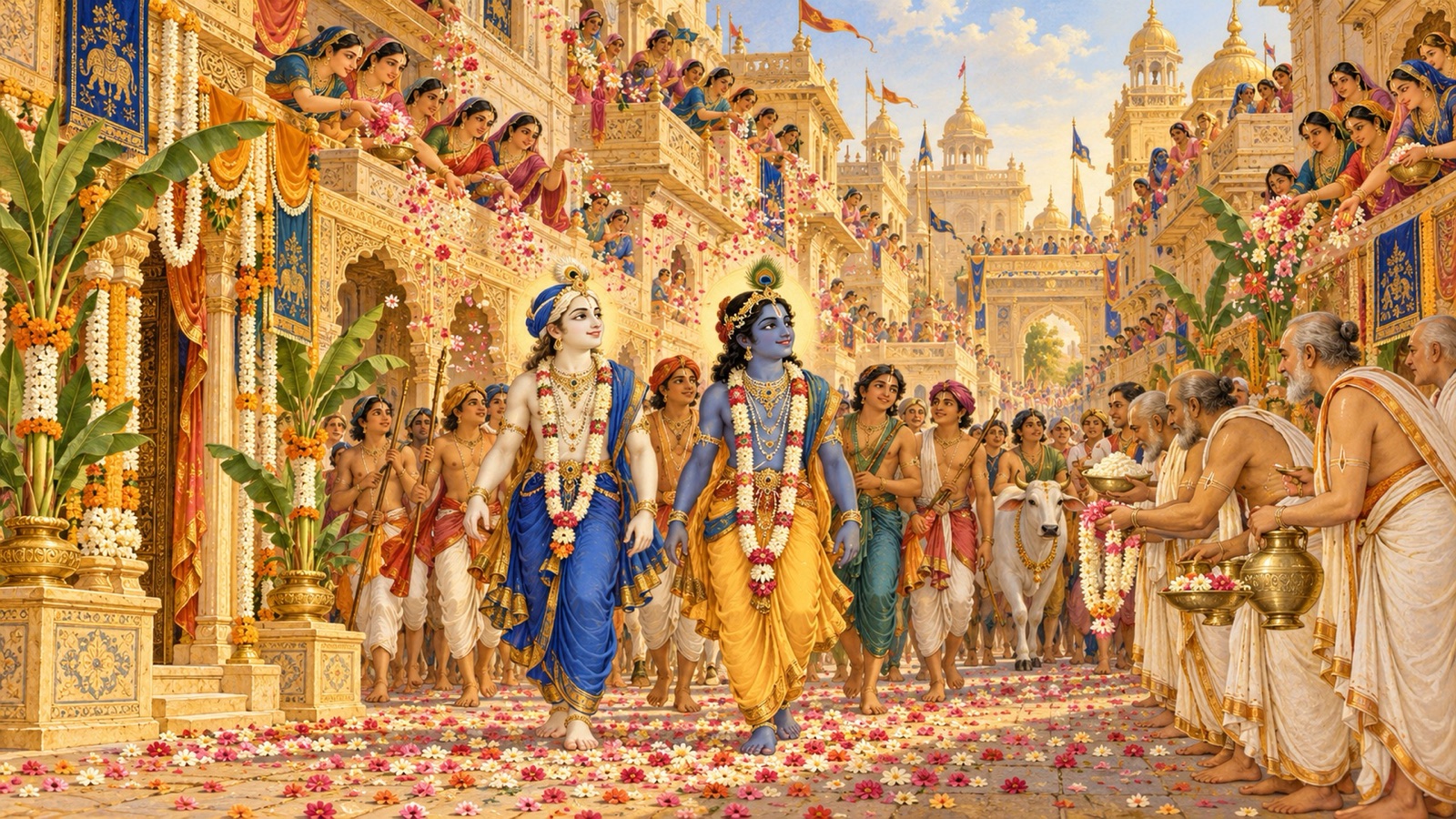
From the rooftops, their lotus faces blossoming with delight, they showered flowers upon Balarama and Krishna, while at every step overjoyed brahmanas honoured the Brothers with curds and unbroken rice, garlands, fragrances, offerings and vessels of water. And the city women said to one another:
ऊचुः पौरा अहो गोप्यस्तपः किमचरन् महत् ।
या ह्येतावनुपश्यन्ति नरलोकमहोत्सवौ ॥ ३१ ॥
ūcuḥ paurā aho gopyas tapaḥ kim acaran mahat yā hy etāv anupaśyanti nara-loka-mahotsavau
Meaning: The city women said: Ah, what great austerity can the cowherd women of Vraja have performed, that they constantly behold these two, who are the great festival of the human world? (Canto 10, Chapter 41, verse 31)
The Washerman and the Weaver
Further on, a washerman who also dyed cloth came that way, and Krishna asked him for his finest laundered garments: give suitable clothes to two who deserved them, and the highest good would be his. But the man served Kamsa and was swollen with his master’s authority. Were such clothes what they usually wore, he sneered, roaming the hills and woods? How dare they ask for the king’s goods? Let the fools be off if they wished to live, for the king’s men bound, slew and stripped the insolent. While he was still boasting, the son of Devaki was roused to anger and with His fingertips alone brought down the washerman’s head. His attendants dropped the bundles and fled, and the Lord took the cloth. Each Brother put on a pair of garments to His liking; the rest They shared among the cowherds, tossing some upon the ground.
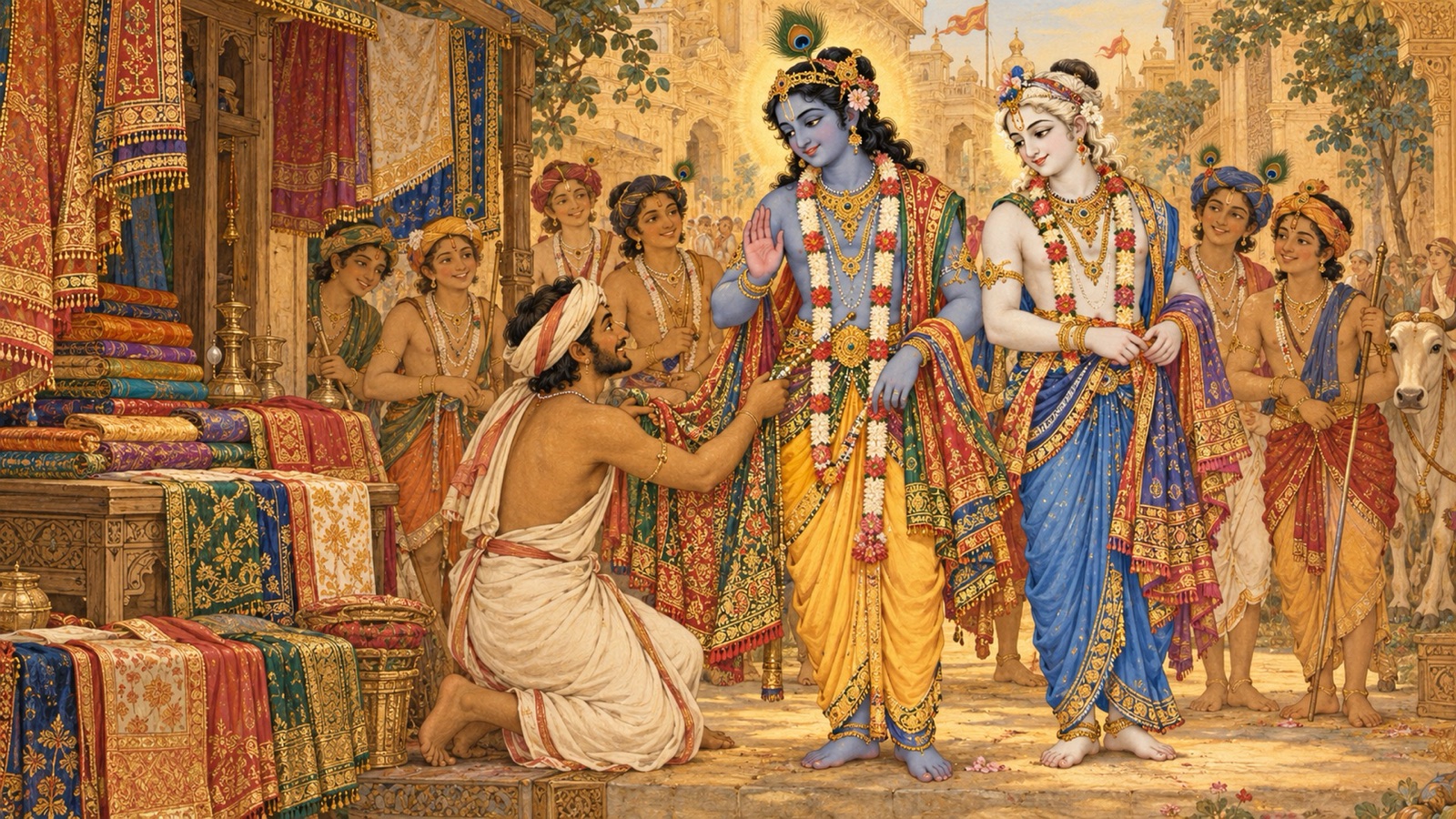
Then a weaver came, full of affection, and dressed Them in ornaments of many-coloured cloth, so that They shone like two young elephants, one dark and one white, decorated for a festival. Pleased, the Lord granted him His own likeness in the life to come, and in this world prosperity, strength, authority, remembrance of God and keenness of the senses.
At the House of Sudama the Garland-Maker
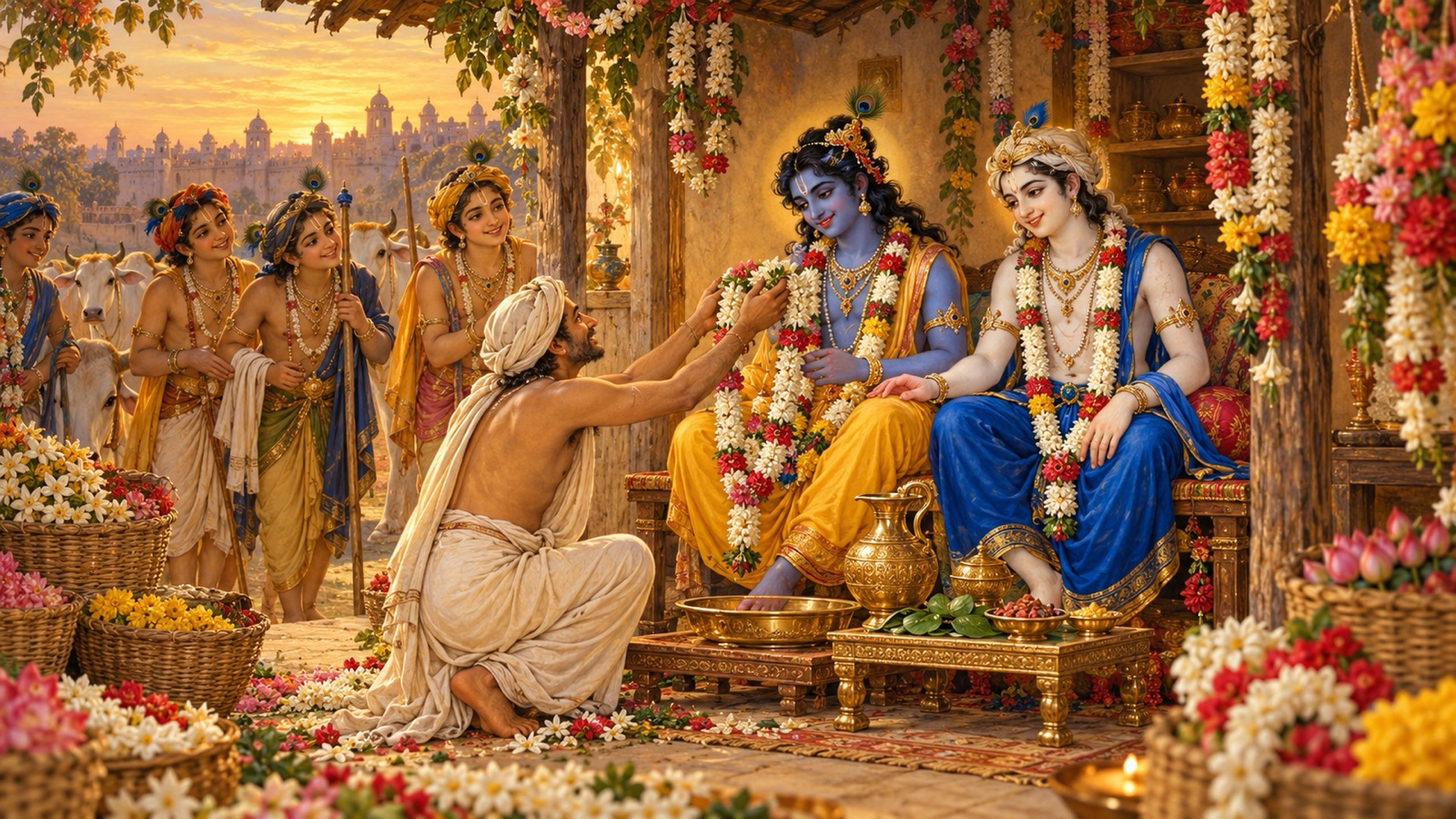
From there the Brothers walked to the house of Sudama the garland-maker. Seeing Them he rose at once and bowed with his head to the ground, brought a seat and water for Their feet, and worshipped Them and Their companions with water for the hands, garlands, prepared betel and sandal-paste. Fruitful is our birth, he said, and purified our family by Your coming; the forefathers, the gods and the sages are pleased with me this day. You two, the ultimate cause of the universe, have descended by Your own will for the protection and growth of the world. Then came the words at the heart of this chapter.
न हि वां विषमा दृष्टिः सुहृदोर्जगदात्मनोः ।
समयोः सर्वभूतेषु भजन्तं भजतोरपि ॥ ४७ ॥
na hi vāṁ viṣamā dṛṣṭiḥ suhṛdor jagad-ātmanoḥ samayoḥ sarva-bhūteṣu bhajantaṁ bhajator api
Meaning: Your vision is never unequal, for You two are the well-wishers and the Self of the universe, the same towards all beings, even while You reciprocate with the one who worships You. (Canto 10, Chapter 41, verse 47)
So command me, Sudama pleaded; tell me what service I may render, for to be entrusted by You with some work is itself a man’s greatest blessing.
The Boon Sudama Asked
Divining what would please Them, the garland-maker, his mind overflowing, offered garlands of the choicest and most fragrant flowers. Adorned with them and delighted, Krishna and Balarama — the givers of every boon — offered a boon to the man bowed before Them in surrender.
सोऽपि वव्रेऽचलां भक्तिं तस्मिन्नेवाखिलात्मनि ।
तद्भक्तेषु च सौहार्दं भूतेषु च दयां पराम् ॥ ५१ ॥
so ‘pi vavre ‘calāṁ bhaktiṁ tasminn evākhilātmani tad-bhakteṣu ca sauhārdaṁ bhūteṣu ca dayāṁ parām
Meaning: He chose unshakable devotion to that very Lord, the Self of all, together with warm friendship for His devotees and the highest compassion towards all living beings. (Canto 10, Chapter 41, verse 51)
Having granted that prayer, the Lord added what had not been asked — a fortune that would grow in the hands of his descendants, with strength, long life, fame and beauty — and left with His elder brother.
Four people met the same Lord that afternoon, and each went away with what he himself had extended. Sudama’s verse is the key: His look is never partial; He is the Self of everyone, and He simply reciprocates. The washerman, clutching his master’s cloth and his own arrogance, lost both. The weaver, with only coloured cloth and affection, received the Lord’s likeness. Akrura, wanting nothing but His presence under his roof, was given a promise. And the garland-maker, who asked for no gift at all, received the three loves he named and his household’s welfare besides. Grace takes the shape of what we hold out to Him.
Principal Teachings of This Chapter
1. One who sees the Lord has nothing left to marvel at. Asked what wonder he had witnessed, Akrura answered that all wonders rest in the Lord. Seeing Him empties our whole collection of wonders.
2. A devotee prays for His company, not His gifts. Akrura pleads only that the dust of those feet should touch his home. Love is measured by how little we can bear His absence.
3. The Lord completes His work before He accepts our hospitality. His reply to Akrura is a promise with a duty attached; divine affection never sets aside the task for which He descended.
4. Nearness is not recognition. The women, the brahmanas and the washerman all stood within arm’s reach of Him. Proximity saves no one; only the heart that acknowledges Him receives Him.
5. The highest boon is devotion, good will and compassion. Offered anything, Sudama asked for unwavering love for the Lord, affection for His devotees and mercy towards every creature — the pattern of what to want.
A Devotional Reflection
Of everyone Krishna meets in Mathura, the one who stays with us is the poor man who sells flowers. He is no sage, has no wealth, and does nothing the world would record. He simply happens to be at home, flowers in hand, when the Lord walks to his door. He does not ask to be made great or even to be saved. He asks to be put to work, and then to go on loving — the Lord, the Lord’s devotees, and every living being. He wants nothing that can be taken from him, and the Lord quietly adds blessings he never thought to name. Our own prayers run the other way: we ask for the additions and forget the one thing.
A Daily Devotional Practice
Today, offer the Lord something you have made or worked for — flowers from your own hand, food you have cooked, service for someone who cannot repay you — and as you offer it, make Sudama’s threefold prayer your own: unshakable devotion to the Lord, warm friendship towards His devotees, and real kindness to every creature. Begin by chanting gently: Om Namo Bhagavate Vasudevaya.
Conclusion
The forty-first chapter of the Tenth Canto brings Krishna and Balarama at last inside the walls of Mathura. A vision closes on the Yamuna, a devotee begs for Their company, a promise waits upon the slaying of Kamsa, and the Brothers walk through a festive city. A proud servant of the king loses what he clung to, a weaver is raised to the Lord’s likeness, and a maker of garlands asks for the only wealth no one can seize. May we learn from Sudama what to request when the Lord stands at our door.
May the divine wisdom of Srimad Bhagavatam awaken pure devotion within our hearts.
Om Namo Bhagavate Vasudevaya.
Jay Shree Madhav.
References and Attribution
- Primary edition: Gita Press, Śrīmad Bhāgavata Mahāpurāṇa (English), Book Ten (First Half), Discourse 41.
- Series: Srimad Bhagavatam Wisdom · Biswa Sanatan Dharma Seva Trust.
- Presented following the spiritual guidance and recommendation of Pandit Dr. Shri Kashinath Mishra.
This is an original, faithful retelling in the writer’s own words, with brief quoted verses shown in Devanāgarī and transliteration and their meanings given as summaries. It is not a reproduction of any single publisher’s continuous translation or commentary. No affiliation with or endorsement by any publisher is implied.
Jay Shree Madhav