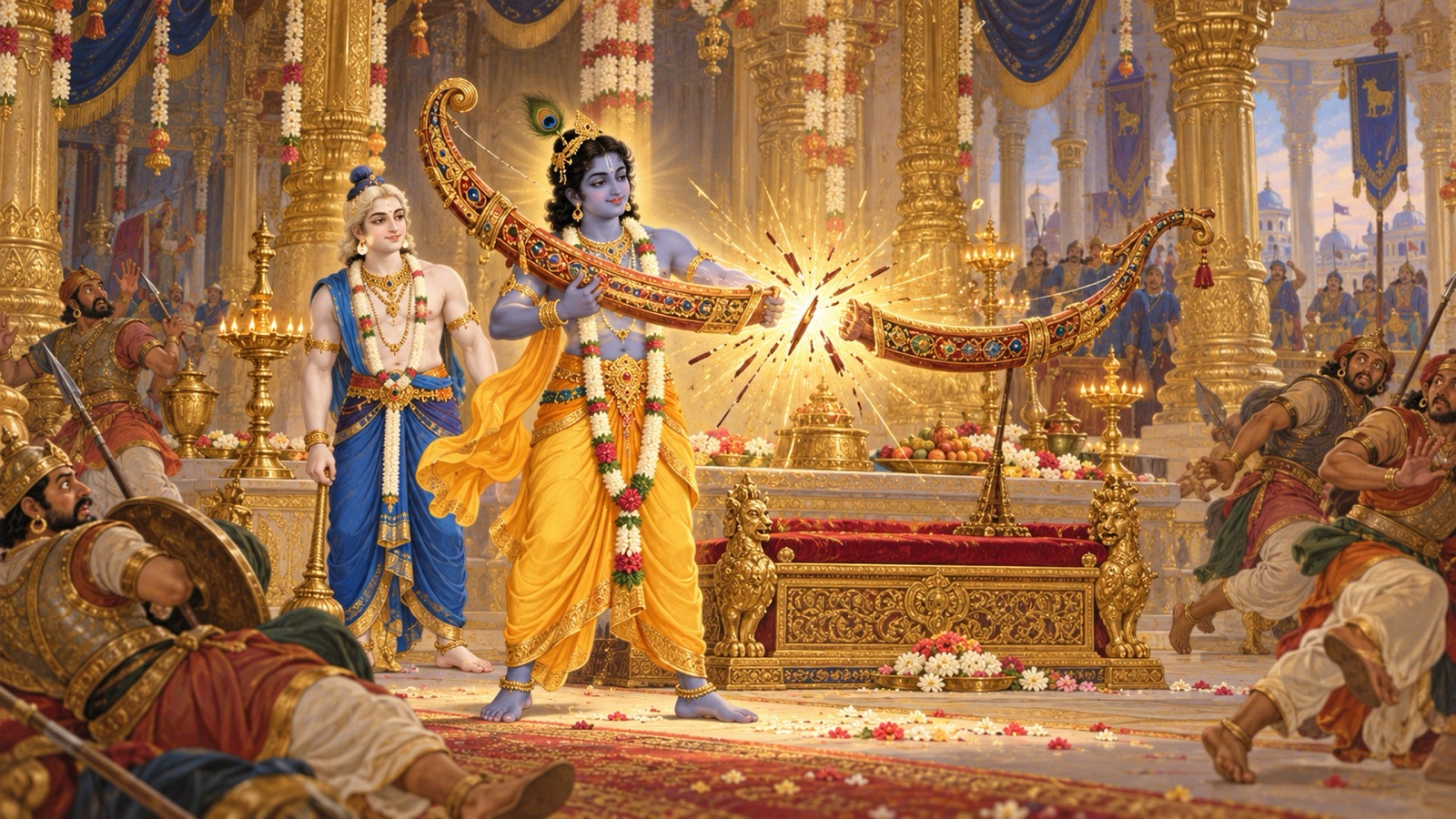
A hunchbacked maidservant is made straight by a single touch, a king’s sacrificial bow snaps like a sugar-cane in the Lord’s hands, and Kamsa, hearing that crash fill the heavens, lies awake all night watching the messengers of his own death.
Om Namo Bhagavate Vasudevaya.
Om Namo Bhagavate Vasudevaya.
Om Namo Bhagavate Vasudevaya.
Welcome back to Srimad Bhagavatam Wisdom, our devotional journey through the sacred histories and teachings of the Srimad Bhagavat Mahapurana. This forty-second chapter of the Tenth Canto follows Krishna along the royal road of Mathura, from His grace to the maidservant Trivakra to the breaking of Kamsa’s bow, the king’s terror-filled night and the dawn of his wrestling festival.
Chapter Information
- Scripture: Śrīmad Bhāgavata Mahāpurāṇa
- Canto: 10 (Book Ten, First Half)
- Chapter: 42 (Discourse 42)
- Chapter title: The Breaking of the Sacrificial Bow
- Principal speaker: Sukadeva Gosvami (narrating to King Parikshit)
- Principal listener: King Parikshit
- Main setting: The royal road and sacrificial hall of Mathurā; the cowherds’ carts outside the city; Kamsa’s palace; the wrestling arena at dawn
- Central subject: Krishna’s grace to Trivakra, the breaking of Kamsa’s sacrificial bow, Kamsa’s evil omens and sleepless night, and the preparation of the wrestling arena
- Principal verse range: Canto 10, Chapter 42, verses 1–38
- Primary edition: Gita Press Śrīmad Bhāgavata Mahāpurāṇa (English, Book Ten)
Context From the Previous Chapter
In Chapter 41, Krishna and Balarama entered Mathura with the cowherds. A proud washerman of Kamsa who refused Them clothes was slain by the Lord’s fingertips; a loving weaver adorned the two Brothers and was blessed; and the florist Sudama worshipped Them, asked only for unflinching devotion, friendship with devotees and compassion for all beings, and received every boon.
The Hunchbacked Maidservant on the Royal Road
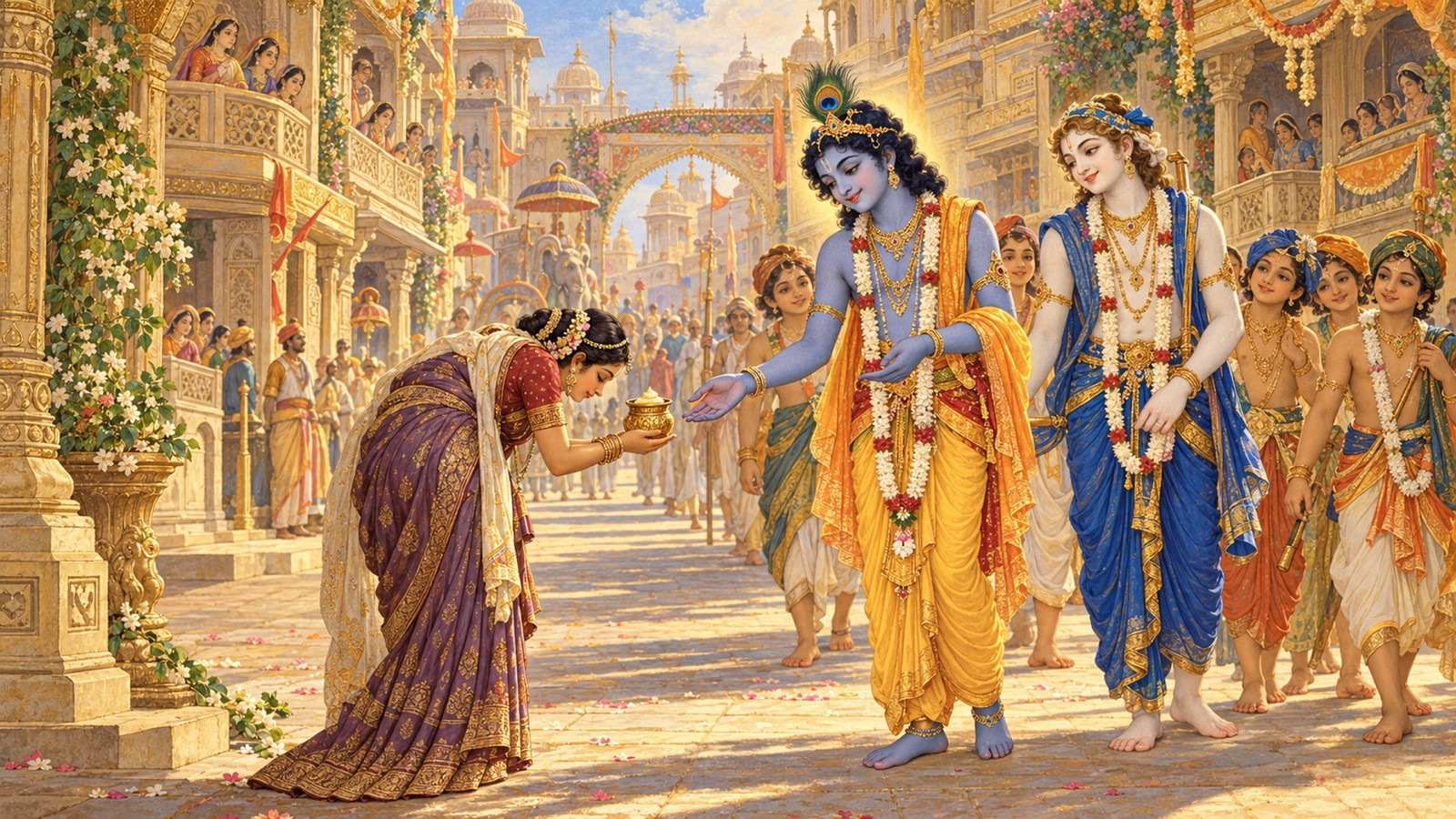
Sukadeva continued. As Krishna walked on along the main road, He saw a young hunchbacked woman of lovely face passing by, carrying a vessel full of sandal-paste. Smiling, He asked her who she was and for whom the paste was meant, and begged her to give its excellent ointment to the two of Them, promising that the highest good would soon come to her through this small service.
She replied that she was a maidservant named Trivakra, esteemed by Kamsa for her skill in preparing sandal-pastes; the paste she made was most dear to the ruler of the Bhojas — yet who, she asked, deserved it more than these two? Her heart captured by the beauty, grace, sweetness, laughter, words and glances of the two Brothers, she gave Them both the thick, fragrant paste. Anointed with a colour that shone in contrast to Their own complexions and adorned the upper parts of Their bodies, Krishna and Balarama looked most charming.
The Fruit of His Darshan
Pleased with her, the Lord resolved to straighten this woman who was bent at three places, the neck, the chest and the waist, though her countenance was so fair, and in doing so to show the whole world the immediate fruit of beholding Him.
प्रसन्नो भगवान् कुब्जां त्रिवक्रां रुचिराननाम् ।
ऋज्वीं कर्तुं मनश्चक्रे दर्शयन् दर्शने फलम् ॥ ६ ॥
prasanno bhagavān kubjāṁ trivakrāṁ rucirānanām ṛjvīṁ kartuṁ manaś cakre darśayan darśane phalam
Meaning: Gratified, the Lord made up His mind to make straight the hunchbacked Trivakra, whose face was lovely, thereby displaying the reward of His very sight. (Canto 10, Chapter 42, verse 6)
Pressing the fore-parts of her feet with His own feet, and placing two upraised fingers of His open hand beneath her chin, the infallible Lord lifted her body upright. By the touch of Mukunda, the giver of liberation, she became in that instant a woman of surpassing beauty, her limbs straight and well-formed.
पद्भ्यामाक्रम्य प्रपदे द्व्यङ्गुल्युत्तानपाणिना ।
प्रगृह्य चिबुकेऽध्यात्ममुदनीनमदच्युतः ॥ ७ ॥
padbhyām ākramya prapade dvy-aṅguly-uttāna-pāṇinā pragṛhya cibuke ’dhyātmam udanīnamad acyutaḥ
Meaning: Pressing down the front of her feet with His feet and holding her chin with two fingers of His upturned hand, Acyuta raised her body straight. (Canto 10, Chapter 42, verse 7)
Here is the heart of the chapter’s teaching. The Lord did not straighten Trivakra merely out of kindness to one servant; He did it to show the world what His darshan accomplishes. A body bent in three places is set straight by one touch — and so, the sacred text implies, is the soul bent by pride, lust and fear made straight the moment it truly beholds Him. Kamsa’s own maidservant, who carried the king’s paste, offered it instead to the Lord, and in exchange received a wholeness no king could give. Devotion offered with whatever we hold in our hands is never refused, and its reward is nothing less than the Lord’s transforming touch.
Her Prayer and the Lord’s Promise
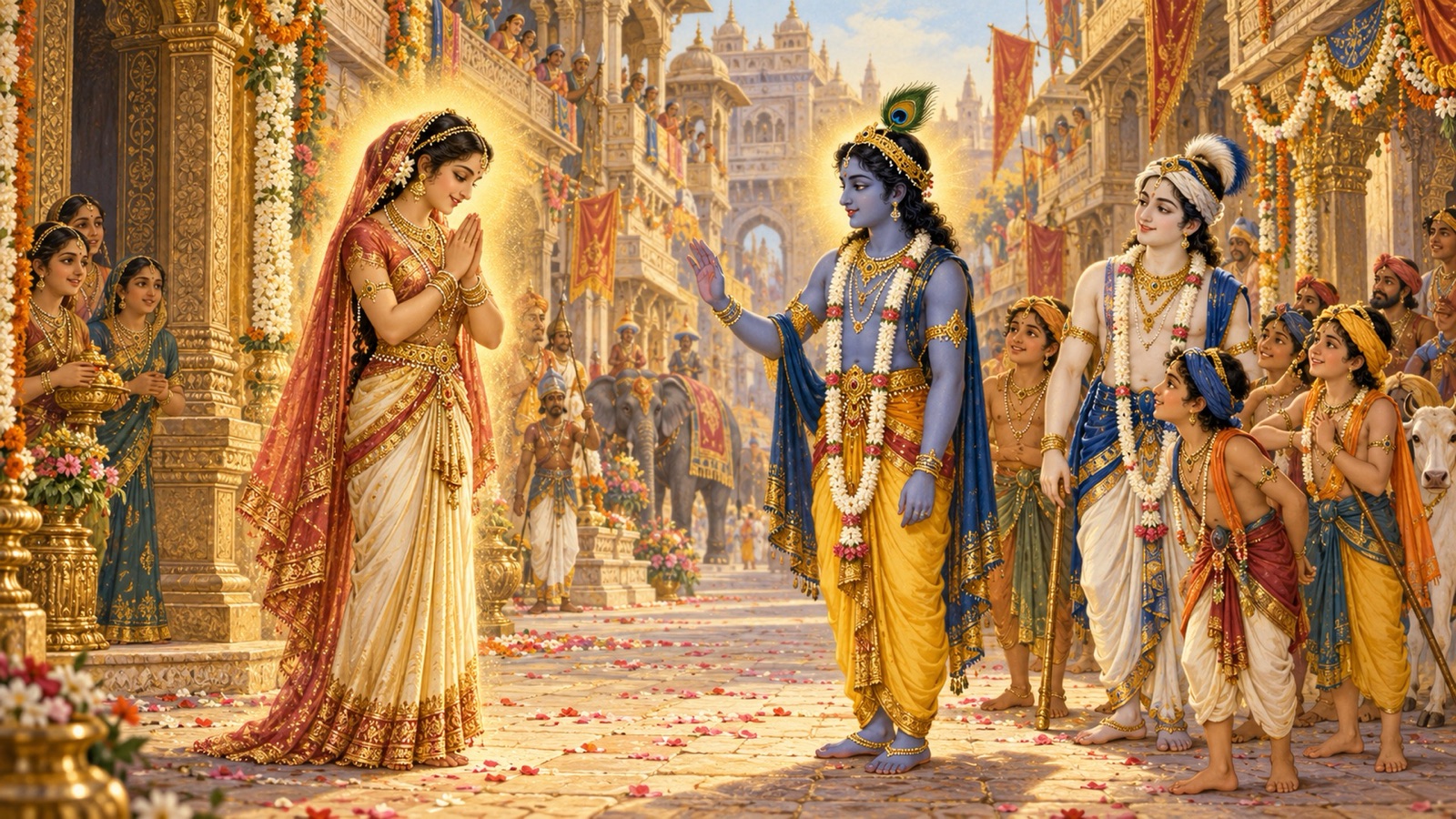
Now endowed with beauty, virtue and generosity of form, Trivakra, in whom love for the Lord had awakened, took hold of the end of His upper garment and smilingly asked Him to come to her home, confessing that she could not bear to leave Him there and begging the jewel among men to be gracious to one whose mind He had stolen. Entreated in this way while Balarama looked on, Krishna glanced at His brother’s face and at the cowherds, laughed, and gave her His word.
एष्यामि ते गृहं सुभ्रु पुंसामाधिविकर्शनम् ।
साधितार्थोऽगृहाणां नः पान्थानां त्वं परायणम् ॥ १२ ॥
eṣyāmi te gṛhaṁ su-bhru puṁsām ādhi-vikarśanam sādhitārtho ’gṛhāṇāṁ naḥ pānthānāṁ tvaṁ parāyaṇam
Meaning: “O fair-browed one, when My errand is accomplished I shall come to your house, which relieves the anguish of men; for you are the final refuge of homeless wayfarers like us.” (Canto 10, Chapter 42, verse 12)
Through the Streets of Mathura
Taking leave of her with these honeyed words, Krishna walked on with His elder brother, and the merchants along the way honoured Them with gifts of every kind, betel, garlands and sandal-paste. The women of the city, their hearts stirred by the sight of Him, forgot themselves entirely: with garments disarrayed, bangles slipping and braids loosened, they stood motionless like figures in a painting.
The Breaking of the Sacrificial Bow
Asking the citizens where the bow had been placed for the sacrifice, the infallible Lord entered the sacrificial hall and beheld a wondrous bow, as marvellous as the bow of Indra, guarded by many men, duly worshipped and surrounded by great wealth. Though the guards tried to stop Him, Krishna seized it by force. Lifting it playfully with His left hand, He strung it and drew it to its limit before their eyes, and in the twinkling of an eye broke it in two at the middle, as an elephant in rut snaps a stalk of sugar-cane.
करेण वामेन सलीलमुद्धृतं सज्यं च कृत्वा निमिषेण पश्यताम् ।
नृणां विकृष्य प्रबभञ्ज मध्यतो यथेक्षुदण्डं मदकर्युरुक्रमः ॥ १७ ॥
kareṇa vāmena sa-līlam uddhṛtaṁ sajyaṁ ca kṛtvā nimiṣeṇa paśyatām nṛṇāṁ vikṛṣya prababhañja madhyato yathekṣu-daṇḍaṁ mada-kary urukramaḥ
Meaning: Having playfully lifted the bow with His left hand and strung it in a moment while the men looked on, Urukrama of mighty stride drew it and snapped it in the middle, as a rutting elephant breaks a sugar-cane. (Canto 10, Chapter 42, verse 17)
The crash of that breaking filled the sky, the earth, the space between and every quarter; and when Kamsa heard it, terror entered his heart.
धनुषो भज्यमानस्य शब्दः खं रोदसी दिशः ।
पूरयामास यं श्रुत्वा कंसस्त्रासमुपागमत् ॥ १८ ॥
dhanuṣo bhajyamānasya śabdaḥ khaṁ rodasī diśaḥ pūrayām āsa yaṁ śrutvā kaṁsas trāsam upāgamat
Meaning: The sound of the bow being broken filled the heavens, the earth and all the directions; hearing it, Kamsa was overcome with dread. (Canto 10, Chapter 42, verse 18)
The custodians of the bow, enraged and bent on seizing Him, surrounded the Lord with their followers, bows drawn, crying, “Seize him! Bind him!” Seeing their wicked intent, Balarama and Krishna grew angry, took up the two halves of the broken bow, and struck them all down. A detachment that Kamsa sent after Them met the same end. Then the two Brothers came out through the gate of the sacrificial pavilion and wandered on, delighting in the splendours of the city; and the citizens, seeing such prowess, boldness, fearlessness and beauty, took Them for two foremost gods.
Evening Outside the City
While They roamed at will the sun set, and surrounded by the cowherds Krishna and Balarama returned to the carts outside the city. Here a tender truth was fulfilled. When the gopis had been stricken with grief at the Lord’s departure from Vraja, they had uttered blessings for those who would behold Him in Mathura — and for the people of that city who now gazed on the beauty of His form, those blessings had come literally true.
गोप्यो मुकुन्दविगमे विरहातुरा या आशासताशिष ऋता मधुपुर्यभूवन् ।
सम्पश्यतां पुरुषभूषणगात्रलक्ष्मीं हित्वेतरान् नु भजतश्चकमेऽयनं श्रीः ॥ २४ ॥
gopyo mukunda-vigame virahāturā yā āśāsatāśiṣa ṛtā madhu-pury abhūvan sampaśyatāṁ puruṣa-bhūṣaṇa-gātra-lakṣmīṁ hitvetarān nu bhajataś cakame ’yanaṁ śrīḥ
Meaning: The blessings uttered by the gopis, stricken with separation when Mukunda left, came true in Mathura for those who gazed upon the bodily splendour of the Jewel of men — which Sri Herself, abandoning all others who worship Her, desired as Her abode. (Canto 10, Chapter 42, verse 24)
Their feet duly washed, the two Brothers ate rice cooked in sweetened milk, and knowing what Kamsa intended for the next day, They passed that night in happiness.
Kamsa’s Sleepless Night
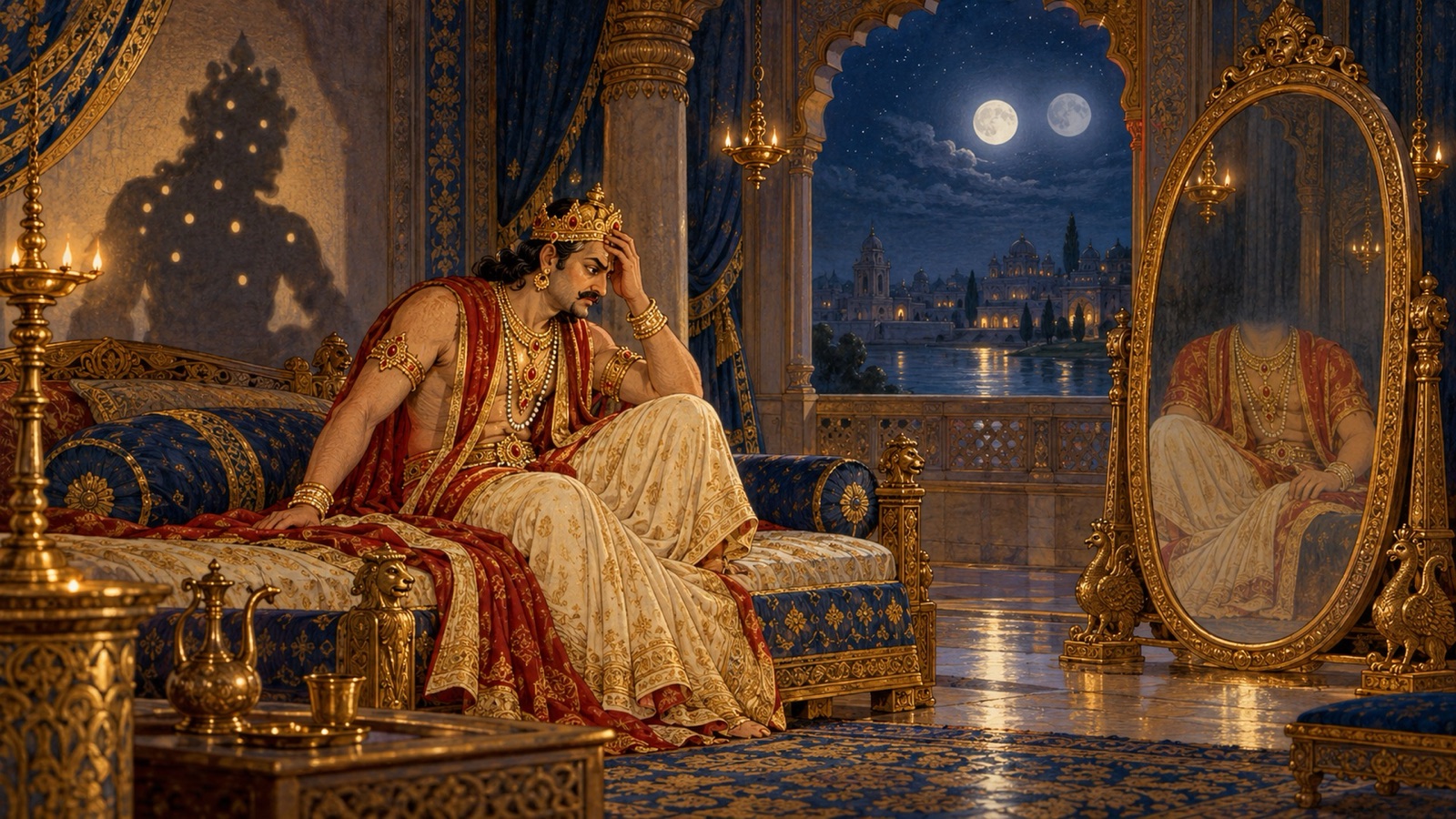
For Kamsa there was no such peace. Hearing of the breaking of the bow and the slaying of its keepers and of his own detachment — mere child’s play for Govinda and Balarama — the evil-minded king lay awake for long hours, and both in dream and in waking he saw many evil portents, the messengers of death. In a mirror he saw his reflection but no head upon it; the lights of the sky appeared doubled though nothing stood before his eyes; he saw holes in his own shadow, and when he closed his ears he could no longer hear the hum of life within them. Trees seemed to him made of gold, and he could not find his own footprints. In dreams he was embraced by the dead, rode on a donkey, drank poison, and wandered alone smeared with oil, wearing a wreath of red flowers and clothed only by the directions. Seeing such sights sleeping and waking, and terrified of death, Kamsa could not close his eyes for anxiety.
The Arena of Wrestling
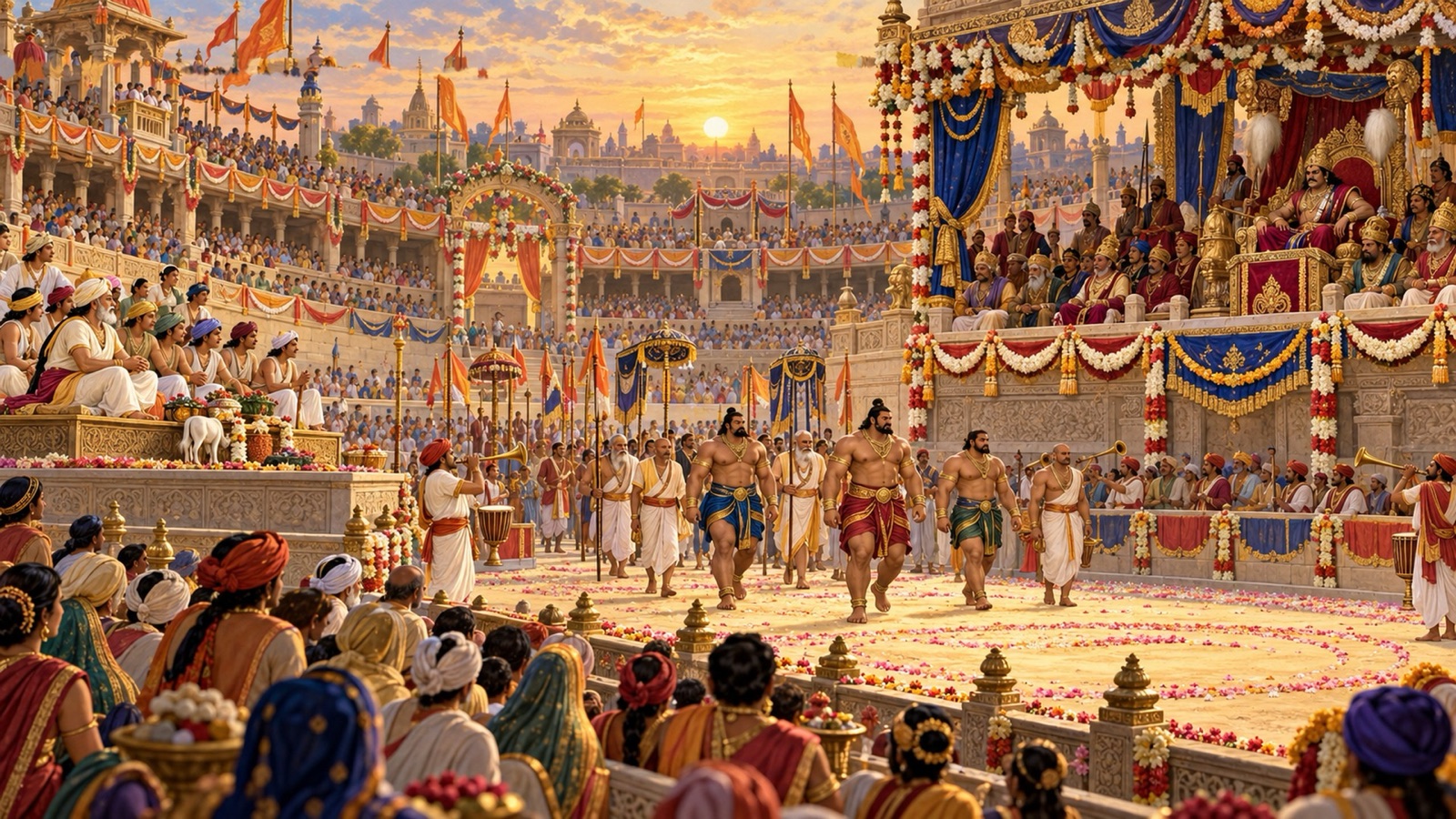
When the night ended and the sun rose from the waters, Kamsa had his great festival of wrestling begun. His men swept the arena, sprinkled it with water, and decorated it with flowers and garlands; trumpets and drums were sounded, and the galleries were adorned with garlands, flags, hangings and arches. Upon them the people of the city and the countryside took their places as they pleased, the brahmanas and kshatriyas foremost among them, and the kings sat upon their own seats.
कंसः परिवृतोऽमात्यै राजमञ्च उपाविशत् ।
मण्डलेश्वरमध्यस्थो हृदयेन विदूयता ॥ ३५ ॥
kaṁsaḥ parivṛto ’mātyai rāja-mañca upāviśat maṇḍaleśvara-madhya-stho hṛdayena vidūyatā
Meaning: Surrounded by his ministers, Kamsa took his seat on the royal dais in the midst of the vassal kings, with a heart that trembled in anguish. (Canto 10, Chapter 42, verse 35)
As the trumpets played to the rhythm of the wrestlers’ slapping arms, the proud champions, richly adorned, entered with their teachers and took their places; Chanura, Mushtika, Kuta, Shala and Toshala, cheered by the sweet music, came forward to the ring. And the cowherds led by Nanda, specially invited by the king of the Bhojas, having offered their presents, sat down together upon a dais of their own.
Principal Teachings of This Chapter
1. His sight itself bears fruit. The Lord straightens Trivakra expressly to reveal what beholding Him accomplishes. Darshan is never a mere glimpse; it reshapes the one who receives it, in body and in soul.
2. What we carry for the world can be offered to Him. Trivakra’s paste was meant for Kamsa, yet she gave it freely to the Brothers and was rewarded beyond measure. Whatever skill or possession we hold becomes sacred the moment it is placed in the Lord’s hands.
3. The Lord honours the love of the humble. To a lowly servant He promises to visit her house and calls her the refuge of wanderers. No devotee, however small in the world’s eyes, is overlooked by Him.
4. Pride’s instruments break in His hands. Kamsa’s worshipped bow, guarded by many, is lifted with one hand and snapped like a cane. The power of the wicked, however ornamented, is a toy before the Lord’s will.
5. The guilty heart cannot rest. Kamsa’s night of portents and his trembling on the dais show that fear is the inseparable companion of enmity toward God, while the Brothers, knowing his plans, sleep in peace.
A Devotional Reflection
Two nights lie side by side in this chapter, and the contrast between them is its quiet sermon. Outside the city, after a simple meal of milk-rice, Krishna and Balarama rest content though They know exactly what Kamsa has prepared for the morning. Inside the palace the king cannot shut his eyes, and every mirror, shadow and star has turned into a herald of his end. Circumstance decides neither; the heart’s relation to the Lord decides both. And between the two stands Trivakra, the bent servant on the road, who had nothing to offer but a vessel of paste and gave it anyway. Hold back from Him and the world itself begins to whisper of death; give Him the little we have and we are lifted upright by a touch, promised a visit, and left at peace.
A Daily Devotional Practice
Today, take one thing you ordinarily keep for yourself or for the world — a skill, a little time, something fragrant — and consciously offer it to the Lord, as Trivakra offered her sandal-paste. As you do, ask that whatever is bent in you be made straight by His sight. Begin by chanting gently: Om Namo Bhagavate Vasudevaya.
Conclusion
Chapter 42 of the Tenth Canto moves from mercy to might and then to dread: the Lord’s gracious touch upon Trivakra, the bow of Kamsa broken in the sacrificial hall, the king’s sleepless night of omens, and the arena filling at dawn with wrestlers, kings and the cowherds of Vraja. Through it all one truth shines — the sight of the Lord straightens the devoted and terrifies the wicked, and both are drawn toward Him. May we come to Him as Trivakra did, with our small offering in our hands.
May the divine wisdom of Srimad Bhagavatam awaken pure devotion within our hearts.
Om Namo Bhagavate Vasudevaya.
Jay Shree Madhav.
References and Attribution
- Primary edition: Gita Press, Śrīmad Bhāgavata Mahāpurāṇa (English), Book Ten (First Half), Discourse 42.
- Series: Srimad Bhagavatam Wisdom · Biswa Sanatan Dharma Seva Trust.
- Presented following the spiritual guidance and recommendation of Pandit Dr. Shri Kashinath Mishra.
This is an original, faithful retelling in the writer’s own words, with brief quoted verses shown in Devanāgarī and transliteration and their meanings given as summaries. It is not a reproduction of any single publisher’s continuous translation or commentary. No affiliation with or endorsement by any publisher is implied.
Jay Shree Madhav