A maddened royal elephant waits at the gate of Kamsa’s arena to crush two cowherd boys — and the Lord of the universe, tightening His waistcloth like a village wrestler, turns the king’s weapon into His own.
Om Namo Bhagavate Vasudevaya.
Om Namo Bhagavate Vasudevaya.
Om Namo Bhagavate Vasudevaya.
Welcome back to Srimad Bhagavatam Wisdom, our devotional journey through the sacred histories and teachings of the Srimad Bhagavat Mahapurana. In this forty-third chapter of the Tenth Canto, Sukadeva Gosvami brings Krishna and Balarama to the gate of Kamsa’s arena, where the elephant Kuvalayapida is set upon the Lord. He subdues it in play, enters the ring with its tusk on His shoulder, is beheld by every heart in its own way, and receives the wrestler Chanura’s challenge.
Chapter Information
- Scripture: Śrīmad Bhāgavata Mahāpurāṇa
- Canto: 10 (Book Ten, First Half)
- Chapter: 43 (Discourse 43)
- Chapter title: Krishna Kills the Elephant Kuvalayapida
- Principal speaker: Sukadeva Gosvami (narrating to King Parikshit)
- Principal listener: King Parikshit
- Main setting: The gateway and galleries of Kamsa’s wrestling arena in Mathurā
- Central subject: The slaying of Kuvalayapida; the brothers’ entry into the arena, where the one Lord is seen in many ways; the citizens’ recollection of His pastimes; Chanura’s challenge
- Principal verse range: Canto 10, Chapter 43, verses 1–40
- Primary edition: Gita Press Śrīmad Bhāgavata Mahāpurāṇa (English, Book Ten, Discourse 43)
Context From the Previous Chapter
In Chapter 42, Krishna straightened the hunchbacked Trivakra, broke Kamsa’s sacrificial bow and scattered its guards. The king, tormented by omens of death, had the arena made ready at dawn; Nanda and the cowherds took their seats on a separate dais as Chanura, Mushtika and the other champions entered the ring.
The Elephant at the Gate
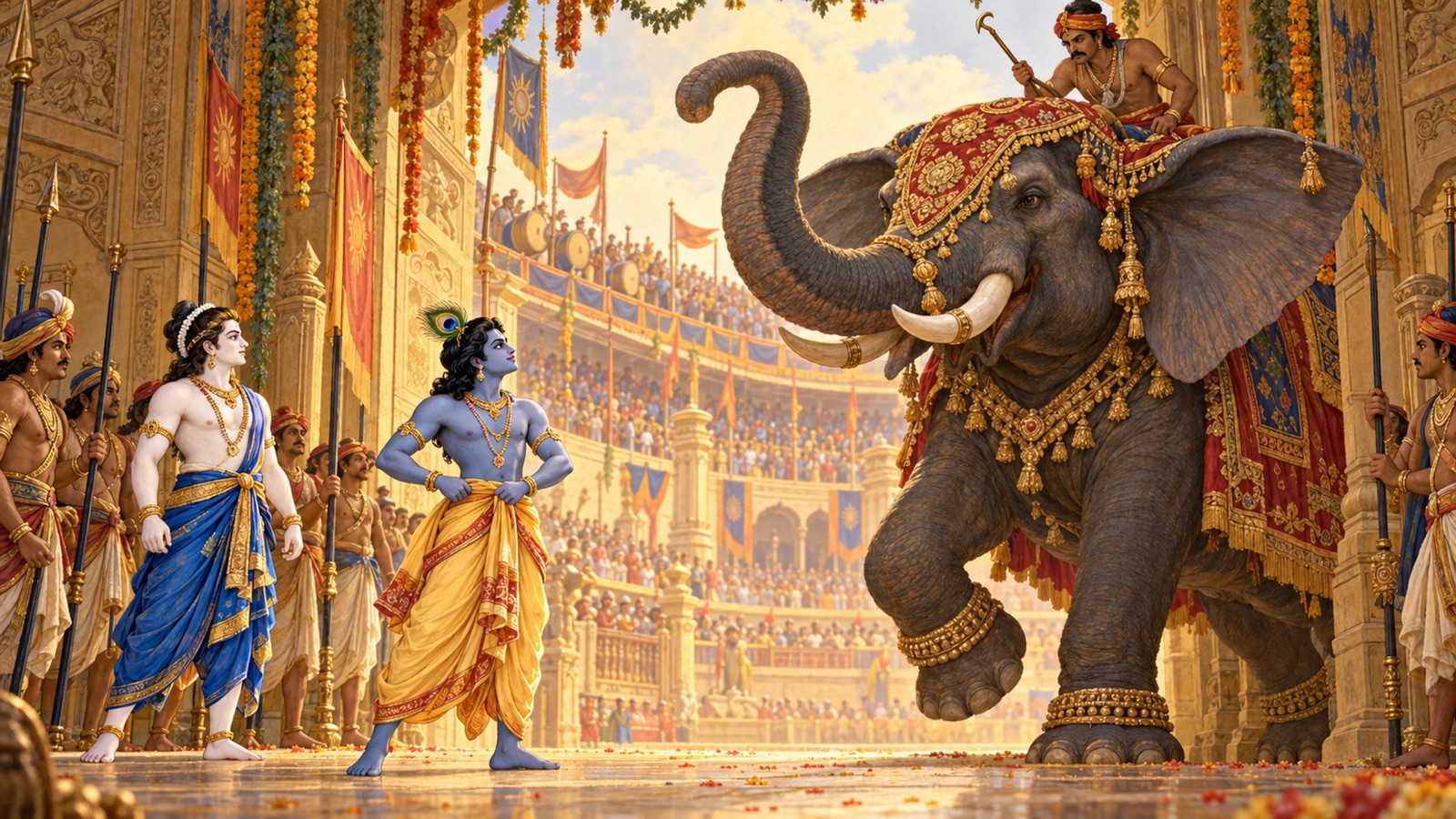
Sukadeva continued: the next morning, having finished Their bath and daily duties, Krishna and Balarama heard the roar of the wrestlers and the thunder of kettledrums, and went to watch the tournament. At the gate of the arena Krishna found the elephant Kuvalayapida stationed in His path at its driver’s command.
The Lord did not hesitate. Tightening the cloth about His waist and binding up His curling locks, as a wrestler readies himself for a bout, He addressed the mahout in a voice as deep as thunder:
अम्बष्ठाम्बष्ठ मार्गं नौ देह्यपक्रम मा चिरम् ।
नो चेत् सकुञ्जरं त्वाद्य नयामि यमसादनम् ॥ ४ ॥
ambaṣṭhāmbaṣṭha mārgaṁ nau dehy apakrama mā ciram no cet sa-kuñjaraṁ tvādya nayāmi yama-sādanam
Meaning: “Driver, O driver! Give way to the two of us and stand aside at once. If you do not, this very day I shall send you, elephant and all, to the abode of Yama.” (Canto 10, Chapter 43, verse 4)
Stung by this threat, the keeper grew furious and goaded the already enraged elephant straight at Krishna — a beast that looked like Yama himself, the Time that ends all beings.
The Lord Sports with Kuvalayapida
The lordly beast charged and swiftly caught Krishna in its trunk. But the Lord slipped free of the coils, struck the trunk with His fist, and vanished among the elephant’s legs. Unable to see Him, the animal tracked Him by scent and gripped Him again with the tip of its trunk; once more Krishna tore Himself from its hold.
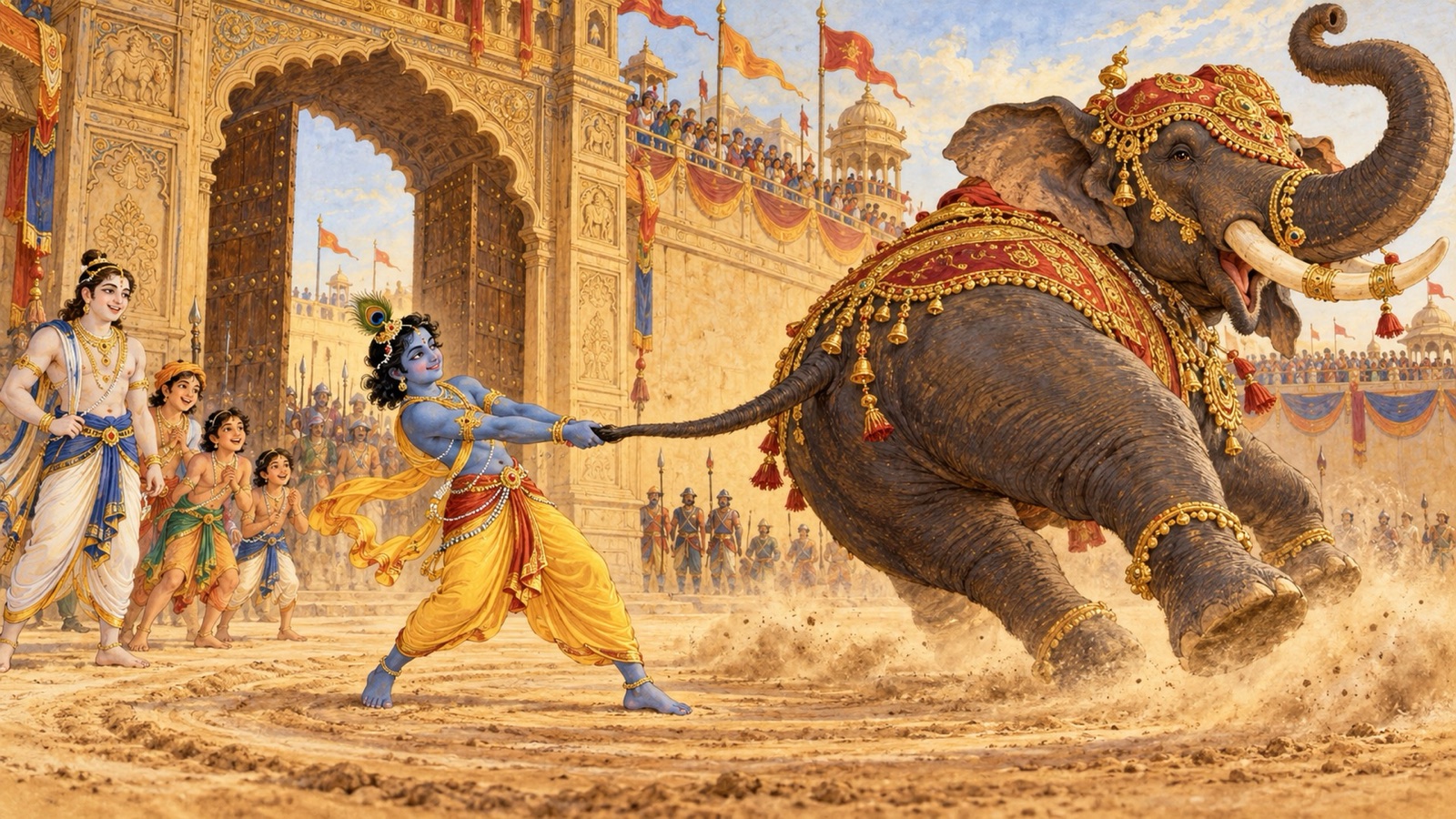
Then, seizing the mighty elephant by its tail, the Lord dragged it backwards the length of twenty-five bows, as easily as Garuda tugs a serpent in play.
पुच्छे प्रगृह्यातिबलं धनुष: पञ्चविंशतिम् ।
विचकर्ष यथा नागं सुपर्ण इव लीलया ॥ ८ ॥
pucche pragṛhyāti-balaṁ dhanuṣaḥ pañca-viṁśatim vicakarṣa yathā nāgaṁ suparṇa iva līlayā
Meaning: Taking hold of the immensely powerful elephant by the tail, He pulled it a distance of twenty-five bow-lengths, sportively, just as Garuda would drag a snake. (Canto 10, Chapter 43, verse 8)
Holding its tail, the infallible Lord wheeled around with the elephant as it turned left and right to reach Him, just as a boy spins a calf. Then He ran before it, struck it with His hand, and darted ahead so close that it seemed to touch Him at every step. Tumbling to the ground in play, He sprang up at once; the furious animal, thinking Him fallen, drove its tusks into the earth. Its charge frustrated and its keepers urging it on, it rushed at Krishna again.
The Elephant Subdued
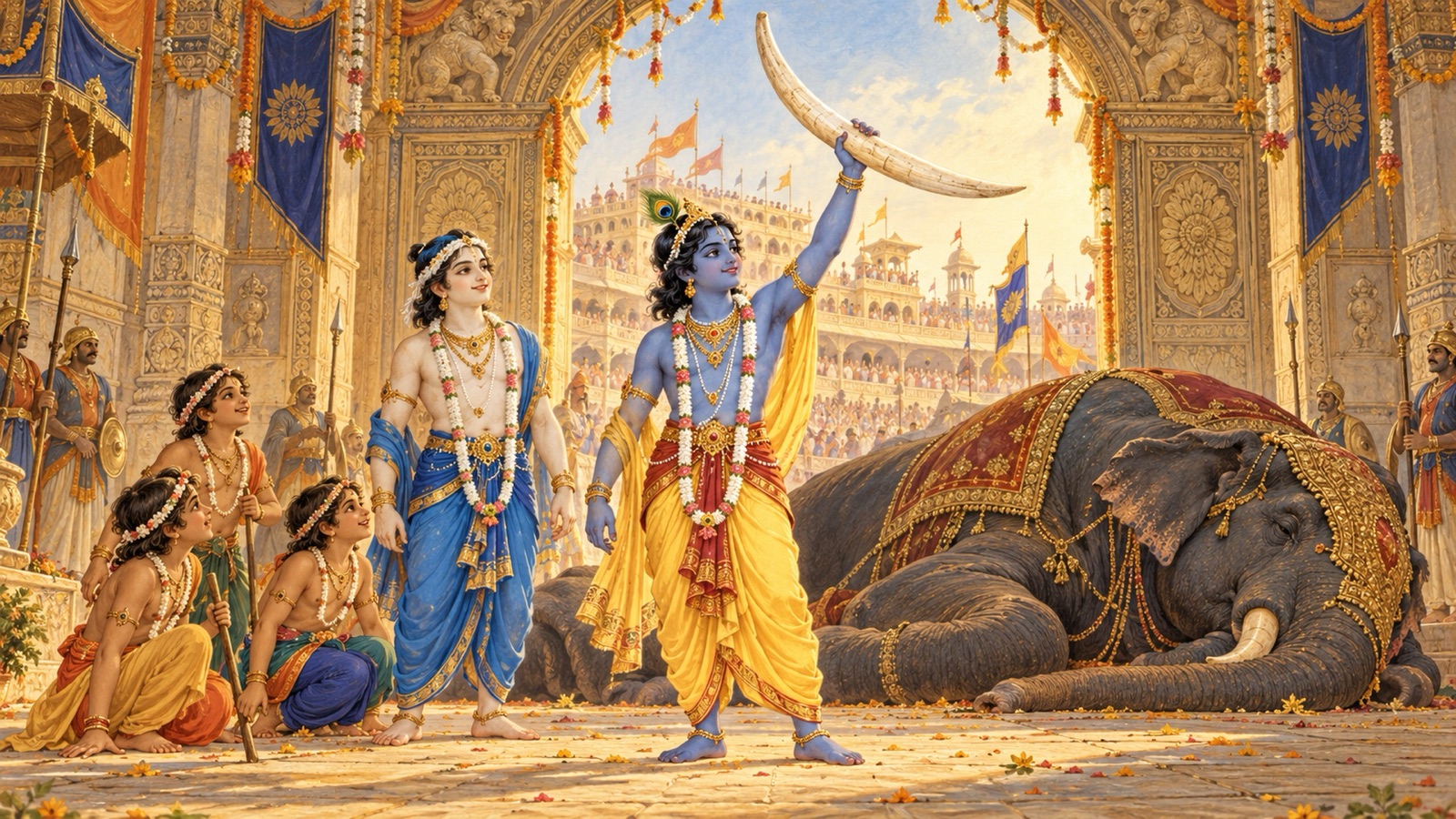
Meeting the elephant as it bore down on Him, Lord Madhusudana caught its trunk in His hand and hurled it to the ground. Then, stepping upon the fallen animal like a lion, He drew out a tusk in sport and with it struck down the elephant and its keepers.
पतितस्य पदाक्रम्य मृगेन्द्र इव लीलया ।
दन्तमुत्पाट्य तेनेभं हस्तिपांश्चाहनद्धरि: ॥ १४ ॥
patitasya padākramya mṛgendra iva līlayā dantam utpāṭya tenebhaṁ hastipāṁś cāhanad dhariḥ
Meaning: Treading on the fallen elephant as the king of beasts would, and playfully pulling out one of its tusks, Sri Hari slew with it both the elephant and its keepers. (Canto 10, Chapter 43, verse 14)
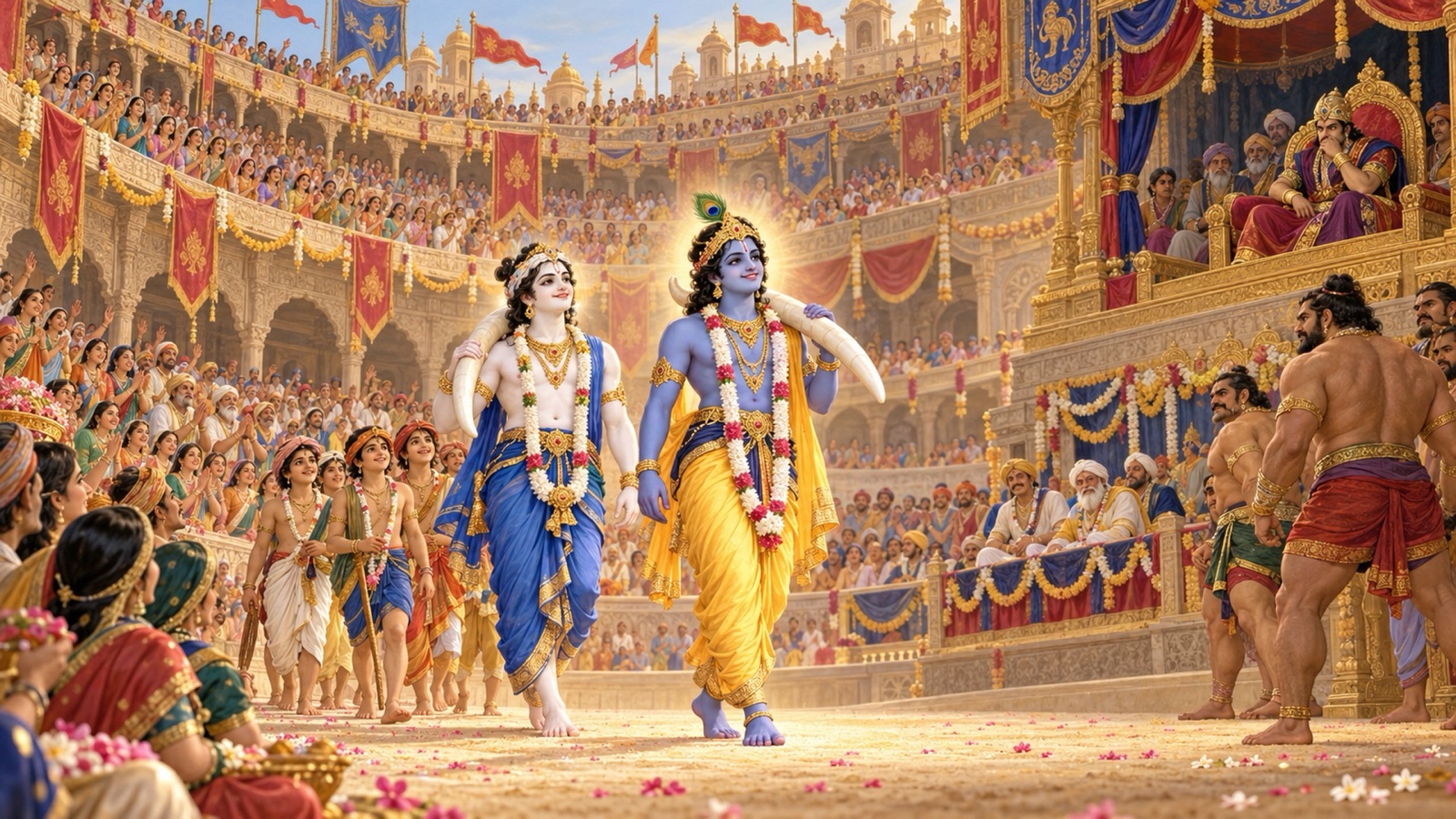
Leaving the lifeless elephant where it lay, the Lord walked on with the tusk resting on His shoulder, marked with drops of its blood and ichor, beads of sweat shining on His lotus face — and so He looked more beautiful than ever. Surrounded by a few cowherd boys, with the tusks for Their splendid weapons, Balarama and Krishna entered the ring.
One Lord, Seen in Many Ways
As He stood in the arena beside His elder brother, the Lord was one, yet He was perceived in as many ways as there were hearts to behold Him.
मल्लानामशनिर्नृणां नरवर: स्त्रीणां स्मरो मूर्तिमान्
गोपानां स्वजनोऽसतां क्षितिभुजां शास्ता स्वपित्रो: शिशु: ।
मृत्युर्भोजपतेर्विराडविदुषां तत्त्वं परं योगिनां
वृष्णीनां परदेवतेति विदितो रङ्गं गत: साग्रज: ॥ १७ ॥
mallānām aśanir nṛṇāṁ nara-varaḥ strīṇāṁ smaro mūrtimān gopānāṁ sva-jano ‘satāṁ kṣiti-bhujāṁ śāstā sva-pitroḥ śiśuḥ mṛtyur bhoja-pater virāḍ aviduṣāṁ tattvaṁ paraṁ yogināṁ vṛṣṇīnāṁ para-devateti vidito raṅgaṁ gataḥ sāgrajaḥ
Meaning: Entering the arena with His elder brother, He was known to the wrestlers as a thunderbolt, to the men as the best of men, to the women as Cupid in person, to the cowherds as their kinsman, to the wicked kings as a punisher, to His parents as a child, to the king of the Bhojas as Death, to the ignorant as a mere physical form, to the yogis as the Supreme Truth, and to the Vrishnis as their highest Deity. (Canto 10, Chapter 43, verse 17)
Here lies the heart of this chapter. The Lord who walked into Kamsa’s arena did not change from one face to another; the beholders changed Him. Each received Him in the measure and mood of their own heart — the wrestler’s dread made Him a thunderbolt, a parent’s tenderness a child, the yogi’s search the Absolute Truth, the guilty king’s terror Death. This is why the same Krishna is bliss to the gopis and doom to Kamsa, and why the Bhagavatam teaches that our relationship with Him is shaped by the bhava we bring. He is complete in Himself; what we see in Him reveals us. Approach Him with love, and love is what He becomes for you.
Seeing Kuvalayapida slain and the two brothers plainly unconquerable, Kamsa was shaken to the core, though he kept his composure. The mighty-armed brothers, adorned in wonderfully varied garments, ornaments and garlands, dazzled the onlookers, shining in the arena like two actors in splendid costume.
The Crowd Drinks in Their Beauty
The people of the city and the countryside, seated in the galleries, gazed upon those two supreme Persons with eyes and faces blossoming in a rush of joy, and could not get their fill of Their faces.
निरीक्ष्य तावुत्तमपूरुषौ जना
मञ्चस्थिता नागरराष्ट्रका नृप ।
प्रहर्षवेगोत्कलितेक्षणानना:
पपुर्न तृप्ता नयनैस्तदाननम् ॥ २० ॥
nirīkṣya tāv uttama-pūruṣau janā mañca-sthitā nāgara-rāṣṭrakā nṛpa praharṣa-vegotkalitekṣaṇānanāḥ papur na tṛptā nayanais tad-ānanam
Meaning: O King, beholding those two supreme Persons, the townspeople and country folk seated in the stands, their eyes and faces opening wide with a surge of delight, drank Their faces in with their eyes and were never satisfied. (Canto 10, Chapter 43, verse 20)
They seemed to drink the brothers in with their eyes, taste Them with their tongues, breathe Them in, embrace Them with their arms; and as if reminded of Their whole story by Their beauty, virtues, sweetness and fearlessness, they began telling one another all they had seen and heard.
What the People of Mathura Said
“These two,” they said, “are surely portions of the Supreme Lord Hari, Narayana Himself, descended in the house of Vasudeva. This younger one was born of Devaki and carried to Gokula, where He grew up hidden in the home of Nanda. By Him Putana was ended, and the whirlwind demon, the Guhyaka, Keshi who came as a horse, Dhenuka and others of their kind; by Him the twin Arjuna trees were uprooted, the cows and cowherds saved from a forest fire, the serpent Kaliya tamed, and Indra humbled when for a whole week this child held up Govardhana on one hand and sheltered Gokula from rain, wind and lightning. The cowherd women, gazing on His ever-smiling face, crossed their many sorrows without effort. The wise say that the line of Yadu, guarded by Him, will win wealth, fame and greatness. And here is His elder brother, the glorious lotus-eyed Balarama, who slew Pralamba, the calf demon, Baka and the rest.”
Chanura’s Challenge
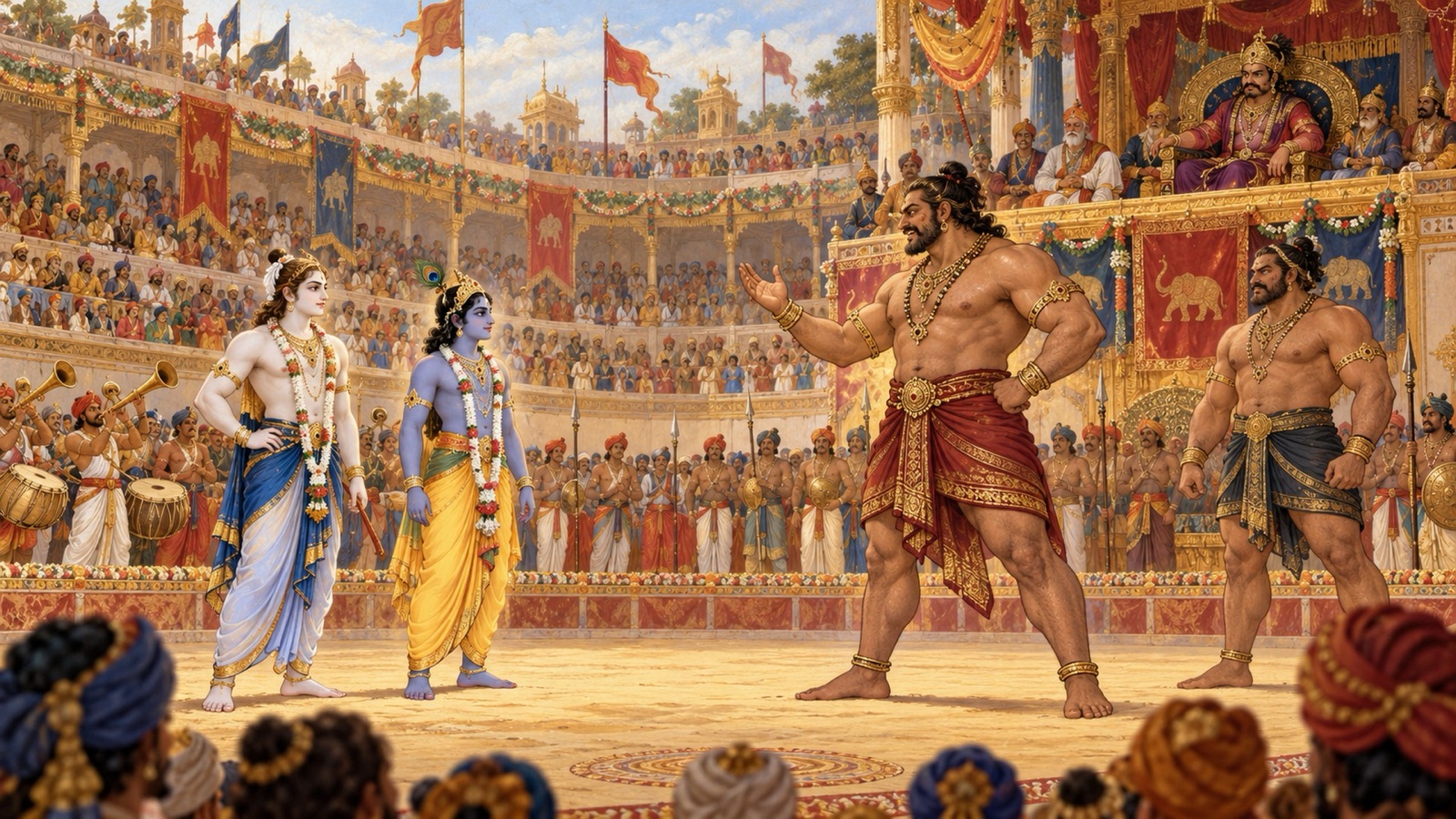
While the people spoke this way and the trumpets blared, Chanura, chief of the king’s wrestlers, hailed Krishna and Balarama: “O son of Nanda, O Balarama, you are honoured as heroes. Hearing of your skill in wrestling, the king, eager to see you, has invited you here. Subjects who please the king in thought, word and deed attain well-being; those who act otherwise meet the opposite. Everyone knows that cowherds, from the days they tend calves, graze their cows in the woods while amusing themselves with wrestling. So let us all do what the king desires; then every being will be pleased with us, for the king embodies all creatures.”
Krishna’s Measured Reply
Krishna welcomed the proposal, for a bout was exactly what He wished, but His reply fitted the time and place: “We forest-dwellers are also subjects of this Bhoja king, just as you are. Let us always do what pleases him; that is the greatest favour to us. Yet we are only boys, and we shall play with those who match us in strength. Let the contest be fair, so that no sin touches this assembly, O wrestler.”
बाला वयं तुल्यबलै: क्रीडिष्यामो यथोचितम् ।
भवेन्नियुद्धं माधर्म: स्पृशेन्मल्ल सभासद: ॥ ३८ ॥
bālā vayaṁ tulya-balaiḥ krīḍiṣyāmo yathocitam bhaven niyuddhaṁ mādharmaḥ spṛśen malla sabhāsadaḥ
Meaning: We are mere boys, and we shall sport with those of equal strength, as is proper. Let the wrestling be well matched, O wrestler, so that no unrighteousness touches those seated in this assembly. (Canto 10, Chapter 43, verse 38)
Chanura would not accept the plea. “You are neither a boy nor a youth,” he said, “nor is Balarama, best of the strong — you who finished off in play an elephant with the strength of a thousand elephants. So you both must fight strong opponents; there is no injustice in that. Show your prowess against me, O descendant of Vrishni, and let Mushtika take on Balarama.” With that challenge the chapter closes, the bout about to begin.
Principal Teachings of This Chapter
1. The Lord walks straight through the obstacle set against Him. Kuvalayapida was posted at the gate by Kamsa’s design, yet Krishna neither turned aside nor sought another entrance. Whatever is placed against a devotee’s approach to the Lord becomes, in His hands, a token of His victory.
2. His might is play. Sukadeva keeps returning to the word “sport”: the tail dragged as Garuda tugs a serpent, the whirling calf, the lion drawing out a tusk. What is a terror to us is a pastime to Him.
3. Each sees Him as the heart allows. Verse 17 is the chapter’s jewel: one Lord, ten perceptions. Our vision of Krishna mirrors our own disposition, so the surest way to see Him sweetly is to cultivate a loving heart.
4. Seeing Him overflows into speaking of Him. The moment the citizens drink in His beauty, they begin recounting His pastimes to one another. Darshana ripens into kirtan; one who has truly looked upon the Lord cannot keep silent about Him.
5. Even in the arena, dharma first. Though a bout was exactly what He wanted, Krishna asked for a fair contest so that no sin would touch the assembly. The Lord never bends righteousness for display, and honours even a hostile king’s authority in speech while keeping His purpose intact.
A Devotional Reflection
What stays with the heart after this chapter is not the elephant but the gallery. The Lord, who had every reason to arrive as a conqueror, arrived as a wrestler with His hair tied up, politely asking a mahout for the road. Then He stood in the ring and let everyone see Him as they wished. The frightened saw a thunderbolt; the loving saw a child; the searching saw the Truth. No one was forced to see rightly, and no one who loved Him was disappointed. We too stand somewhere in that gallery every day; the question is not whether Krishna will come — He has already walked through the gate — but with what eyes we will meet Him. If Kamsa’s guilt could turn the Lord’s face into Death, surely a little love can turn it into the face of a friend.
A Daily Devotional Practice
Today, before you look at anyone, pause for a breath and remember that ten kinds of hearts saw the Lord in Kamsa’s arena in ten different ways. Ask with what heart you are looking, and choose, as far as you can, the heart of the cowherds who saw their own kinsman. Begin by chanting gently: Om Namo Bhagavate Vasudevaya.
Conclusion
The forty-third chapter of the Tenth Canto carries Krishna from the gate of Kamsa’s arena to the very edge of the wrestling bout. Kuvalayapida falls, its tusk becomes the Lord’s weapon, and the two brothers enter the ring to be beheld by every heart in its own way. Its one central lesson is that the Lord is seen as we are able to see Him. May we bring Him the eyes of love, so that when He walks through the gate of our lives, we recognize our own.
May the divine wisdom of Srimad Bhagavatam awaken pure devotion within our hearts.
Om Namo Bhagavate Vasudevaya.
Jay Shree Madhav.
References and Attribution
- Primary edition: Gita Press, Śrīmad Bhāgavata Mahāpurāṇa (English), Book Ten (First Half), Discourse 43.
- Series: Srimad Bhagavatam Wisdom · Biswa Sanatan Dharma Seva Trust.
- Presented following the spiritual guidance and recommendation of Pandit Dr. Shri Kashinath Mishra.
This is an original, faithful retelling in the writer’s own words, with brief quoted verses shown in Devanāgarī and transliteration and their meanings given as summaries. It is not a reproduction of any single publisher’s continuous translation or commentary. No affiliation with or endorsement by any publisher is implied.
Jay Shree Madhav