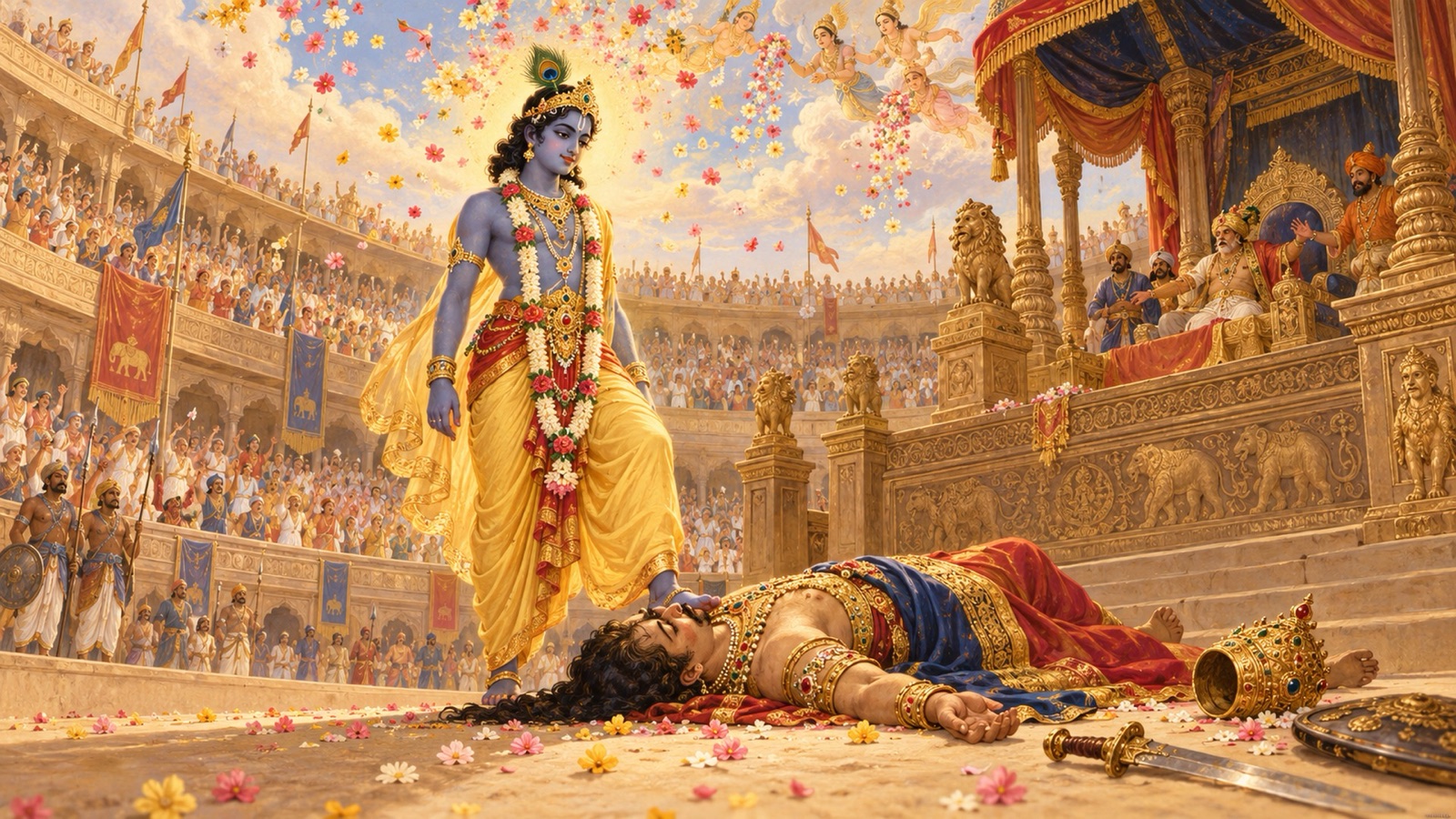
In Mathura’s arena two tender-limbed boys from Vraja overthrow the king’s champions, and then the Lord springs onto the royal dais and ends the long tyranny of Kamsa.
Om Namo Bhagavate Vasudevaya.
Om Namo Bhagavate Vasudevaya.
Om Namo Bhagavate Vasudevaya.
Welcome back to Srimad Bhagavatam Wisdom, our devotional journey through the sacred histories and teachings of the Srimad Bhagavat Mahapurana. This forty-fourth chapter of the Tenth Canto is the hour toward which every chapter since Krishna’s birth has been moving: before all Mathura the two Brothers wrestle Chanura and Mushtika, and the Lord at last lays His hand upon Kamsa.
Chapter Information
- Scripture: Śrīmad Bhāgavata Mahāpurāṇa
- Canto: 10 (Book Ten, First Half)
- Chapter: 44 (Discourse 44)
- Chapter title: The Killing of Kamsa
- Principal speaker: Sukadeva Gosvami (narrating to King Parikshit)
- Principal listener: King Parikshit
- Main setting: The wrestling arena of Mathura, before Kamsa’s royal dais
- Central subject: The wrestling match; the words of the women of Mathura; the slaying of Kamsa; the lament of the queens; the release of Vasudeva and Devaki
- Principal verse range: Canto 10, Chapter 44, verses 1–51
- Primary edition: Gita Press Śrīmad Bhāgavata Mahāpurāṇa (English, Book Ten)
Context From the Previous Chapter
In Chapter 43 Krishna slew the elephant Kuvalayapida at the gate of the arena and entered with its tusk upon His shoulder. Chanura, Kamsa’s chief wrestler, invited the Brothers to wrestle before the king. Krishna asked for a fair bout between equals; Chanura replied that the slayers of that mighty elephant were no boys, and called on Krishna to face him and Balarama to face Mushtika.
The Wrestling Begins
Sukadeva continued: challenged in this way, Lord Madhusudana, His resolve already fixed, at once closed with Chanura, and Balarama, the son of Rohini, with Mushtika. Hand locked in hand and foot braced against foot, each pair tugged at the other with fierce determination to throw him down. Elbow struck elbow, knee met knee, head pressed against head and chest against chest. They wheeled each other round, shoved and squeezed, threw and slipped to front and rear; they lifted, carried, flung and pinned, each hungry for victory, before the eyes of all Mathura.
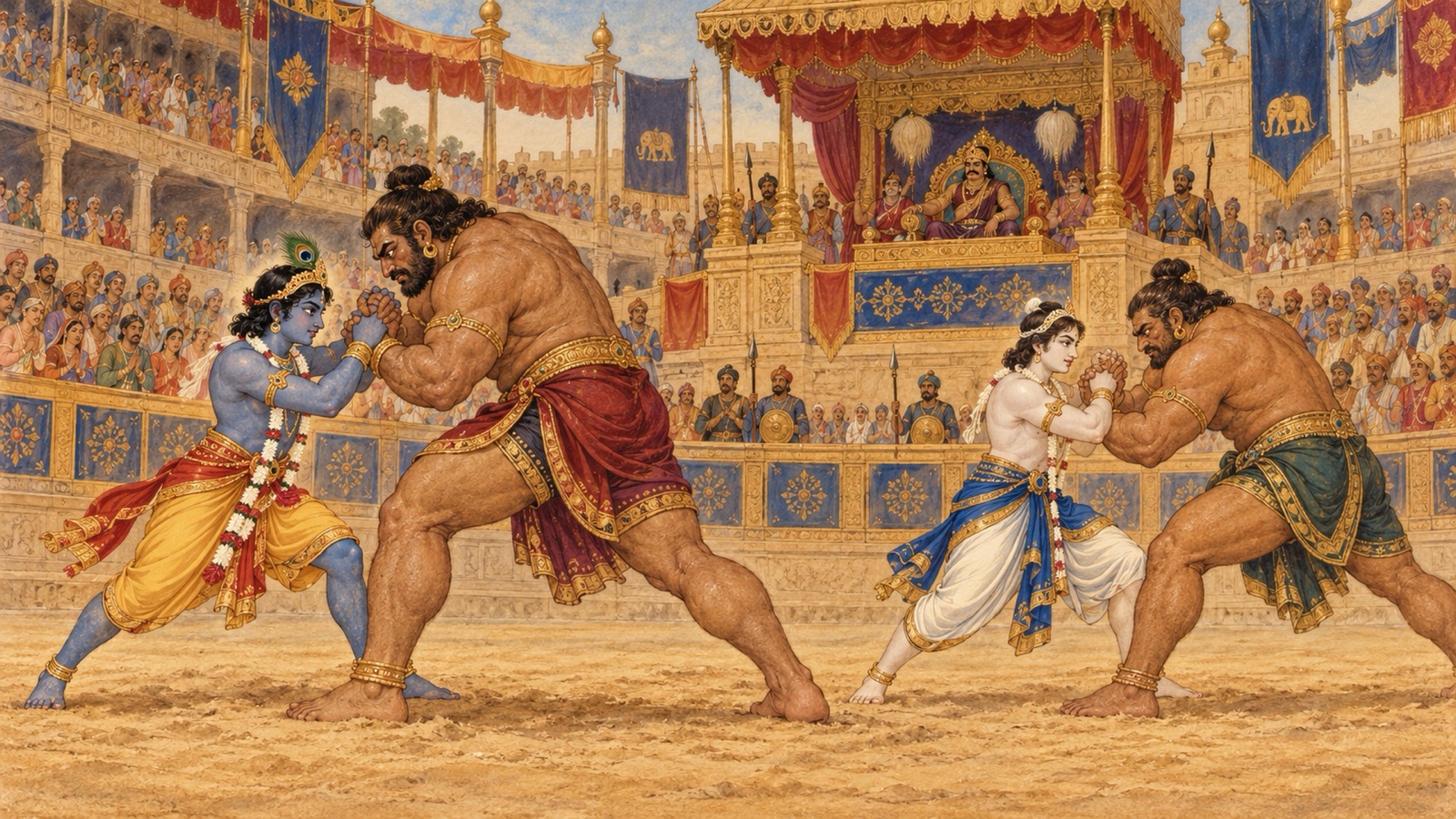
The Women of Mathura Speak
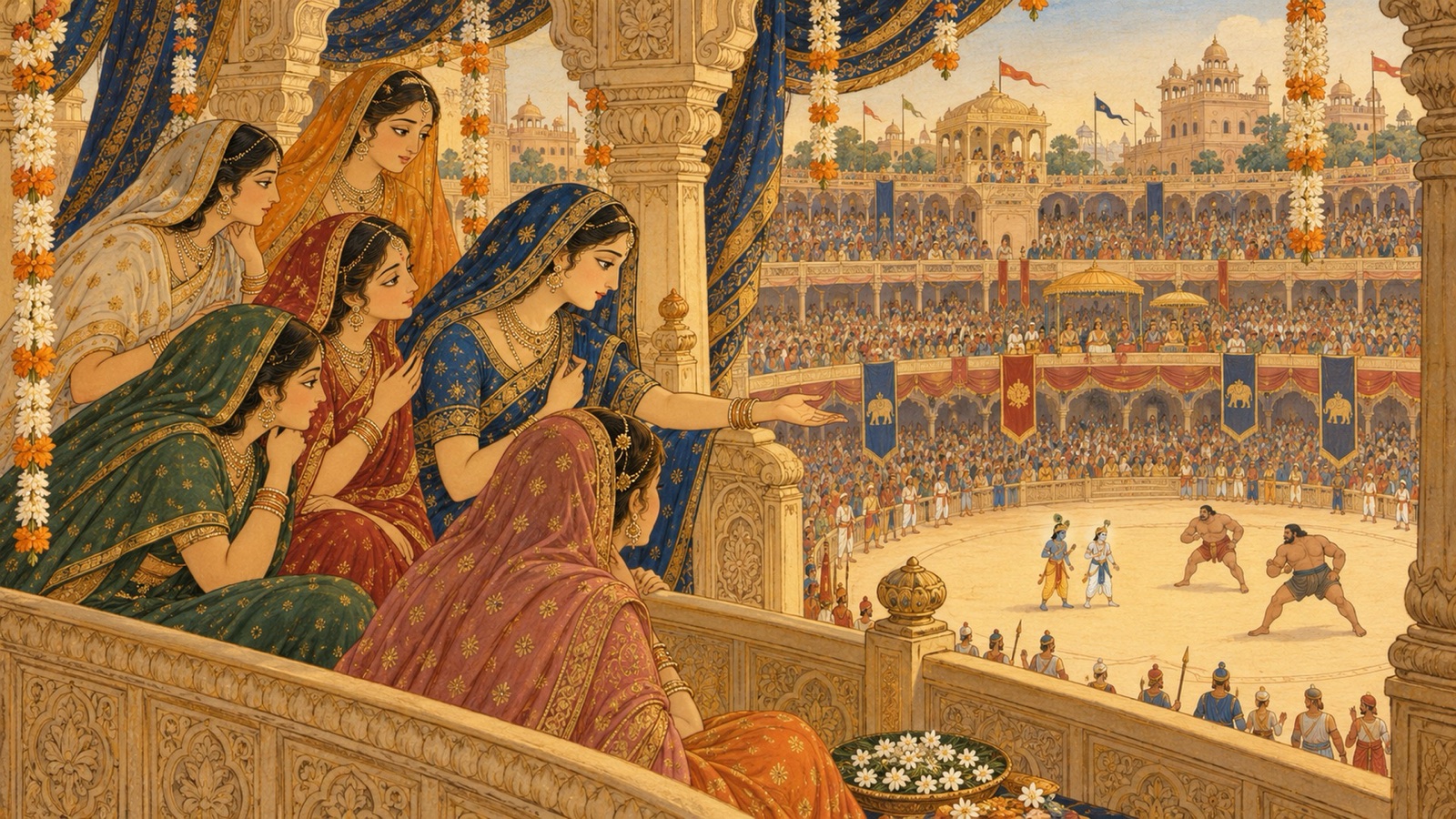
It was a contest between the strong and the weak, and the women present could not watch it in silence. Full of compassion, they drew together in groups and spoke among themselves. ‘What a great sin these courtiers commit,’ they said, ‘who allow such an unequal fight while the king sits looking on! On one side, two wrestlers whose every limb is hard as a thunderbolt, like a pair of great mountains; on the other, two tender-bodied boys who have not yet reached their youth. This assembly will surely forfeit its merit, for one must never remain where unrighteousness raises its head.’
न सभां प्रविशेत् प्राज्ञः सभ्यदोषाननुस्मरन् ।
अब्रुवन् विब्रुवन्नज्ञो नरः किल्बिषमश्नुते ॥ १० ॥
na sabhāṁ praviśet prājñaḥ sabhya-doṣān anusmaran abruvan vibruvann ajño naraḥ kilbiṣam aśnute
Meaning: A wise person, mindful of the faults of those who sit in an assembly, should not enter it at all; for one who stays silent there, or speaks falsely, or pleads ignorance, takes sin upon himself. (Canto 10, Chapter 44, verse 10)
Yet even as they condemned the match, their eyes were held fast by the Lord. ‘Look at the lotus face of Krishna,’ they said, ‘beaded with sweat like a lotus bud sprinkled with water as He darts about His opponent. And see the face of Balarama, His eyes reddened with anger at Mushtika, shining with laughter and the spirit of battle.’ Then their thoughts flew to Vraja.
पुण्या बत व्रजभुवो यदयं नृलिङ्गगूढः पुराणपुरुषो वनचित्रमाल्यः ।
गाः पालयन् सहबलः क्वणयंश्च वेणुं विक्रीडयाञ्चति गिरित्ररमार्चिताङ्घ्रिः ॥ १३ ॥
puṇyā bata vraja-bhuvo yad ayaṁ nṛ-liṅga- gūḍhaḥ purāṇa-puruṣo vana-citra-mālyaḥ gāḥ pālayan saha-balaḥ kvaṇayaṁś ca veṇuṁ vikrīḍayāñcati giritra-ramārcitāṅghriḥ
Meaning: Ah, blessed is the soil of Vraja, where this Most Ancient Person, hidden in a human form and garlanded with forest flowers, whose feet are worshipped by Shiva and by Lakshmi, wanders in sport, tending the cows with Balarama and sounding His flute. (Canto 10, Chapter 44, verse 13)
‘What austerities did the gopis perform,’ they went on, ‘that with their eyes they drink His form, the essence of loveliness, ever new and hard to attain? Blessed are the women of Vraja who sing of Him while they milk the cows, churn the curd and rock the cradles, their throats choked with tears; and fortunate are those who, hearing His flute at morning and evening, hurry to the road and behold His smiling, kindly face.’
The Fall of Chanura and Mushtika
While the women spoke thus in anxious tones, Sri Hari, the Master of Yoga who reads every heart, resolved to finish His enemy. Hearing those fearful words, Vasudeva and Devaki, unaware of their Sons’ strength, were tormented with anxiety. The two pairs fought on with every mode of wrestling, and under the blows of the Lord’s limbs, hard as crashing thunderbolts, Chanura’s body was shattered again and again and he grew faint. With the speed of a hawk he clenched both fists and struck the Lord on the chest in fury. Krishna no more moved under that blow than an elephant struck with a garland. He seized Chanura by the arms, whirled him round many times and cast him upon the ground; the life had left him even as he spun, and he fell like Indra’s great banner-pole, his ornaments and hair in disarray.
In the same way Mushtika, having first struck Balarama with his fist, was struck in return by the open palm of the mighty Balabhadra; trembling, blood rising to his lips, he dropped lifeless like a tree blown down by the wind. The wrestler Kuta came next, and Balarama, foremost of fighters, disposed of him playfully with His left fist. That very moment Shala fell to a blow of Krishna’s foot and Toshala was broken like a blade of grass. With these five gone, the remaining wrestlers fled for their lives, and the two Brothers drew Their cowherd friends into the arena and danced with them to the trumpets, Their anklets ringing.
Kamsa’s Last Command
All the people rejoiced at the feat of Balarama and Krishna, and the foremost brahmanas and the righteous cried ‘Well done! Well done!’ — all but Kamsa. The king of the Bhojas silenced his trumpets and gave his orders: ‘Drive these two ill-behaved sons of Vasudeva out of the city. Seize the wealth of the cowherds and put the wicked Nanda in chains. Let the evil-minded Vasudeva, lowest of men, be killed at once, and my father Ugrasena too, with his followers, for he has taken my enemies’ side.’
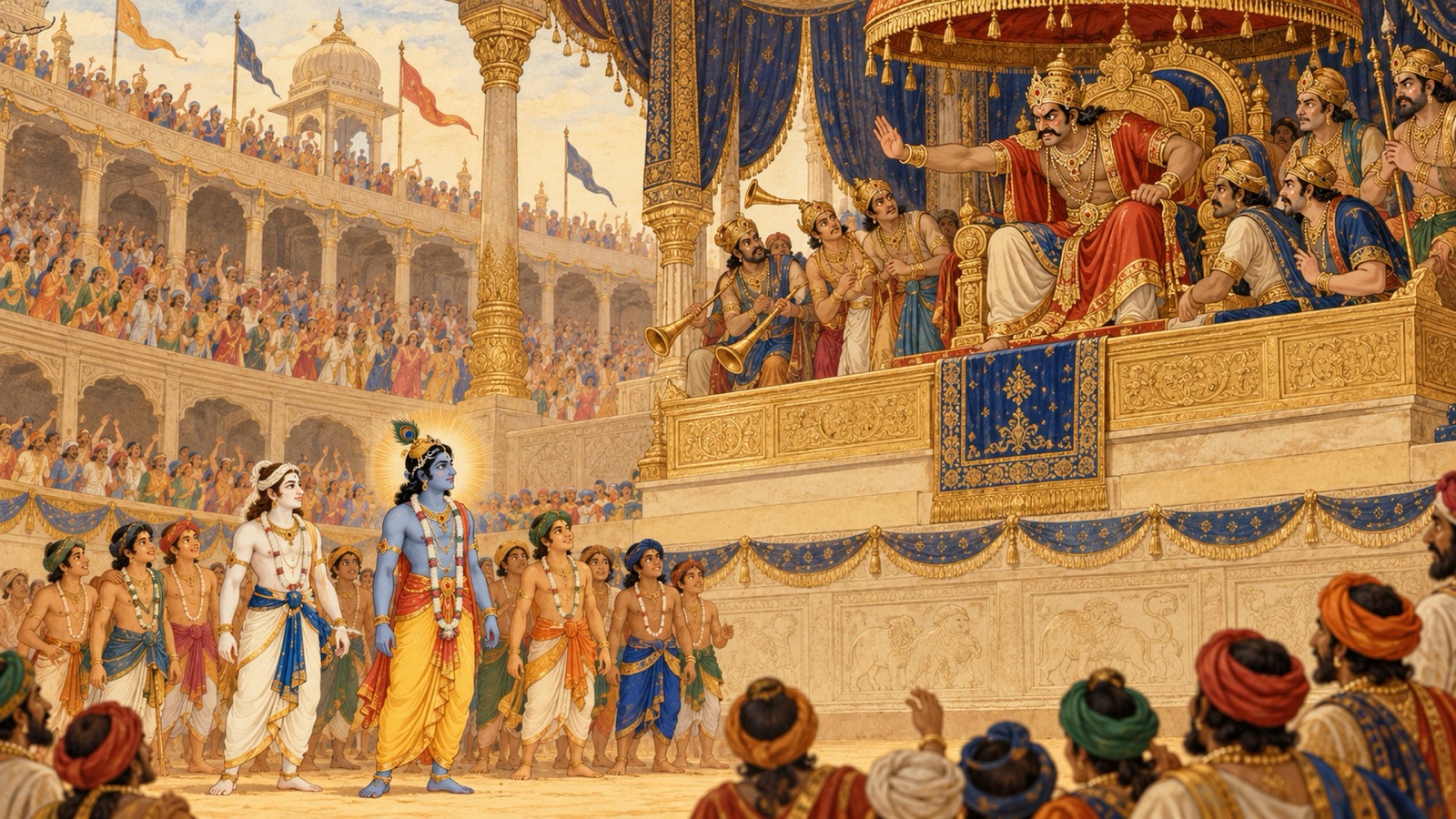
The Killing of Kamsa
As Kamsa raved in this way the infallible Lord grew angry; with one light leap He sprang onto the high royal dais. Seeing his own death approaching, the proud Kamsa rose and snatched up his sword and shield. But as he wheeled right and left like a hawk in the air, Krishna, of fierce and irresistible might, seized him with a firm grip, as Garuda seizes a serpent.
प्रगृह्य केशेषु चलत्किरीटं निपात्य रङ्गोपरि तुङ्गमञ्चात् ।
तस्योपरिष्टात् स्वयमब्जनाभः पपात विश्वाश्रय आत्मतन्त्रः ॥ ३७ ॥
pragṛhya keśeṣu calat-kirīṭaṁ nipātya raṅgopari tuṅga-mañcāt tasyopariṣṭāt svayam abja-nābhaḥ papāta viśvāśraya ātma-tantraḥ
Meaning: Grasping him by the hair, his crown slipping off, the Lord hurled him from the lofty dais down into the arena; and then the lotus-navelled Lord, the support of the universe, who depends on none but Himself, leapt down upon him in person. (Canto 10, Chapter 44, verse 37)
Then, as the world looked on, the Lord dragged his lifeless body along the ground as a lion drags an elephant, and a great cry of ‘Alas!’ rose from the people. Yet see the mercy hidden within this terrible scene. For years Kamsa, with a mind full of dread, had seen that very Lord with discus in hand before him in every act of his life; and by that unbroken remembrance, born though it was of fear, he attained after death the Lord’s own form.
स नित्यदोद्विग्नधिया तमीश्वरं पिबन्नदन्वा विचरन् स्वपन् श्वसन् ।
ददर्श चक्रायुधमग्रतो यतस्तदेव रूपं दुरवापमाप ॥ ३९ ॥
sa nityadodvigna-dhiyā tam īśvaraṁ pibann adan vā vicaran svapan śvasan dadarśa cakrāyudham agrato yatas tad eva rūpaṁ duravāpam āpa
Meaning: Because, with a mind ever troubled by fear, he saw that same Lord, discus in hand, before him whether he drank or ate, walked or slept, or merely breathed, he attained that very form of the Lord, so difficult to attain. (Canto 10, Chapter 44, verse 39)
Here lies the heart of the chapter. The Lord does not slay Kamsa as one king destroys a rival; He slays him as the Supreme Lord releasing a soul who, however perversely, could not stop thinking of Him. The same terror that drove Kamsa to imprison his sister and kill her newborn children also fixed his mind unceasingly on Krishna, and such absorption, even in enmity, bears the fruit that yogis labour for through lifetimes. Krishna’s hand upon Kamsa is therefore judgement and grace at once: the oppression of Mathura ends, the innocent are spared, and the tyrant himself is carried beyond death into the Lord’s likeness.
Kamsa’s Brothers and the Lament of the Queens
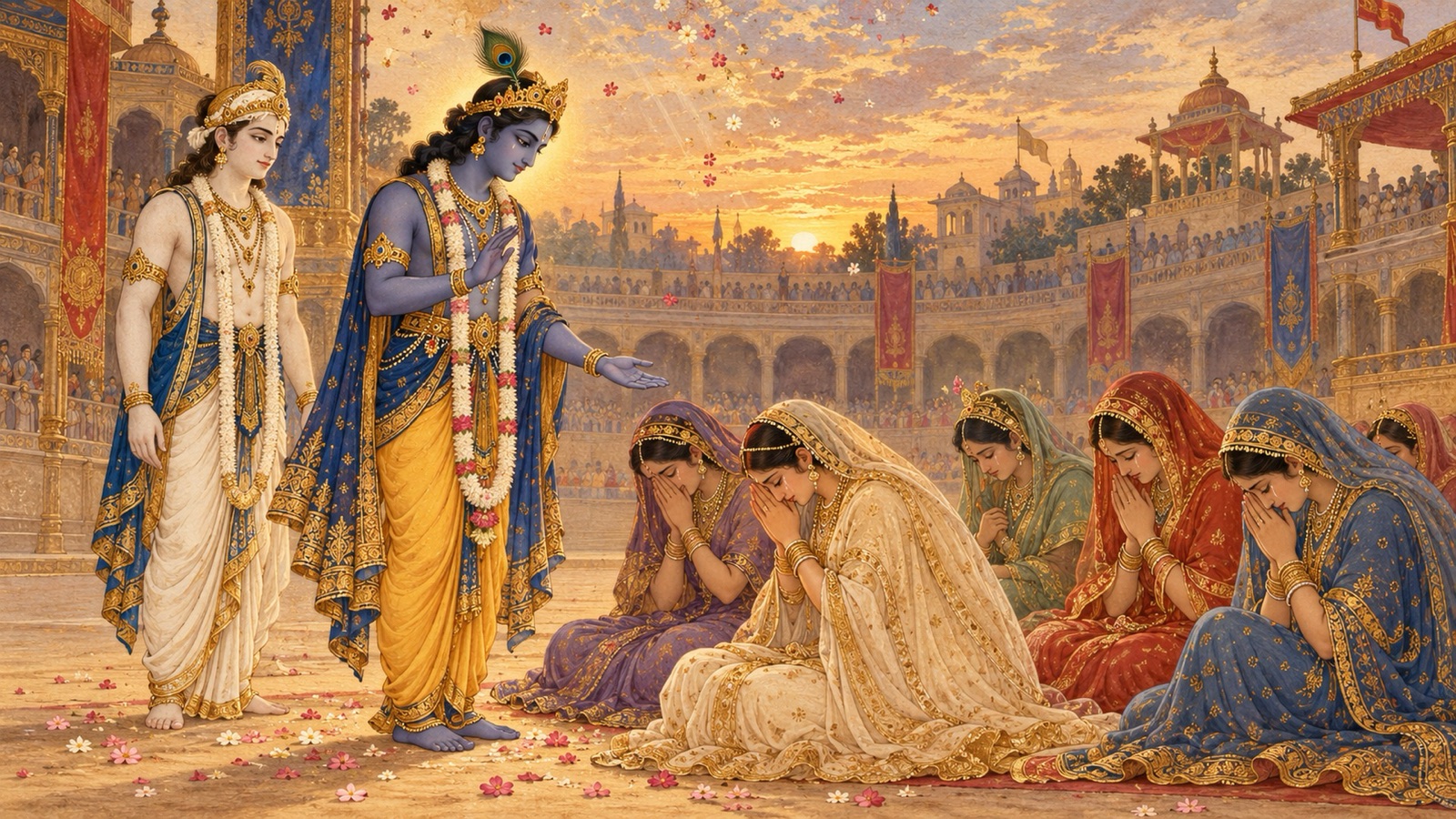
Kamsa’s eight younger brothers, Kanka, Nyagrodha and the rest, burning with rage, rushed at Krishna to avenge him; but Balarama took up His club and ended them as they came, as a lion fells cattle. Kettledrums sounded in the heavens; Brahma, Shiva and the other divine powers praised the Lord with showers of flowers, and the celestial women danced.
Then the wives of the slain, grieving for their dear ones, came to the arena with tears in their eyes, beating their heads in sorrow, and embracing their husbands where they lay upon the hero’s bed, they wept aloud. ‘Alas, beloved lord, knower of dharma, kind to the helpless,’ they cried, ‘with you slain, we too are slain, with our homes and children. Bereft of you, this city no longer shines, any more than we do, its festivity and good fortune gone.’ Yet in the midst of their grief the queens saw clearly: ‘You did cruel harm to innocent beings, and for that you have been brought to this state. What oppressor of living creatures can ever find peace?’
सर्वेषामिह भूतानामेष हि प्रभवाप्ययः ।
गोप्ता च तदवध्यायी न क्वचित्सुखमेधते ॥ ४८ ॥
sarveṣām iha bhūtānām eṣa hi prabhavāpyayaḥ goptā ca tad-avadhyāyī na kvacit sukham edhate
Meaning: This Krishna is indeed the origin, the dissolution and the protector of all beings in this world; whoever shows Him disrespect can never flourish in happiness. (Canto 10, Chapter 44, verse 48)
The Lord Frees His Parents
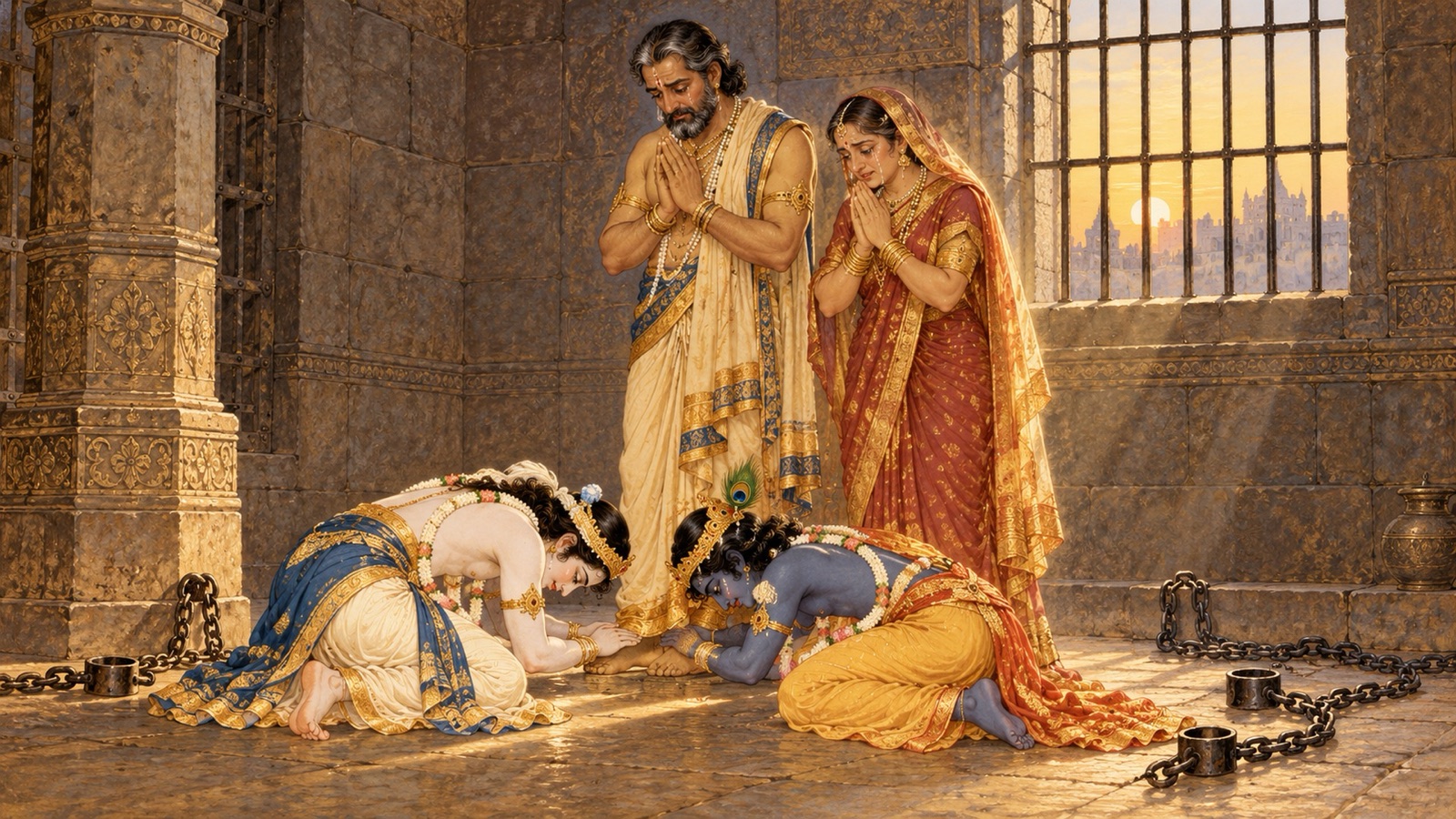
Sukadeva said: having comforted the royal ladies, the Lord, who cares for the worlds, had the funeral rites of the slain duly performed for their welfare hereafter. Then Krishna and Balarama released Their mother and father from their bonds and bowed to them, touching their feet with Their heads. But Devaki and Vasudeva, knowing now that the Sons who bowed before them were the Lords of the universe, held back in awe and did not embrace Them.
देवकी वसुदेवश्च विज्ञाय जगदीश्वरौ ।
कृतसंवन्दनौ पुत्रौ सस्वजाते न शङ्कितौ ॥ ५१ ॥
devakī vasudevaś ca vijñāya jagad-īśvarau kṛta-saṁvandanau putrau sasvajāte na śaṅkitau
Meaning: Devaki and Vasudeva, recognising their Sons who had offered them obeisance to be the Rulers of the universe, were filled with apprehension and did not embrace Them. (Canto 10, Chapter 44, verse 51)
Principal Teachings of This Chapter
1. Never lend your presence to unrighteousness. The women of Mathura declare that an assembly tolerating an unequal contest loses its merit. Silence before a wrong, or false speech to please the powerful, both bring sin.
2. The Most Ancient Person walks hidden in a human form. The women recognise the One whose feet Shiva and Lakshmi adore, wandering Vraja with a flute and forest flowers. Blessed is any ordinary work done while singing His name.
3. Adharma ends by devouring its own. Kamsa’s final order condemns Nanda, Vasudeva and even his own father Ugrasena. Unrighteousness, once it rules, spares no one; and the Lord acts the moment the innocent are threatened.
4. Remembrance of the Lord, even in fear, delivers. Kamsa saw the discus-bearing Lord before him in every act of his life, and by that dread-filled absorption attained the Lord’s own form. What, then, can loving remembrance not bestow?
5. He is the source, the end and the protector of all. The grieving queens see that no oppressor of living beings can be happy and that whoever disregards Krishna cannot prosper.
A Devotional Reflection
What stays with us is not only the thunder of the arena but two quiet gestures at its close. First, the Lord of the universe consoles the widows of the very men He has slain and sees to their husbands’ last rites; His compassion does not stop at the boundary of His enemies’ households. Second, having set the whole city free, Krishna and Balarama walk to the two prisoners who had waited for Them since the night of His birth, and lay Their heads at their feet. Devaki had kept this Son for only a night; now He stands before her as the destroyer of her tormentor, and she is too overcome by His majesty to hold Him. Every devotee knows both moments: the longing to embrace the Lord as our own, and the awe that makes us fall at His feet instead.
A Daily Devotional Practice
Today, take Kamsa’s unbroken remembrance and turn it to love. Whenever you eat or drink, walk or lie down, or simply notice your breath, pause for a moment and see the Lord before you, not with the dread of an enemy but with the gratitude of a child set free. If fearful remembrance carried the tyrant to the Lord’s own form, let loving remembrance carry you to His feet. Begin by chanting gently: Om Namo Bhagavate Vasudevaya.
Conclusion
In this chapter the long shadow that fell over Mathura on the night of Krishna’s birth is finally lifted. The champions fall, and the king who ordered the death of his own father falls after them. But the chapter’s deepest lesson is spoken over the fallen tyrant: the Lord he feared without pause became the Lord he attained. May we, who need not fear Him, remember Him with the same constancy and with love, and may the hand that broke the chains of Devaki and Vasudeva loosen every bond that keeps our hearts from Him.
May the divine wisdom of Srimad Bhagavatam awaken pure devotion within our hearts.
Om Namo Bhagavate Vasudevaya.
Jay Shree Madhav.
References and Attribution
- Primary edition: Gita Press, Śrīmad Bhāgavata Mahāpurāṇa (English), Book Ten (First Half), Discourse 44.
- Series: Srimad Bhagavatam Wisdom · Biswa Sanatan Dharma Seva Trust.
- Presented following the spiritual guidance and recommendation of Pandit Dr. Shri Kashinath Mishra.
This is an original, faithful retelling in the writer’s own words, with brief quoted verses shown in Devanāgarī and transliteration and their meanings given as summaries. It is not a reproduction of any single publisher’s continuous translation or commentary. No affiliation with or endorsement by any publisher is implied.
Jay Shree Madhav