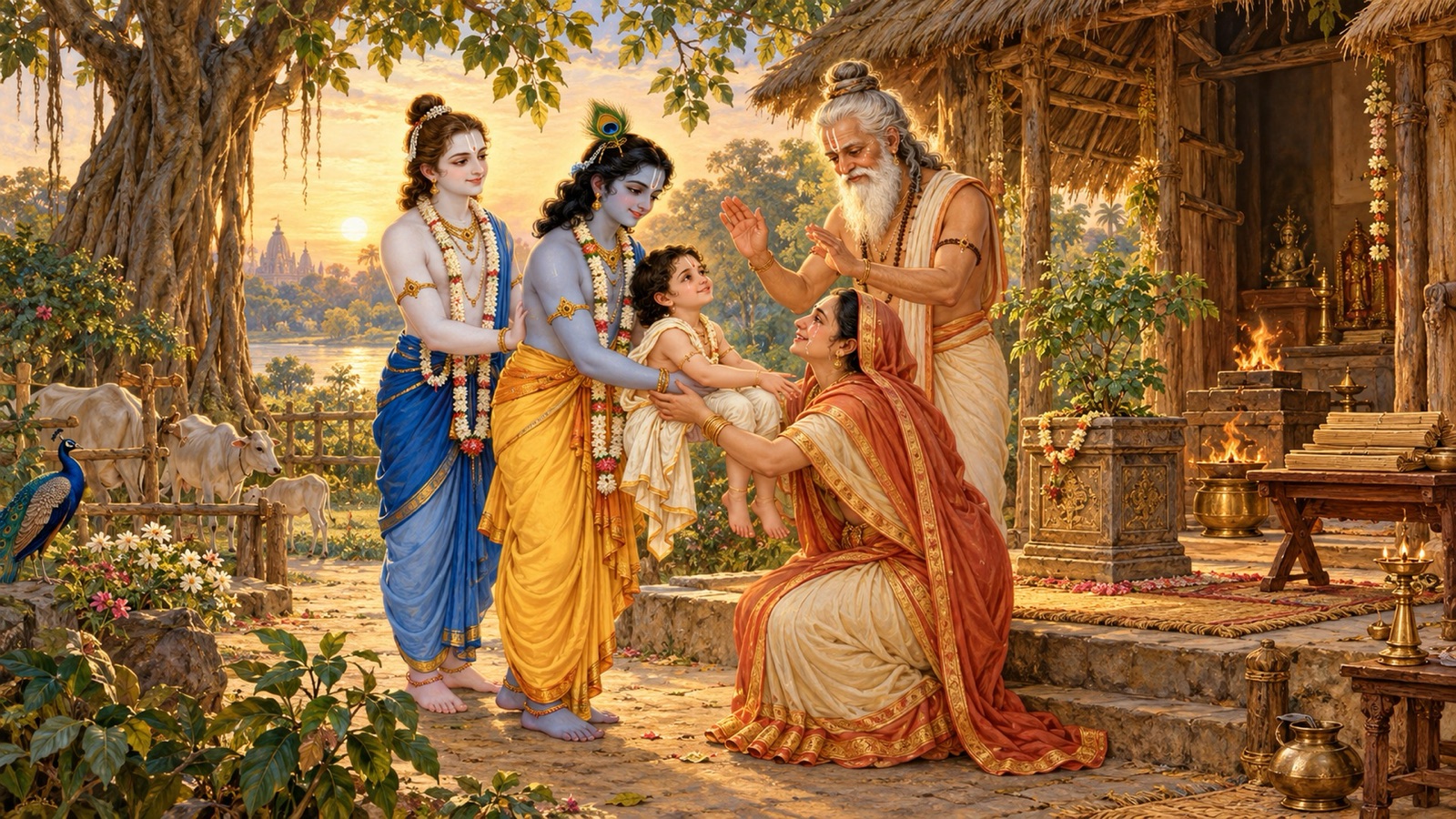
With Kamsa slain, Krishna and Balarama bow to Devaki and Vasudeva, seat Ugrasena on the throne, send Nanda home to Vraja, and sit as humble students in the ashram of Sandipani — whose lost child They bring back from the very city of Yama.
Om Namo Bhagavate Vasudevaya.
Om Namo Bhagavate Vasudevaya.
Om Namo Bhagavate Vasudevaya.
Welcome back to Srimad Bhagavatam Wisdom, our devotional journey through the sacred histories and teachings of the Srimad Bhagavat Mahapurana. This forty-fifth chapter of the Tenth Canto follows the Lord through the tender duties that come after victory — and to a guru’s ashram, where the only fee His teacher asks is a son who has died.
Chapter Information
- Scripture: Śrīmad Bhāgavata Mahāpurāṇa
- Canto: 10 (Book Ten, First Half)
- Chapter: 45 (Discourse 45)
- Chapter title: Krishna Rescues His Teacher’s Son
- Principal speaker: Sukadeva Gosvami (narrating to King Parikshit); within the narrative, Sri Krishna, Yama and the preceptor Sandipani
- Principal listener: King Parikshit
- Main setting: Mathura; Sandipani’s ashram at Avantipura; the shore at Prabhasa; Samyamani, the city of Yama
- Central subject: The consoling of Devaki and Vasudeva; Ugrasena’s coronation; Nanda’s return; the sacred-thread rite; the studies under Sandipani; the recovery of the preceptor’s son
- Principal verse range: Canto 10, Chapter 45, verses 1–50
- Primary edition: Gita Press Śrīmad Bhāgavata Mahāpurāṇa (English, Book Ten, Discourse 45)
Context From the Previous Chapter
In Chapter 44, Krishna killed Kamsa in the wrestling arena and Balarama struck down his eight brothers. The Brothers then freed Devaki and Vasudeva from their bonds and bowed at their feet; seeing in their sons the Rulers of the universe, the parents stood in awe and did not dare to embrace Them.
Krishna Consoles Devaki and Vasudeva
Sukadeva resumed. The Lord saw that His parents had grasped the truth of His divinity too soon — before they had tasted the sweetness of loving Him simply as their child. So the Supreme Person spread His own Maya, which bewilders even those nearest to Him, so that such knowledge would not endure.
श्रीशुक उवाच
पितरावुपलब्धार्थौ विदित्वा पुरुषोत्तम: ।
मा भूदिति निजां मायां ततान जनमोहिनीम् ॥ १ ॥
śrī-śuka uvāca pitarāv upalabdhārthau viditvā puruṣottamaḥ mā bhūd iti nijāṁ māyāṁ tatāna jana-mohinīm
Meaning: Sri Suka said: Knowing that His parents had already grasped the truth about Him, the Supreme Person spread His own Maya, which enchants His people, thinking, “Let it not be so.” (Canto 10, Chapter 45, verse 1)
Then, with His elder brother beside Him, the Jewel of the Satvatas bowed humbly before His father and mother and, to delight them, called them “Mother” and “Father.” Though you always longed for us, He said, you never saw your sons’ infancy, childhood and boyhood; and we, unfortunate, never knew the happiness of children fondled by their parents at home.
Then He spoke of the debt every child owes.
सर्वार्थसम्भवो देहो जनित: पोषितो यत: ।
न तयोर्याति निर्वेशं पित्रोर्मर्त्य: शतायुषा ॥ ५ ॥
sarvārtha-sambhavo deho janitaḥ poṣito yataḥ na tayor yāti nirveśaṁ pitror martyaḥ śatāyuṣā
Meaning: Even by serving them for a full hundred years, a mortal cannot repay the parents from whom this body — the means of attaining all the aims of life — was born and nourished. (Canto 10, Chapter 45, verse 5)
An able-bodied son who does not maintain his parents, He continued, is made by Yama’s servants to eat his own flesh after death. One who can support his mother, aged father, chaste wife, infant child, guru, a dependent brahmana and anyone who seeks his shelter, yet fails to do so, is dead though he breathes. Our days have slipped away in vain, He said, for fear of Kamsa kept us from serving you. Forgive us, Mother and Father, this failure toward you who were oppressed by that wicked man and not free to act.
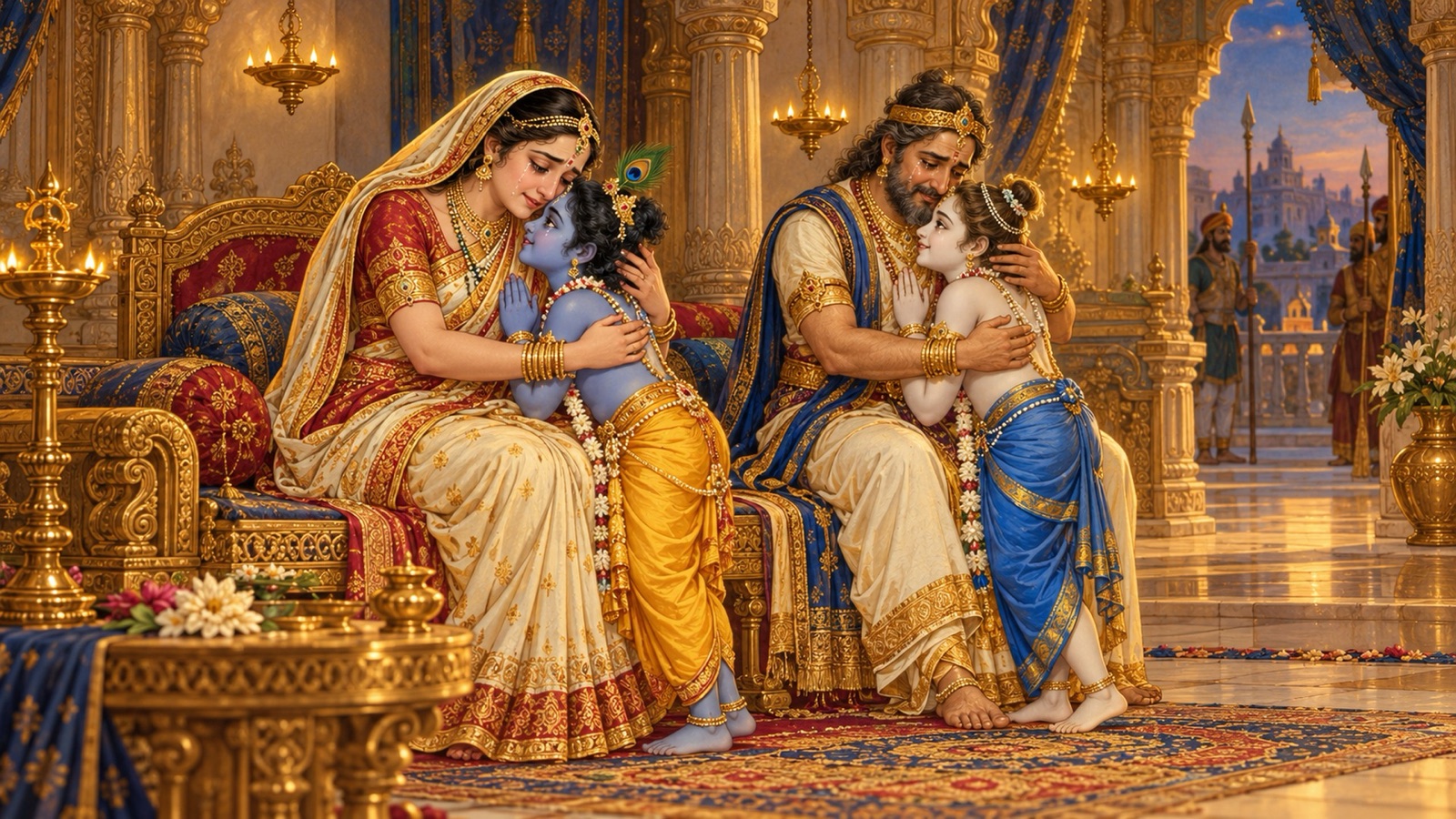
Bewildered by these words of Hari, the Soul of the universe who seemed a mere man through His Maya, the royal couple took Him on their laps, folded Him in their arms and bathed Him in streams of tears. Bound by the ropes of affection, their throats choked, they could say nothing at all.
Here is a secret. The Lord does not want awe from Devaki and Vasudeva; He wants to be their son. Knowledge of His majesty would have kept them at a respectful distance for life, so He veils it Himself. His Maya, which elsewhere binds the world, here serves love — it lets a mother hold God in her lap and weep over Him. Such affection is dearer to the Lord than any homage paid to His greatness.
Ugrasena Crowned and the Yadus Brought Home
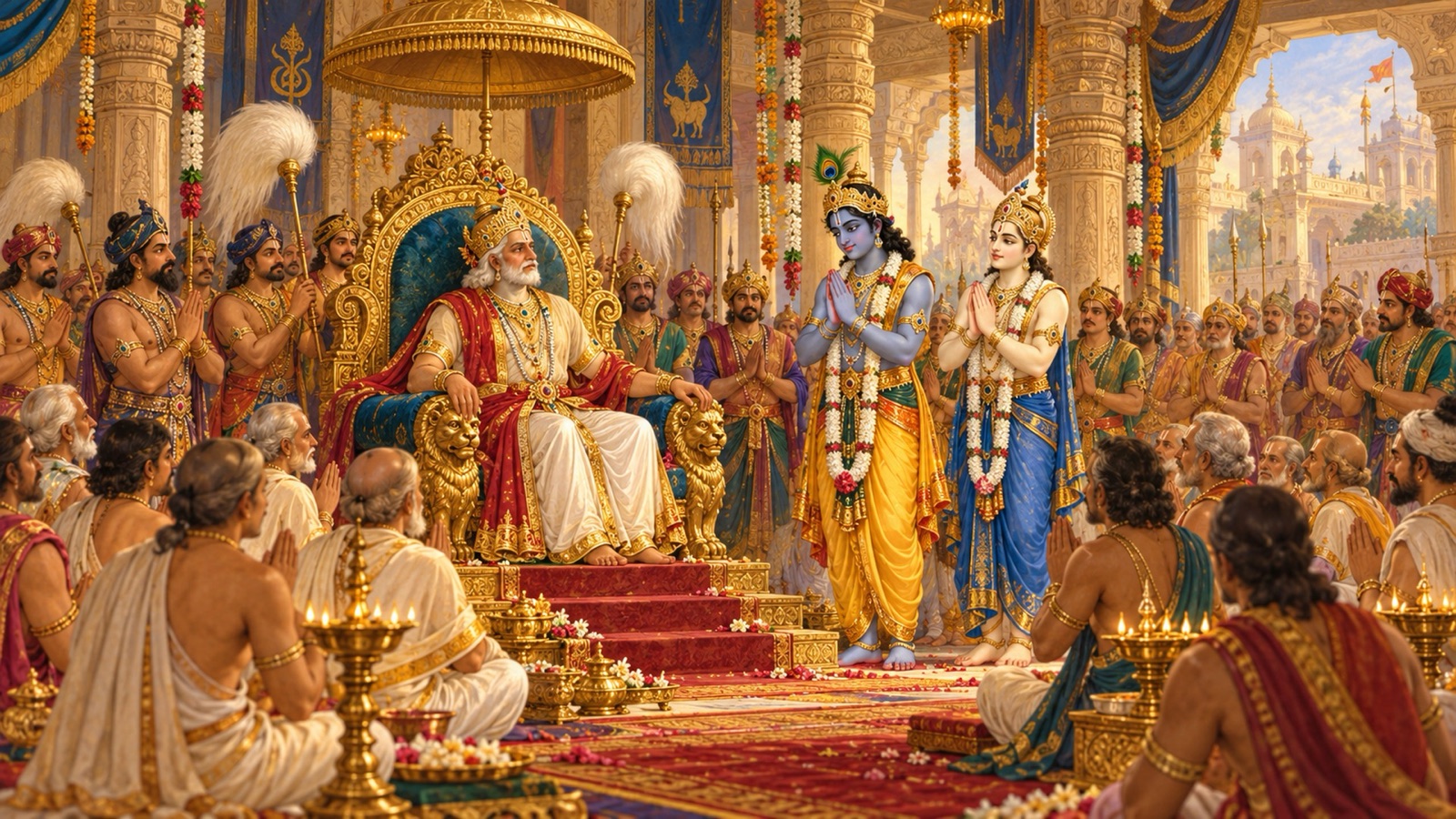
Having comforted His parents, the Son of Devaki installed His maternal grand-uncle Ugrasena as king of the Yadus. “Great King,” He said, “be pleased to command us, your servants, and the people of Mathura. Because of Yayati’s curse the Yadus may not sit on a royal throne; but when I attend on you as your servant, even the gods will bow and bring you tribute — what to say of other kings?”
Then Sri Krishna, Maker of the universe, called back from every direction the kinsmen who had fled Mathura in fear of Kamsa and been worn down in foreign lands — the Yadus, Vrishnis, Andhakas, Madhus, Dasarhas, Kukuras and the rest. He consoled them, gratified them with wealth and settled them in their own homes. Protected by the arms of Krishna and Sankarshana, their distress gone, they lived happily. Day after day they gazed on the lotus face of Mukunda, ever bright with joy and compassionate, smiling glances; drinking its nectar with the cup of their eyes, even the old among them grew young again.
Nanda Returns to Vraja
Now the Lord, with Sankarshana, went to Nanda and embraced him. “Father,” He said, “by you and by Mother Yasoda we two have been nourished and fondled with the greatest care. The love parents bear their children is surely deeper than the love they bear their own selves.”
स पिता सा च जननी यौ पुष्णीतां स्वपुत्रवत् ।
शिशून् बन्धुभिरुत्सृष्टानकल्पै: पोषरक्षणे ॥ २२ ॥
sa pitā sā ca jananī yau puṣṇītāṁ sva-putra-vat śiśūn bandhubhir utsṛṣṭān akalpaiḥ poṣa-rakṣaṇe
Meaning: He is the true father and she the true mother who nourish like their own children the infants given up by relatives unable to feed and protect them. (Canto 10, Chapter 45, verse 22)
“Return now to Vraja, dear father. After bringing some joy to our kinsmen here, we shall come to see you and all our people who pine for us in love.” Having consoled Nanda and the people of Vraja, the immortal Lord honoured them with garments, ornaments, vessels and loving gifts. Overwhelmed with affection, Nanda clasped the two Brothers, his eyes brimming with tears, and went home with the cowherds.
The Sacred Thread and the Student’s Vow
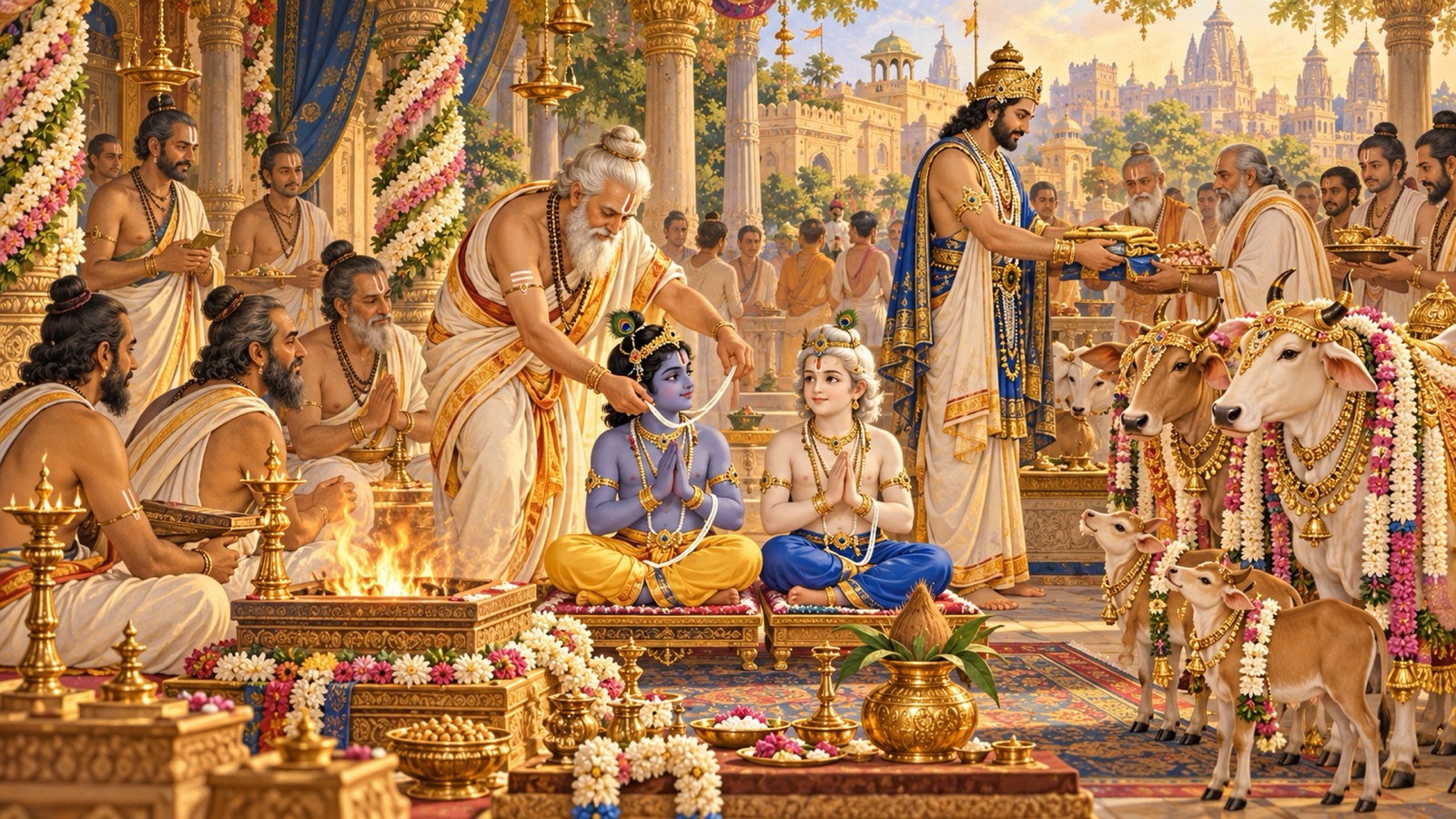
Vasudeva then had the purifying rite of the sacred thread, which confers the rank of the twice-born, performed for both sons by his family priest Garga and other brahmanas, according to scripture. He worshipped the brahmanas, gave their fees, and presented cows decked with gold necklaces and silk wreaths, each with her calf. Remembering the vow made in his mind on the night of Krishna’s birth, the noble-hearted Vasudeva now gave away even the cows he had then silently pledged, which Kamsa had unlawfully seized. Having become twice-born, the Brothers took up the vow of celibacy under Garga, preceptor of the Yadu race.
Students at the Ashram of Sandipani
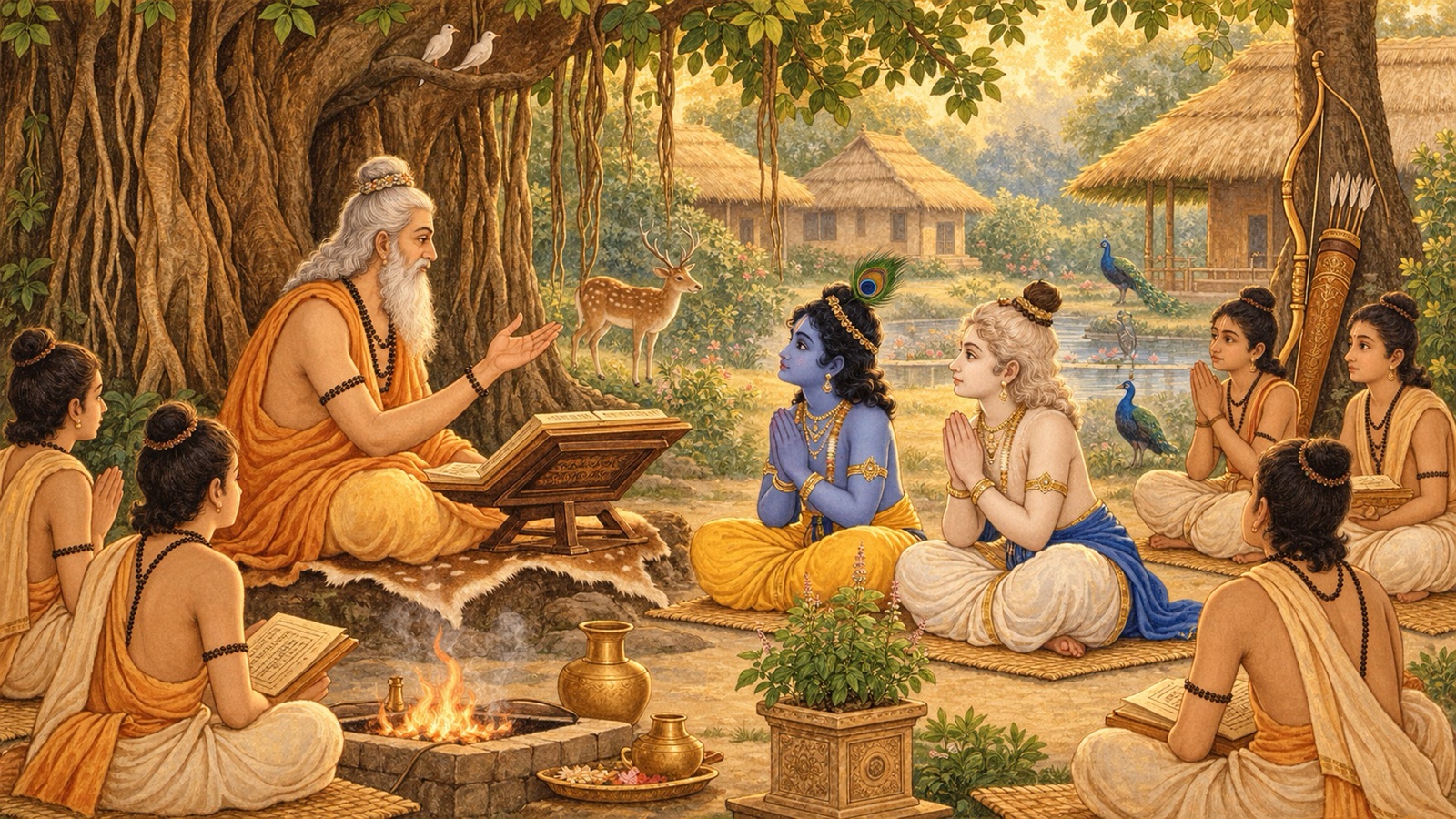
Though They were the omniscient Rulers of the universe and the source of all learning, the two Brothers hid Their self-born wisdom behind human-seeming actions and wished to live in a preceptor’s house to set an example for the world. So They went to Sandipani, a brahmana of the Kasya line living in Avantipura, and waited on him as on a god, teaching all people the conduct owed to a guru.
यथोपसाद्य तौ दान्तौ गुरौ वृत्तिमनिन्दिताम् ।
ग्राहयन्तावुपेतौ स्म भक्त्या देवमिवादृतौ ॥ ३२ ॥
yathopasādya tau dāntau gurau vṛttim aninditām grāhayantāv upetau sma bhaktyā devam ivādṛtau
Meaning: Having duly approached him, the two self-controlled Brothers served Their guru with devotion, honouring him as a god, and thereby taught the world irreproachable conduct toward one’s preceptor. (Canto 10, Chapter 45, verse 32)
Pleased with such sincere service, Sandipani taught Them the Vedas with their six limbs and the Upanishads, the science of archery with its secret mantras, the codes of dharma, philosophy and logic, and statecraft with its six branches. Being the originators of every science, the two jewels among men grasped it all at a single hearing, and then pressed Their teacher to name his fee.
अहोरात्रैश्चतु:षष्ट्या संयत्तौ तावती: कला: ।
गुरुदक्षिणयाचार्यं छन्दयामासतुर्नृप ॥ ३६ ॥
aho-rātraiś catuḥ-ṣaṣṭyā saṁyattau tāvatīḥ kalāḥ guru-dakṣiṇayācāryaṁ chandayām āsatur nṛpa
Meaning: In sixty-four days and nights, with full concentration, They mastered as many arts, and then, O King, They invited Their teacher to choose his fee. (Canto 10, Chapter 45, verse 36)
The Guru’s Fee: A Child Lost at Prabhasa
Sandipani had seen the wonder of it — all knowledge mastered without effort, an intelligence beyond the human. After taking counsel with his wife, the brahmana asked as his fee the return of their child, lost in the ocean at Prabhasa. “So be it,” said the Brothers, and mounting Their chariot They came to Prabhasa and sat for a moment by the shore. Knowing who They were, the god of the ocean came before Them with offerings. The Lord said, “Give back at once My preceptor’s son, the boy you swallowed here in a great wave.”
The ocean replied, “It was not I who took him, O Lord. A mighty demon of the Daitya race named Panchajana lives beneath these waters in the form of a conch; surely he carried the child away.” At once Krishna plunged into the sea and overcame the demon — but the boy was not within him. Taking the conch that had been the demon’s body, the Lord returned to the chariot.
Then Sri Krishna, with Balarama who bears the plough, went to Samyamani, the beloved city of Yama, and blew that conch. Hearing its blast, Yama — who punishes those who break the sacred law — worshipped the Brothers with great devotion and splendour. Bowing before the Lord who dwells in every heart, he asked, “O Vishnu, playing as a human by Your sweet will, what may we do for You both?”
श्रीभगवानुवाच
गुरुपुत्रमिहानीतं निजकर्मनिबन्धनम् ।
आनयस्व महाराज मच्छासनपुरस्कृत: ॥ ४५ ॥
śrī-bhagavān uvāca guru-putram ihānītaṁ nija-karma-nibandhanam ānayasva mahā-rāja mac-chāsana-puraskṛtaḥ
Meaning: The glorious Lord said: Great King, honouring My command, bring here My preceptor’s son, who was carried to this place by the bonds of his own karma. (Canto 10, Chapter 45, verse 45)
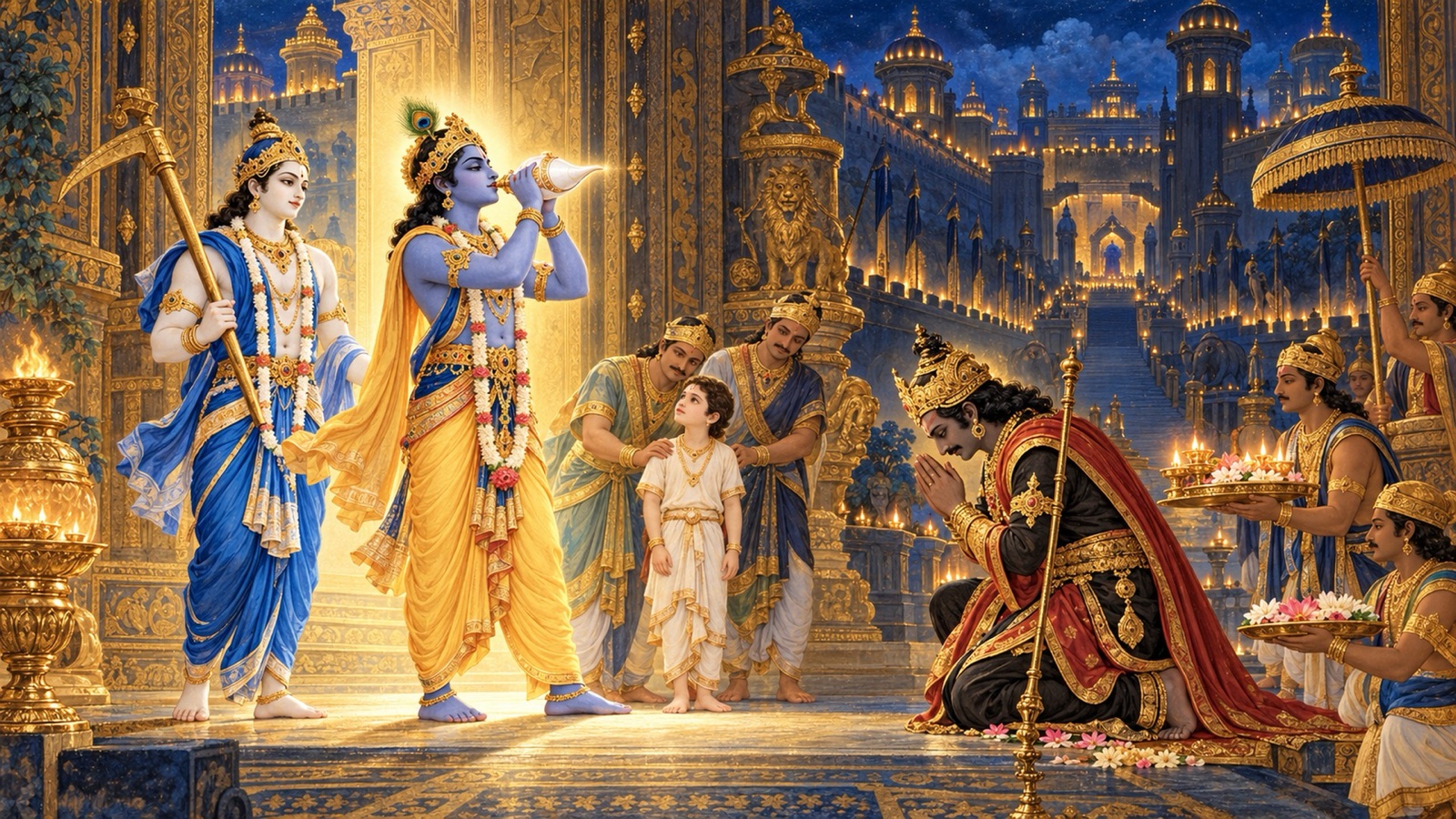
Yama said, “So be it,” and brought the boy. The two foremost of the Yadus placed him in Their preceptor’s hands and said, “Please ask for another boon of your choice.”
The Preceptor’s Blessing and the Return to Mathura
Sandipani answered, “My child, the debt to your guru has been fully paid by you both. What wish of a teacher could remain unfulfilled when his pupils are such as you?”
गच्छतं स्वगृहं वीरौ कीर्तिर्वामस्तु पावनी ।
छन्दांस्ययातयामानि भवन्त्विह परत्र च ॥ ४८ ॥
gacchataṁ sva-gṛhaṁ vīrau kīrtir vām astu pāvanī chandāṁsy ayāta-yāmāni bhavantv iha paratra ca
Meaning: Go home, O heroes. May your fame purify the world, and may the Vedic hymns remain ever fresh in your memory, in this world and the next. (Canto 10, Chapter 45, verse 48)
With their teacher’s leave, the Brothers returned at once to Mathura in Their chariot, swift as the wind and thundering like a cloud. The people, who had missed Balarama and Krishna for many days, rejoiced to behold Them — like those who had lost their wealth and found it again.
Principal Teachings of This Chapter
1. The Lord veils His majesty so that He may be loved. By covering His parents’ knowledge of His divinity, Krishna chooses a mother’s lap over a worshipper’s distance. Affection, not awe, is the bond He treasures most.
2. The debt to our parents cannot be fully repaid. A hundred years of service does not discharge what we owe to those who gave and nourished this body; neglecting them while able is a living death.
3. Those who nurture are true parents. Krishna calls Nanda and Yasoda father and mother because they raised Him as their own. We owe gratitude to every hand that fed and protected us.
4. The source of all knowledge sits as a student. Though omniscient, Krishna serves Sandipani as a god. If He bows to a guru, no learner may think himself above humility, service and a teacher’s fee.
5. Even the ocean and Yama obey His word. The sea brings offerings, and the chastiser of the worlds bows and returns a departed soul at His command. Death itself serves the Lord.
A Devotional Reflection
What moves the heart in this chapter is how small the Lord makes Himself. He who has just slain Kamsa does not take the throne; He gives it to Ugrasena and calls Himself a servant. He who is the source of the Vedas waits on Sandipani like any other pupil. He who is adored by the gods lets His mother bathe Him in her tears. Every step downward is a step toward love. We imagine greatness as rising above others; Krishna shows that divine greatness delights in bowing — to parents, to a foster-father, to a teacher. And when at last He exercises His sovereign power, it is for His guru’s grief, not for Himself: He walks into the city of Death to bring back a child. May we learn from Him to honour those who raised and taught us.
A Daily Devotional Practice
Today, offer a small act of service to someone who raised or taught you — a parent, an elder, a teacher — without being asked, remembering that Krishna Himself bowed to Devaki, Nanda and Sandipani. If they are no longer with you, offer a prayer of gratitude in their name. Begin by chanting gently: Om Namo Bhagavate Vasudevaya.
Conclusion
The forty-fifth chapter of the Tenth Canto shows the Lord binding up a household and a city after Kamsa’s fall, then humbling Himself as a student before Sandipani. Its single thread is reverence flowing downward from the Supreme: Krishna repays parents, foster-parents and teacher, and for the last of these commands even Yama to give a son back. May we carry that gratitude into our own homes.
May the divine wisdom of Srimad Bhagavatam awaken pure devotion within our hearts.
Om Namo Bhagavate Vasudevaya.
Jay Shree Madhav.
References and Attribution
- Primary edition: Gita Press, Śrīmad Bhāgavata Mahāpurāṇa (English), Book Ten (First Half), Discourse 45.
- Series: Srimad Bhagavatam Wisdom · Biswa Sanatan Dharma Seva Trust.
- Presented following the spiritual guidance and recommendation of Pandit Dr. Shri Kashinath Mishra.
This is an original, faithful retelling in the writer’s own words, with brief quoted verses shown in Devanāgarī and transliteration and their meanings given as summaries. It is not a reproduction of any single publisher’s continuous translation or commentary. No affiliation with or endorsement by any publisher is implied.
Jay Shree Madhav