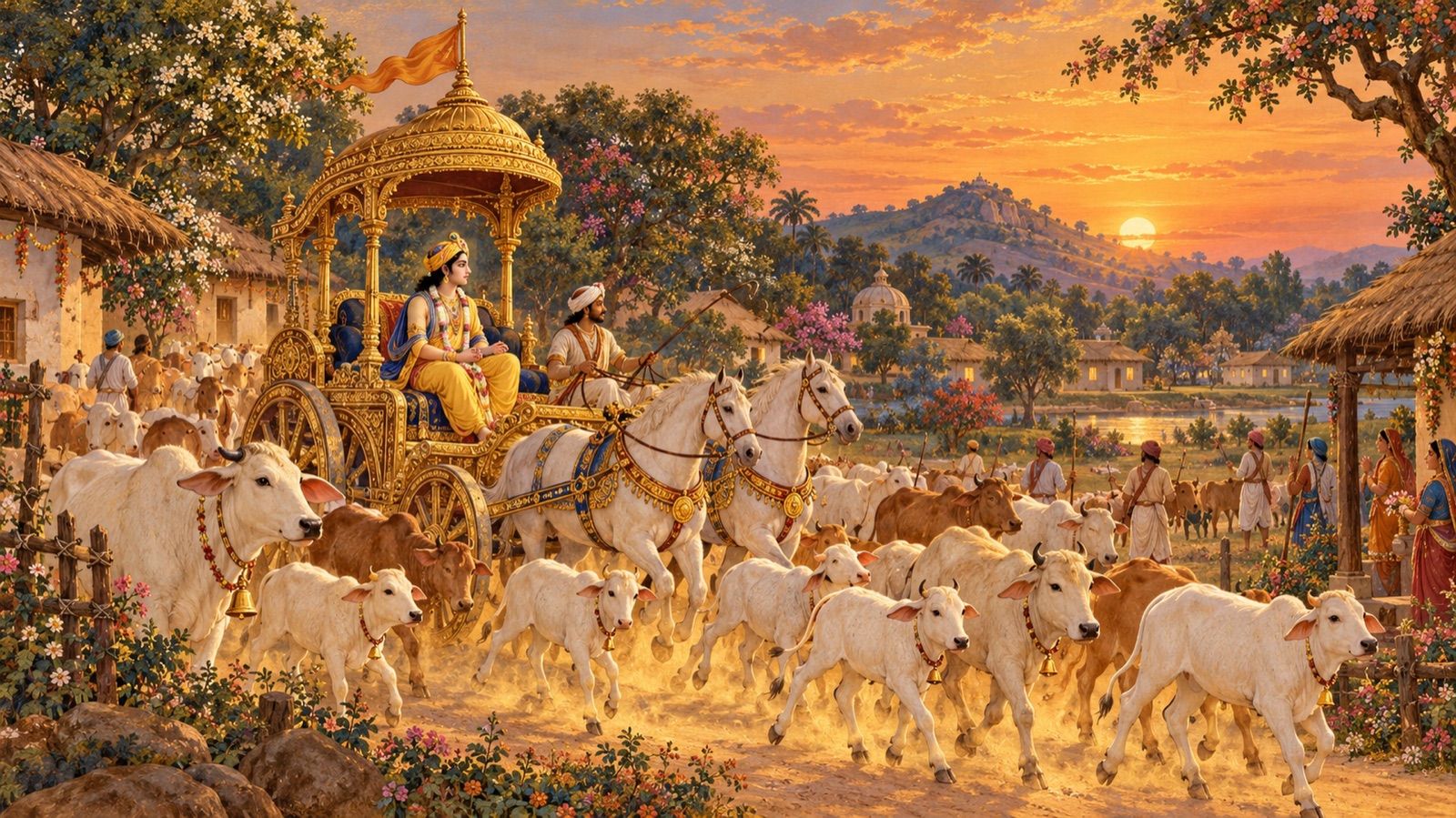
Sent from Mathura with a message of love, Uddhava reaches Nanda’s Vraja as the cows come home at dusk, and spends a night among hearts that cannot forget Krishna.
Om Namo Bhagavate Vasudevaya.
Om Namo Bhagavate Vasudevaya.
Om Namo Bhagavate Vasudevaya.
Welcome back to Srimad Bhagavatam Wisdom, our devotional journey through the sacred histories and teachings of the Srimad Bhagavat Mahapurana. In this forty-sixth chapter of the Tenth Canto, Krishna, now in Mathura, sends His dearest friend Uddhava to console Nanda, Yashoda and the gopis who are pining for Him, and Uddhava answers a father’s remembrance with a truth that reaches far beyond Vraja: the child of Nanda’s house is the Self and Lord of every being.
Chapter Information
- Scripture: Śrīmad Bhāgavata Mahāpurāṇa
- Canto: 10 (Book Ten, First Half)
- Chapter: 46 (Discourse 46)
- Chapter title: Uddhava Visits Vrindavana
- Principal speaker: Sukadeva Gosvami; within the chapter, Sri Krishna, Nanda and Uddhava
- Principal listener: King Parikshit
- Main setting: Mathura, and Nanda’s Gokula in Vraja (Vrindavana)
- Central subject: Krishna’s message to Vraja through Uddhava; Nanda’s remembrance; Uddhava’s teaching that Krishna is the Self of all
- Principal verse range: Canto 10, Chapter 46, verses 1–49
- Primary edition: Gita Press Śrīmad Bhāgavata Mahāpurāṇa (English, Book Ten)
Context From the Previous Chapter
In Chapter 45, Krishna and Balarama completed Their studies under the sage Sandipani, recovered the preceptor’s lost son from the abode of Yama as His fee, and returned to Mathura to the joy of its people.
Krishna Sends Uddhava to Vraja
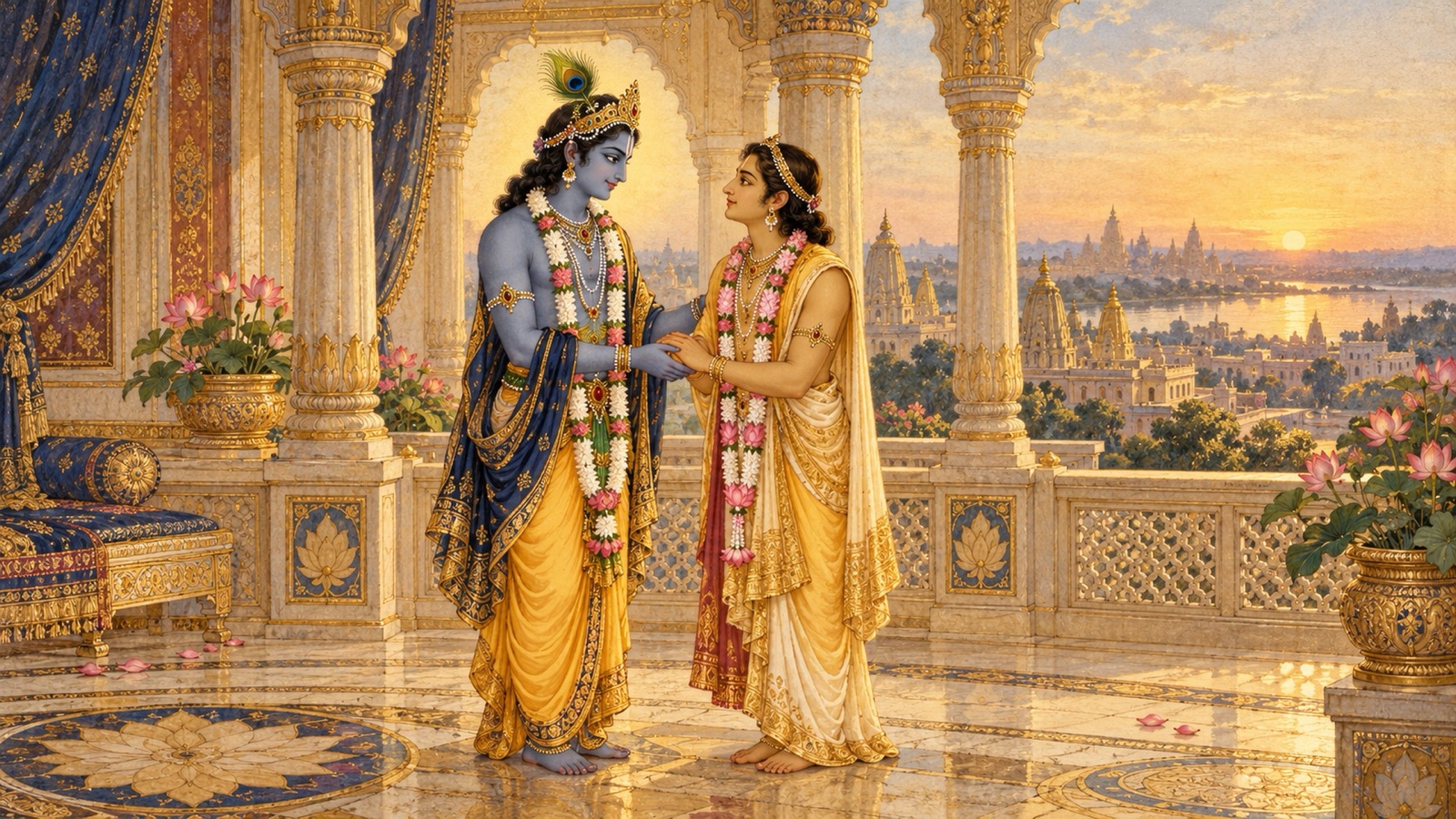
Sukadeva continued. Among the Vrishnis there was Uddhava, foremost of that clan, Krishna’s counsellor and beloved friend, a direct disciple of Brihaspati and the wisest of men. One day Lord Hari, who takes away the suffering of those who come to Him for shelter, clasped Uddhava’s hand in His own and spoke to this devotee who belonged to Him alone.
गच्छोद्धव व्रजं सौम्य पित्रोर्नौ प्रीतिमावह ।
गोपीनां मद्वियोगाधिं मत्सन्देशैर्विमोचय ॥ ३ ॥
gacchoddhava vrajaṁ saumya pitror nau prītim āvaha gopīnāṁ mad-viyogādhiṁ mat-sandeśair vimocaya
Meaning: Go, gentle Uddhava, to Vraja; bring joy to Our two parents, and with My messages release the gopis from the anguish of mind born of separation from Me. (Canto 10, Chapter 46, verse 3)
Then the Lord Himself described the state of the women of Vraja, who had given Him their minds, their lives and their very selves.
ता मन्मनस्का मत्प्राणा मदर्थे त्यक्तदैहिकाः ।
मामेव दयितं प्रेष्ठमात्मानं मनसा गताः ।
ये त्यक्तलोकधर्माश्च मदर्थे तान् बिभर्म्यहम् ॥ ४ ॥
tā man-manaskā mat-prāṇā mad-arthe tyakta-daihikāḥ mām eva dayitaṁ preṣṭham ātmānaṁ manasā gatāḥ ye tyakta-loka-dharmāś ca mad-arthe tān bibharmy aham
Meaning: Their minds are fixed on Me and their life-breath rests in Me; for My sake they have renounced all that belongs to the body, and in their hearts they have accepted Me alone as their beloved, their dearest, their very Self. Those who have given up even the duties of the world for My sake, I sustain. (Canto 10, Chapter 46, verse 4)
With Me, the dearest of all they hold dear, so far away, Krishna continued, the women of Gokula remember Me and lose all sense of themselves, overwhelmed by the yearning of separation; they hold on to life only with the greatest difficulty, propped up by My assurances that I will return.
The Chariot Reaches Vraja at Sunset
So instructed, Uddhava reverently took up his Master’s message, mounted a chariot and set out for Nanda’s Gokula. He reached Nanda’s Vraja just as the sun was going down, his chariot veiled in the dust raised by the hooves of the cattle streaming home at that very hour.
Bulls in rut bellowed and contended; cows, heavy with milk, hurried to their calves; white calves capered about; the sound of milking mingled with flutes. Gopis in their finest ornaments sang the auspicious deeds of Balarama and Krishna among the cowherds. In the homes the sacred fires, the sun-god, guests, cows, brahmanas, forefathers and gods were being worshipped amid incense, lamps and garlands. All around, the groves were in blossom, loud with birds and bees, and lotus beds were crowded with swans and karandava ducks. Vraja was as lovely as ever, and every song in it was of Krishna.
Nanda Welcomes Krishna’s Messenger
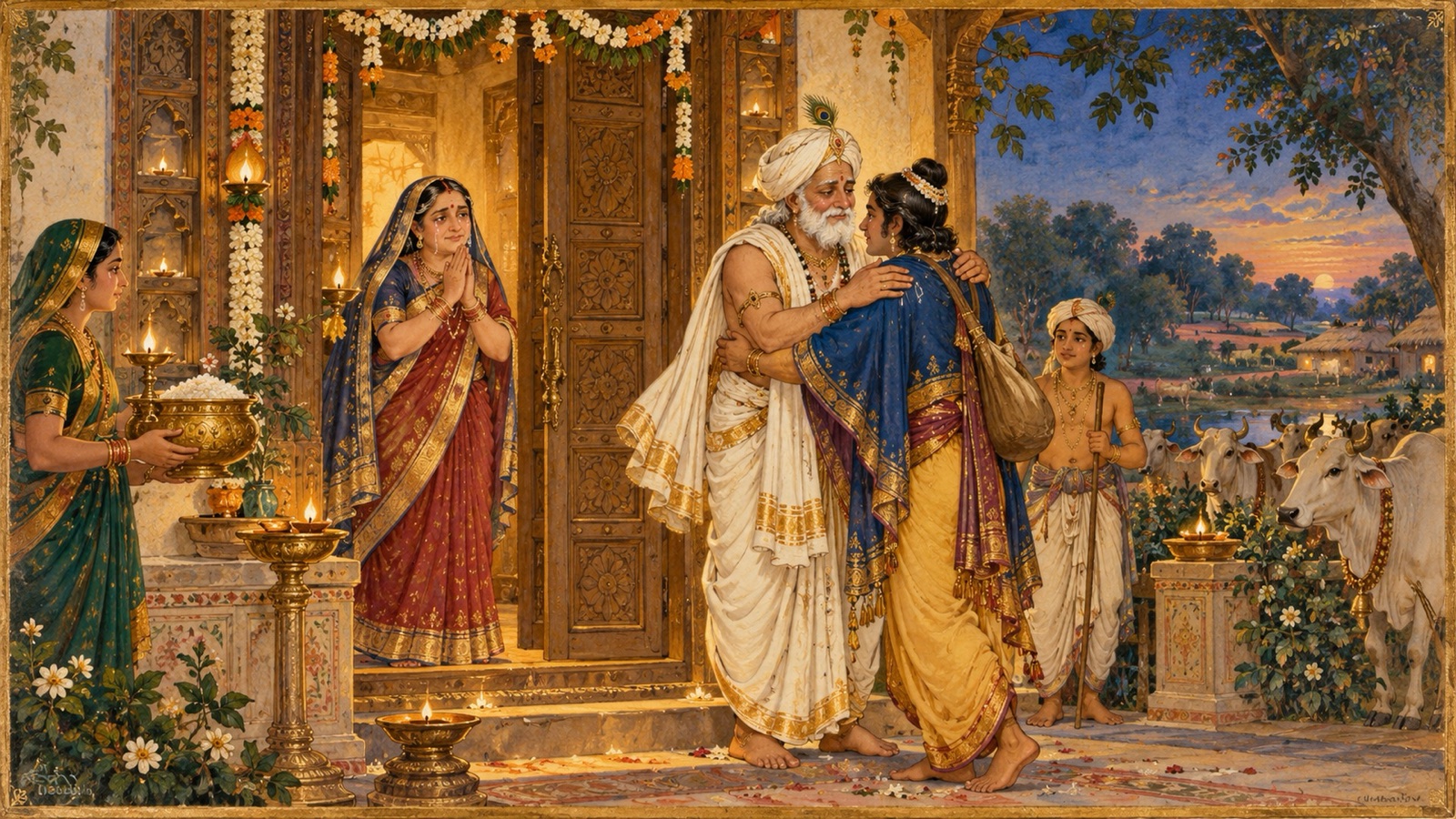
Nanda met Krishna’s beloved attendant at his door, embraced him with delight, and honoured him exactly as he would have honoured Krishna Himself. When Uddhava had been fed with sweet rice boiled in milk, seated on a couch, and relieved of his weariness by the kneading of his feet, Nanda began to ask after the ones he loved.
Is our friend Vasudeva, the son of Shura, well, he asked, now that he is free and reunited with his children and kinsmen? By good fortune the sinful Kamsa, who always hated the righteous Yadus, has been slain with his followers by his own sin. And then the question of his heart.
अपि स्मरति नः कृष्णो मातरं सुहृदः सखीन् ।
गोपान् व्रजं चात्मनाथं गावो वृन्दावनं गिरिम् ॥ १८ ॥
api smarati naḥ kṛṣṇo mātaraṁ suhṛdaḥ sakhīn gopān vrajaṁ cātma-nāthaṁ gāvo vṛndāvanaṁ girim
Meaning: Does Krishna remember us — his mother, his well-wishers and companions, the cowherds, Vraja which looked upon him as its protector, the cows, Vrindavana and the hill? (Canto 10, Chapter 46, verse 18)
Will Govinda come even once to see His own people, Nanda went on; then we would gaze again upon that face with its fine nose, sweet smile and glances. He recalled how Krishna, so great of soul, had saved them from the forest fire, the wind and rain, the bull-demon Arishta and the python — deaths impossible to escape. Whenever we remember Krishna’s exploits, dear Uddhava, his playful sidelong looks, his laughter and his talk, all our work falls slack; and when we look upon the rivers, hills, forests and playgrounds adorned with Mukunda’s footprints, our minds become wholly absorbed in Him.
Nanda confessed that he looked upon Krishna and Balarama as the greatest of the gods, come to earth for some mighty purpose of the gods, as the sage Garga had foretold. Had They not killed Kamsa, strong as ten thousand elephants, with his two wrestlers and the elephant Kuvalayapida, as easily as a lion kills lesser beasts? Krishna had snapped Kamsa’s mighty bow as an elephant breaks a sugar-cane, and had held up the hill on one hand for a week. And here in Vraja They had playfully slain Pralamba, Dhenuka, Arishta, Trinavarta, Baka and other demons, conquerors of gods and demons alike.
Nanda’s Silence and Yashoda’s Tears
Remembering all this again and again, Nanda, whose heart was bound to Krishna, fell silent, seized by an unbearable longing and submerged in a flood of love. Yashoda, listening as the deeds of her Son were recounted, wept, and milk flowed from her breasts in a mother’s tenderness. Seeing such supreme love in them both, Uddhava was filled with joy and spoke to Nanda.
Uddhava’s Reply: Not Your Son Alone
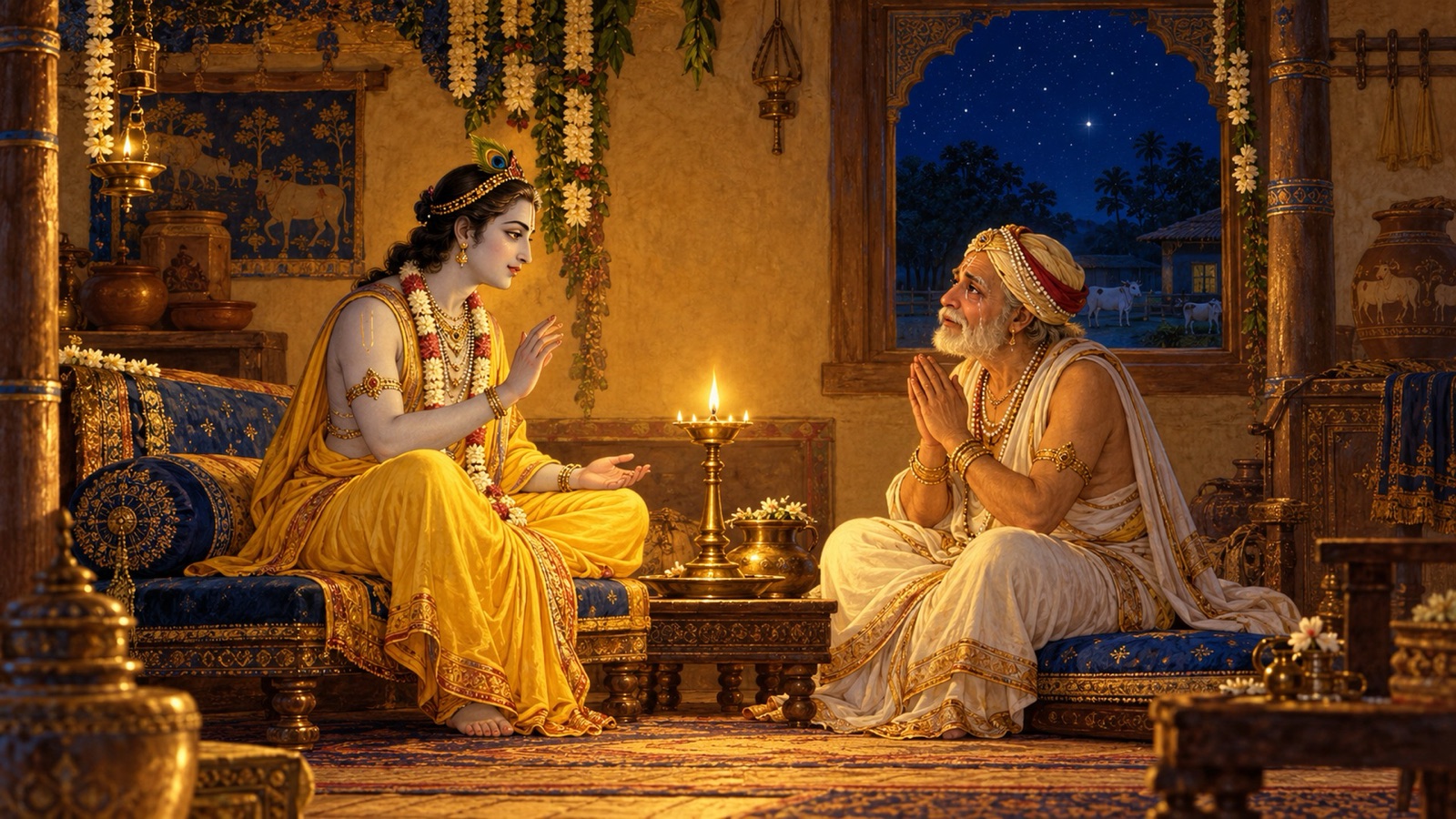
You two, Uddhava began, are surely the most praiseworthy of all embodied beings on earth, O giver of honour, for you have conceived such love for Narayana, the guru of all. Balarama and Krishna are the seed and the womb of the universe, the Purusha and the Pradhana; entering into living beings, these two ancient Ones rule over the consciousness within them. One who fixes even an impure mind upon Krishna for a moment at the hour of death burns away the whole store of karma and swiftly attains the supreme goal. You have placed your whole heart in Narayana, the cause and Self of all, who for a purpose of His own has taken a human-like form. What meritorious deed can still remain for you to perform?
Before long, Uddhava promised, Achyuta, the Lord of the Satvatas, will come back to Vraja and gladden His parents. Having slain Kamsa in the open arena, He will make true what He told you when He came to you.
मा खिद्यतं महाभागौ द्रक्ष्यथः कृष्णमन्तिके ।
अन्तर्हृदि स भूतानामास्ते ज्योतिरिवैधसि ॥ ३६ ॥
mā khidyataṁ mahā-bhāgau drakṣyathaḥ kṛṣṇam antike antar hṛdi sa bhūtānām āste jyotir ivaidhasi
Meaning: Do not grieve, O greatly blessed ones; you will see Krishna near you. He dwells within the heart of all beings, as fire dwells latent within wood. (Canto 10, Chapter 46, verse 36)
Uddhava then unfolded the nature of the One they loved. To Him, who identifies with no body, no one is dear and no one unwelcome; no one is superior, inferior or unequal in His eyes, for He is the same to all. He has no mother, no father, no wife, no sons; no one is His own and no one a stranger; neither body nor birth nor action can be ascribed to Him. Yet for His play and the protection of the virtuous, He takes birth among high, low and mixed orders of beings. Untouched by the three modes of nature, He takes on sattva, rajas and tamas and, sporting with them, the birthless Lord creates, maintains and withdraws the universe. As the earth seems to spin to one whose eyes are whirling, and the self is taken to be the doer when it is really the mind that acts, so God is held to be the maker of the world although the modes do the work.
युवयोरेव नैवायमात्मजो भगवान् हरिः ।
सर्वेषामात्मजो ह्यात्मा पिता माता स ईश्वरः ॥ ४२ ॥
yuvayor eva naivāyam ātmajo bhagavān hariḥ sarveṣām ātmajo hy ātmā pitā mātā sa īśvaraḥ
Meaning: This Lord Hari is not the son of you two alone; He is the son, the Self, the father, the mother and the Lord of all. (Canto 10, Chapter 46, verse 42)
Whatever is seen or heard, Uddhava concluded, whatever has been, is or is yet to be, whatever moves or stands still, great or small — nothing at all can truly be named apart from Achyuta. He alone is everything; He alone is the Supreme Self.
The Night Passes and the Gopis Churn at Dawn
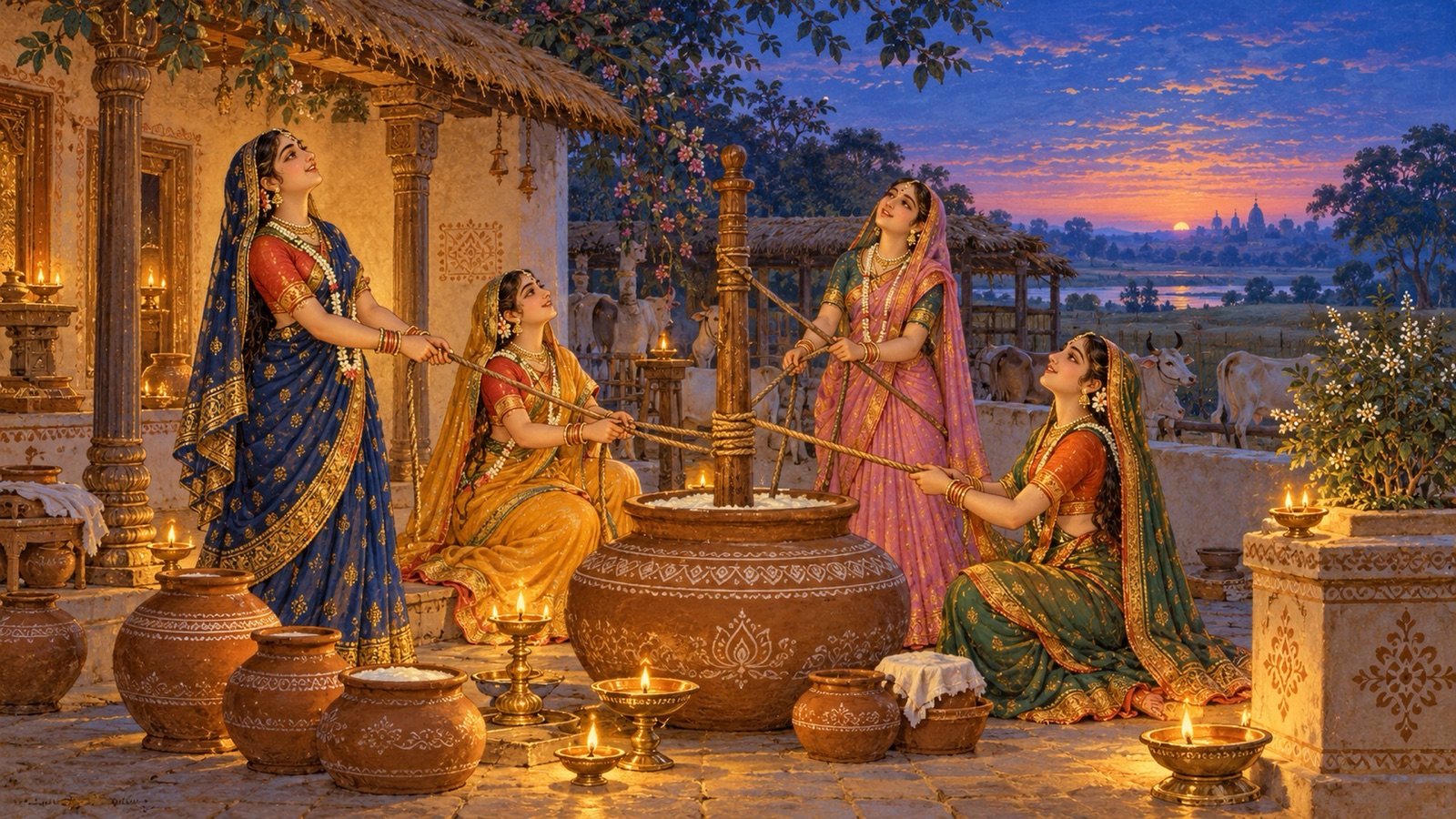
So the night slipped by while Nanda and Krishna’s attendant spoke together, O King. Toward its close the gopis rose, kindled their lamps, worshipped the deities of their households, and began to churn the curd. In the lamplight their jewels shone; their bangles swung as they pulled the churning cords; their earrings flashed against cheeks bright with red kunkuma. And as they churned, they sang aloud of the lotus-eyed Lord, and their voices, blended with the sound of the churning, rose to touch the heavens and drove every inauspiciousness from the quarters.
A Golden Chariot at Nanda’s Door
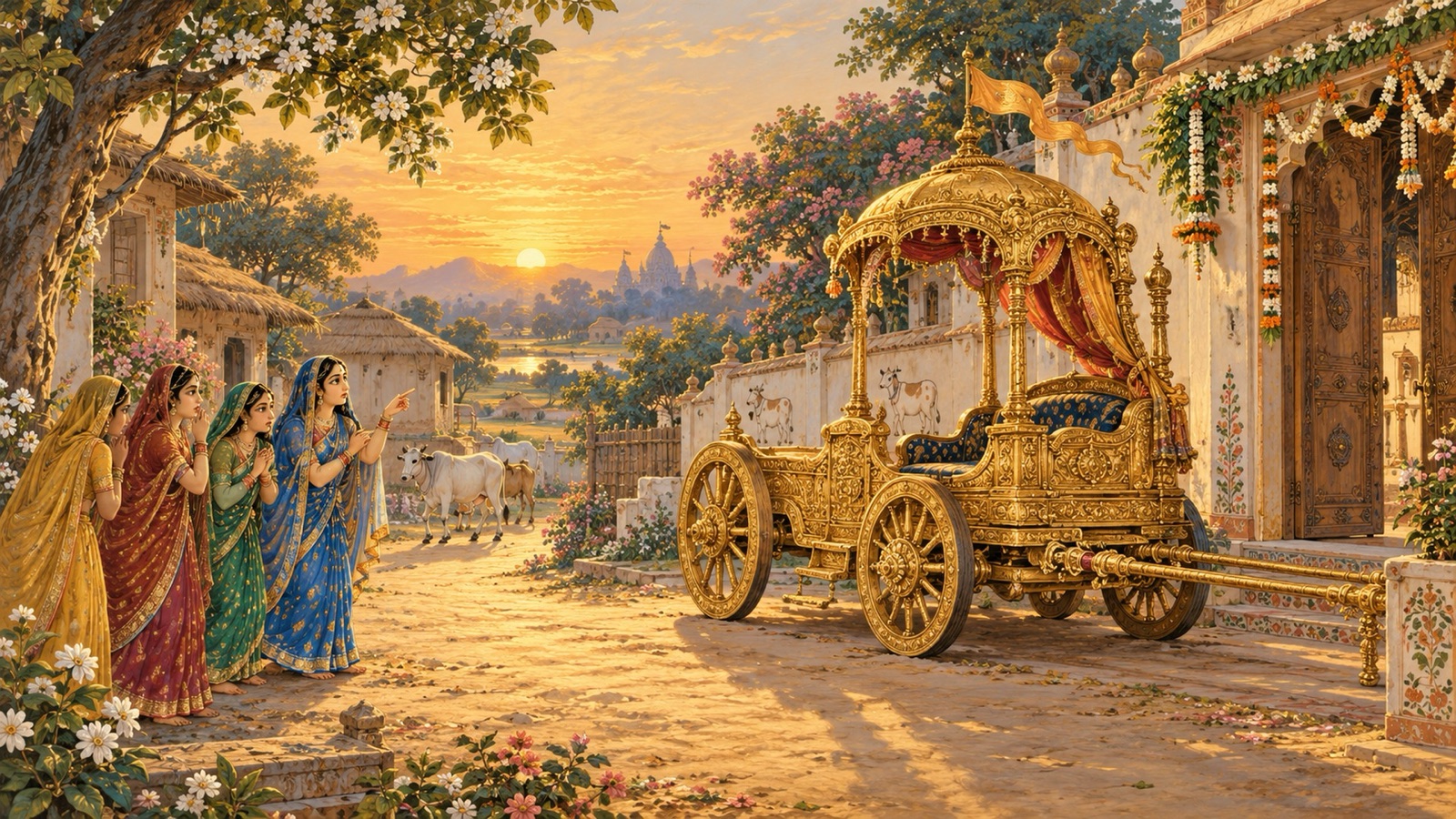
When the glorious sun had risen, the people of Vraja saw a golden chariot at Nanda’s gate, and the women, who knew nothing of the world beyond Krishna, asked one another whose it could be. Has Akrura come back, they wondered — he who did Kamsa’s work and carried the lotus-eyed Krishna away to Mathura? Does he now mean to offer our very bodies as the funeral oblation to his dead master? While the women were still speaking so, Uddhava, having finished his morning rites, returned to Nanda’s house.
Principal Teachings of This Chapter
1. The Lord Himself sustains those who give up everything for Him. Krishna tells Uddhava that the gopis have surrendered body, world and even worldly duty for His sake, and that He personally upholds such souls.
2. Separation can be the deepest form of remembrance. Nanda cannot work, for every river, hill and footprint turns his mind to Mukunda; Yashoda weeps at the mere telling of her Son’s deeds. Such grief is not the absence of devotion but its most concentrated form.
3. Love for the Lord is the highest attainment. Having given their whole hearts to Narayana, Uddhava says, no further pious deed remains for Nanda and Yashoda to perform. Bhakti is not a step toward some higher goal; it is the goal.
4. The Lord who played in Vraja is the Self of all. This is the heart of Uddhava’s message and the reason the Lord sends it. Nanda and Yashoda grieve for a son gone to Mathura; Uddhava lifts their eyes to the truth that this Son is Narayana, the seed and womb of the universe, hidden in every heart as fire lies within wood — the son, father, mother and Self of every being, who takes birth only in play, for the protection of the good, untouched by the modes through which He creates, sustains and withdraws the worlds. Krishna’s comfort thus comes in two forms at once: the promise that He will return, and the revelation that He has never left any heart.
5. Devotion sanctifies daily work. The gopis worship their household deities and churn the curd while singing of the lotus-eyed Lord, and that song drives inauspiciousness from the quarters. Ordinary tasks done in remembrance of Krishna become worship.
A Devotional Reflection
There is a quiet wonder in this chapter: Krishna, the Lord of the universe, cannot stop thinking of Vraja. The One whom the gopis cannot forget has not forgotten them; He describes their condition so intimately that we realise He has felt every pang of their longing from Mathura. Uddhava finds that Vraja has not stopped singing — but every sound has become Krishna’s name. Nanda’s questions are heartbreakingly simple: does He remember us? Will He come even once? Uddhava’s answer does not dismiss that ache; it deepens it into knowledge. Perhaps our own separations from the Lord are meant to be met the same way: not by pretending we do not miss Him, but by letting that missing turn every stream and hill of our lives into a reminder of Him.
A Daily Devotional Practice
Today, let one ordinary task become the gopis’ churning: as you cook, clean, walk or work, softly repeat the name of Krishna for the whole length of that task, offering the work itself to Him. If you feel any distance from the Lord, turn it, as Nanda did, into the question of a loving heart, and rest in Uddhava’s assurance that He dwells within. Begin by chanting gently: Om Namo Bhagavate Vasudevaya.
Conclusion
The forty-sixth chapter of the Tenth Canto carries Krishna’s heart from Mathura back to Vraja in the person of Uddhava. The Lord vows to sustain the gopis who have surrendered everything to Him; Nanda pours out his remembrance until love silences him; and Uddhava reveals that the Son of Vraja is Narayana within every heart, who will surely return. The chapter’s single lesson is that the Lord we grieve for is already within us, and that such grief is itself His gift of love.
May the divine wisdom of Srimad Bhagavatam awaken pure devotion within our hearts.
Om Namo Bhagavate Vasudevaya.
Jay Shree Madhav.
References and Attribution
- Primary edition: Gita Press, Śrīmad Bhāgavata Mahāpurāṇa (English), Book Ten (First Half), Discourse 46, pages 296–301.
- Series: Srimad Bhagavatam Wisdom · Biswa Sanatan Dharma Seva Trust.
- Presented following the spiritual guidance and recommendation of Pandit Dr. Shri Kashinath Mishra.
This is an original, faithful retelling in the writer’s own words, with brief quoted verses shown in Devanāgarī and transliteration and their meanings given as summaries. It is not a reproduction of any single publisher’s continuous translation or commentary. No affiliation with or endorsement by any publisher is implied.
Jay Shree Madhav