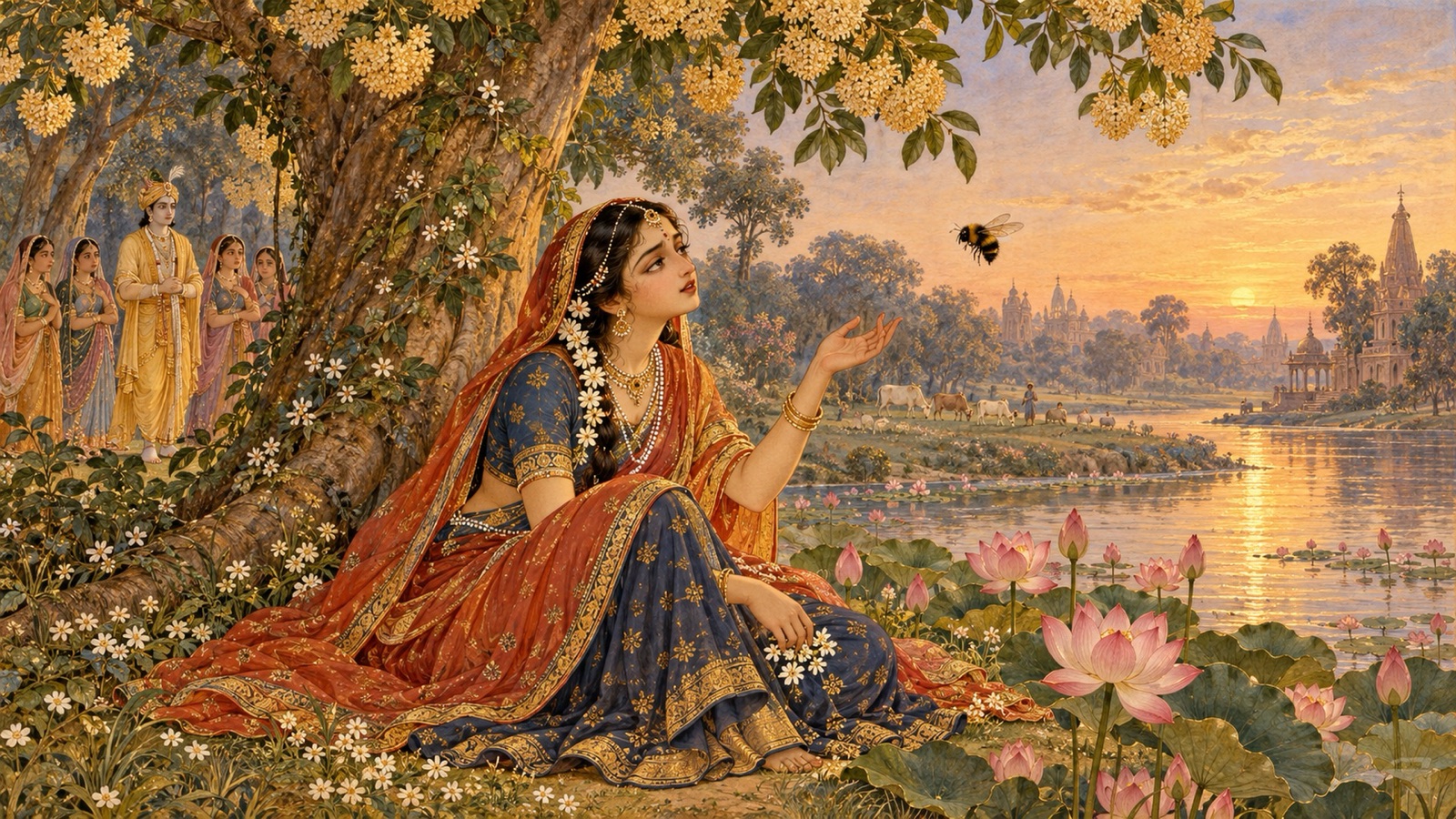
A bumblebee hovers before a grieving gopi of Vraja, and she speaks to it as though it were Krishna’s own envoy — reproach, longing and undying love pouring out together in the Bhramara-gita.
Om Namo Bhagavate Vasudevaya.
Om Namo Bhagavate Vasudevaya.
Om Namo Bhagavate Vasudevaya.
Welcome back to Srimad Bhagavatam Wisdom, our devotional journey through the Srimad Bhagavat Mahapurana. In this forty-seventh chapter of the Tenth Canto, Uddhava meets the gopis at dawn, hears the song to the bee, delivers Krishna’s message on separation and returns to Mathura.
Chapter Information
- Scripture: Śrīmad Bhāgavata Mahāpurāṇa
- Canto: 10
- Chapter: 47
- Chapter title: The Song of the Bee (Bhramara-gītā)
- Principal speaker: Sukadeva Gosvami; within it the gopis, Uddhava and Krishna’s message
- Principal listener: King Parikshit
- Main setting: Nanda’s Gokula in Vraja; at the close, Mathurā
- Central subject: The song to the bee; Krishna’s message on separation; Uddhava’s hymn and return
- Principal verse range: Canto 10, Chapter 47, verses 1–69
- Primary edition: Gita Press Śrīmad Bhāgavata Mahāpurāṇa (English)
The Gopis Gather Around Uddhava
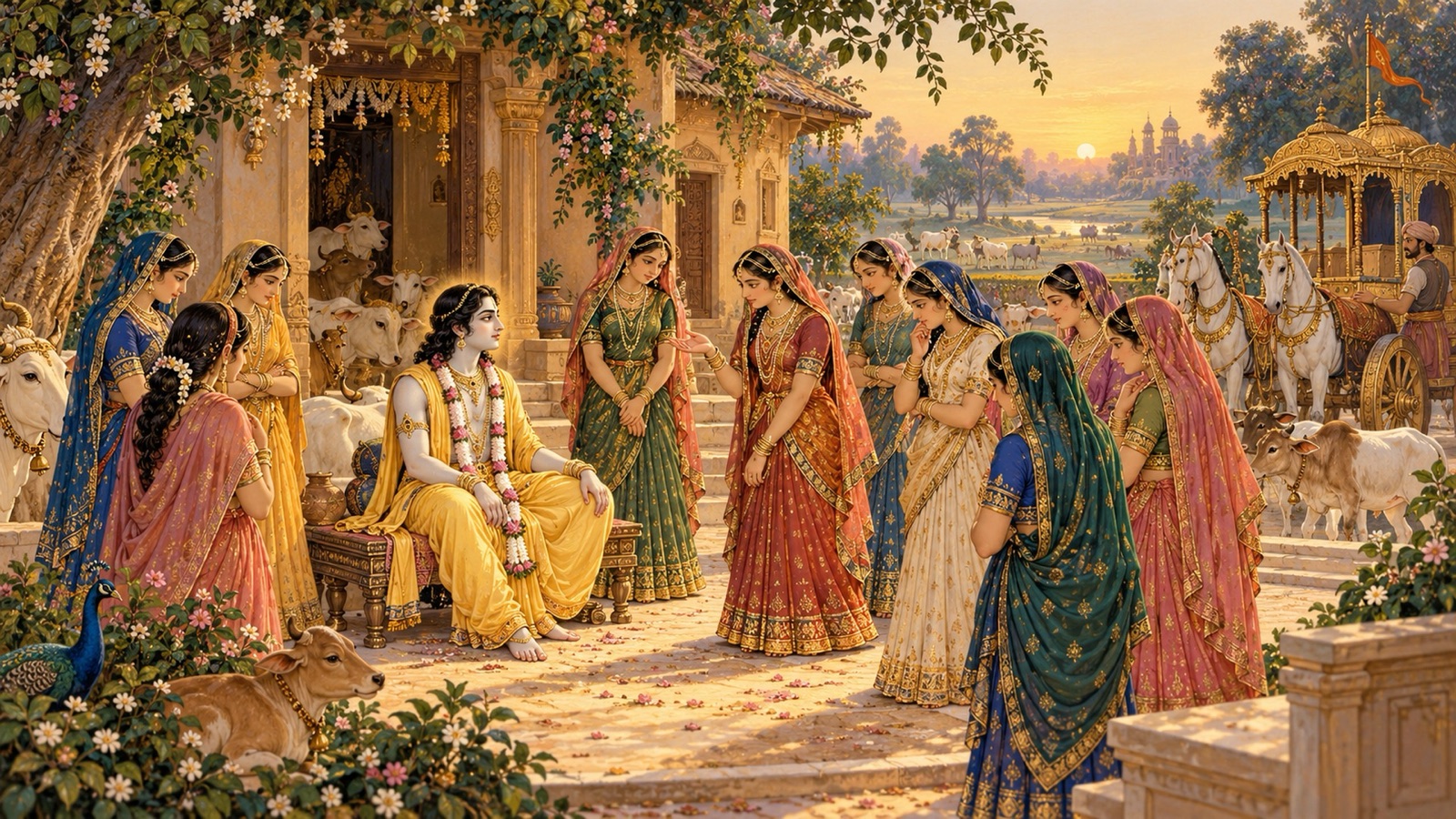
When Uddhava returned at dawn from his devotions at the Yamuna, the women of Vraja gazed at this servant of Krishna — long of arm, lotus-eyed, clad in yellow silk, garlanded with lotuses, his earrings gleaming — and asked one another who this stranger was, dressed just like Acyuta Himself. Eagerly they gathered around him; judging him to be Krishna’s messenger, they greeted him with shy smiles and kind words, seated him and, heads bowed in modesty, questioned him in private.
“Such Friendship Lasts Only While It Serves”
“We know you,” they said, “as a companion of the Lord of the Yadus, sent to bring joy to His parents. Otherwise what is there in Vraja, a mere cow-pasture, for Him to remember? Even a sage finds affection for his own kin hard to break, but affection for others lasts only while it serves, like a bee’s for a flower.” Bitterly they recited whom the world forsakes: harlots a penniless lover, subjects an incapable king, students their teacher, priests the sacrificer once paid, birds a fruitless tree, guests a house after the meal, animals a burnt forest, and a paramour the woman he has enjoyed.
So spoke the cowherd women, whose speech, body and mind belonged wholly to Govinda, casting aside all restraint; remembering Krishna’s infancy and boyhood, they sang and wept, all shame forgotten. Then one gopi, absorbed in the memory of her union with Him and seeing a bumblebee before her, took it for her Beloved’s messenger and spoke to it. The tradition recognizes in her Sri Radha Herself.
The Song to the Bee
मधुप कितवबन्धो मा स्पृशाङ्घ्रिं सपत्न्याः
कुचविलुलितमालाकुङ्कुमश्मश्रुभिर्नः ।
वहतु मधुपतिस्तन्मानिनीनां प्रसादं
यदुसदसि विडम्ब्यं यस्य दूतस्त्वमीदृक् ॥ १२ ॥
madhupa kitava-bandho mā spṛśāṅghriṁ sapatnyāḥ kuca-vilulita-mālā-kuṅkuma-śmaśrubhir naḥ vahatu madhu-patis tan-māninīnāṁ prasādaṁ yadu-sadasi viḍambyaṁ yasya dūtas tvam īdṛk
Meaning: O honey-drinker, friend of a deceiver! Do not touch our feet with your whiskers, stained by the kunkuma of the garland crushed upon our rival’s bosom. Let the Lord of the Madhus Himself carry the favour of those proud women — a favour the Yadu assembly will laugh at, since His messenger is one such as you. (Canto 10, Chapter 47, verse 12)
Having let us taste once the nectar of His lips, she went on, He abandoned us in an instant, as a bee leaves a flower; Lakshmi serves His feet only because His honeyed words have captured her heart. “Why, O six-legged one, sing His glories before us homeless women? Sing them to His new companions in Mathura; they will reward you.” What woman in the three worlds could resist the play of His brows and His smile — and what are we to Him, whose foot-dust even Lakshmi worships? Yet the name Uttamashloka belongs only to one who champions the forlorn. “Leave my foot, on which you have laid your head — you learnt this flattery from Him. He left us who gave up children, husbands and the next world for His sake. What is gained by making peace with Him?”
Her reproach reached back through His earlier descents: as Rama He shot Vali like a hunter and, swayed by His consort, disfigured a woman who came to Him in desire; as the Dwarf He took Bali’s gift and then bound him, like a crow turning on its feeder. “Enough of friendship with the dark-hued — and yet the treasure of His stories cannot be given up.” Whoever tastes a drop of that nectar leaves home and wanders like a bird, a mendicant. “Like foolish does trusting the hunter’s music, we believed His false professions and suffered again and again. Speak of something else, O messenger.”
Then grief melted into longing. “O friend of our Beloved — has He sent you again? Ask what you will, honoured one. But how will you carry us to Him, whose company once tasted cannot be renounced, on whose bosom Sri Herself abides? Is my Beloved now in Mathura? Does He remember His father’s house, His kinsmen and the cowherds? Does He ever speak of us, His maidservants? When will He lay upon our heads His arm, fragrant as aloe?”
Uddhava Praises the Gopis
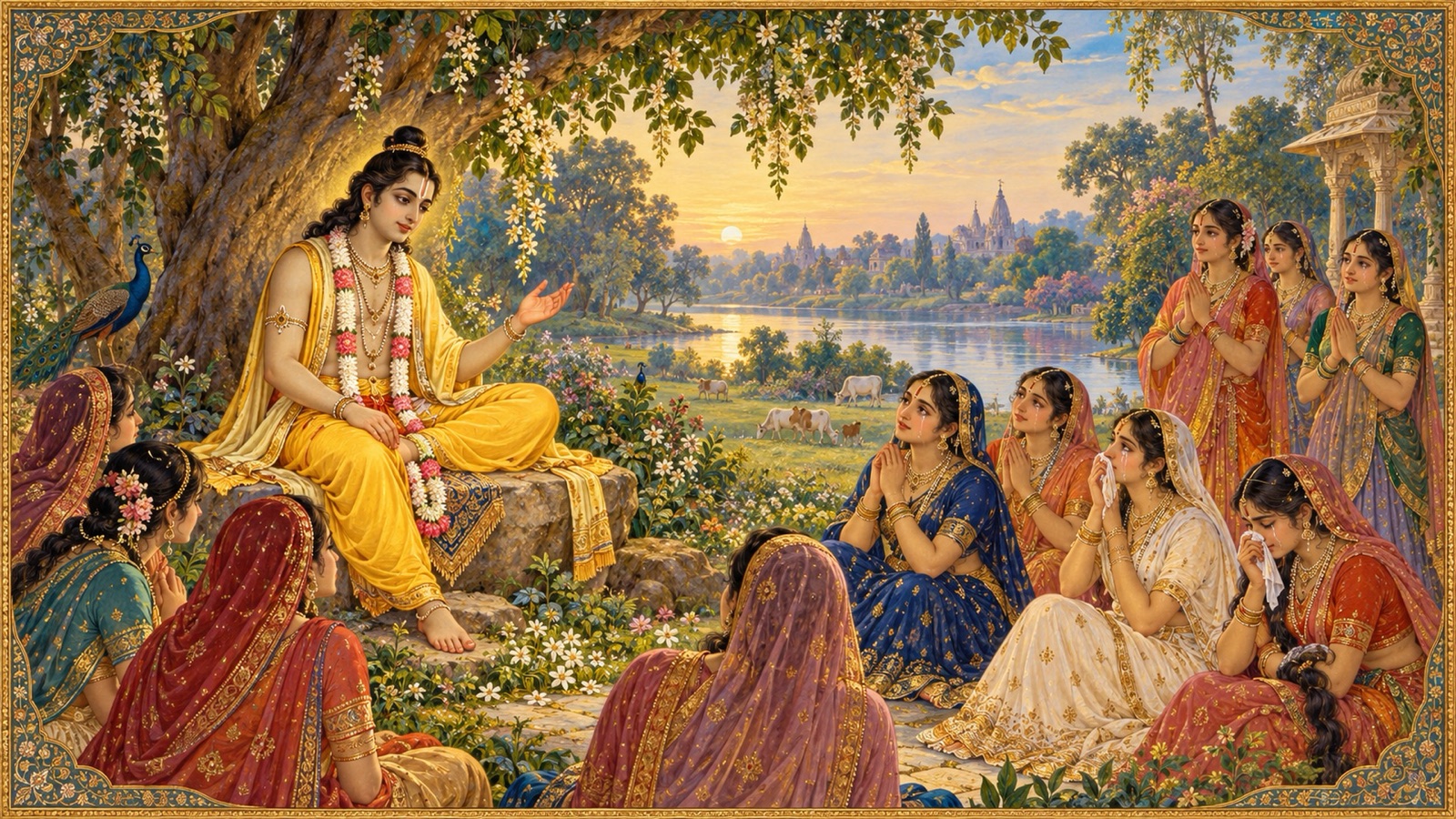
Hearing this outpouring of love, Uddhava comforted the gopis with their Beloved’s own words. “Blessed are you,” he said, “and worshipped by all the worlds, for your minds are wholly offered to Lord Vasudeva. What people seek through charity, vows, austerity, fire-offerings, japa, Vedic study and self-control is devotion to Krishna; you have set up its highest ideal, hard even for sages, seeking Him at the cost of children, husbands, homes and your very bodies. Through separation you have gained exclusive devotion to Him, and in letting me witness it you have blessed me. Now hear the message of your Beloved, which I, His confidant, bring.”
The Lord’s Message
भवतीनां वियोगो मे न हि सर्वात्मना क्वचित् ।
यथा भूतानि भूतेषु खं वाय्वग्निर्जलं मही ।
तथाहं च मनःप्राणभूतेन्द्रियगुणाश्रयः ॥ २९ ॥
bhavatīnāṁ viyogo me na hi sarvātmanā kvacit yathā bhūtāni bhūteṣu khaṁ vāyv-agnir jalaṁ mahī tathāhaṁ ca manaḥ-prāṇa-bhūtendriya-guṇāśrayaḥ
Meaning: The glorious Lord says: Your separation from Me, who am the Self of all, is never possible. Just as ether, air, fire, water and earth are present in all created beings, so am I the ground of the mind, the life-airs, the elements, the senses and the gunas. (Canto 10, Chapter 47, verse 29)
In Myself, the Lord continued, I create, sustain and dissolve Myself as this world by My own Maya. The Self is pure knowledge, transcendent, untouched by the gunas, known through waking, dream and deep sleep, which Maya brings about. Stay watchful, therefore, and master the mind that conjures up sense-objects as unreal as a dream. The Vedas, yoga, Sankhya, renunciation, austerity, sense-control and truthfulness all end in mastery of the mind, as rivers end in the ocean.
यत्त्वहं भवतीनां वै दूरे वर्ते प्रियो दृशाम् ।
मनसः सन्निकर्षार्थं मदनुध्यानकाम्यया ॥ ३४ ॥
yat tv ahaṁ bhavatīnāṁ vai dūre varte priyo dṛśām manasaḥ sannikarṣārthaṁ mad-anudhyāna-kāmyayā
Meaning: That I, your Beloved, stay far from your eyes is only so that your minds may be drawn closer to Me through constant meditation upon Me. (Canto 10, Chapter 47, verse 34)
A woman’s mind, He explained, dwells less on a beloved before her eyes than on one far away. Fixing your whole mind on Me and remembering Me always, you will come to Me before long — as did the fortunate women who, held back in Vraja on that night of the forest, reached Me through contemplation alone.
The Gopis Open Their Hearts Again
Delighted by the message, the gopis spoke once more. By good fortune Kamsa, tormentor of the Yadus, was slain, and Krishna was well among His kinsmen. But does the elder brother of Gada now delight the women of the city? Does He ever mention us village women? Does He recall the moonlit nights of the Rasa in Vrindavana? Will He come again to revive us, as Indra’s clouds revive a scorched forest? Others answered: why would He come, having slain His enemies, won a kingdom and married princesses? What purpose of the self-satisfied Lord of Sri could we forest-dwellers serve? Even Pingala declared hopelessness the highest happiness — “we know it, and still our hope of meeting Krishna cannot be conquered. Who can withdraw the mind from His intimate talks?” River, hill, forests, cows and flute-notes, hallowed by Krishna and Sankarshana, bring the son of Nanda back ceaselessly through His footprints; His gait, laughter, glances and honeyed words hold their minds captive. And they ended in prayer: “O Lord, O Spouse of Rama, O Lord of Vraja, destroyer of distress, O Govinda — lift Gokula out of the ocean of suffering.”
Uddhava’s Months in Vraja
Their anguish largely eased, the gopis worshipped Uddhava as Krishna Himself. He stayed some months to dispel their grief, gladdening Gokula with songs of Krishna’s pastimes; the days passed for Vraja like moments in talk of Him, and Uddhava wandered the river and woodlands in delight, asking about the pastimes each spot recalled.
Uddhava’s Hymn to the Dust of Vraja
Overwhelmed by the gopis’ absorption in Krishna, Uddhava bowed before them and sang: these cowherd women alone have made the human body fruitful, for their love is fixed on Govinda, the Self of all — the love that sages fearing rebirth, and we ourselves, long for; what need has one who relishes the Lord’s stories of births as a Brahmana, or even as Brahma? How strange that women of the forests, scorned as unfaithful to their husbands, should hold such perfect love for the Supreme Spirit — proof that the Lord bestows the highest good on whoever remembers Him, even without knowing His nature, as nectar heals whoever drinks it unknowingly. The grace that fell upon them in the Rasa was granted neither to the nymphs of heaven nor to Sri upon His bosom.
आसामहो चरणरेणुजुषामहं स्यां
वृन्दावने किमपि गुल्मलतौषधीनाम् ।
या दुस्त्यजं स्वजनमार्यपथं च हित्वा
भेजुर्मुकुन्दपदवीं श्रुतिभिर्विमृग्याम् ॥ ६१ ॥
āsām aho caraṇa-reṇu-juṣām ahaṁ syāṁ vṛndāvane kim api gulma-latauṣadhīnām yā dustyajaṁ sva-janam ārya-pathaṁ ca hitvā bhejur mukunda-padavīṁ śrutibhir vimṛgyām
Meaning: Ah, let me become any shrub, creeper or herb in Vrindavana that receives the dust of these women’s feet! Giving up their own people and the path of the virtuous, so hard to abandon, they took to the path of Mukunda that the Vedas are still seeking. (Canto 10, Chapter 47, verse 61)
The lotus feet that Sri caresses and that Brahma, the sages and the masters of yoga adore in their hearts — those feet the gopis embraced in the Rasa, and so shook off their grief.
वन्दे नन्दव्रजस्त्रीणां पादरेणुमभीक्ष्णशः ।
यासां हरिकथोद्गीतं पुनाति भुवनत्रयम् ॥ ६३ ॥
vande nanda-vraja-strīṇāṁ pāda-reṇum abhīkṣṇaśaḥ yāsāṁ hari-kathodgītaṁ punāti bhuvana-trayam
Meaning: Again and again I bow to the dust of the feet of the women of Nanda’s Vraja, whose loud singing of Hari’s stories purifies the three worlds. (Canto 10, Chapter 47, verse 63)
The Farewell and the Return to Mathura
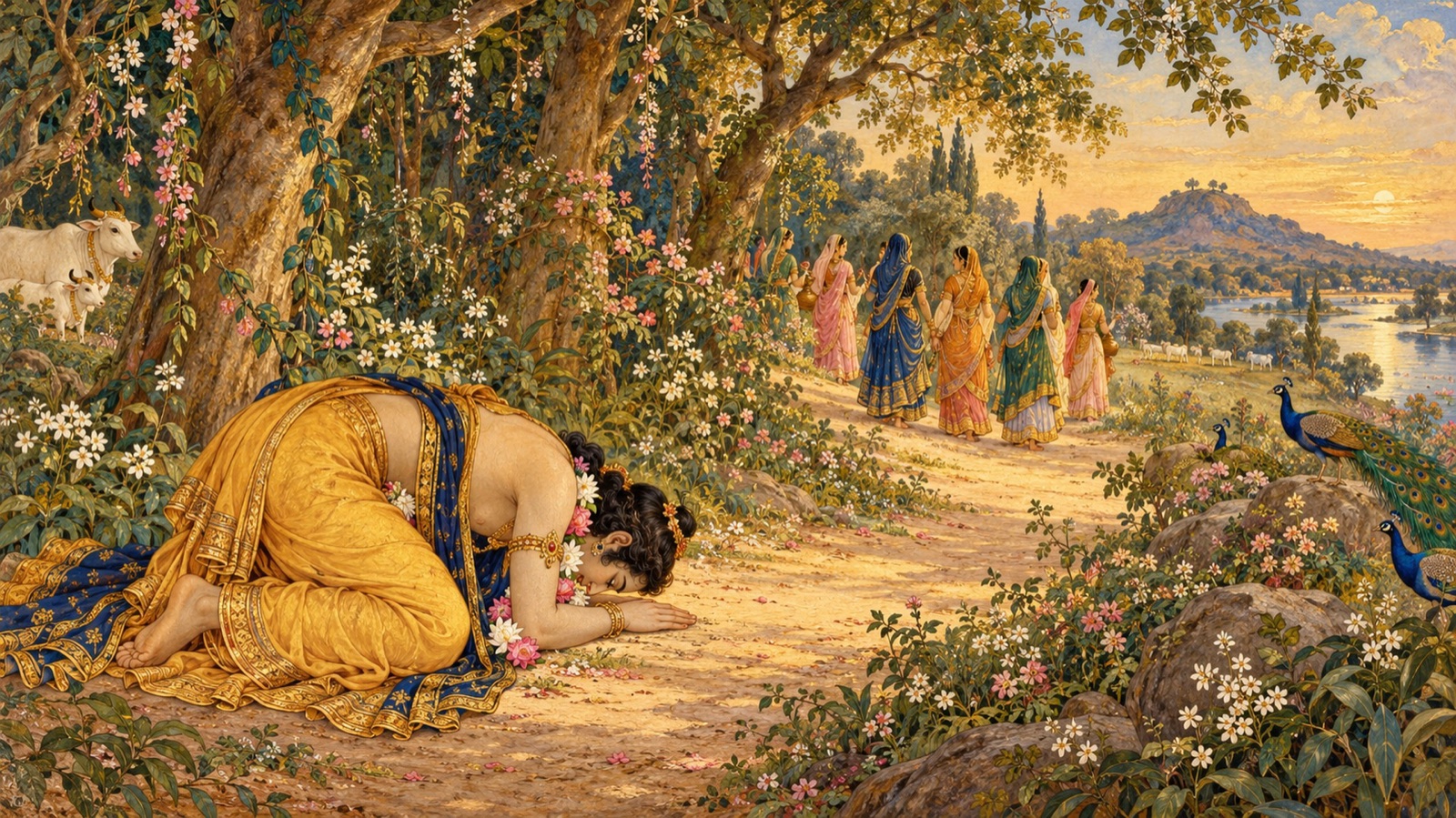
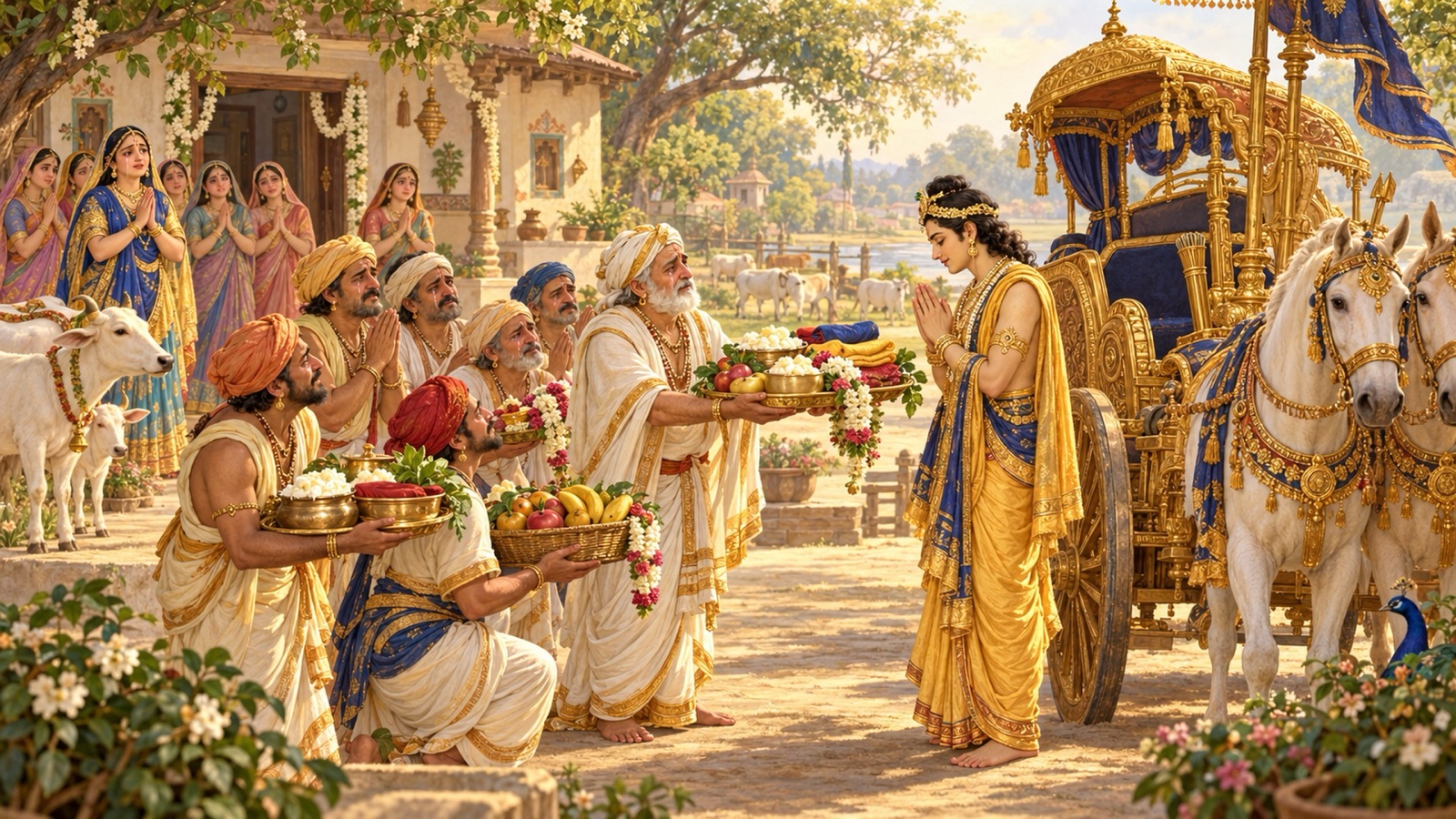
Taking leave of the gopis, Yashoda, Nanda and the cowherds, Uddhava mounted his chariot. As he left Nanda’s house, Nanda and the others came with gifts for Krishna and Balarama and prayed through their tears: “May every movement of our minds rest on Krishna’s lotus feet; may our speech utter His names; may our bodies bow to Him. Wherever our deeds and the Lord’s will may cast us, may the merit of our good works keep our love fixed on the almighty Krishna.”
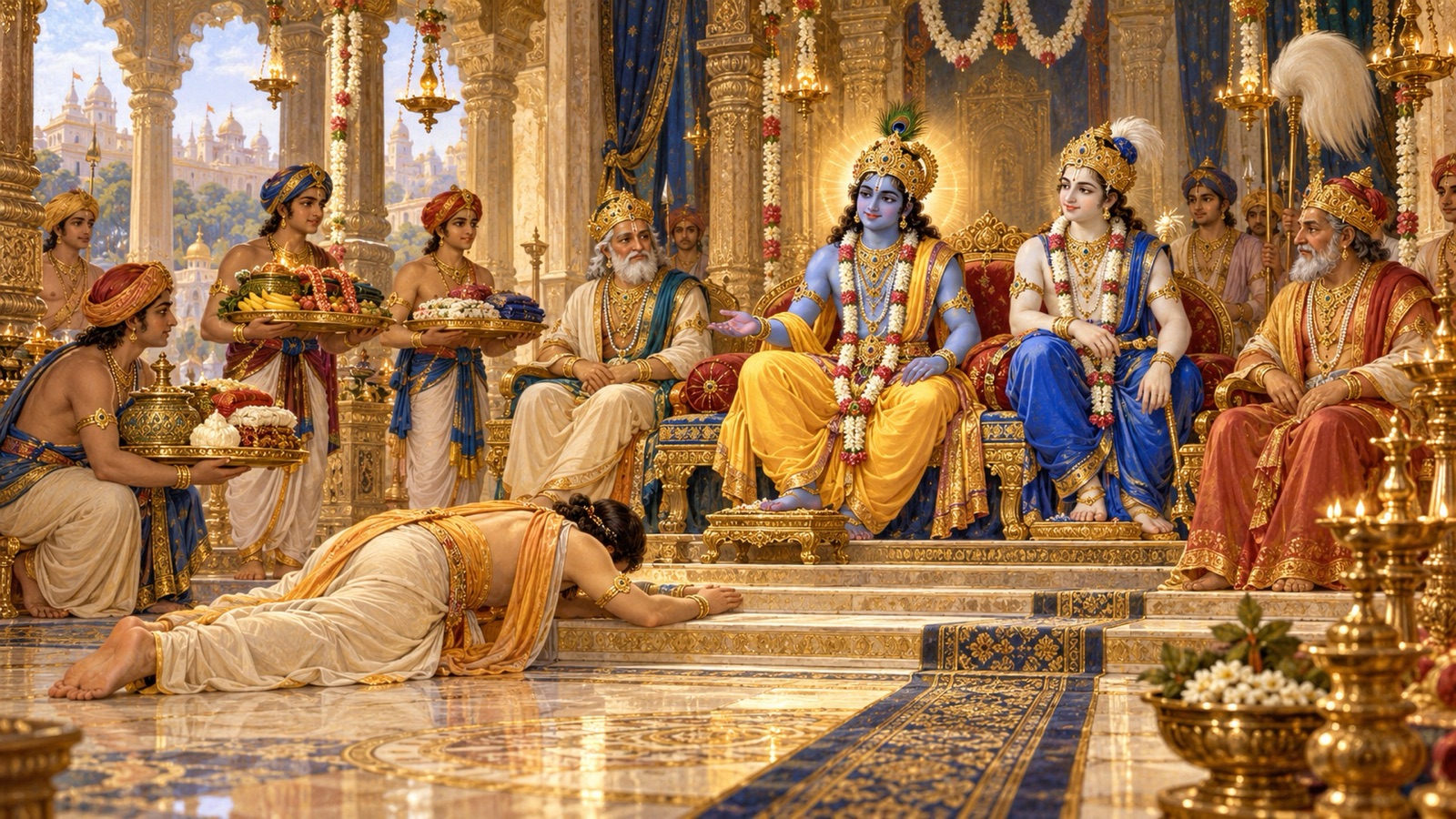
Honoured thus, Uddhava returned to Mathura, now protected by Krishna, prostrated before the Lord, told Him of Vraja’s overflowing devotion, and handed Nanda’s presents to Him, to Vasudeva, Balarama and King Ugrasena.
Principal Teachings of This Chapter
1. Separation is the Lord’s own means of drawing the mind near. This is the chapter’s heart. Krishna first assures the gopis that separation from Him is impossible, since He pervades every being; then He reveals why He still stays beyond their sight: so that their minds, with nowhere else to rest, may seek Him in unbroken remembrance, for a distant beloved absorbs the mind more completely than one at hand. The gopis who missed the Rasa yet attained Him by contemplation are His proof. Separation is thus not a withdrawal of grace but its instrument: the Lord arranges the distance so that love may ripen into total absorption in Him.
2. Mastery of the mind is the goal of every discipline. Vedas, yoga, Sankhya, renunciation and austerity all terminate in control of the mind, as rivers in the ocean; and charity, vows and study, Uddhava says, ultimately seek devotion to Krishna.
3. Love that keeps nothing back is the highest attainment. The Lord’s own confidant declares that the gopis alone have made human birth fruitful, and asks only to be a shrub touched by the dust of their feet.
4. Remembrance bears fruit even without knowledge of His greatness. As nectar heals whoever drinks it, the Lord grants the highest good to whoever keeps Him in mind.
A Devotional Reflection
What moves us most is the honesty of the gopis’ love. They call Krishna a deceiver, recite the wrongs of His earlier descents — and in the same breath confess that His stories cannot be given up. Real love does not pretend to be at peace; it argues, weeps and still refuses to let go. Krishna honours that love: He promises no early return, but reveals that His absence itself is gathering their minds to Him. Most telling is Uddhava, who came to teach and went home having learnt; his wish to be a creeper under the gopis’ feet shows where the summit of spiritual life lies — in a heart that belongs wholly to Govinda.
A Daily Devotional Practice
Today, when some absence or loss weighs on you, turn it, as the gopis did, into remembrance. Recall that Krishna stays out of sight so that the mind may be drawn near, let your longing become meditation, and close by chanting gently: Om Namo Bhagavate Vasudevaya.
Conclusion
This chapter sets the song to the bee beside the Lord’s own teaching on absence. The gopi’s wounded words, Krishna’s assurance that He withdraws from sight only to draw the mind closer, Uddhava’s hymn to the dust of their feet and Nanda’s tearful gifts lead to one truth: the Lord uses even separation to deepen love, and such love is the highest fruit of human birth. When He seems far, may we remember that He is drawing us near.
May the divine wisdom of Srimad Bhagavatam awaken pure devotion within our hearts.
Om Namo Bhagavate Vasudevaya.
Jay Shree Madhav.
References and Attribution
- Primary edition: Gita Press, Śrīmad Bhāgavata Mahāpurāṇa (English), Book Ten (First Half), Discourse 47, pages 301–309.
- Series: Srimad Bhagavatam Wisdom · Biswa Sanatan Dharma Seva Trust.
- Presented following the spiritual guidance and recommendation of Pandit Dr. Shri Kashinath Mishra.
This is an original, faithful retelling in the writer’s own words, with brief quoted verses shown in Devanāgarī and transliteration and their meanings given as summaries. It is not a reproduction of any single publisher’s continuous translation or commentary. No affiliation with or endorsement by any publisher is implied.
Jay Shree Madhav