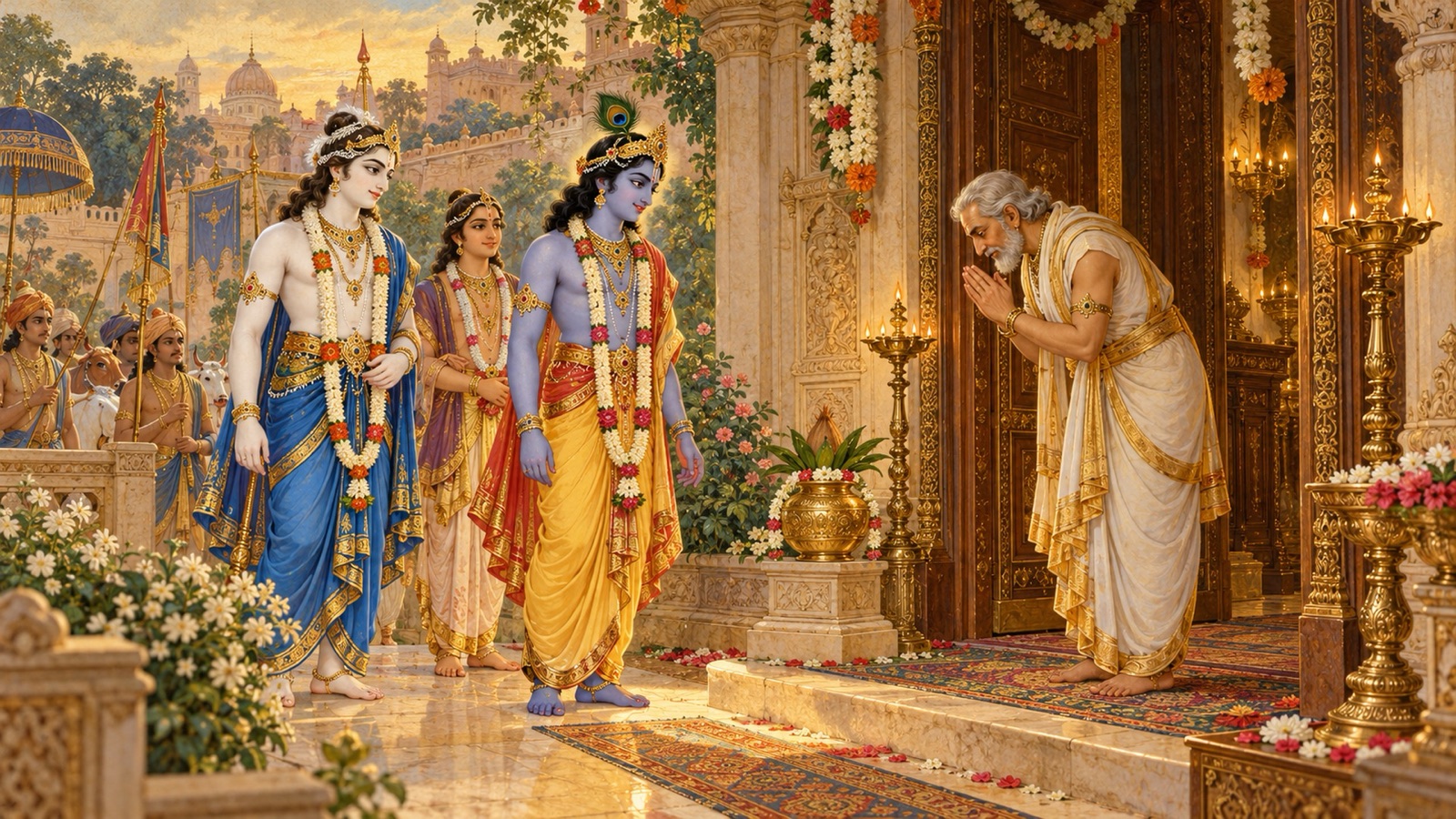
Two homes in Mathura open their doors to the Lord in a single chapter: the house of Trivakra, whose long sorrow He comes to set at rest, and the house of Akrura, where a devotee washes His feet, pours out a hymn of praise, and receives a mission to Hastinapura.
Om Namo Bhagavate Vasudevaya.
Om Namo Bhagavate Vasudevaya.
Om Namo Bhagavate Vasudevaya.
Welcome back to Srimad Bhagavatam Wisdom, our devotional journey through the sacred histories and teachings of the Srimad Bhagavat Mahapurana. In this forty-eighth chapter of the Tenth Canto, Sukadeva shows the Lord keeping two promises made in Mathura — to the woman who once anointed Him with sandal-paste, and to Akrura, the elder who had brought Him from Vraja — and teaching through these visits what a devotee should ask of Him.
Chapter Information
- Scripture: Śrīmad Bhāgavata Mahāpurāṇa
- Canto: 10 (Book Ten, First Half)
- Chapter: 48 (Discourse 48)
- Chapter title: Krishna Pleases His Devotees
- Principal speaker: Sukadeva Gosvami (narrating to King Parikshit); within the chapter, Akrura and Lord Krishna
- Principal listener: King Parikshit
- Main setting: Mathurā — the house of Trivakra and the residence of Akrura
- Central subject: The Lord’s visit to Trivakra; His visit with Balarama and Uddhava to Akrura’s house; Akrura’s hymn; the Lord’s praise of saintly devotees; and Akrura’s mission to Hastinapura on behalf of the Pandavas
- Principal verse range: Canto 10, Chapter 48, verses 1–36
- Primary edition: Gita Press Śrīmad Bhāgavata Mahāpurāṇa (English, Book Ten, Discourse 48)
Context From the Previous Chapter
In Chapter 47, Uddhava lived among the Gopis of Vraja, heard them pour out their love in the song to the bee, and stayed for months honouring the dust of their feet. He then returned to Mathura with Nanda’s gifts and told Krishna of the boundless devotion of Vraja.
The Lord Visits the House of Trivakra
Sukadeva now turns to a promise the Lord had made on the day He entered Mathura. Trivakra, the hunchbacked servant-woman of Kamsa, had once offered Him the sandal-paste meant for her master, and He had straightened her body and promised to come to her house. Knowing the longing that still burned in her heart, the all-seeing Lord, the Soul of all beings, went to her home to give her what she desired. Her house stood ready with costly furnishings, strings of pearls, banners, canopies, fine seats, incense, lamps, garlands and perfumes.
Seeing Him come, she rose in a flurry of joy and, with her companions, received Him with every honour, offering a fine seat and the articles of worship. Uddhava too was honoured; but he touched the offered seat with his head and sat upon the floor, unwilling to sit as an equal before his Lord. Krishna, following the ways of the world, took His place upon the couch prepared for Him.
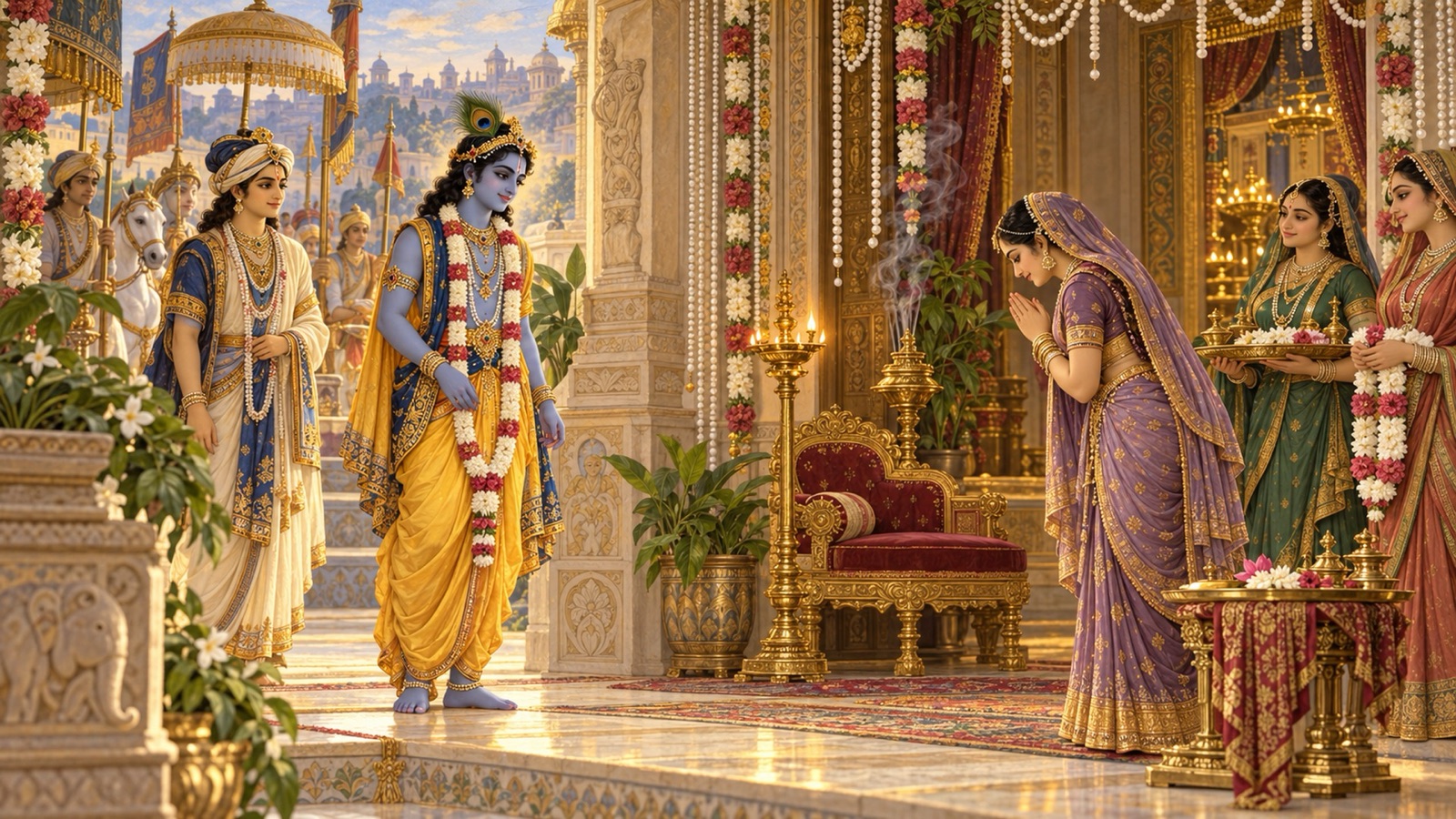
Trivakra then bathed, adorned herself with fine garments, ornaments and garlands, and approached the Lord shyly, with the smiles of a heart that had waited long. The Lord took her by the hand, seated her beside Him, and gave her the companionship she had yearned for; the one merit that earned her this rare grace was the sandal-paste she had once offered Him. Through the touch of His feet and the nearness of the all-blissful Lord, her long anguish was wholly removed.
And yet, Sukadeva says with a sigh, having obtained by that one offering the Lord Himself — the Giver of liberation, so hard to attain — the unfortunate woman asked only this: “Stay here a few days, my dearest friend, and delight with me; I cannot bear to give up your company, O lotus-eyed one.” The Lord, who honours the wishes of all, granted her boon, honoured her with kind words and gifts, and returned with Uddhava to His own prosperous home. Sukadeva then states the lesson plainly:
दुराराध्यं समाराध्य विष्णुं सर्वेश्वरेश्वरम् ।
यो वृणीते मनोग्राह्यमसत्त्वात् कुमनीष्यसौ ॥ ११ ॥
durārādhyaṁ samārādhya viṣṇuṁ sarveśvareśvaram yo vṛṇīte mano-grāhyam asattvāt kumanīṣy asau
Meaning: Having fully worshipped Vishnu, the Lord of all lords, who is so hard to please, one who then asks of Him only what gratifies the mind is of poor understanding, because of his pettiness. (Canto 10, Chapter 48, verse 11)
At the Door of Akrura
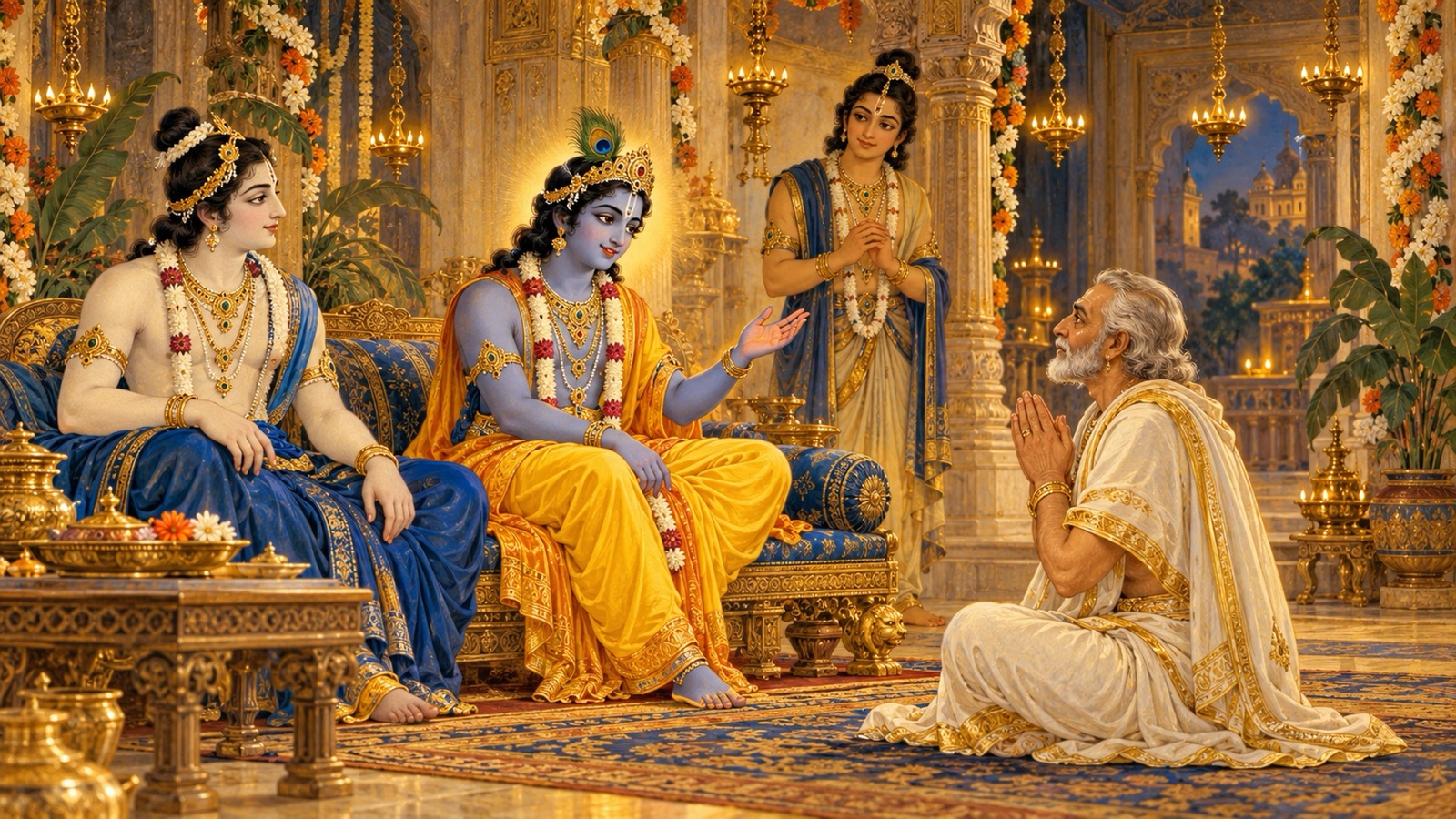
Wishing to have Akrura carry out an errand, and also to please him, the Lord next went in state to Akrura’s residence with Balarama and Uddhava. Seeing from afar these jewels among men — his own kinsmen — Akrura rose in delight, embraced them and welcomed them. He bowed to Krishna and Balarama despite Their youth, for he knew who They were, and when They had greeted him and taken Their seats, he worshipped Them according to the rites.
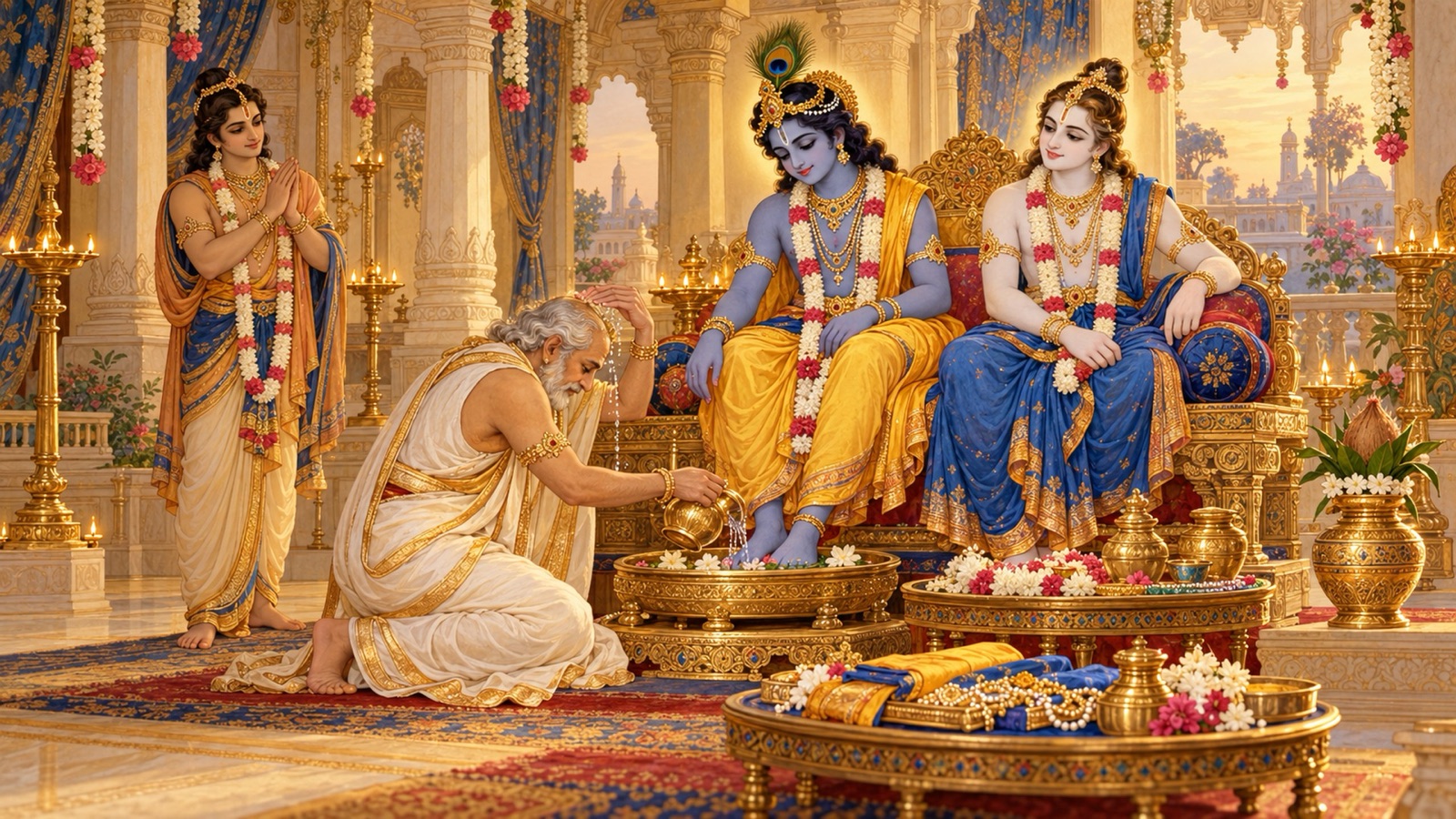
Akrura washed Their feet and sprinkled that water over his head on every side. He honoured Them with the articles of worship, exquisite robes, sandal-paste, garlands and fine jewels; then, bending low in humility, he bowed his head, took Their feet upon his lap, and gently pressed them as he began to speak.
Akrura’s Hymn
“By good fortune,” Akrura said, “You two have slain the sinful Kamsa with his followers, and this family of Yours has been delivered from a calamity hard to cross and made to flourish. You are Pradhana and Purusha, the material and the efficient cause of the universe, and one with it; apart from You there is nothing, neither cause nor effect. Having created this world through Your own potencies, You enter it as its inner ruler, O Krishna, and so are perceived in countless forms by those who hear and see — just as the elements appear in many forms in all moving and unmoving beings.”
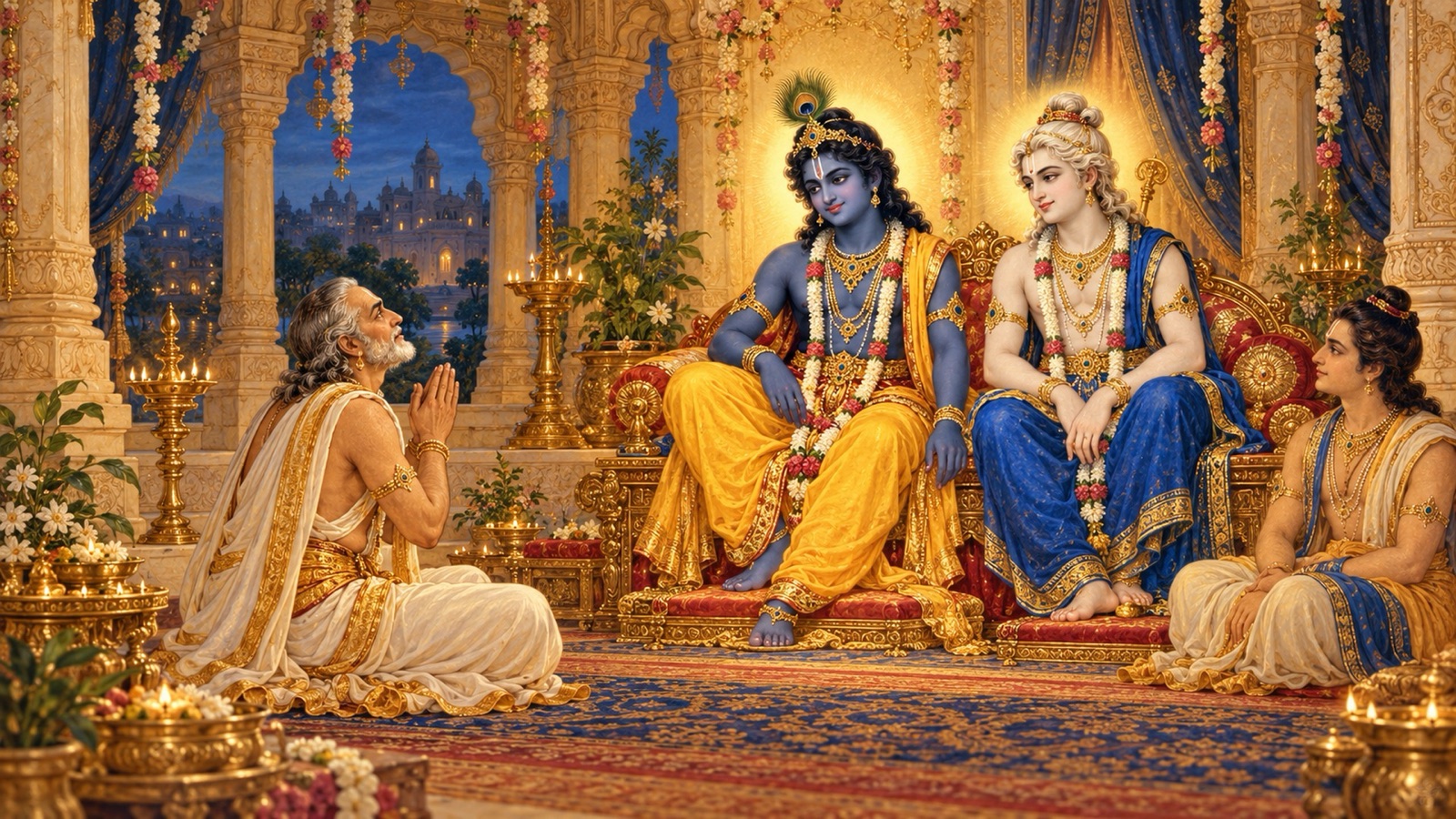
Akrura then praised the Lord’s freedom from every bond. “Through Your own energies — Rajas, Sattva and Tamas — You create, preserve and withdraw the universe, yet You are never bound by those qualities or acts; for You are Consciousness itself, and ignorance can never touch You. Since the body and its coverings cannot be shown to belong to the Self, neither birth nor division truly touches the spirit; for You there is neither bondage nor liberation, and whatever seems so is only the confusion of our minds.” From this Akrura came to the reason for the Lord’s descent:
त्वयोदितोऽयं जगतो हिताय
यदा यदा वेदपथ: पुराण: ।
बाध्येत पाखण्डपथैरसद्भि-
स्तदा भवान् सत्त्वगुणं बिभर्ति ॥ २३ ॥
tvayodito ‘yaṁ jagato hitāya yadā yadā veda-pathaḥ purāṇaḥ bādhyeta pākhaṇḍa-pathair asadbhis tadā bhavān sattva-guṇaṁ bibharti
Meaning: Whenever this ancient path of the Vedas, which You Yourself declared for the good of the world, is obstructed by the wicked through heretical ways, You assume a form of pure Sattva to restore it. (Canto 10, Chapter 48, verse 23)
“And so, O Lord,” Akrura continued, “You have now been born in the house of Vasudeva with Your own expansion, Balarama, to lighten the earth’s burden by destroying hundreds of Akshauhinis of demonic kings, and to spread the fame of the Yadus. Today our dwelling is supremely blessed, for You have entered it — You, the Father and Preceptor of the universe, beyond the senses, present in all the gods, forefathers, spirits and kings, the water of whose feet, flowing as the Ganga, purifies the three worlds.”
क: पण्डितस्त्वदपरं शरणं समीयाद्
भक्तप्रियादृतगिर: सुहृद: कृतज्ञात् ।
सर्वान् ददाति सुहृदो भजतोऽभिकामा-
नात्मानमप्युपचयापचयौ न यस्य ॥ २६ ॥
kaḥ paṇḍitas tvad-aparaṁ śaraṇaṁ samīyād bhakta-priyād ṛta-giraḥ suhṛdaḥ kṛta-jñāt sarvān dadāti suhṛdo bhajato ‘bhikāmān ātmānam apy upacayāpacayau na yasya
Meaning: What wise person would seek any refuge other than You — who love Your devotees, whose word is truth, who are the friend of all and ever grateful, and who grant Your worshippers all they desire, even Your own Self, which knows neither increase nor decrease? (Canto 10, Chapter 48, verse 26)
Then came the prayer in which Akrura’s whole hymn finds its purpose. He asked neither for wealth nor for protection, but for the cutting of the rope that binds every householder’s heart.
दिष्ट्या जनार्दन भवानिह न: प्रतीतो
योगेश्वरैरपि दुरापगति: सुरेशै: ।
छिन्ध्याशु न: सुतकलत्रधनाप्तगेह-
देहादिमोहरशनां भवदीयमायाम् ॥ २७ ॥
diṣṭyā janārdana bhavān iha naḥ pratīto yogeśvarair api durāpa-gatiḥ sureśaiḥ chindhy āśu naḥ suta-kalatra-dhanāpta-geha- dehādi-moha-raśanāṁ bhavadīya-māyām
Meaning: By good fortune, O Janardana, You have appeared here before us — You whose course even the masters of Yoga and the rulers of the gods cannot easily fathom. Quickly cut the rope of Your Maya, the delusion that binds us to children, wife, wealth, relatives, home, body and the rest. (Canto 10, Chapter 48, verse 27)
Trivakra and Akrura each received the same Lord beneath their roof and each was granted what they asked; but one asked for a few more days of His presence, the other to be freed from everything that stands between the soul and Him. The Lord grants both, for He respects the wishes of all, yet Sukadeva marks which prayer is worthy of the One addressed: the devotee who knows who stands before him asks not for His company on the terms of the senses, but for His Maya to be cut.
The Lord’s Reply: Saints Above Gods and Holy Places
Thus honoured and glorified by His devotee, Lord Hari smiled and answered Akrura, enchanting him with gentle words. “You are our preceptor, our uncle and our praiseworthy friend,” He said; “we are your children, whom you must ever protect, nourish and treat with compassion. Men who seek their welfare should always serve exalted souls such as you, more than the gods; for the gods act from self-interest, but the saintly do good without looking for a return.”
न ह्यम्मयानि तीर्थानि न देवा मृच्छिलामया: ।
ते पुनन्त्युरुकालेन दर्शनादेव साधव: ॥ ३१ ॥
na hy am-mayāni tīrthāni na devā mṛc-chilā-mayāḥ te punanty uru-kālena darśanād eva sādhavaḥ
Meaning: It is not that holy places made of water, and deities made of clay and stone, do not purify; but they purify after a long time, whereas the saintly purify by their very sight. (Canto 10, Chapter 48, verse 31)
The Mission to Hastinapura
Having placed His devotee above gods and holy rivers, the Lord entrusted him with a task fit for such a friend.
स भवान् सुहृदां वै न: श्रेयाञ्छ्रेयश्चिकीर्षया ।
जिज्ञासार्थं पाण्डवानां गच्छस्व त्वं गजाह्वयम् ॥ ३२ ॥
sa bhavān suhṛdāṁ vai naḥ śreyāñ chreyaś-cikīrṣayā jijñāsārthaṁ pāṇḍavānāṁ gacchasva tvaṁ gajāhvayam
Meaning: You are the best of our friends; therefore, wishing to do good to the sons of Pandu, go to Hastinapura to learn how they fare. (Canto 10, Chapter 48, verse 32)
“We have heard,” the Lord explained, “that after their father’s passing the young sons of Pandu were brought with their mother to the capital by King Dhritarashtra, and live there in great distress. The feeble-minded king, blind and ruled by his wicked son, does not treat his nephews impartially. Go, then, and discover his conduct toward them, good or bad; knowing it for certain, we shall arrange whatever secures the welfare of our friends.”
Having instructed Akrura in this way, the almighty Lord Hari, who takes away the sorrows of His devotees, returned to His own residence together with Sankarsana and Uddhava.
Principal Teachings of This Chapter
1. Ask the Lord for what befits Him. Having worshipped the One whom even the gods find hard to please, the devotee of narrow heart asks for what merely gratifies the mind, as verse 11 warns. The measure of our devotion shows in what we ask.
2. He descends to restore the path of the Vedas. Whenever the ancient way is choked by false creeds, the Lord takes a form of pure Sattva, as Akrura confesses in verse 23; His birth in Vasudeva’s house is for the relief of the earth.
3. There is no other refuge. Verse 26 asks who, being wise, would seek shelter elsewhere, when the Lord gives His devotees everything, even His own Self, which never wanes.
4. The highest prayer is for the cutting of Maya. Akrura’s climactic request in verse 27 is not for anything of this world but for release from attachment to children, wife, wealth, home and body.
5. Saints purify by their very sight. The Lord Himself declares in verse 31 that holy waters and sacred images sanctify slowly, but the saintly sanctify at once; such souls deserve honour above even the gods, who serve their own interest. And by sending Akrura to Hastinapura He shows that His care reaches His suffering friends across kingdoms.
A Devotional Reflection
What stays with us from this chapter is how differently two devotees spoke when the Lord sat before them. Trivakra, bent for years and loyal enough to give Him her master’s sandal-paste, could think of nothing better than a few more days of His company. We are not asked to despise her; the Lord did not. He fulfilled her wish and left her with honour, and even her touch of His feet secured the highest blessing. But Sukadeva tells us, gently, that she might have asked for so much more. Akrura shows what that “more” is. He too wanted the Lord to stay — not for a few days in his house, but forever in his heart, with nothing left to crowd Him out; and so he prayed for the rope of Maya to be cut. Most of us pray like Trivakra: for relief, for comfort, for the Lord to remain in our life as it is. The chapter invites us to pray like Akrura, so that our attachments may loosen and the Lord who has entered our home may never have to leave it.
A Daily Devotional Practice
Today, before asking the Lord for anything, pause and consider what you would request if He stood in your doorway as He stood in Akrura’s. Then offer Akrura’s prayer in your own words: “Cut quickly the rope of attachment that binds me to what I own and to this body, so that nothing may come between me and You.” If you meet a saintly person today, honour them, remembering that such souls purify by their very sight. Begin by chanting gently: Om Namo Bhagavate Vasudevaya.
Conclusion
This chapter carries the Lord into two Mathura homes and leaves each richer. At Trivakra’s He repays a gift of sandal-paste with His presence and grants her boon; at Akrura’s He is worshipped, hears a hymn that climaxes in the plea to cut away Maya, places His devotee above gods and holy waters, and sends him to Hastinapura for the Pandavas’ sake. The one lesson binding the two visits is the worth of the prayer we offer when the Lord is near: may we learn to ask Him for Himself.
May the divine wisdom of Srimad Bhagavatam awaken pure devotion within our hearts.
Om Namo Bhagavate Vasudevaya.
Jay Shree Madhav.
References and Attribution
- Primary edition: Gita Press, Śrīmad Bhāgavata Mahāpurāṇa (English), Book Ten (First Half), Discourse 48.
- Series: Srimad Bhagavatam Wisdom · Biswa Sanatan Dharma Seva Trust.
- Presented following the spiritual guidance and recommendation of Pandit Dr. Shri Kashinath Mishra.
This is an original, faithful retelling in the writer’s own words, with brief quoted verses shown in Devanāgarī and transliteration and their meanings given as summaries. It is not a reproduction of any single publisher’s continuous translation or commentary. No affiliation with or endorsement by any publisher is implied.
Jay Shree Madhav