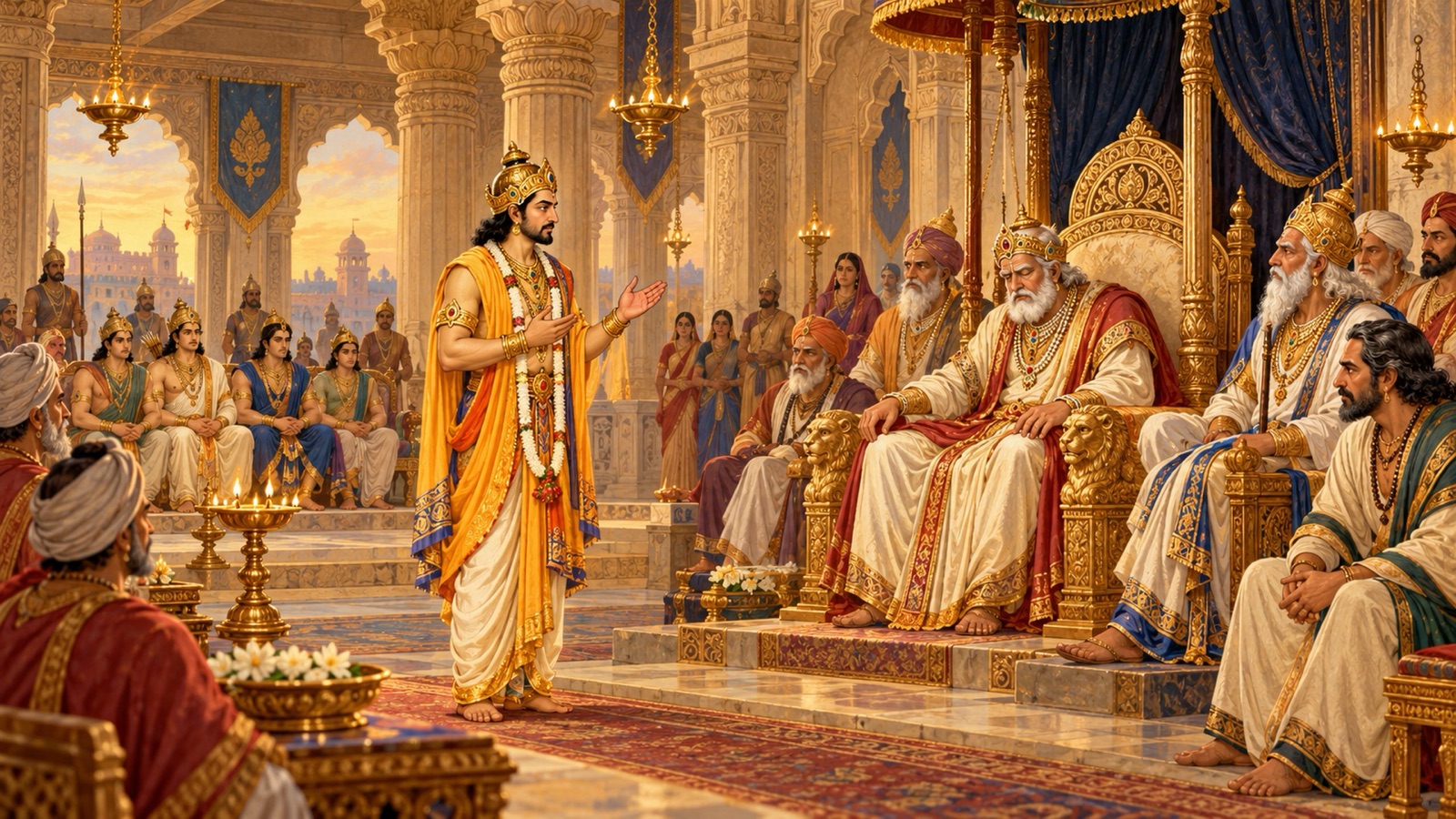
Sent by Krishna to learn how the fatherless sons of Pandu are faring, Akrura hears Kunti’s tearful prayer, speaks dharma to the blind king of the Kurus, and discovers that a heart ruled by love for its sons cannot hold wholesome words.
Om Namo Bhagavate Vasudevaya.
Om Namo Bhagavate Vasudevaya.
Om Namo Bhagavate Vasudevaya.
Welcome back to Srimad Bhagavatam Wisdom, our devotional journey through the sacred histories and teachings of the Srimad Bhagavat Mahapurana. In this forty-ninth chapter of the Tenth Canto, Akrura carries out the errand the Lord entrusted to him in Hastinapura, counsels King Dhritarashtra in the open court, and carries the king’s honest, helpless answer back to Balarama and Krishna.
Chapter Information
- Scripture: Śrīmad Bhāgavata Mahāpurāṇa
- Canto: 10 (Book Ten, First Half)
- Chapter: 49 (Discourse 49)
- Chapter title: Akrura’s Mission in Hastinapura
- Principal speaker: Sukadeva Gosvami (narrating to King Parikshit); within the chapter, Kunti, Akrura and Dhritarashtra speak
- Principal listener: King Parikshit
- Main setting: Hastinapura, the capital of the Kuru kings; closing at Mathura
- Central subject: Akrura’s stay in Hastinapura; Kunti’s lament and prayer to Krishna; Akrura’s counsel of impartiality to Dhritarashtra; the king’s confession of attachment and his bow to the Lord’s will; Akrura’s report to Balarama and Krishna
- Principal verse range: Canto 10, Chapter 49, verses 1–31
- Primary edition: Gita Press Śrīmad Bhāgavata Mahāpurāṇa (English edition, Book Ten)
Context From the Previous Chapter
In Chapter 48, Krishna visited the home of Akrura, who worshipped Him and praised Him as the shelter of the surrendered. The Lord then gave him a mission: to go to Hastinapura and find out how Kunti and her fatherless sons were being treated by Dhritarashtra, the blind king who followed the will of his wicked son, so that the Yadus could act for the Pandavas’ welfare.
Akrura Arrives in Hastinapura
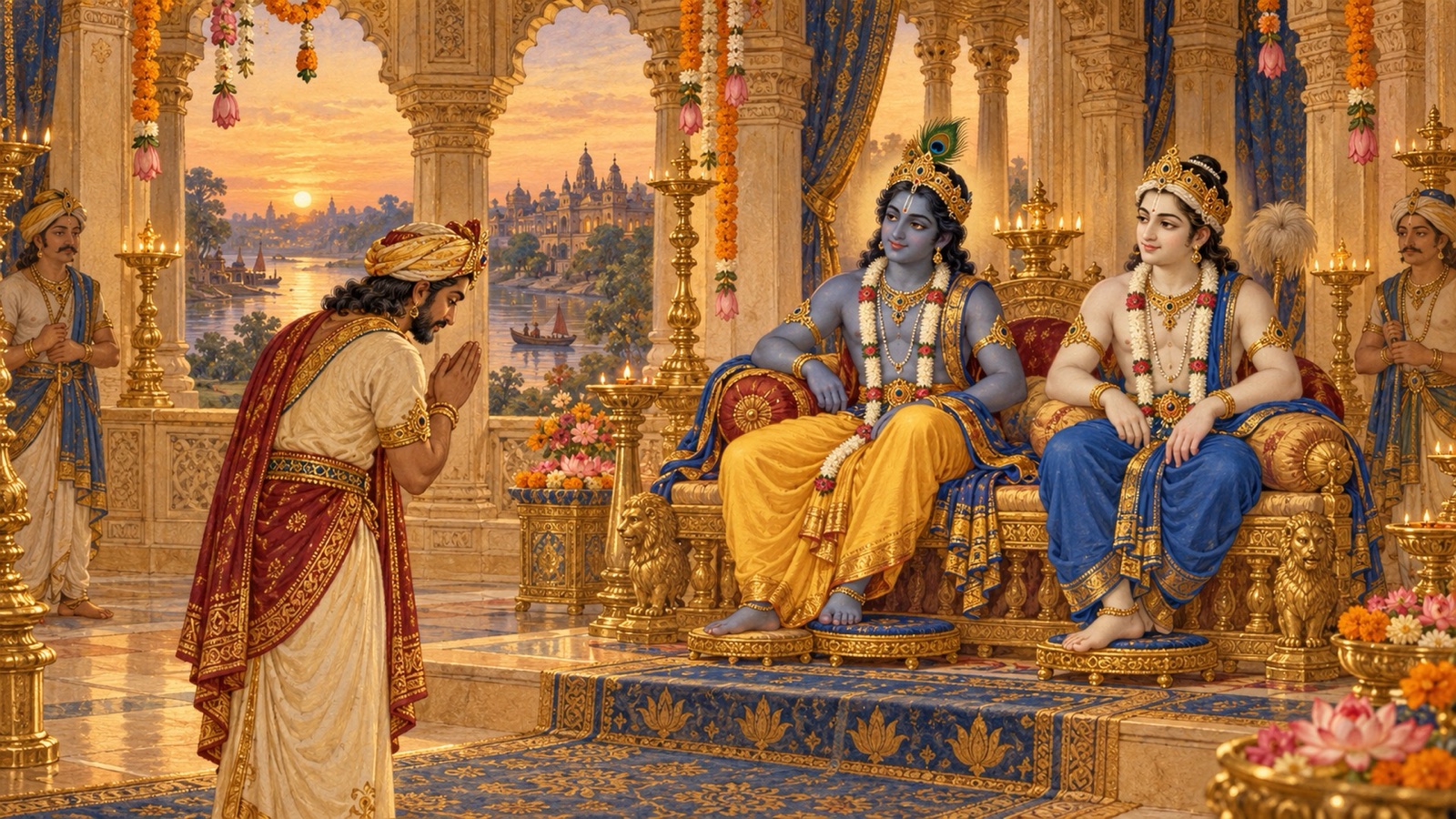
Sukadeva continued his narration to King Parikshit. Akrura reached Hastinapura, the city stamped with the glory of the kings of Puru’s line, and there he saw Dhritarashtra, the son of Ambika, surrounded by the great men of the house: Bhishma, Vidura and Kunti; Bahlika with his son Somadatta; Drona, the son of Bharadvaja, and Kripa of the line of Gotama; Karna, Duryodhana and Ashvatthama; Yudhishthira with his four brothers; and other friends of the family. The son of Gandini greeted each of his kinsmen in the manner due to him. They asked him eagerly for news of their relatives in Mathura, and he in turn enquired after their well-being.
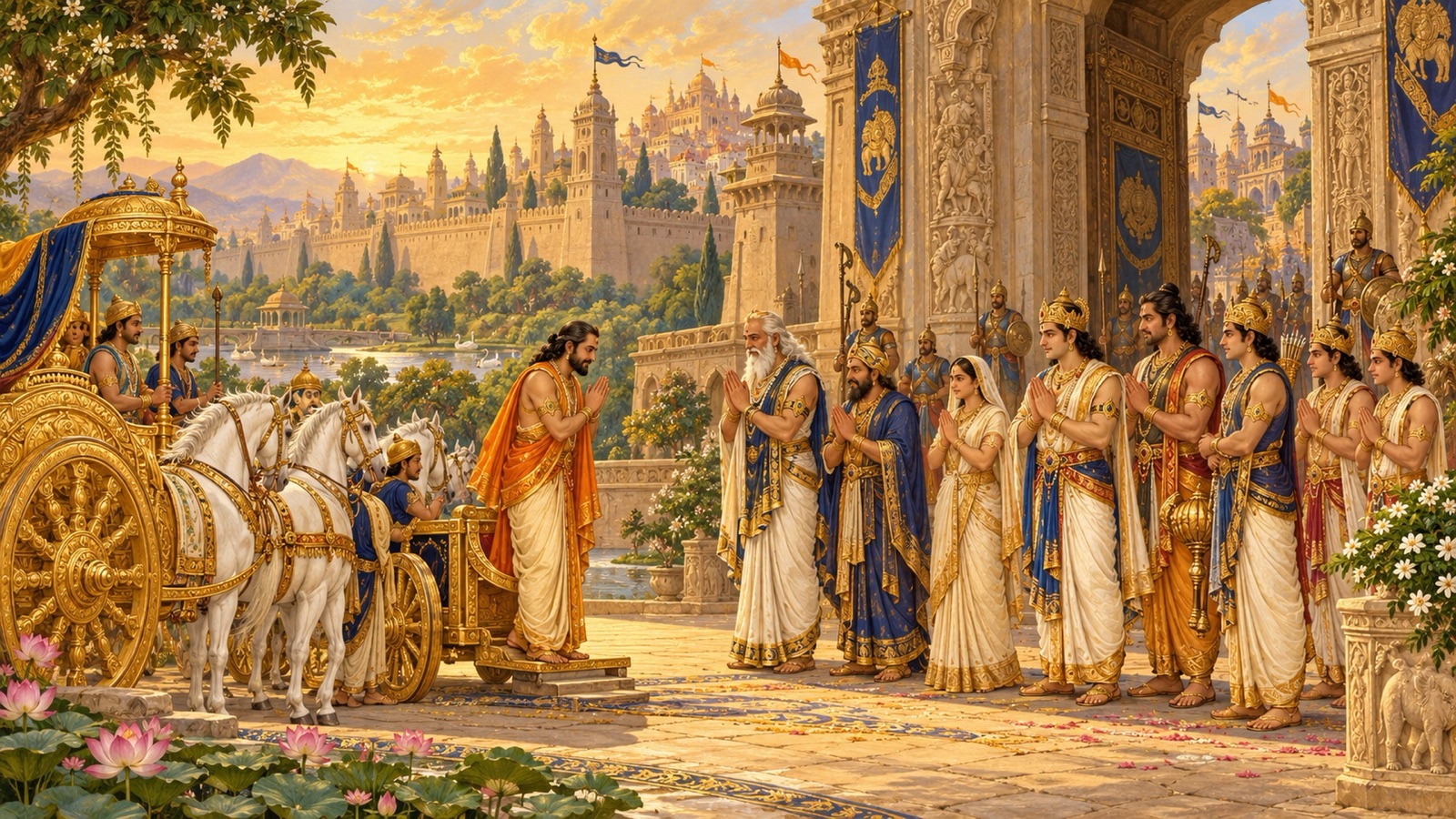
Akrura stayed in Hastinapura for several months, for he wished to see with his own eyes how the king conducted himself towards the sons of Pandu — a king whose sons were wicked, whose moral strength was small, and who let himself be led by the will of evil counsellors. What he could not observe, Kunti and Vidura told him plainly. They described all that Duryodhana and his brothers had already done and were still plotting against the Pandavas, down to the giving of poison, because they could not bear the brilliance, the energy, the strength and valour, the modesty and the other fine qualities of Kunti’s sons, nor the love that the people bore them.
Kunti’s Lament
Then Kunti drew near to Akrura, her kinsman and a brother to her. Memories of Mathura, the home of her birth, rose in her heart, and with tears gathering in her eyes she began to speak. “Gentle one, do my parents still remember me? Do my brothers and my sisters, my nephews, the ladies of our household and the friends of my girlhood think of me at all? Does my nephew Krishna, the shelter of all and the lover of His devotees, remember the sons of His father’s sister? Does lotus-eyed Balarama remember them? I am grieving here in the midst of enemies like a doe among wolves. Will He ever come and console me with His words, and these boys of mine who have no father?”
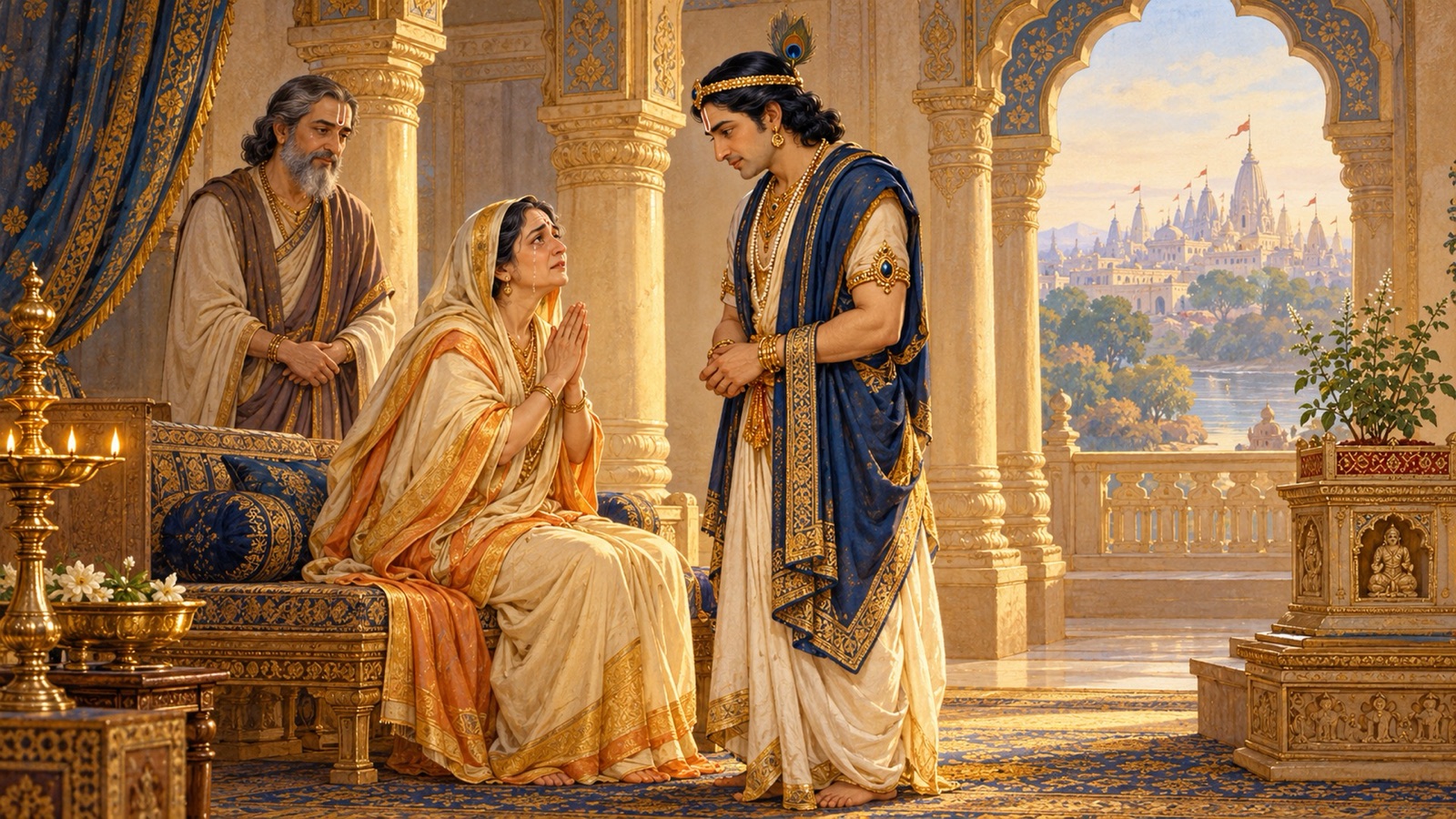
Her complaint turned, as a devotee’s complaint always does, into prayer.
कृष्ण कृष्ण महायोगिन् विश्वात्मन् विश्वभावन ।
प्रपन्नां पाहि गोविन्द शिशुभिश्चावसीदतीम् ॥ ११ ॥
kṛṣṇa kṛṣṇa mahā-yogin viśvātman viśva-bhāvana prapannāṁ pāhi govinda śiśubhiś cāvasīdatīm
Meaning: O Krishna, Krishna, great master of Yoga, Soul of the universe and its protector! O Govinda, I have taken refuge in You; save me, for I am sinking together with my children. (Canto 10, Chapter 49, verse 11)
For those who fear death and the round of rebirth, she went on, she could see no shelter anywhere but His lotus feet, which alone bestow liberation, for He is the almighty Lord. And she closed with an obeisance that is itself a confession of faith.
नम: कृष्णाय शुद्धाय ब्रह्मणे परमात्मने ।
योगेश्वराय योगाय त्वामहं शरणं गता ॥ १३ ॥
namaḥ kṛṣṇāya śuddhāya brahmaṇe paramātmane yogeśvarāya yogāya tvām ahaṁ śaraṇaṁ gatā
Meaning: Obeisance to Krishna, the all-pure, who is Brahman and the Supreme Self, the Lord of Yoga and Yoga itself; I have come to You for refuge. (Canto 10, Chapter 49, verse 13)
Remembering her own people in this way, and above all Krishna, the Lord of the universe, Parikshit’s great-grandmother wept bitterly in her distress. Akrura, who met joy and sorrow with the same even mind, and the far-famed Vidura comforted her by reminding her of the divine fathers by whose grace her sons had been born.
Akrura Counsels the Blind King
When the time came for him to return, Akrura approached King Dhritarashtra, who made a difference between his own sons and his nephews and leaned towards the former. There, in the midst of the king’s kinsmen, he delivered the message that Krishna and Balarama had sent out of goodwill.
“O son of Vichitravirya,” he said, “O enhancer of the glory of the Kurus, with the passing of your brother Pandu you now sit upon the throne.”
धर्मेण पालयन्नुर्वीं प्रजा: शीलेन रञ्जयन् ।
वर्तमान: सम: स्वेषु श्रेय: कीर्तिमवाप्स्यसि ॥ १८ ॥
dharmeṇa pālayann urvīṁ prajāḥ śīlena rañjayan vartamānaḥ samaḥ sveṣu śreyaḥ kīrtim avāpsyasi
Meaning: Protecting the earth with righteousness, delighting the people by your good character, and treating your own kinsmen as equals, you will attain lasting welfare and fame. (Canto 10, Chapter 49, verse 18)
Should he act otherwise, Akrura warned, he would be condemned in this world and sink into darkness after death; therefore he should deal with the sons of Pandu exactly as with his own. Then the envoy of the Yadus lifted the king’s gaze to the truth of life itself. No one, he said, stays with anyone for ever in this world — not even with one’s own body; what then of wife and children?
एक: प्रसूयते जन्तुरेक एव प्रलीयते ।
एकोऽनुभुङ्क्ते सुकृतमेक एव च दुष्कृतम् ॥ २१ ॥
ekaḥ prasūyate jantur eka eva pralīyate eko ‘nubhuṅkte sukṛtam eka eva ca duṣkṛtam
Meaning: A living being is born alone and dies alone; alone it enjoys the fruit of its good deeds, and alone it suffers the results of its wrongdoing. (Canto 10, Chapter 49, verse 21)
Those who go by the name of sons and dependants, he continued, drain away the wealth that a foolish man has heaped up by unrighteous means, just as the young of a water creature drink up the very water that is its life. The life, the riches and the sons that a man nourishes through adharma, believing them his own, abandon that ignorant man while his purposes are still unfulfilled. Deserted by them, with only his burden of sin left to him, blind to his real interest and turned away from his own dharma, he descends into the darkness of hell.
तस्माल्लोकमिमं राजन् स्वप्नमायामनोरथम् ।
वीक्ष्यायम्यात्मनाऽऽत्मानं सम: शान्तो भव प्रभो ॥ २५ ॥
tasmāl lokam imaṁ rājan svapna-māyā-manoratham vīkṣyāyamyātmanātmānaṁ samaḥ śānto bhava prabho
Meaning: Therefore, O king, seeing this world to be a dream, an illusion, a mere fancy of the mind, restrain the mind by the intelligence and become even-minded and at peace, O lord. (Canto 10, Chapter 49, verse 25)
Dhritarashtra’s Reply
The blind king answered with a candour that is painful to hear. “O prince among the charitable,” he said, “I cannot have enough of these wholesome words of yours, any more than a mortal who has found nectar. And yet, gentle one, this good and true counsel will not stay in my unsteady heart, swayed as it is by love for my sons — just as a flash of lightning does not stay in a cloud.”
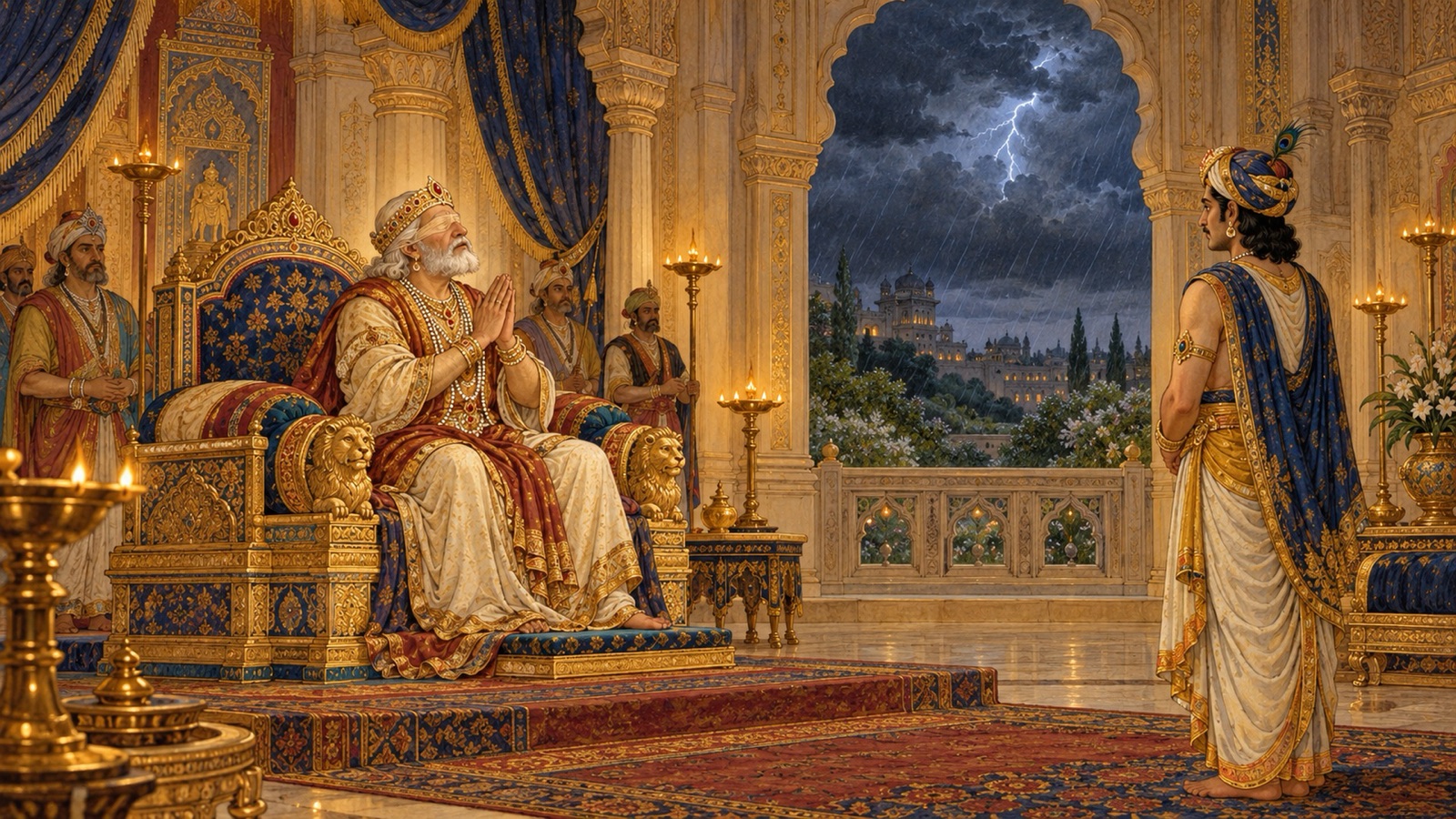
Then he reached past his own weakness to the one certainty he possessed.
ईश्वरस्य विधिं को नु विधुनोत्यन्यथा पुमान् ।
भूमेर्भारावताराय योऽवतीर्णो यदो: कुले ॥ २८ ॥
īśvarasya vidhiṁ ko nu vidhunoty anyathā pumān bhūmer bhārāvatārāya yo ‘vatīrṇo yadoḥ kule
Meaning: What man can possibly turn aside the decree of the Supreme Lord, who has descended in the family of Yadu to relieve the burden of the earth? (Canto 10, Chapter 49, verse 28)
यो दुर्विमर्शपथया निजमाययेदं सृष्ट्वा गुणान् विभजते तदनुप्रविष्ट: ।
तस्मै नमो दुरवबोधविहारतन्त्रसंसारचक्रगतये परमेश्वराय ॥ २९ ॥
yo durvimarśa-pathayā nija-māyayedaṁ sṛṣṭvā guṇān vibhajate tad-anupraviṣṭaḥ tasmai namo duravabodha-vihāra-tantra- saṁsāra-cakra-gataye parameśvarāya
Meaning: Obeisance to that Supreme Lord who, having created this universe by His own inconceivable power and entered within it, apportions to all beings their functions and their fruits, and by whose unfathomable pastime the wheel of worldly existence is kept turning. (Canto 10, Chapter 49, verse 29)
Here lies the heart of the chapter. Dhritarashtra knows what is right, admits that his heart cannot hold it, and then lays the whole matter at the feet of the Lord born among the Yadus. His words are at once an excuse and a foreshadowing. Krishna had not sent Akrura to reform the king; He had sent him to learn the king’s mind, and that mind now stands revealed — dharma heard with delight and abandoned through attachment. The burden of the earth that the Lord descended to remove is made of exactly such hearts, rulers who see the right and cling to the wrong; and the king’s own confession shows that the lifting of that burden will be the Lord’s arrangement, not an accident of politics. Even his obeisance is true, for the hand that turns the wheel of samsara will also protect the Pandavas.
Akrura Returns to Mathura
Having thus understood the king’s mind, and taking leave with the permission of his kinsmen, the Kurus and the sons of Pandu alike, Akrura, the scion of Yadu, went back to Mathura, the city of the Yadus. There he reported to Balarama and Krishna how Dhritarashtra was behaving towards Yudhishthira and his brothers — the very thing, Sukadeva reminded Parikshit, for which They had sent him. With this homecoming the first half of the Tenth Canto closes.
Principal Teachings of This Chapter
1. The Lord sends His devotee where His care is needed. Akrura does not merely carry a message; he lives among the Kurus for months, watches and listens. The Lord’s concern for His devotees reaches them through servants patient enough to see the truth.
2. A devotee’s grief ripens into prayer. Kunti begins by asking whether anyone in Mathura remembers her and ends by calling on Govinda to save her and her children, as verse 11 shows, declaring in verse 13 that she has come to Him for refuge. Sorrow offered to the Lord becomes surrender.
3. Impartiality is the ruler’s dharma and his protection. Verse 18 promises welfare and fame to the king who treats his own kinsmen as equals, and the following warning makes clear that partiality earns disgrace here and darkness hereafter.
4. We come alone and we go alone. Verse 21 states the plain truth that each soul is born alone, dies alone and reaps its own deeds alone, and Akrura draws out its consequence in verse 25: seeing the world as a dream, be even-minded and at peace.
5. Attachment can hear the truth and still not keep it. Dhritarashtra relishes Akrura’s words like nectar and yet confesses they slide from his heart like lightning from a cloud. Knowledge without detachment cannot change a life.
6. No one can undo the Lord’s arrangement. The king’s question in verse 28 and his obeisance in verse 29 acknowledge that the Lord has descended among the Yadus to relieve the earth, and that His pastime moves the whole wheel of existence.
A Devotional Reflection
Two prayers rise from Hastinapura in this chapter, and they could not be more different. Kunti, surrounded by enemies and sinking with her children, calls on Krishna by name and takes refuge in His lotus feet; her helplessness becomes the doorway to surrender. Dhritarashtra, seated on a throne with every power in his hands, also bows to the Supreme Lord — but his bow is the sigh of a man who will not let go of what he loves and hopes the Lord will take the responsibility for it. Both know that the Lord rules the wheel of the world. One lets that knowledge carry her to His feet; the other uses it to stay where he is. We too can taste good counsel like nectar and still watch it vanish like lightning in a cloud, because some attachment sits in the place where the Lord should be. Kunti shows the other way: when nothing in the world remembers us, the Soul of the universe still does, if only we cry out to Him. The question left with every reader is simply which of these two voices speaks for our own heart.
A Daily Devotional Practice
Today, notice one place where you already know the right thing and are not doing it because of some attachment. Instead of arguing with yourself, take it to the Lord in Kunti’s words — “I have taken refuge in You; save me” — and ask Him for the even mind that Akrura urged upon the king. Then read or hear Kunti’s prayer once more and rest in it. Begin by chanting gently: Om Namo Bhagavate Vasudevaya.
Conclusion
The forty-ninth chapter of the Tenth Canto completes the mission on which Krishna had sent Akrura and brings the first half of the canto to its close. In Hastinapura the envoy of the Yadus learns the truth of the Pandavas’ danger, receives Kunti’s tearful prayer to Govinda, and sets before the blind king the dharma of impartiality and the solitude of every soul before its own deeds. Dhritarashtra’s reply lays bare the single lesson of the chapter: counsel cannot save a heart that loves its attachments more than the truth, and what such hearts set in motion the Lord Himself will bring to its appointed end. May we be found on Kunti’s side, with our refuge in His feet.
May the divine wisdom of Srimad Bhagavatam awaken pure devotion within our hearts.
Om Namo Bhagavate Vasudevaya.
Jay Shree Madhav.
References and Attribution
- Primary edition: Gita Press, Śrīmad Bhāgavata Mahāpurāṇa (English edition), Book Ten (First Half), Discourse 49.
- Series: Srimad Bhagavatam Wisdom · Biswa Sanatan Dharma Seva Trust.
- Presented following the spiritual guidance and recommendation of Pandit Dr. Shri Kashinath Mishra.
This is an original, faithful retelling in the writer’s own words, with brief quoted verses shown in Devanāgarī and transliteration and their meanings given as summaries. It is not a reproduction of any single publisher’s continuous translation or commentary. No affiliation with or endorsement by any publisher is implied.
Jay Shree Madhav