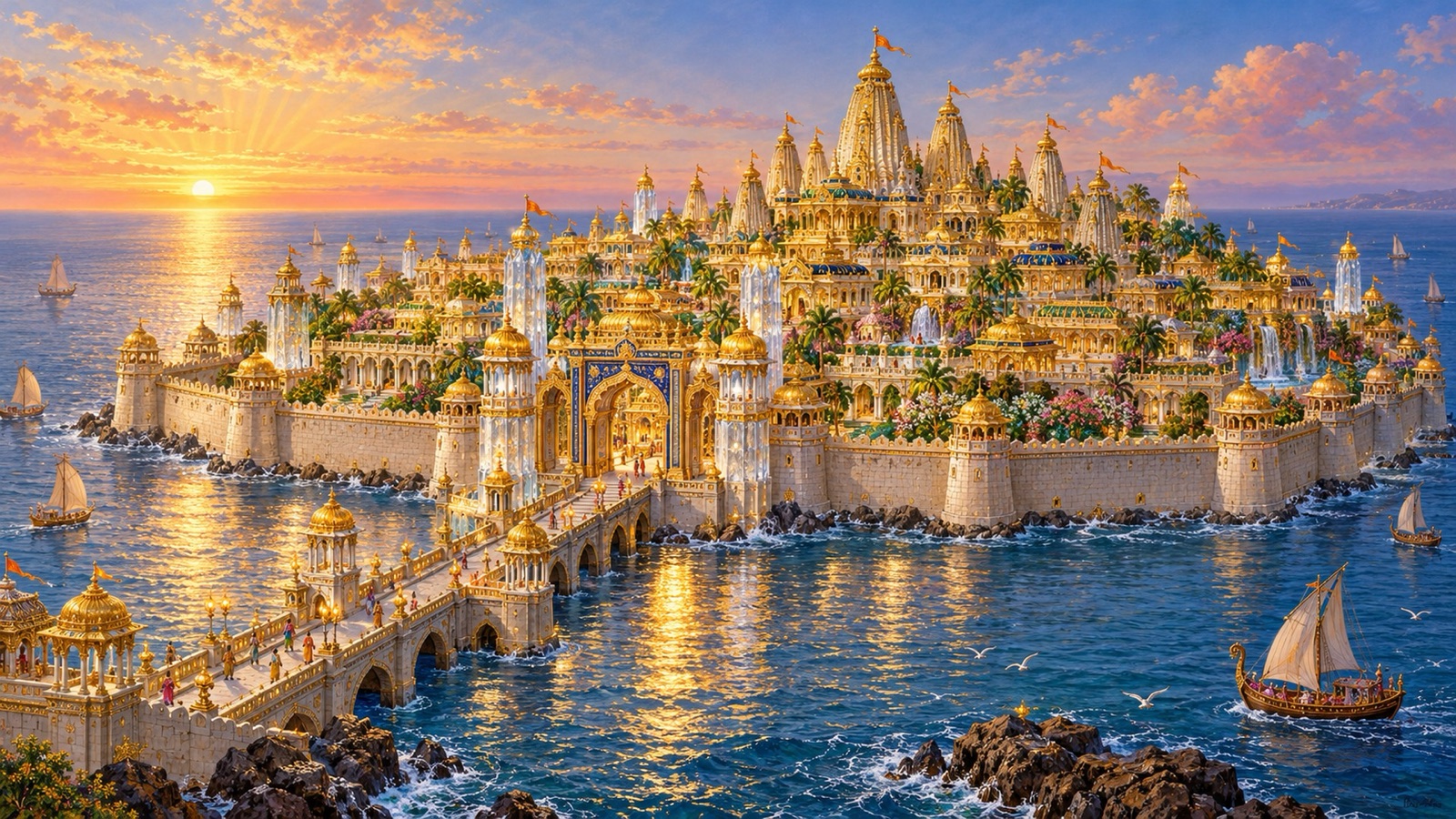
Seventeen times Jarasandha hurls his armies against Mathura, and seventeen times Krishna and Balarama scatter them like dust; then the Lord raises a wondrous city within the sea and carries His people to safety.
Om Namo Bhagavate Vasudevaya.
Om Namo Bhagavate Vasudevaya.
Om Namo Bhagavate Vasudevaya.
Welcome back to Srimad Bhagavatam Wisdom, our devotional journey through the sacred histories and teachings of the Srimad Bhagavat Mahapurana. This fiftieth chapter opens the latter half of the Tenth Canto with Jarasandha’s sieges of Mathura, chariots sent from heaven, and the building of Dvaraka in the ocean.
Chapter Information
- Scripture: Śrīmad Bhāgavata Mahāpurāṇa
- Canto: 10 (Book Ten, Latter Half)
- Chapter: 50 (Discourse 50)
- Chapter title: Krishna Establishes the City of Dvaraka
- Principal speaker: Sukadeva Gosvami (narrating to King Parikshit)
- Principal listener: King Parikshit
- Main setting: Mathura; later the western sea, where Dvaraka is built
- Central subject: Jarasandha’s sieges of Mathura; the purpose of the Lord’s descent; the sparing of Jarasandha; Kalayavana’s arrival; the building of Dvaraka
- Principal verse range: Canto 10, Chapter 50, verses 1–57
- Primary edition: Gita Press Śrīmad Bhāgavata Mahāpurāṇa (English)
Context From the Previous Chapter
In Chapter 49, Akrura visited Hastinapura, saw how Dhritarashtra favoured his own sons over the Pandavas, heard Kunti’s prayer and counselled the blind king to rule justly, then returned and reported all to Balarama and Krishna. The story now turns to Magadha, where another grief is being nursed into war.
Kamsa’s Widows and Jarasandha’s Resolve
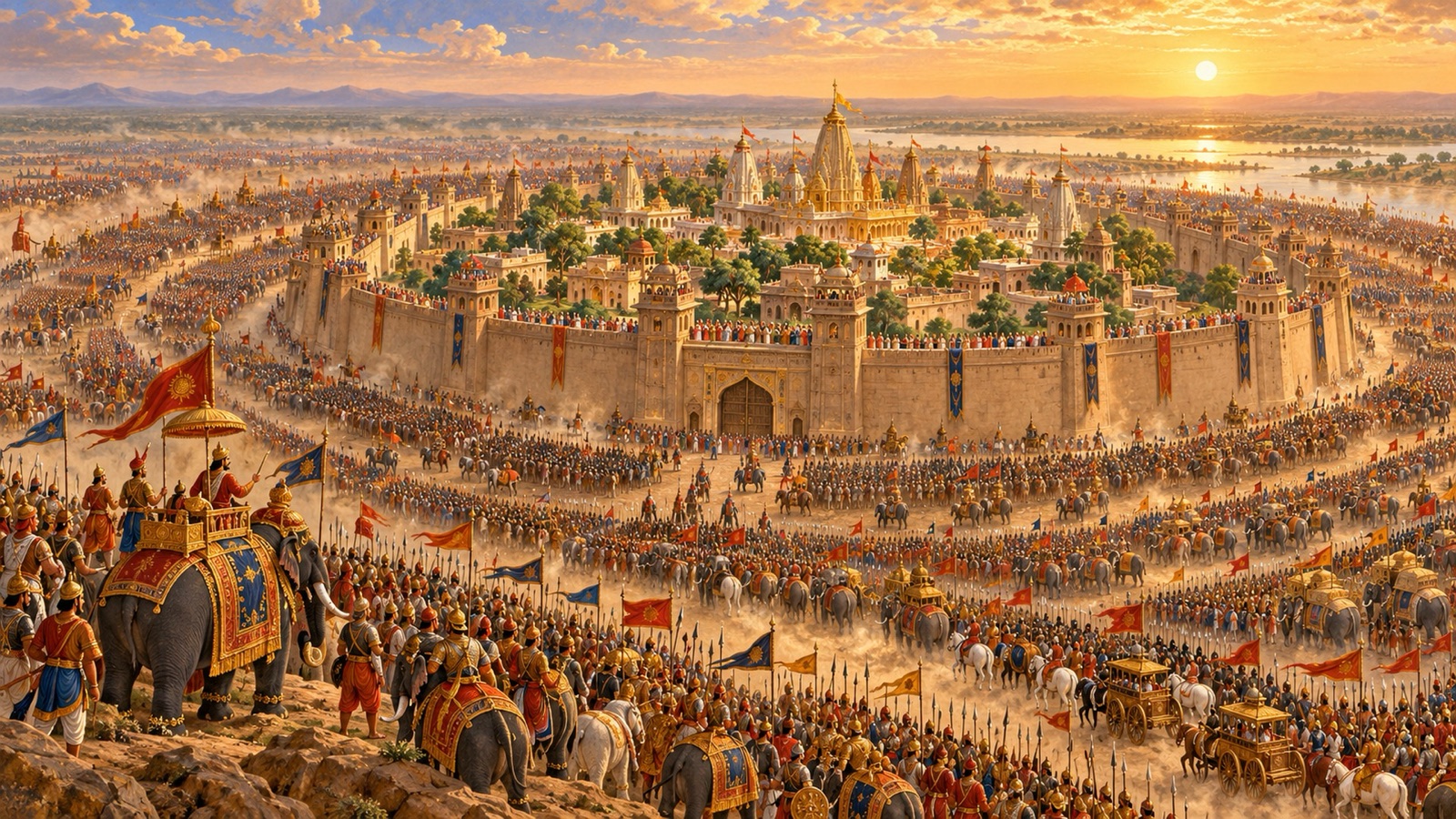
When Kamsa was slain, his two queens, Asti and Prapti, went grief-stricken to the house of their father, Jarasandha, the ruler of the Magadhas, and told him all that had brought about their widowhood. Hearing that unwelcome story, Jarasandha, full of grief and indignation, resolved to rid the earth of the Yadavas. Gathering twenty-three akshauhinis, he marched on Mathura, the capital of the Yadus, and surrounded it on every side.
The Lord Reflects on the Purpose of His Descent
Krishna looked out upon that army, like an ocean overflowing its banks, upon His own city hemmed in by it and upon His people trembling with fear. He who is Lord Hari Himself, appearing in human semblance for a purpose, pondered the reason for His descent and what the time and place required. Then He resolved: “I shall certainly destroy this army of dependent kings that Jarasandha has gathered, a burden heaped upon the earth. But Jarasandha himself is not to be killed; if he is let go, he will surely raise another army.”
एतदर्थोऽवतारोऽयं भूभारहरणाय मे ।
संरक्षणाय साधूनां कृतोऽन्येषां वधाय च ॥ ९ ॥
etad-artho ’vatāro ’yaṁ bhū-bhāra-haraṇāya me saṁrakṣaṇāya sādhūnāṁ kṛto ’nyeṣāṁ vadhāya ca
Meaning: This descent of Mine has been undertaken for this very purpose: to remove the burden of the earth, to protect the virtuous and to destroy the wicked. (Canto 10, Chapter 50, verse 9)
Other forms too, the Lord added, such as the Boar and the Man-Lion, He assumes from time to time to uphold righteousness and check unrighteousness.
Here is the heart of the chapter. The Lord does not fight because He is threatened; He fights because the earth is weighed down, and He has come to lift that weight. Even His mercy serves this purpose: the proud king is allowed to live so that, siege after siege, he will keep gathering the world’s wicked forces into one place where they can be removed. What looks like a long war is, from the Lord’s side, the orderly fulfilment of verse 9 by One who already knows the end.
Chariots From the Sky
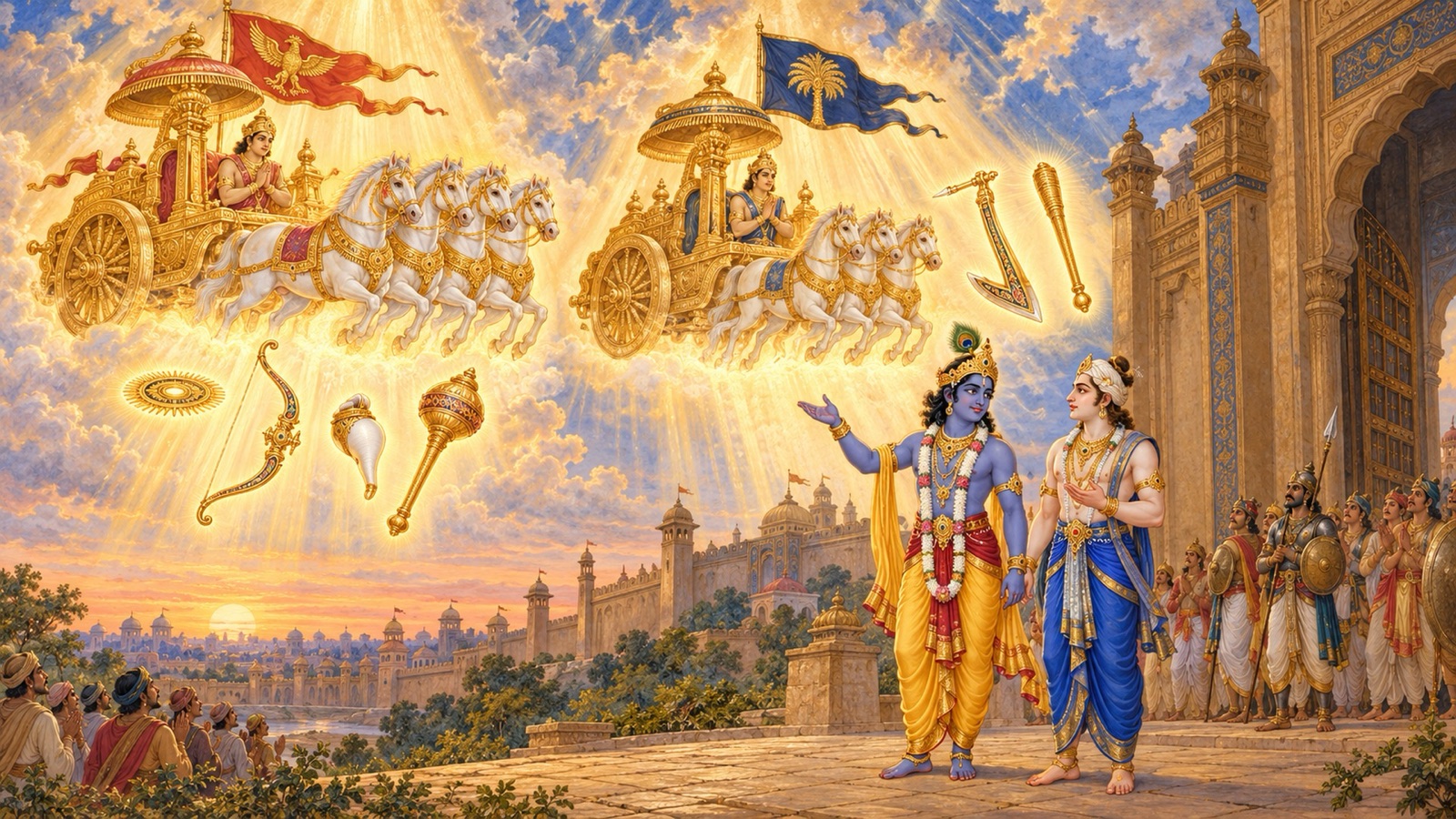
While Govinda was thus contemplating, two chariots descended from the heavens, effulgent as the sun, each with its charioteer; and the Lord’s eternal divine weapons appeared of their own accord. Seeing them, Hrishikesha said to Sankarshana: “See, noble brother, the calamity that has come upon the Yadus, whose guardian You are. Here is Your chariot, and here Your favourite weapons. Mount it and deliver Your people. For this very end We have taken birth, O Lord; remove the earth’s burden called the twenty-three akshauhinis.”
So the two scions of Dasharha rode out in Their chariots, armoured and attended by only a small force. In the open, Hari, with Daruka as His charioteer, blew His conch, and terror ran through the enemy ranks.
Jarasandha’s Taunt and the Lord’s Reply
The ruler of Magadha mocked the two brothers: “O Krishna, vilest of men, for very shame I will not fight with a boy who stands alone. You who hid Yourself so long, go away, slayer of Your own uncle. And You, Balarama, if You have any appetite for battle, fight me; either cast off a body torn by my arrows and ascend to heaven, or slay me.”
न वै शूरा विकत्थन्ते दर्शयन्त्येव पौरुषम् ।
न गृह्णीमो वचो राजन्नातुरस्य मुमूर्षत: ॥ १९ ॥
na vai śūrā vikatthante darśayanty eva pauruṣam na gṛhṇīmo vaco rājann āturasya mumūrṣataḥ
Meaning: The Lord replied: Heroes do not brag; they simply display their prowess. We do not take to heart the words of one who is distraught with grief, O king, and about to die. (Canto 10, Chapter 50, verse 19)
The Battle Before Mathura
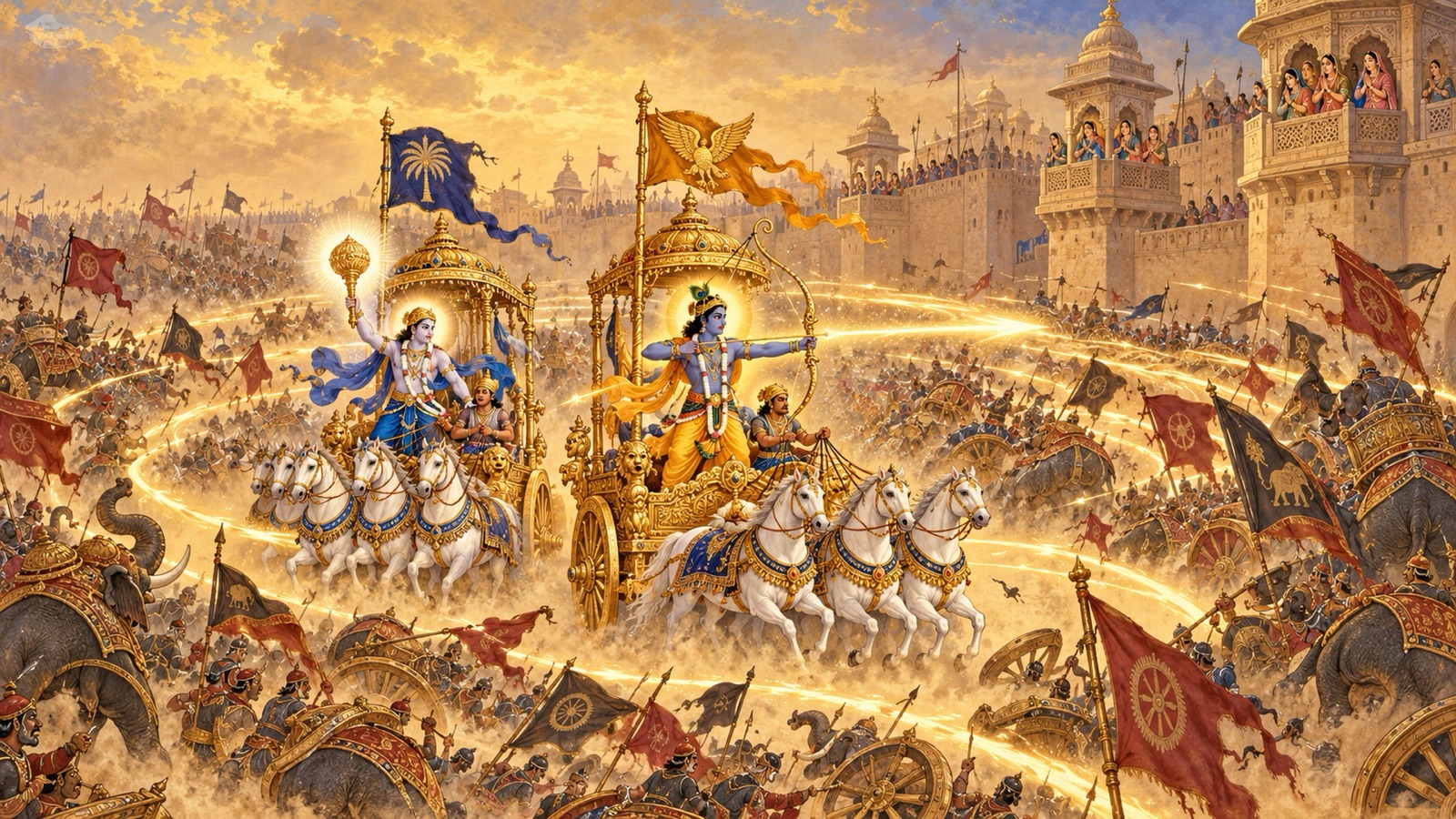
The son of Jara advanced on the two Madhavas and engulfed Them, with Their troops, chariots, banners, horses and charioteers, in his huge host, as a tempest hides the sun behind clouds and smothers a fire with dust. From the watchtowers and gateways of Mathura the women watched; when they could no longer see the chariots marked with the ensigns of Garuda and the palmyra tree, they fainted with grief.
Seeing His small force harassed by that dense shower of arrows, Hari twanged His excellent Sharnga bow, honoured by gods and demons alike. Loosing volleys of sharp shafts without pause, He struck down chariots, elephants, horses and foot soldiers on every side, wheeling like a circling firebrand, until streams of blood ran across the field, terrifying the timid and heartening the brave. And Sankarshana of immeasurable might, crushing the arrogant enemy with His club, destroyed what remained of that force, fearsome as the ocean and seemingly without end. For the two sons of Vasudeva, the rulers of the universe, all this was but a pastime.
स्थित्युद्भवान्तं भुवनत्रयस्य य: समीहितेऽनन्तगुण: स्वलीलया ।
न तस्य चित्रं परपक्षनिग्रहस्तथापि मर्त्यानुविधस्य वर्ण्यते ॥ २९ ॥
sthity-udbhavāntaṁ bhuvana-trayasya yaḥ samīhite ’nanta-guṇaḥ sva-līlayā na tasya citraṁ para-pakṣa-nigrahas tathāpi martyānuvidhasya varṇyate
Meaning: For Him who by His own sport brings about the creation, maintenance and dissolution of the three worlds, and who possesses endless attributes, the subduing of an enemy’s forces is no wonder; still it is described, because He imitates the ways of mortals. (Canto 10, Chapter 50, verse 29)
Jarasandha Captured and Released
As one lion seizes another, Balarama caught hold of the mighty Jarasandha, who had lost his chariot and was left with nothing but his life. But Govinda, wishing to accomplish His own work through him, stopped Balarama from binding him with the cords of Varuna and with human ropes.
बध्यमानं हतारातिं पाशैर्वारुणमानुषै: ।
वारयामास गोविन्दस्तेन कार्यचिकीर्षया ॥ ३१ ॥
badhyamānaṁ hatārātiṁ pāśair vāruṇa-mānuṣaiḥ vārayām āsa govindas tena kārya-cikīrṣayā
Meaning: As that slayer of many enemies was being bound with the ropes of Varuna and of men, Govinda prevented it, desiring to accomplish His purpose through him. (Canto 10, Chapter 50, verse 31)
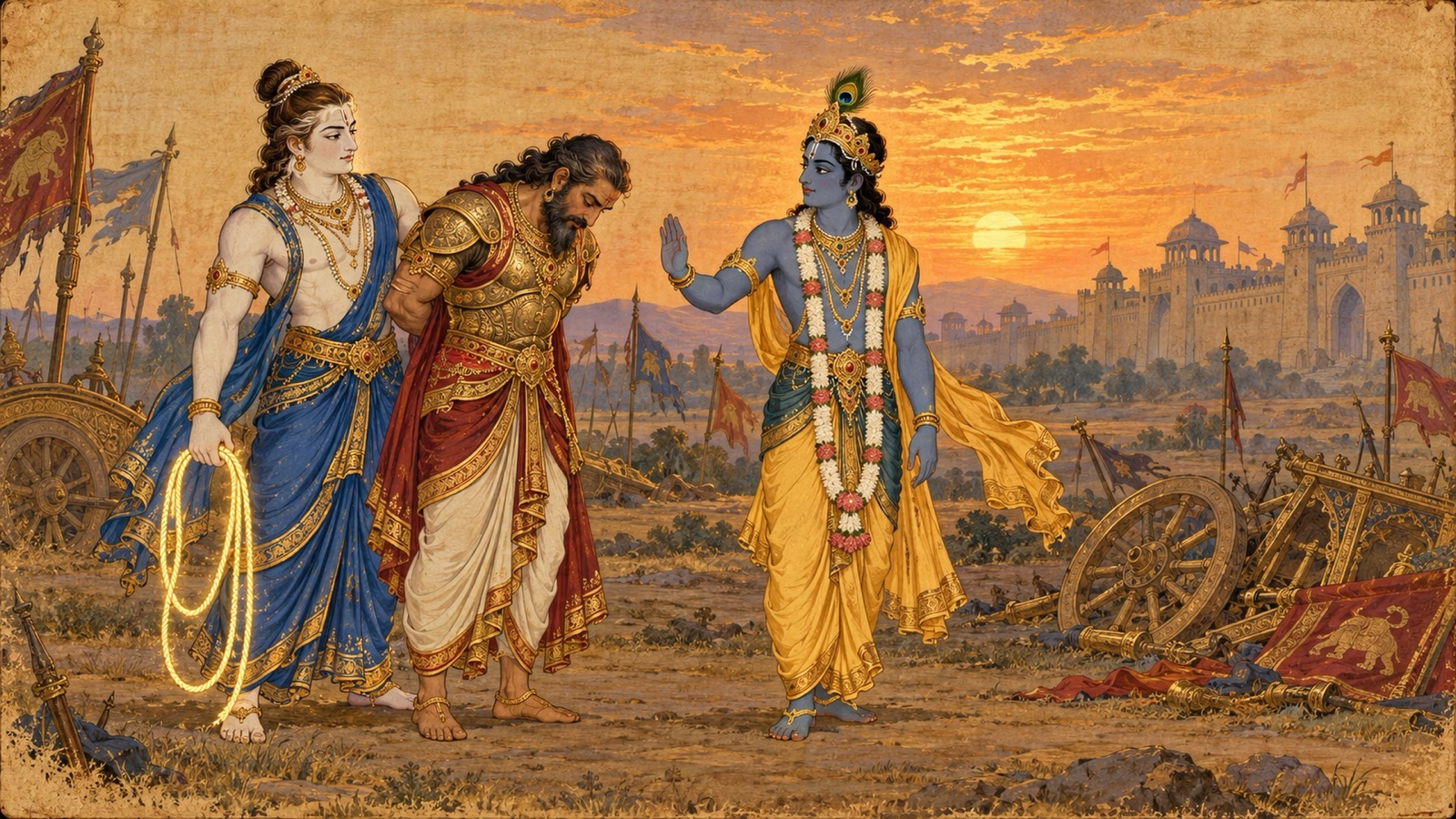
Set free by the two Lords of the universe and overcome with shame, Jarasandha resolved to retire to austerities; but on the way other kings stopped him with sacred and worldly counsel, telling him that this defeat by the Yadus had come through his own past deeds. Disregarded by the Lord, the son of Brihadratha returned dispirited to Magadha.
Mathura Welcomes the Victorious Lord
Mukunda, His own army unscathed, had crossed the ocean of the enemy’s forces without effort. The gods rained flowers upon Him, and the citizens of Mathura, freed from their anguish, came out to greet Him while bards sang His victory. As He entered the city, conches, drums, lutes and flutes sounded together; the roads were sprinkled with water, flags and festive arches adorned the streets, and the air rang with Vedic chant. Women showered Him with flowers, curds, unbroken rice and sprouts and gazed on Him with loving eyes. All the wealth lying on the battlefield the Lord presented to King Ugrasena.
Seventeen Sieges and the Coming of Kalayavana
In this way, each time with twenty-three akshauhinis, the king of Magadha fought seventeen times with the Yadus, who were guarded by Krishna. Each time the Vrishnis, empowered by Krishna’s might, annihilated his entire force, and each time the king was let go and withdrew. But while the eighteenth encounter was still to come, there appeared a Yavana hero named Kalayavana, sent by the sage Narada. Having heard from Narada that the Yadus were his equals, this warrior without rival among men besieged Mathura with thirty million Mlecchas.
The Lord’s Counsel and the Building of Dvaraka
Seeing him, Krishna, with Sankarshana at His side, reflected: “Ah, a great calamity has come upon the Yadus from two sides at once. This mighty Yavana has invested us today, and the Magadha king will come today, tomorrow or the day after. If Jarasandha arrives while We two are engaged with this fellow, he will slay our kinsmen or carry them off. Therefore this very day We shall build a fortress that no man can approach, settle our kinsmen there, and then have the Yavana killed.”
इति सम्मन्त्र्य भगवान् दुर्गं द्वादशयोजनम् ।
अन्त:समुद्रे नगरं कृत्स्नाद्भुतमचीकरत् ॥ ४९ ॥
iti sammantrya bhagavān durgaṁ dvādaśa-yojanam antaḥ-samudre nagaraṁ kṛtsnādbhutam acīkarat
Meaning: Having deliberated thus, the Lord caused a fortress-city of twelve yojanas to be built within the sea, wonderful in every part. (Canto 10, Chapter 50, verse 49)
In that city, raised in the western sea by Vishvakarma, the architect of the gods, the science of Tvashta and the finest craftsmanship stood revealed. Its roads, streets and squares followed the treatises exactly. It was graced with gardens of celestial trees; its crystal watchtowers and gateways touched the sky with domes of gold; its storehouses of silver and brass bore golden pitchers; its houses of gold had tops of jewels and floors of emerald; and there were temples to the deities of the homestead. The city thronged with people of the four orders and shone with the palaces of the Yadu lords.
The Gifts of the Gods and the Passage to Dvaraka
The great Indra sent down for Hari his assembly hall Sudharma and the Parijata tree, beneath which a mortal is no longer bound by the conditions of mortals. Varuna sent white horses, each with one dark ear, swift as thought; Kubera sent the eight treasures; and the guardians of the other spheres sent their own riches. Whatever lordship the Lord had granted them, they now returned to Him in full, for Hari Himself had come down to the earth.
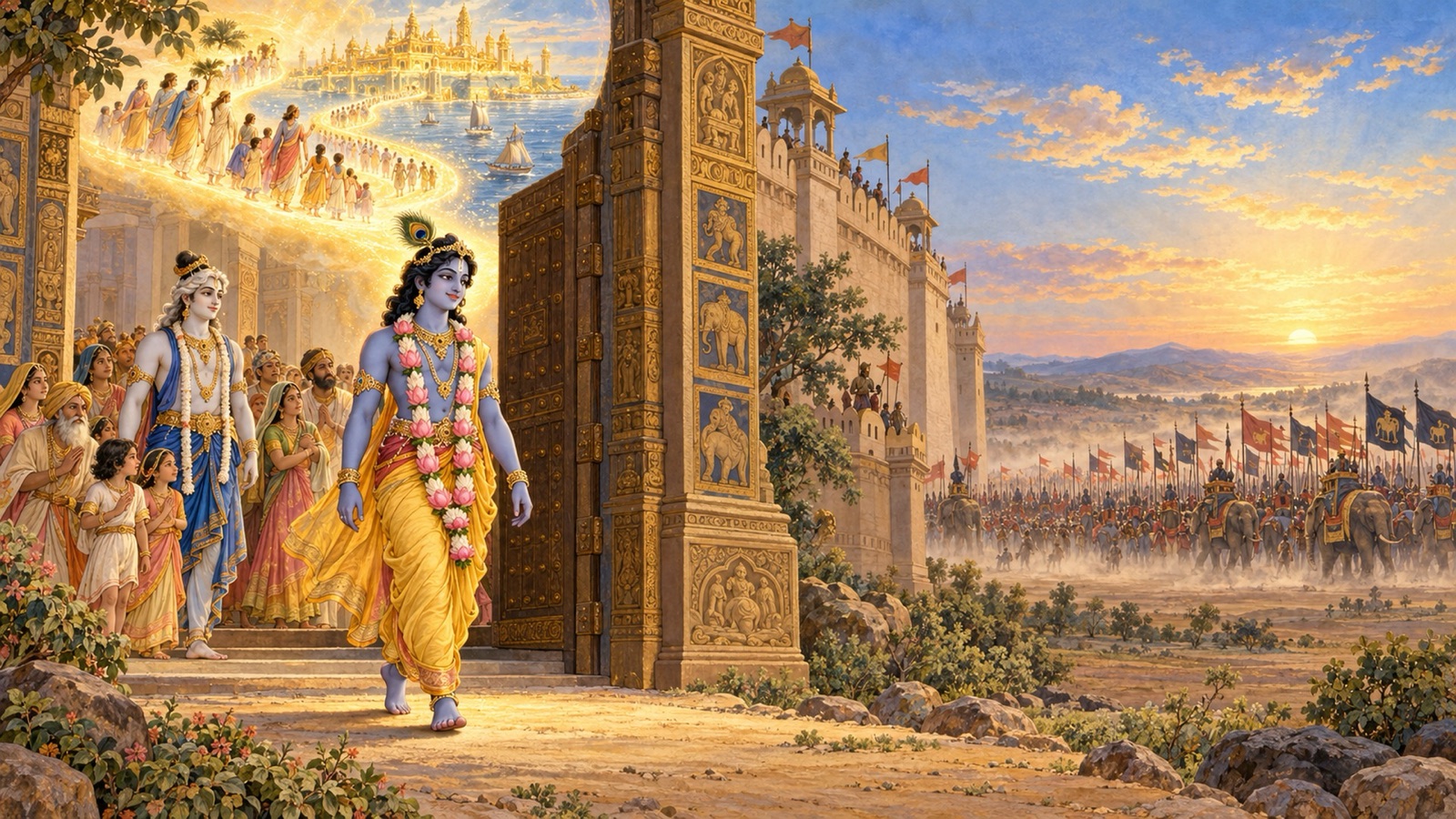
Then Krishna, by the power of His yoga, transferred all the people of Mathura to that city. Having conferred with Balarama, who watched over the people, the Lord walked out of the city gate wearing a garland of lotuses and bearing no weapon.
तत्र योगप्रभावेन नीत्वा सर्वजनं हरि: ।
प्रजापालेन रामेण कृष्ण: समनुमन्त्रित: ।
निर्जगाम पुरद्वारात् पद्ममाली निरायुध: ॥ ५७ ॥
tatra yoga-prabhāvena nītvā sarva-janaṁ hariḥ prajā-pālena rāmeṇa kṛṣṇaḥ samanumantritaḥ nirjagāma pura-dvārāt padma-mālī nirāyudhaḥ
Meaning: Having brought all the people there by His yogic power, and having consulted Balarama, the protector of the people, Krishna went out through the city gate wearing a lotus garland and unarmed. (Canto 10, Chapter 50, verse 57)
Principal Teachings of This Chapter
1. The Lord descends to lift the earth’s burden. In verse 9 Krishna states plainly why He has come: to relieve the earth, protect the virtuous and destroy the wicked. His avatara is never a reaction to danger but a purpose fixed before the danger arose.
2. Heroes act; they do not boast. Answering Jarasandha’s taunts in verse 19, the Lord says that the brave show their prowess rather than talk of it.
3. The Lord’s victories are His play. Verse 29 reminds us that for Him who creates, sustains and dissolves the three worlds in sport, scattering an army is no marvel; it is told because He chooses to move among us in human ways.
4. Mercy, too, serves His design. Krishna spares Jarasandha in verse 31 so that His larger work may be accomplished through him. His restraint is not weakness but purpose seen from a height we cannot reach.
5. All power is His, and His own are sheltered first. The guardians of the worlds return their lordships to Krishna once He walks the earth, and before facing Kalayavana alone He places His people within Dvaraka. Whatever we hold is on loan from Him, and whoever belongs to Him is made safe before the battle begins.
A Devotional Reflection
What moves the heart most in this chapter is not the thunder of twenty-three armies but a single quiet image at its close: Krishna, who had just raised a city in the sea and carried a whole people into it, stepping out of Mathura’s gate with nothing in His hands but a garland of lotuses. The Lord who wheeled like a firebrand across the battlefield now walks calmly toward thirty million enemies. He is never anxious, because He is never fighting for Himself; He is lifting a burden from the earth and sheltering those who are His own. If He can be so unhurried while besieged on two sides, surely we can loosen our grip on our fears. Our part is to stay inside the city He has built for us, trusting that the One who guards the Yadus has already measured the end of every siege.
A Daily Devotional Practice
Today, whenever a worry presses in from more than one side, pause and remember Krishna raising Dvaraka before He faced Kalayavana. Say quietly to the Lord, “You have already made a safe place for me.” Then begin your day by chanting gently: Om Namo Bhagavate Vasudevaya.
Conclusion
This chapter shows the Lord’s descent at work in history: Jarasandha’s grief swells into seventeen sieges, the Magadha host is scattered as a pastime, and the proud king is spared by design. When Kalayavana arrives, Krishna raises Dvaraka within the sea, brings His people there by yoga and walks out unarmed to meet the new foe. One truth binds it all: the Lord fights, forgives and builds for a single purpose, to remove the earth’s burden and keep His devotees safe. May He guard the city of our hearts.
May the divine wisdom of Srimad Bhagavatam awaken pure devotion within our hearts.
Om Namo Bhagavate Vasudevaya.
Jay Shree Madhav.
References and Attribution
- Primary edition: Gita Press, Śrīmad Bhāgavata Mahāpurāṇa (English), Book Ten (Latter Half), Discourse 50.
- Series: Srimad Bhagavatam Wisdom · Biswa Sanatan Dharma Seva Trust.
- Presented following the spiritual guidance and recommendation of Pandit Dr. Shri Kashinath Mishra.
This is an original, faithful retelling in the writer’s own words, with brief quoted verses shown in Devanāgarī and transliteration and their meanings given as summaries. It is not a reproduction of any single publisher’s continuous translation or commentary. No affiliation with or endorsement by any publisher is implied.
Jay Shree Madhav