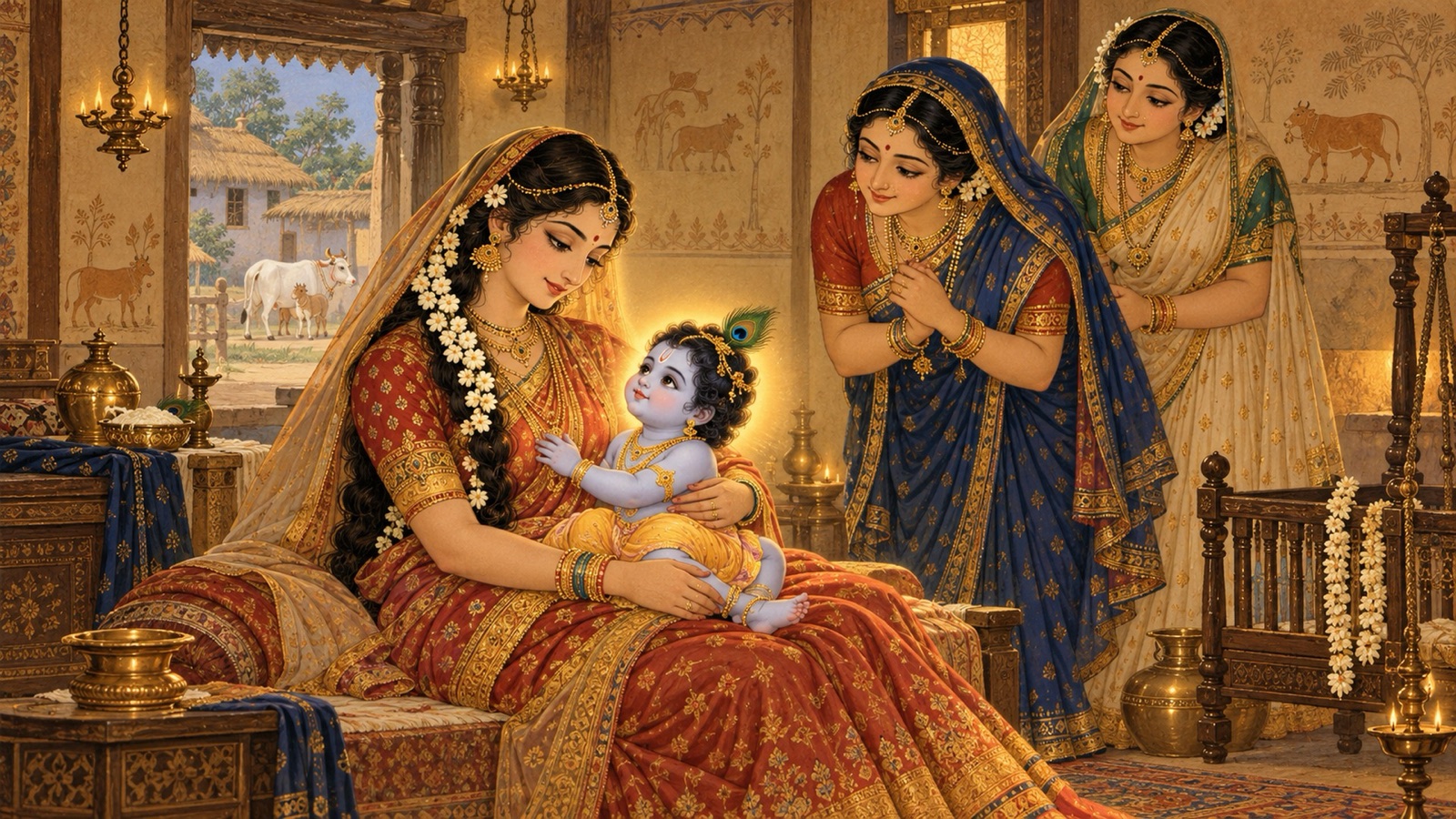
Sent by Kamsa in the guise of a beautiful woman, the child-killing Putana takes the infant Lord into her lap — and receives, instead of His death, a deliverance worthy of the saints.
Om Namo Bhagavate Vasudevaya.
Om Namo Bhagavate Vasudevaya.
Om Namo Bhagavate Vasudevaya.
Welcome back to Srimad Bhagavatam Wisdom, our devotional journey through the sacred histories and teachings of the Srimad Bhagavat Mahapurana. In the previous chapter, Nanda returned from Mathura carrying his friend Vasudeva’s quiet warning of dangers at Gokula. This sixth chapter shows the first of those dangers, and the first of the Lord’s wondrous childhood pastimes. The ogress Putana, dispatched by Kamsa to destroy infants, comes to Gokula disguised as a lovely woman and takes the divine child upon her lap with murder in her heart. Yet the very Lord she means to kill draws out her life along with her poison — and, because she gave Him her breast even with a wicked motive, she is granted the destiny of the saints. It is a chapter that reveals both the futility of enmity against God and the boundless generosity of His grace.
Chapter Information
- Scripture: Śrīmad Bhāgavata Mahāpurāṇa
- Canto: 10 (Book Ten, First Half)
- Chapter: 6 (Discourse 6)
- Chapter title: The Deliverance of Putana
- Principal speaker: Sukadeva Gosvami (narrating to King Parikshit); related in turn by Suta Gosvami to the sages at Naimisharanya
- Principal listener: King Parikshit (within Sukadeva’s narration); the sages assembled at Naimisharanya
- Main setting: The cowherd village of Gokula in Vraja
- Central subject: The coming of the ogress Putana, the Lord’s deliverance of her, the protection of the child by the cowherd women, and Putana’s attainment of a saintly destiny
- Principal verse range: Canto 10, Chapter 6, verses 1–44
- Primary edition: Gita Press Śrīmad Bhāgavata Mahāpurāṇa
Context From the Previous Chapter
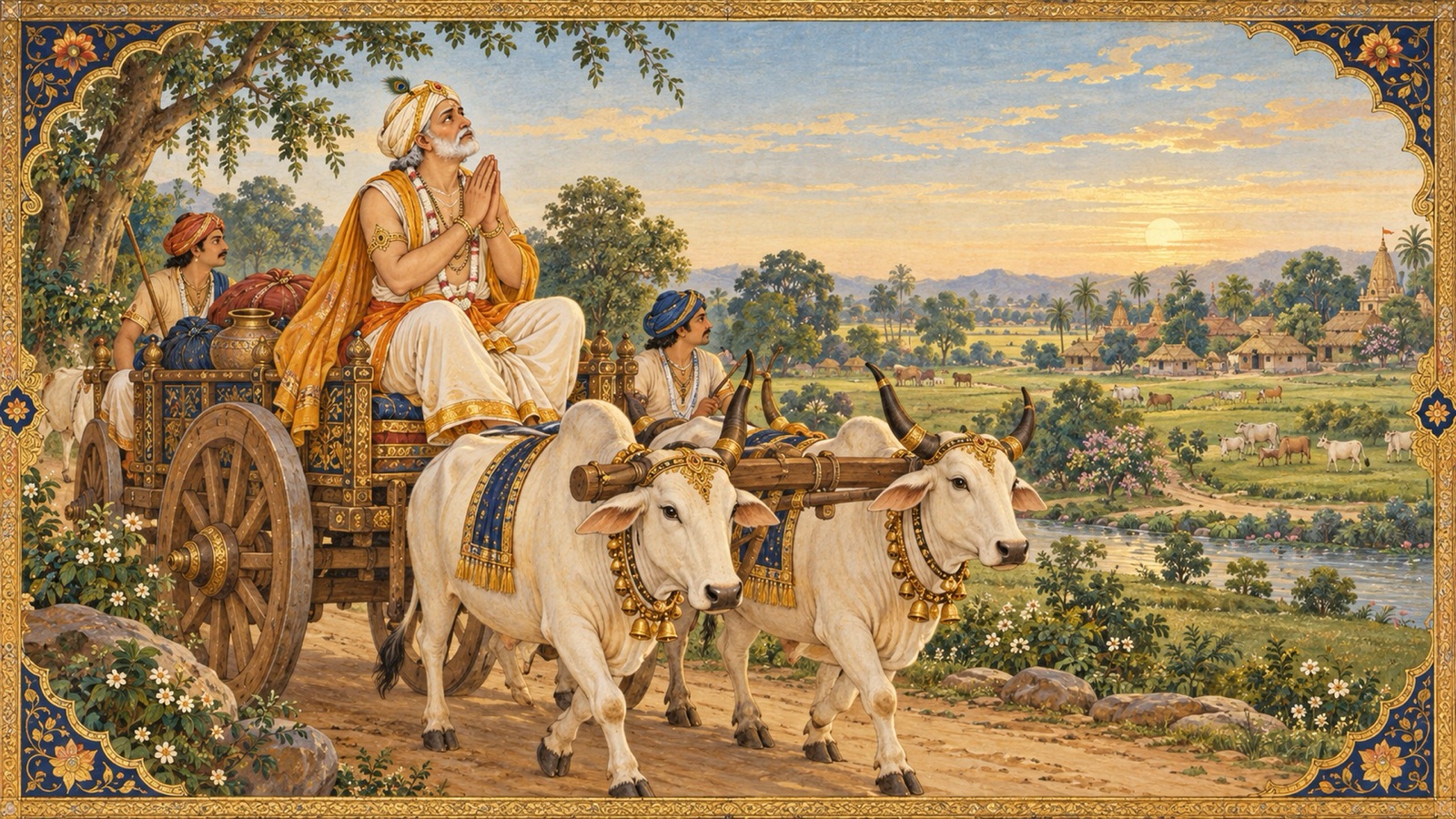
In Chapter 5 the birth of Krishna was celebrated with great festivity at Gokula, and Nanda travelled to Mathura to pay his tribute to Kamsa. There he met Vasudeva, who, sensing the danger closing in, urged his friend to hurry home, for strange and alarming things were happening at Gokula. Nanda set out at once with the other cowherds. This chapter opens as he journeys back, his heart uneasy.
Nanda’s Foreboding and the Coming of Putana
Pondering on the road that Vasudeva’s words could not prove false, Nanda took refuge in Sri Hari, apprehensive of the calamities to come. And indeed calamity was already abroad: sent by Kamsa, the terrible ogress Putana, who made a practice of killing infants, was roaming through towns, villages, and cowherd stations, destroying children wherever she went. Sukadeva pauses to teach why such dark powers can gain entry at all.
न यत्र श्रवणादीनि रक्षोघ्नानि स्वकर्मसु । कुर्वन्ति सात्वतां भर्तुर्यातुधान्यश्च तत्र हि ॥ ३ ॥
na yatra śravaṇādīni rakṣo-ghnāni sva-karmasu kurvanti sātvatāṁ bhartur yātudhānyaś ca tatra hi
Meaning: Ogresses and evil spirits find their way only into those places where people, even amid their duties, fail to practise the hearing and chanting of the names and glories of the Lord, the protector of His devotees — for such hearing destroys all demons. (Canto 10, Chapter 6, verse 3)
Putana Enters Gokula in Disguise
Able to travel through the air and go wherever she wished, Putana came upon Gokula and, by her witchcraft, took the form of a beautiful woman before entering the village. Seeing this lovely stranger — finely dressed, jasmine in her braid, a lotus in her hand, her smile and sidelong glances captivating all — the cowherd women mistook her for Lakshmi herself come to visit her Lord. She searched among the houses for infants and found, lying in Nanda’s home, the child Krishna, whose immeasurable glory lay veiled like fire buried under ashes.
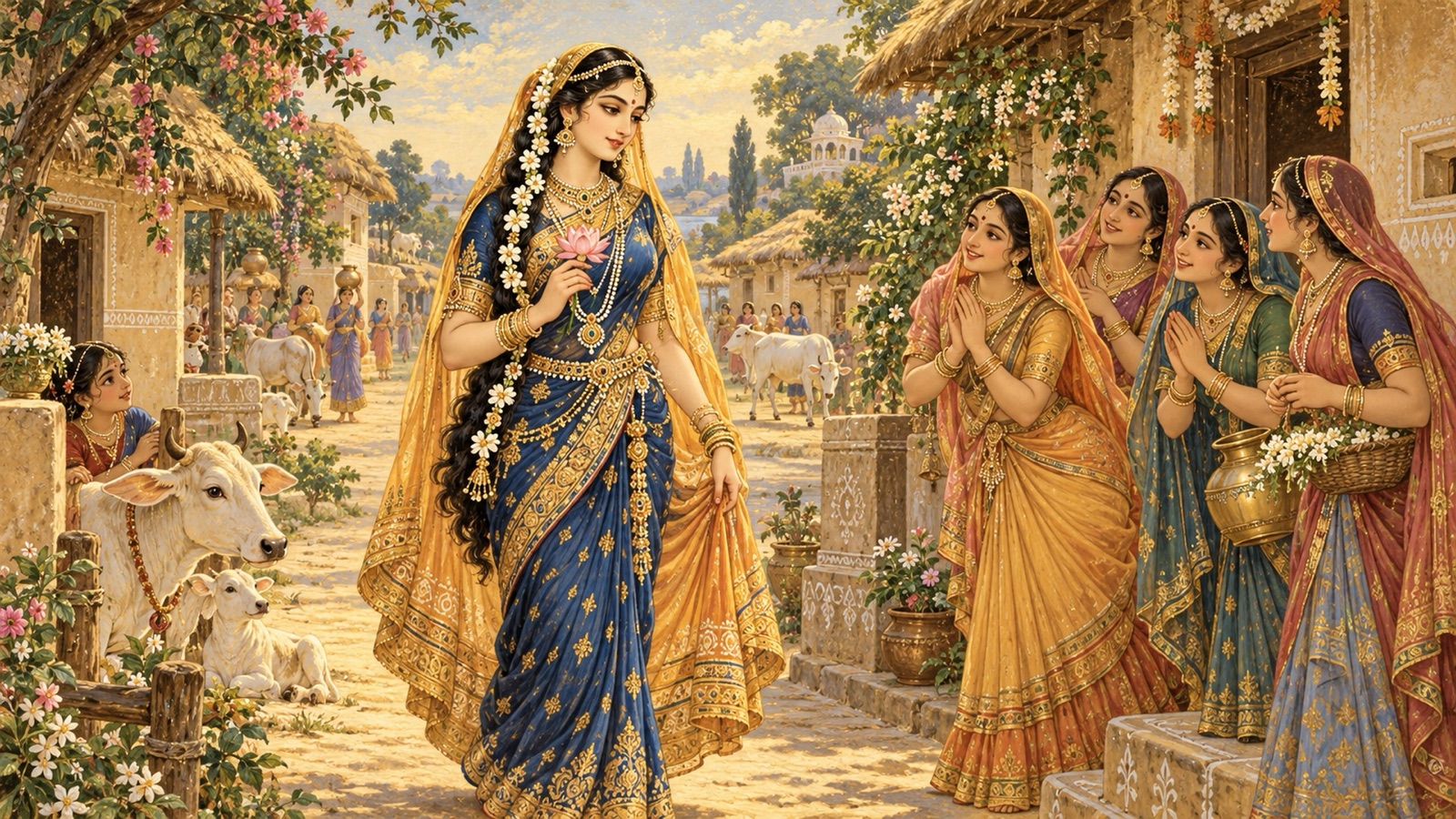
Knowing her at once for what she was, the Lord closed His eyes, as if asleep. She lifted Him into her lap the way an unknowing man might pick up a sleeping serpent, mistaking it for a rope. The two mothers, Rohini and Yasoda, seeing a woman whose manner seemed so tender — though her heart was cruel, like a sword sheathed in a beautiful scabbard — stood gazing, overwhelmed by her splendour and unable to intervene.
The Lord Delivers Putana
Taking the child upon her lap, Putana gave Him her breast, which she had smeared with a deadly poison. But the infant Lord, pressing it firmly with both His little hands, drew out her very life along with the poison. Crying out for release, the ogress thrashed and screamed until, abandoning her disguise and returning to her own monstrous form, she fell lifeless upon the outskirts of Vraja. So vast was that fallen form that it crushed the trees for miles around — a great and terrible wonder. The cowherds and cowherd women, their hearts already shaken by her final cry, were struck with fear at the sight.
Yet in the midst of it all, the divine child was found fearlessly playing upon the body of the fallen ogress, wholly unharmed. The cowherd women hurried to Him and snatched Him up in relief.
The Cowherd Women Protect the Child
Overcome with love and anxiety, Yasoda, Rohini, and the other women at once performed every sacred rite of protection for the boy. They waved the tail of a cow about Him, bathed Him with cow’s urine held as pure as Ganga water, sprinkled Him with the dust raised by the cows’ hooves, and marked twelve parts of His body with cowdung while uttering twelve holy names of the Lord.
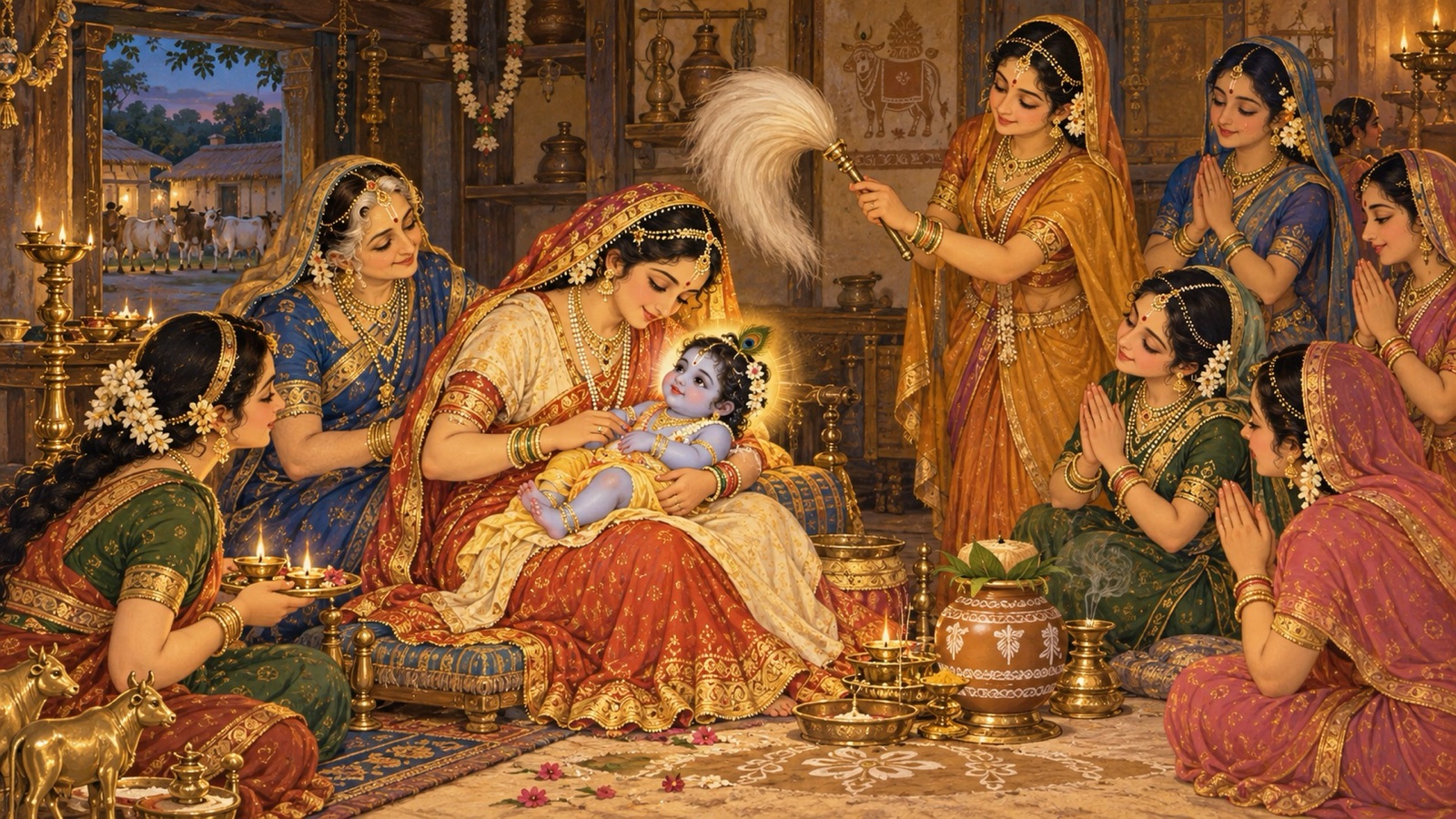
Then, sipping water and consecrating their own limbs and His with sacred sounds, they recited a beautiful prayer of protection over the child — invoking the Lord under His many names to guard every limb and every activity: to protect Him while He played and while He slept, while He walked and while He rested, and to drive far away every evil spirit that torments the innocent. Their prayer shows that these simple cowherd women were devoted servants of the Lord, sheltering the child in the armour of His own holy names. Reassured, Yasoda nursed her son and gently laid Him to sleep.
Putana Attains the Destiny of Saints
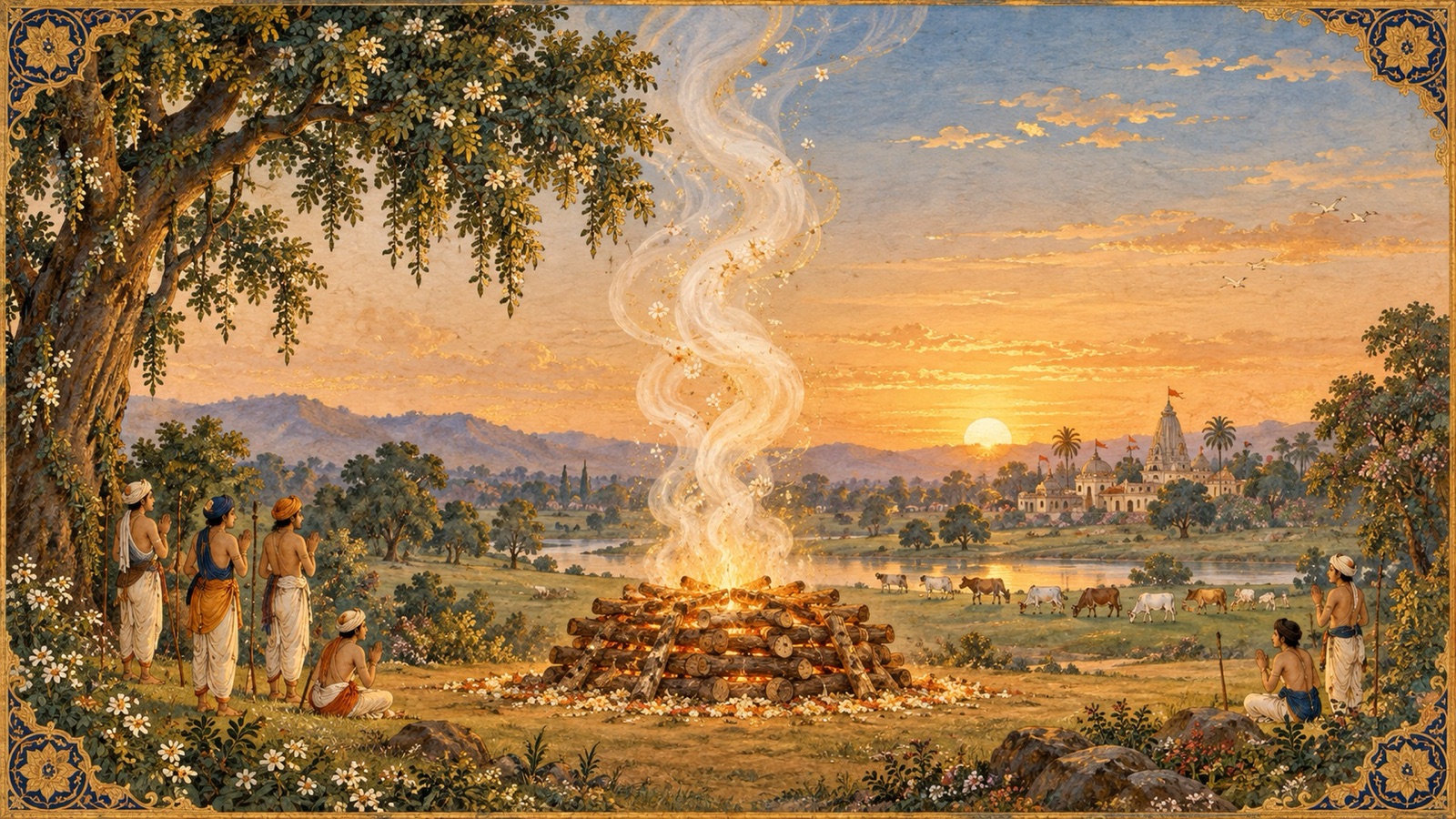
Meanwhile Nanda and the cowherds arrived from Mathura and were astonished to behold Putana’s enormous body. “Surely,” they said, “Vasudeva has become a seer, or a great master of yoga — for the very calamity he foretold has come to pass.” Cutting the body apart and carrying it far off, the villagers burned it upon a pile of wood; and from the flames rose a smoke fragrant as aloe-wood, for the moment the Lord had drawn out her life, all her sin had been wiped away. Here Sukadeva reveals the astonishing heart of the story.
पूतना लोकबालघ्नी राक्षसी रुधिराशना । जिघांसयापि हरये स्तनं दत्त्वाप सद्गतिम् ॥ ३५ ॥
pūtanā loka-bāla-ghnī rākṣasī rudhirāśanā jighāṁsayāpi haraye stanaṁ dattvāpa sad-gatim
Meaning: Putana, a blood-thirsty ogress who slaughtered the infants of the world, attained the destiny of the saints — and this though she offered her breast to the Lord only with the intent to kill Him. (Canto 10, Chapter 6, verse 35)
If even one who approached the Lord with murder in her heart received such grace, Sukadeva asks, how much more must be granted to those who offer Him what is dearest to them with reverence and love, as His affectionate mothers and the gentle cows of Vraja did?
यातुधान्यपि सा स्वर्गमवाप जननीगतिम् । कृष्णभुक्तस्तनक्षीरा: किमु गावोऽनुमातर: ॥ ३८ ॥
yātudhāny api sā svargam avāpa jananī-gatim kṛṣṇa-bhukta-stana-kṣīrāḥ kim u gāvo ’numātaraḥ
Meaning: Even that ogress attained the heavenly destiny reserved for His mothers, because the Lord placed His feet upon her and accepted her breast; how much more, then, the cows and mothers whose milk Krishna lovingly drank? (Canto 10, Chapter 6, verse 38)
Smelling the sweet fragrance drifting from the cremation, Nanda and the others returned to Vraja and, hearing the whole account of Putana’s coming and end and the child’s safety, were filled with wonder. Nanda took up his son, who seemed to have returned from the very jaws of death, and, smelling His head with tender love, was flooded with joy.
Principal Teachings of This Chapter
1. The remembrance of the Lord is the truest protection. Evil finds entry only where the Lord’s names and glories are not heard; where His remembrance is cultivated, no darkness can take hold (verse 3).
2. Enmity against God is powerless. Putana comes armed with poison and disguise, yet the sleeping infant effortlessly undoes her. No scheme against the Lord can ever succeed (verses 7-13).
3. The Lord accepts even the smallest offering — and transforms the giver. Because Putana gave Him her breast, however wicked her intent, the mere contact with the Lord purified her and lifted her to a saintly destiny. His grace responds to any offering that brings a soul near Him (verses 35-38).
4. Devotion is the armour of the innocent. The cowherd women shelter the child not with weapons but with the holy names of God, showing that the surest safeguard is to place ourselves and our loved ones under the Lord’s protection (verses 19-29).
5. Love offered to God is never lost. The mothers and cows of Vraja, who gave Krishna their affection and their milk, are assured the highest destiny. What we lovingly offer the Lord returns to us as His eternal grace (verses 36-40).
A Devotional Reflection
The wonder of this chapter is not that the Lord destroys a demoness — it is that He delivers her. Putana comes to Gokula as death itself, and leaves it as one bound for the destiny of saints. She gives the Lord her poisoned breast intending murder, and He responds by drawing her, poison and all, into Himself, burning away her sin in the fire of His touch. If such is His response to an enemy, what must be His response to love? The chapter quietly overturns our sense of who is worthy. It suggests that any contact with the Divine, any offering however imperfect its motive, is not wasted — that the Lord is forever seeking a reason to give Himself. For the devotee, this is a source of immense hope: our offerings are always flawed, our motives never pure, and yet the Lord accepts them, and accepts us, and turns even our poor gifts into the doorway of His grace.
A Daily Devotional Practice
Today, guard your home and your heart with the simplest of protections: the name of the Lord. As the cowherd women covered the child in the armour of God’s holy names, take a few moments to chant the Lord’s name over your day, your family, and your work, entrusting all of them to His care. Let His remembrance be the doorway no darkness can pass. As you begin, chant: “Om Namo Bhagavate Vasudevaya.”
Conclusion
The sixth chapter of the Tenth Canto gives us the first of Krishna’s childhood wonders — and one of the most moving. Sent to kill, the ogress Putana instead meets her deliverance; the poison meant for the Lord becomes the occasion of her purification; and the child emerges untouched, sheltered by the love of His mothers and the armour of the holy names. Beneath the terror of the tale runs a current of astonishing mercy: that the Lord grants a saintly destiny even to one who came as His murderer, because she came near Him at all. Sukadeva closes by promising that whoever hears this account of the deliverance of Putana with reverence will come to develop pure love for Krishna, the protector of the cows.
य एतत् पूतनामोक्षं कृष्णस्यार्भकमद्भुतम् । शृणुयाच्छ्रद्धया मर्त्यो गोविन्दे लभते रतिम् ॥ ४४ ॥
ya etat pūtanā-mokṣaṁ kṛṣṇasyārbhakam adbhutam śṛṇuyāc chraddhayā martyo govinde labhate ratim
Meaning: Any mortal who hears with faith this wondrous childhood pastime of Krishna — the deliverance of Putana — comes to develop loving devotion for Govinda. (Canto 10, Chapter 6, verse 44)
May the divine wisdom of Srimad Bhagavatam awaken pure devotion within our hearts.
Om Namo Bhagavate Vasudevaya.
Jay Shree Madhav.
References and Attribution
- Primary edition: Gita Press, Śrīmad Bhāgavata Mahāpurāṇa (English, complete), Book Ten (First Half), Discourse 6.
- Series: Srimad Bhagavatam Wisdom · Biswa Sanatan Dharma Seva Trust.
- Presented following the spiritual guidance and recommendation of Pandit Dr. Shri Kashinath Mishra.
This is an original, faithful retelling in the writer’s own words, with brief quoted verses shown in Devanāgarī and transliteration and their meanings given as summaries. It is not a reproduction of any single publisher’s continuous translation or commentary. No affiliation with or endorsement by any publisher is implied.
Jay Shree Madhav