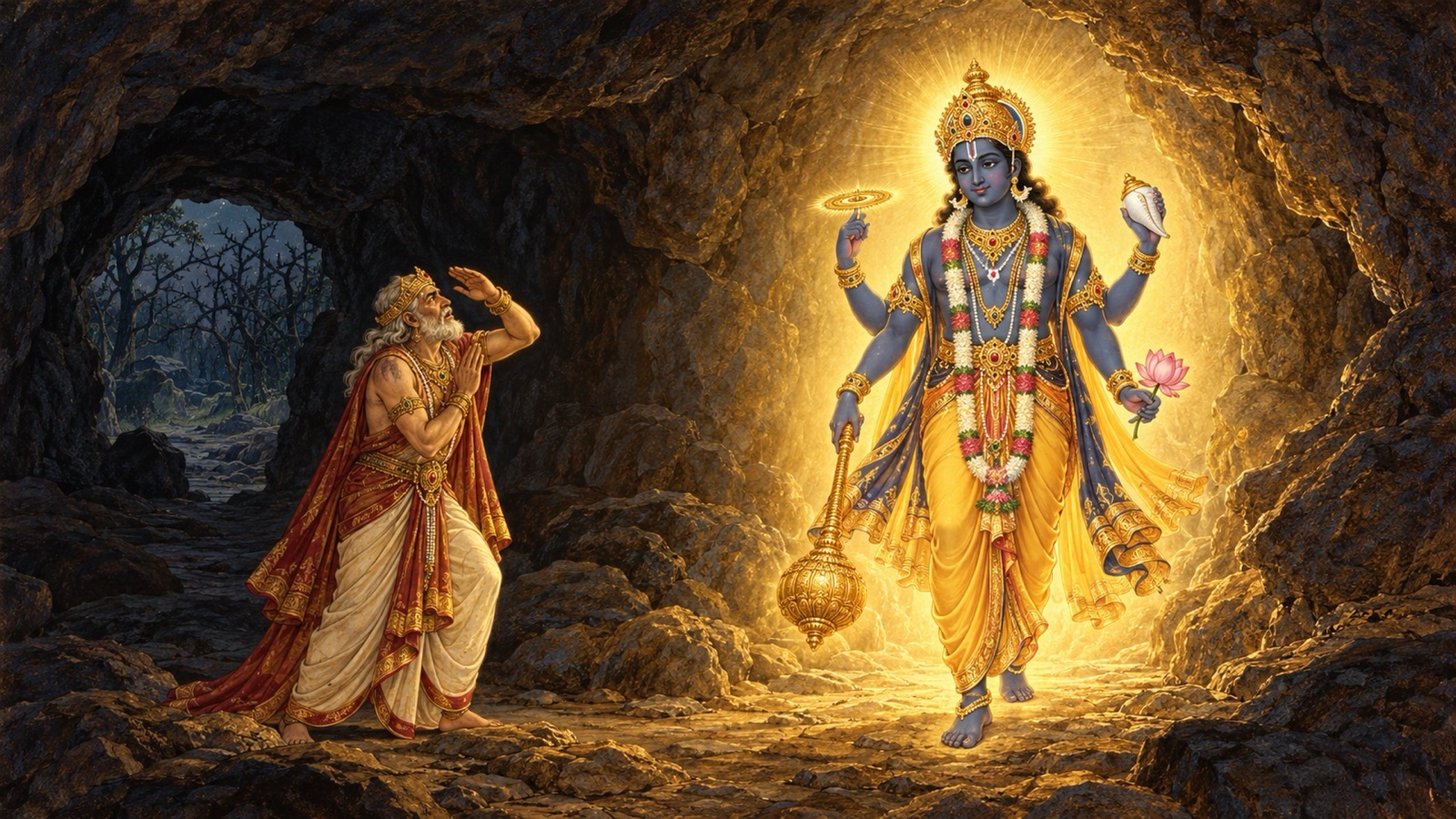
A barbarian king chases the unarmed Lord into a cave and is turned to ashes by the glance of a sleeper he kicks awake; then that ancient king, Mucukunda, beholds the four-armed Lord and asks for nothing but the service of His feet.
Om Namo Bhagavate Vasudevaya.
Om Namo Bhagavate Vasudevaya.
Om Namo Bhagavate Vasudevaya.
Welcome back to Srimad Bhagavatam Wisdom, our devotional journey through the sacred histories and teachings of the Srimad Bhagavat Mahapurana. In this fifty-first chapter of the Tenth Canto, Sukadeva Gosvami tells King Parikshit how the unarmed Krishna drew Kalayavana to a distant cave, where the glance of a long-sleeping king consumed him, and how that king, Mucukunda, then beheld the Lord and prayed to Him.
Chapter Information
- Scripture: Śrīmad Bhāgavata Mahāpurāṇa
- Canto: 10 (Book Ten, Latter Half)
- Chapter: 51 (Discourse 51)
- Chapter title: The Deliverance of Mucukunda
- Principal speaker: Sukadeva Gosvami (narrating to King Parikshit)
- Principal listener: King Parikshit
- Main setting: Outside the gate of Mathurā, and a cave in a distant mountain
- Central subject: Kalayavana’s pursuit and burning; Mucukunda’s history, vision of the Lord, prayer and blessing
- Principal verse range: Canto 10, Chapter 51, verses 1–63
- Primary edition: Gita Press Śrīmad Bhāgavata Mahāpurāṇa (English, Volume 2)
Context From the Previous Chapter
In Chapter 50, with Jarasandha’s sieges broken and Kalayavana’s vast army now at Mathura’s gates, Krishna had a fortress-city built in the sea, carried the people there by His yogic power, and walked out of the city unarmed, wearing a garland of lotuses.
The Lord Walks Out and the Yavana Gives Chase
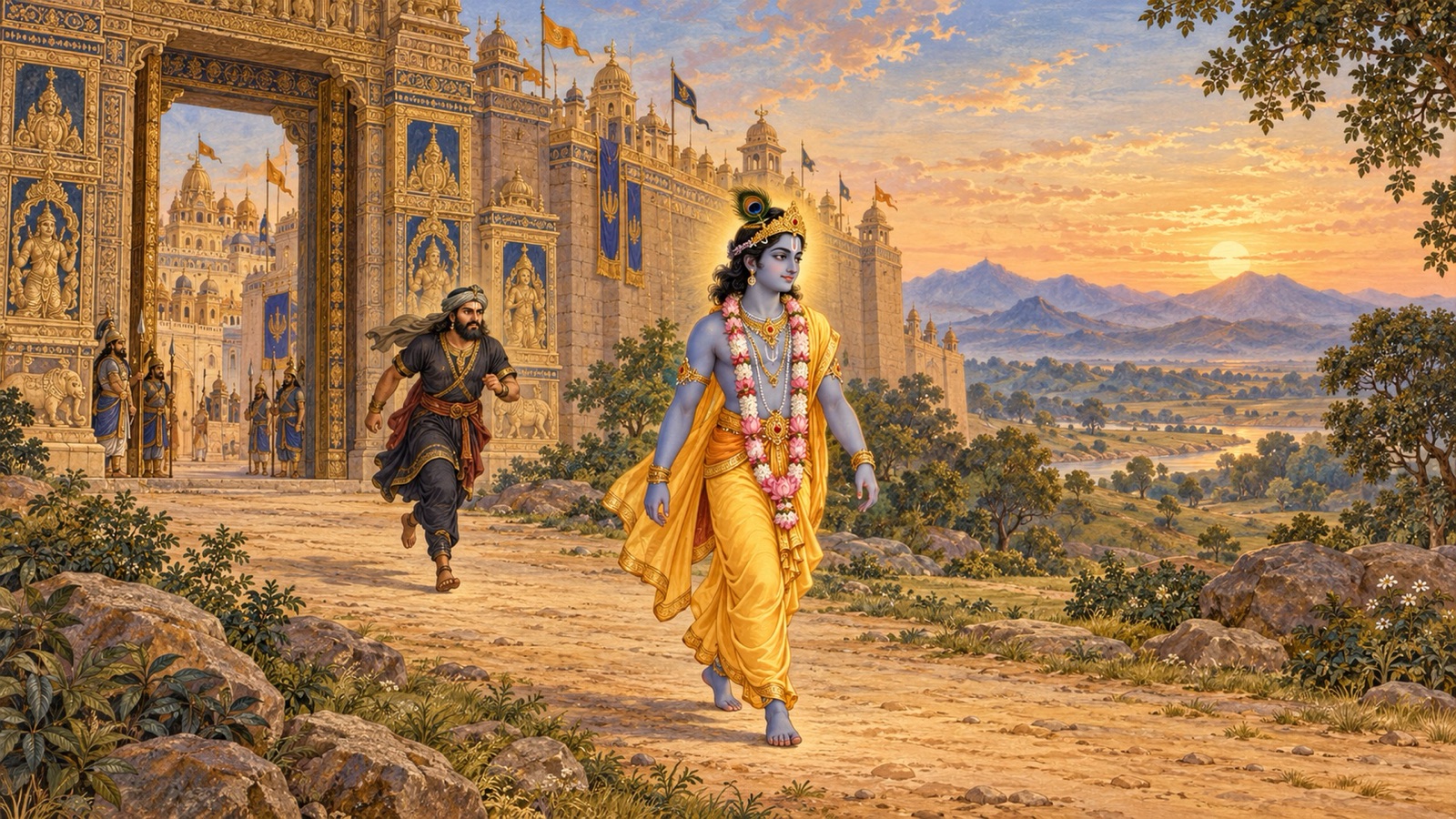
Sukadeva resumed: Kalayavana saw Krishna emerge from the gate like the rising moon — dark of hue, clad in yellow silk, bearing Srivatsa and the blazing Kaustubha, with four long and mighty arms, eyes ruddy as a fresh lotus, a joyful lotus face and glittering shark-shaped earrings. From the signs Narada had described, the Yavana concluded that this could be none other than Vasudeva’s son. Seeing Him weaponless and on foot, he resolved to meet Him likewise and ran after Him; the Lord turned and fled, and Kalayavana pursued One whom even yogis cannot reach.
At every step Krishna seemed almost within his grasp, and so He led the Yavana lord far away to a mountain cave. “Flight does not befit one born in the Yadu line!” Kalayavana jeered as he ran; yet he could not lay hold of Him, for the sins that barred him were not yet spent. Reviled like this, the Lord entered the cave. The Yavana went in after Him — and found there another man, lying asleep.
The Sleeper Wakes
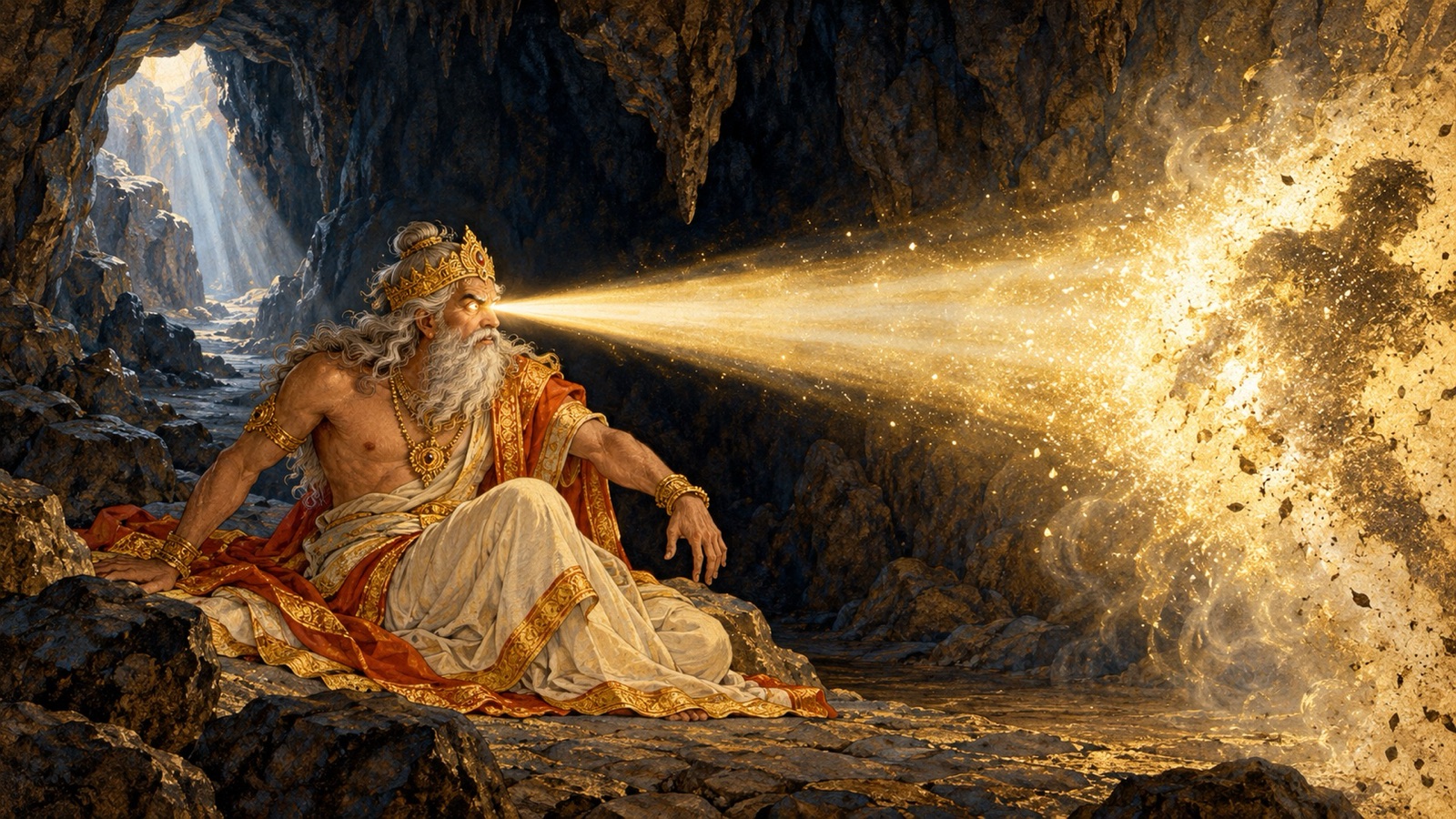
“So this is his trick — after dragging me so far, he lies here like an innocent!” Taking the sleeper for the infallible Lord, the fool struck him hard with his foot. The man, who had slept a very long time, rose, slowly opened his eyes, looked about, and saw the Yavana standing beside him. The moment that angry glance fell upon him, O Parikshit, the Yavana was burnt by a fire born within his own body and reduced to ashes in an instant.
Parikshit asked: “Who was that man who destroyed the Yavana, O brahmana — of what family and what power, and why was he sleeping in that cave?”
Mucukunda, Guardian of the Gods
Sukadeva replied: He was Mucukunda, born in the line of Ikshvaku, the great son of Mandhata, devoted to the brahmanas and true to his word. When the gods led by Indra, terrified of the demons, begged him for protection, he guarded them through a long age. When at last they had obtained Guha, Shiva’s son, as heaven’s guardian, they said to him: “O king, rest now from the hard labour of protecting us. To defend us you gave up a kingdom cleared of every thorn, and every enjoyment of yours was forsaken. Your sons, queens, kinsmen, ministers and the very people of your time are no more — all swept away by time. Time, mightier than the mighty, is the imperishable Lord Himself; as a herdsman drives his herd, so it drives all creatures away as if in play.”
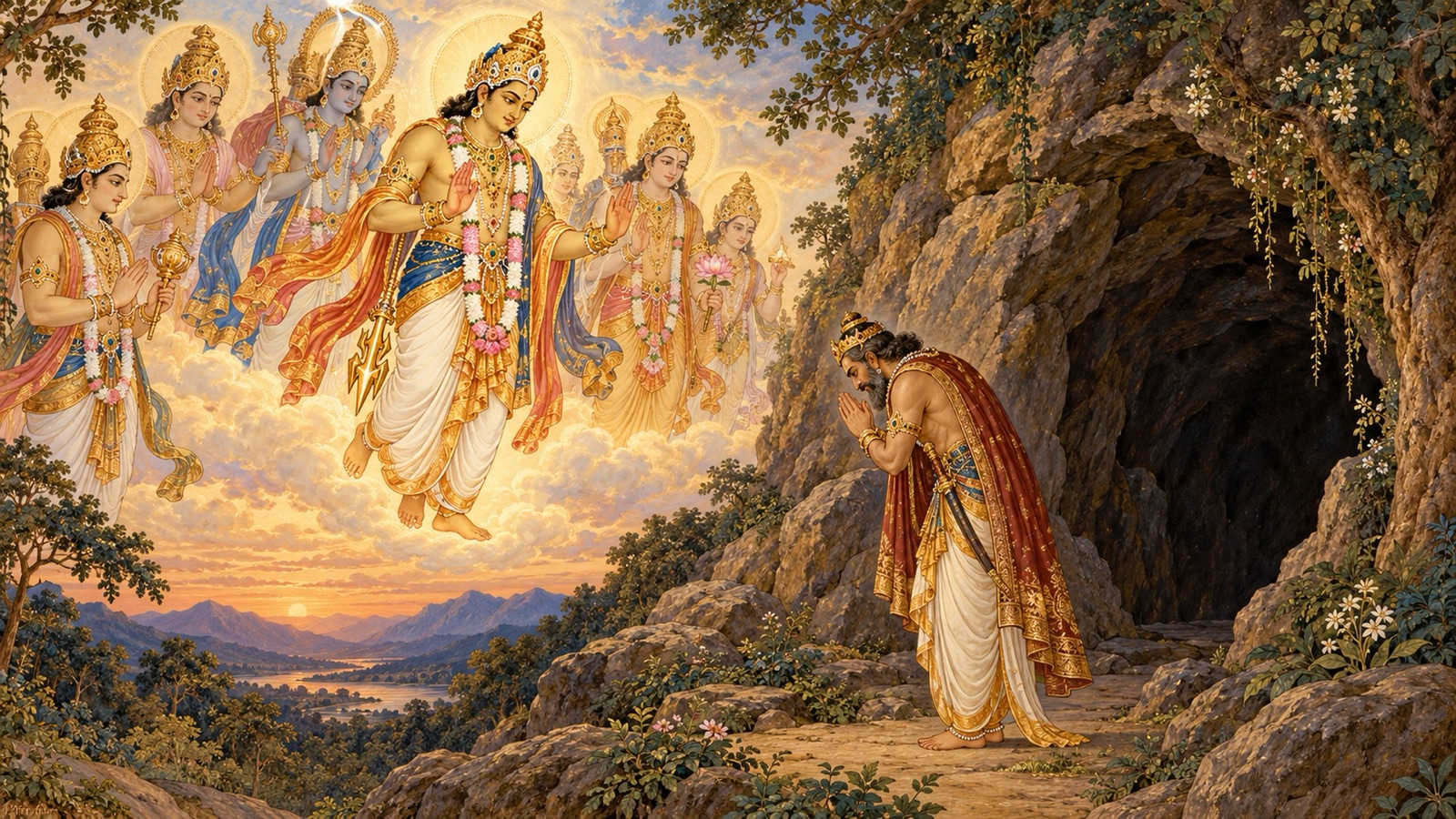
“Blessings upon you — choose any boon except liberation, for the imperishable Lord Vishnu alone is its master.” The renowned king bowed to the gods and, entering the cave, lay down in a sleep the gods themselves had granted; and they had added that whoever thoughtlessly roused him would be reduced to ashes the instant his eye fell upon him.
The Lord Shows Himself
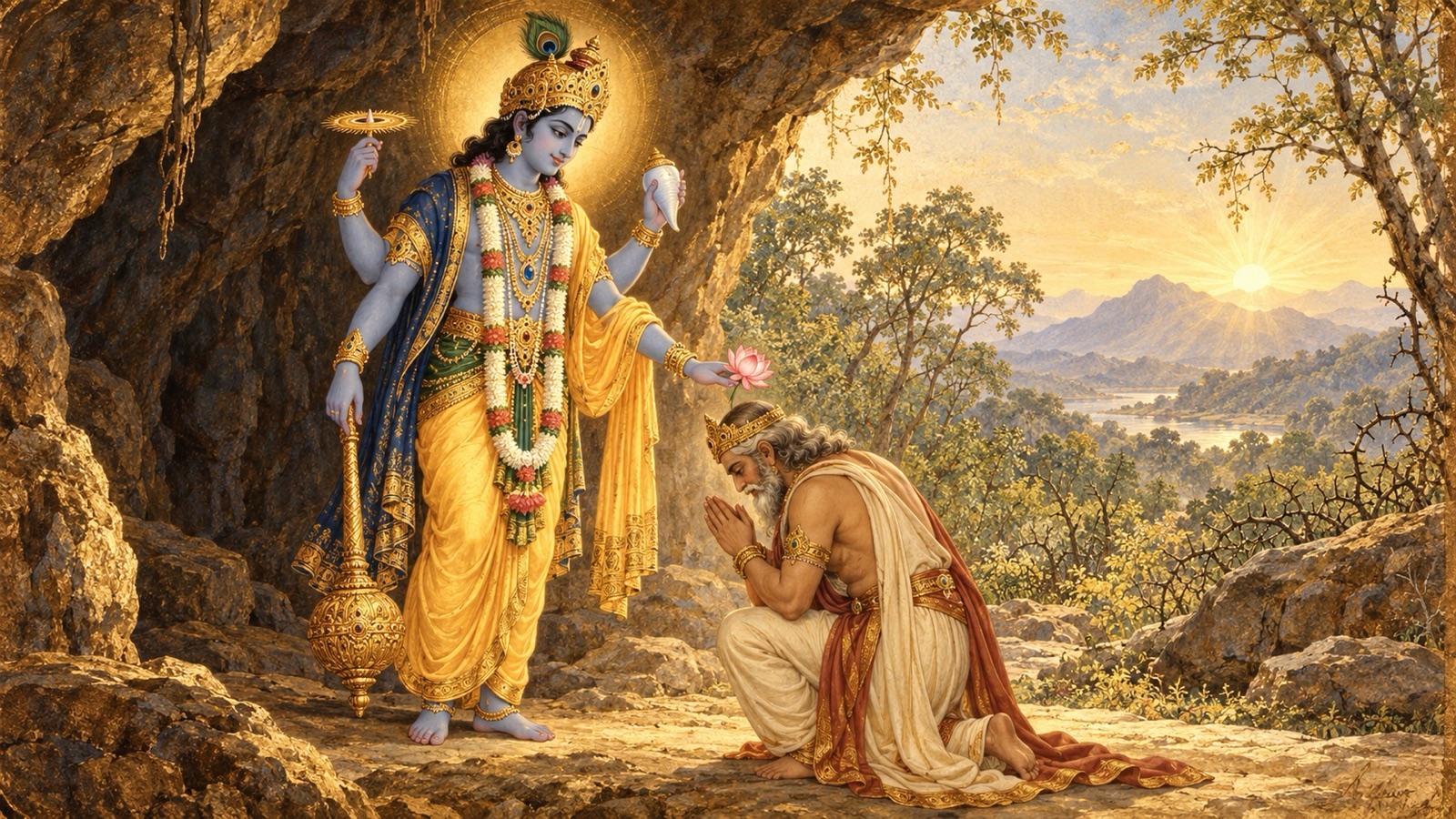
When the Yavana had been turned to ashes, the Lord, foremost of the Satvatas, revealed Himself to the wise Mucukunda — dark as a raincloud, four-armed, radiant with the Kaustubha and the Vaijayanti garland, His smile and glance full of love, stepping with the noble stride of a lion. Overwhelmed by that splendour, the king, with a tremor of awe, slowly asked: “Who are You, come to this cave, walking this thorny forest on feet soft as lotus petals? Are You the fire-god, the sun, the moon, great Indra, or some other guardian of the worlds? I take You for the foremost Person among the three chief gods, for You drive away the darkness of this cave with Your radiance, as a lamp does with its light.”
“If it pleases You, O best of men, tell us, who long to hear, of Your birth, deeds and family. We are kshatriyas of the Ikshvaku line; I am Mucukunda, son of Mandhata. Worn out by long vigil and overpowered by sleep, I lay in this lonely cave until just now someone roused me — and he has surely been burnt to ashes by his own sin. Then I saw You, glorious chastiser of foes. We cannot gaze long upon Your unbearable splendour, O greatly blessed One, worthy of honour from every embodied being.”
“My Births and Deeds Cannot Be Counted”
The Lord, creator of all beings, laughed and replied in a voice deep as thunder: “My births, deeds and names, dear one, are thousands upon thousands; being infinite, they cannot be counted even by Me. One might count the dust of the earth over many lifetimes, but never My qualities, deeds, names and births; even the greatest sages never reach their end. Still, hear of those of the present age. Entreated by Brahma to protect dharma and destroy the demons burdening the earth, I have descended in the Yadu line, in the house of Anakadundubhi; being Vasudeva’s son, people call Me Vasudeva. I have slain Kalanemi, who was born as Kamsa, and Pralamba and other enemies of the righteous; and this Yavana, O king, has been burnt by your fiery eyes. Prayed to by you many times before, I have come to this cave only to bestow My grace on you, for I love My devotees.”
वरान्वृणीष्व राजर्षे सर्वान् कामान् ददामि ते ।
मां प्रपन्नो जन: कश्चिन्न भूयोऽर्हति शोचितुम् ॥ ४३ ॥
varān vṛṇīṣva rājarṣe sarvān kāmān dadāmi te māṁ prapanno janaḥ kaścin na bhūyo ’rhati śocitum
Meaning: Choose boons, O royal sage; I grant you everything you desire. One who has taken refuge in Me need never grieve again. (Canto 10, Chapter 51, verse 43)
Mucukunda’s Prayer
Remembering the elder sage Garga’s prophecy and knowing this to be Lord Narayana Himself, Mucukunda bowed low and joyfully began to pray.
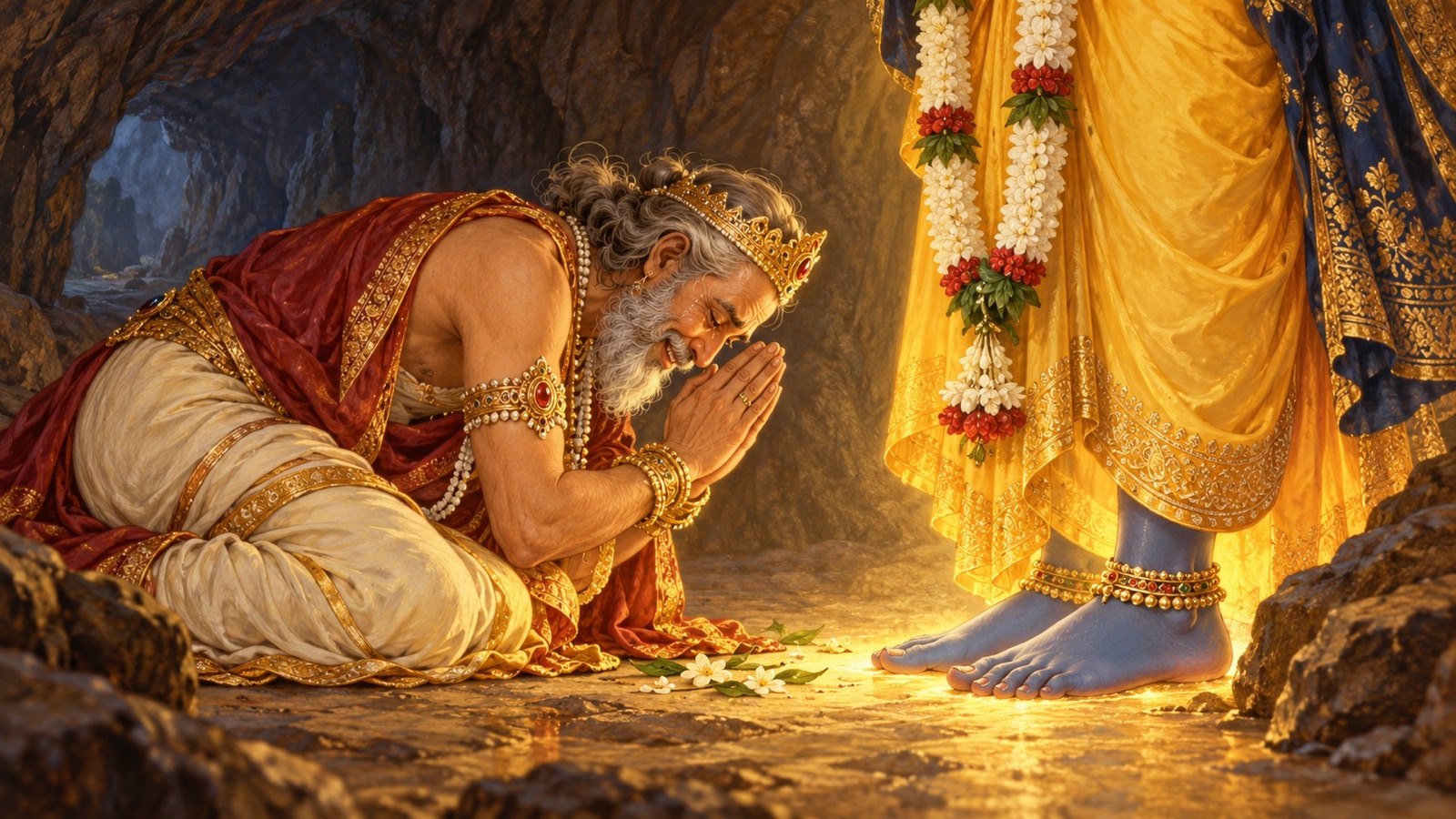
“Deluded by Your Maya, O Lord, and blind to the true good, this creature — whether woman or man — does not worship You; hoping for happiness, it clings to the home, which breeds only sorrow, and is cheated.”
लब्ध्वा जनो दुर्लभमत्र मानुषं
कथञ्चिदव्यङ्गमयत्नतोऽनघ ।
पादारविन्दं न भजत्यसन्मति-
र्गृहान्धकूपे पतितो यथा पशु: ॥ ४६ ॥
labdhvā jano durlabham atra mānuṣaṁ kathañcid avyaṅgam ayatnato ’nagha pādāravindaṁ na bhajaty asan-matir gṛhāndha-kūpe patito yathā paśuḥ
Meaning: Having somehow obtained, without any effort of his own, this rare human birth with body and mind unimpaired, O sinless Lord, the man of perverted intelligence does not worship Your lotus feet, but lies fallen in the blind well of household life like a beast. (Canto 10, Chapter 51, verse 46)
“My own time, O unconquerable Lord, has slipped away in vain. Drunk with royal fortune, taking this mortal body — no different from a pot or a wall — for my very self, I stayed bound to sons, wives, treasury and lands in endless anxiety, and roamed the earth with my armies in wild pride, counting You as nothing. But You, never heedless, fall suddenly as Death upon the careless man absorbed in his schemes and greedy for pleasure, as a hungry serpent seizes a mouse. The body that once rode gold-adorned chariots and bore the title ‘king’ is, under irresistible Time, named at last excrement, worms or ashes. The conqueror of every quarter, enthroned and saluted by his equals, is led about the home like a pet deer of women; and the man who performs austerities and rites to be reborn a sovereign only feeds his thirst and never finds happiness.”
भवापवर्गो भ्रमतो यदा भवे-
ज्जनस्य तर्ह्यच्युत सत्समागम: ।
सत्सङ्गमो यर्हि तदैव सद्गतौ
परावरेशे त्वयि जायते मति: ॥ ५३ ॥
bhavāpavargo bhramato yadā bhavej janasya tarhy acyuta sat-samāgamaḥ sat-saṅgamo yarhi tadaiva sad-gatau parāvareśe tvayi jāyate matiḥ
Meaning: When the end of a wandering soul’s worldly existence draws near, O Acyuta, then he meets with saints; and only when there is the company of saints does the mind turn to You, the refuge of the saintly and the Lord of the high and the low. (Canto 10, Chapter 51, verse 53)
“I count it Your grace, O Lord, that the bonds of kingship fell from me of themselves — the very release that wise rulers of the whole earth pray for when they wish to enter the forest alone.”
न कामयेऽन्यं तव पादसेवना-
दकिञ्चनप्रार्थ्यतमाद्वरं विभो ।
आराध्य कस्त्वां ह्यपवर्गदं हरे
वृणीत आर्यो वरमात्मबन्धनम् ॥ ५५ ॥
na kāmaye ’nyaṁ tava pāda-sevanād akiñcana-prārthyatamād varaṁ vibho ārādhya kas tvāṁ hy apavarga-daṁ hare vṛṇīta āryo varam ātma-bandhanam
Meaning: I desire no boon other than the service of Your feet, the one boon most prized by those who call nothing their own, O almighty Lord. Having worshipped You, the giver of liberation, O Hari, what wise man would choose a boon that only binds the soul? (Canto 10, Chapter 51, verse 55)
“Therefore, O Lord, casting aside every blessing bound up with the three gunas, I come to You alone — the taintless, non-dual Supreme Person, pure consciousness itself. Long tormented by the fruits of my deeds, my six enemies never sated, I could find no peace; yet somehow I have reached Your lotus feet, fearless, true and free of sorrow. Protect me, O Lord, for I am in distress.”
The Lord’s Blessing
The Lord replied: “O great king, ruler of the whole earth, your mind is pure and strong, for even when tempted with boons it was not shaken by desire.”
प्रलोभितो वरैर्यत्त्वमप्रमादाय विद्धि तत् ।
न धीरेकान्तभक्तानामाशीर्भिर्भिद्यते क्वचित् ॥ ५९ ॥
pralobhito varair yat tvam apramādāya viddhi tat na dhīr ekānta-bhaktānām āśīrbhir bhidyate kvacit
Meaning: Know that you were tempted with boons only to show that you would not be misled; the intelligence of those who are devoted to Me alone is never perverted by blessings. (Canto 10, Chapter 51, verse 59)
“The minds of non-devotees, though curbed by breath-control and other practices, rise up again, O king, for their cravings are not worn away. Wander the earth as you please with your mind fixed on Me, and may your devotion to Me remain unbroken for ever. As a kshatriya you killed creatures in the hunt; sheltered in Me and composed, wipe away that sin by austerity. In your very next birth you will become a brahmana, the best friend of all beings, and you will come to Me alone.”
Principal Teachings of This Chapter
1. The Lord’s “flight” was a devotee’s deliverance. Krishna did not run from Kalayavana out of fear. He tells Mucukunda in verse 42 that He came to the cave to bestow grace on one who had prayed to Him long before, and in verse 41 that the Yavana was burnt by Him through the king’s eyes. The chase was the Lord keeping an ancient appointment: His enemy’s end and His devotee’s awakening were accomplished in one movement, without His lifting a weapon, while Shiva’s boon to the Yavana was still honoured. Nothing in His pastimes is accidental.
2. Time is the Lord Himself. Verse 19, confirmed by Mucukunda’s own loss of sons, queens and people, keeps the heart humble and awake.
3. The human birth is for worship, not for the blind well. Verse 46 names the tragedy: a sound human body, gained without effort, wasted in household attachment like a beast in a well.
4. Everything turns on the company of saints. Verse 53 gives the order of grace: as a soul’s wandering nears its end, saints are met, and from their company devotion is born.
5. Ask for His feet, not for boons. Offered everything, Mucukunda chooses only service in verse 55; the Lord confirms in verse 59 that such steadiness marks exclusive devotion, and in verse 60 that discipline without devotion leaves cravings alive.
A Devotional Reflection
What moves us most here is that the Lord had already heard Mucukunda. Ages before, a tired king had prayed to see Him; the Lord said yes, and then arranged the pride of a Yavana so that a sleeper in a cave would open his eyes upon Narayana. We often feel our prayers are lost; the chapter answers that each waits for the hour the Lord has chosen. And when He comes, He tests us gently, not to refuse us anything but to let us discover what we truly want. May we answer as that king did: nothing but His feet.
A Daily Devotional Practice
Today, before any other request, sit quietly and recall Mucukunda’s choice. Tell the Lord in one honest sentence what your heart has been chasing, then ask Him for the single boon the king asked — the service of His feet — and seek the company of a devotee, even briefly. Begin by chanting gently: Om Namo Bhagavate Vasudevaya.
Conclusion
Here the unarmed Lord lures Kalayavana into a cave, where the glance of the awakened Mucukunda turns him to ashes; the Lord then reveals His four-armed form, offers any boon, and receives instead a prayer that wants only His feet. Blessed with unbroken devotion and a brahmana’s birth leading to Him, Mucukunda stands for every soul the Lord quietly comes to meet. May we, like him, prefer His service to every other gift.
May the divine wisdom of Srimad Bhagavatam awaken pure devotion within our hearts.
Om Namo Bhagavate Vasudevaya.
Jay Shree Madhav.
References and Attribution
- Primary edition: Gita Press, Śrīmad Bhāgavata Mahāpurāṇa (English, Volume 2), Book Ten (Latter Half), Discourse 51.
- Series: Srimad Bhagavatam Wisdom · Biswa Sanatan Dharma Seva Trust.
- Presented following the spiritual guidance and recommendation of Pandit Dr. Shri Kashinath Mishra.
This is an original, faithful retelling in the writer’s own words, with brief quoted verses shown in Devanāgarī and transliteration and their meanings given as summaries. It is not a reproduction of any single publisher’s continuous translation or commentary. No affiliation with or endorsement by any publisher is implied.
Jay Shree Madhav