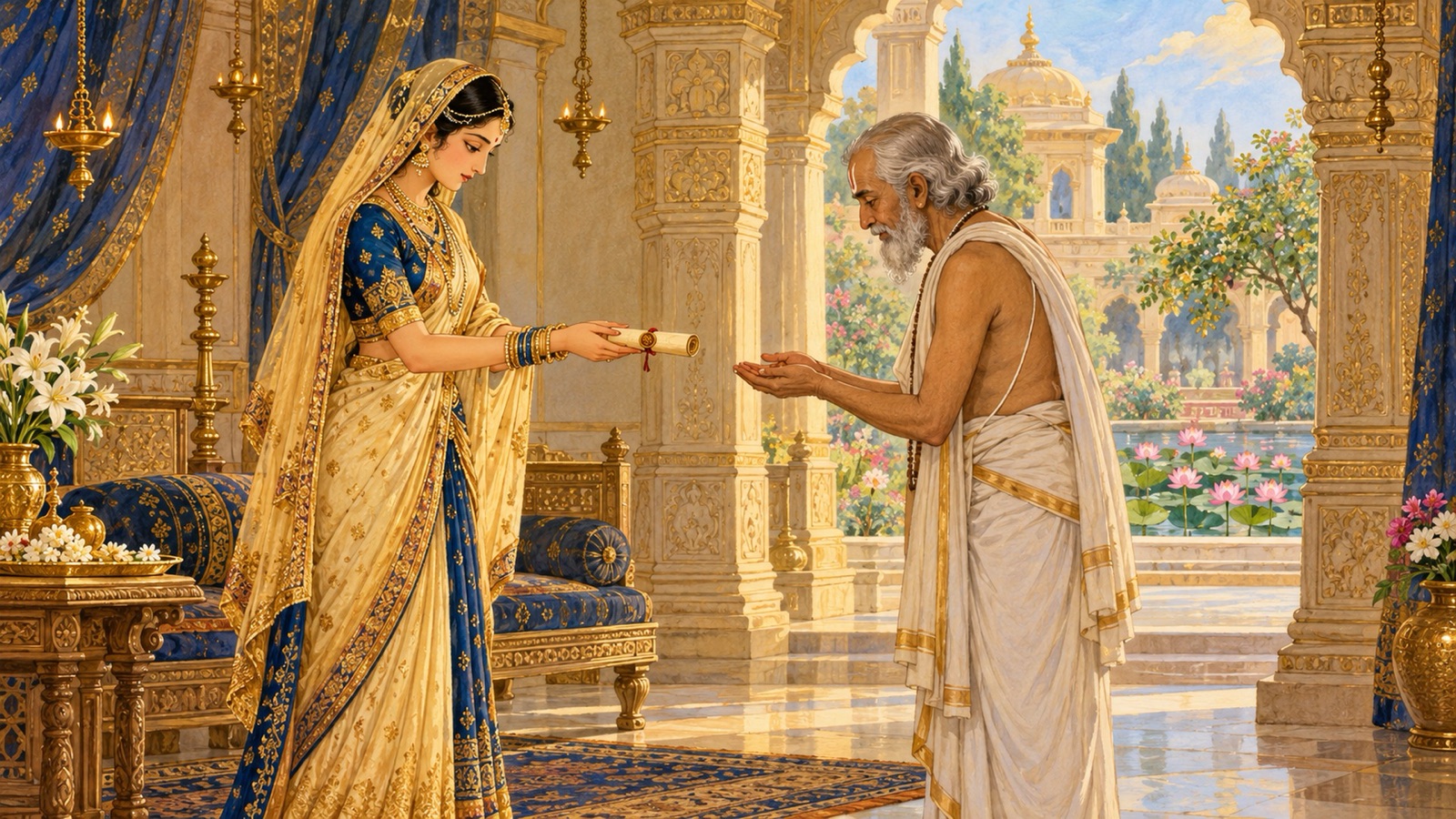
A princess who has never set eyes on Krishna gives Him her heart on the strength of hearing alone, and sends a trusted brahmana across the sea to Dvaraka, where the Lord steps down from His golden throne to serve her messenger with His own hands.
Om Namo Bhagavate Vasudevaya.
Om Namo Bhagavate Vasudevaya.
Om Namo Bhagavate Vasudevaya.
Welcome back to Srimad Bhagavatam Wisdom, our devotional journey through the sacred histories and teachings of the Srimad Bhagavat Mahapurana. In this fifty-second chapter of the Tenth Canto, Jarasandha sets a mountain ablaze beneath the two brothers, Balarama is wed to Revati, and Rukmini entrusts a brahmana with a secret message for the Lord of the Yadus.
Chapter Information
- Scripture: Śrīmad Bhāgavata Mahāpurāṇa
- Canto: 10 (Book Ten, Latter Half)
- Chapter: 52 (Discourse 52)
- Chapter title: Rukmini’s Message to Lord Krishna
- Principal speaker: Sukadeva Gosvami (narrating to King Parikshit)
- Principal listener: King Parikshit
- Main setting: Badarikasrama; Mathura and Mount Pravarshana; Dvaraka; Kundinapura in Vidarbha
- Central subject: Mucukunda’s departure; the escape from Jarasandha on the blazing mountain; the brahmana honoured in Dvaraka; Rukmini’s message
- Principal verse range: Canto 10, Chapter 52, verses 1–44
- Primary edition: Gita Press Śrīmad Bhāgavata Mahāpurāṇa (English)
Context From the Previous Chapter
In Chapter 51, Kalayavana pursued Krishna into a mountain cave and was burned to ashes by the glance of the sleeping King Mucukunda. Recognising the Lord, Mucukunda prayed in surrender, and Krishna blessed him to wander the earth with his mind fixed on Him, to be born next as a brahmana, and then to attain Him.
Mucukunda Departs for Badarikasrama
Thus blessed, Mucukunda, the delight of the Ikshvaku line, circled the Lord in reverence, bowed low, and stepped out through the mouth of the cave. Men, beasts, creepers and trees had all grown small, and from this he understood that the age of Kali had arrived; so he turned north. Steadfast in faith, free of attachment and of every doubt, with his mind fixed on Krishna, he entered the forest of Mount Gandhamadana and came at last to Badarikasrama, the hermitage of the sages Nara and Narayana, where he worshipped Hari through austerity.
बदर्याश्रममासाद्य नरनारायणालयम् ।
सर्वद्वन्द्वसह: शान्तस्तपसाराधयद्धरिम् ॥ ४ ॥
badary-āśramam āsādya nara-nārāyaṇālayam sarva-dvandva-sahaḥ śāntas tapasārādhayad dharim
Meaning: Reaching Badarikasrama, the abode of Nara and Narayana, enduring every pair of opposites and tranquil at heart, he worshipped Hari through austerity. (Canto 10, Chapter 52, verse 4)
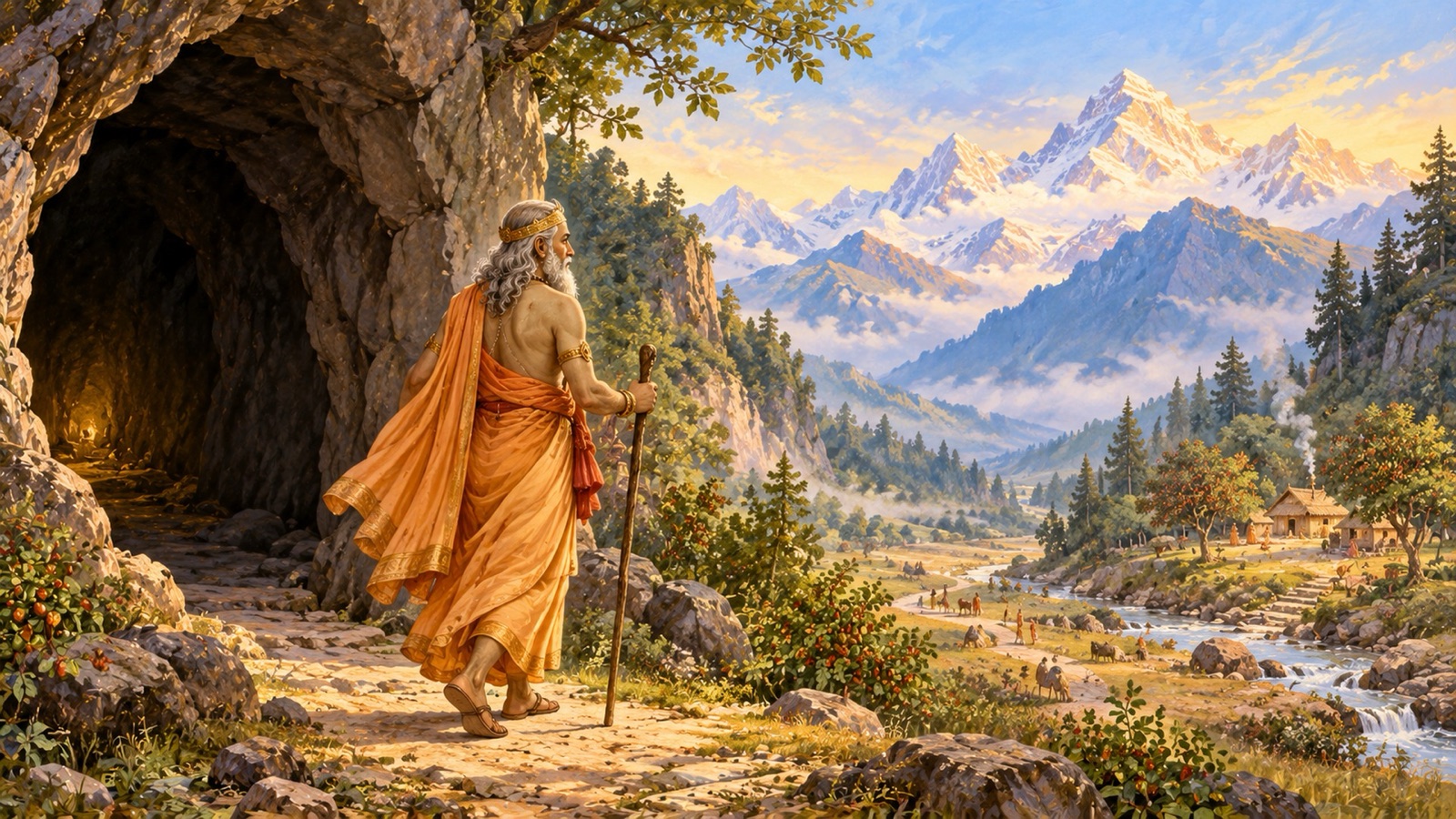
The Lord Returns to Mathura, and Jarasandha Comes Again
The Lord went back to Mathura, still besieged by the Yavanas, destroyed the barbarian host, and began to carry its wealth away to Dvaraka. But while that treasure was being moved on oxen and men at Krishna’s bidding, Jarasandha appeared once more at the head of twenty-three akshauhinis. Seeing the headlong rush of the enemy host, Balarama and Krishna, who had taken on the ways of human beings, turned at once and ran, leaving the immense spoils where they lay.
विहाय वित्तं प्रचुरमभीतौ भीरुभीतवत् ।
पद्भ्यां पद्मपलाशाभ्यां चेलतुर्बहुयोजनम् ॥ ८ ॥
vihāya vittaṁ pracuram abhītau bhīru-bhīta-vat padbhyāṁ padma-palāśābhyāṁ celatur bahu-yojanam
Meaning: Abandoning the abundant wealth, the two, though fearless, fled like frightened men, covering many yojanas on feet like lotus petals. (Canto 10, Chapter 52, verse 8)
Jarasandha laughed aloud to see Them flee and, knowing nothing of the true measure of the two Lords, gave chase with his hosts of chariots.
The Blazing Mountain of Pravarshana
After a long run, seemingly exhausted, the brothers climbed the lofty mountain Pravarshana, where the glorious Indra pours down rain without pause. Jarasandha concluded that They had hidden on it but could not discover where; so he girded the mountain with piles of firewood and set it ablaze on every side. Then, from that summit eleven yojanas high, its slopes all burning, the two sprang with tremendous force and came down upon the plain beyond.
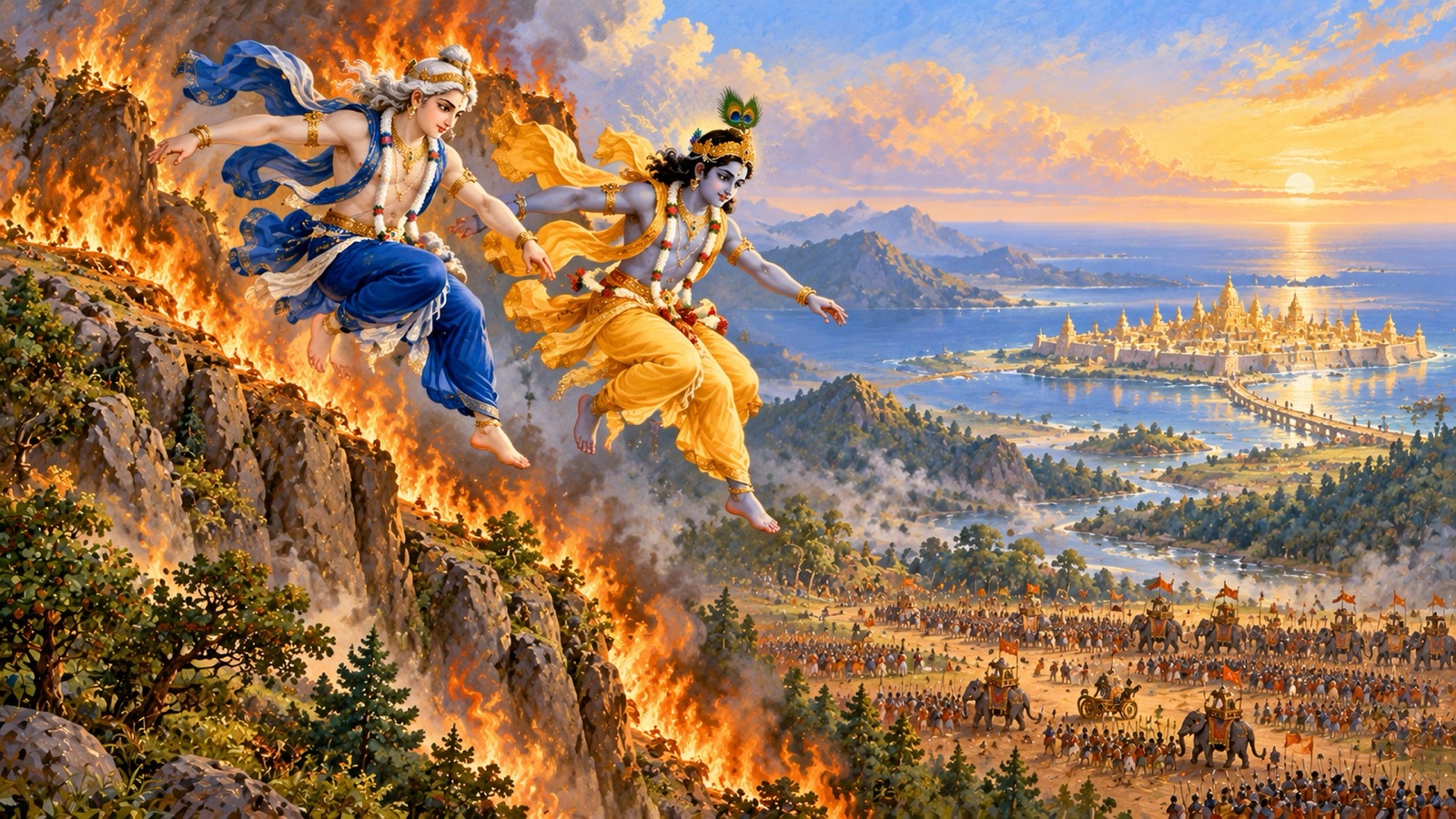
Unseen by the enemy and his followers, the two jewels of the Yadu race returned to Dvaraka, moated by the sea. Jarasandha, falsely believing Balarama and Keshava had perished in the flames, led his vast army home to Magadha.
Two Weddings Announced
Sukadeva now spoke of two marriages. Raivata, the glorious lord of Anarta, had at Brahma’s bidding given his daughter Revati to Balarama — a history already told. And Lord Govinda Himself married Rukmini, daughter of Bhishmaka of Vidarbha and a portion of the goddess Shri, in a svayamvara: crushing Shalva and the other kings who sided with the prince of Chedi, He carried her away before the eyes of all the world, as Garuda once carried off the nectar.
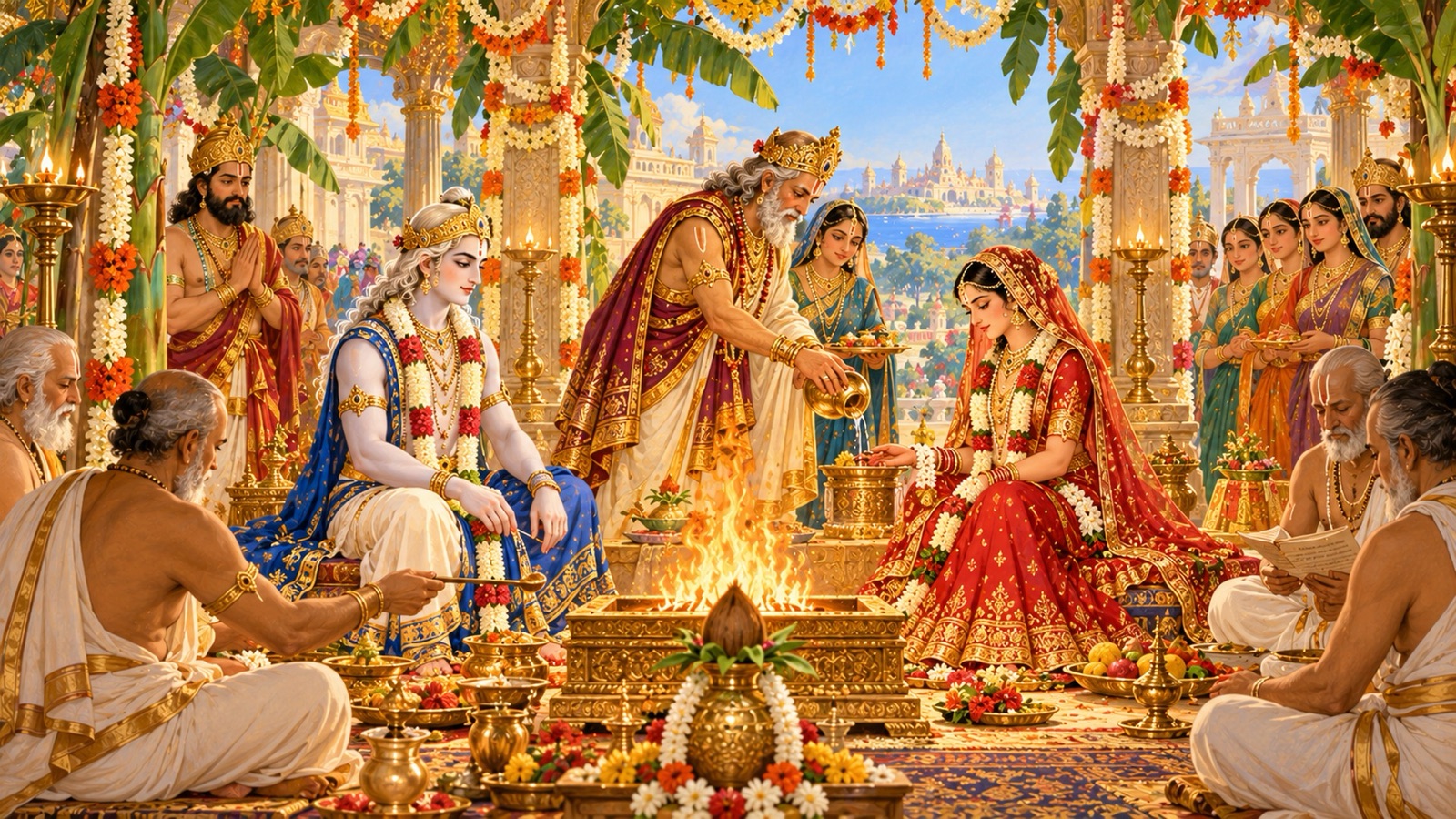
Parikshit Longs to Hear
‘It is heard,’ said the king, ‘that the Lord married Bhishmaka’s lovely daughter Rukmini by the rakshasa rite, taking her by force. O divine sage, I long to hear how Krishna of boundless splendour defeated Jarasandha, Shalva and the rest and carried off the bride.’ Then he spoke words every listener of the Bhagavatam has echoed since:
ब्रह्मन् कृष्णकथा: पुण्या माध्वीर्लोकमलापहा: ।
को नु तृप्येत शृण्वान: श्रुतज्ञो नित्यनूतना: ॥ २० ॥
brahman kṛṣṇa-kathāḥ puṇyā mādhvīr loka-malāpahāḥ ko nu tṛpyeta śṛṇvānaḥ śruta-jño nitya-nūtanāḥ
Meaning: O brahmana, the stories of Krishna are holy, sweet as honey, cleansing the world of its impurity, and ever new; what person who understands what he hears could ever have enough of them? (Canto 10, Chapter 52, verse 20)
The Princess of Vidarbha
Sukadeva began. Bhishmaka, the great king of Vidarbha, had five sons and one daughter of lovely countenance. The eldest son was Rukmi; after him came Rukmaratha, Rukmabahu, Rukmakesha and Rukmamali; their virtuous sister was Rukmini. Visitors to the palace would sing of Mukunda — His beauty, valour, virtues and splendour — and listening closely, Rukmini came to regard Him as her rightful husband. Krishna, too, had learned from such reports that she was a treasury of intelligence, auspicious marks, generosity, beauty, character and virtue, and resolved to take her as His worthy consort. Her parents and brothers wished to give her to Krishna; but Rukmi, who hated Krishna, prevented them and fixed instead upon Shishupala, king of Chedi. Learning this, the dark-eyed princess was deeply troubled; she pondered, and swiftly sent a trusted brahmana to Krishna.
The Brahmana in Dvaraka
Led in by the doorkeepers at Dvaraka, the brahmana saw the Primeval Person seated on a throne of gold. The moment Krishna saw him, He who holds the brahmanas dear came down from His own seat, placed the guest upon it, and worshipped him as the gods worship Krishna when He visits their realm. When the brahmana had eaten and rested, the Refuge of the saintly sat beside him, kneaded his feet gently with His own hand, and asked calmly: ‘O best of the twice-born, is your religious life, approved by the elders, proceeding without great hardship? Is your mind always content? When a brahmana is satisfied with whatever comes and never abandons his own dharma, that very contentment yields him every blessing. A discontented Indra wanders from world to world and finds no rest; a contented soul, though he owns nothing, sleeps soundly, free of every fever.’
विप्रान् स्वलाभसन्तुष्टान् साधून् भूतसुहृत्तमान् ।
निरहङ्कारिण: शान्तान् नमस्ये शिरसासकृत् ॥ ३३ ॥
viprān sva-lābha-santuṣṭān sādhūn bhūta-suhṛttamān nirahaṅkāriṇaḥ śāntān namasye śirasāsakṛt
Meaning: To brahmanas content with whatever they receive, saintly, the best friends of all beings, free of ego and peaceful, I bow My head again and again. (Canto 10, Chapter 52, verse 33)
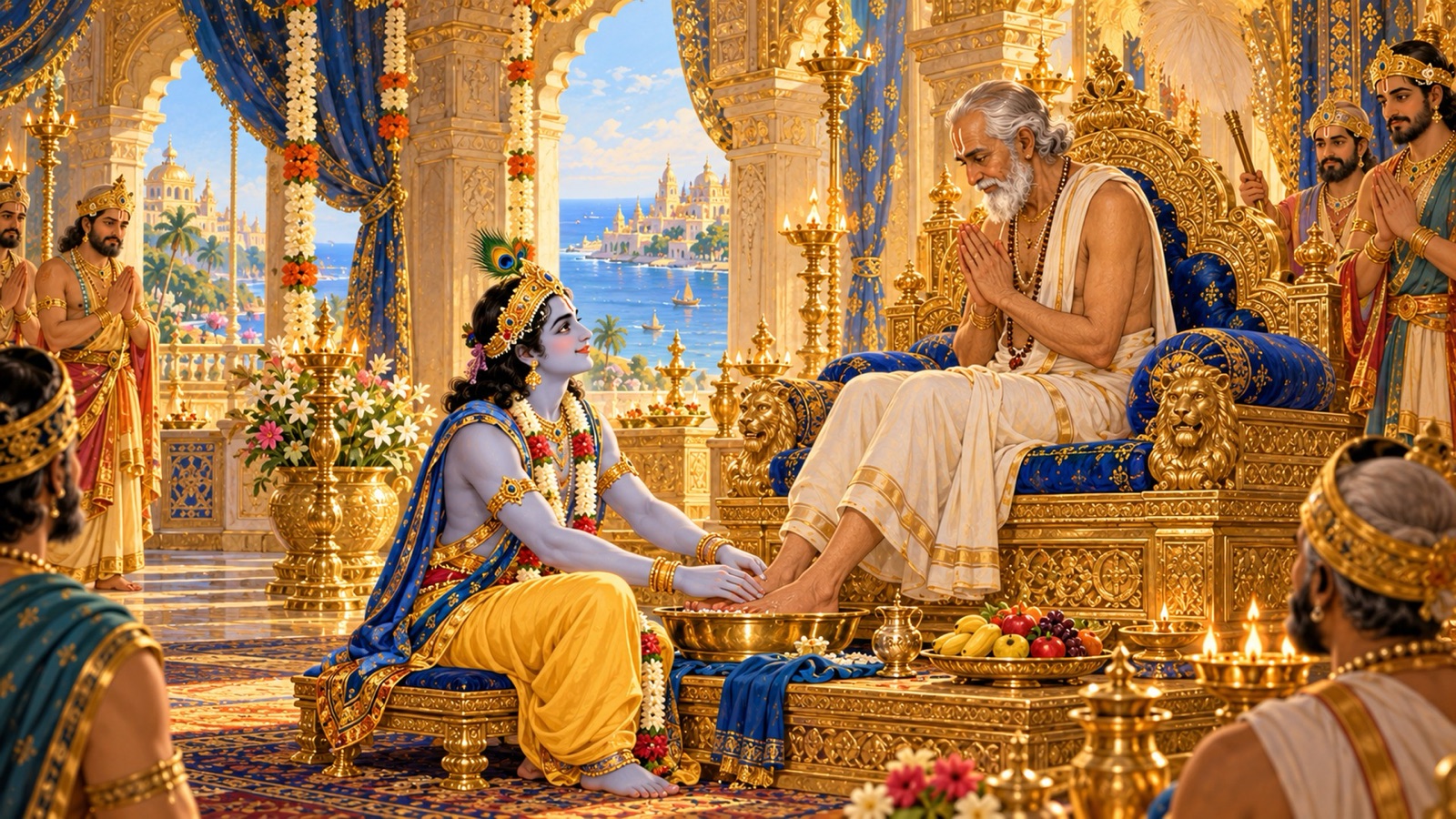
‘Is all well with you under your king?’ the Lord went on. ‘A king whose people live happily under his protection is dear to Me. Now tell us, if it is no secret, from where you have come and what you seek, crossing the sea so hard to cross. What can we do for you?’ Questioned so kindly by the Supreme Ruler, who had taken a body for His play, the brahmana told Him everything — and delivered the words of the princess.
Rukmini’s Message
Rukmini’s words begin not with a plea but with a confession of how she came to love Him:
श्रुत्वा गुणान् भुवनसुन्दर शृण्वतां ते
निर्विश्य कर्णविवरैर्हरतोऽङ्गतापम् ।
रूपं दृशां दृशिमतामखिलार्थलाभं
त्वय्यच्युताविशति चित्तमपत्रपं मे ॥ ३७ ॥
śrutvā guṇān bhuvana-sundara śṛṇvatāṁ te nirviśya karṇa-vivarair harato ‘ṅga-tāpam rūpaṁ dṛśāṁ dṛśimatām akhilārtha-lābhaṁ tvayy acyutāviśati cittam apatrapaṁ me
Meaning: O most beautiful one in all the worlds, hearing of Your virtues, which enter through the ears and remove the burning of the heart of those who listen, and of Your form, which gives those who have eyes everything their eyes could seek, my mind, O Achyuta, has entered into You and lost all shame. (Canto 10, Chapter 52, verse 37)
‘What noble, steadfast, high-born maiden, O Mukunda,’ she continues, ‘would not, when her time came, choose You — equal only to Yourself in lineage, character, beauty, learning, youth, wealth and glory, O Lion among men?’ Then she declares her choice, and names the danger that threatens it.
तन्मे भवान् खलु वृत: पतिरङ्ग जाया-
मात्मार्पितश्च भवतोऽत्र विभो विधेहि ।
मा वीरभागमभिमर्शतु चैद्य आराद्
गोमायुवन्मृगपतेर्बलिमम्बुजाक्ष ॥ ३९ ॥
tan me bhavān khalu vṛtaḥ patir aṅga jāyām ātmārpitaś ca bhavato ‘tra vibho vidhehi mā vīra-bhāgam abhimarśatu caidya ārād gomāyu-van mṛga-pater balim ambujākṣa
Meaning: Therefore, dear Lord, You have been chosen by me as my husband, and this self is offered to You; O almighty one, make me Your wife here. Let not the prince of Chedi, O lotus-eyed one, touch the hero’s portion as a jackal would the lion’s prey. (Canto 10, Chapter 52, verse 39)
If the Supreme Lord has been pleased by her pious works, sacrifices and gifts, her vows and her worship of gods, brahmanas and elders, then may Gadagraja alone come and take her hand — not Damaghosha’s son or any other. She lays out the plan: ‘Come to Vidarbha unseen on the day before my wedding, O invincible one, with the commanders of Your army; crush the forces of Chedi and Magadha and marry me by the rakshasa rite, winning me as the prize of Your valour.’ She even answers His likely objection — how can He take her from the inner apartments without slaying her kinsmen? — on the eve of the wedding the new bride must leave the palace in procession to worship Girija, the family goddess. Then comes the vow that seals her message:
यस्याङ्घ्रिपङ्कजरज:स्नपनं महान्तो
वाञ्छन्त्युमापतिरिवात्मतमोऽपहत्यै ।
यर्ह्यम्बुजाक्ष न लभेय भवत्प्रसादं
जह्यामसून्व्रतकृशान् शतजन्मभि: स्यात् ॥ ४३ ॥
yasyāṅghri-paṅkaja-rajaḥ-snapanaṁ mahānto vāñchanty umā-patir ivātma-tamo-‘pahatyai yarhy ambujākṣa na labheya bhavat-prasādaṁ jahyām asūn vrata-kṛśān śata-janmabhiḥ syāt
Meaning: Great souls such as the Lord of Uma long to bathe in the dust of Your lotus feet to dispel the darkness of their own hearts; if I cannot obtain Your grace, O lotus-eyed one, I will give up this life, wasted by vows, and seek it again through a hundred births. (Canto 10, Chapter 52, verse 43)
The Brahmana’s Closing Words
‘These are the secret messages I have brought, O Lord of the Yadus,’ the brahmana ended. ‘Consider them, and let whatever must be done be done without delay.’ The Lord’s reply belongs to the story that follows.
Principal Teachings of This Chapter
1. The Lord plays the human part completely. Fearless beyond all fear, Krishna and Balarama run from Jarasandha ‘like frightened men’, as verse 8 says, and leap from a burning summit. The Lord veils His power so that His pastimes may be relished as a human story.
2. Hearing of Krishna never satiates. Parikshit’s cry in verse 20 is the Bhagavatam’s own confession: Krishna’s stories are holy, sweet, cleansing and ever new, and whoever understands them can never have enough.
3. God bows before the humble. The Lord seats a poor brahmana on His golden throne, kneads his feet, and declares in verse 33 that He bows His head again and again to brahmanas who are content and free of ego.
4. Contentment is the wealth that fulfils every wish. One who is satisfied with what comes and faithful to his dharma gains every blessing, the Lord tells the brahmana, while a discontented Indra finds no rest.
5. Why the Lord arranged this winning of Rukmini. Rukmini is a portion of the goddess Shri, the eternal consort of the Lord; yet she comes to Him by the road open to every soul — hearing His glories from devotees, surrendering her heart in verse 37, choosing Him in verse 39, and vowing in verse 43 to persist through a hundred births. By playing the human role, the Lord lets His own Lakshmi show the world how a soul reaches Him: not by sight but by faith born of hearing and a love that offers itself wholly and refuses to bargain. And in receiving her message He shows how He answers such surrender — by coming down from His throne.
A Devotional Reflection
Two journeys cross in this chapter, and both are made in faith. Mucukunda walks north into a diminished world to worship the Lord he has just beheld; Rukmini has never beheld Him at all, yet her mind has already entered Him through the ear. Between them stands a brahmana who crosses the sea with nothing but a message — and finds the Lord of the universe kneading his tired feet. The Lord who lets a mountain burn around Him comes down from His golden seat the instant a humble servant arrives. Rukmini does not ask Krishna to prove Himself worthy; she declares that she has already chosen Him, and that if grace is withheld she will wait a hundred lives. We hear His glories and are moved, then wait to see before we commit. She commits on hearing alone.
A Daily Devotional Practice
Today, set aside a few quiet minutes simply to hear of the Lord — a verse read aloud, a kirtan, a passage of this chapter — and notice where the hearing takes your heart. Then offer her resolve in your own words: ‘I have chosen You; I will not bargain.’ If a guest crosses your path, serve them as Krishna served the brahmana. Begin by chanting gently: Om Namo Bhagavate Vasudevaya.
Conclusion
The fifty-second chapter of the Tenth Canto turns from the blazing Pravarshana to a quieter wonder: a brahmana seated on Krishna’s own throne, and a princess who has chosen the Lord without ever seeing Him. In Rukmini’s message the Bhagavatam shows what surrender sounds like — faith born of hearing, a self offered without reserve, and a vow to persist through a hundred births. May we, hearing His glories as she did, choose Him with the same unbargaining heart.
May the divine wisdom of Srimad Bhagavatam awaken pure devotion within our hearts.
Om Namo Bhagavate Vasudevaya.
Jay Shree Madhav.
References and Attribution
- Primary edition: Gita Press, Śrīmad Bhāgavata Mahāpurāṇa (English), Book Ten (Latter Half), Discourse 52, pages 331–336.
- Series: Srimad Bhagavatam Wisdom · Biswa Sanatan Dharma Seva Trust.
- Presented following the spiritual guidance and recommendation of Pandit Dr. Shri Kashinath Mishra.
This is an original, faithful retelling in the writer’s own words, with brief quoted verses shown in Devanāgarī and transliteration and their meanings given as summaries. It is not a reproduction of any single publisher’s continuous translation or commentary. No affiliation with or endorsement by any publisher is implied.
Jay Shree Madhav