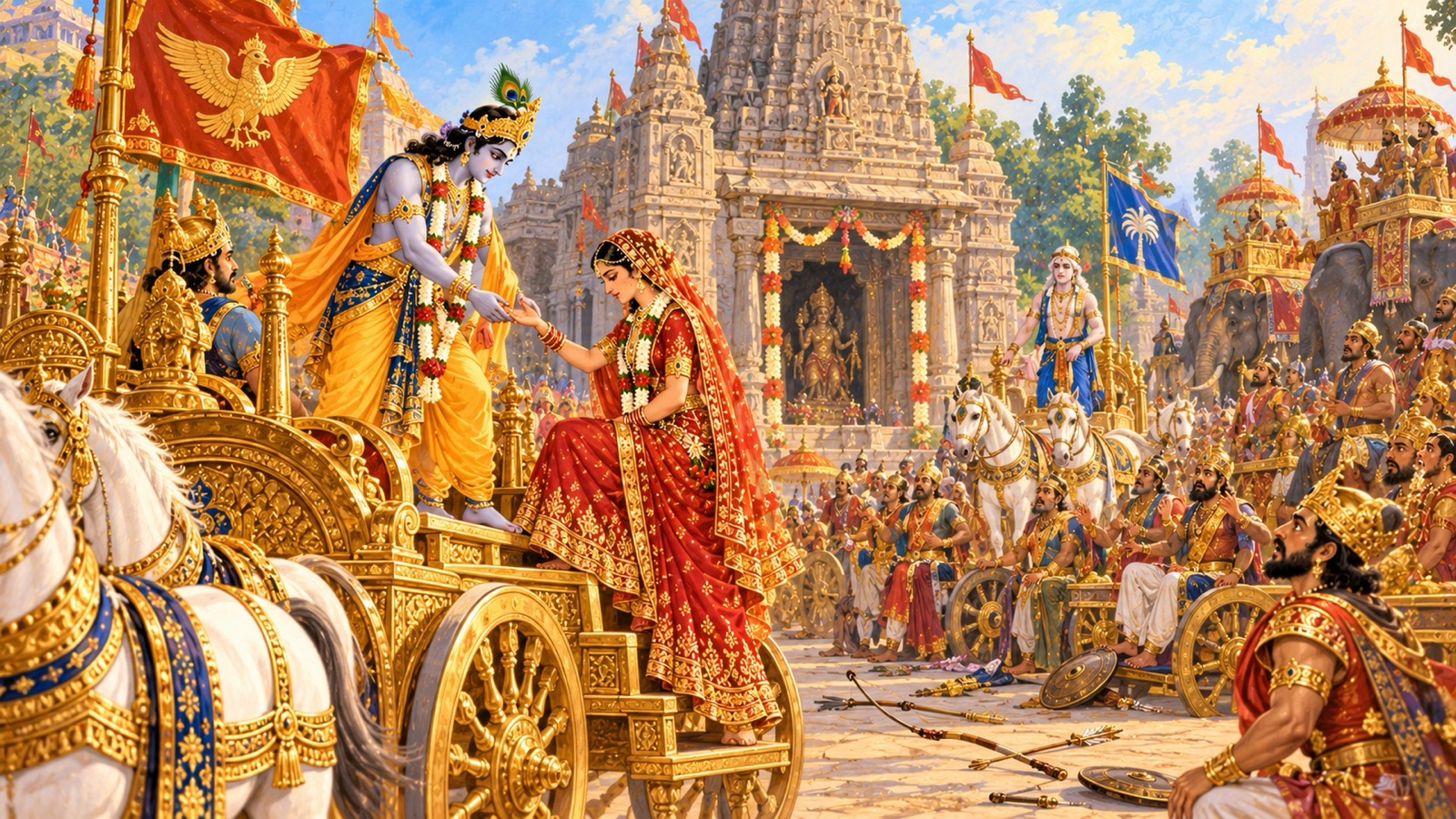
One night’s ride from Anarta to Vidarbha, and a princess who asked the Goddess for nothing but Krishna — the day the Lord came for Rukmini while a thousand kings looked on.
Om Namo Bhagavate Vasudevaya.
Om Namo Bhagavate Vasudevaya.
Om Namo Bhagavate Vasudevaya.
Welcome back to Srimad Bhagavatam Wisdom, our devotional journey through the sacred histories and teachings of the Srimad Bhagavat Mahapurana. In this fifty-third chapter of the Tenth Canto, Sukadeva Gosvami tells King Parikshit how Krishna answered Rukmini’s message and took her up into His chariot before Shishupala and his allies.
Chapter Information
- Scripture: Śrīmad Bhāgavata Mahāpurāṇa
- Canto: 10 (Book Ten, Latter Half)
- Chapter: 53 (Discourse 53)
- Chapter title: Krishna Kidnaps Rukmini (Rukmiṇī-haraṇa — the Lord carries away Rukmini)
- Principal speaker: Sukadeva Gosvami (narrating to King Parikshit)
- Principal listener: King Parikshit
- Main setting: Dwaraka, then Kuṇḍina, capital of Vidarbha, and the shrine of Goddess Ambika
- Central subject: Krishna’s journey to Kundina; the wedding preparations and hostile kings; Rukmini’s wait, her worship of Ambika, and the Lord carrying her away
- Principal verse range: Canto 10, Chapter 53, verses 1–57
- Primary edition: Gita Press Śrīmad Bhāgavata Mahāpurāṇa (English, Book Ten, Latter Half)
Context From the Previous Chapter
In Chapter 52, Rukmini, daughter of King Bhishmaka of Vidarbha, set her heart on Krishna after hearing of His glories. When her eldest brother Rukmi promised her instead to Shishupala, she secretly sent a trusted brahmana to Dwaraka asking the Lord to take her from the bridal procession to the Ambika temple.
The Lord Laughs and Gives His Word
When the brahmana had delivered Rukmini’s message, Krishna, the delight of the Yadus, laughed aloud, clasped the brahmana’s hand warmly in His own, and answered him. “My mind too is fixed on her,” He said, “and I get no sleep at night. I know that Rukmi, out of hatred for Me, has stopped our marriage.” Then the Lord declared what He would do.
तामानयिष्य उन्मथ्य राजन्यापसदान् मृधे ।
मत्परामनवद्याङ्गीमेधसोऽग्निशिखामिव ॥ ३ ॥
tām ānayiṣya unmathya rājanyāpasadān mṛdhe mat-parām anavadyāṅgīm edhaso ‘gni-śikhām iva
Meaning: Crushing those worthless kings in battle, I shall bring her here — she of faultless limbs, whose heart is fixed on Me — as one draws out a flame from firewood. (Canto 10, Chapter 53, verse 3)
One Night’s Ride to Vidarbha
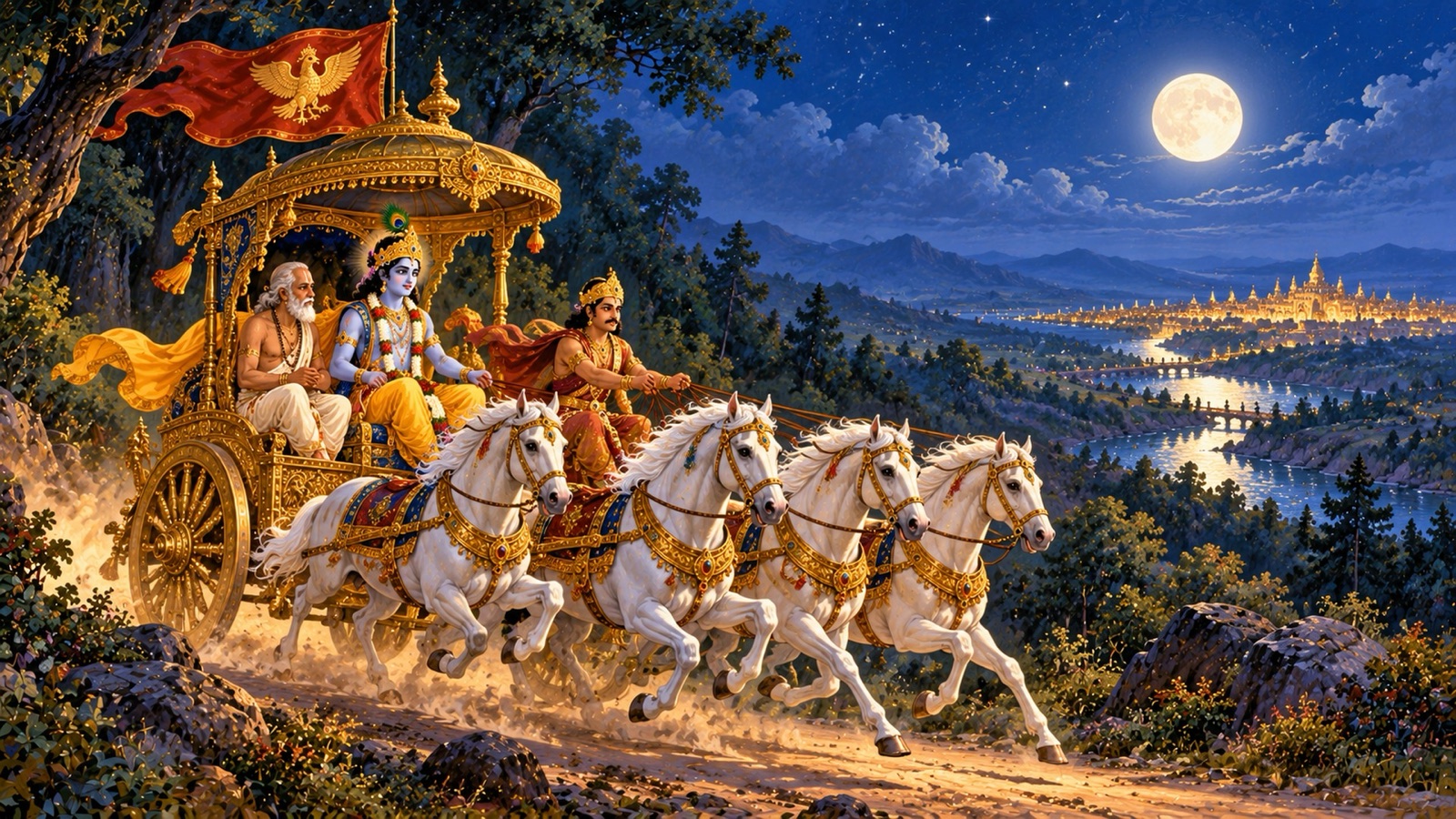
Having learned from the brahmana under which lunar asterism the wedding would be held, Krishna told His charioteer, “Daruka, yoke the chariot at once.” Daruka brought the chariot drawn by the four horses Shaibya, Sugriva, Meghapushpa and Balahaka, and stood before Him with folded palms. Krishna mounted, took the brahmana up beside Him, and with those swift horses covered the whole distance from Anarta to Vidarbha in a single night.
Kundina Prepares for a Wedding
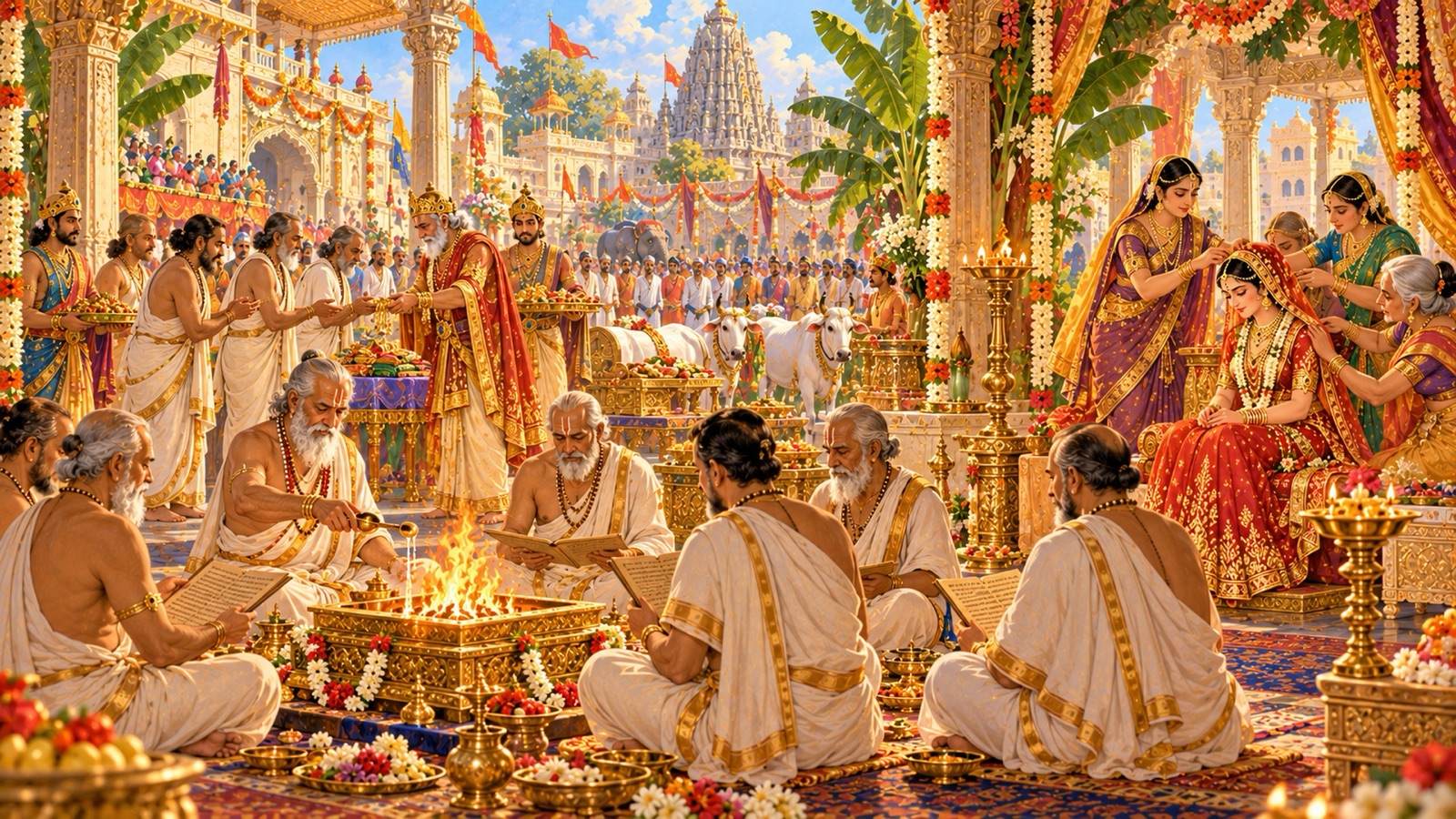
Meanwhile King Bhishmaka, yielding to his son’s wish out of affection, was going ahead with giving his daughter to Shishupala and had the preliminary rites performed. The streets of the city were swept and sprinkled, flags and ornamental arches raised, the mansions fragrant with aloe incense, and the citizens adorned with sandal-paste, garlands, white garments and jewels.
Bhishmaka worshipped the forefathers and the gods, fed the brahmanas, and had blessings recited for his daughter. Rukmini was bathed and adorned with the auspicious thread carrying a small piece of gold, new silken garments and fine ornaments. The foremost brahmanas protected the bride by chanting from the Sama, Rig and Yajur Vedas, while the family priest, learned in the Atharva Veda, poured oblations to pacify the planets. The king gave the brahmanas gold, silver, cloth, sesame mixed with jaggery, and cows.
King Damaghosha of Cedi likewise had every auspicious rite performed for his son Shishupala and marched on Kundina with elephants in rut, chariots hung with golden necklaces, and troops of foot-soldiers and horsemen. Bhishmaka went out to receive him with honour and lodged him in a mansion built for the bridegroom’s party.
The Kings Gather, and Balarama Follows
Shalva, Jarasandha, Dantavakra, Viduratha, Paundraka and other rulers hostile to Krishna and Balarama came to Kundina in their thousands on Shishupala’s side. They had agreed that if Krishna came with Balarama and the Yadus to carry off the bride, they would fight Him together, and each had brought his whole army.
Balarama heard of this alliance, and that Krishna had set out alone. Fearing a battle, and overcome with love for His brother, He hurried to Kundina with a great force of elephants, horses, chariots and infantry.
Rukmini’s Anxious Wait
In the inner apartments of the palace, Rukmini watched for Hari’s coming and saw no sign of the brahmana returning. The beautiful daughter of Bhishmaka began to reason with herself in fear.
अहो त्रियामान्तरित उद्वाहो मेऽल्पराधस: ।
नागच्छत्यरविन्दाक्षो नाहं वेद्म्यत्र कारणम् ।
सोऽपि नावर्ततेऽद्यापि मत्सन्देशहरो द्विज: ॥ २३ ॥
aho tri-yāmāntarita udvāho me ‘lpa-rādhasaḥ nāgacchaty aravindākṣo nāhaṁ vedmy atra kāraṇam so ‘pi nāvartate ‘dyāpi mat-sandeśa-haro dvijaḥ
Meaning: Alas! Only one night now stands between me and my wedding, and my merit is so small. The lotus-eyed Lord has not come, and I do not know the reason; and even the brahmana who carried my message has not returned. (Canto 10, Chapter 53, verse 23)
Perhaps, she thought, the faultless Lord had found something blameworthy in her and, though He had made ready to come, was not coming after all — and that was why the brahmana too was returning slowly, disheartened. Neither Brahma nor Shiva was favourable to her, she felt, nor Gauri, the daughter of the mountain, Shiva’s chaste consort. Her mind stolen by Govinda, the young princess closed her tear-filled eyes, for she knew that an auspicious hour was no time for weeping.
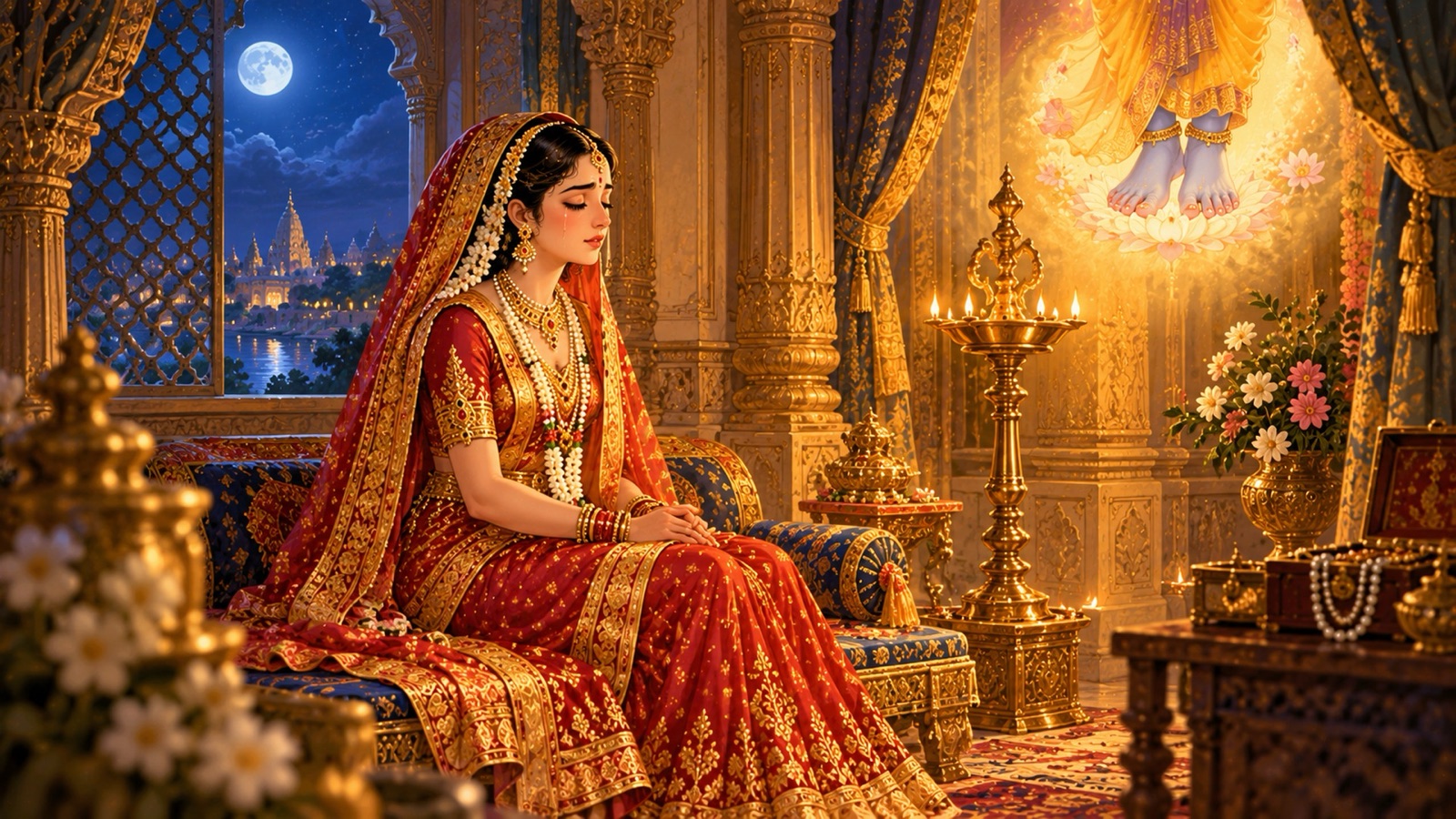
Even as she waited, her left thigh, left arm and left eye began to throb — signs that foretold something dear to her heart.
Sunanda Brings Word of the Lord
Then the brahmana, sent on by Krishna to announce Him, came to the inner palace and found the princess radiant. Reading the joy in his face and the sureness of his step, Rukmini smiled and questioned him. He told her that Krishna had come, and conveyed the Lord’s firm promise to take her away as His bride. Her heart overflowed; and finding nothing fit to reward such a messenger, she bowed to him.
Kundina Welcomes Krishna and Balarama
When Bhishmaka learned that Balarama and Krishna had arrived to witness the wedding, he went out to receive Them with music and articles of worship. He offered Them madhuparka, fresh garments and gifts, honoured Them with the full ritual of welcome, and lodged Them with Their troops in a residence furnished with every comfort. He extended hospitality to all the assembled kings as well, according to the prowess, age, strength and wealth of each.
Hearing that Krishna had come, the people of Kundina went out to see Him.
कृष्णमागतमाकर्ण्य विदर्भपुरवासिन: ।
आगत्य नेत्राञ्जलिभि: पपुस्तन्मुखपङ्कजम् ॥ ३६ ॥
kṛṣṇam āgatam ākarṇya vidarbha-pura-vāsinaḥ āgatya netrāñjalibhiḥ papus tan-mukha-paṅkajam
Meaning: Hearing that Krishna had come, the people of the Vidarbha capital came out and drank the lotus of His face with the cupped palms of their eyes. (Canto 10, Chapter 53, verse 36)
“Rukmini alone deserves to be his wife,” they said to one another, “and he alone, of faultless form, is the fitting husband for the daughter of Bhishmaka. May the Maker of the three worlds be pleased with whatever little merit we have earned, and grant that Acyuta, and no one else, take the hand of the princess of Vidarbha.” So spoke the citizens, bound to Rukmini by deep affection.
The Procession to the Shrine of Ambika
Then the bride, guarded by soldiers, came out of the inner palace and drove to the temple of Goddess Ambika. At its gate she stepped down and went on foot to behold the tender feet of Bhavani.
पद्भ्यां विनिर्ययौ द्रष्टुं भवान्या: पादपल्लवम् ।
सा चानुध्यायती सम्यङ्मुकुन्दचरणाम्बुजम् ॥ ४० ॥
padbhyāṁ viniryayau draṣṭuṁ bhavānyāḥ pāda-pallavam sā cānudhyāyatī samyaṅ mukunda-caraṇāmbujam
Meaning: She went forth on foot to see the tender feet of Bhavani, all the while meditating fully upon the lotus feet of Mukunda. (Canto 10, Chapter 53, verse 40)
She kept a vow of silence as she walked, her mother and the elder ladies beside her, her companions around her, and the king’s bravest soldiers guarding her in armour with weapons raised. Drums, conches, tabors and trumpets sounded. Thousands of dancing women with offerings, brahmana wives adorned with garlands and jewels, singers and musicians, and the Sutas, Magadhas and Vandis who sang her praises, all moved with the bride.
Rukmini’s Prayer Before the Goddess
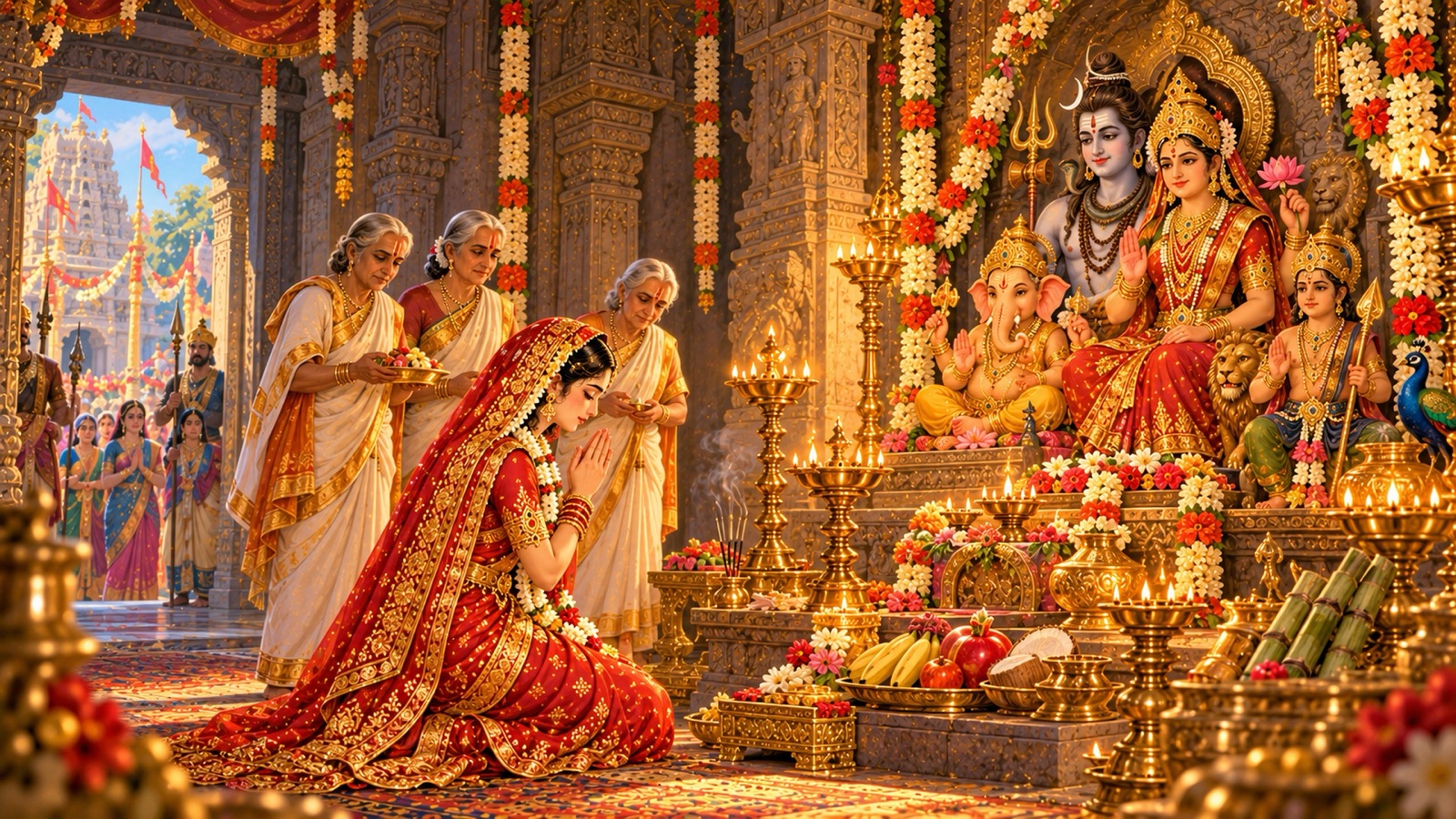
Reaching the sanctuary, Rukmini washed her lotus hands and feet, sipped water, and, pure and tranquil, entered the presence of Ambika. The elderly brahmana ladies who knew the rite led her in bowing to Bhavani together with Bhava, Lord Shiva; and the princess prayed.
नमस्ये त्वाम्बिकेऽभीक्ष्णं स्वसन्तानयुतां शिवाम् ।
भूयात् पतिर्मे भगवान् कृष्णस्तदनुमोदताम् ॥ ४६ ॥
namasye tvāmbike ‘bhīkṣṇaṁ sva-santāna-yutāṁ śivām bhūyāt patir me bhagavān kṛṣṇas tad anumodatām
Meaning: O Ambika, auspicious Mother, together with your children I bow to you again and again. May Lord Krishna become my husband; may you grant this. (Canto 10, Chapter 53, verse 46)
She then worshipped the Goddess and Her divine family with water, sandal-paste, unbroken rice, incense, garments, garlands, ornaments, food offerings and rows of lamps, and honoured the brahmana ladies whose husbands were living with the same articles, adding savoury cakes, betel, neck-threads, fruits and sugarcane. They gave her a share of the Goddess’s offerings with their blessings. Rukmini bowed to them and to the Goddess, accepted the remnants, and, ending her silence, came out of the shrine holding a maidservant by the hand — her own hand bright with jewelled rings.
The Lion Takes His Own
As she emerged, the gathered heroes beheld her — her face graced with earrings, her bright smile, her swan-like gait, her anklets chiming — and were bewildered, as though by the Lord’s own enchanting Maya. Captivated by her gentle smile and bashful glances, the kings let their weapons slip and fell stupefied from their elephants, chariots and horses. Yet under the pretext of this procession she was offering her beauty to Hari alone. Moving her lotus-bud feet slowly, watching for the Lord, she brushed back her locks with her left hand, glanced shyly at the kings — and saw Acyuta.
तां राजकन्यां रथमारुरुक्षतीं जहार कृष्णो द्विषतां समीक्षताम् ।
रथं समारोप्य सुपर्णलक्षणं राजन्यचक्रं परिभूय माधव: ॥ ५५ ॥
ततो ययौ रामपुरोगम: शनै: शृगालमध्यादिव भागहृद्धरि: ॥ ५६ ॥
tāṁ rāja-kanyāṁ ratham ārurukṣatīṁ jahāra kṛṣṇo dviṣatāṁ samīkṣatām rathaṁ samāropya suparṇa-lakṣaṇaṁ rājanya-cakraṁ paribhūya mādhavaḥ tato yayau rāma-purogamaḥ śanaiḥ śṛgāla-madhyād iva bhāga-hṛd dhariḥ
Meaning: Even as the princess was about to mount her chariot, Krishna took her away while His enemies looked on. Seating her in His chariot marked with the emblem of Garuda, and scorning the whole circle of kings, Madhava then departed slowly, Balarama at the head, like a lion carrying off its share from the midst of jackals. (Canto 10, Chapter 53, verses 55–56)
The proud kings, Jarasandha foremost among them, could not bear this defeat and the ruin of their fame. “Fie upon us,” they said to one another in verse 57; “though we stood with bows in hand, our glory has been carried off by cowherds, as the glory of lions is taken by deer.”
Principal Teachings of This Chapter
1. The Lord answers longing with longing. Rukmini had written that her mind was set on Him; in verse 2 the Lord replies that His mind too is fixed on her and He cannot sleep. The soul’s yearning for Krishna is more than met by His yearning for the soul.
2. What belongs to Him cannot be held back. The Lord calls Rukmini mat-parām, one devoted to Him, and promises to draw her out as a flame is drawn from wood. Rukmi’s scheming and Jarasandha’s alliance are the wood; they cannot keep the flame.
3. Faith can tremble and still be faith. Rukmini’s night of doubt is recorded without reproach; her refusal to weep at an auspicious hour and her unbroken meditation on Mukunda’s feet carry her through.
4. Full worship, one prayer. In Ambika’s shrine Rukmini performs the whole rite with care, yet asks for a single thing: that Krishna be her husband. Honour the entire divine family; keep one desire at the centre.
5. The Lord’s design beneath the story. Why does Krishna, who could simply have willed the outcome, ride alone through the night, accept Bhishmaka’s madhuparka and lift Rukmini in front of every hostile king? The hint in verse 31 is that Rukmini is Lakshmi Herself; the Lord is reclaiming His eternal consort, and He does it openly so that the kings, the citizens and every later listener would see that whoever gives herself wholly to Him is taken into His chariot in the sight of the world.
A Devotional Reflection
There is a particular tenderness in this chapter for anyone who has ever waited on God. Rukmini has done everything right: she chose the Lord, sent her message, trusted the brahmana. Still the night before her wedding finds her alone, inventing reasons why He might not come. We know what she does not — that He laughed when He heard her letter, that He could not sleep, that His horses were already eating the road to Vidarbha. The distance between her fear and His eagerness is the distance every devotee stands in during a dark hour, and the chapter does not scold her for it. May we learn her way of waiting: keep the silence, keep the meditation, keep walking to the temple, and trust that the One we long for is already on the road.
A Daily Devotional Practice
Today, bring one unanswered prayer before the Lord as Rukmini brought hers to Ambika: perform your ordinary worship fully and without hurry, then ask for the single thing your heart most wants, in one sentence, and leave it there. Whenever anxiety returns, remember the brahmana’s message — the Lord has come and has given His word — and chant: Om Namo Bhagavate Vasudevaya.
Conclusion
The fifty-third chapter of the Tenth Canto carries Rukmini’s letter to its answer. Krishna’s laughter in Dwaraka becomes a night ride to Kundina; the bride’s doubt gives way to good news; her prayer to Ambika is heard; and the Lord, unhurried and unopposed, lifts her into His Garuda-bannered chariot while Jarasandha’s alliance looks on. One truth binds it all: the heart that fixes itself on Krishna is already His, and nothing can keep Him from claiming it.
May the divine wisdom of Srimad Bhagavatam awaken pure devotion within our hearts.
Om Namo Bhagavate Vasudevaya.
Jay Shree Madhav.
References and Attribution
- Primary edition: Gita Press, Śrīmad Bhāgavata Mahāpurāṇa (English), Book Ten (Latter Half), Discourse 53.
- Series: Srimad Bhagavatam Wisdom · Biswa Sanatan Dharma Seva Trust.
- Presented following the spiritual guidance and recommendation of Pandit Dr. Shri Kashinath Mishra.
This is an original, faithful retelling in the writer’s own words, with brief quoted verses shown in Devanāgarī and transliteration and their meanings given as summaries. It is not a reproduction of any single publisher’s continuous translation or commentary. No affiliation with or endorsement by any publisher is implied.
Jay Shree Madhav