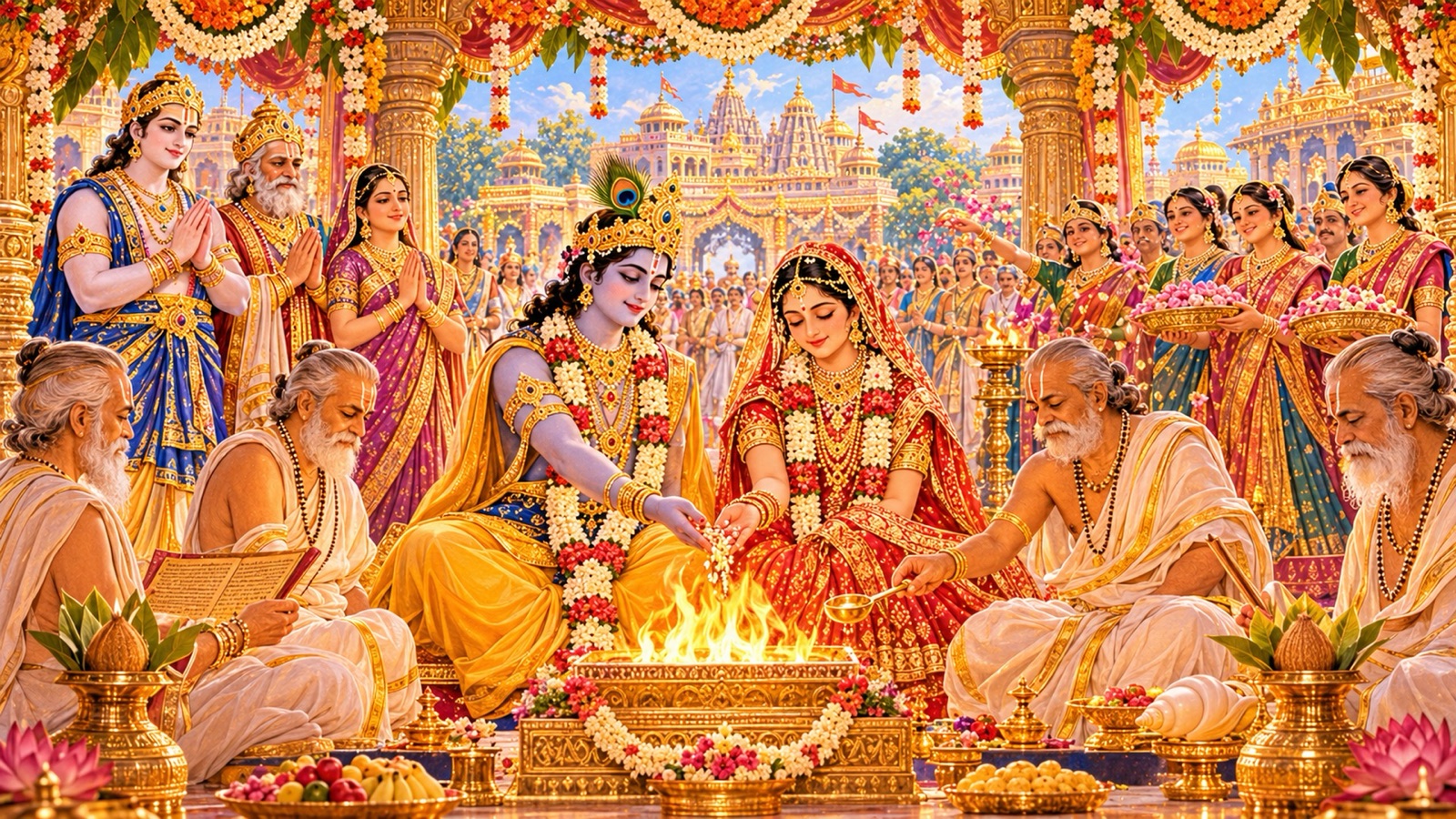
A brother’s sword is broken and his life spared at a sister’s prayer, and Dvaraka blazes with lamps as Krishna takes the hand of Rukmini, who is Lakshmi herself.
Om Namo Bhagavate Vasudevaya.
Om Namo Bhagavate Vasudevaya.
Om Namo Bhagavate Vasudevaya.
Welcome back to Srimad Bhagavatam Wisdom, our devotional journey through the sacred histories and teachings of the Srimad Bhagavat Mahapurana. In this fifty-fourth chapter of the Tenth Canto, Sukadeva Gosvami carries King Parikshit from the dust of pursuit to the festival of a wedding.
Chapter Information
- Scripture: Śrīmad Bhāgavata Mahāpurāṇa
- Canto: 10 (Book Ten, Latter Half)
- Chapter: 54 (Discourse 54)
- Chapter title: The Marriage of Krishna and Rukmini
- Principal speaker: Sukadeva Gosvami (narrating to King Parikshit)
- Principal listener: King Parikshit
- Main setting: The road from Kundinapura in Vidarbha, and then the city of Dvaraka
- Central subject: The rout of the pursuing kings; Rukmi’s challenge and disgrace; Rukmini’s plea and Balarama’s counsel; the wedding in Dvaraka
- Principal verse range: Canto 10, Chapter 54, verses 1–60
- Primary edition: Gita Press Śrīmad Bhāgavata Mahāpurāṇa (English, Book Ten)
Context From the Previous Chapter
In Chapter 53, Krishna rode to Kundinapura on the eve of Rukmini’s forced marriage to Shishupala. As the princess returned from worshipping Goddess Ambika, the Lord lifted her onto His chariot before every assembled king and drove away, while the kings cried out that their honour had been snatched by mere cowherds.
The Kings Give Chase
Burning with rage, all those kings mounted their horses, elephants and chariots, each with his own troops, and rode after Krishna in full armour with bows in hand. The famed generals of the Yadava army turned and stood facing them, O king, twanging their bowstrings, and the enemy loosed volleys of arrows upon the Yadus like clouds pouring rain upon a mountain.
Rukmini saw her Lord’s army hidden beneath that storm of shafts, and with eyes bewildered by fear she looked up shyly into His face. The Lord laughed aloud and reassured her.
प्रहस्य भगवानाह मा स्म भैर्वामलोचने ।
विनङ्क्ष्यत्यधुनैवैतत् तावकैः शात्रवं बलम् ॥ ५ ॥
prahasya bhagavān āha mā sma bhair vāma-locane vinaṅkṣyaty adhunaivaitat tāvakaiḥ śātravaṁ balam
Meaning: Laughing, the Lord said: Do not be afraid, O fair-eyed one. This army of the enemy is about to be destroyed this very moment by your own troops. (Canto 10, Chapter 54, verse 5)
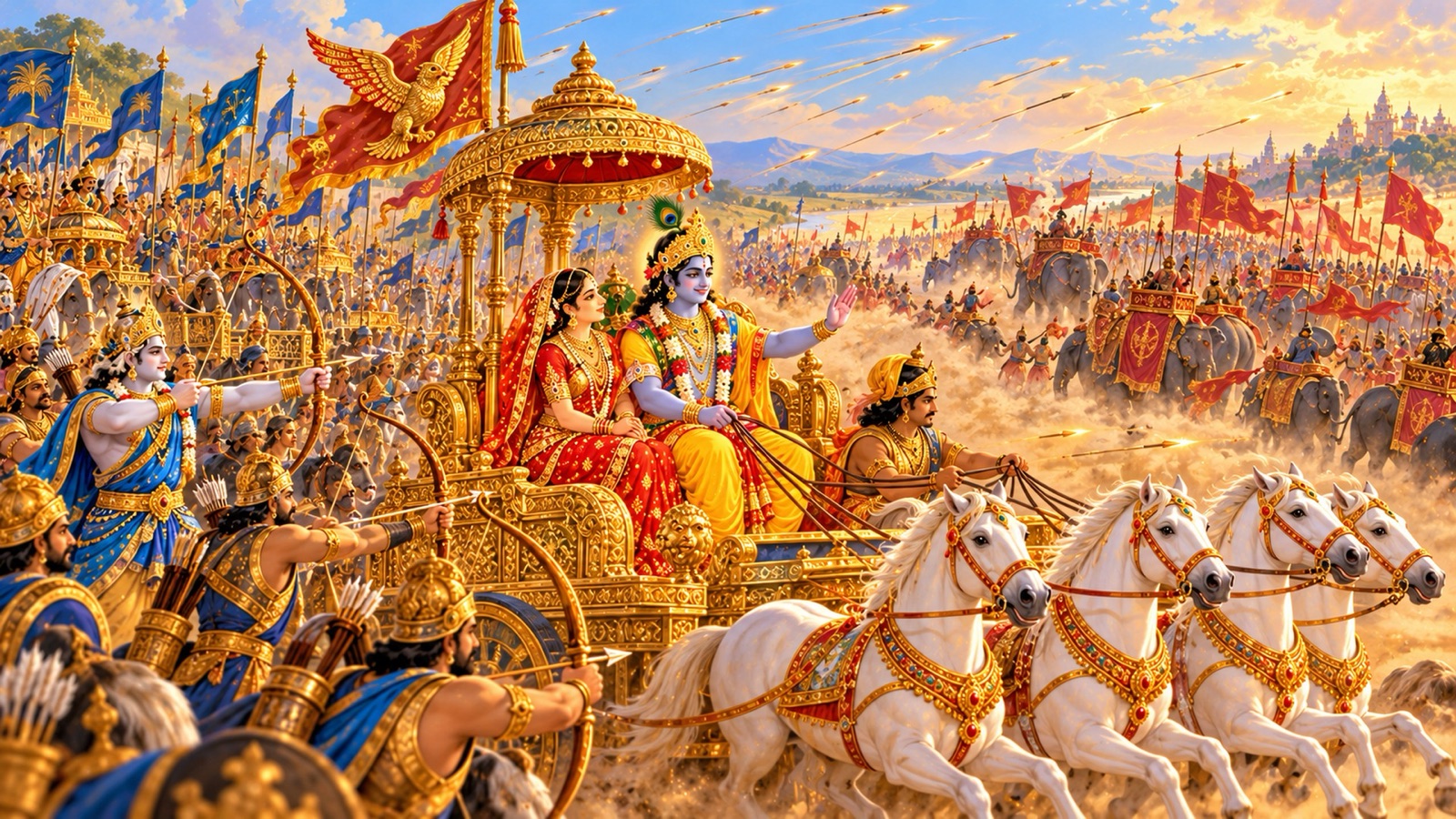
Unable to bear the enemy’s show of strength, Gada, Sankarshana and the other Yadu heroes struck back with iron-tipped arrows at the horses, elephants and chariots of the hostile host. Heads adorned with earrings, crowns and turbans, arms still gripping their weapons, and the limbs of warriors and mounts fell to the earth in tens of millions. Their armies thus broken by the Vrishnis, the kings led by Jarasandha turned their backs and left the field.
Jarasandha Consoles Shishupala
Shishupala stood as though his own wedded wife had been stolen; his face had lost its colour and his spirit its strength. Jarasandha and the others came to him and spoke. “O tiger among men, shake off this despondency. Joy and sorrow never stay for long in any embodied being. As a wooden puppet dances at the will of the showman, so does this creature strive and reap joy and sorrow under the will of Providence.”
Seventeen times, Jarasandha said, he had marched against Krishna with twenty-three akshauhinis, and seventeen times he had been defeated; only once had he won. Yet he neither grieved nor exulted, knowing the world to be driven by time joined with destiny. “This time too we, who command the commanders of armies, have been beaten by the Yadus, protected by Krishna with so small a force. Time favoured them now; when it turns, we shall prevail.” So comforted, Shishupala returned to his capital with his surviving followers, and the other surviving kings went each to his own city.
Rukmi’s Vow and His Challenge
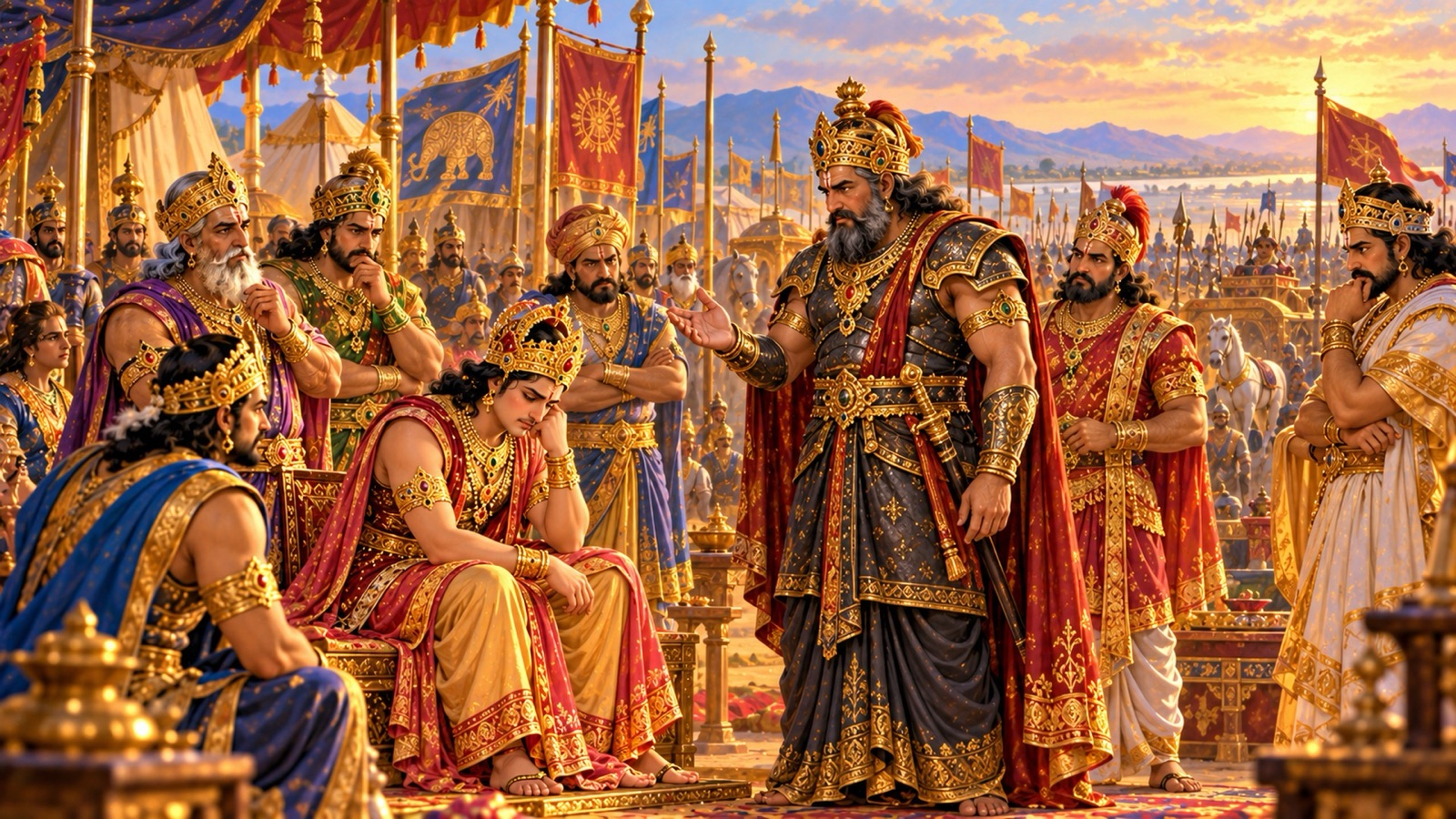
But the mighty Rukmi, who hated Krishna and could not endure that his sister had been taken in the manner of the Rakshasas, followed close behind with a full akshauhini. Seething with indignation, he had sworn before all the kings: “Without slaying Krishna in battle and bringing back Rukmini, I shall not re-enter Kundinapura.” He ordered his charioteer to drive wherever Krishna might be, boasting that his arrows would strip the pride from the wicked cowherd who had carried off his sister.
The braggart, ignorant of the greatness of the almighty Lord, came up in a single chariot shouting, “Stop! Stop!” He struck Krishna with three arrows and cried, “Wait, you disgrace of the Yadu race! You have stolen my sister as a crow steals a sacrificial offering — where will you go? Leave my sister, you deceitful fighter, before my arrows lay you in the dust.”
Smiling, Krishna shattered his bow and pierced Rukmi with six shafts, his four horses with eight, his charioteer with two and his banner with three. Rukmi seized another bow and struck the Lord with five arrows; the imperishable Lord broke that bow, and the next, and split every weapon Rukmi lifted — club, spear, pike, sword and shield, javelin and bludgeon. At last Rukmi leaped from his chariot, sword in hand, and rushed at Krishna to kill Him, as a moth flies into a flame. The Lord cut that sword and shield to pieces with His shafts and took up a keen-edged sword of His own to finish him.
Rukmini Pleads for Her Brother
Seeing her Lord ready to end her brother’s life, the virtuous Rukmini, overwhelmed with fear, fell at the feet of her Husband and prayed in piteous words.
योगेश्वराप्रमेयात्मन् देवदेव जगत्पते ।
हन्तुं नार्हसि कल्याण भ्रातरं मे महाभुज ॥ ३३ ॥
yogeśvarāprameyātman deva-deva jagat-pate hantuṁ nārhasi kalyāṇa bhrātaraṁ me mahā-bhuja
Meaning: O Master of Yoga, O Lord whose Self is beyond measure, O God of gods, O Lord of the universe, O all-auspicious and mighty-armed One, You ought not to kill my brother. (Canto 10, Chapter 54, verse 33)
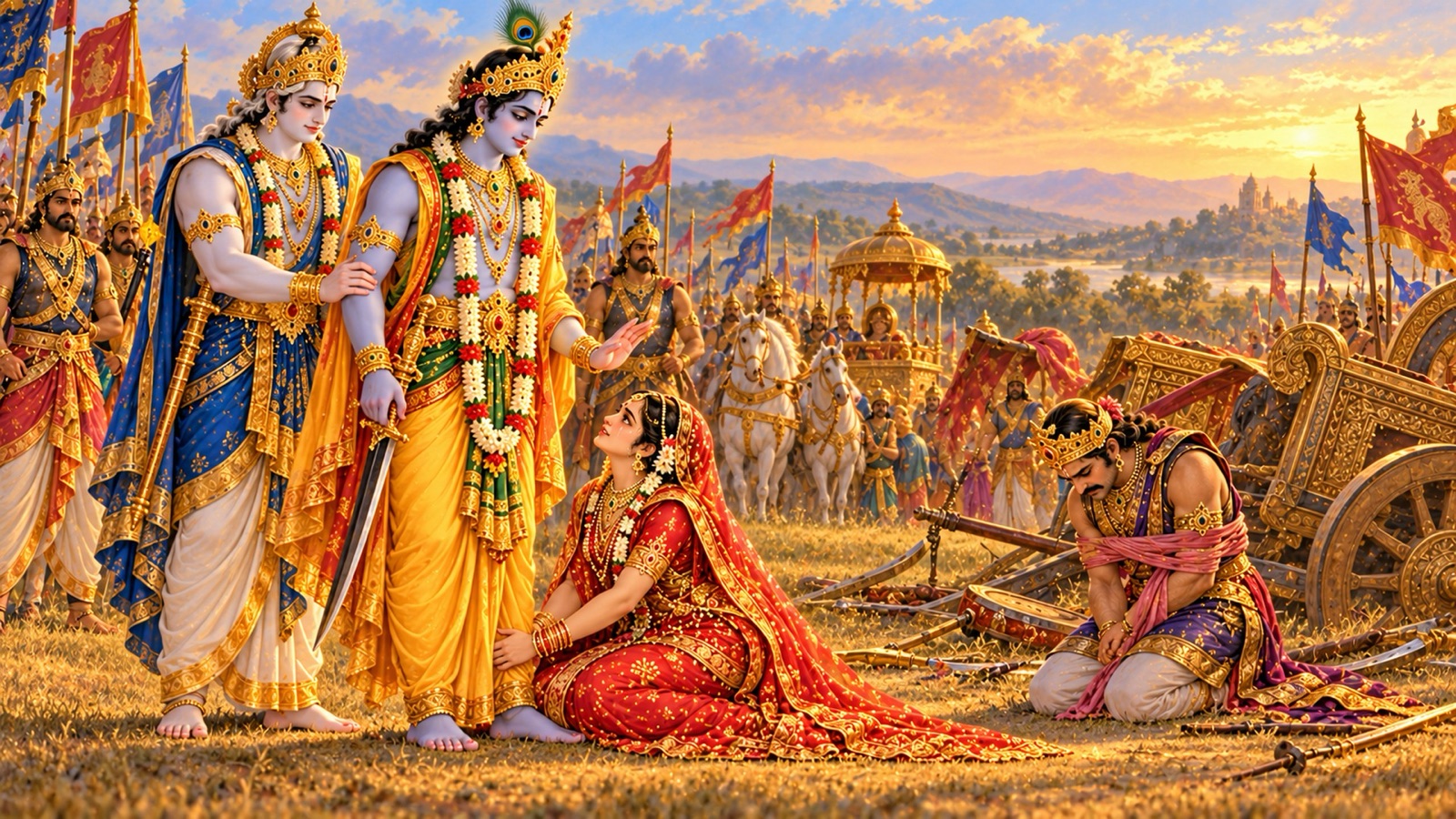
Her limbs trembled with terror, her throat was choked with grief, and her golden necklace had slipped from its place. With His feet clasped by such a one, the merciful Lord desisted. Yet the evil-doer did not go unpunished: Krishna bound Rukmi with his own scarf and, with the blade of His sword, shaved away part of his moustache and locks, leaving him disfigured. Meanwhile the chosen Yadu warriors crushed Rukmi’s army as elephants trample a bed of lotuses.
Balarama’s Counsel
When the Yadu heroes came into Krishna’s presence they found Rukmi in that humiliating state, all but dead with shame. Moved to pity at the sight of him bound, the almighty Sankarshana released him and turned to Krishna: “You have done an impious thing, abhorred by our family. To shave off a kinsman’s moustache and hair and so disfigure him is as good as killing him.”
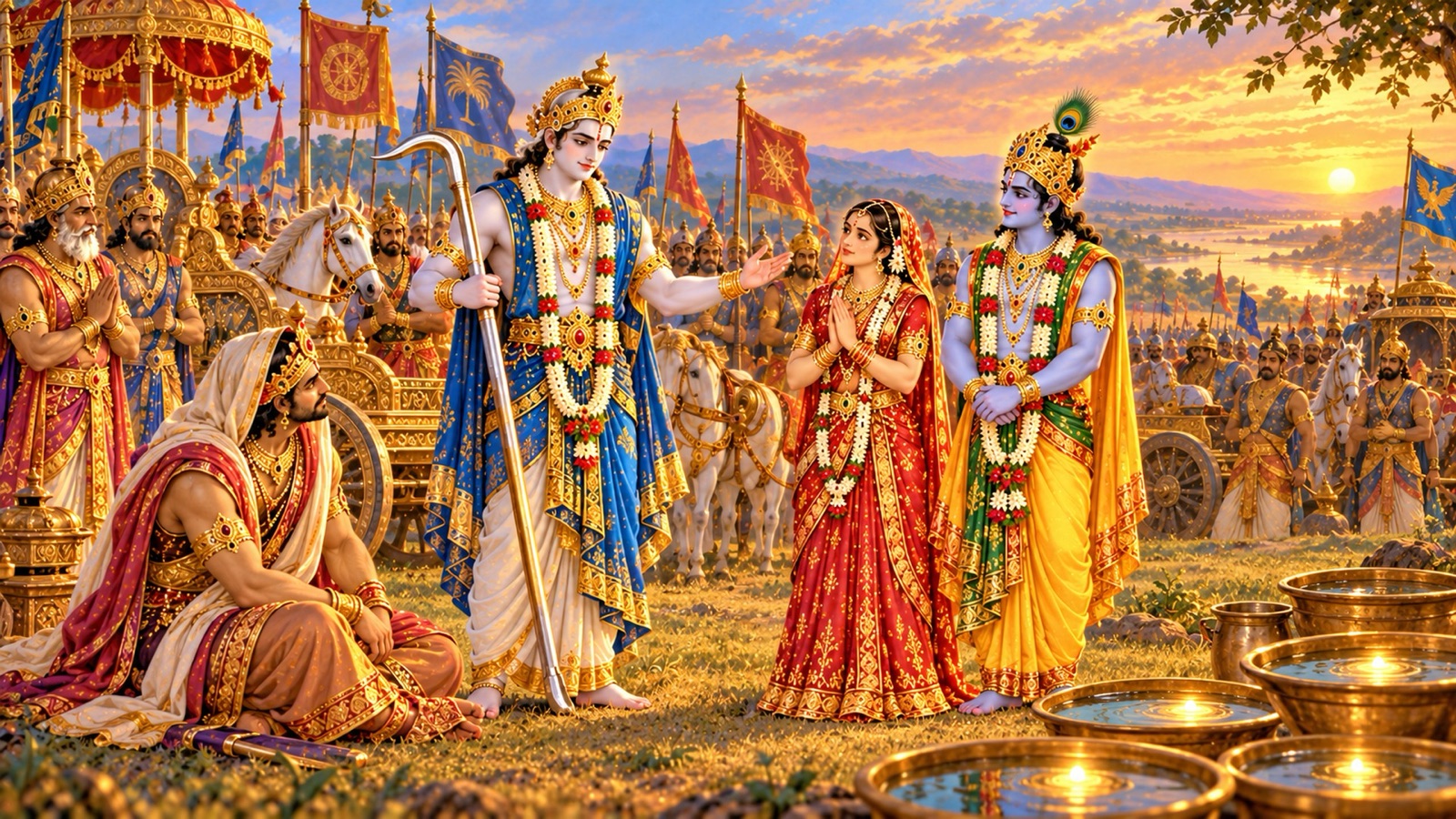
Then He turned gently to Rukmini.
मैवास्मान् साध्व्यसूयेथा भ्रातुर्वैरूप्यचिन्तया ।
सुखदुःखदो न चान्योऽस्ति यतः स्वकृतभुक् पुमान् ॥ ३८ ॥
maivāsmān sādhvy asūyethā bhrātur vairūpya-cintayā sukha-duḥkha-do na cānyo ‘sti yataḥ sva-kṛta-bhuk pumān
Meaning: O virtuous lady, do not bear ill-will toward us on account of your brother’s disfigurement. No one else is the giver of a person’s joy and sorrow, for a man reaps the fruit of his own deeds. (Canto 10, Chapter 54, verse 38)
A kinsman, Balarama went on, does not deserve death at a kinsman’s hands even when his offence deserves it; he should be let go, for why kill again one already slain by his own fault? Such is the code Brahma laid down for the Kshatriya race, so harsh that under it a brother may slay a brother. Those blinded by pride of fortune insult their own relatives for the sake of kingdom, land, wealth, women or honour. And it is a divided outlook, He told Rukmini, that makes one wish harm to the hostile and good to the kind, as the ignorant do.
आत्ममोहो नृणामेव कल्पते देवमायया ।
सुहृद् दुर्हृदुदासीन इति देहात्ममानिनाम् ॥ ४३ ॥
ātma-moho nṛṇām eva kalpate deva-māyayā suhṛd durhṛd udāsīna iti dehātma-māninām
Meaning: By the Lord’s Maya this self-delusion arises in the minds of those who take the body to be the self — that this one is a friend, that one an enemy, and a third a stranger. (Canto 10, Chapter 54, verse 43)
The one supreme Self dwells alike in all embodied beings, He continued, yet the foolish see it as many, as one sun seems many when reflected in many vessels of water, or as the one sky seems divided by the jars that enclose it. This body of elements, senses and their objects has a beginning and an end; imposed upon the Self by ignorance, it drags the soul through birth after birth, though the Self neither joins nor parts from anything, just as the sun neither joins nor parts from the eye and the colours it reveals. Birth and its changes belong to the body alone, as waxing and waning belong to the moon’s phases and never to the moon; and the body’s death is wrongly laid upon the soul, as the dark night is called the moon’s disappearance. As a dreamer experiences what is not real, so the ignorant soul wanders through transmigration. “Therefore,” He concluded, “O lady of the pure smile, cast off by knowledge of the truth this grief born of ignorance, which withers and bewilders the heart, and be at peace.”
Comforted by Lord Balarama, the slender bride let go of her sorrow and steadied her mind.
Rukmi Builds Bhojakata
Rukmi had escaped with nothing but his life. His army and glory were shattered, his hopes undone, and his disfigurement gnawed at him. Bound by his oath never to re-enter Kundinapura without killing Krishna and recovering his sister, he built a great city called Bhojakata and lived there in resentment.
The Wedding in Dvaraka
Having thus routed the hostile kings, the Lord brought Rukmini, the daughter of Bhishmaka, to Dvaraka and married her with full ceremony, O jewel of the Kurus. Every house of that city, whose people held Krishna as their one beloved, kept festival. Men and women, radiant with joy and wearing earrings of polished gems, came bearing gifts for the bride and Bridegroom in their splendid wedding attire.
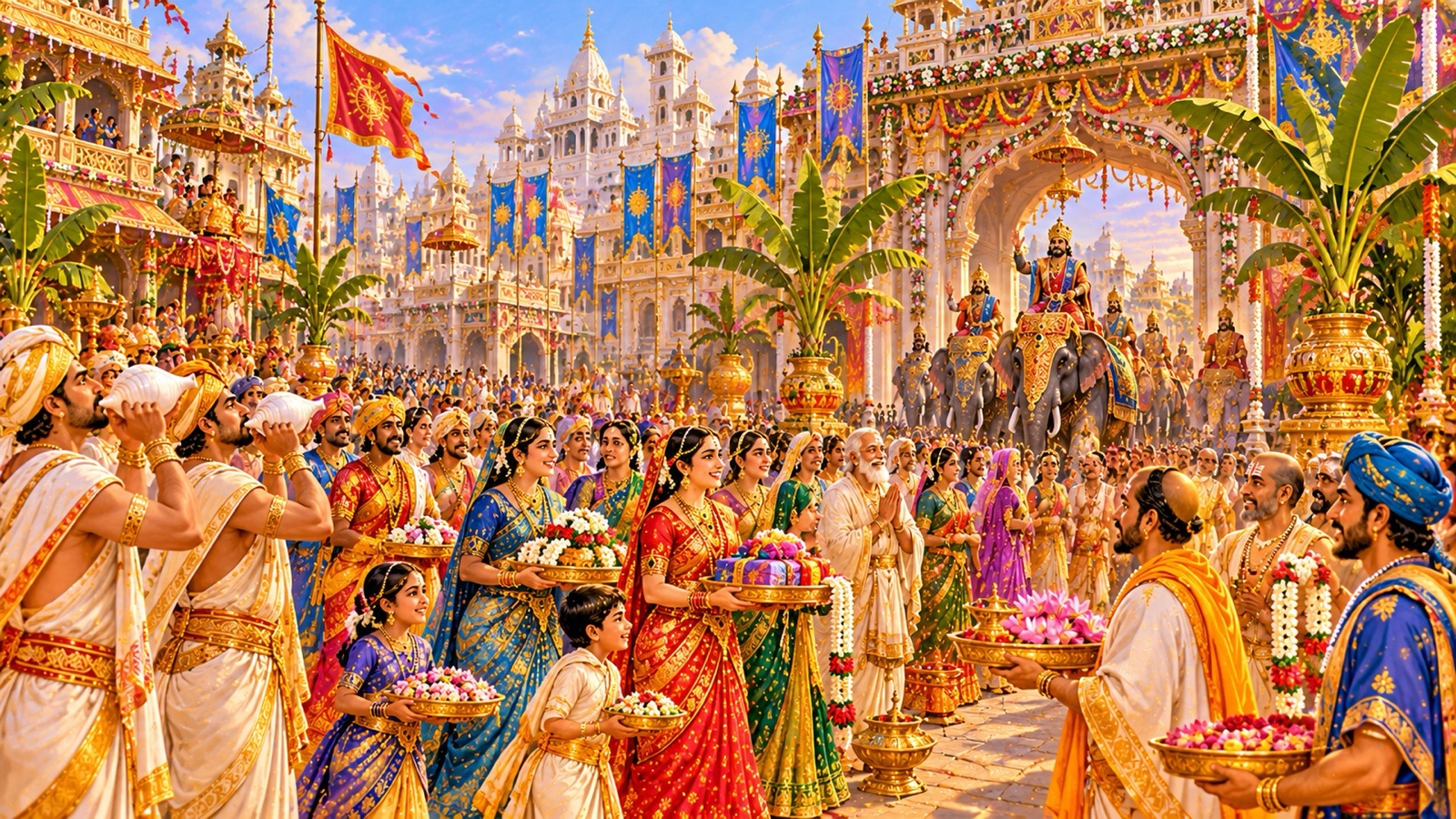
The city of the Vrishnis was adorned with flags raised in honour of Indra, with garlands, tapestries and jewelled archways, with auspicious offerings and water-filled pitchers at every door, with aloe-wood incense and rows of lamps. Its roads were wet with the ichor of the invited kings’ elephants, and tall plantain and areca trees stood at the gateways. The Kurus, Srinjayas, Kaikeyas, Vidarbhas, Yadus and Kuntis rejoiced to meet one another, and the gathered princes and princesses marvelled to hear the story of Rukmini’s abduction sung on every side.
द्वारकायामभूद् राजन् महामोदः पुरौकसाम् ।
रुक्मिण्या रमयोपेतं दृष्ट्वा कृष्णं श्रियः पतिम् ॥ ६० ॥
dvārakāyām abhūd rājan mahā-modaḥ puraukasām rukmiṇyā ramayopetaṁ dṛṣṭvā kṛṣṇaṁ śriyaḥ patim
Meaning: O king, great was the joy of the citizens of Dvaraka when they beheld Krishna, the Lord of Sri, united with Rukmini, who is Rama, the Goddess of Fortune herself. (Canto 10, Chapter 54, verse 60)
Principal Teachings of This Chapter
1. Fear dissolves in the Lord’s laughter. When Rukmini looks up in dread at the rain of arrows, Krishna laughs and promises in verse 5 that the enemy will vanish at once. No hostile power lastingly threatens the soul on His chariot.
2. Joy and sorrow come by Providence. Jarasandha’s image of the puppet, though spoken by the Lord’s enemy, is true: the embodied being reaps happiness and distress under a higher control, and equanimity is wisdom.
3. The Lord bends to the prayer of His devotee. Krishna, sword in hand, is halted by nothing but Rukmini’s trembling appeal in verse 33; mercy to the one who clasps His feet outweighs the offender’s guilt.
4. Each reaps his own deeds; kin are not to be slain by kin. Balarama’s words in verse 38 lay Rukmi’s shame on Rukmi’s own conduct, and a relative is to be released, not killed.
5. Friend, enemy and stranger are labels of Maya. The heart of the chapter is Balarama’s teaching in verse 43: one Self shines in every body like one sun in many vessels, and grief arises only when ignorance mistakes the body for the self.
The chapter’s deepest point is that the Lord arranged this whole ordeal as a teaching for His bride. Krishna raised the sword so that Rukmini’s compassion for an enemy might be revealed, and He let Balarama speak so that she, and every hearer, might learn that no one but ourselves gives us joy or sorrow, and that kinship and enmity alike are costumes worn by the one Self. When the closing verse names Rukmini as Rama, the Goddess of Fortune, the whole chapter stands unveiled as the eternal union of the Lord with His own consort.
A Devotional Reflection
What stays with me is the contrast between two kinds of counsel offered to two grieving people. Jarasandha consoles Shishupala with the philosophy of the puppet: fortune turns, time will favour us, we shall win next time. It is worldly wisdom, but it leaves Shishupala nursing his hope of revenge. Balarama consoles Rukmini with something altogether different. He does not promise her a better turn of fortune; He tells her who she really is, and that the shame she feels belongs to a body that was never the Self. And the Lord who shatters every weapon raised against Him is held fast by a single sincere plea, and is glad to be held.
A Daily Devotional Practice
Today, whenever someone’s words or conduct wound you, recall Balarama’s teaching that friend, enemy and stranger are distinctions drawn by Maya upon the one Self. Instead of replying from that division, silently offer the person to the Lord as Rukmini offered her brother, asking Him to spare and to bless. Then chant gently: Om Namo Bhagavate Vasudevaya.
Conclusion
The fifty-fourth chapter of the Tenth Canto brings the carrying away of Rukmini to its fulfilment. The pursuing kings are driven back, and Rukmi, who swore to kill Krishna, is left bound and shorn, alive only because his sister prayed for him. Balarama’s teaching on the one Self turns the bride’s grief into peace, and Dvaraka pours out its joy as the Lord of Fortune and Fortune herself are joined in marriage. May we learn from Rukmini to plead for mercy even for those who oppose us, and from Balarama to see the one Lord in every being.
May the divine wisdom of Srimad Bhagavatam awaken pure devotion within our hearts.
Om Namo Bhagavate Vasudevaya.
Jay Shree Madhav.
References and Attribution
- Primary edition: Gita Press, Śrīmad Bhāgavata Mahāpurāṇa (English), Book Ten (Latter Half), Discourse 54.
- Series: Srimad Bhagavatam Wisdom · Biswa Sanatan Dharma Seva Trust.
- Presented following the spiritual guidance and recommendation of Pandit Dr. Shri Kashinath Mishra.
This is an original, faithful retelling in the writer’s own words, with brief quoted verses shown in Devanāgarī and transliteration and their meanings given as summaries. It is not a reproduction of any single publisher’s continuous translation or commentary. No affiliation with or endorsement by any publisher is implied.
Jay Shree Madhav