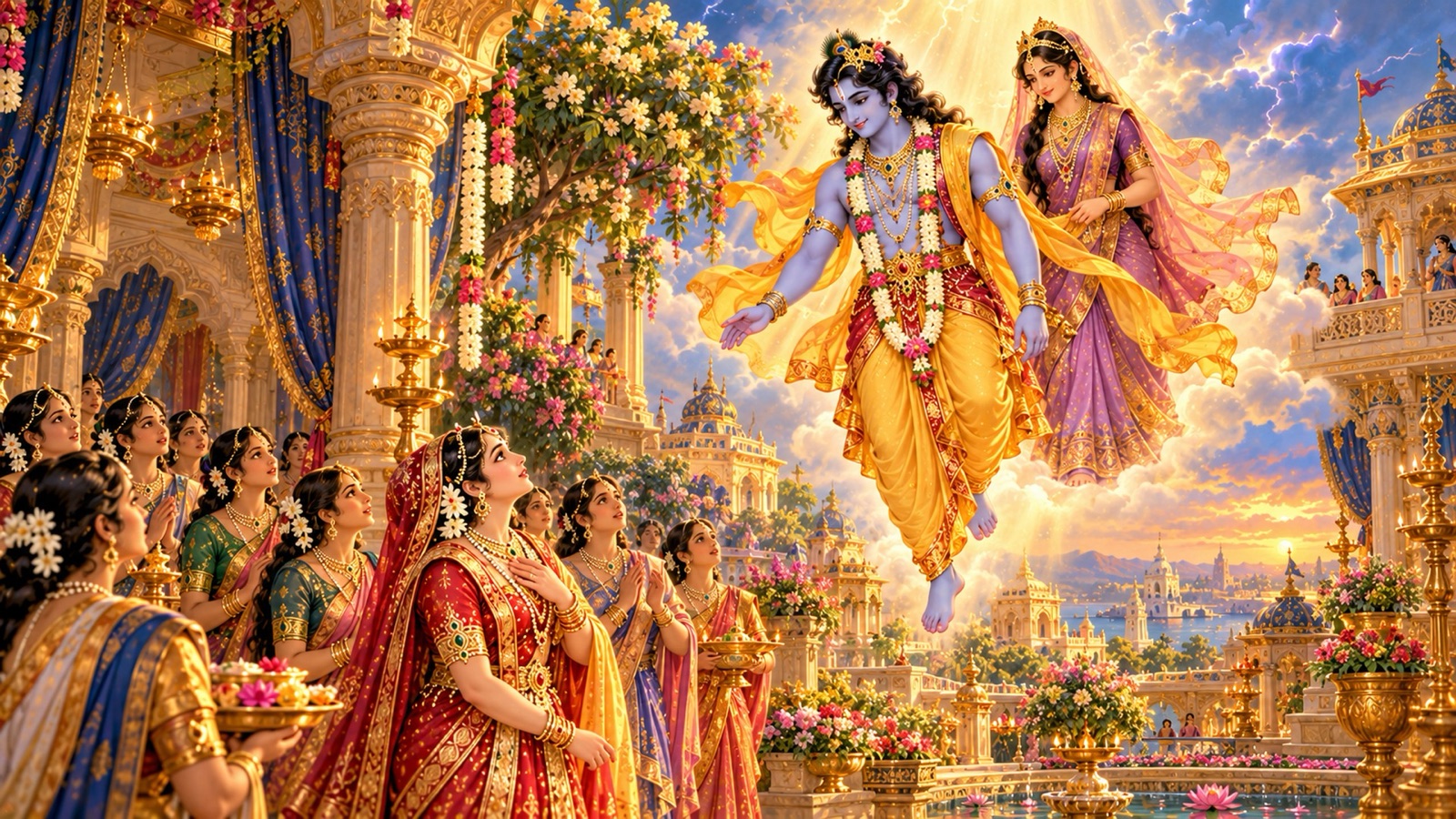
Stolen before he was ten days old and flung into the sea, the infant son of Krishna and Rukmini passes through a fish, a demon’s kitchen and the tender care of Rati herself — and comes home through the sky as the conqueror of Shambara.
Om Namo Bhagavate Vasudevaya.
Om Namo Bhagavate Vasudevaya.
Om Namo Bhagavate Vasudevaya.
Welcome back to Srimad Bhagavatam Wisdom, our devotional journey through the sacred histories and teachings of the Srimad Bhagavat Mahapurana. The fifty-fifth chapter of the Tenth Canto tells how Kamadeva, reduced to ashes by the wrath of Rudra, was born again as Pradyumna, the first son of Krishna and Rukmini; how the demon Shambara threw the newborn into the ocean; and how the child, swallowed by a fish and placed by providence in the hands of his own wife of old, grew up in his enemy’s house, destroyed Shambara, and returned to a mother whose heart knew him before anyone spoke his name.
Chapter Information
- Scripture: Śrīmad Bhāgavata Mahāpurāṇa
- Canto: 10 (Book Ten, Latter Half)
- Chapter: 55 (Discourse 55)
- Chapter title: The History of Pradyumna
- Principal speaker: Sukadeva Gosvami (narrating to King Parikshit)
- Principal listener: King Parikshit
- Main setting: Dvārakā, the ocean, and the house of the demon Shambara
- Central subject: Kamadeva reborn as Pradyumna; his abduction by Shambara; his upbringing by Mayavati (Rati); Shambara’s fall; the return to Dvaraka
- Principal verse range: Canto 10, Chapter 55, verses 1–40
- Primary edition: Gita Press Śrīmad Bhāgavata Mahāpurāṇa (English, Book Ten, Latter Half)
Context From the Previous Chapter
In Chapter 54, Balarama consoled Rukmini with teachings on the eternal Self after her brother Rukmi was spared yet humbled; Rukmi built the city of Bhojakata, vowing not to return home until he had slain Krishna. Then the Lord wedded Rukmini in Dvaraka, and the whole city rejoiced at the union of the Spouse of Sri with Lakshmi herself.
The Rebirth of Kamadeva
Sukadeva resumed his narration to King Parikshit. Long ago Kamadeva, the god of love, who is himself a portion of Lord Vasudeva, had been burnt to ashes by the anger of Rudra. Needing a body once more, he turned to none other than the Lord of whom he is a part. And so the selfsame Kama, begotten by Krishna, was born of Rukmini, the princess of Vidarbha, and became famed as Pradyumna — in no respect inferior to his Father.
कामस्तु वासुदेवांशो दग्ध: प्राग् रुद्रमन्युना ।
देहोपपत्तये भूयस्तमेव प्रत्यपद्यत ॥ १ ॥
kāmas tu vāsudevāṁśo dagdhaḥ prāg rudra-manyunā dehopapattaye bhūyas tam eva pratyapadyata
Meaning: Kamadeva, a portion of Vasudeva, who had earlier been burnt by the wrath of Rudra, turned once again to that very Lord in order to obtain a body. (Canto 10, Chapter 55, verse 1)
Shambara Carries Off the Child
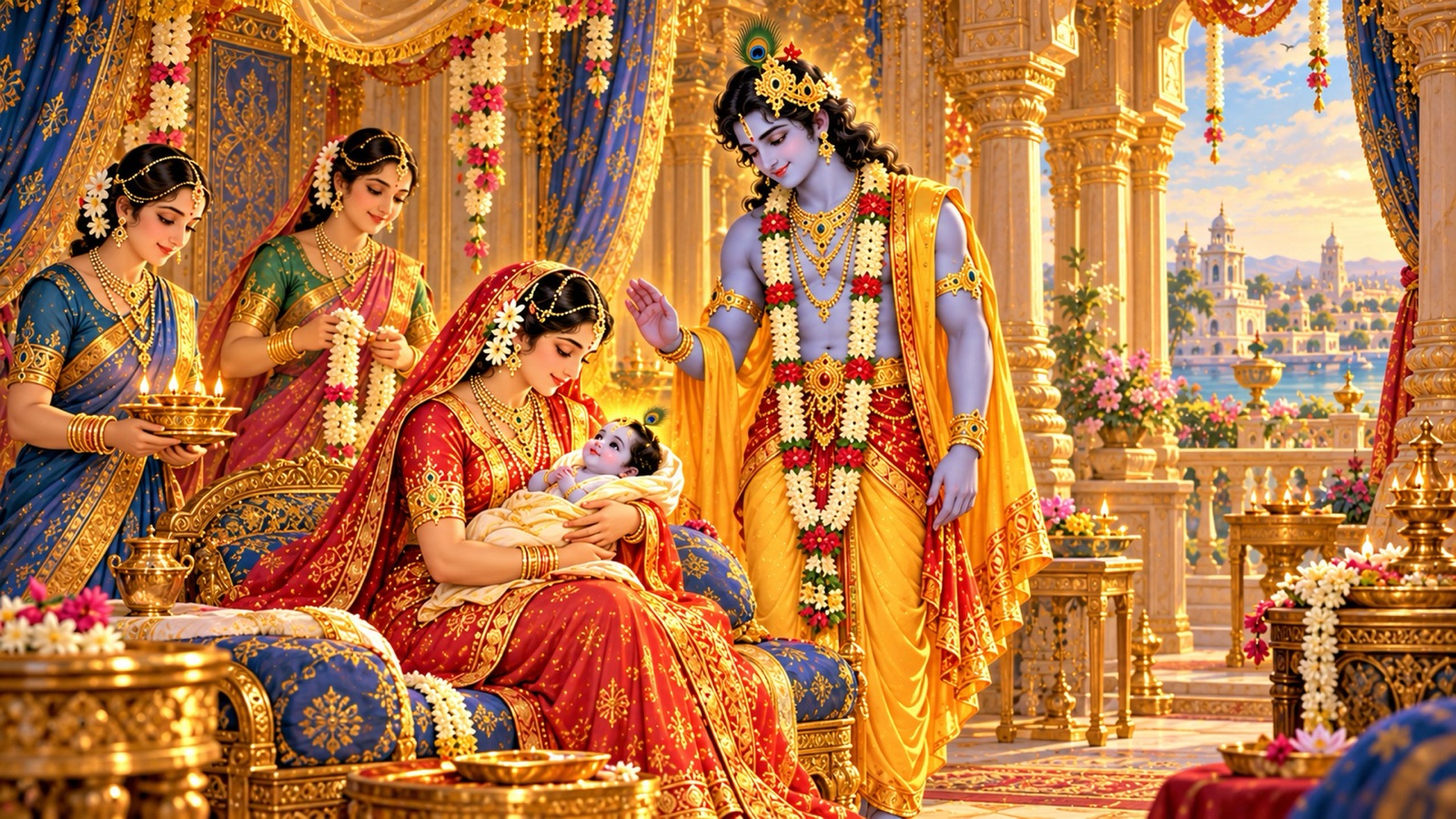
The joy of that birth was cut short almost at once. The demon Shambara, who could assume any form at will, knew this child was destined to be his enemy. Before the infant was even ten days old he carried him away from the lying-in chamber, cast him into the sea, and went home believing the danger ended.

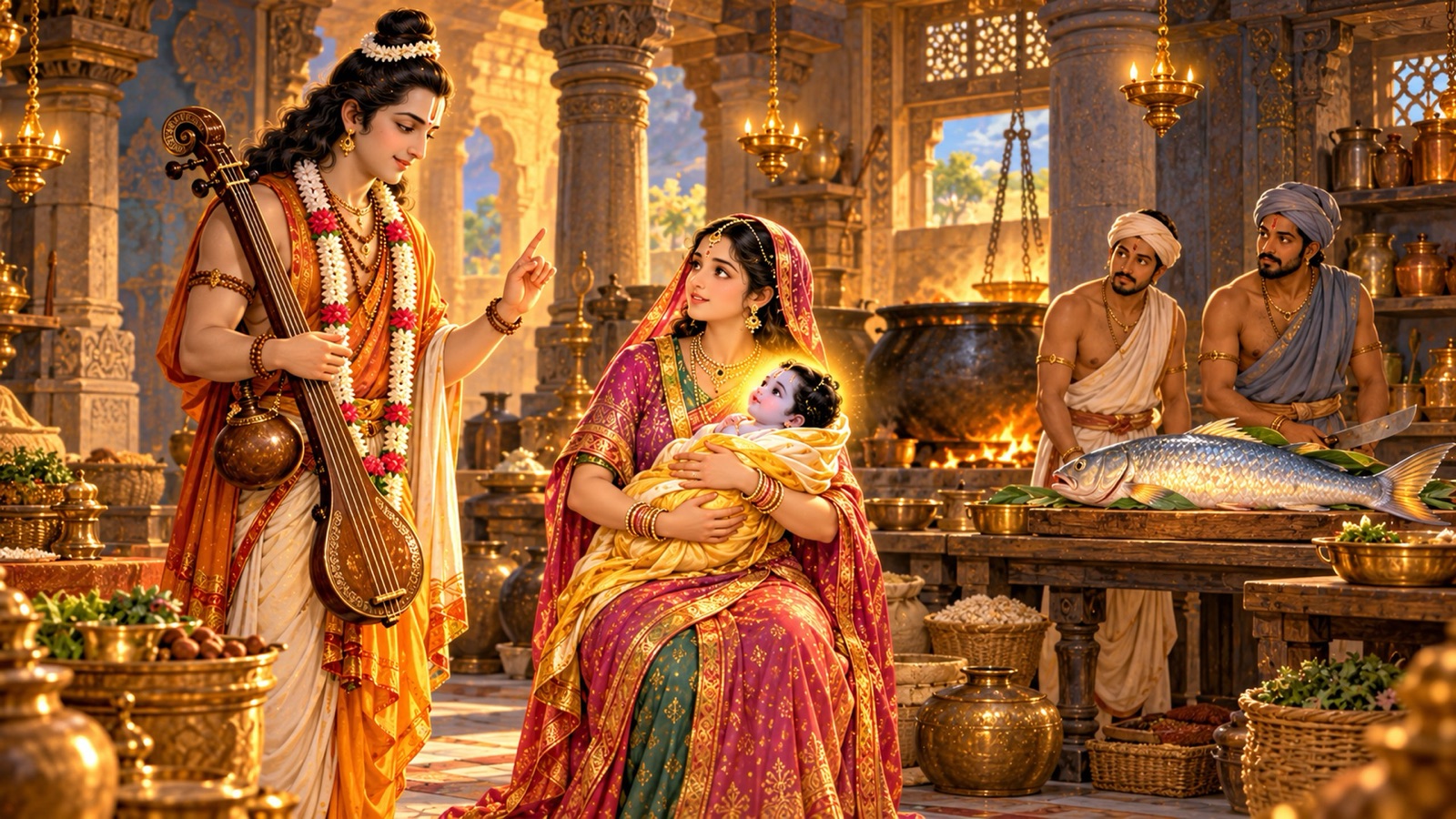
A mighty fish swallowed the child whole. That fish was itself caught, with many others, in the great net of fishermen, who brought it to Shambara as a gift. His cooks carried the wonderful fish into the kitchen and cut it open — and found a living baby within.
Mayavati and the Words of Narada
Astonished, the cooks handed the infant to Mayavati of Shambara’s kitchen. Her mind was full of doubt, until the celestial sage Narada arrived and told her everything — who the boy was, how he had been born, and how he had reached the belly of the fish.
For Mayavati was no ordinary servant. She was the illustrious Rati, wife of Kamadeva, who had waited all this while for her husband to receive a new body after Shiva’s anger burnt the old one. Shambara had set her to cook the pulses and rice of his household; now, knowing the baby in her arms to be Kamadeva himself, she poured out her whole affection upon him.
Pradyumna Comes of Age, and Rati Speaks
Before long the son of Krishna grew into the full bloom of youth, so beautiful that women who looked upon him were stirred at heart. Rati, who had waited so many years, no longer saw a child before her. Knowing him to be her own husband — lotus-eyed, long-armed, the most handsome of men — she greeted him with the shy smile of a wife rather than a foster-mother’s gaze.
Pradyumna was taken aback. “Mother,” he said, “your feeling has changed; setting aside a mother’s heart, you behave toward me like a lover.”
तामाह भगवान् कार्ष्णिर्मातस्ते मतिरन्यथा ।
मातृभावमतिक्रम्य वर्तसे कामिनी यथा ॥ ११ ॥
tām āha bhagavān kārṣṇir mātas te matir anyathā mātṛ-bhāvam atikramya vartase kāminī yathā
Meaning: The glorious son of Krishna said to her: “Mother, your attitude has altered; passing beyond a mother’s feeling, you conduct yourself like a woman in love.” (Canto 10, Chapter 55, verse 11)
Then Rati told him the truth. “You are the son of Narayana,” she said, “stolen from your home by the demon Shambara. I am Rati, your rightful wife, and you, my lord, are Kama himself. Before you were ten days old that demon threw you into the sea; a fish swallowed you, and from its belly you came to this very house. Slay this unassailable foe, who knows a hundred kinds of magic, with magic of your own — bewilderment and the rest. And your mother weeps for you, like an osprey robbed of her young, like a cow whose calf is lost.”
परिशोचति ते माता कुररीव गतप्रजा ।
पुत्रस्नेहाकुला दीना विवत्सा गौरिवातुरा ॥ १५ ॥
pariśocati te mātā kurarīva gata-prajā putra-snehākulā dīnā vivatsā gaur ivāturā
Meaning: Your mother grieves for you like a kurari bird that has lost her young — distressed and wretched with love for her son, like a cow bereft of her calf. (Canto 10, Chapter 55, verse 15)
The Gift of Mahamaya
Having spoken thus, Mayavati — so called for her mastery of the magical arts — bestowed on the great-souled Pradyumna the mystic knowledge named Mahamaya, which destroys every illusion.
प्रभाष्यैवं ददौ विद्यां प्रद्युम्नाय महात्मने ।
मायावती महामायां सर्वमायाविनाशिनीम् ॥ १६ ॥
prabhāṣyaivaṁ dadau vidyāṁ pradyumnāya mahātmane māyāvatī mahā-māyāṁ sarva-māyā-vināśinīm
Meaning: Having spoken thus, Mayavati gave to the high-souled Pradyumna the knowledge called Mahamaya, the destroyer of all illusions. (Canto 10, Chapter 55, verse 16)
The Fall of Shambara
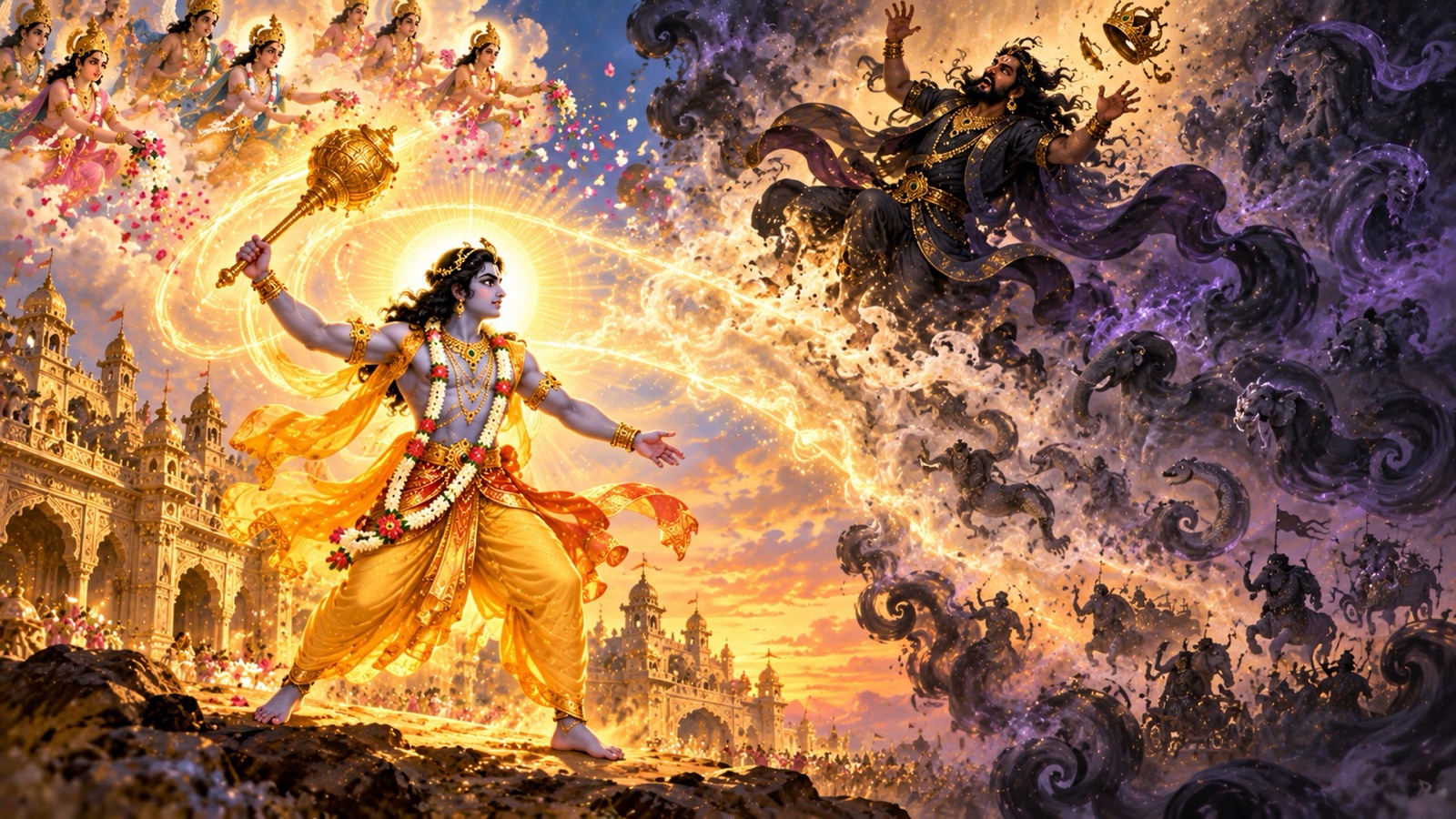
Armed with that knowledge, Pradyumna went straight to Shambara and challenged him to combat, provoking him with taunts no warrior could bear. Stung like a serpent trodden underfoot, Shambara came out with mace in hand, his eyes copper-red with rage, and hurled it at Pradyumna with a roar as harsh as a thunderclap. Pradyumna struck the flying mace aside with his own, and in anger flung his mace back at the enemy.
Now Shambara took refuge in the demonic magic taught by Maya. Rising unseen into the sky, he rained weapons upon the son of Krishna. Harassed by that downpour, Pradyumna, the great warrior born of Rukmini, brought forth the knowledge of pure sattva that renders every illusion powerless.
बाध्यमानोऽस्त्रवर्षेण रौक्मिणेयो महारथ: ।
सत्त्वात्मिकां महाविद्यां सर्वमायोपमर्दिनीम् ॥ २२ ॥
bādhyamāno ’stra-varṣeṇa raukmiṇeyo mahā-rathaḥ sattvātmikāṁ mahā-vidyāṁ sarva-māyopamardinīm
Meaning: Oppressed by the rain of weapons, the mighty warrior born of Rukmini employed the great knowledge composed of pure goodness, which subdues all illusions. (Canto 10, Chapter 55, verse 22)
Then the demon launched hundreds of illusions — the spells of the Guhyakas, Gandharvas, Pishachas, Nagas and Rakshasas — and the son of Krishna swept them all away. At last, lifting a sharp sword, Pradyumna severed Shambara’s head, with its copper-coloured beard, diadem and earrings, from his body.
Home Through the Sky
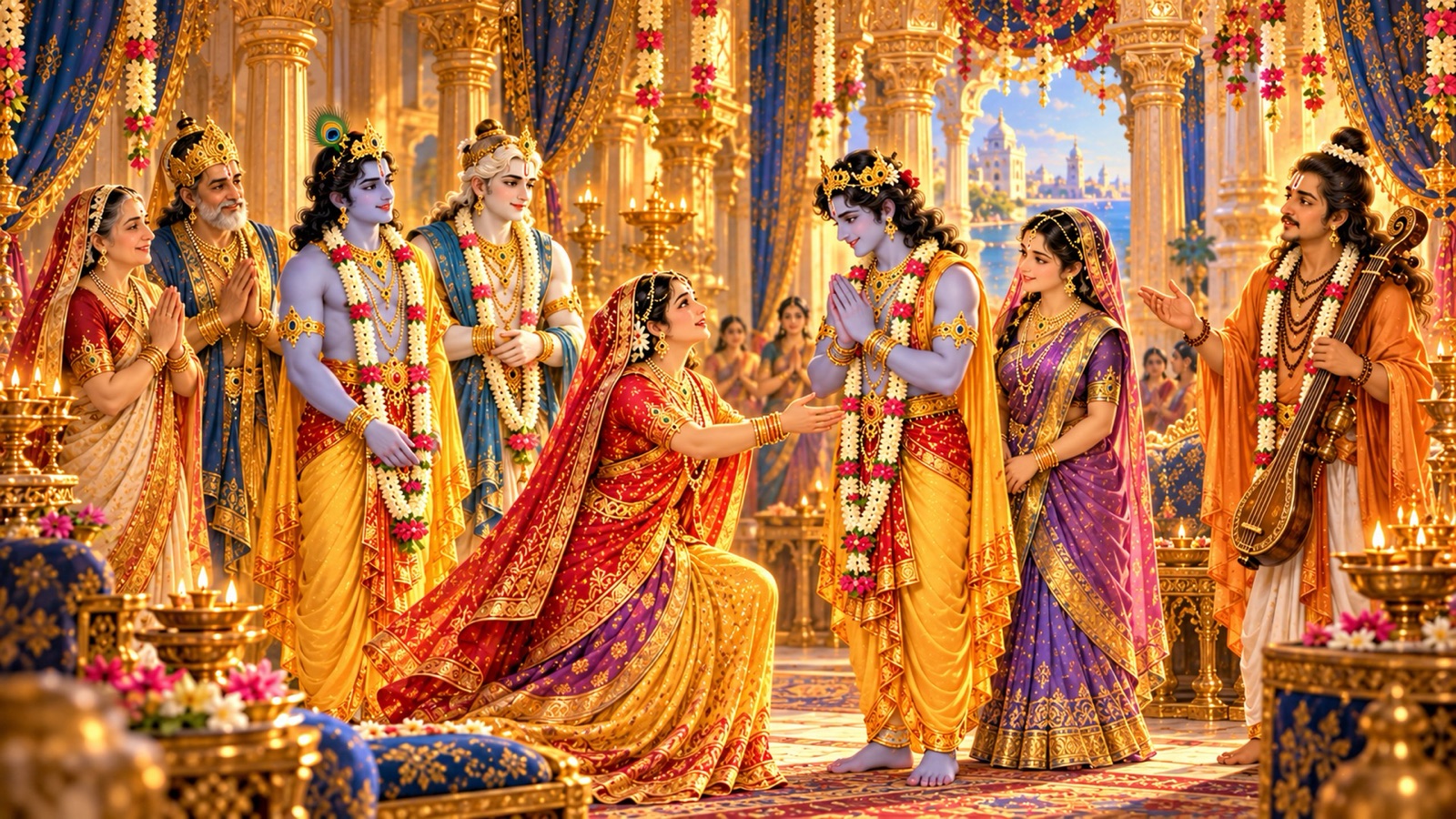
As the gods sang his praise and showered him with heaps of flowers, Pradyumna was carried through the air to Dvaraka by his wife, who possessed the power to travel the sky. Like a cloud attended by lightning, he descended with her into the splendid inner palace, where hundreds of ladies dwelt.
Seeing him dark as a raincloud, clad in yellow silk, long-armed, with reddish eyes and a smiling lotus face framed by dark curling locks, the ladies took him for Krishna Himself and hid out of modesty. Only slowly, from slight differences, did they realise he was not the Lord; then they came up delighted, wondering at the jewel of a young woman at his side.
Rukmini Knows Her Son
Then Rukmini, the dark-eyed, sweet-voiced princess of Vidarbha, remembered her lost son — and milk flowed from her breast with a mother’s love. “Who is this jewel among men with lotus eyes?” she wondered. “Whose son is he, and who is this young woman he has won? My own stolen son would be just this age and look just like this, if he lives somewhere. But how has this boy come to resemble the wielder of the Sharnga bow in form and limbs, in gait and voice, in smile and glance? Surely he is the very child I bore; my love overflows, and my left arm is throbbing.”
स एव वा भवेन्नूनं यो मे गर्भे धृतोऽर्भक: ।
अमुष्मिन् प्रीतिरधिका वाम: स्फुरति मे भुज: ॥ ३४ ॥
sa eva vā bhaven nūnaṁ yo me garbhe dhṛto ’rbhakaḥ amuṣmin prītir adhikā vāmaḥ sphurati me bhujaḥ
Meaning: Or surely he must be the very child I carried in my womb; my affection for him is exceeding, and my left arm is throbbing. (Canto 10, Chapter 55, verse 34)
Narada Speaks and Dvaraka Rejoices
While Rukmini pondered thus, Lord Krishna of glorious renown arrived together with Devaki and Vasudeva. Though the Lord knew everything, He said nothing; it was the sage Narada who told them all — how Shambara had stolen the child, and everything that followed.
विज्ञातार्थोऽपि भगवांस्तूष्णीमास जनार्दन: ।
नारदोऽकथयत् सर्वं शम्बराहरणादिकम् ॥ ३६ ॥
vijñātārtho ’pi bhagavāṁs tūṣṇīm āsa janārdanaḥ nārado ’kathayat sarvaṁ śambarāharaṇādikam
Meaning: Though He knew the whole matter, Lord Janardana remained silent; Narada related everything, beginning with the abduction by Shambara. (Canto 10, Chapter 55, verse 36)
Hearing that marvel, the ladies of Krishna’s household welcomed the boy who had been lost so many years and had come back as if from the dead. Devaki and Vasudeva, Krishna and Balarama, Rukmini and all the women embraced the young couple with joy. When the citizens of Dvaraka heard that the lost Pradyumna had come home, they said to one another, “Ah, by good fortune the boy has returned, as though from death itself!”
Sukadeva closed with a gentle observation. Pradyumna was so exact a likeness of Krishna, the abode of Lakshmi, that even the ladies who stood to him as mothers repeatedly mistook him for their Lord and withdrew in modesty. If Kama himself could so stir his own mothers, what wonder that other women were moved?
Principal Teachings of This Chapter
1. Even the gods receive their being from the Lord. Kamadeva, burnt to ashes, could regain a body only from Vasudeva, of whom he is a portion, as verse 1 declares. Every power and beauty in creation shines with His borrowed light.
2. Why the Lord allowed His own child to be stolen. Krishna knew everything from the first moment, yet He let Shambara act — because the demon’s crime was the very path by which Kama would be restored. Rati, the wife Kama had lost, was living in Shambara’s house; only by being thrown into the sea and carried into that kitchen could the child reach her arms, receive the Mahamaya knowledge, and grow up to destroy the one who thought he had destroyed him. The Lord’s silence in verse 36 is not indifference but the patience of a plan already perfect.
3. Knowledge born of pure sattva conquers illusion. Shambara commanded a hundred magics, yet the knowledge Mayavati gave in verse 16 and the sattva-born vidya of verse 22 swept them away. Illusion yields not to a greater illusion but to purity and truth.
4. Hold to dharma even before the truth is known. Not yet knowing who he was, Pradyumna honoured the mother’s bond and spoke plainly in verse 11. Propriety guards us until the Lord reveals what is hidden.
5. The Lord lets His saints tell His story. Krishna stayed silent and Narada spoke. The truths of His pastimes reach us through the holy, who delight in declaring them.
A Devotional Reflection
Among all the wonders of this chapter, the one that lingers is a mother’s left arm trembling before her mind has understood. Rukmini has no proof. She reasons, she compares, she doubts — and all the while her body already knows that the young man before her is the child she lost. Love, it seems, recognises the Lord’s own before intellect catches up. Is that not how devotion works in us? The heart leaps at the sound of Krishna before we can explain why; recognition comes first, understanding follows. And there is Rati, who waited through the long ashes of her husband’s absence and found him placed in her own arms as a baby. Her waiting was a vigil. Pradyumna himself teaches something quieter: thrown into the sea, raised among enemies, he still carried his Father’s likeness so completely that a whole palace mistook him for the Lord. Whatever sea we are thrown into, the likeness of our origin is not lost. May we wait like Rati, recognise like Rukmini, and carry the Lord’s image like Pradyumna.
A Daily Devotional Practice
Today, call to mind one situation in your life that feels like being cast into the sea — a loss, a separation, a long waiting without answer. Then recall Pradyumna: swallowed, carried, hidden, and all the while brought exactly where the Lord intended. Offer that situation to Krishna with the simple prayer, “I do not see the path, but You already know it.” Rest in that trust a few quiet minutes, and begin by chanting gently: Om Namo Bhagavate Vasudevaya.
Conclusion
The fifty-fifth chapter of the Tenth Canto gives us Pradyumna: Kamadeva reborn as the son of Krishna and Rukmini, stolen by Shambara, swallowed by a fish, raised by Rati in disguise, and victorious through the knowledge she bestowed. Its one central truth is that the Lord’s care never fails His own — an enemy’s cruelty became the road that led the child to his wife, his strength and his home. May we trust that same unseen hand in our own seasons of loss.
May the divine wisdom of Srimad Bhagavatam awaken pure devotion within our hearts.
Om Namo Bhagavate Vasudevaya.
Jay Shree Madhav.
References and Attribution
- Primary edition: Gita Press, Śrīmad Bhāgavata Mahāpurāṇa (English), Book Ten (Latter Half), Discourse 55.
- Series: Srimad Bhagavatam Wisdom · Biswa Sanatan Dharma Seva Trust.
- Presented following the spiritual guidance and recommendation of Pandit Dr. Shri Kashinath Mishra.
This is an original, faithful retelling in the writer’s own words, with brief quoted verses shown in Devanāgarī and transliteration and their meanings given as summaries. It is not a reproduction of any single publisher’s continuous translation or commentary. No affiliation with or endorsement by any publisher is implied.
Jay Shree Madhav