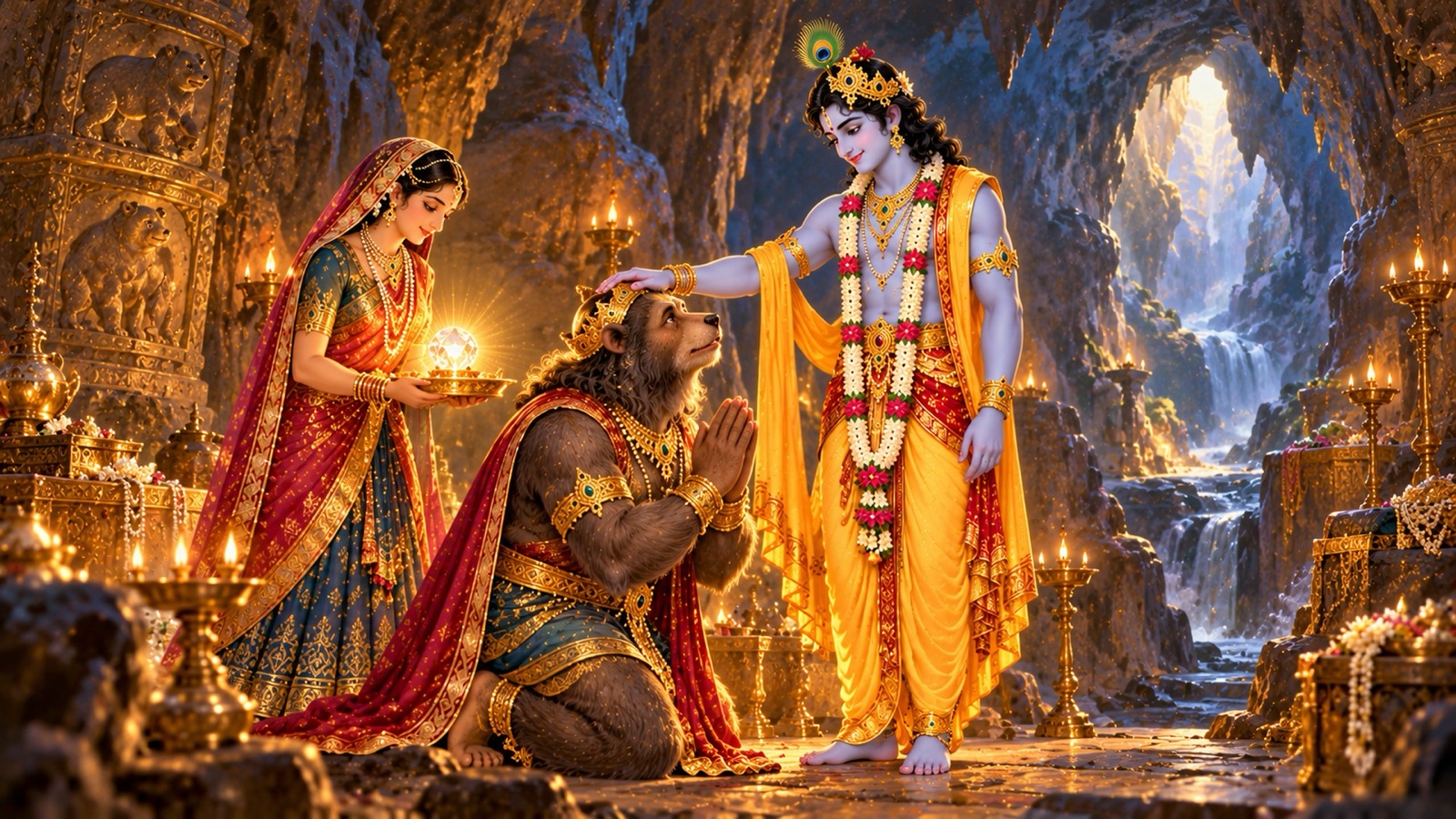
A jewel that pours out gold and drives away famine passes from the sun-god to Satrajit, from a lion to the king of bears, and at last into the hands of Krishna, who enters a dark cave alone to clear His name and comes out with a bride.
Om Namo Bhagavate Vasudevaya.
Om Namo Bhagavate Vasudevaya.
Om Namo Bhagavate Vasudevaya.
Welcome back to Srimad Bhagavatam Wisdom, our devotional journey through the sacred histories and teachings of the Srimad Bhagavat Mahapurana. In this fifty-sixth chapter of the Tenth Canto, Sukadeva tells King Parikshit the history of the Syamantaka jewel: how the sun-god gave it to Satrajit, how a brother’s death brought a false accusation upon Krishna, and how the Lord tracked the jewel to the cave of Jambavan and returned to Dwaraka with two brides, Jambavati and Satyabhama.
Chapter Information
- Scripture: Śrīmad Bhāgavata Mahāpurāṇa
- Canto: 10 (Book Ten, Latter Half)
- Chapter: 56 (Discourse 56)
- Chapter title: The Syamantaka Jewel
- Principal speaker: Sukadeva Gosvami (narrating to King Parikshit)
- Principal listener: King Parikshit
- Main setting: Dwaraka, the forest where Prasena hunted, and the mountain cave of Jambavan
- Central subject: The gift of the Syamantaka jewel; Satrajit’s slander of Krishna; the Lord’s search, His contest with Jambavan and recognition by him; the jewel restored and the marriages to Jambavati and Satyabhama
- Principal verse range: Canto 10, Chapter 56, verses 1–45
- Primary edition: Gita Press Śrīmad Bhāgavata Mahāpurāṇa (English, Book Ten)
Context From the Previous Chapter
Chapter 55 told how Pradyumna, stolen as an infant by the demon Sambara, slew him and returned with Rati to the joy of Dwaraka. Sukadeva now turns to the history of a jewel and of a slander against the Lord.
Parikshit’s Question
Sukadeva began by saying that Satrajit, having wronged Krishna, later gave Him his own daughter together with the Syamantaka jewel, of his own accord and with great effort. King Parikshit at once wished to know more. What wrong had Satrajit done to Krishna? Where had he obtained the Syamantaka? And why did he give his daughter to Hari? Sukadeva then told the whole history.
The Gift of the Sun-god
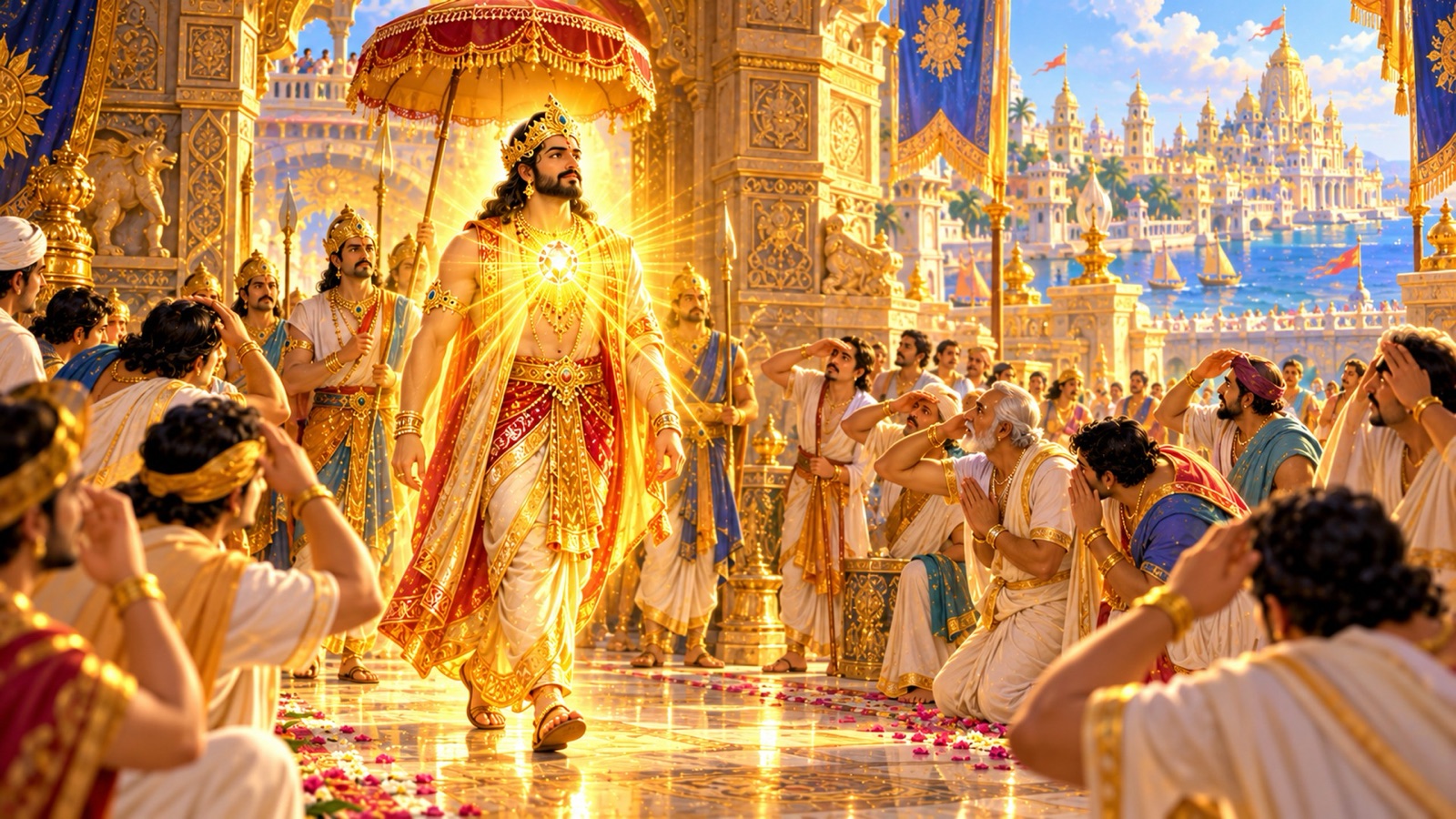
Satrajit was a devotee of the sun-god, and Surya, pleased with his worship, treated him as a dear friend and gave him the Syamantaka jewel. Wearing it about his neck, Satrajit entered Dwaraka shining like the sun itself — so dazzling that no one could tell who he was. The citizens, their eyes blinded by that splendour, took him for Surya in person and hurried to report it to the Lord, who was playing at dice.
‘Obeisance to You, O Narayana, holder of conch, discus and mace,’ they said. ‘O Damodara, O lotus-eyed Govinda, O joy of the Yadus! The sun-god himself, stealing men’s sight with his rays, is coming to see You, O Lord of the universe. The foremost of the gods search for the way to You throughout the three worlds; having learned that You now live hidden among the Yadus, the unborn Surya has come to behold You.’
The Jewel in Satrajit’s House
Hearing these innocent words, the lotus-eyed Lord laughed aloud. ‘That is not the sun-god,’ He said. ‘It is Satrajit, glowing with his jewel.’ Satrajit went in state to his splendid house, decorated for a festival, and had the brahmanas install the jewel in his chamber of worship. Its power was wonderful.
दिने दिने स्वर्णभारानष्टौ स सृजति प्रभो ।
दुर्भिक्षमार्यरिष्टानि सर्पाधिव्याधयोऽशुभाः ।
न सन्ति मायिनस्तत्र यत्रास्तेऽभ्यर्चितो मणिः ॥ ११ ॥
dine dine svarṇa-bhārān aṣṭau sa sṛjati prabho durbhikṣa-māry-ariṣṭāni sarpādhi-vyādhayo ‘śubhāḥ na santi māyinas tatra yatrāste ‘bhyarcito maṇiḥ
Meaning: Day after day, O lord, the jewel produced eight bharas of gold; and wherever it was kept and duly worshipped, there was no famine, pestilence or calamity, no serpents, no mental anguish or bodily disease, and no deceivers. (Canto 10, Chapter 56, verse 11)
Krishna once asked Satrajit to present such a jewel to Ugrasena, the king of the Yadus. But Satrajit was greedy for wealth, and he refused, never considering what the refusal of that request might bring upon him.
Prasena, the Lion and the King of Bears
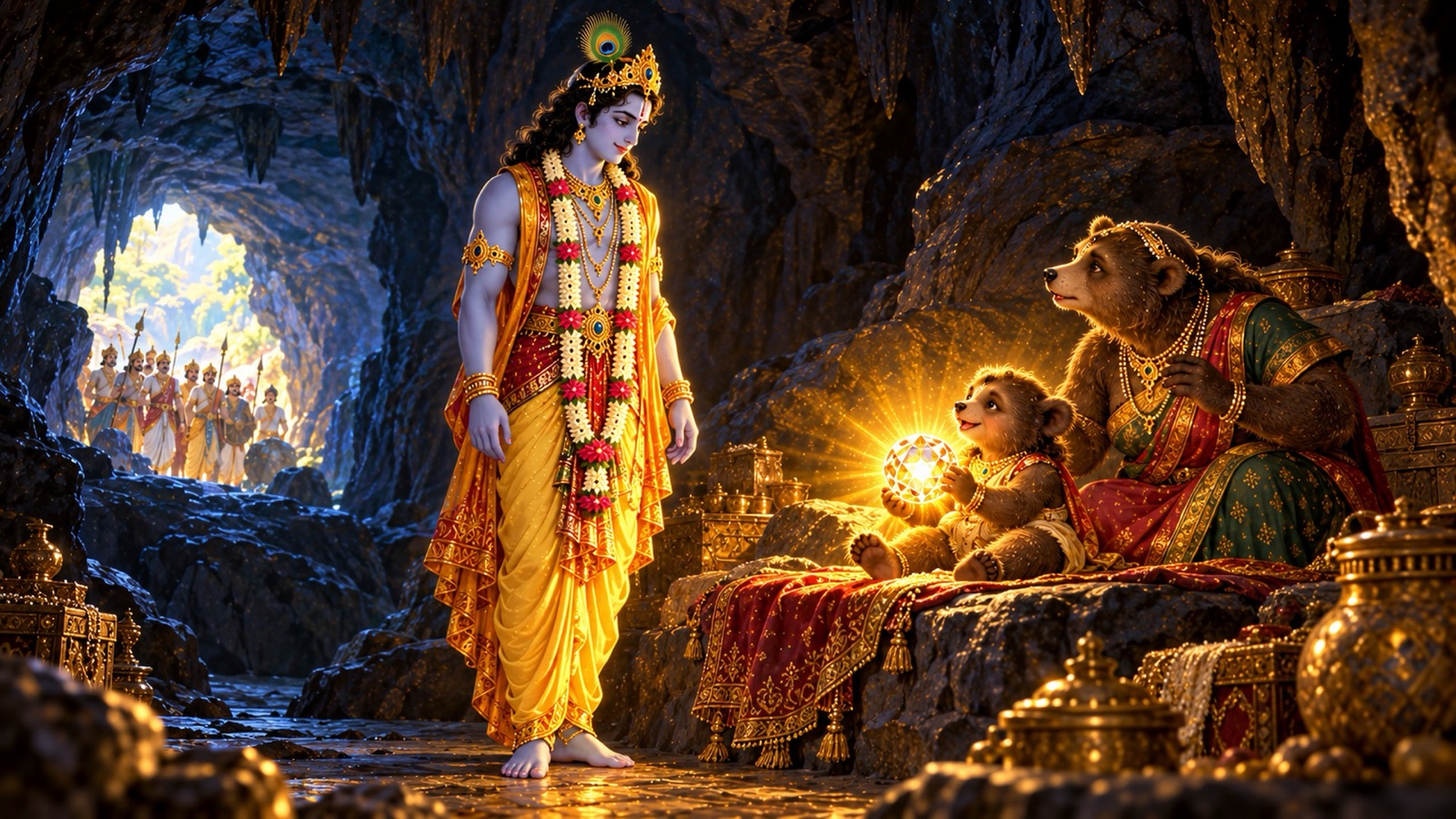
One day Satrajit’s brother Prasena fastened the brilliant jewel about his own neck and rode out on horseback to hunt in the forest. There a lion killed him and his horse and carried off the jewel; and as the lion was entering a mountain cave, Jambavan, the king of bears, who wanted the stone, struck the lion down and took it. Within his cave Jambavan gave the Syamantaka to his little son as a plaything.
When Prasena did not return, Satrajit was stricken with grief, and he said to his people: ‘My brother went to the forest wearing the jewel; surely Krishna has killed him.’ Those who heard this began to whisper it from ear to ear, and the slander spread through the city.
The Lord Follows the Trail
भगवांस्तदुपश्रुत्य दुर्यशो लिप्तमात्मनि ।
मार्ष्टुं प्रसेनपदवीमन्वपद्यत नागरैः ॥ १७ ॥
bhagavāṁs tad upaśrutya duryaśo liptam ātmani mārṣṭuṁ prasena-padavīm anvapadyata nāgaraiḥ
Meaning: When the Lord heard of the infamy thus fastened upon Him, He set out with the citizens along the path Prasena had taken, in order to wipe it away. (Canto 10, Chapter 56, verse 17)
Following the tracks, the party came first upon Prasena and his horse, slain by a lion in the forest; and farther along, on the mountainside, they saw the lion itself lying dead, killed by a bear. The trail led on to the mouth of a fearful cave, shrouded in blind darkness. Krishna stationed the people outside and went in alone. Within, He saw the precious jewel turned into a child’s toy, and, resolved to take it, He stood quietly beside the infant.
Twenty-Eight Days in the Cave
The child’s nurse, seeing a man such as she had never seen before, cried out as if in terror. Jambavan, foremost of the mighty, heard the scream and rushed in, blazing with anger. Taking the stranger for an ordinary mortal, and unable to perceive His greatness, the king of bears fell upon the very Lord who was his own Master.
स वै भगवता तेन युयुधे स्वामिनात्मनः ।
पुरुषं प्राकृतं मत्वा कुपितो नानुभाववित् ॥ २२ ॥
sa vai bhagavatā tena yuyudhe svāminātmanaḥ puruṣaṁ prākṛtaṁ matvā kupito nānubhāva-vit
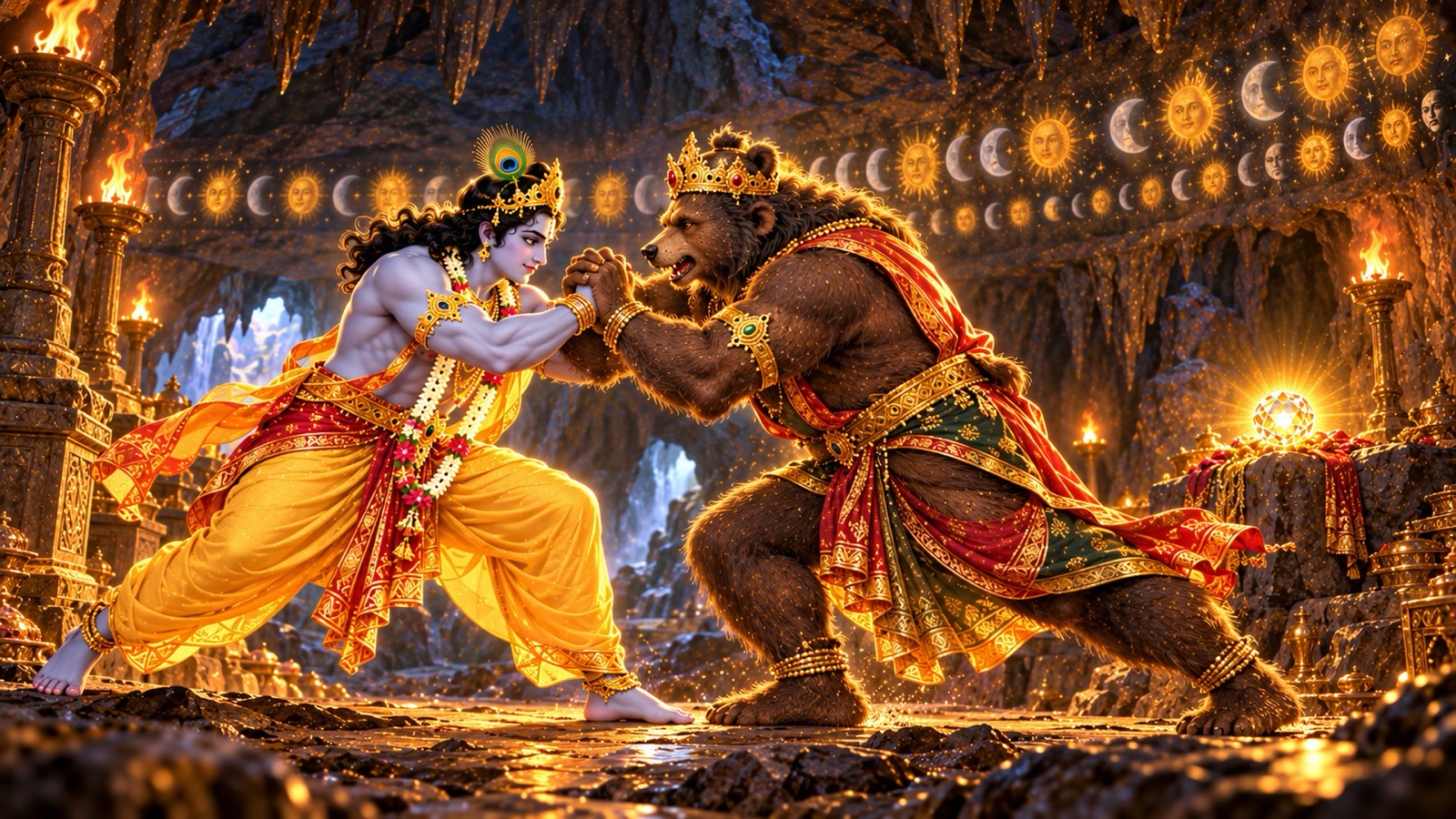
Meaning: Full of anger, and not knowing His true glory, Jambavan took Him for an ordinary human being and fought with that Lord, the Master of his own self. (Canto 10, Chapter 56, verse 22)
A tremendous duel followed, each straining to overthrow the other like two hawks fighting over a piece of flesh. They fought with weapons, then with rocks and trees, then with bare arms, and finally with fists that fell like thunderbolts; and the combat went on without pause, day and night, for twenty-eight days. At last Jambavan’s joints and muscles were pounded by the blows of Krishna’s fists; his strength and courage drained away, his limbs streamed with sweat, and in utter astonishment he began to speak.
Jambavan Recognises His Master
जाने त्वां सर्वभूतानां प्राण ओजः सहो बलम् ।
विष्णुं पुराणपुरुषं प्रभविष्णुमधीश्वरम् ॥ २६ ॥
jāne tvāṁ sarva-bhūtānāṁ prāṇa ojaḥ saho balam viṣṇuṁ purāṇa-puruṣaṁ prabhaviṣṇum adhīśvaram
Meaning: Now I know You: You are the life-breath, the vigour, the inner strength and the bodily might of all living beings — Vishnu, the most ancient Person, the all-powerful supreme Lord. (Canto 10, Chapter 56, verse 26)
Jambavan went on: ‘You are the creator of Brahma and the other creators, and the very substance underlying all that is created; You are Time, the ruler of those who rule, and the supreme Self of all embodied souls.’ Then a memory broke open in the old bear’s heart. ‘You are my Lord Ramacandra,’ he said, ‘at whose slightly angry sidelong glance the ocean with its crocodiles and whales grew agitated and gave You a path; by whom a bridge was built as a monument of Your own glory; by whom Lanka was set ablaze, and by whose arrows the heads of the ogres fell to the ground.’
Then the lotus-eyed Lord, the son of Devaki, stroked His devotee with His soothing hand and spoke to him with supreme compassion, in a voice as deep as thunder.
मणिहेतोरिह प्राप्ता वयमृक्षपते बिलम् ।
मिथ्याभिशापं प्रमृजन्नात्मनो मणिनामुना ॥ ३१ ॥
maṇi-hetor iha prāptā vayam ṛkṣa-pate bilam mithyābhiśāpaṁ pramṛjann ātmano maṇināmunā
Meaning: For the sake of this jewel we have come to your cave, O king of bears; by means of it I shall wipe away the false accusation made against Me. (Canto 10, Chapter 56, verse 31)
So addressed, Jambavan joyfully gave Krishna his own unmarried daughter Jambavati together with the jewel, as an offering of honour to his Lord.
Grief in Dwaraka and the Lord’s Return
Outside the cave the citizens had waited twelve days for Krishna to come out. When He did not appear, they returned to Dwaraka in sorrow. Hearing that Krishna had not emerged, Devaki, Rukmini and Vasudeva, with all His friends and kinsmen, grieved for Him, and the people of Dwaraka, cursing Satrajit, worshipped Goddess Durga, known there as Candrabhaga, for the Lord’s safe return. The Goddess granted her blessing — and suddenly Hari Himself appeared among them with His new bride, His purpose accomplished. Seeing Hrishikesha with a wife beside Him and the Syamantaka about His neck, as if He had come back from the dead, the whole city burst into festival.
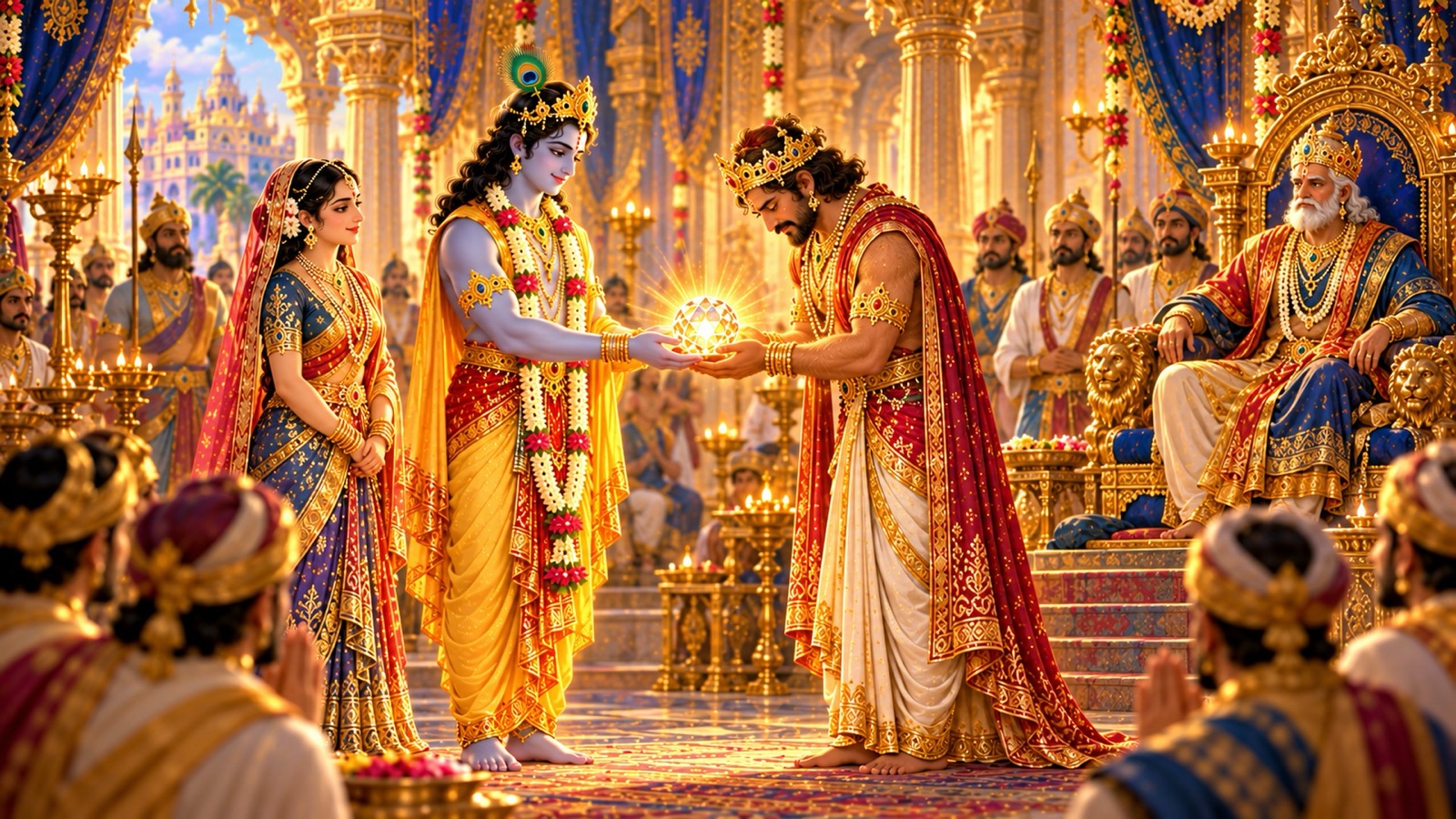
The Lord then summoned Satrajit to the royal assembly in the presence of King Ugrasena, related how He had recovered the gem, and handed it over to him. Satrajit took the jewel with his face cast down, burning with shame, and went home repenting of the sin he had committed.
Satrajit’s Remorse and the Wedding of Satyabhama
Brooding on that one offence, and anxious about the quarrel he had created with the mighty Lord and His followers, Satrajit thought: ‘How shall I wash away my guilt, and how may Acyuta be reconciled? What can I do that will bring me good, so that people will not curse me as short-sighted, mean, foolish and greedy for wealth? I will give Him my daughter, a jewel among women, and the jewel itself besides. That is the proper remedy; otherwise this quarrel will never end.’
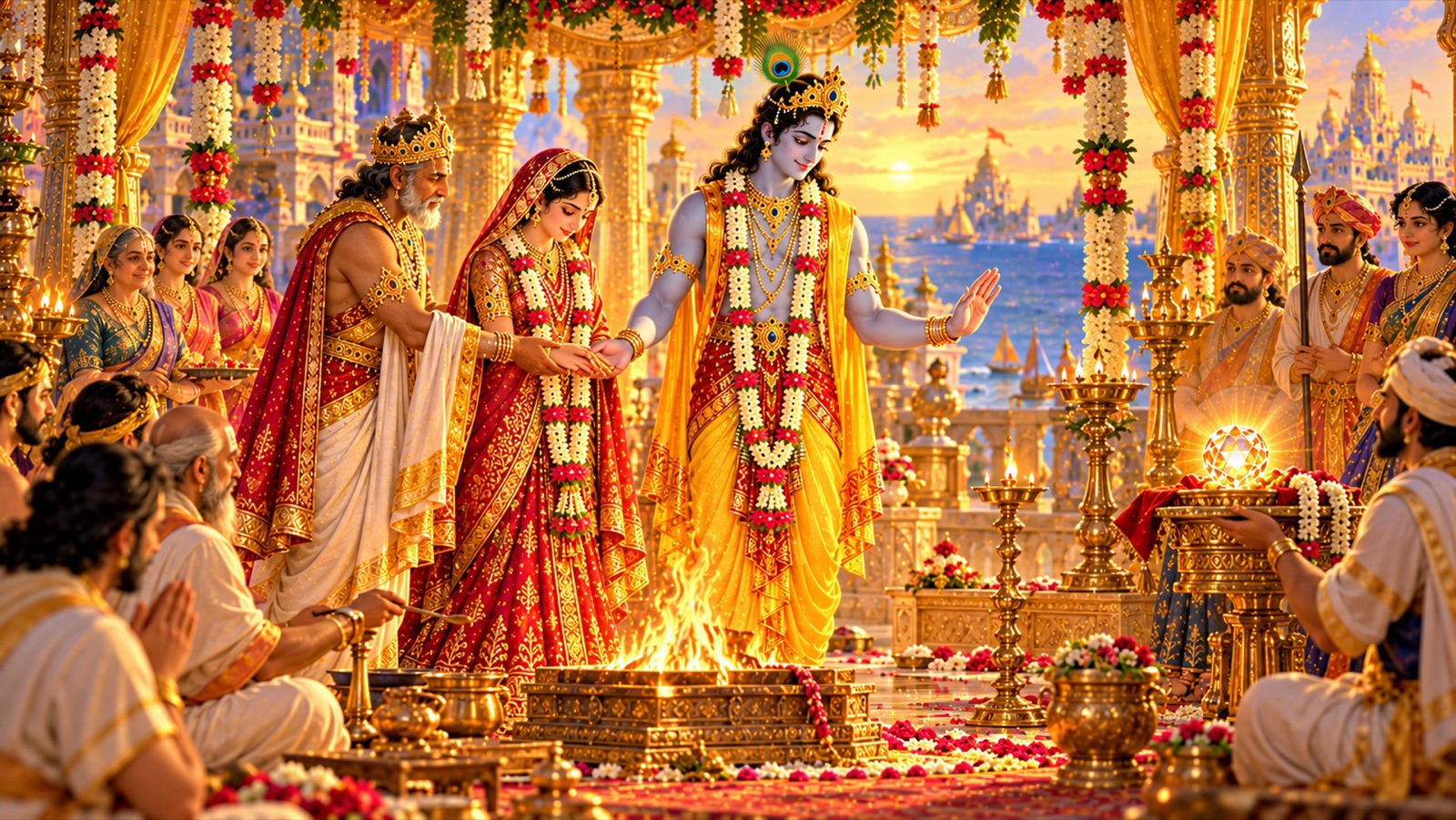
Having resolved thus by his own reasoning, Satrajit went to Krishna of his own accord and presented to Him his blessed daughter and the Syamantaka. The Lord married Satyabhama according to the scriptural rites — a maiden sought by many suitors, endowed with good character, beauty, generosity and every virtue.
भगवानाह न मणिं प्रतीच्छामो वयं नृप ।
तवास्तां देवभक्तस्य वयं च फलभागिनः ॥ ४५ ॥
bhagavān āha na maṇiṁ pratīcchāmo vayaṁ nṛpa tavāstāṁ deva-bhaktasya vayaṁ ca phala-bhāginaḥ
Meaning: The Lord said: O king, we do not wish to accept the jewel. Let it stay with you, who are a devotee of the sun-god; we shall simply share in its fruit. (Canto 10, Chapter 56, verse 45)
Principal Teachings of This Chapter
1. What is held back from the Lord becomes a burden. Satrajit’s wrong was not that he owned the jewel but that, covetous of wealth, he refused the Lord’s request to give it to the king. Verse 12 notes that he never weighed the consequences; the loss of his brother, the slander and his own shame all grew from that one refusal.
2. The Lord guards His good name for His devotees’ sake. Krishna has nothing to gain from any jewel, yet in verse 17 He personally follows Prasena’s trail to remove the false charge — He will not leave His own people believing a lie about Him.
3. Fighting the Lord in ignorance ends in surrender. Verse 22 says Jambavan fought his own Master because he could not perceive His greatness. The moment his pride gave way, the bear who had struck the Lord was stroked by the Lord’s own hand.
4. Recognition is the fruit of exhausted pride. Only when his strength was spent could Jambavan say ‘I know You’ and name Him as Vishnu and as his beloved Rama, as verse 26 records. Devotion often dawns at the end of our own power, not at its height.
5. The Lord accepts the heart and refuses the price. When Satrajit offers daughter and jewel together, Krishna takes the devoted daughter and returns the jewel, as verse 45 records. Love He accepts; payment He declines.
A Devotional Reflection
What moves me most in this chapter is that the Lord of the universe takes the trouble to clear His own name. He could have let the whispering of Dwaraka pass unnoticed; instead He walks into the forest, reads the tracks, and goes alone into a cave where no light enters. And look at how He clears it — not by punishing Satrajit, but by patient toil, twenty-eight days of it, in the dark. Jambavan, too, teaches me something about myself. How often do I wrestle with what life sends me, angry, taking it for an ordinary enemy, when it is the Master Himself who has come into my cave? Only when my strength is gone do I look up and say, ‘I know You.’ Then the hand that struck me becomes the hand that soothes. The Syamantaka produced gold every day, yet Krishna never kept it. He kept only Jambavati and Satyabhama — hearts offered to Him. Perhaps that is what He wants from me as well.
A Daily Devotional Practice
Today, bring to mind one thing you have been holding back from the Lord — a possession, a plan, a grievance you keep like a jewel in a locked room. Offer it to Him in prayer, remembering that He asked Satrajit for the gem only to give it to another, and returned it in the end. Then recall Jambavan’s words at the end of his strength, and make them your own: ‘I know You.’ Begin by chanting gently: Om Namo Bhagavate Vasudevaya.
Conclusion
The fifty-sixth chapter of the Tenth Canto is the story of a jewel that no one could keep in peace until it had passed through the hands of the Lord. From Satrajit’s greed came a slander; from the slander came Krishna’s descent into the cave, Jambavan’s recognition and the gift of Jambavati; and from the Lord’s patience came Satrajit’s repentance and the marriage of Satyabhama. The one point every devotee may carry away is Krishna’s final word — He declined the gold-giving stone and kept the devotion offered with it. May we learn to offer Him not our treasures but our hearts.
May the divine wisdom of Srimad Bhagavatam awaken pure devotion within our hearts.
Om Namo Bhagavate Vasudevaya.
Jay Shree Madhav.
References and Attribution
- Primary edition: Gita Press, Śrīmad Bhāgavata Mahāpurāṇa (English), Book Ten (Latter Half), Discourse 56, pages 351–355.
- Series: Srimad Bhagavatam Wisdom · Biswa Sanatan Dharma Seva Trust.
- Presented following the spiritual guidance and recommendation of Pandit Dr. Shri Kashinath Mishra.
This is an original, faithful retelling in the writer’s own words, with brief quoted verses shown in Devanāgarī and transliteration and their meanings given as summaries. It is not a reproduction of any single publisher’s continuous translation or commentary. No affiliation with or endorsement by any publisher is implied.
Jay Shree Madhav