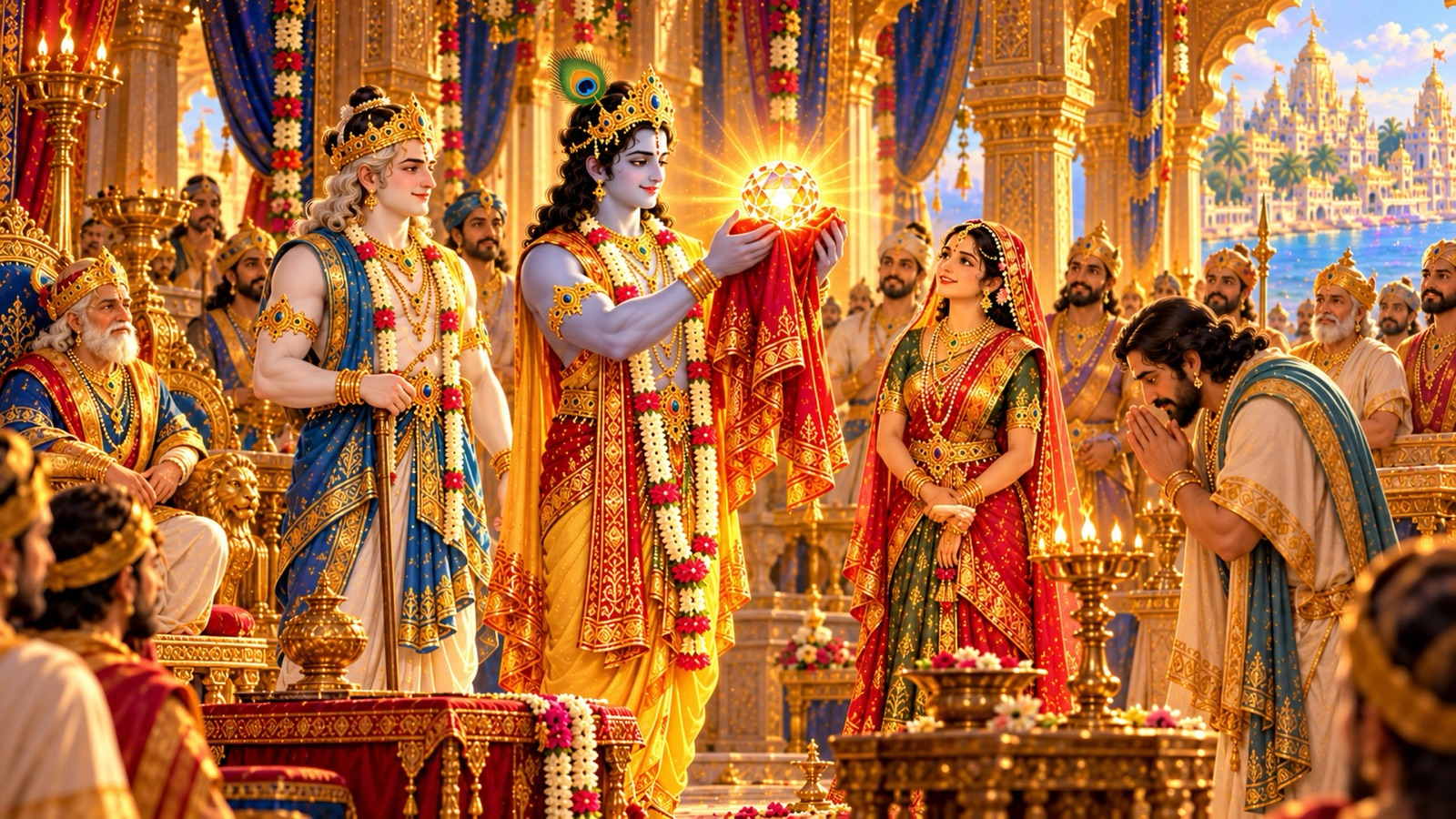
A slander once followed the Lord, and now a murder follows the jewel that caused it; yet when Krishna unwraps the Syamantaka before His kinsmen, every stain is wiped away and the gem passes back into a devotee’s keeping.
Om Namo Bhagavate Vasudevaya.
Om Namo Bhagavate Vasudevaya.
Om Namo Bhagavate Vasudevaya.
Welcome back to Srimad Bhagavatam Wisdom, our devotional journey through the sacred histories and teachings of the Srimad Bhagavat Mahapurana. The fifty-seventh chapter of the Tenth Canto carries the story of the Syamantaka to its sorrowful and then luminous end: Satrajit is slain for the gem while Krishna is away, and the Lord brings the jewel into the open so that no shadow remains upon Him.
Chapter Information
- Scripture: Śrīmad Bhāgavata Mahāpurāṇa
- Canto: 10 (Book Ten, Latter Half)
- Chapter: 57 (Discourse 57)
- Chapter title: Satrajit Murdered, the Jewel Returned
- Principal speaker: Sukadeva Gosvami (narrating to King Parikshit)
- Principal listener: King Parikshit
- Main setting: Hastināpura, Dvārakā and the outskirts of Mithilā
- Central subject: Satrajit’s murder by Shatadhanva; Krishna and Balarama’s pursuit; Balarama in Mithila; Akrura’s recall and the Syamantaka revealed
- Principal verse range: Canto 10, Chapter 57, verses 1–42
- Primary edition: Gita Press Śrīmad Bhāgavata Mahāpurāṇa (English, Book Ten)
Context From the Previous Chapter
In Chapter 56 the Syamantaka, the sun-god’s gift to Satrajit, was lost with his brother Prasena, and Satrajit let it be whispered that Krishna had taken it. The Lord recovered the gem from Jambavan’s cave, won Jambavati, and returned it to Satrajit before the court; the ashamed Satrajit then gave Krishna his daughter Satyabhama, and the Lord left the jewel in his keeping.
Krishna Goes to Hastinapura
Sukadeva resumed the history. Word came that the sons of Pandu and their mother Kunti had perished in the burning of the house of lac. Govinda knew the truth — the Pandavas had escaped unharmed — yet, honouring the ways of kinship, He went with Balarama to the kingdom of the Kurus to console the family. There He met Bhishma, Kripa, Vidura, Gandhari and Drona, shared their grief as one of them, and said with sorrow, ‘Alas, what a pity.’
The Plot Against Satrajit
Krishna’s absence from Dwaraka opened a door for old resentments. Akrura and Kritavarma approached Shatadhanva and asked why the gem should not now be seized, and why Satrajit, who had promised them his jewel of a daughter and then slighted them by giving her to Krishna, should not meet the end his brother Prasena had met. Their words found a ready heart. Shatadhanva, wicked and greedy, his span of life already running out, killed Satrajit as he slept; then, while the women of the household cried out as though left without a protector, he took the Syamantaka and withdrew.
Satyabhama’s Grief
Satyabhama saw her father lying slain and wept piteously, calling ‘Father, dear father, I am undone,’ and again and again losing her senses. Then, placing his body in a vessel of oil so that it would not decay, the grieving princess drove all the way to Hastinapura and told Krishna what had happened — though He, who knows all, already knew.
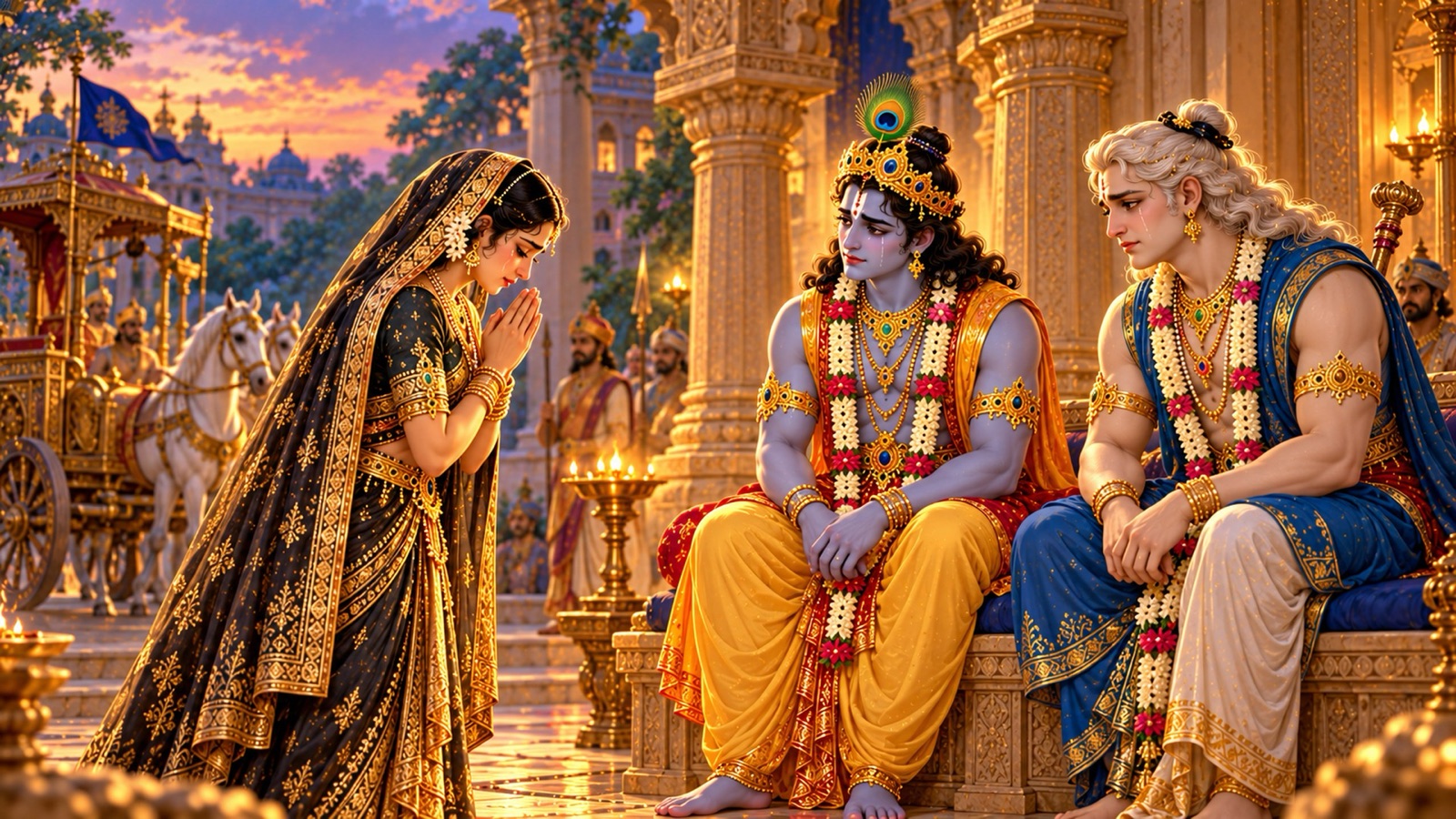
The two brothers, Lords of all yet moving among men as men, wept and spoke of the heavy blow that had fallen upon Them.
तदाकर्ण्येश्वरौ राजन्ननुसृत्य नृलोकताम् ।
अहो नः परमं कष्टमित्यस्राक्षौ विलेपतुः ॥ ९ ॥
tadākarṇyeśvarau rājann anusṛtya nṛ-lokatām aho naḥ paramaṁ kaṣṭam ity asrākṣau vilepatuḥ
Meaning: Hearing this, O King, the two Lords, following the ways of the human world, lamented with tearful eyes: ‘Alas, a great calamity has come upon us.’ (Canto 10, Chapter 57, verse 9)
The Lord then returned at once to Dwaraka with His consort and His elder brother, and made ready to kill Shatadhanva and recover the jewel.
Shatadhanva Seeks Help and Is Refused
Learning of Krishna’s resolve, Shatadhanva feared for his life and ran first to Kritavarma. But the man who had whispered the plot would not stand behind it. He declared that he dared not offend the two divine brothers, for no one who had harmed Them had ever found any peace; Kamsa and his followers had perished through enmity with Them, and Jarasandha had fled seventeen battles robbed even of his chariot.
नाहमीश्वरयोः कुर्यां हेलनं रामकृष्णयोः ।
को नु क्षेमाय कल्पेत तयोर्वृजिनमाचरन् ॥ १२ ॥
nāham īśvarayoḥ kuryāṁ helanaṁ rāma-kṛṣṇayoḥ ko nu kṣemāya kalpeta tayor vṛjinam ācaran
Meaning: I will not show disrespect to Rama and Krishna, the two Lords. Who that acts wrongly against Them can hope to be well? (Canto 10, Chapter 57, verse 12)
Refused there, Shatadhanva turned to Akrura — and Akrura’s answer rose from refusal into praise. Who, knowing the strength of the two Lords, would dare stand against Them? Krishna creates, protects and withdraws this universe as play; even the creators of the worlds, bewildered by His Maya, cannot grasp His ways; as a boy of seven He tore up a mountain and held it in one hand as easily as a child lifts a mushroom.
नमस्तस्मै भगवते कृष्णायाद्भुतकर्मणे ।
अनन्तायादिभूताय कूटस्थायात्मने नमः ॥ १७ ॥
namas tasmai bhagavate kṛṣṇāyādbhuta-karmaṇe anantāyādi-bhūtāya kūṭa-sthāyātmane namaḥ
Meaning: Obeisance to that glorious Lord Krishna of wondrous deeds; obeisance to Him who is infinite, the first of all beings, the unchanging Self. (Canto 10, Chapter 57, verse 17)
The men who had urged the crime knew whom they were dealing with; their dread and their praise alike confess that the Lord’s power was never in doubt, only the will to obey Him. Turned away by both, Shatadhanva left the gem in Akrura’s keeping, mounted a horse that could cover a hundred yojanas in a single journey, and fled Dwaraka.
The Pursuit and the Missing Jewel
Balarama and Krishna mounted Their chariot, its banner marked with Garuda, drawn by four horses of extraordinary speed, and gave chase to the slayer of Their father-in-law.
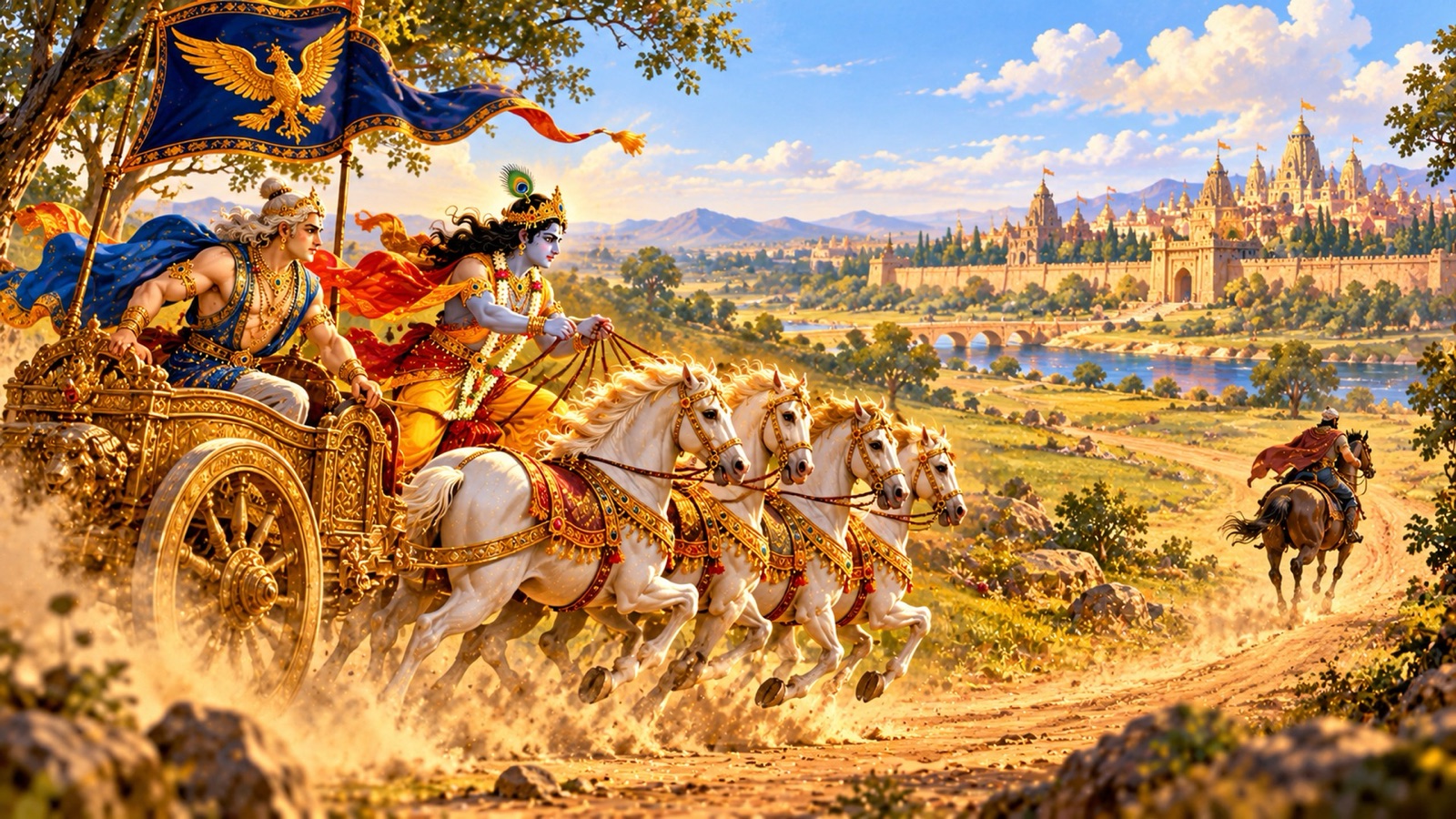
In a garden on the outskirts of Mithila, Shatadhanva’s horse collapsed exhausted. In terror he ran on foot, and Krishna, in fairness to an enemy on foot, pursued him on foot as well and cut off his head with His sharp-edged discus. Then the Lord searched the man’s upper and lower garments for the jewel — and did not find it. Returning to the chariot, He told His elder brother that Shatadhanva had been slain in vain, for the gem was not on him. Balarama answered that the jewel must have been left with someone in Dwaraka, and that Krishna should return and seek him out.
Balarama in Mithila, and a Grieving Household Consoled
Balarama Himself wished to see His dear friend the king of Videha, and so He entered Mithila. The king rose at once in joy and worshipped Him according to scripture with fitting gifts, and Balarama, honoured by the great-souled Janaka, stayed in that city for several years; during that time Suyodhana, the son of Dhritarashtra, learned the art of the mace at His feet.
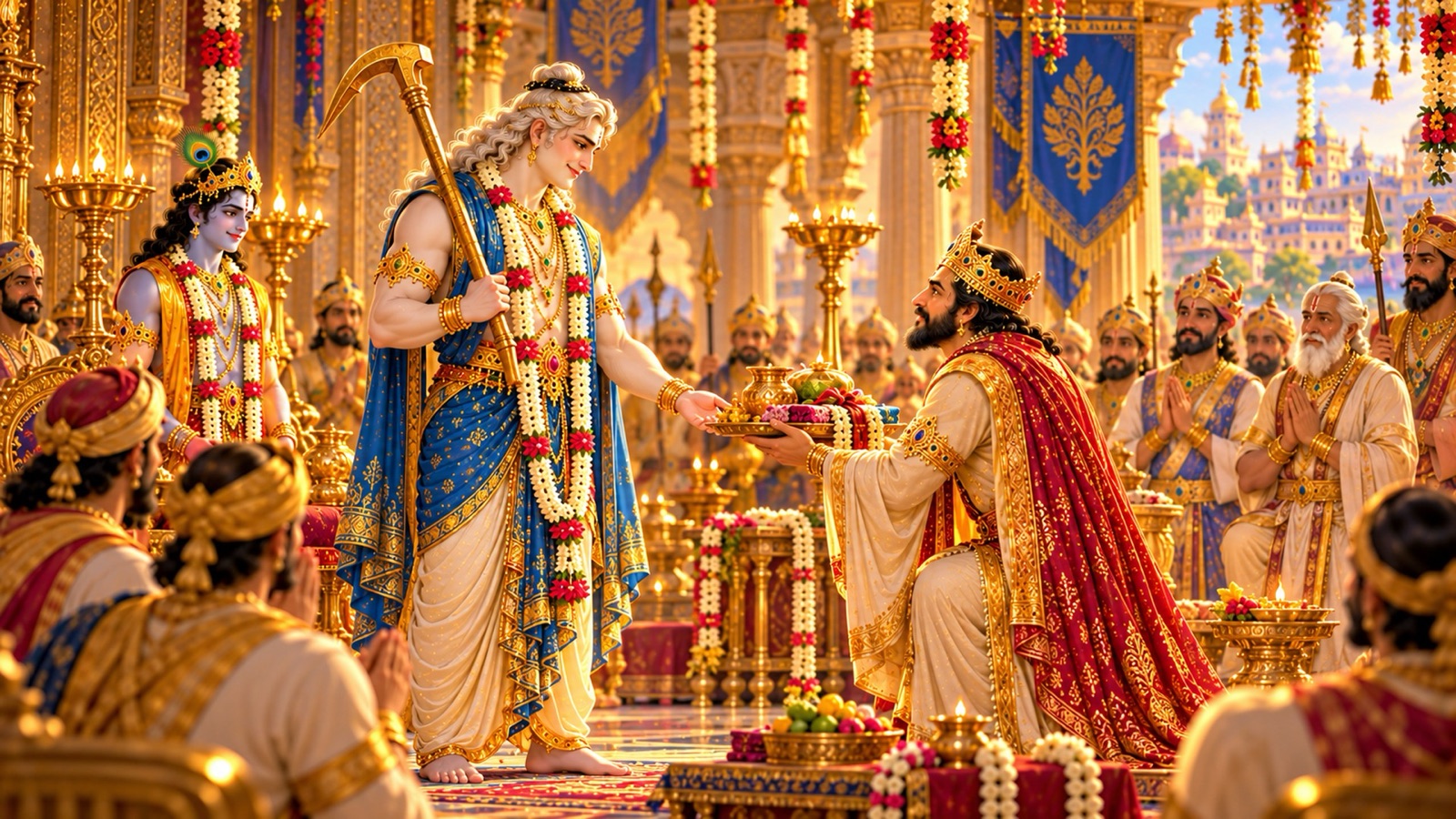
Krishna meanwhile reached Dwaraka and told Satyabhama how He had slain Shatadhanva yet had not recovered the gem, wishing to comfort her with the news that her father’s killer was no more. Then, with His kinsmen, He had every funeral rite performed for the murdered Satrajit that secures a soul’s welfare in the world beyond.
Akrura’s Flight and the Omens in Dwaraka
When Akrura and Kritavarma heard that Shatadhanva had been killed, fear seized them, and they left Dwaraka. Some say that from the time Akrura went away, evil omens appeared to the people of the city, and troubles of body and mind, from the gods and from other beings, afflicted them again and again. But Sukadeva set the record straight for Parikshit: those who teach this have forgotten what was declared earlier. How could ill omens ever be seen in the city where the Lord Himself dwells, the resting place of sages whose very presence dispels all evil?
इत्यङ्गोपदिशन्त्येके विस्मृत्य प्रागुदाहृतम् ।
मुनिवासनिवासे किं घटेतारिष्टदर्शनम् ॥ ३१ ॥
ity aṅgopadiśanty eke vismṛtya prāg udāhṛtam muni-vāsa-nivāse kiṁ ghaṭetāriṣṭa-darśanam
Meaning: Thus, dear King, some instruct, forgetting what was stated before; how could evil portents ever occur in the dwelling of Him who is the abode of the sages? (Canto 10, Chapter 57, verse 31)
The elders of Dwaraka nonetheless recalled an old history. Once, when Indra withheld the rains in Kashi, its ruler gave his daughter Gandini in marriage to Shvaphalka, Akrura’s father, who had come to his city, and the rains fell. Akrura, they said, had inherited that virtue.
तत्सुतस्तत्प्रभावोऽसावक्रूरो यत्र यत्र ह ।
देवोऽभिवर्षते तत्र नोपतापा न मारिकाः ॥ ३३ ॥
tat-sutas tat-prabhāvo ’sāv akrūro yatra yatra ha devo ’bhivarṣate tatra nopatāpā na mārikāḥ
Meaning: His son Akrura carries that same power: wherever he stays, Indra sends rain, and there neither afflictions nor epidemics arise. (Canto 10, Chapter 57, verse 33)
Hearing the elders, and knowing well that Akrura’s absence was not the only cause of the city’s troubles, Krishna had him brought back with honour and spoke with him.
The Jewel Revealed
The Lord, who knows all and reads every heart, received Akrura with respect, conversed with him pleasantly, and then, smiling, came to the matter. He said it was already known to Him that Shatadhanva had deposited the glorious Syamantaka with Akrura, that master of charity. Satrajit had left no son, so the sons of his daughter Satyabhama should offer him the oblations of water and food, pay his debts and inherit his estate.
तथापि दुर्धरस्त्वन्यैस्त्वय्यास्तां सुव्रते मणिः ।
किन्तु मामग्रजः सम्यङ् न प्रत्येति मणिं प्रति ॥ ३८ ॥
tathāpi durdharas tv anyais tvayy āstāṁ su-vrate maṇiḥ kintu mām agrajaḥ samyaṅ na pratyeti maṇiṁ prati
Meaning: Still, let the jewel remain with you, O man of firm vows, for others could hardly keep it; only My elder brother does not fully believe Me concerning the gem. (Canto 10, Chapter 57, verse 38)
So let Akrura, the Lord continued, show the jewel and bring peace to the family; and with a gentle smile He added that Akrura’s sacrifices were going on without pause these days upon altars of gold — wealth that only the Syamantaka could explain. Won over by these sweet words, Akrura brought out the gem, radiant as the sun, wrapped in cloth, and placed it before the Lord.
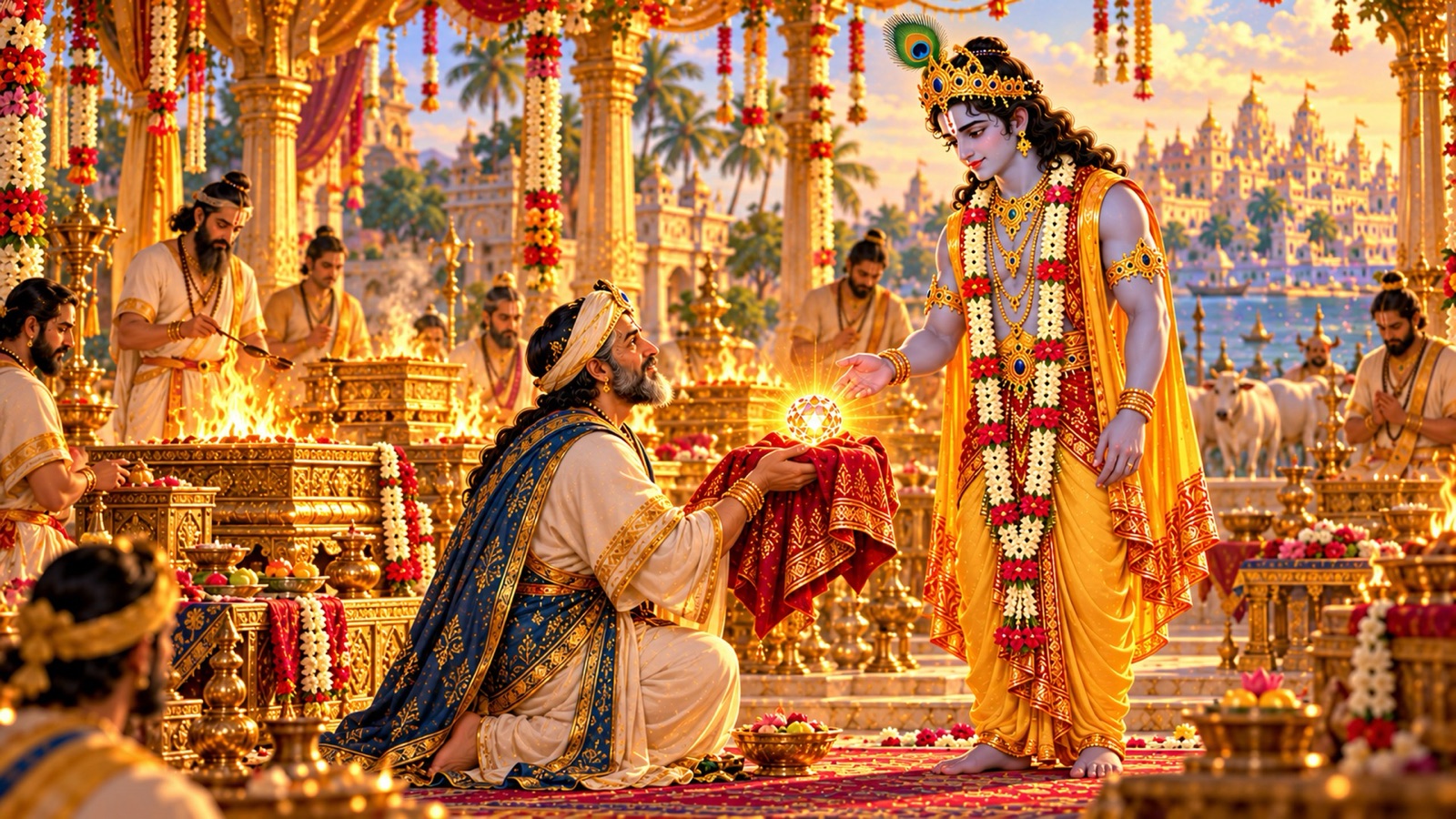
Krishna showed the Syamantaka to His kinsmen, and with that one sight the blame that had clung to Him was rubbed away; then He gave the jewel back to Akrura.
Why did the Lord, who could have claimed the gem by every right of kinship and conquest, hand it away again? Because the jewel had never been what He wanted. From the moment the slander arose, Krishna’s whole concern was to clear His name before His own people and to settle the matter in dharma — the dead honoured, the heirs provided for, Balarama’s doubt dissolved, a devotee of firm vows trusted with what others could not hold. The Lord who owns all worlds asks of them only a clean heart and an honest account; wealth He leaves with those who will use it in His service.
The Fruit of Hearing This History
Sukadeva closed the account with its blessing.
यस्त्वेतद् भगवत ईश्वरस्य विष्णोर्वीर्याढ्यं वृजिनहरं सुमङ्गलं च ।
आख्यानं पठति शृणोत्यनुस्मरेद् वा दुष्कीर्तिं दुरितमपोह्य याति शान्तिम् ॥ ४२ ॥
yas tv etad bhagavata īśvarasya viṣṇor vīryāḍhyaṁ vṛjina-haraṁ su-maṅgalaṁ ca ākhyānaṁ paṭhati śṛṇoty anusmared vā duṣkīrtiṁ duritam apohya yāti śāntim
Meaning: Whoever reads, hears or remembers this most auspicious account, rich in the prowess of Lord Vishnu, the Supreme Lord, and destructive of sin, casts off ill repute and wrongdoing and attains peace. (Canto 10, Chapter 57, verse 42)
Principal Teachings of This Chapter
1. Greed finds its own instrument. Akrura and Kritavarma spoke the plot; Shatadhanva carried it out; all three fled its consequences. A wrong desire, once voiced, looks for hands to serve it.
2. Knowing the Lord’s power is not the same as obeying Him. Kritavarma admitted that no enemy of Rama and Krishna ever prospered, and Akrura sang a hymn to the Lord of wondrous deeds — yet both had just encouraged a crime. Devotion begins where knowledge becomes surrender of the will.
3. The Lord honours human ways. Krishna wept for Satrajit, travelled to console the Kurus, and performed every rite for a man who had slandered Him. His divinity never excused Him from kindness or duty.
4. Where the Lord dwells, no evil can truly abide. Sukadeva corrected the tale of omens: the home of the Lord, the shelter of sages, cannot harbour ill portents.
5. A devotee blesses his whole land; the Lord wants hearts, not treasure. Rain followed Akrura wherever he lived because he carried his father’s virtue; and once the gem had dissolved every doubt, Krishna gave it back to him. The Lord seeks our trust, not our wealth.
A Devotional Reflection
What stays with the heart in this chapter is how patiently Krishna bears a stain He never earned. The slander began with Satrajit; the murder came from men who owed the Lord their loyalty; the missing gem left even Balarama unsure. At every point Krishna could have swept the matter aside with His power. Instead He weeps, consoles, pursues, performs the rites, listens to the elders, and wins Akrura with gentle words rather than command. We who grow restless when misunderstood may learn here. The Lord does not hurry to vindicate Himself; He lets dharma do its slow work until the truth is seen by all. If He can wait so gently for His name to be cleared, surely we can hold our own small injuries with less heat, trusting that truth will one day be shown in the open like the Syamantaka in Krishna’s hand.
A Daily Devotional Practice
Today, when you feel misjudged or wrongly blamed, pause before defending yourself and offer the matter to the Lord who waited so long to unwrap the Syamantaka. Then, if some duty toward another person waits unfinished — a word of comfort, a debt, a rite of remembrance — attend to it today as Krishna attended to Satrajit’s. Close the day by chanting softly: Om Namo Bhagavate Vasudevaya.
Conclusion
This chapter brings the long story of the Syamantaka to rest. Through a murder in Dwaraka, a chase to the gates of Mithila and the recall of Akrura, Krishna moves with sorrow, fairness and patience until the jewel lies open before His kinsmen and no shadow remains upon Him. May we learn from the Lord to bear misunderstanding with grace, to fulfil our duties to the living and the departed, and to remember that where He dwells no evil can truly abide.
May the divine wisdom of Srimad Bhagavatam awaken pure devotion within our hearts.
Om Namo Bhagavate Vasudevaya.
Jay Shree Madhav.
References and Attribution
- Primary edition: Gita Press, Śrīmad Bhāgavata Mahāpurāṇa (English), Book Ten (Latter Half), Discourse 57.
- Series: Srimad Bhagavatam Wisdom · Biswa Sanatan Dharma Seva Trust.
- Presented following the spiritual guidance and recommendation of Pandit Dr. Shri Kashinath Mishra.
This is an original, faithful retelling in the writer’s own words, with brief quoted verses shown in Devanāgarī and transliteration and their meanings given as summaries. It is not a reproduction of any single publisher’s continuous translation or commentary. No affiliation with or endorsement by any publisher is implied.
Jay Shree Madhav