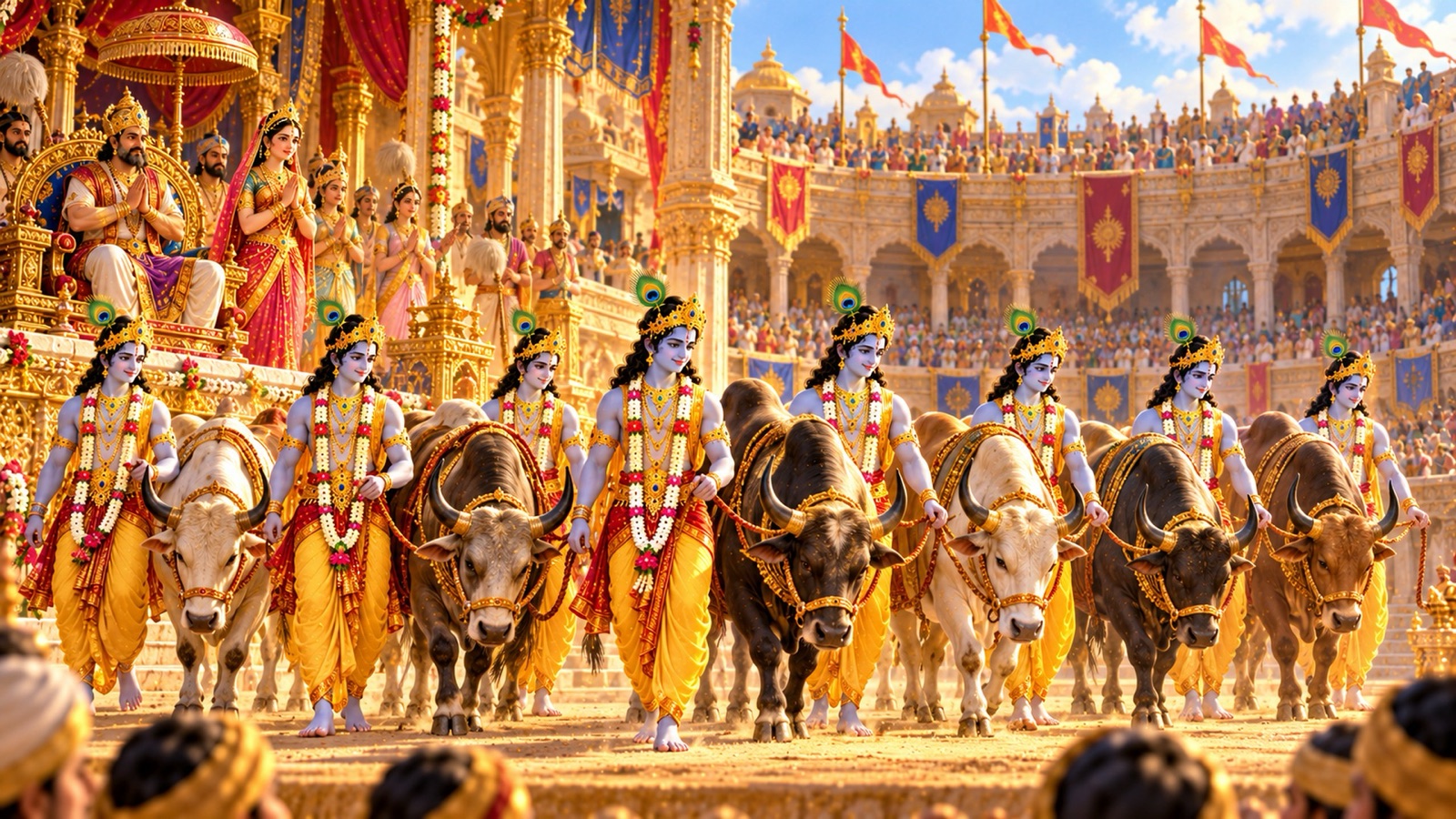
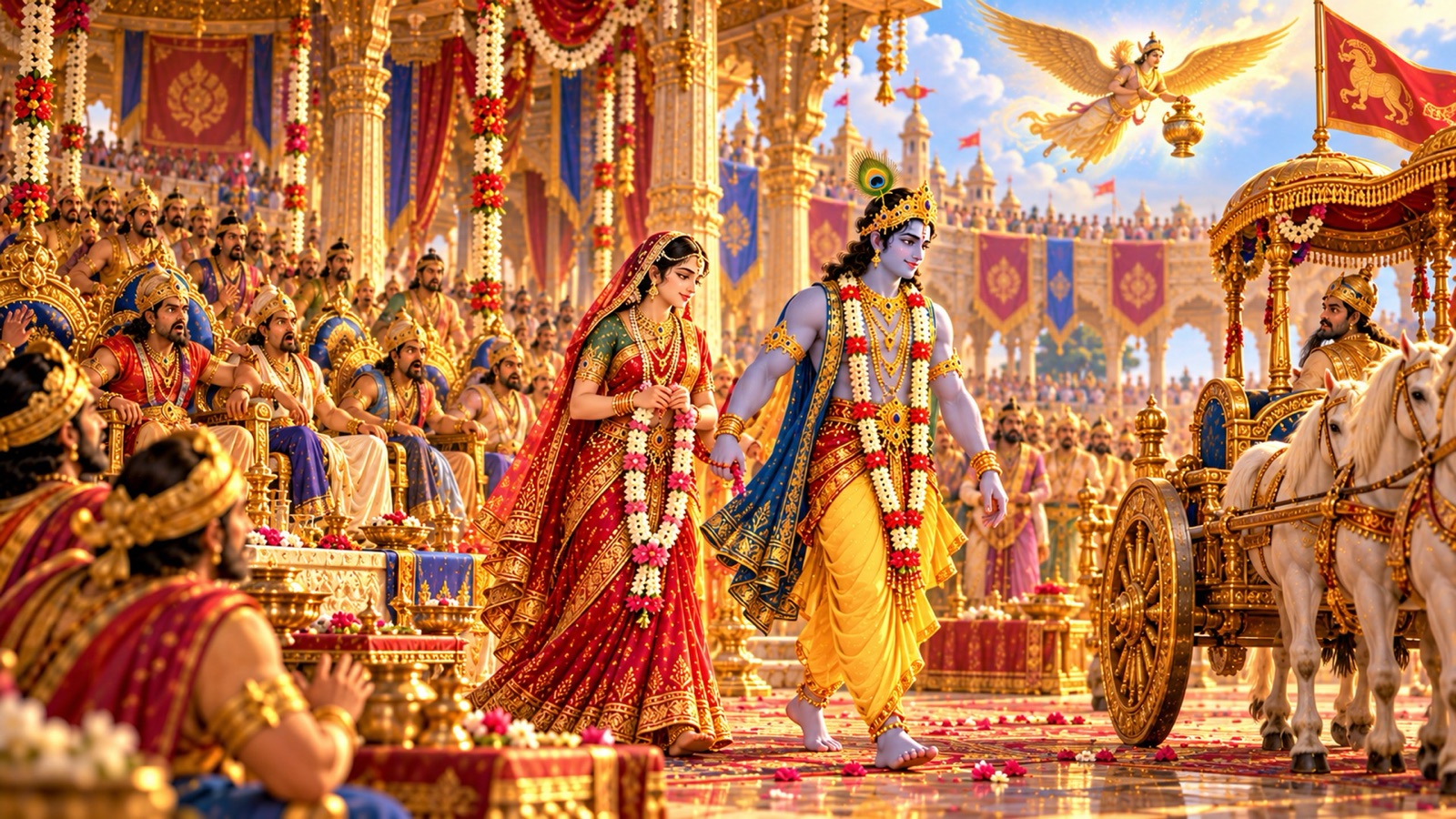
Seven untamed bulls that had broken the limbs of princes are led across the royal ground of Ayodhya like wooden toys — and the daughter of Nagnajit sees the Lord she had prayed for standing before her as her bridegroom.
Om Namo Bhagavate Vasudevaya.
Om Namo Bhagavate Vasudevaya.
Om Namo Bhagavate Vasudevaya.
Welcome back to Srimad Bhagavatam Wisdom, our devotional journey through the sacred histories and teachings of the Srimad Bhagavat Mahapurana. In this fifty-eighth chapter of the Tenth Canto, Krishna spends the rains with the Pandavas at Indraprastha; then follow the weddings of Kalindi, Mitravinda, Satya, Bhadra and Lakshmana, in which the Lord, complete in His own bliss, allows Himself to be won by hearts set on Him alone.
Chapter Information
- Scripture: Śrīmad Bhāgavata Mahāpurāṇa
- Canto: 10 (Book Ten, Latter Half)
- Chapter: 58 (Discourse 58)
- Chapter title: Krishna Marries Five Princesses
- Principal speaker: Sukadeva Gosvami (narrating to King Parikshit)
- Principal listener: King Parikshit
- Main setting: Indraprastha, the bank of the Yamunā, Ayodhyā in Kosala, and Dvārakā
- Central subject: Krishna’s stay with the Pandavas; His marriages to Kalindi, Mitravinda, Satya (Nagnajiti), Bhadra and Lakshmana
- Principal verse range: Canto 10, Chapter 58, verses 1–58
- Primary edition: Gita Press Śrīmad Bhāgavata Mahāpurāṇa (English, Book Ten)
The Lord Comes to Indraprastha
Once, Sukadeva told Parikshit, the glorious Krishna set out for Indraprastha with Satyaki and other companions to see the sons of Pandu, who had emerged safely from the house of lac. When the heroic sons of Pritha saw Mukunda, the Lord of all, at their door, they rose together at once, as the senses come alive when the life-breath returns. They embraced the infallible Lord, whose touch wiped away whatever sin remained in them, and gazing on His face bright with affectionate smiles they were filled with joy.
Krishna bowed at the feet of Yudhishthira and Bhima, His elders, embraced Arjuna, and received the salutations of Nakula and Sahadeva. Then Draupadi — Krishna by name as well, blameless, newly wedded and a little shy — came slowly forward to the Lord on His splendid seat and bowed before Him. Satyaki and the other companions were honoured and seated around Him.
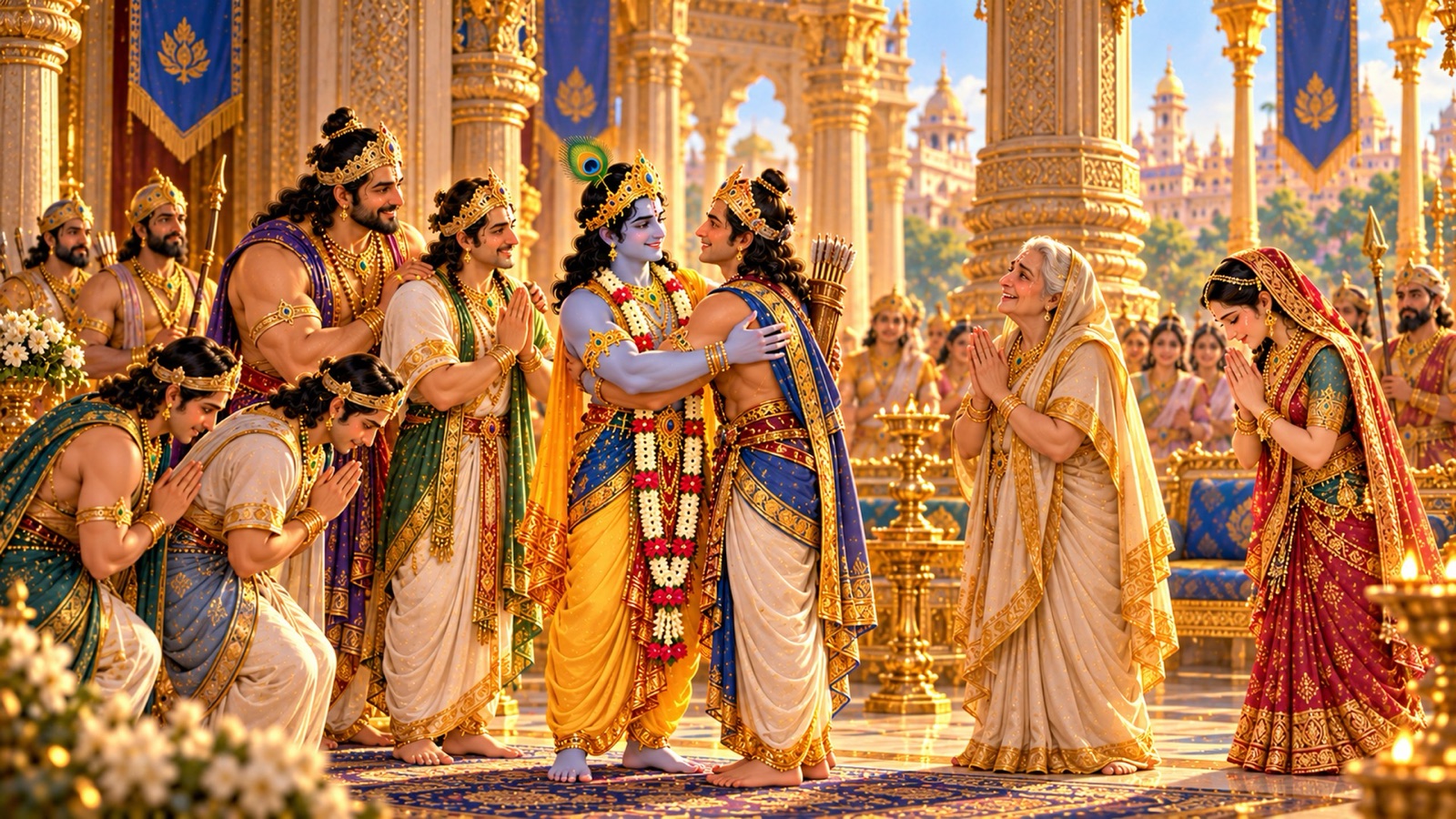
Then the Lord went to His father’s sister Pritha, whom we know as Kunti. He bowed to her, and she embraced Him with eyes wet with affection; He asked after her welfare and that of her daughter-in-law, and she asked Him about all their kinsfolk.
Kunti’s Words and Yudhishthira’s Humility
Remembering her many past sorrows, Kunti felt her throat tighten and her eyes fill with tears as she spoke to the Lord, whose very appearance ends suffering. “From the moment You remembered us and sent my brother Akrura to us,” she said, “our welfare returned and we were no longer without a protector.” Then she spoke the words that every devotee treasures.
न तेऽस्ति स्वपरभ्रान्तिर्विश्वस्य सुहृदात्मनः ।
तथापि स्मरतां शश्वत् क्लेशान् हंसि हृदि स्थितः ॥ १० ॥
na te ‘sti sva-para-bhrāntir viśvasya suhṛd-ātmanaḥ tathāpi smaratāṁ śaśvat kleśān haṁsi hṛdi sthitaḥ
Meaning: In You, the friend and very Self of the universe, there is no delusion of “mine” and “another’s“; yet, dwelling in the heart of those who constantly remember You, You destroy their sufferings. (Canto 10, Chapter 58, verse 10)
Yudhishthira, too, could only wonder at his good fortune: what merit, he asked, could dull-witted men like themselves have earned, that the Lord whom even the masters of yoga can scarcely behold had come before their eyes? Entreated by the king, the Lord gladly stayed through the four months of the rains, and the people of Indraprastha drank in the sight of Him with delight.
Arjuna’s Hunt and the Maiden by the Yamuna
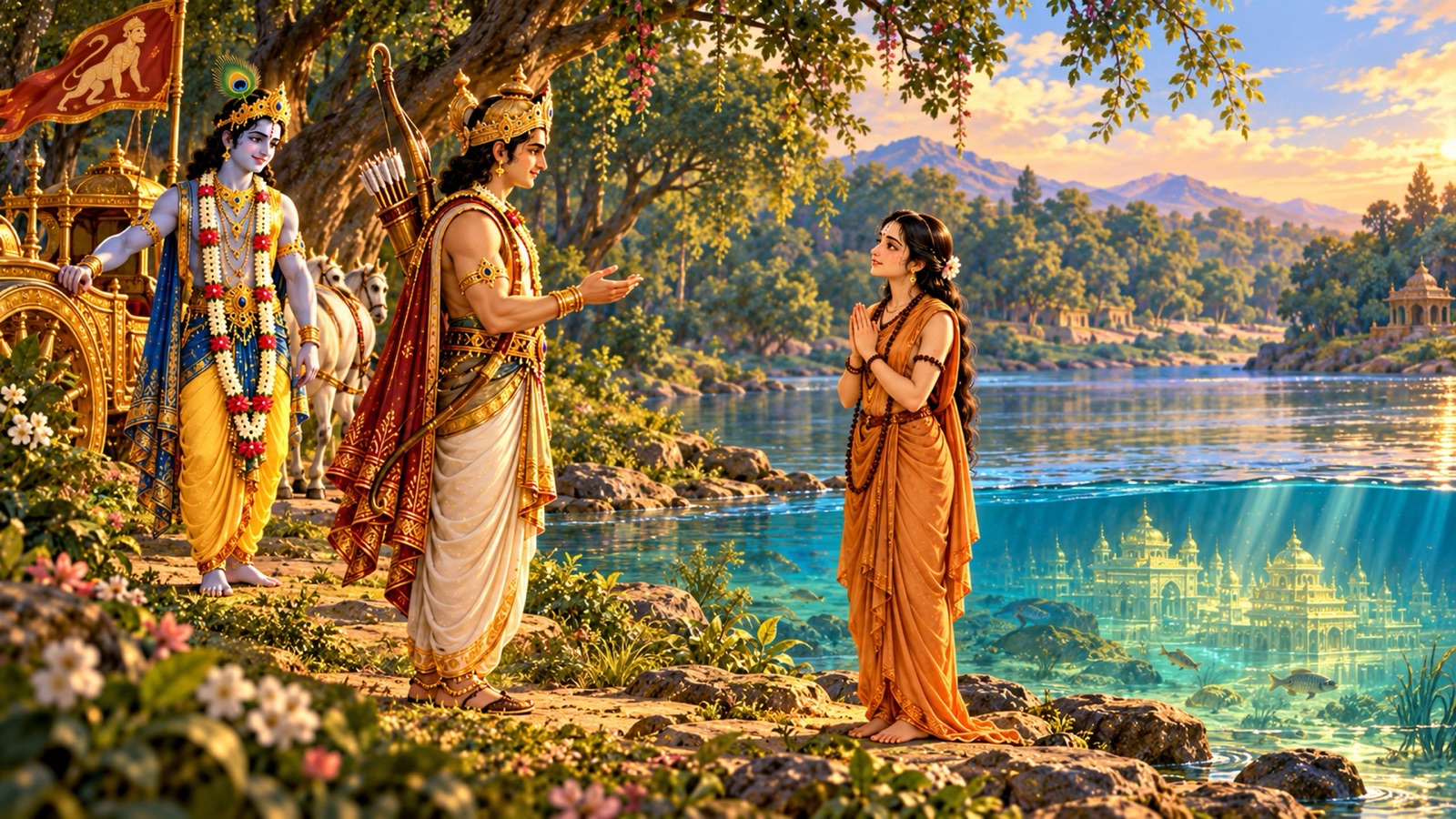
One day Arjuna put on his armour, took up the Gandiva bow and his two inexhaustible quivers, and mounted his monkey-bannered chariot. With Krishna beside him he entered a great forest to hunt, bringing down tigers, boars, buffaloes, deer, rhinoceroses, hares and porcupines; the animals fit for sacrifice were carried to King Yudhishthira, for the full-moon day was near. Thirsty and tired, Arjuna went to the Yamuna, where the two Krishnas bathed and drank its clear water.
There on the bank they noticed a lovely young woman walking alone. Sent by his divine friend, Arjuna approached the fair maiden with the beautiful teeth and gracious face and asked her: “Who are you, whose daughter, and where have you come from? What do you intend to do here? I think you are seeking a husband — tell me everything, gentle one.”
Kalindi, Daughter of the Sun
The maiden answered that she was the daughter of the glorious sun-god and that she was performing the severest austerities because she wished to have Vishnu, the giver of all boons, as her husband.
नान्यं पतिं वृणे वीर तमृते श्रीनिकेतनम् ।
तुष्यतां मे स भगवान् मुकुन्दोऽनाथसंश्रयः ॥ २१ ॥
nānyaṁ patiṁ vṛṇe vīra tam ṛte śrī-niketanam tuṣyatāṁ me sa bhagavān mukundo ‘nātha-saṁśrayaḥ
Meaning: I will choose no other husband, O hero, than Him who is the abode of Sri; may that Lord Mukunda, the shelter of the shelterless, be pleased with me. (Canto 10, Chapter 58, verse 21)
“I am known as Kalindi,” she went on, “and I live in a mansion my father built for me within the waters of the Yamuna. There I shall remain until I see the infallible Lord.” Arjuna told Krishna, who already knew; the Lord took her into His chariot and drove back to Yudhishthira.
Here Sukadeva recalled how dearly the Lord had served the Pandavas. At their request He had had Vishvakarma build that wonderful city for them, and living among them He had driven Arjuna’s chariot when the Khandava forest was offered to Agni. The grateful god of fire gave Arjuna the Gandiva, a chariot with four white horses, two inexhaustible quivers and an impenetrable armour; and Maya, the architect rescued from the blaze, built for Arjuna the assembly hall in which Duryodhana would one day mistake water for floor and floor for water.
When the rains had passed, Krishna took leave of Arjuna, Yudhishthira and His other dear ones and returned to Dwaraka. Then, on a day when stars, planets and season were all auspicious, the Lord, who is Himself the highest bliss, married Kalindi and brought great joy to all His people.
Mitravinda of Avanti
Vinda and Anuvinda, the kings of Avanti, followed Duryodhana’s will and forbade their sister Mitravinda — daughter of Rajadhidevi, Krishna’s own aunt — from choosing the Lord in her svayamvara, though her heart belonged to Him. Krishna carried Mitravinda away before the assembled princes, who could only stand and watch.
Satya, the Princess of Kosala
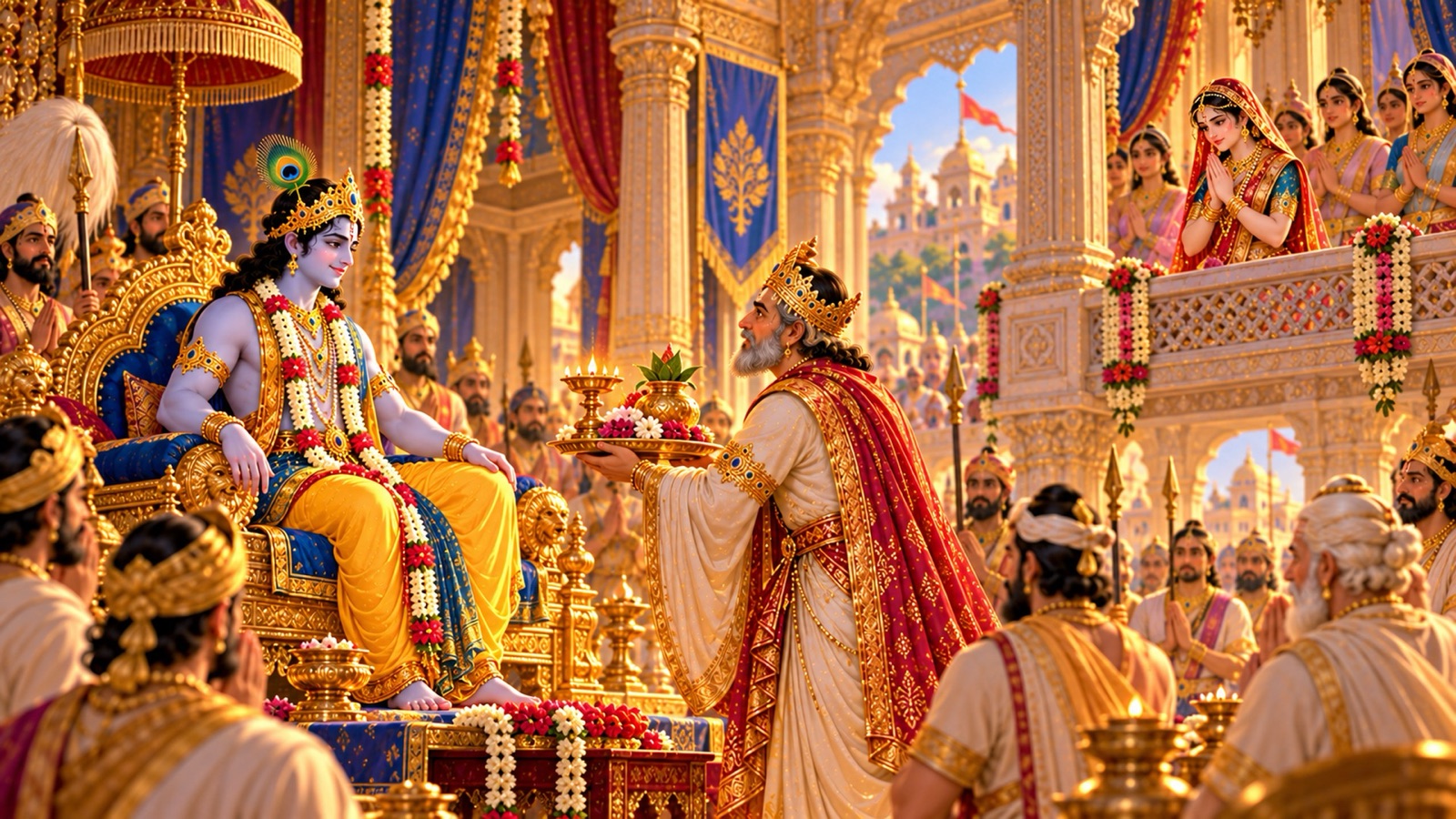
In Kosala there ruled a deeply righteous king named Nagnajit, whose daughter Satya was also called Nagnajiti after him. No prince had met her father’s condition: seven fierce, sharp-horned bulls, intolerant of a warrior’s very scent, had to be subdued to win her. Hearing of this, Krishna set out for Ayodhya, the capital of Kosala, with a great army. The delighted king came out to receive Him, offered Him a seat of honour and articles of worship, and was greeted warmly in return.
When the princess saw the husband of Lakshmi arrive in such splendour, her heart went out to Him; silently she prayed, “If I have truly kept my vows with Him as my goal, may He fulfil my hope and become my husband.”
यत्पादपङ्कजरजः शिरसा बिभर्ति श्रीरब्जजः सगिरिशः सहलोकपालैः ।
लीलातनुः स्वकृतसेतुपरीप्सया यः काले दधत् स भगवान् मम केन तुष्येत् ॥ ३७ ॥
yat-pāda-paṅkaja-rajaḥ śirasā bibharti śrīr abja-jaḥ sa-giriśaḥ saha loka-pālaiḥ līlā-tanuḥ sva-kṛta-setu-parīpsayā yaḥ kāle dadhat sa bhagavān mama kena tuṣyet
Meaning: Lakshmi, the lotus-born Brahma, Shiva and the guardians of the worlds carry the dust of His lotus feet upon their heads; to protect the codes of conduct He Himself has laid down, He assumes pastime-forms from age to age. By what effort of mine could that Lord be pleased? (Canto 10, Chapter 58, verse 37)
King Nagnajit, having worshipped Krishna, spoke humbly: “O Narayana, Lord of the universe, You are full in the bliss of Your own Self — what can a poor man like me do for You?”
The Lord Asks and the King Answers
Krishna, seated at ease and smiling, answered in a voice as deep as thunder from a rain-cloud.
नरेन्द्र याच्ञा कविभिर्विगर्हिता राजन्यबन्धोर्निजधर्मवर्तिनः ।
तथापि याचे तव सौहृदेच्छया कन्यां त्वदीयां न हि शुल्कदा वयम् ॥ ४० ॥
narendra yācñā kavibhir vigarhitā rājanya-bandhor nija-dharma-vartinaḥ tathāpi yāce tava sauhṛdecchayā kanyāṁ tvadīyāṁ na hi śulka-dā vayam
Meaning: The Lord said: O king, the wise condemn begging on the part of a kshatriya who abides by his own duty. Yet, wishing for your friendship, I ask you for your daughter — for we are not givers of any bride-price. (Canto 10, Chapter 58, verse 40)
The king replied that no bridegroom could be worthier than the Lord on whose chest Sri herself dwells forever. But a vow had been made, he explained, to test the valour of suitors: here stood seven bulls of terrible strength who had broken the limbs of many princes. “If You alone can curb them, O scion of Yadu, You will be my daughter’s chosen husband, O Lord of Sri.”
Seven Bulls Led Like Wooden Toys
Hearing the condition, the Lord tightened His girdle, made Himself sevenfold, and brought the seven bulls under control as if in play.
बद्ध्वा तान् दामभिः शौरिर्भग्नदर्पान् हतौजसः ।
व्यकर्षल्लीलया बद्धान् बालो दारुमयान् यथा ॥ ४६ ॥
baddhvā tān dāmabhiḥ śaurir bhagna-darpān hataujasaḥ vyakarṣal līlayā baddhān bālo dāru-mayān yathā
Meaning: Binding them with ropes, Shauri — their pride broken and their strength spent — dragged the bound bulls about in sport, as a child drags toy bulls made of wood. (Canto 10, Chapter 58, verse 46)
Astonished and overjoyed, King Nagnajit gave Satya to Krishna, and the almighty Lord accepted His worthy bride with full rites, while the queens of Kosala rejoiced. Conchs and drums sounded, brahmanas chanted blessings, and men and women in fine garments celebrated. The king gave as dowry ten thousand cows, three thousand maidservants adorned with gold necklaces, nine thousand elephants, and chariots, horses and servants each a hundredfold more than the last. Then, his heart melting with love, he sent the couple forth in a chariot with a large army.
The Road to Dwaraka
The envious kings who had been defeated before by the Yadus, and lately by those very bulls, blocked the Lord’s path as He travelled with His bride. Arjuna, wielder of the Gandiva, was there to serve his friend; as they came showering arrows, he drove them off as a lion scatters small beasts. Krishna reached Dwaraka with the dowry and lived happily with Satya.
Bhadra and Lakshmana
Krishna next married Bhadra, princess of Kekaya, the daughter of His father’s sister Shrutakirti; her brothers, led by Santardana, themselves offered her to Him. Then, at the svayamvara of Lakshmana, daughter of the king of Madra and a princess bearing every auspicious mark, the Lord carried her off single-handed, as Garuda once bore away the nectar of the gods.
Sukadeva added that besides these the Lord had thousands of other lovely wives, brought home after He slew Bhaumasura and freed them from his prison.
Principal Teachings of This Chapter
1. The Lord dwells in the heart of those who remember Him. Kunti confesses that in the Lord there is no “mine” and “yours,” yet He sits in the heart of whoever remembers Him and removes their pain. Remembrance, not kinship, draws His protection.
2. His presence is grace, never our achievement. Yudhishthira cannot name a single merit that earned him the Lord’s company; the one who truly sees the Lord is left only with wonder and gratitude.
3. Austerity aimed at the Lord alone bears fruit. Kalindi’s penance beneath the Yamuna has one purpose — to have no husband but Mukunda — and such single-pointed longing is answered by the Lord Himself.
4. The Lord descends to protect the dharma He has established. Satya’s prayer names the One whose foot-dust Lakshmi, Brahma and Shiva bear on their heads, and who takes pastime-forms in every age to guard His own codes.
5. The Lord allows Himself to be won by love. Nagnajit confesses that the Lord is full in His own bliss and needs nothing; yet that same Lord sets aside a kshatriya’s dignity and asks a king for his daughter, pleading only for his friendship. He tames the bulls and accepts a dowry for hearts that wanted no one else — Kalindi had vowed to accept none but Him, and Satya had kept her vows with Him alone as her goal. These marriages are His sweet consent to be bound by the devotion of those who sought Him.
A Devotional Reflection
This chapter leaves us with a beautiful inversion. Everyone who meets Krishna here feels unworthy: Kunti weeps that He remembered them, Yudhishthira cannot find a merit to his name, Satya asks by what effort she could ever please Him. And the Lord, before whom all of them bow, lowers Himself again and again — bowing at the feet of His elders, asking a father for his daughter, pulling bulls on a rope like a boy at play. The shelter of the shelterless makes Himself approachable to the point of asking favours of His devotees.
Kalindi’s example speaks especially to a devotee’s heart. She did not run after the Lord; she stayed in one place, in prayer and austerity, certain that He would come. And He came — quietly, up from the river, sending a friend to ask her name. Longing that is single and patient need not search for Him; He knows where we wait.
A Daily Devotional Practice
Today, sit quietly for a few minutes and remember the Lord as Kunti described Him — dwelling in the heart of the one who remembers Him. Gently repeat His name, picturing Him seated within you and hearing every sorrow you carry; then offer Him one wish in Kalindi’s spirit: not for things, but for Him. Begin by chanting softly: Om Namo Bhagavate Vasudevaya.
Conclusion
In this fifty-eighth chapter the Lord stays with the Pandavas through the rains, finds Kalindi waiting beside the Yamuna, carries off Mitravinda, tames the seven bulls of Kosala to win Satya, and accepts Bhadra and Lakshmana. Through every scene runs one truth: the Lord who needs nothing lets Himself be won by those whose hearts hold nothing but Him. May we wait for Him as Kalindi waited and remember Him as Kunti did, so that He may dwell within us and take away our pain.
May the divine wisdom of Srimad Bhagavatam awaken pure devotion within our hearts.
Om Namo Bhagavate Vasudevaya.
Jay Shree Madhav.
References and Attribution
- Primary edition: Gita Press, Śrīmad Bhāgavata Mahāpurāṇa (English, Complete), Book Ten (Latter Half), Discourse 58.
- Series: Srimad Bhagavatam Wisdom · Biswa Sanatan Dharma Seva Trust.
- Presented following the spiritual guidance and recommendation of Pandit Dr. Shri Kashinath Mishra.
This is an original, faithful retelling in the writer’s own words, with brief quoted verses shown in Devanāgarī and transliteration and their meanings given as summaries. It is not a reproduction of any single publisher’s continuous translation or commentary. No affiliation with or endorsement by any publisher is implied.
Jay Shree Madhav