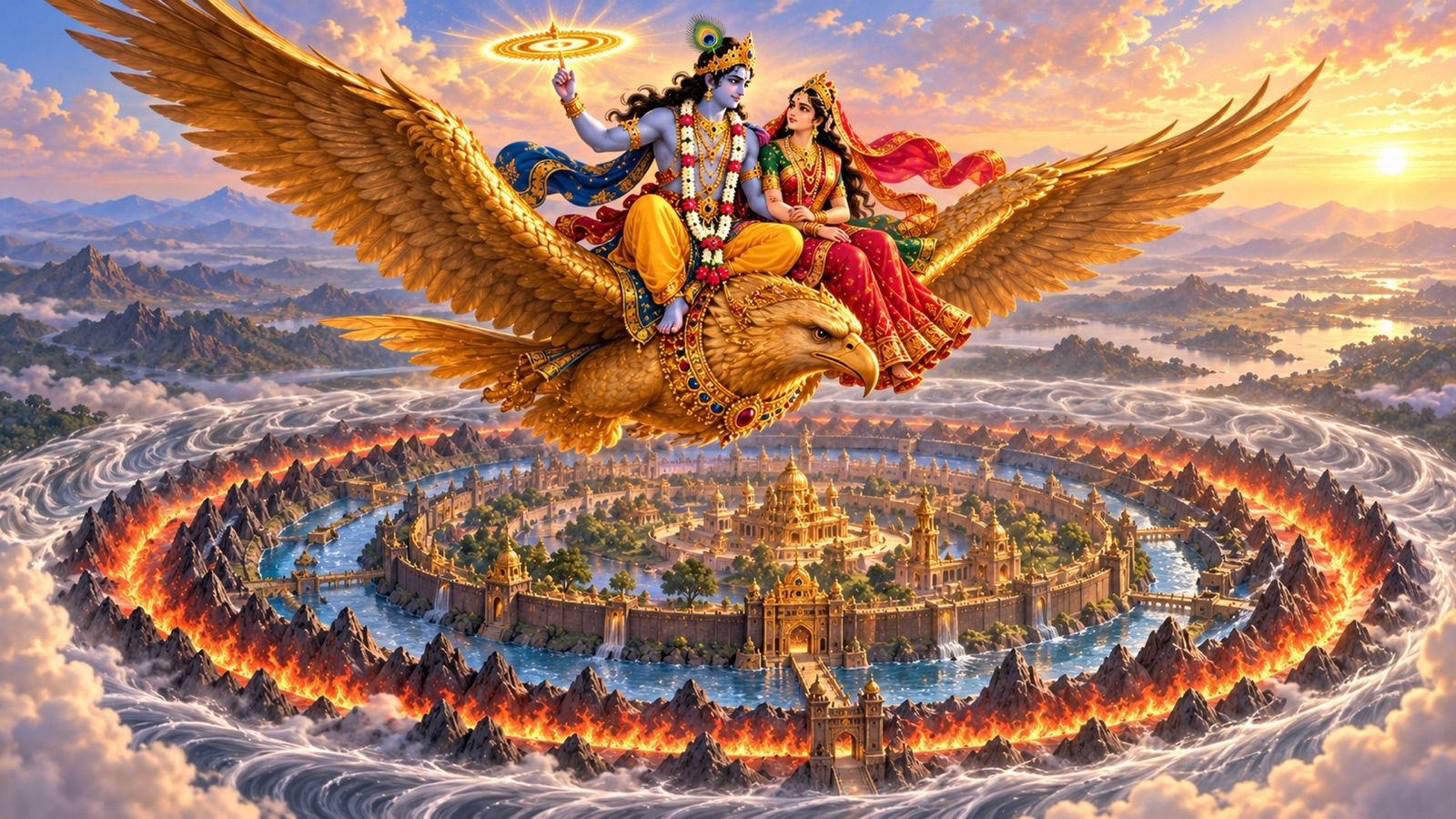
Riding Garuda with Satyabhama at His side, Krishna breaks through the walls of mountain, water, fire and wind around Pragjyotishapura, slays Naraka, and frees sixteen thousand captive princesses.
Om Namo Bhagavate Vasudevaya.
Om Namo Bhagavate Vasudevaya.
Om Namo Bhagavate Vasudevaya.
Welcome back to Srimad Bhagavatam Wisdom, our devotional journey through the sacred histories and teachings of the Srimad Bhagavat Mahapurana. In this fifty-ninth chapter of the Tenth Canto, Sukadeva Gosvami tells King Parikshit how the demon Naraka met his end and how the Lord delivered the imprisoned maidens and made them His own.
Chapter Information
- Scripture: Śrīmad Bhāgavata Mahāpurāṇa
- Canto: 10 (Latter Half)
- Chapter: 59
- Chapter title: The Killing of the Demon Naraka
- Principal speaker: Sukadeva Gosvami; Goddess Earth (Bhūmi) in her prayer
- Principal listener: King Parikshit
- Main setting: Prāgjyotiṣapura, the fortress-city of Naraka; Indra’s heaven; Dvārakā
- Central subject: The slaying of Mura and Narakāsura, Bhūmi’s prayer, the rescue of the princesses, the Pārijāta tree, and the Lord’s marriages
- Principal verse range: Canto 10, Chapter 59, verses 1–45
- Primary edition: Gita Press Śrīmad Bhāgavata Mahāpurāṇa (English)
Context From the Previous Chapter
Chapter 58 described how Krishna wedded Kalindi, Mitravinda, Satya, Bhadra and Lakshmana, completing His eight principal queens, and closed by remarking that thousands of other consorts had been rescued from the captivity of Bhaumasura after the Lord slew him.
Parikshit’s Question
King Parikshit then asked Sukadeva to recount that exploit of the wielder of the Sharnga bow: how was Bhauma, the demon born of Mother Earth, slain, and why had he confined so many women? Sukadeva answered with the whole history.
Indra’s Appeal and the Flight to Pragjyotishapura
The grievance came from heaven itself. Naraka, also called Bhauma, had carried off the royal umbrella of Varuna, robbed Aditi, mother of the gods, of her earrings, and seized Maniparvata, the jewelled summit of Mount Mandara where the gods dwelt. Indra laid these outrages before Krishna, and the Lord at once mounted Garuda, took His beloved Satyabhama with Him, and flew toward Pragjyotishapura, the demon’s capital.
That city was a fortress within a fortress: ramparts of mountains, batteries of weapons, belts of water, fire and wind, and tens of thousands of dreadful snares set by the demon Mura, Naraka’s ally. Krishna did not pause before any of it.
गदया निर्बिभेदाद्रीन् शस्त्रदुर्गाणि सायकैः ।
चक्रेणाग्निं जलं वायुं मुरपाशांस्तथासिना ॥ ४ ॥
gadayā nirbibhedādrīn śastra-durgāṇi sāyakaiḥ cakreṇāgniṁ jalaṁ vāyuṁ mura-pāśāṁs tathāsinā
Meaning: He broke the mountain ramparts with His mace, the weapon-fortifications with His arrows, the barriers of fire, water and wind with His discus, and the snares of Mura with His sword. (Canto 10, Chapter 59, verse 4)
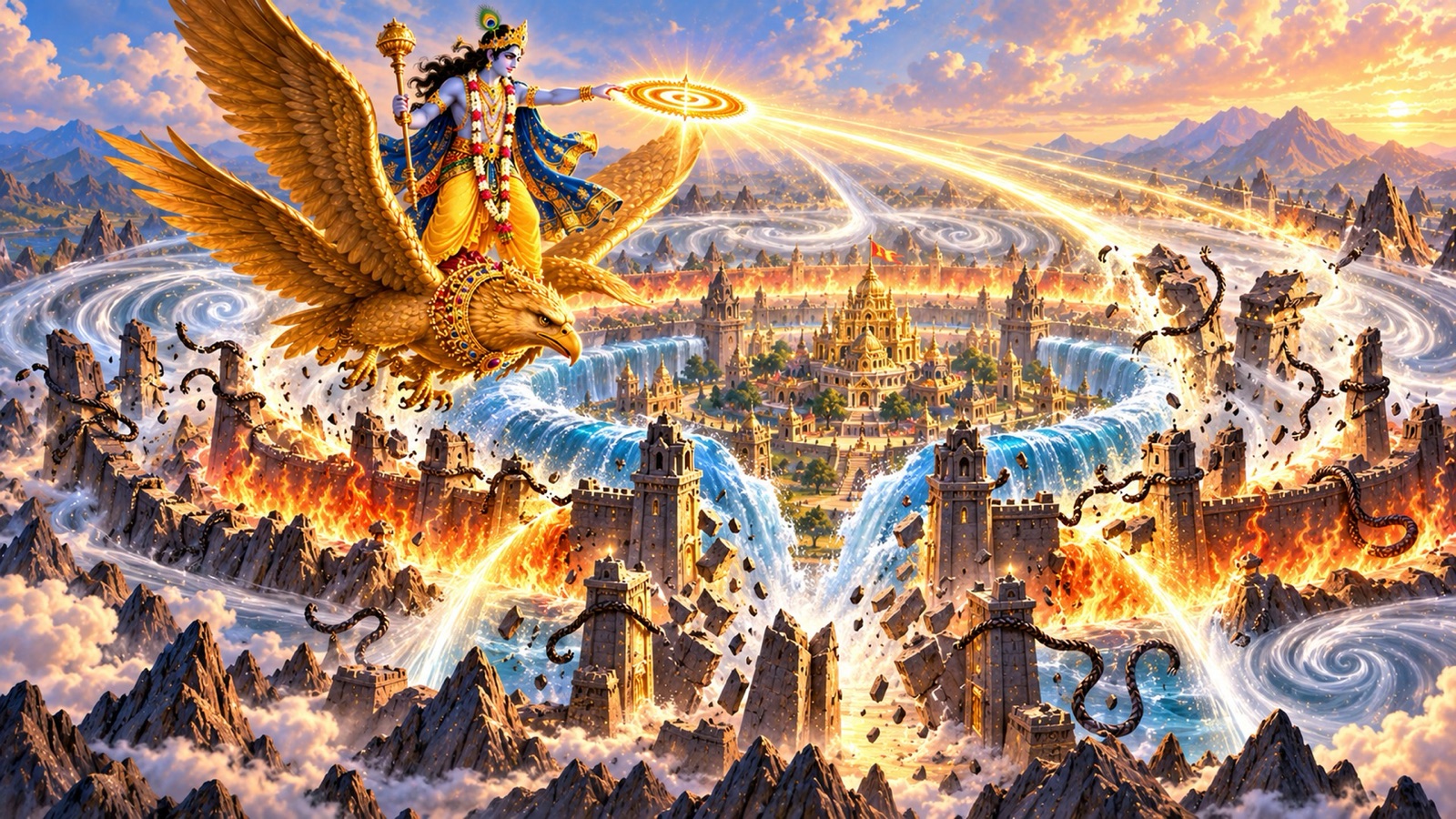
Then Gadadhara blew His conch Panchajanya. Its blast tore the war-engines from the ramparts and shook the courage of the defenders, and His heavy mace Kaumodaki brought down the city wall itself.
The Fall of the Five-Headed Mura
That conch-blast was terrible as the thunder at the end of an age. Hearing it, the five-headed demon Mura, asleep beneath the water of the moat, rose up. Lifting his trident, blazing like the fire of universal dissolution, he rushed at Garuda like a serpent, as though to swallow the three worlds with his five mouths, and his roar filled earth and sky.
Krishna broke the flying trident in three with two arrows, struck the demon’s mouths with more, and splintered Mura’s hurled mace into a thousand pieces with His own. As the demon charged with arms upraised, the unconquerable Lord, in mere sport, took off all five heads with His discus, and Mura fell lifeless into the water like a mountain whose peak Indra’s thunderbolt has sheared away.
The Seven Sons and the Army of Naraka
Mura’s seven sons, grief-stricken and burning for revenge, were sent out by Naraka under their general Pitha: Tamra, Antariksha, Shravana, Vibhavasu, Vasu, Nabhasvan and Aruna hurled a storm of weapons at the Lord. Krishna, whose prowess never fails, cut that mass of weapons into pieces as fine as sesame seeds and sent Pitha and his companions to the abode of Death.
Watching his generals fall, Naraka rode out in rage with an army of ocean-born elephants descended from Airavata. Seeing Krishna on Garuda with Satyabhama beside Him, like a dark cloud joined with lightning above the sun, he flung at Him the javelin Shataghni, and all his warriors struck together. With sharp arrows Krishna at once shattered that army and cut down every weapon the enemy had loosed. Garuda, striking with wings, beak and claws, drove the elephants back into the city, and Naraka fought on alone.
The Death of Naraka
The son of Earth hurled at Garuda the spear that had once turned back Indra’s thunderbolt; pierced by it, Garuda did not flinch, like an elephant brushed by a garland. Foiled, Naraka took up a pike to strike Krishna Himself.
शूलं भौमोऽच्युतं हन्तुमाददे वितथोद्यमः ।
तद्विसर्गात् पूर्वमेव नरकस्य शिरो हरिः ।
अपाहरद् गजस्थस्य चक्रेण क्षुरनेमिना ॥ २१ ॥
śūlaṁ bhaumo ’cyutaṁ hantum ādade vitathodyamaḥ tad-visargāt pūrvam eva narakasya śiro hariḥ apāharad gaja-sthasya cakreṇa kṣura-neminā
Meaning: His effort frustrated, Bhauma seized a pike to kill the infallible Lord; but even before he could throw it, Hari with His sharp-edged discus took off the head of Naraka, who was mounted on his elephant. (Canto 10, Chapter 59, verse 21)
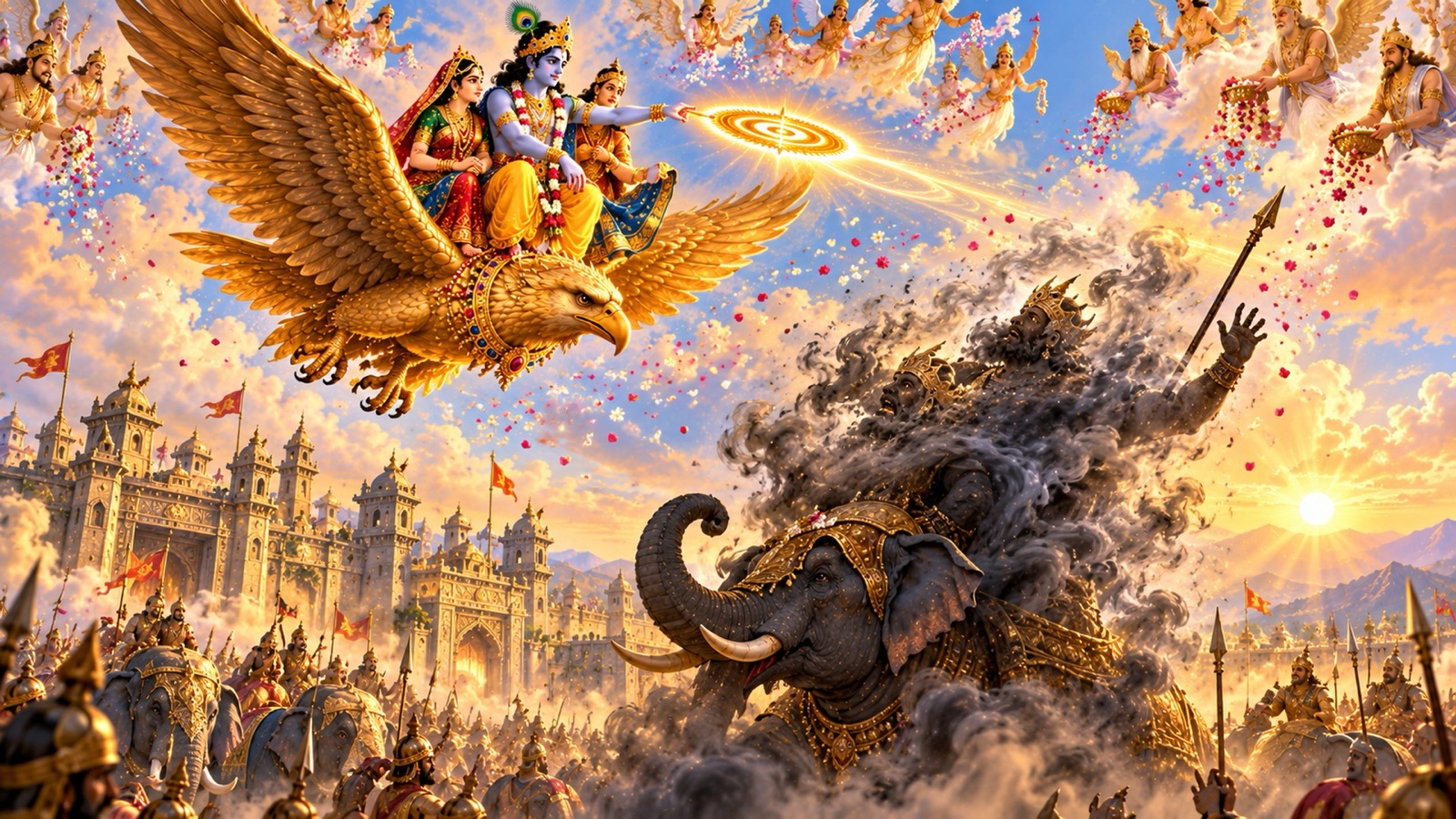
Fallen to the ground, the demon’s head, still bearing its earrings and diadem, shone brilliantly. “Alas!” cried his people; “Well done!” cried the seers; and the lords of the gods, showering flowers, praised Mukunda, the giver of liberation.
Mother Earth Offers the Earrings and Prays
Now Goddess Earth, Naraka’s mother, came before Krishna. She placed in His hands the earrings of Aditi, glowing with jewels set in purest gold, a forest garland with the Vaijayanti, the umbrella of Varuna, and the jewelled peak Mahamani her son had seized. Then, bowing low with joined palms and a mind absorbed in devotion, she praised the Lord of the universe whom even the chief gods worship.
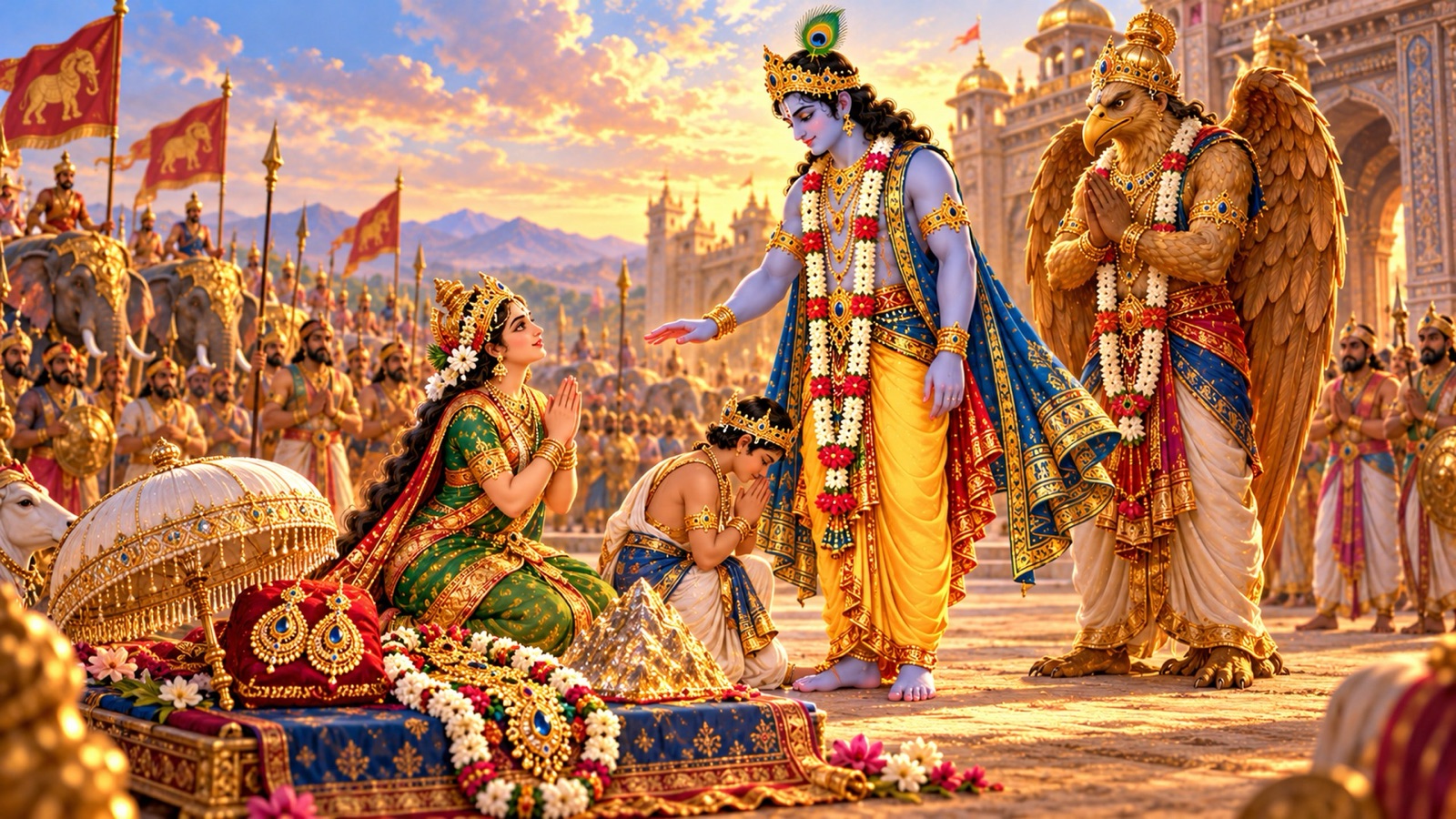
She hailed Him as the God of gods, wielder of conch, discus and mace, the Supreme Soul who takes a visible form because His devotees desire it, and bowed to Him whose navel, garland, eyes and feet are all lotuses. She went on to bow to Him as Vasudeva and Vishnu, the primal Person and first seed of all, complete knowledge itself; as the unborn Creator of unlimited potency, the Self of the high and the low, the Supreme Self. It is He, she confessed, who takes on rajas to create, tamas to dissolve and sattva to maintain the world, yet stays untouched by all three; He is time, primordial nature and the soul, and beyond them all. Herself the earth, with water, fire, air and ether, the senses and their objects, the gods, mind, ego and cosmic intelligence, the whole moving and unmoving creation, is but a shimmering appearance within Him who is one without a second.
Then she brought Naraka’s frightened son, Bhagadatta, to the Lord’s feet.
तस्यात्मजोऽयं तव पादपङ्कजं भीतः प्रपन्नार्तिहरोपसादितः ।
तत् पालयैनं कुरु हस्तपङ्कजं शिरस्यमुष्याखिलकल्मषापहम् ॥ ३१ ॥
tasyātmajo ’yaṁ tava pāda-paṅkajaṁ bhītaḥ prapannārti-haropasāditaḥ tat pālayainaṁ kuru hasta-paṅkajaṁ śirasy amuṣyākhila-kalmaṣāpaham
Meaning: This son of his, terrified, has been led to Your lotus feet, O remover of the distress of the surrendered; therefore protect him, and lay upon his head Your lotus hand, which takes away all sin. (Canto 10, Chapter 59, verse 31)
Entreated thus by Goddess Earth bowed low in devotion, the Lord granted the boy fearlessness.
The Freed Princesses
Krishna then entered Bhauma’s palace, filled with every kind of wealth. There He saw sixteen thousand royal maidens (and a hundred more, the tradition adds) whom Naraka had carried off by force from the kings of the earth and even from gods, Siddhas and demons. Beholding the foremost of men entering their quarters, the maidens were captivated, and each chose Him in her heart as the husband destiny had brought to her door.
भूयात् पतिरयं मह्यं धाता तदनुमोदताम् ।
इति सर्वाः पृथक् कृष्णे भावेन हृदयं दधुः ॥ ३५ ॥
bhūyāt patir ayaṁ mahyaṁ dhātā tad anumodatām iti sarvāḥ pṛthak kṛṣṇe bhāvena hṛdayaṁ dadhuḥ
Meaning: “May this one become my husband, and may Providence approve it” — thinking thus, every one of them separately fixed her heart on Krishna with love. (Canto 10, Chapter 59, verse 35)
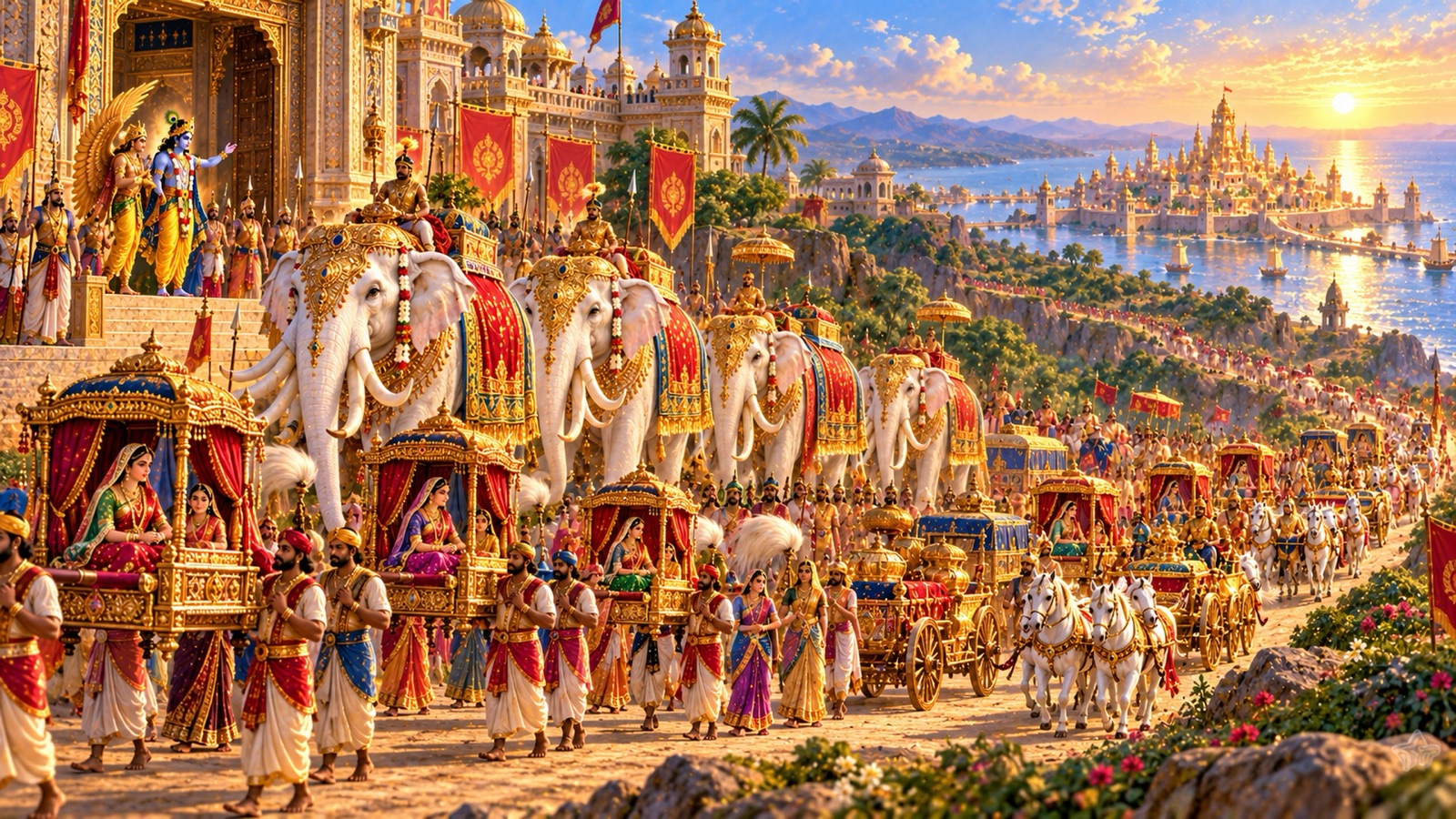
The Lord had them bathed and dressed in spotless garments and sent them in palanquins to Dvaraka, with great treasures, chariots, horses and riches, and sixty-four swift white four-tusked elephants of Airavata’s line.
The Parijata Tree and Indra’s Forgetfulness
From Pragjyotishapura the Lord flew to the abode of Indra. He returned her earrings to Aditi and Varuna’s umbrella to Indra, and the king of the gods, with his queen Shachi, worshipped Him and His beloved consort. Then, at Satyabhama’s urging, Krishna uprooted a Parijata tree from Indra’s garden, set it on Garuda’s back, defeated Indra and the gods who opposed Him, and carried it home to Dvaraka.
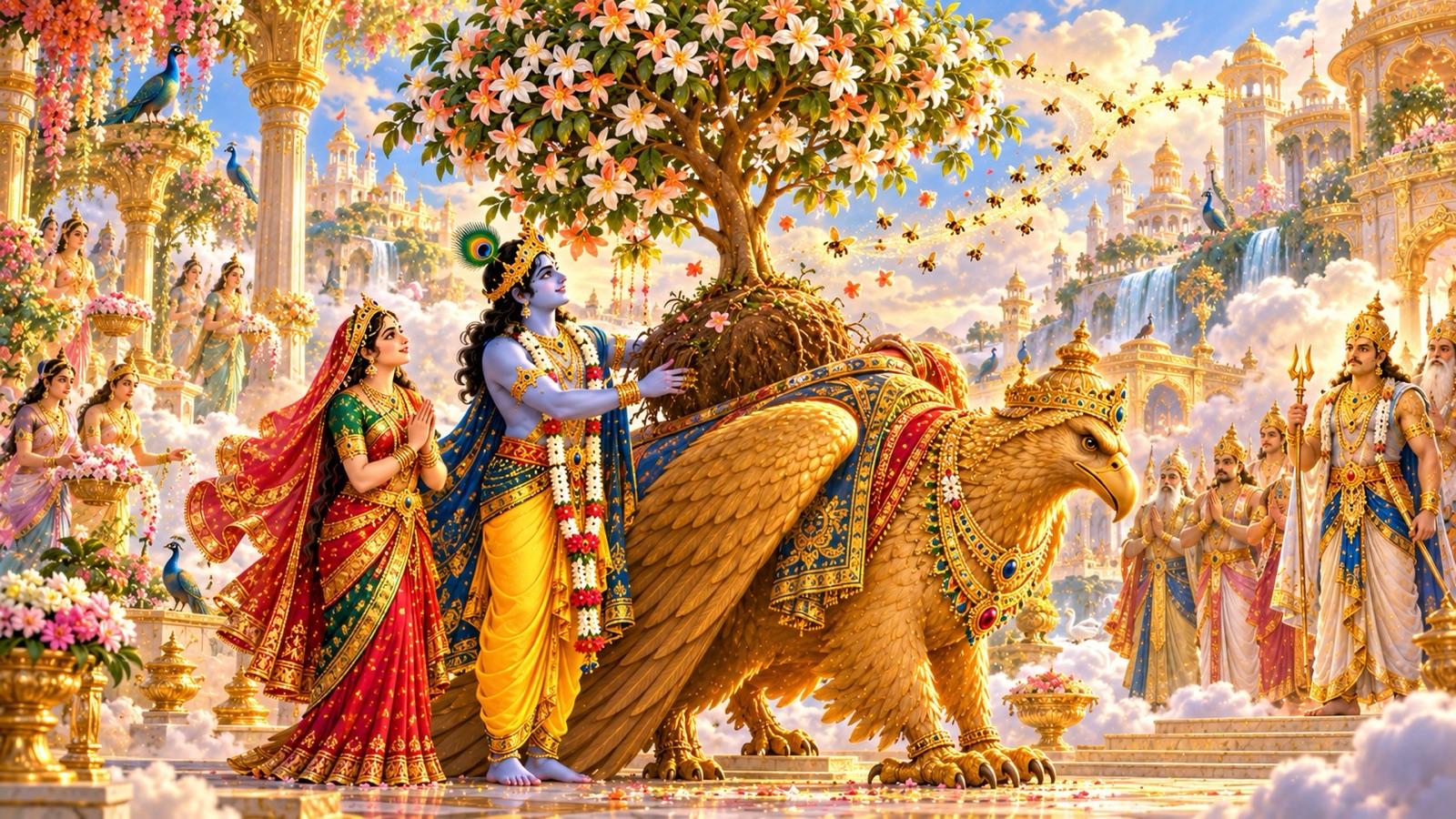
The tree was planted in the garden beside Satyabhama’s palace, and the bees of heaven, greedy for its fragrance and nectar, followed it down to earth. Here Sukadeva lays bare the heart of the gods. A little earlier Indra had bowed before Krishna, touching His feet with the tips of his crown and begging for help; the moment his wish was gained, the same Indra took up arms against Him.
ययाच आनम्य किरीटकोटिभिः पादौ स्पृशन्नच्युतमर्थसाधनम् ।
सिद्धार्थ एतेन विगृह्यते महानहो सुराणां च तमो धिगाढ्यताम् ॥ ४१ ॥
yayāca ānamya kirīṭa-koṭibhiḥ pādau spṛśann acyutam artha-sādhanam siddhārtha etena vigṛhyate mahān aho surāṇāṁ ca tamo dhig āḍhyatām
Meaning: Bowing down and touching His feet with the points of his crown, Indra had begged the infallible Lord to fulfil his aim; his aim fulfilled, that exalted god now fought against Him. Alas, how deep the darkness even of the gods! Shame upon riches! (Canto 10, Chapter 59, verse 41)
Here is the quiet lesson beneath the battles. The Lord slays Naraka, yet in the same hour shelters Naraka’s son; He restores to the gods everything the demon had taken, yet those gods, once their comfort is secured, forget the hand that gave it. Goddess Earth, who has just lost a son, bows and surrenders; Indra, who has just regained his honour, grasps and fights. The difference is not fortune but the heart. Opulence enjoyed without remembrance of its Giver breeds darkness even in heaven, while surrender in the hour of loss draws down the Lord’s protecting hand.
One Lord in Sixteen Thousand Homes
Back in Dvaraka, the imperishable Lord took as many forms as there were brides and, at a single auspicious hour, married every one of them with due rites, each in her own mansion.
अथो मुहूर्त एकस्मिन् नानागारेषु ताः स्त्रियः ।
यथोपयेमे भगवान् तावद्रूपधरोऽव्ययः ॥ ४२ ॥
atho muhūrta ekasmin nānāgāreṣu tāḥ striyaḥ yathopayeme bhagavān tāvad-rūpa-dharo ’vyayaḥ
Meaning: Then, in one and the same moment, the imperishable Lord, taking on as many forms as there were maidens, duly married those women in their separate dwellings. (Canto 10, Chapter 59, verse 42)
Remaining always present in those matchless palaces, Krishna, whose deeds surpass all reasoning and who is ever full in His own bliss, lived with those expansions of the goddess of fortune like an ordinary householder, faithfully carrying out a householder’s duties. Having gained as their husband the Lord of Rama, whose path even Brahma cannot trace, those women served Him with ever-growing love, greeting Him with affectionate smiles, glances, playful words and shy reserve. Though each had hundreds of maidservants, they themselves rose to receive Him, washed His feet, offered betel, fanned Him, anointed Him with sandal, dressed His hair, prepared His bed and served His meals.
Principal Teachings of This Chapter
1. No fortress keeps out the Lord. Mountain, weapon, water, fire, wind and ten thousand snares could not delay Krishna for a moment. Whatever walls pride or fear build around a heart, His grace breaks through.
2. The Lord’s victory is effortless and compassionate. Mura’s heads fall in sport; Naraka is finished before his pike leaves his hand. He destroys only to end oppression, and the sages cry “Well done.”
3. Surrender turns loss into shelter. Earth acknowledges that everything, herself included, is an appearance within the one Lord, and asks protection for her grandson; fearlessness is granted at once.
4. Opulence without remembrance breeds ingratitude. Indra begged at the Lord’s feet and then fought Him over a tree. Comforts gained through grace become pride unless gratitude is kept alive.
5. The Lord accepts whoever chooses Him. The captive maidens had nothing to offer but a wish in the heart, and that wish made the Lord of the goddess of fortune their husband.
A Devotional Reflection
This chapter moves from the clang of weapons to the hush of palace service, and the two ends belong together: the Lord who breaks a demon’s fortress is the Lord who sits still while a queen washes His feet, and in both He is answering love and ending fear. What stays with me is the contrast of two faces at His feet: Mother Earth, bending low on the day her son has died, and Indra, bending low only until his wish is met. Some days loss bows us down and we find, like Earth, that His hand is already on the head of what we love. Other days our prayers are answered and, like Indra, we rise too quickly and quarrel over trifles. The princesses show a third way: they neither bargained nor forgot; they wanted only Him, and He came to each as if she alone existed. May our devotion learn their undivided wish.
A Daily Devotional Practice
Today, call to mind one prayer of yours that has already been answered, however small, and before asking the Lord for anything else, thank Him for it with folded hands. Then, remembering how Goddess Earth laid Bhagadatta at Krishna’s feet, name one person you fear for and inwardly place them there, asking that His lotus hand rest upon their head. Begin by chanting gently: Om Namo Bhagavate Vasudevaya.
Conclusion
The fifty-ninth chapter answers Parikshit’s question about the thousands of queens by showing the mercy hidden inside a battle. Krishna storms an impregnable city, fells Mura and Naraka, then listens to a grieving mother, protects her grandson, restores heaven’s treasures, carries the Parijata home for Satyabhama, and weds every maiden who chose Him. May we hold the two postures set side by side here, Earth’s surrender and Indra’s forgetfulness, and choose with the freed princesses the undivided longing that makes the Lord our own.
May the divine wisdom of Srimad Bhagavatam awaken pure devotion within our hearts.
Om Namo Bhagavate Vasudevaya.
Jay Shree Madhav.
References and Attribution
- Primary edition: Gita Press, Śrīmad Bhāgavata Mahāpurāṇa (English), Book Ten (Latter Half), Discourse 59.
- Series: Srimad Bhagavatam Wisdom · Biswa Sanatan Dharma Seva Trust.
- Presented following the spiritual guidance and recommendation of Pandit Dr. Shri Kashinath Mishra.
This is an original, faithful retelling in the writer’s own words, with brief quoted verses shown in Devanāgarī and transliteration and their meanings given as summaries. It is not a reproduction of any single publisher’s continuous translation or commentary. No affiliation with or endorsement by any publisher is implied.
Jay Shree Madhav