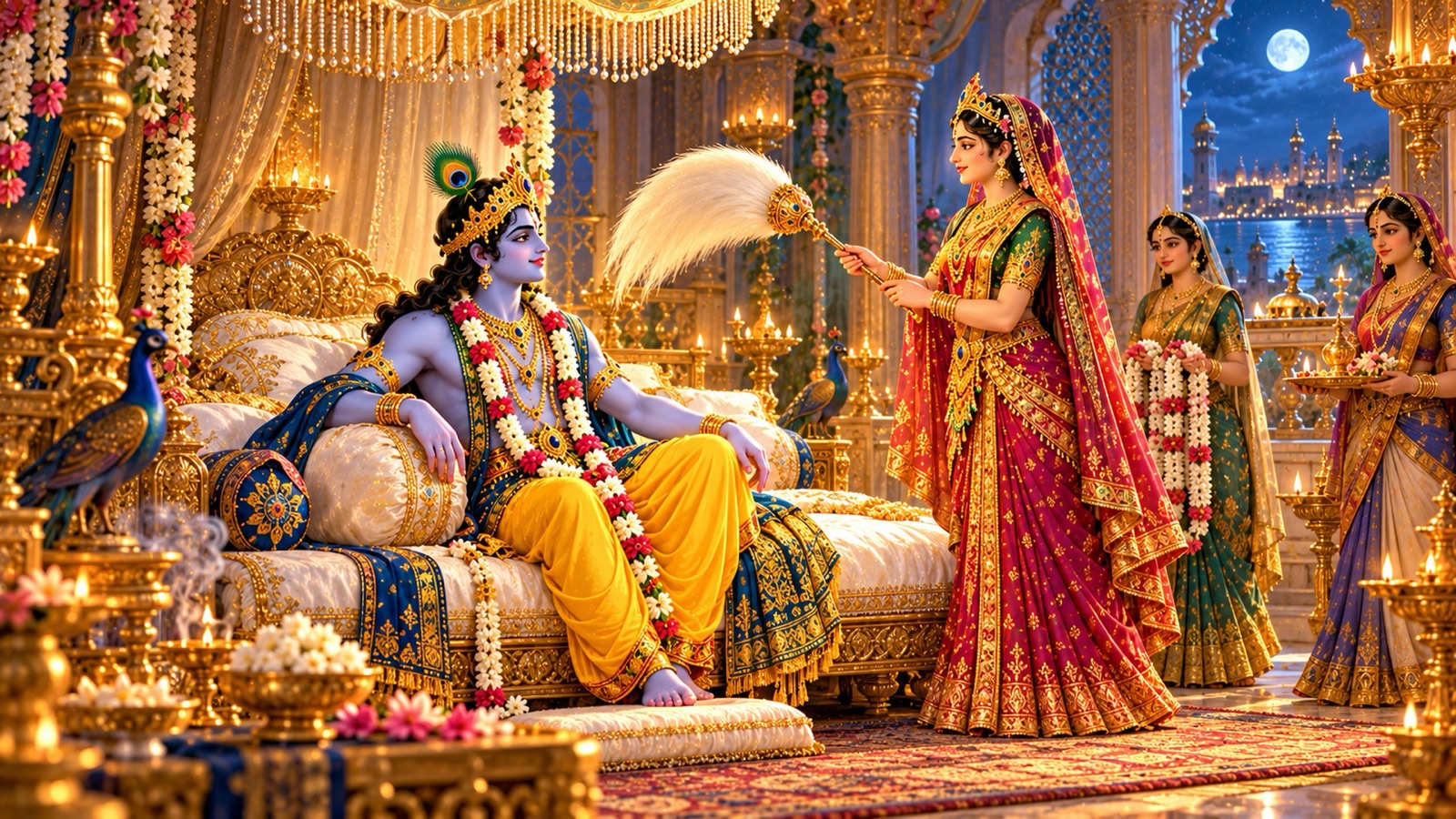
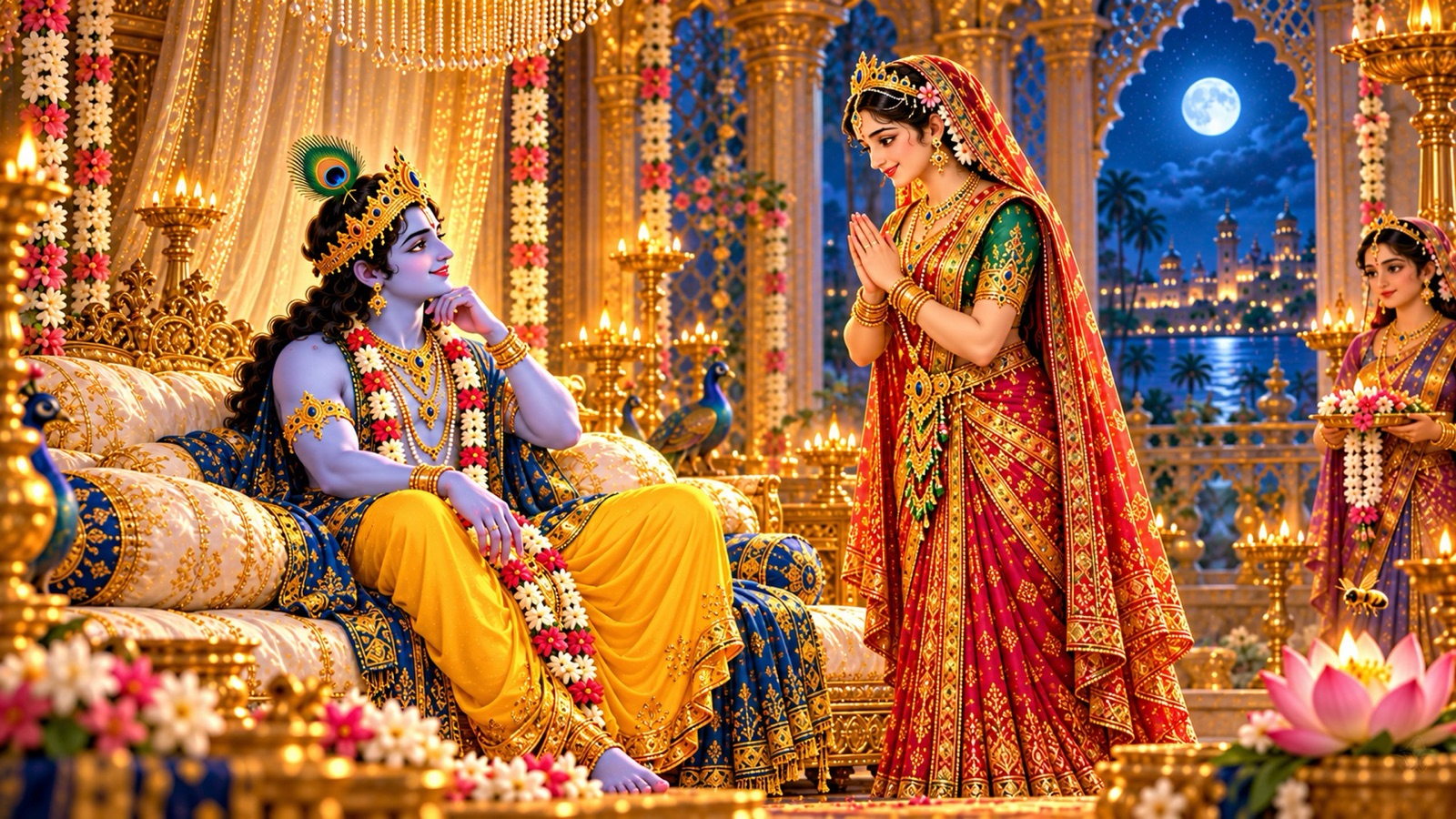
In a pearl-lit chamber Queen Rukmini waves a chamara over her Lord, and with a few teasing words Krishna draws from her a confession of love so pure that He declares Himself conquered by it.
Om Namo Bhagavate Vasudevaya.
Om Namo Bhagavate Vasudevaya.
Om Namo Bhagavate Vasudevaya.
Welcome back to Srimad Bhagavatam Wisdom, our devotional journey through the sacred histories and teachings of the Srimad Bhagavat Mahapurana. The sixtieth chapter of the Tenth Canto takes us into Queen Rukmini’s private apartment in Dvaraka, where the Lord speaks a jest His first queen has never heard before, and through her tears and her answer shows what it means to love God for His own sake.
Chapter Information
- Scripture: Śrīmad Bhāgavata Mahāpurāṇa
- Canto: 10 (Book Ten, Latter Half)
- Chapter: 60 (Discourse 60)
- Chapter title: Lord Krishna Teases Queen Rukmini
- Principal speaker: Sukadeva Gosvami (narrating to King Parikshit); within the narrative, Lord Krishna and Queen Rukmini
- Principal listener: King Parikshit
- Main setting: The inner apartment of Queen Rukmini’s palace in Dvārakā
- Central subject: The Lord’s playful words to Rukmini, her swoon, His consolation, her reply revealing true devotion, and His praise of her love
- Principal verse range: Canto 10, Chapter 60, verses 1–59
- Primary edition: Gita Press Śrīmad Bhāgavata Mahāpurāṇa (English, Part II)
Context From the Previous Chapter
In Chapter 59 the Lord slew the demon Naraka, restored Aditi’s earrings and Varuna’s umbrella, married the rescued princesses in a single hour, and brought the Parijata tree to Dvaraka, where He dwelt in every queen’s palace at once like an ordinary householder.
The Queen Fans Her Lord
Sukadeva Gosvami began again. One night, he told King Parikshit, Rukmini, the daughter of King Bhishmaka, was serving her husband in her own chamber, attended by her companions. The birthless Lord who in sport creates, sustains and dissolves the universe, and who had taken birth among the Yadus to uphold dharma, reclined there while His queen fanned Him.
Sukadeva lingers lovingly over that room. A canopy fringed with pearl-strings hung overhead; gems served as lamps; jasmine garlands hummed with bees; moonlight slipped through the lattice, and garden breezes carried the scent of Parijata and aloe. On a cushion white as the foam of milk sat the Lord of all the worlds, and Rukmini, taking a jewel-handled chamara from a companion, fanned Him, her gem-set anklets making soft music. This was Lakshmi herself, radiant with a nectar-sweet smile. Seeing her so, Krishna, who steals the hearts of all, began to speak with a smile.
The Lord’s Teasing Words
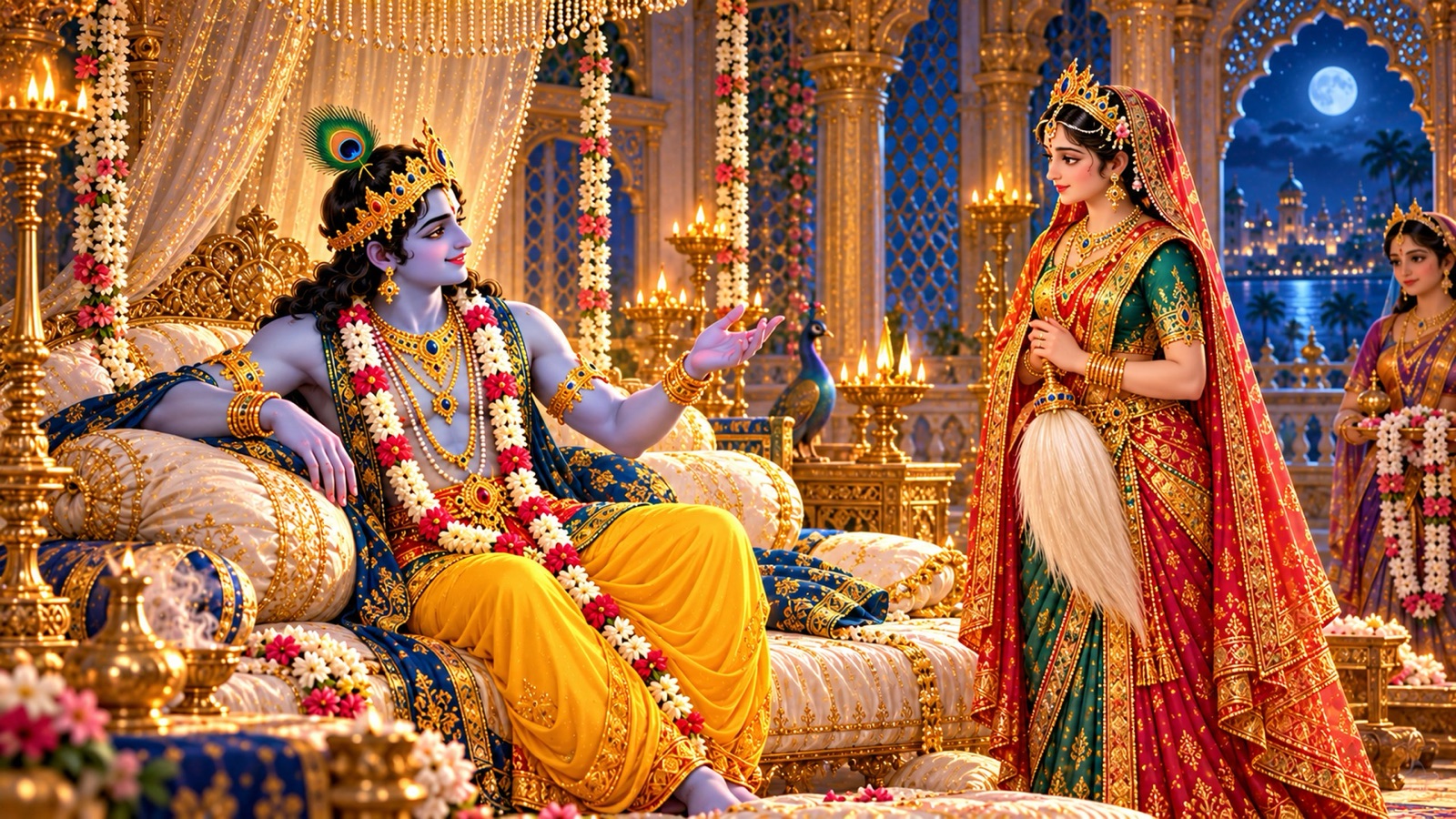
“Princess,” He said, “kings who rivalled the guardians of the worlds in wealth, beauty and strength sought your hand; your brother and father had promised you to the king of Cedi and the others. Why did you set them aside and choose Us, who are no match for you? We are afraid of kings; We have fled to the ocean, made enemies of the powerful, and all but given up a royal throne. Women who follow men whose ways are unclear come to grief. We own nothing, and We are dear to those who own nothing; that is why the wealthy seldom turn to Me.”
ययोरात्मसमं वित्तं जन्मैश्वर्याकृतिर्भव: ।
तयोर्विवाहो मैत्री च नोत्तमाधमयो: क्वचित् ॥ १५ ॥
yayor ātma-samaṁ vittaṁ janmaiśvaryākṛtir bhavaḥ tayor vivāho maitrī ca nottamādhamayoḥ kvacit
Meaning: Marriage and friendship are fitting between two who are alike in riches, birth, power, appearance and prospects, never between one who is high and one who is low. (Canto 10, Chapter 60, verse 15)
“Not seeing this, O princess of Vidarbha,” the Lord continued, “you chose Us, whom beggars praise for nothing. Even now, choose a Kshatriya who is your equal and gain your heart’s desire through him. Shishupala, Shalva, Jarasandha, Dantavaktra and your own brother Rukmi all hate Me; I carried you away only to crush the pride of those arrogant kings. We have no longing for wives, children or wealth; complete in the Self, We remain towards home and body like a lamp — a witness that does nothing.”
The Queen’s Grief
Having said this much to Rukmini — who, because she was always at His side, thought of herself as His dearest wife — the Lord, wishing to humble that pride, fell silent. Never had she heard such words from her beloved. Terror seized her; her heart trembled, tears flowed, and she sank into a grief without shore. Her voice choked; she stood scraping the floor with her toes, face lowered, her collyrium-darkened tears soaking her garments.
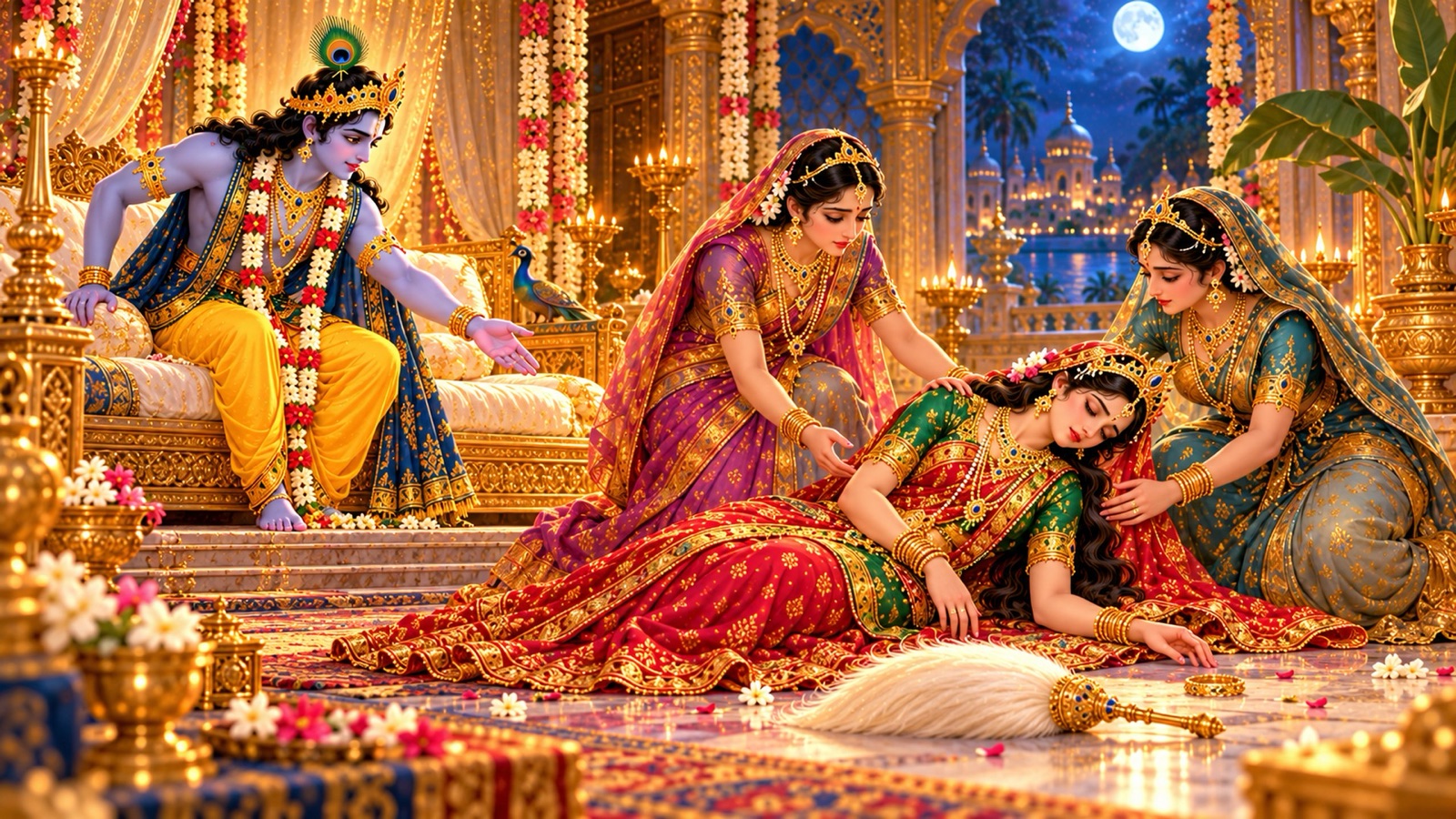
Then anguish, fear and sorrow overwhelmed her reason. The chamara slipped from her hand, her bracelets slid from a wrist gone slack, and she fainted and fell, her hair scattered, like a plantain tree torn up by the wind.
The Lord Lifts Her Up
Seeing His beloved so bound to Him by love that she could not grasp His jest, the merciful Lord was moved with compassion. He stepped down at once from the couch and — manifesting four arms — raised her up, gathered her loosened hair, and wiped her face with His lotus hand. Holding the virtuous queen who had given her whole heart to Him, the Lord who knows how to console comforted her, for she had been bewildered by a joke she did not deserve.
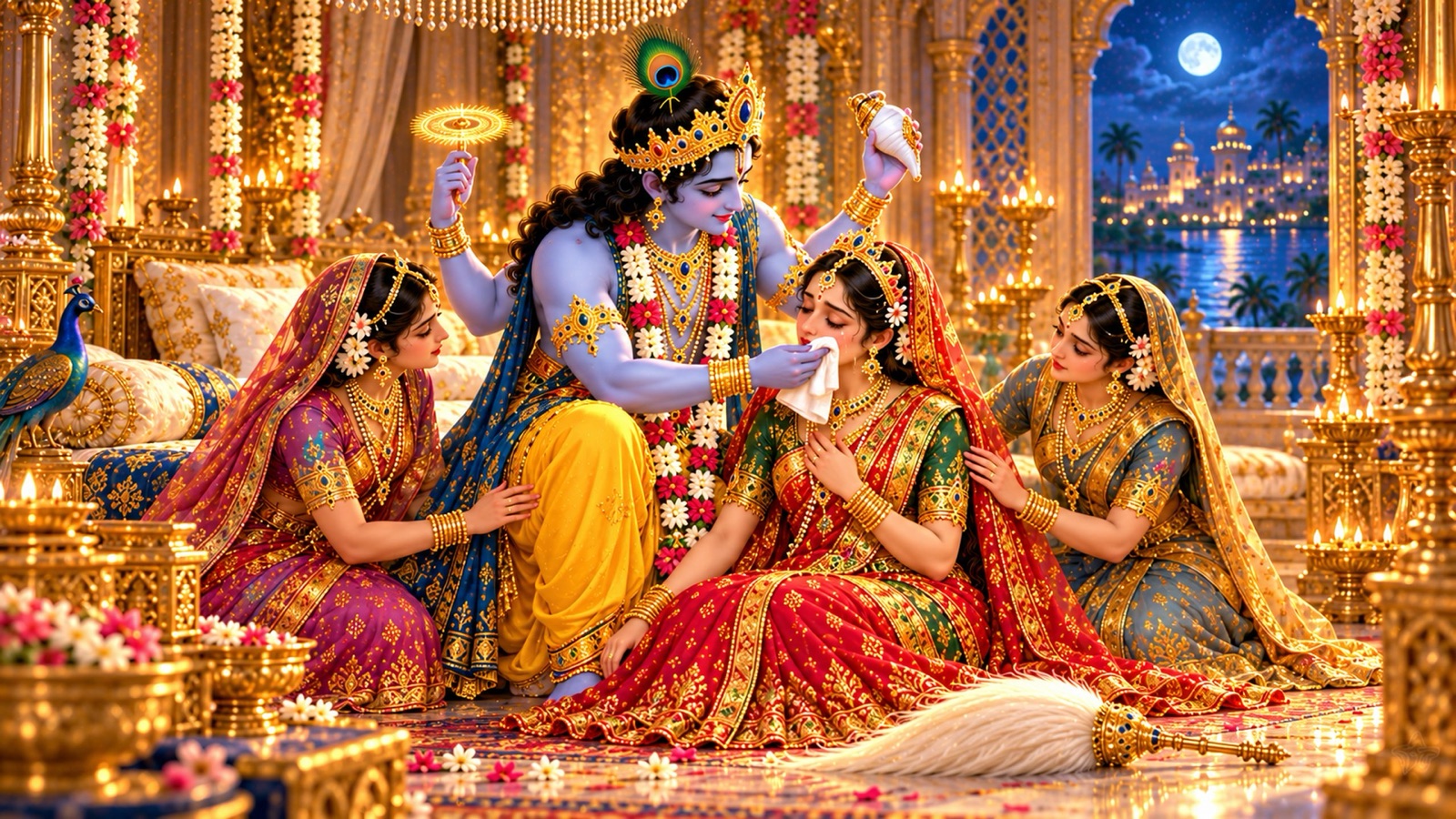
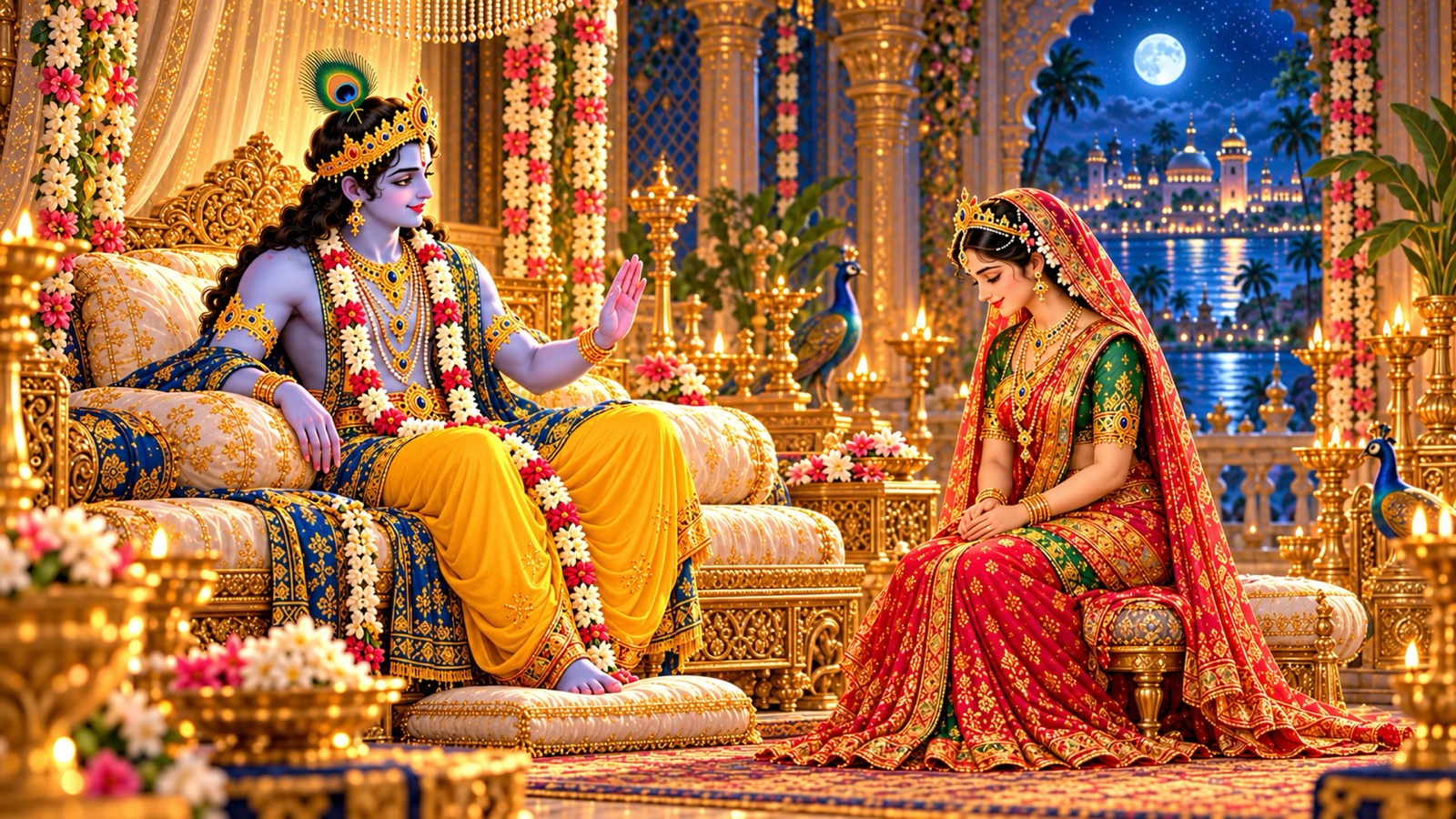
“O daughter of Vidarbha,” He said, “do not be displeased with Me. I know that you are devoted to Me. I spoke in play only to hear your retort and to see your face with its lips trembling in loving anger, your eyes reddened, your brows knit. For householders, the greatest gain is to pass a few hours in laughter with the beloved.”
Thus consoled, Rukmini understood the jest, let go of her fear of abandonment, and, with a shy, affectionate smile, replied.
Rukmini’s Wise Reply
“It is just as You say, O lotus-eyed Lord,” she began. “I am indeed no match for You. Where are You, the master even of Brahma, Vishnu and Shiva, resting in Your own glory — and where am I, mere Prakriti, whose feet the ignorant clutch?”
सत्यं भयादिव गुणेभ्य उरुक्रमान्त:
शेते समुद्र उपलम्भनमात्र आत्मा ।
नित्यं कदिन्द्रियगणै: कृतविग्रहस्त्वं
त्वत्सेवकैर्नृपपदं विधुतं तमोऽन्धम् ॥ ३५ ॥
satyaṁ bhayād iva guṇebhya urukramāntaḥ śete samudra upalambhana-mātra ātmā nityaṁ kad-indriya-gaṇaiḥ kṛta-vigrahas tvaṁ tvat-sevakair nṛpa-padaṁ vidhutaṁ tamo ’ndham
Meaning: True, O Lord of mighty strides, You sleep in the ocean as though fearing the gunas — but that ocean is the heart, and You are pure awareness; You battle constantly with the unruly senses; and Your servants have cast aside kingship as blind darkness. (Canto 10, Chapter 60, verse 35)
So, one by one, she turned each of His jests inside out. His path is hidden because even the ways of sages who taste the honey of His lotus feet are beyond beast-like men; He owns nothing because nothing exists apart from Him; those blinded by wealth cannot know Him, but to His devotees He is the most beloved. Union with Him befits the renounced wise, not couples bound by pleasure and pain.
“I chose You,” she said, “knowing that sages sing Your glory and that You give Yourself to Your devotees. I passed over Brahma and the lords of heaven, whose fortune Time sweeps away at a movement of Your eyebrows — what then of Shishupala and his like? Your plea of fleeing to the sea is empty, O elder brother of Gada: with the twang of Your Sharnga bow You scattered those kings and took me as a lion claims its prey. Did Anga, Prithu, Bharata, Yayati and Gaya suffer because they left their kingdoms to seek Your feet?”
कान्यं श्रयेत तव पादसरोजगन्ध-
माघ्राय सन्मुखरितं जनतापवर्गम् ।
लक्ष्म्यालयं त्वविगणय्य गुणालयस्य
मर्त्या सदोरुभयमर्थविविक्तदृष्टि: ॥ ४२ ॥
kānyaṁ śrayeta tava pāda-saroja-gandham āghrāya san-mukharitaṁ janatāpavargam lakṣmy-ālayaṁ tv avigaṇayya guṇālayasya martyā sadoru-bhayam artha-vivikta-dṛṣṭiḥ
Meaning: What mortal woman of clear discernment, having once breathed the fragrance of Your lotus feet — praised by the saintly, bestowing liberation, the home of Lakshmi, O abode of virtues — would disregard it and take shelter of another who lives in constant fear? (Canto 10, Chapter 60, verse 42)
She prayed that His feet, which free the worshipper from the deceptive round of birth and death, be her shelter after her long wandering through lives. Let the kings He named be chosen by some woman who has never heard His glories sung in the assemblies of Shiva and Brahma; only a woman who has never tasted the honey of His feet would serve this body — a living corpse wrapped in skin and hair — as her husband. “Even if You, delighting in Yourself, see nothing special in me, let my love for Your feet only grow. When You once glanced upon me as Prakriti for the increase of this world, that glance alone was Your supreme grace.” Nor did she dismiss His words entirely: some women, like Amba, do set their hearts on another, and such a wife a wise man should not keep.
The Lord Praises Her Devotion
The Lord replied: “O virtuous one, I teased you only so that I might hear you speak exactly like this; the meaning you have drawn from My words is the plain truth. Whatever blessings you desire from Me are already yours for ever, O blessed one, for you are wholly devoted to Me — and blessings asked of Me lead to freedom from desire itself. O sinless one, I have now seen your love and fidelity: though My words tried to shake you, your mind could not be drawn from Me.”
Then He opened the deeper teaching. Those who worship Him, the giver of liberation, merely to win married happiness have handed their hearts to sense-pleasure and are deluded by His Maya.
मां प्राप्य मानिन्यपवर्गसम्पदं
वाञ्छन्ति ये सम्पद एव तत्पतिम् ।
ते मन्दभागा निरयेऽपि ये नृणां
मात्रात्मकत्वान्निरय: सुसङ्गम: ॥ ५३ ॥
māṁ prāpya māniny apavarga-sampadaṁ vāñchanti ye sampada eva tat-patim te manda-bhāgā niraye ’pi ye nṛṇāṁ mātrātmakatvān nirayaḥ su-saṅgamaḥ
Meaning: O proud lady, having reached Me, the treasure of liberation and the master of all riches, those who want only the riches are unfortunate indeed, for such things can be had even in hell; and to people whose minds dwell on sense objects, hell itself seems a pleasant home. (Canto 10, Chapter 60, verse 53)
Here lies the heart of the chapter. The Lord uses a domestic jest to show all who would ever hear this story that love for Him is not a bargain. Rukmini could have answered with hurt pride or with demands; instead every sentence of her reply sought Him alone. By declaring that His gifts end in desirelessness, and that those who come to the Lord of liberation merely to collect fortune are pitiable, Krishna draws the line between devotion and transaction. His teasing was the test, her unshaken mind the proof, and His praise the verdict.
“Well done, O mistress of My house,” He continued, “that you have steadily practised devotion to Me, which frees from worldly bondage. In all My household I see no wife as loving as you, who, passing over the assembled kings, sent a Brahmana with a secret message to Me whom you knew only by hearsay. You bore your brother’s disfigurement in battle and his death at the dice-match during Aniruddha’s wedding, yet never spoke a word of that grief, for fear of being parted from Us. By this you have conquered Me. While I delayed, you saw the world as empty and were ready to give up this body. We can never repay such love; We can only hail it with joy.”
The Lord as Householder
In this way the almighty Lord, though immersed in the bliss of His own Self, imitated human ways and sported in loving conversation with Lakshmi in the form of Rukmini; and in the palaces of His other queens too the preceptor of the universe played in the same way, like an ordinary householder.
Principal Teachings of This Chapter
1. The Lord tests His devotees out of love, not doubt. Krishna’s jest was designed to call forth Rukmini’s answer, and He tells her so twice. When trials shake us, He may be inviting words of surrender we have never spoken.
2. The devotee reads the Lord’s words with the eye of faith. Rukmini accepts each of Krishna’s self-deprecating statements and reveals its hidden glory.
3. Pure devotion asks for the Lord alone. Rukmini wants only that her love for His feet should grow — bhakti free of bargaining.
4. Blessings sought from the Lord lead to freedom from desire. What Krishna grants the devoted ends in liberation; those who approach Him only for wealth are unfortunate.
5. Steadfastness is proved in silence as much as in speech. Rukmini bore her brother’s humiliation and death without complaint; Krishna says this silence won Him.
A Devotional Reflection
What moves us most in this chapter is not the splendour of Rukmini’s palace but the fragility it reveals. The goddess of fortune herself can be shattered by a few words that seem to threaten separation from her Lord; her collapse is not weakness but the measure of how completely she belongs to Him. And when she rises and speaks, every line is a lesson we might spend a lifetime learning: that the Lord’s apparent poverty is His fullness, and His enemies only our own wild senses. Yet the Lord ends not with correction but with wonder, confessing that He has been won over. If Lakshmi herself counts His glance alone as her supreme grace, how much more should we learn to want only Him?
A Daily Devotional Practice
Today, take one request you habitually place before the Lord and set it beside Rukmini’s prayer: “Let my love for Your feet only grow.” Offer the request still, but ask first for Him — for devotion, remembrance and the shelter of His feet. Begin by chanting gently: Om Namo Bhagavate Vasudevaya.
Conclusion
In the sixtieth chapter of the Tenth Canto the Lord speaks a jest that brings His queen to the ground — only to lift her up and listen as she turns His every word into praise. Together her reply and His answer give the Bhagavata one of its clearest statements of pure devotion: the Lord gives Himself to those who want nothing else, and His blessings end in liberation rather than in fulfilled desires. May we hold fast to His feet as Rukmini did, unshaken by any word or trial, and may He find in our hearts a love He delights to call His own.
May the divine wisdom of Srimad Bhagavatam awaken pure devotion within our hearts.
Om Namo Bhagavate Vasudevaya.
Jay Shree Madhav.
References and Attribution
- Primary edition: Gita Press, Śrīmad Bhāgavata Mahāpurāṇa (English, Part II), Book Ten (Latter Half), Discourse 60, pages 371–377.
- Series: Srimad Bhagavatam Wisdom · Biswa Sanatan Dharma Seva Trust.
- Presented following the spiritual guidance and recommendation of Pandit Dr. Shri Kashinath Mishra.
This is an original, faithful retelling in the writer’s own words, with brief quoted verses shown in Devanāgarī and transliteration and their meanings given as summaries. It is not a reproduction of any single publisher’s continuous translation or commentary. No affiliation with or endorsement by any publisher is implied.
Jay Shree Madhav