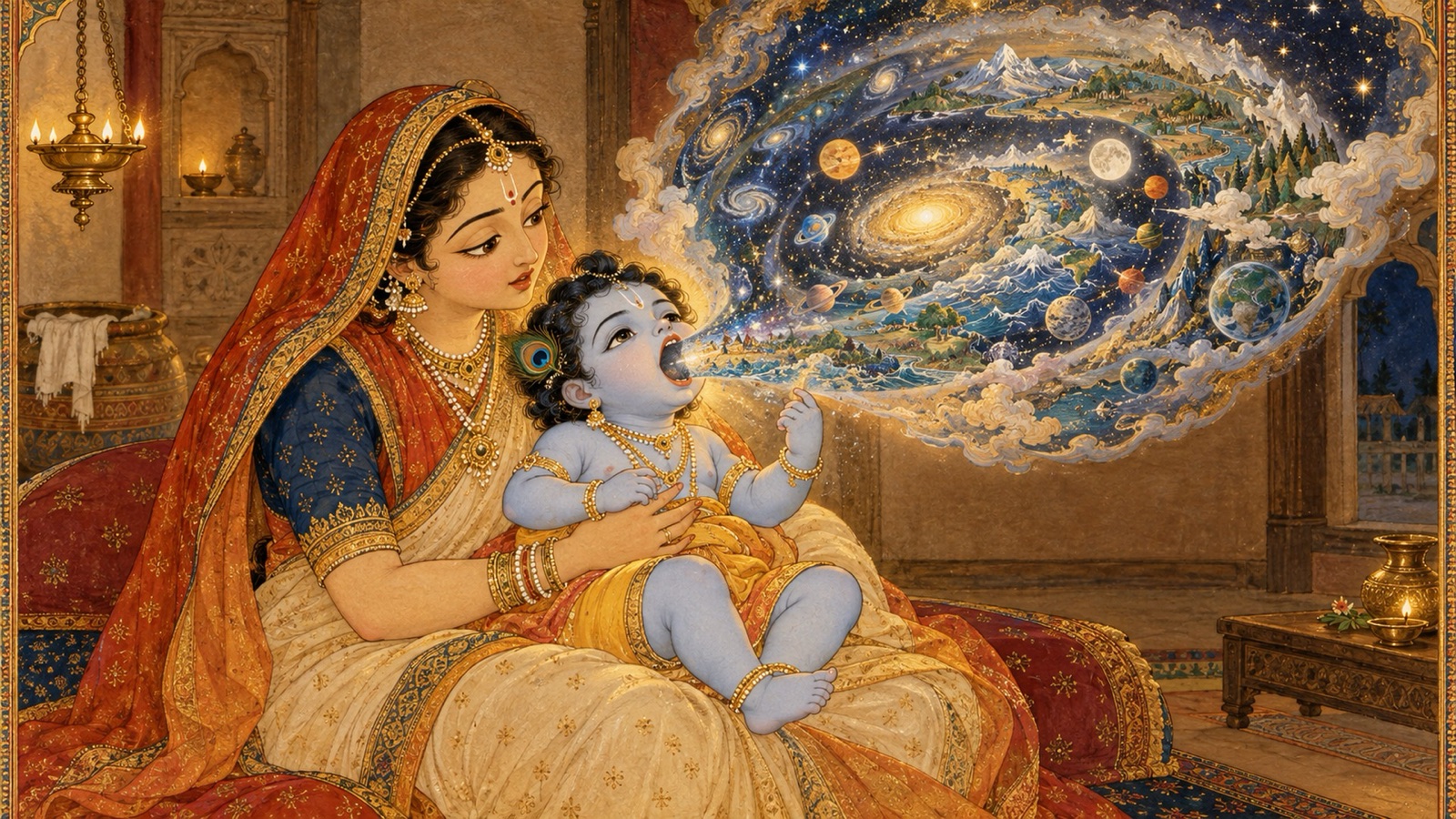
As the infant Krishna yawns in her lap, the loving Yasoda beholds within His little mouth the whole of creation — the skies, the seas, the mountains and all beings — and stands trembling with wonder.
Om Namo Bhagavate Vasudevaya.
Om Namo Bhagavate Vasudevaya.
Om Namo Bhagavate Vasudevaya.
Welcome back to Srimad Bhagavatam Wisdom, our devotional journey through the sacred histories and teachings of the Srimad Bhagavat Mahapurana. In the previous chapter the ogress Putana came to Gokula to kill the infant Lord and instead received from Him the destiny of the saints. This seventh chapter continues the wondrous childhood pastimes of Sri Krishna, and King Parikshit, unable to hear enough of them, begs the sage Sukadeva for more. Sukadeva relates three marvels: how the divine child, crying for His mother’s breast, overturned a heavy cart with a touch of His tiny foot; how the demon Trinavarta, servant of Kamsa, swept the Babe into the sky in the form of a whirlwind, only to fall lifeless while the child returned unharmed; and how the tender mother Yasoda, gazing into her yawning son’s mouth, beheld within it the entire universe. Through each of these the Lord quietly reveals, to those with eyes to see, that the little cowherd boy of Vraja is the Supreme Person Himself.
Chapter Information
- Scripture: Śrīmad Bhāgavata Mahāpurāṇa
- Canto: 10 (Book Ten, First Half)
- Chapter: 7 (Discourse 7)
- Chapter title: The Deliverance of Trinavarta
- Principal speaker: Sukadeva Gosvami (narrating to King Parikshit); related in turn by Suta Gosvami to the sages at Naimisharanya
- Principal listener: King Parikshit (within Sukadeva’s narration); the sages assembled at Naimisharanya
- Main setting: The cowherd village of Gokula in Vraja
- Central subject: Parikshit’s longing to hear more of Krishna’s childhood; the overturning of the cart; the deliverance of the whirlwind-demon Trinavarta; and Yasoda’s vision of the universe within the mouth of the child
- Principal verse range: Canto 10, Chapter 7, verses 1–37
- Primary edition: Gita Press Śrīmad Bhāgavata Mahāpurāṇa
Context From the Previous Chapter
In Chapter 6 the child-killing ogress Putana came to Gokula in the guise of a beautiful woman and offered her poisoned breast to the infant Krishna. The Lord drew out her life along with the poison, and because she had given Him her breast — even with a wicked motive — she attained the destiny of the saints. Nanda, returning from Mathura, marvelled at all that had happened and treasured Vasudeva’s warning. This chapter opens with King Parikshit, entranced, asking to hear still more of the Lord’s infantile sports.
Parikshit Longs for More of the Lord’s Pastimes
King Parikshit cannot contain his longing. The deeds that the almighty Lord Sri Hari performs through His various descents, he says, are charming to the ear and delightful to the mind. He asks Sukadeva to recount that story of Sri Hari by hearing which a person’s weariness and cravings dissolve, the mind is swiftly purified, devotion to the Lord is born, and friendship is formed with His devotees.
श्रीराजोवाच
येन येनावतारेण भगवान् हरिरीश्वर: ।
करोति कर्णरम्याणि मनोज्ञानि च न: प्रभो ॥ १ ॥
यच्छृण्वतोऽपैत्यरतिर्वितृष्णा
सत्त्वं च शुद्ध्यत्यचिरेण पुंस: ।
भक्तिर्हरौ तत्पुरुषे च सख्यं
तदेव हारं वद मन्यसे चेत् ॥ २ ॥
śrī-rājovāca yena yenāvatāreṇa bhagavān harir īśvaraḥ karoti karṇa-ramyāṇi mano-jñāni ca naḥ prabho yac-chṛṇvato ‘paity aratir vitṛṣṇā sattvaṁ ca śuddhyaty acireṇa puṁsaḥ bhaktir harau tat-puruṣe ca sakhyaṁ tad eva hāraṁ vada manyase cet
Meaning: The King said: Through whatever descent the almighty Lord Sri Hari performs His deeds, they are charming to our ears and pleasing to our minds, O master. Kindly narrate that very story of Sri Hari by hearing which a person’s discontent and cravings depart, his heart is quickly purified, devotion to the Lord arises, and friendship with His devotees is formed — if you think it fit. (Canto 10, Chapter 7, verses 1-2)
He asks Sukadeva to relate the other marvellous infant pastimes of Sri Krishna, who, descending into the mortal world, imitated the ways of the human race.
The Overturning of the Cart
Sukadeva begins. On the occasion of the ceremony marking the child’s first turning over in bed — held about the end of three months, when the star Rohini under which He was born was in the ascendant — Yasoda performed the rite of bathing her son amid the assembled ladies, with music, song, and the chanting of sacred texts by the Brahmanas. When the bathing and blessings were finished and the honoured Brahmanas gratified with gifts, the drowsy child was gently laid to sleep beneath a handcart.
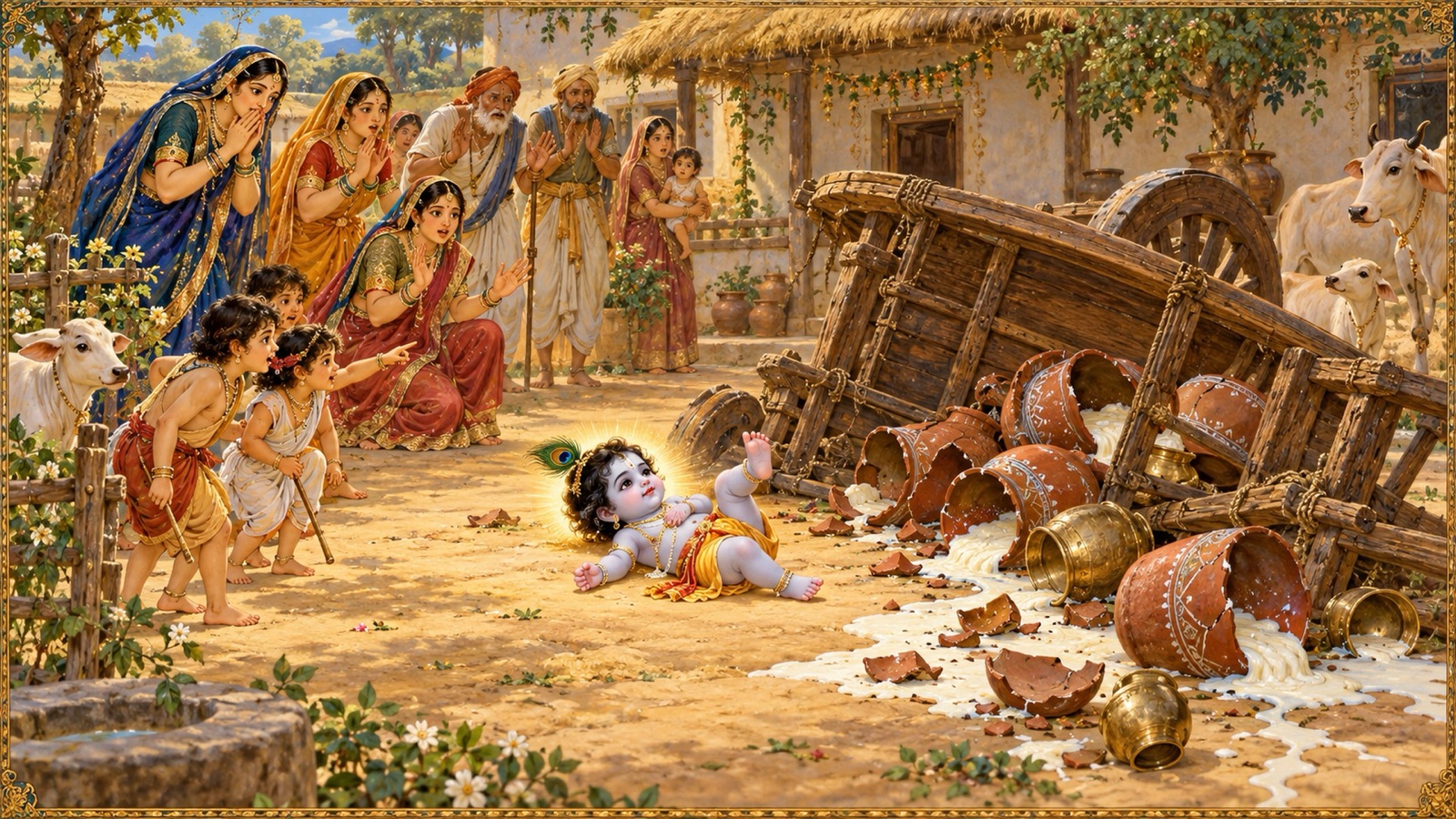
Busy honouring the guests of Vraja, the good-hearted Yasoda did not hear her infant son crying for His mother’s milk. Craving the breast, the child tossed up His little feet.
औत्थानिकौत्सुक्यमना मनस्विनी
समागतान् पूजयती व्रजौकस: ।
नैवाशृणोद् वै रुदितं सुतस्य सा
रुदन् स्तनार्थी चरणावुदक्षिपत् ॥ ६ ॥
autthānikautsukya-manā manasvinī samāgatān pūjayatī vrajaukasaḥ naivāśṛṇod vai ruditaṁ sutasya sā rudan stanārthī caraṇāv udakṣipat
Meaning: Her mind absorbed in the festival of her son’s first turning-over and busy honouring the people of Vraja who had gathered, the noble Yasoda did not hear the crying of her son, who, weeping for the breast, tossed up His feet. (Canto 10, Chapter 7, verse 6)
Struck by the tender, leaf-soft feet of the Babe lying beneath it, the cart turned completely upside down. Its metal jars of milk, curds, and ghee were crushed, its wheels and axle inverted, and its pole shattered. Yasoda, Nanda, and the assembled women, perplexed by the astonishing sight, wondered how the cart could have turned over by itself. The little boys who had been playing there told the cowherds plainly that the crying Krishna had knocked it down with His foot — but the elders would not believe such talk of children, for they could not fathom the immeasurable strength of that Boy.
Rites of Blessing and Protection
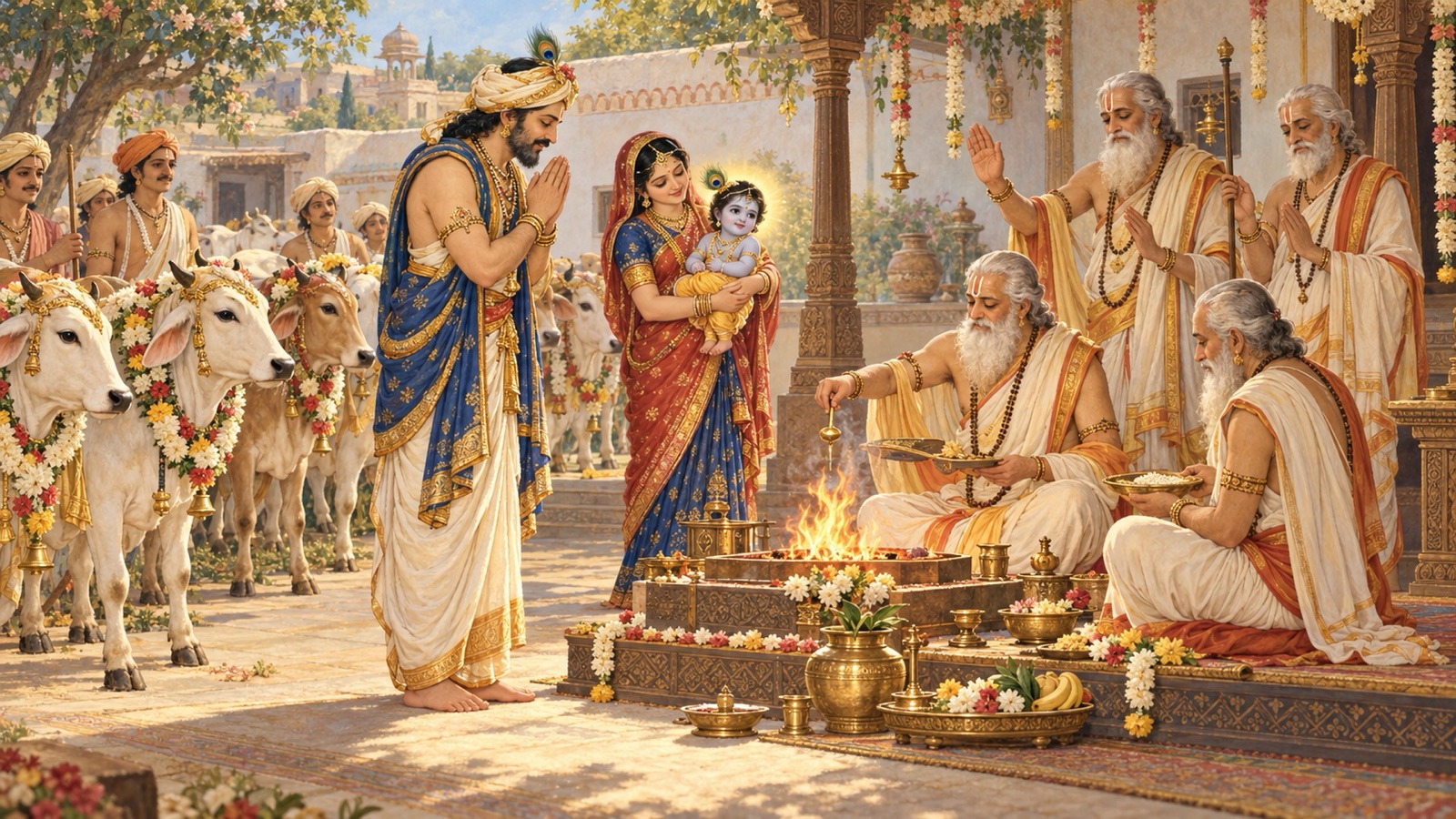
Fearing the presence of some evil spirit, Yasoda took up her crying son and nursed Him only after the Brahmanas had performed the ceremony of protection with Vedic hymns. The Brahmanas poured oblations into the sacred fire and worshipped the restored cart with curds, whole grains of rice, blades of kusa grass, and water. Taking up the child and sprinkling Him with water consecrated by sacred texts and hallowed herbs, Nanda — convinced that the blessings of truthful souls free from malice, falsehood, and pride never go in vain — fed the foremost Brahmanas most wholesome food, and, for his son’s all-round prosperity, gave away cows adorned with cloth, garlands, and gold. The Brahmanas returned their choicest blessings, for the benedictions of those learned in sacred prayer and united with God never prove fruitless.
The Coming of the Whirlwind-Demon Trinavarta
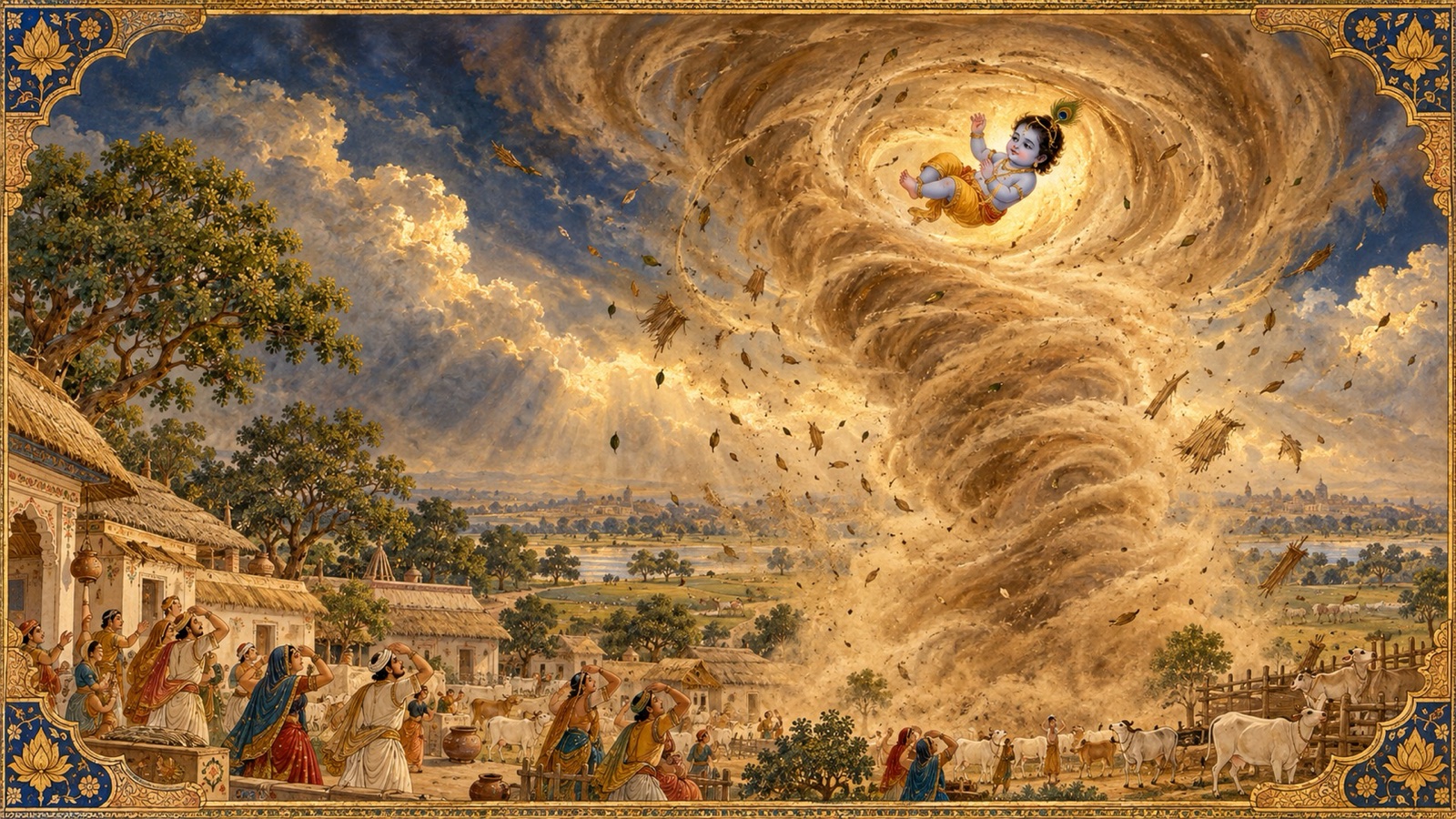
One day, when Krishna had grown to about a year, Yasoda was fondling her son upon her lap when suddenly she could no longer bear His weight, for He had become as heavy as a mountain-peak. Astonished and burdened, she set Him down upon the ground, silently contemplated the Supreme Person, and turned to her household tasks. In that very moment, a demon named Trinavarta, a servant of Kamsa sent by him, appeared in the form of a whirlwind.
दैत्यो नाम्ना तृणावर्त: कंसभृत्य: प्रणोदित: ।
चक्रवातस्वरूपेण जहारासीनमर्भकम् ॥ २० ॥
daityo nāmnā tṛṇāvartaḥ kaṁsa-bhṛtyaḥ praṇoditaḥ cakravāta-svarūpeṇa jahārāsīnam arbhakam
Meaning: A demon named Trinavarta, a servant of Kamsa and directed by him, took the form of a whirlwind and carried away the child as He sat upon the ground. (Canto 10, Chapter 7, verse 20)
Enveloping all of Gokula in a storm of dust, blinding every eye, and shaking the very quarters with his terrible roar, the demon bore the seated Babe aloft. For a while Vraja lay smothered in dust and darkness, and Yasoda could not find her son where she had set Him down. Choked and confused by the swirling sand, no one could see even themselves, let alone another. Finding no trace of her child, the helpless mother lamented and sank to the ground like a cow that had lost its calf, and the cowherd women too wept, their faces flooded with tears.
But rising high into the sky, Trinavarta could climb no further, for the child had grown suddenly and impossibly heavy. Unable to bear the burden or to fling away the Boy who clung about his neck like an immovable mountain, the demon was choked at the throat and fell lifeless to the outskirts of Vraja, his strength utterly spent. The weeping women gathered and beheld the great demon fallen upon a slab of rock — and, to their astonishment, the child Krishna safe upon his breast, wholly unharmed.
The Child Restored to His Mother
Wonderstruck, the cowherd women lifted the child from the demon’s chest and restored Him to His mother.
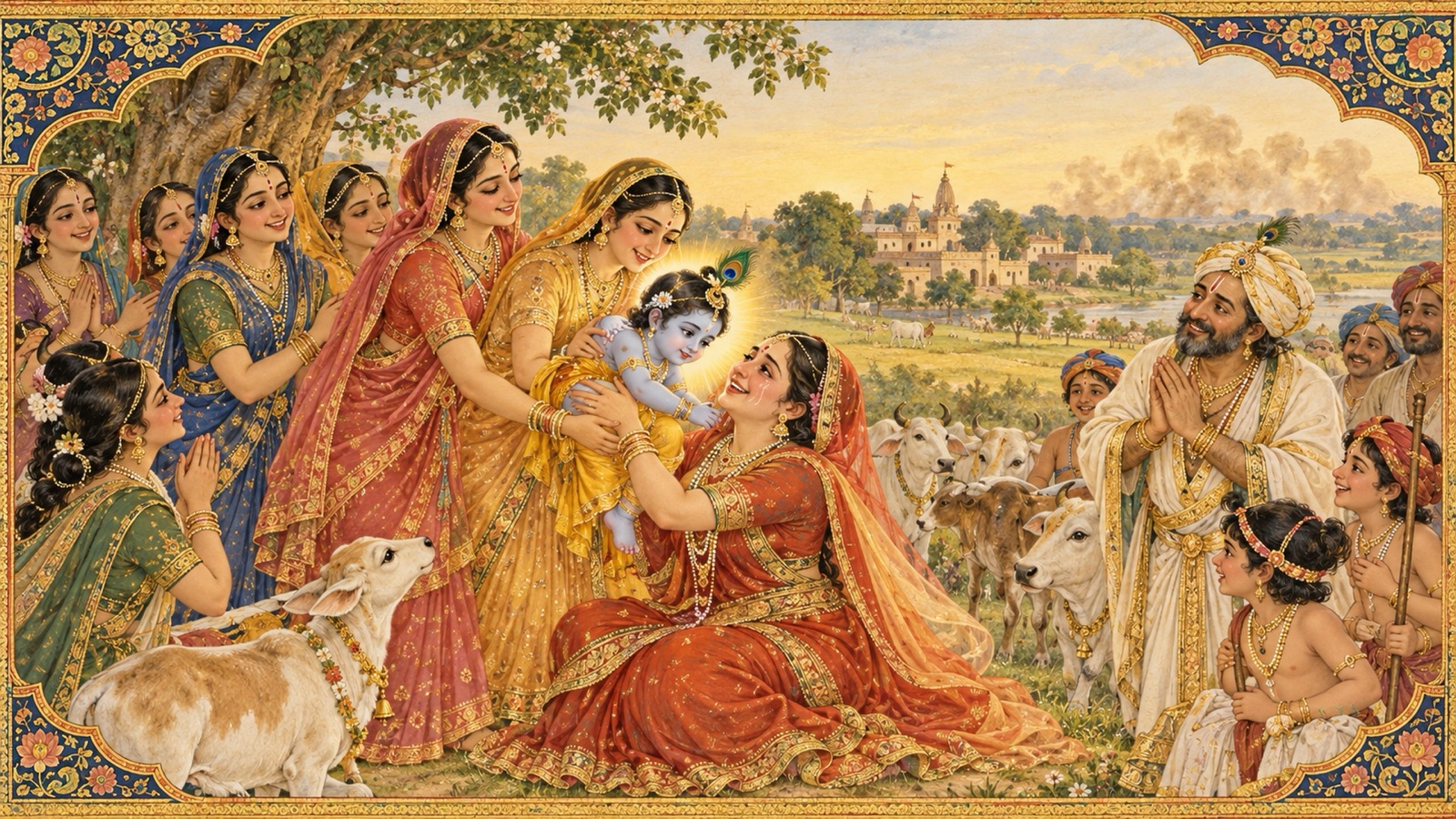
प्रादाय मात्रे प्रतिहृत्य विस्मिता:
कृष्णं च तस्योरसि लम्बमानम् ।
तं स्वस्तिमन्तं पुरुषादनीतं
विहायसा मृत्युमुखात् प्रमुक्तम् ।
गोप्यश्च गोपा: किल नन्दमुख्या
लब्ध्वा पुन: प्रापुरतीव मोदम् ॥ ३० ॥
prādāya mātre pratihṛtya vismitāḥ kṛṣṇaṁ ca tasyorasi lambamānam taṁ svastimantaṁ puruṣāda-nītaṁ vihāyasā mṛtyu-mukhāt pramuktam gopyaś ca gopāḥ kila nanda-mukhyā labdhvā punaḥ prāpur atīva modam
Meaning: Amazed, the cowherd women took the child Krishna, who had been clinging to the demon’s breast, and gave Him back to His mother. Having recovered the Babe safe and sound — carried off through the air by the man-eater yet freed from the very jaws of death — the cowherds and cowherd women headed by Nanda were filled with the greatest joy. (Canto 10, Chapter 7, verse 30)
The pious folk of Vraja wondered what austerities, worship of Lord Vishnu, and acts of charity they must have performed, that their child, though as good as lost, had been restored to them and had revived their very lives. And Nanda, seeing wonder upon wonder unfold at Gokula, treasured Vasudeva’s foretelling again and again in his heart.
Yasoda Beholds the Universe
One day, taking up her son and settling Him in her lap, the blessed Yasoda, overwhelmed with affection, nursed Him at her milk-laden breast.
एकदार्भकमादाय स्वाङ्कमारोप्य भामिनी ।
प्रस्नुतं पाययामास स्तनं स्नेहपरिप्लुता ॥ ३४ ॥
ekadārbhakam ādāya svāṅkam āropya bhāminī prasnutaṁ pāyayām āsa stanaṁ sneha-pariplutā
Meaning: One day the blessed lady Yasoda, overflowing with tenderness, took her child upon her lap and gave Him her breast, which flowed with milk. (Canto 10, Chapter 7, verse 34)
As she caressed the smiling mouth of the child, who had nearly finished suckling, the little one yawned — and within His mouth Yasoda beheld the whole of creation: the sky and the horizon, the host of stars, the four quarters, the sun and the moon, fire, air, and the oceans, the broad divisions of the earth, the mountains and the rivers, the forests, and all beings moving and unmoving. Seized with trembling to see the entire universe revealed at once within her infant’s mouth, the fawn-eyed mother closed her eyes and stood utterly amazed. Thus the seventh discourse, “The Deliverance of Trinavarta,” draws to a close on this vision of infinity glimpsed within the smallest and dearest of forms.
Principal Teachings of This Chapter
1. The Lord’s pastimes purify all who hear them. Parikshit begins by declaring that Sri Hari’s deeds, heard with attention, dissolve discontent and craving, purify the heart, and awaken devotion (verses 1-2). To hear of Krishna is itself a spiritual practice.
2. Divinity lies hidden within the ordinary. A cart overturned by a baby’s kick, a child too heavy to hold — the villagers cannot believe what they see. The Lord conceals His majesty within the tenderness of infancy, revealing it only to loving eyes.
3. No power of the world can harm the Lord’s own. Trinavarta sweeps the child into the sky with all the violence of a storm, yet falls dead while the Babe returns unharmed (verse 20, verse 30). What is entrusted to God is beyond the reach of death.
4. Devotion and gratitude are the right response to grace. The cowherds meet each deliverance not with pride but with rites of blessing, charity to the Brahmanas, and heartfelt wonder at their good fortune (verses 11-17, verse 32).
5. The infinite dwells within the intimate. In Yasoda’s vision, the entire cosmos is seen within the mouth of the child she cradles (verses 34-37). The Supreme is not distant and abstract; He is as near as the object of our love.
A Devotional Reflection
This chapter turns on a single, tender paradox: the child who needs His mother’s milk holds the universe within His mouth. Yasoda does not love Krishna because she knows He is God; she loves Him as her own little son — and it is precisely into that love that the vision of infinity is given. The Bhagavatam seems to whisper that the highest truth is not reserved for the philosopher on his mountain, but is disclosed within the most ordinary bonds of affection, to those whose hearts are soft. The demons come armed with poison and whirlwind and cannot touch Him; the mother comes armed only with love, and to her alone the whole of creation is shown. We are invited to approach the Lord not as a problem to be solved but as one to be loved — and to trust that in that loving nearness, everything we truly need will, in time, be revealed.
A Daily Devotional Practice
Today, let your remembrance of the Lord be as intimate as a mother’s love. Choose one small, ordinary moment — holding a child, sharing a meal, looking at the sky — and quietly offer it to Krishna, seeing His presence hidden within it, as Yasoda saw the universe within her son. As you do, gently chant: “Om Namo Bhagavate Vasudevaya.”
Conclusion
The seventh chapter of the Tenth Canto gathers three wonders into a single garland: the overturned cart, the fall of the whirlwind-demon Trinavarta, and the vision of the universe within the mouth of the child. In each, the Supreme Lord who has descended as the darling of Vraja allows His hidden glory to show through the veil of infancy — undoing a demon’s violence as easily as a baby kicks a cart, and unveiling the whole of creation to the eyes of a loving mother. Beneath the drama runs the Bhagavatam’s constant assurance: that the Lord protects His own from every danger, and that He reveals Himself most fully not to power or cunning but to simple, wholehearted love. May we, hearing these pastimes, come to cherish the child of Yasoda in our own hearts, and find in that nearness the beginning of pure devotion.
May the divine wisdom of Srimad Bhagavatam awaken pure devotion within our hearts.
Om Namo Bhagavate Vasudevaya.
Jay Shree Madhav.
References and Attribution
- Primary edition: Gita Press, Śrīmad Bhāgavata Mahāpurāṇa (English, complete), Book Ten (First Half), Discourse 7.
- Series: Srimad Bhagavatam Wisdom · Biswa Sanatan Dharma Seva Trust.
- Presented following the spiritual guidance and recommendation of Pandit Dr. Shri Kashinath Mishra.
This is an original, faithful retelling in the writer’s own words, with brief quoted verses shown in Devanāgarī and transliteration and their meanings given as summaries. It is not a reproduction of any single publisher’s continuous translation or commentary. No affiliation with or endorsement by any publisher is implied.
Jay Shree Madhav