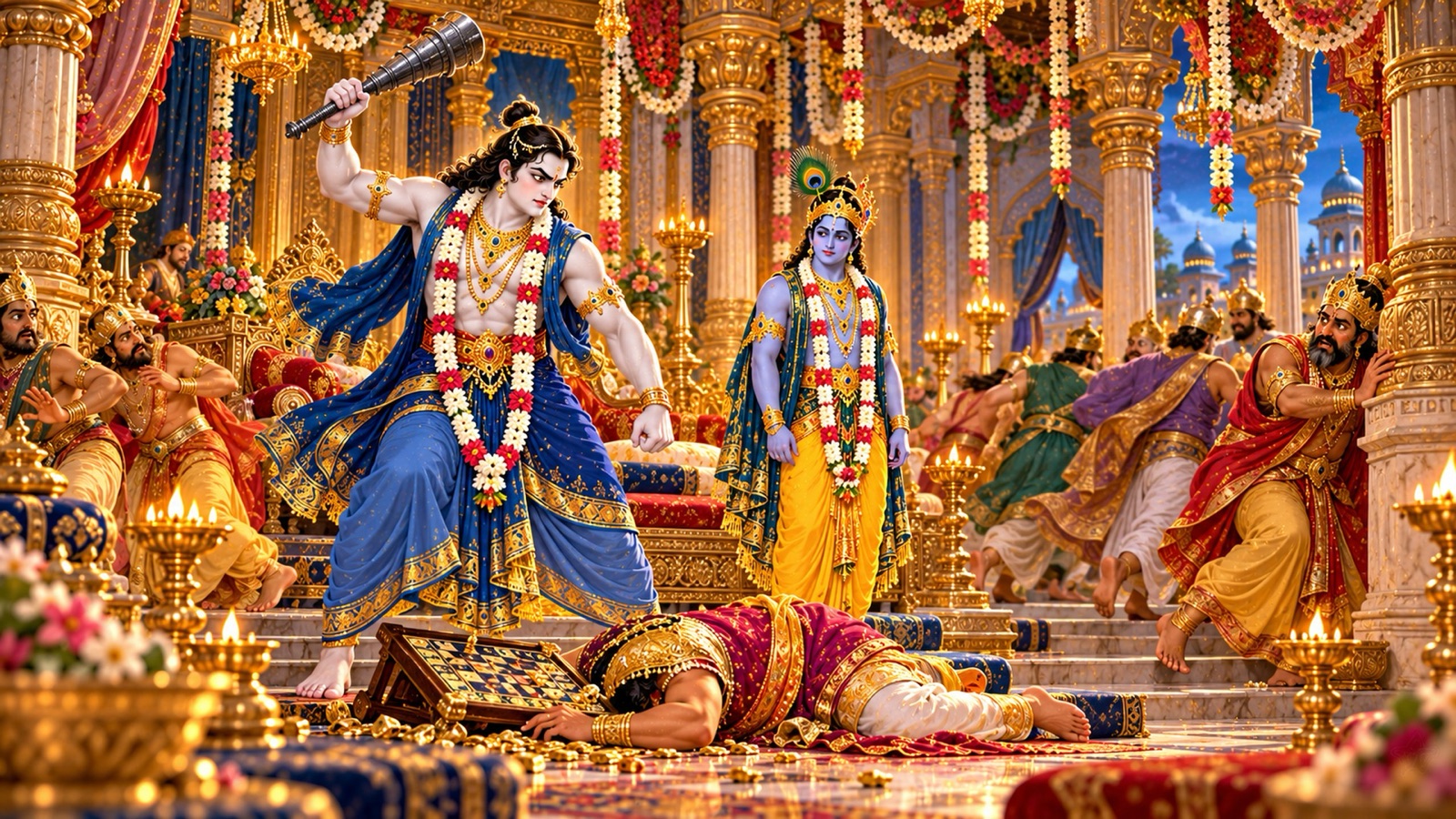
At a wedding feast in Bhojakata a crooked game of dice and a proud man’s mockery bring Rukmi’s lifelong hatred to its end beneath Balarama’s club — while Krishna, standing between brother and beloved, says not a word.
Om Namo Bhagavate Vasudevaya.
Om Namo Bhagavate Vasudevaya.
Om Namo Bhagavate Vasudevaya.
Welcome back to Srimad Bhagavatam Wisdom, our devotional journey through the sacred histories and teachings of the Srimad Bhagavat Mahapurana. This sixty-first chapter of the Tenth Canto first names the princes born to Krishna’s queens in Dvaraka, and then tells how the marriage of His grandson Aniruddha ended with Rukmi slain by Balarama over a dishonest game of dice.
Chapter Information
- Scripture: Śrīmad Bhāgavata Mahāpurāṇa
- Canto: 10 (Book Ten, Latter Half)
- Chapter: 61 (Discourse 61)
- Chapter title: Lord Balarama Slays Rukmi
- Principal speaker: Sukadeva Gosvami (narrating to King Parikshit)
- Principal listener: King Parikshit
- Main setting: Dvārakā, and the city of Bhojakaṭa, Rukmi’s capital
- Central subject: The sons of Krishna’s queens; the marriages of Pradyumna and Aniruddha into Rukmi’s house; the dice game at Bhojakata; Rukmi’s death at Balarama’s hands; and Krishna’s silence
- Principal verse range: Canto 10, Chapter 61, verses 1–40
- Primary edition: Gita Press Śrīmad Bhāgavata Mahāpurāṇa (English, Book Ten, Latter Half)
Context From the Previous Chapter
In Chapter 60, Krishna teased Rukmini in her chamber, pretending that she had chosen poorly in marrying Him; when she fainted with grief He consoled her, and she answered Him with words of unshakeable love. He praised her fidelity, recalling among her trials that she had borne even her brother Rukmi’s death at a wedding without a word of complaint. This chapter now tells that story in full.
The Sons of the Lord’s Queens
Sukadeva resumed his narration for King Parikshit by turning to the households of Dvaraka. Every one of Krishna’s queens gave birth to ten princes, and not one of these boys fell short of his divine Father in strength, beauty, or nobility of character.
एकैकशस्ताः कृष्णस्य पुत्रान् दश दशाबलाः ।
अजीजनन्ननवमान् पितुः सर्वात्मसम्पदा ॥ १ ॥
ekaikaśas tāḥ kṛṣṇasya putrān daśa-daśābalāḥ ajījanann anavamān pituḥ sarvātma-sampadā
Meaning: Each of those wives of Krishna bore Him ten sons, who were in no way inferior to their Father in the fullness of every personal excellence. (Canto 10, Chapter 61, verse 1)
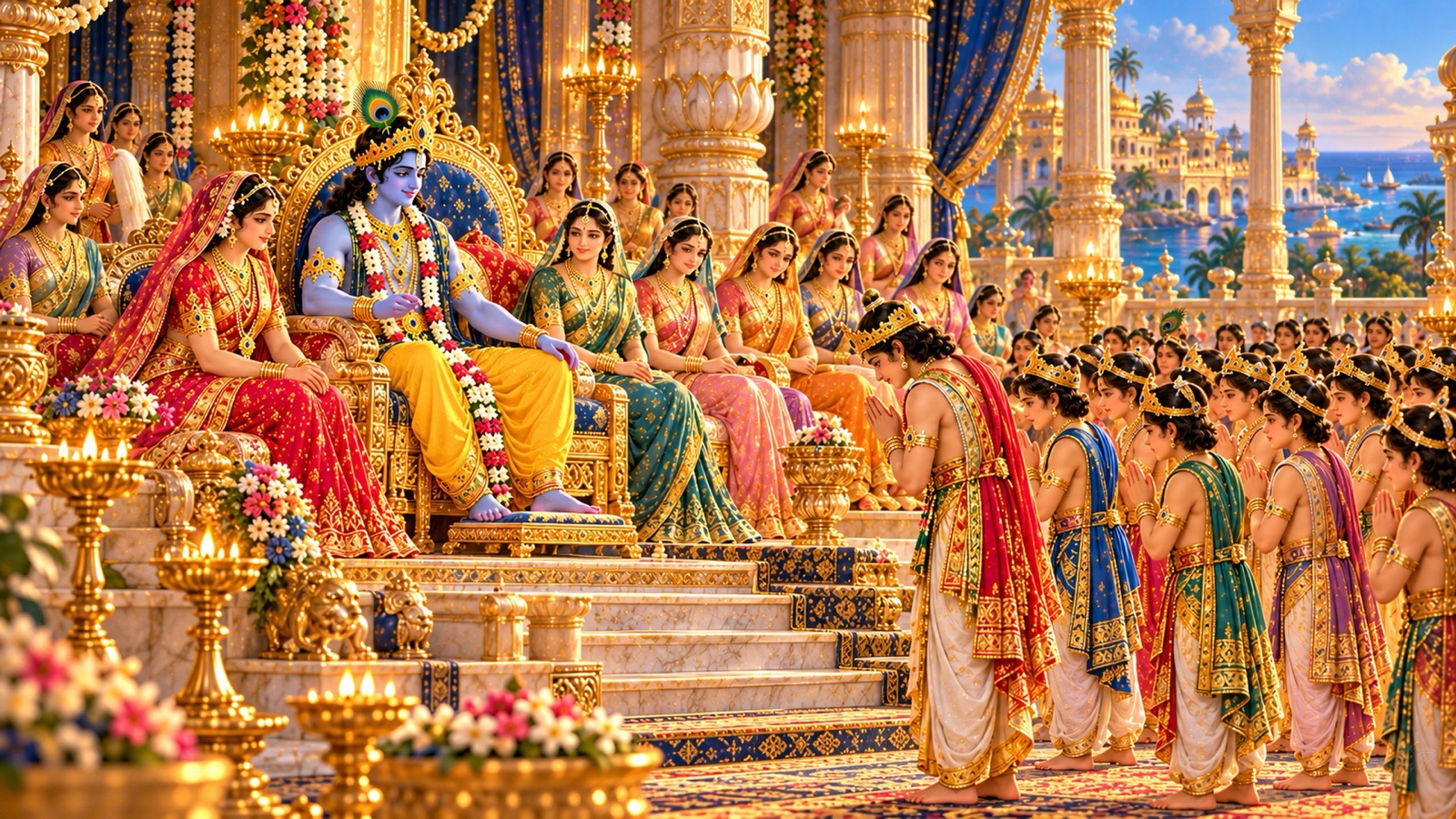
Because the infallible Lord never seemed to leave her own palace, each princess believed herself to be His most beloved; they did not grasp the truth of who He was. His lotus face, long arms, large eyes, loving glances and sweet speech enchanted them, yet with all their charms they could not conquer the heart of the all-perfect One. Sixteen thousand wives sent the arrows of Cupid from arched brows and sidelong smiles, and still His senses remained unmoved. Having gained as husband the Lord of Lakshmi, whose path even Brahma cannot trace, they served Him with ever-fresh delight: though each had hundreds of maidservants, they themselves rose to greet Him, washed His feet, brought betel, fanned Him, anointed Him with sandal, garlanded Him, prepared His bed and served His meals.
Sukadeva then named the sons of the eight principal queens. Rukmini’s ten, headed by Pradyumna, were Carudesna, Sudesna, the valorous Carudeha, Sucaru, Carugupta, Bhadracaru, Carucandra, Vicaru and Caru. Satyabhama’s were Bhanu, Subhanu, Svarbhanu, Prabhanu, Bhanuman, Candrabhanu, Brhadbhanu, Atibhanu, Sribhanu and Pratibhanu. Jambavati’s beloved sons, led by Samba, were Sumitra, Purujit, Satajit, Sahasrajit, Vijaya, Citraketu, Vasuman, Dravida and Kratu. Nagnajiti bore Vira, Candra, Asvasena, Citragu, Vegavan, Vrsa, Ama, Sanku, Vasu and the glorious Kunti. Kalindi’s were Sruta, Kavi, Vrsa, Vira, Subahu, Bhadra, Santi, Darsa, Purnamasa and Somaka. Laksmana of Madra bore Praghosa, Gatravan, Simha, Bala, Prabala, Urdhvaga, Mahasakti, Saha, Oja and Aparajita. Mitravinda’s were Vrka, Harsa, Anila, Grdhra, Vardhana, Annada, Mahasa, Pavana, Vahni and Ksudhi. Bhadra’s were Sangramajit, Brhatsena, Sura, Praharana, Arijit, Jaya, Subhadra, Vama, Ayu and Satyaka; and Rohini, first among the other queens, bore Diptiman, Tamra, Tapta and more. Through Pradyumna and Rukmavati, Rukmi’s daughter, was born the mighty Aniruddha in the city of Bhojakata. With sixteen thousand mothers, the sons and grandsons of the Lord’s family came to number tens of millions.
Parikshit’s Question
Here the king interrupted with wonder. Rukmi had been humiliated in battle by Krishna and had waited ever since for a chance to kill Him; how, then, could such a man give his daughter to his enemy’s own son? Parikshit begged the learned sage to explain this marriage between two hostile houses, for yogis see clearly the past, the present and the future, and whatever is hidden, distant or beyond the senses.
Pradyumna, Rukmavati and the Bond with Rukmi
Sukadeva answered that Rukmavati herself had chosen Pradyumna, Love incarnate in a human form, at her svayamvara; alone upon a single chariot he defeated the assembled kings and carried her away. And Rukmi, though the old wound of Krishna’s contempt still burned in his memory, consented to the match for his sister’s sake.
यद्यप्यनुस्मरन् वैरं रुक्मी कृष्णावमानितः ।
व्यतरद् भागिनेयाय सुतां कुर्वन् स्वसुः प्रियम् ॥ २३ ॥
yady apy anusmaran vairaṁ rukmī kṛṣṇāvamānitaḥ vyatarad bhāgineyāya sutāṁ kurvan svasuḥ priyam
Meaning: Although Rukmi, who had been disgraced by Krishna, kept remembering that enmity, he gave his daughter to his sister’s son in order to please his sister. (Canto 10, Chapter 61, verse 23)
In the same spirit of kinship, Bali, the son of Krtavarma, married Rukmini’s large-eyed daughter Carumati. And Rukmi went a step further still: bound by cords of affection for Rukmini, he offered his granddaughter Rochana to her grandson Aniruddha — knowing all the while that such a union among close relatives was contrary to dharma, and nursing his hatred of Krishna even as he gave the bride.
दौहित्रायानिरुद्धाय पौत्रीं रुक्म्याददाद्धरेः ।
रोचनां बद्धवैरोऽपि स्वसुः प्रियचिकीर्षया ।
जानन्नधर्मं तद् यौनं स्नेहपाशानुबन्धनः ॥ २५ ॥
dauhitrāyāniruddhāya pautrīṁ rukmy ādadād dhareḥ rocanāṁ baddha-vairo ‘pi svasuḥ priya-cikīrṣayā jānann adharmaṁ tad yaunaṁ sneha-pāśānubandhanaḥ
Meaning: Though his enmity toward the Lord was fixed, Rukmi, wishing to gratify his sister and tied by the bonds of affection, bestowed his granddaughter Rochana on Aniruddha, his daughter’s son, even while knowing that such a marriage was not in keeping with dharma. (Canto 10, Chapter 61, verse 25)
The Wedding at Bhojakata
For the festive occasion Rukmini, Balarama and Krishna, with Samba, Pradyumna and the other Yadavas, travelled to Bhojakata, Rukmi’s city, and the wedding of Aniruddha and Rochana was celebrated there.
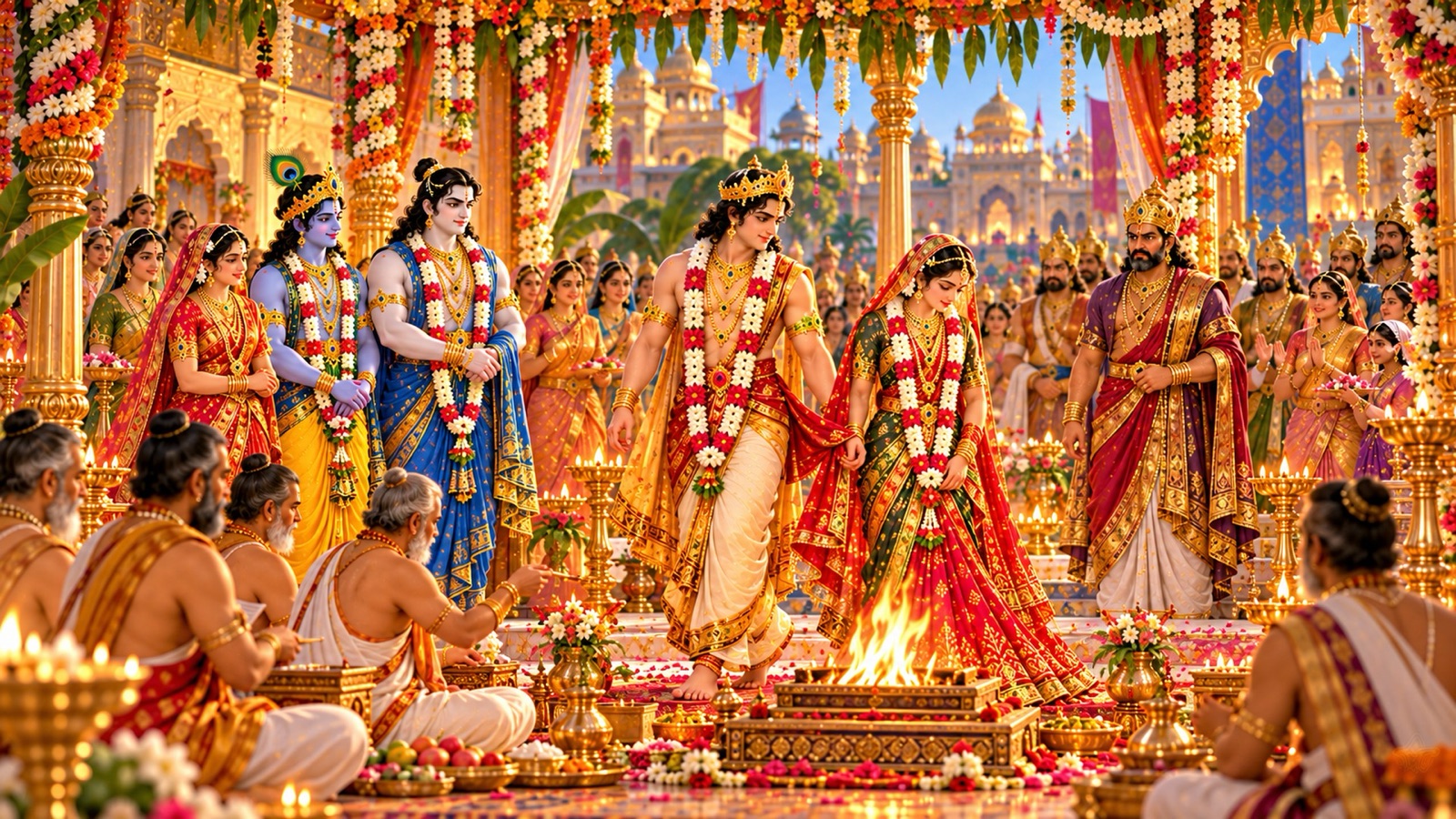
When the ceremonies were complete, certain arrogant kings led by the ruler of Kalinga drew Rukmi aside. “Defeat Balarama at dice,” they urged. “He knows nothing of the game, yet his fondness for it is great.” Swayed by their words, Rukmi invited Balarama to play.
The Game of Dice
Balarama staked a hundred gold coins, then a thousand, then ten thousand, and Rukmi won every throw. At this the king of Kalinga laughed aloud, baring his teeth at the wielder of the plough — a mockery Balarama did not forget. Rukmi then wagered a hundred thousand, and this time Balarama won; but Rukmi, resorting to deceit, announced, “The stake is mine.”
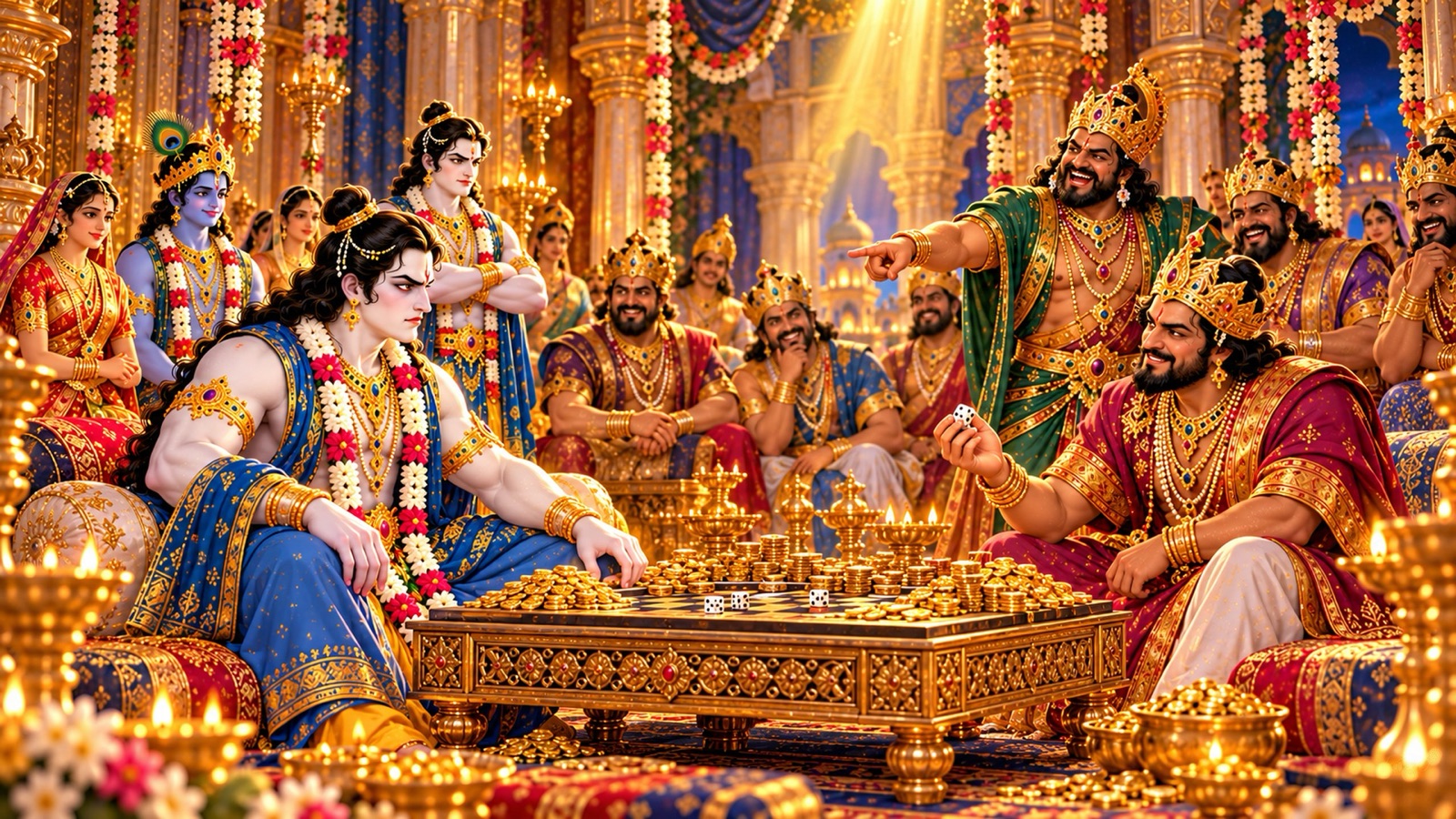
Stirred like the ocean at the full moon, the glorious Balarama, His naturally reddish eyes now blazing, placed a wager of a hundred million. By the laws of the game He won that too — and once more Rukmi claimed the victory, calling on the onlookers to judge. Then a voice sounded from the sky.
तदाब्रवीन्नभोवाणी बलेनैव जितो ग्लहः ।
धर्मतो वचनेनैव रुक्मी वदति वै मृषा ॥ ३३ ॥
tadābravīn nabho-vāṇī balenaiva jito glahaḥ dharmato vacanenaiva rukmī vadati vai mṛṣā
Meaning: Then a voice from the heavens declared: “By right this stake has been won by Balarama alone; Rukmi speaks a falsehood with his words.” (Canto 10, Chapter 61, verse 33)
Rukmi’s Mockery
Rukmi paid the divine voice no heed. Goaded by the wicked kings around him and driven on by his own approaching death, he turned on Balarama with ridicule.
नैवाक्षकोविदा यूयं गोपाला वनगोचराः ।
अक्षैर्दीव्यन्ति राजानो बाणैश्च न भवादृशाः ॥ ३५ ॥
naivākṣa-kovidā yūyaṁ gopālā vana-gocarāḥ akṣair dīvyanti rājāno bāṇaiś ca na bhavādṛśāḥ
Meaning: “You cowherds who wander the forests are surely no experts at dice. It is kings who play with dice and with arrows — not the likes of you.” (Canto 10, Chapter 61, verse 35)
Balarama’s Wrath
Taunted by Rukmi and laughed at by the assembled kings, Balarama could bear no more. Seizing an iron club, He struck Rukmi down there in the midst of that auspicious gathering.
रुक्मिणैवमधिक्षिप्तो राजभिश्चोपहासितः ।
क्रुद्धः परिघमुद्यम्य जघ्ने तं नृम्णसंसदि ॥ ३६ ॥
rukmiṇaivam adhikṣipto rājabhiś copahāsitaḥ kruddhaḥ parigham udyamya jaghne taṁ nṛmṇa-saṁsadi
Meaning: Insulted thus by Rukmi and ridiculed by the kings, Balarama in anger lifted His iron club and slew him in that festive assembly. (Canto 10, Chapter 61, verse 36)
The king of Kalinga fled, but Balarama caught him at the tenth step and knocked out the very teeth he had bared in laughter. The other kings, battered by His club and bleeding from arms, thighs and heads, ran from the hall in terror.
The Lord’s Silence
Rukmi was Krishna’s brother-in-law, and he lay slain by Krishna’s own brother. Yet the Lord spoke not one word, neither of approval nor of blame. Rukmini loved her brother; Balarama was His elder; a single syllable either way might have wounded the affection of one or the other, and so Hari kept silent.
निहते रुक्मिणि श्याले नाब्रवीत् साध्वसाधु वा ।
रुक्मिणीबलयो राजन् स्नेहभङ्गभयाद्धरिः ॥ ३९ ॥
nihate rukmiṇi śyāle nābravīt sādhv asādhu vā rukmiṇī-balayo rājan sneha-bhaṅga-bhayād dhariḥ
Meaning: When His brother-in-law Rukmi had been killed, O King, Hari said nothing, good or bad, for fear of breaking the bond of love with either Rukmini or Balarama. (Canto 10, Chapter 61, verse 39)
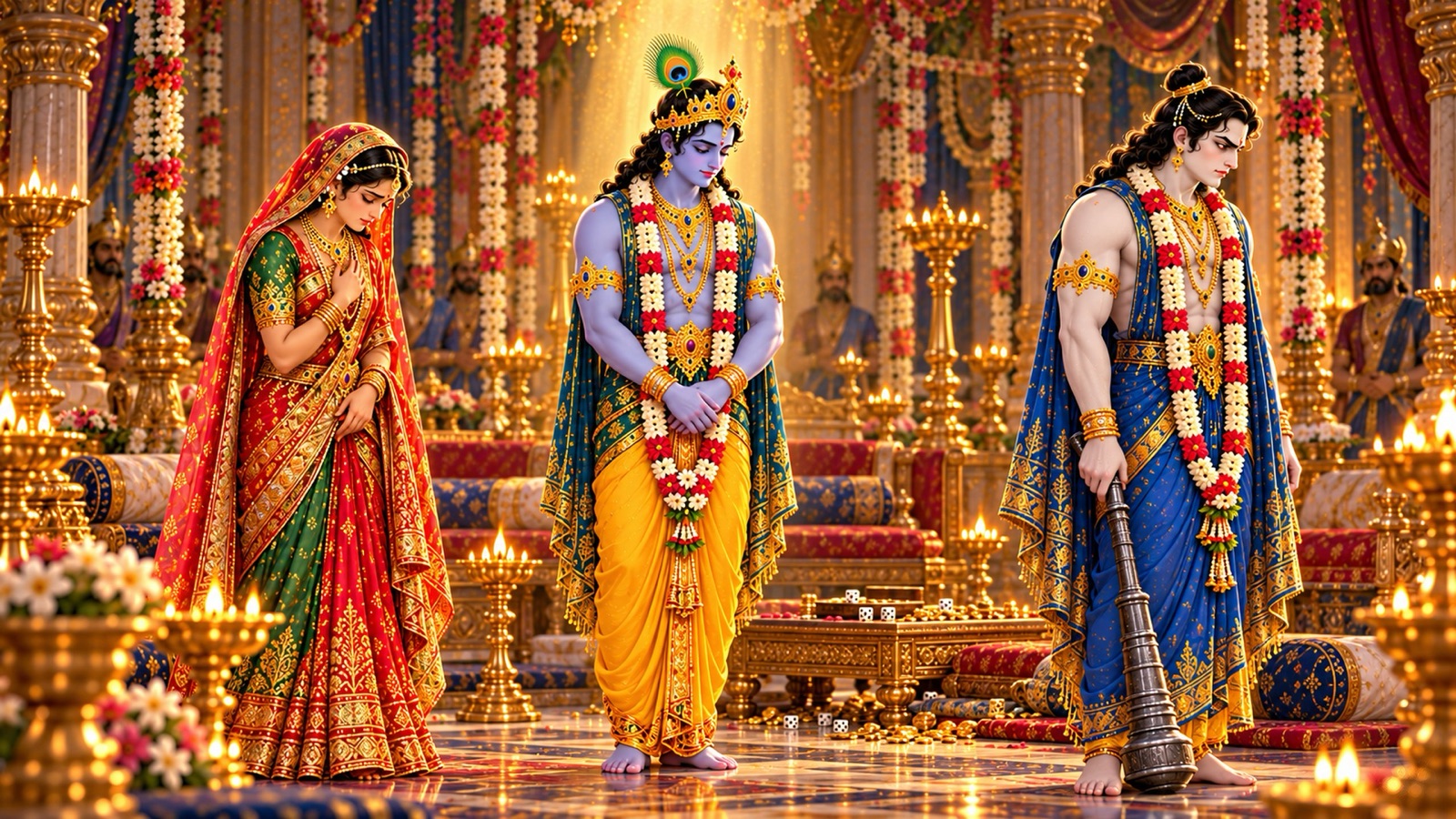
In that silence lies the deepest teaching of the chapter. Rukmi’s death was not Krishna’s doing, yet it unfolded entirely within His sight: the man who had sworn to kill the Lord met his end instead at a festival of his own house, impelled, as the sage says, by his own time. Krishna neither hastened it nor prevented it nor passed judgment upon it. He allowed dharma, declared openly by the voice from the sky, to run its course through Balarama, and then held His peace so that neither His wife nor His brother would be hurt. The Lord who had once spared Rukmi’s life at Rukmini’s plea now protects her heart in a different way — by refusing to add a single word to her grief. Here the supreme controller shows Himself also the supremely considerate kinsman.
The Return to Dvaraka
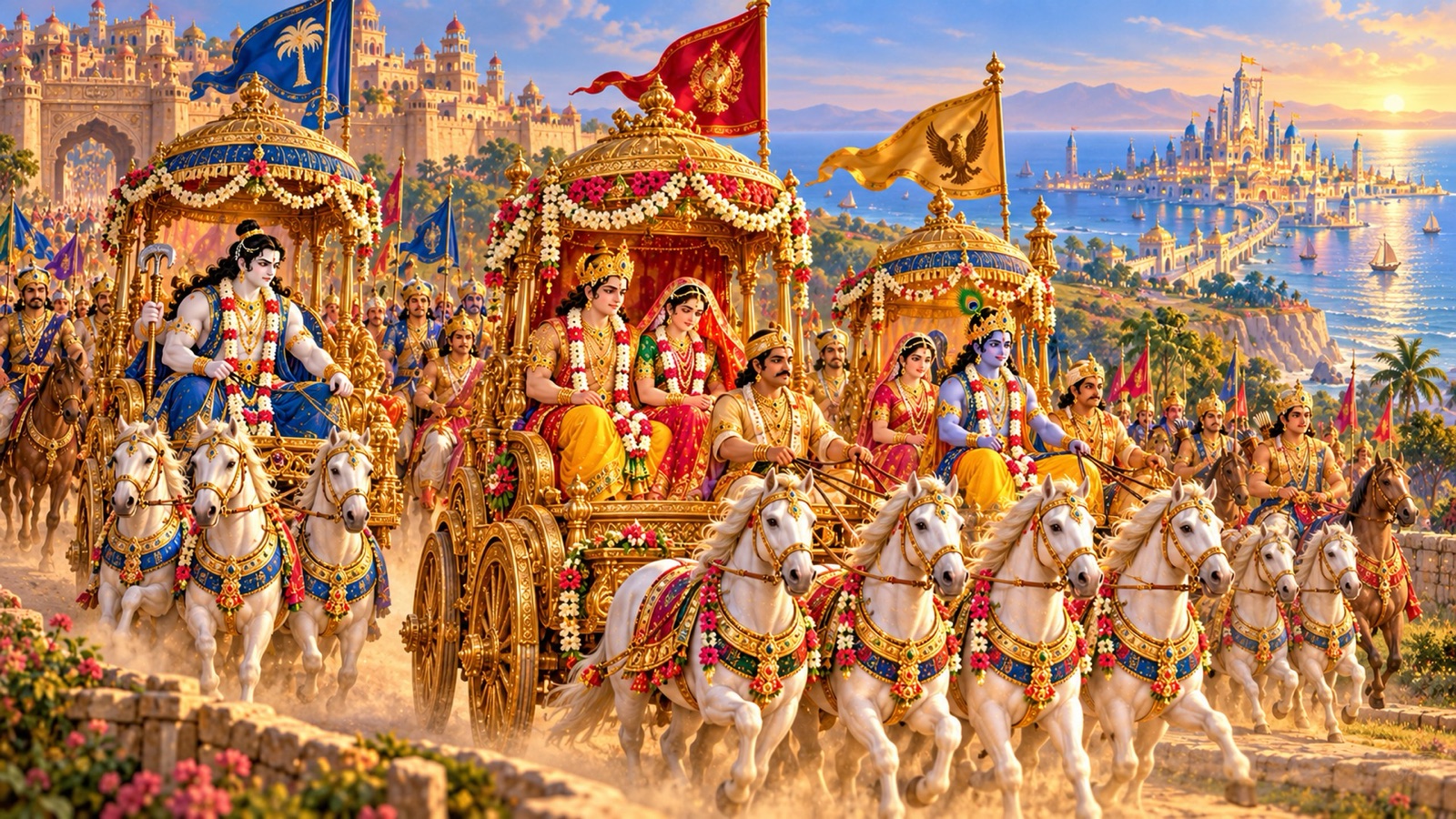
Their purpose fulfilled, the Dasarhas seated Aniruddha and his bride upon a fine chariot and, with Balarama at their head and Krishna as their refuge, departed Bhojakata for Dvaraka.
ततोऽनिरुद्धं सह सूर्यया वरं रथं समारोप्य ययुः कुशस्थलीम् ।
रामादयो भोजकटाद् दशार्हाः सिद्धाखिलार्था मधुसूदनाश्रयाः ॥ ४० ॥
tato ‘niruddhaṁ saha sūryayā varaṁ rathaṁ samāropya yayuḥ kuśasthalīm rāmādayo bhojakaṭād daśārhāḥ siddhākhilārthā madhusūdanāśrayāḥ
Meaning: Then, having placed the bridegroom Aniruddha together with his bride upon an excellent chariot, Balarama and the other descendants of Dasarha, all their aims accomplished and sheltered by the slayer of Madhu, went from Bhojakata to Kusasthali, Dvaraka. (Canto 10, Chapter 61, verse 40)
Principal Teachings of This Chapter
1. The Lord is never bound by what binds us. Sixteen thousand devoted queens could not shake the mind of the all-perfect One with their charms. He accepts their loving service fully, yet remains the Self-satisfied Lord whose heart no allurement can capture.
2. Affection can override even long hatred — but it cannot sanctify adharma. Love for his sister moved Rukmi to give both daughter and granddaughter into Krishna’s family. Yet the sage notes plainly that he knew the second marriage to be against dharma; affection explained his act without excusing it.
3. Deceit against the righteous invites ruin. Rukmi cheated at dice, dismissed the voice of heaven, and mocked Balarama as a forest cowherd. Pride that will not hear even a divine correction walks willingly toward its end.
4. Truth is upheld from above. When the onlookers were asked to judge, the sky itself answered. Dharma does not depend on the honesty of the judges in the hall; the Lord’s order declares what is right.
5. Compassion sometimes speaks through silence. Krishna withheld every comment on Rukmi’s death to spare Rukmini and Balarama. There are moments when the most loving word is the one left unsaid.
A Devotional Reflection
It is a sobering chapter. It opens in the warm light of Dvaraka’s households, with queens tenderly serving the Lord and princes beyond counting, and it closes in a wedding hall turned battlefield. Between the two stands Rukmi, a man who cannot stop hating and cannot stop loving — hating Krishna for a defeat long past, loving Rukmini enough to give his children to her line. His tragedy is that he never once bowed. Krishna had spared him; Rukmini had pleaded for him; the sky itself told him he was lying. Each was an open door, and he walked past them all. And then there is Krishna’s silence. How easy it would have been to justify Balarama, to grieve with Rukmini, to pronounce on dharma. He said nothing, because love pulled in two directions and He would wound neither. When we feel compelled to have the last word, we might remember Hari standing quietly in Bhojakata, holding both His brother and His beloved in a single wordless embrace.
A Daily Devotional Practice
Today, in one conversation where you feel the urge to pronounce judgment on a matter that is not yours to settle, hold your peace the way the Lord did at Bhojakata — and in that silence offer the people involved to Him. Then recall Rukmi, who ignored even a voice from heaven, and ask the Lord to make you quick to hear and quick to bend when truth is spoken to you. Begin by chanting gently: Om Namo Bhagavate Vasudevaya.
Conclusion
The sixty-first chapter of the Tenth Canto moves from the blessed fruitfulness of Krishna’s family to the fall of Rukmi. After the princes and the marriages that twice joined Rukmi’s house to Dvaraka, Sukadeva recounts the dice game at Aniruddha’s wedding — the cheating, the heavenly verdict, the insult, and the club of Balarama. Over it all stands the single image the chapter leaves with us: Krishna, brother to one and husband to the other, keeping a silence of pure love. May we learn to honour truth when it is declared to us, and to guard the hearts entrusted to us even at the cost of our own words.
May the divine wisdom of Srimad Bhagavatam awaken pure devotion within our hearts.
Om Namo Bhagavate Vasudevaya.
Jay Shree Madhav.
References and Attribution
- Primary edition: Gita Press, Śrīmad Bhāgavata Mahāpurāṇa (English), Book Ten (Latter Half), Discourse 61.
- Series: Srimad Bhagavatam Wisdom · Biswa Sanatan Dharma Seva Trust.
- Presented following the spiritual guidance and recommendation of Pandit Dr. Shri Kashinath Mishra.
This is an original, faithful retelling in the writer’s own words, with brief quoted verses shown in Devanāgarī and transliteration and their meanings given as summaries. It is not a reproduction of any single publisher’s continuous translation or commentary. No affiliation with or endorsement by any publisher is implied.
Jay Shree Madhav