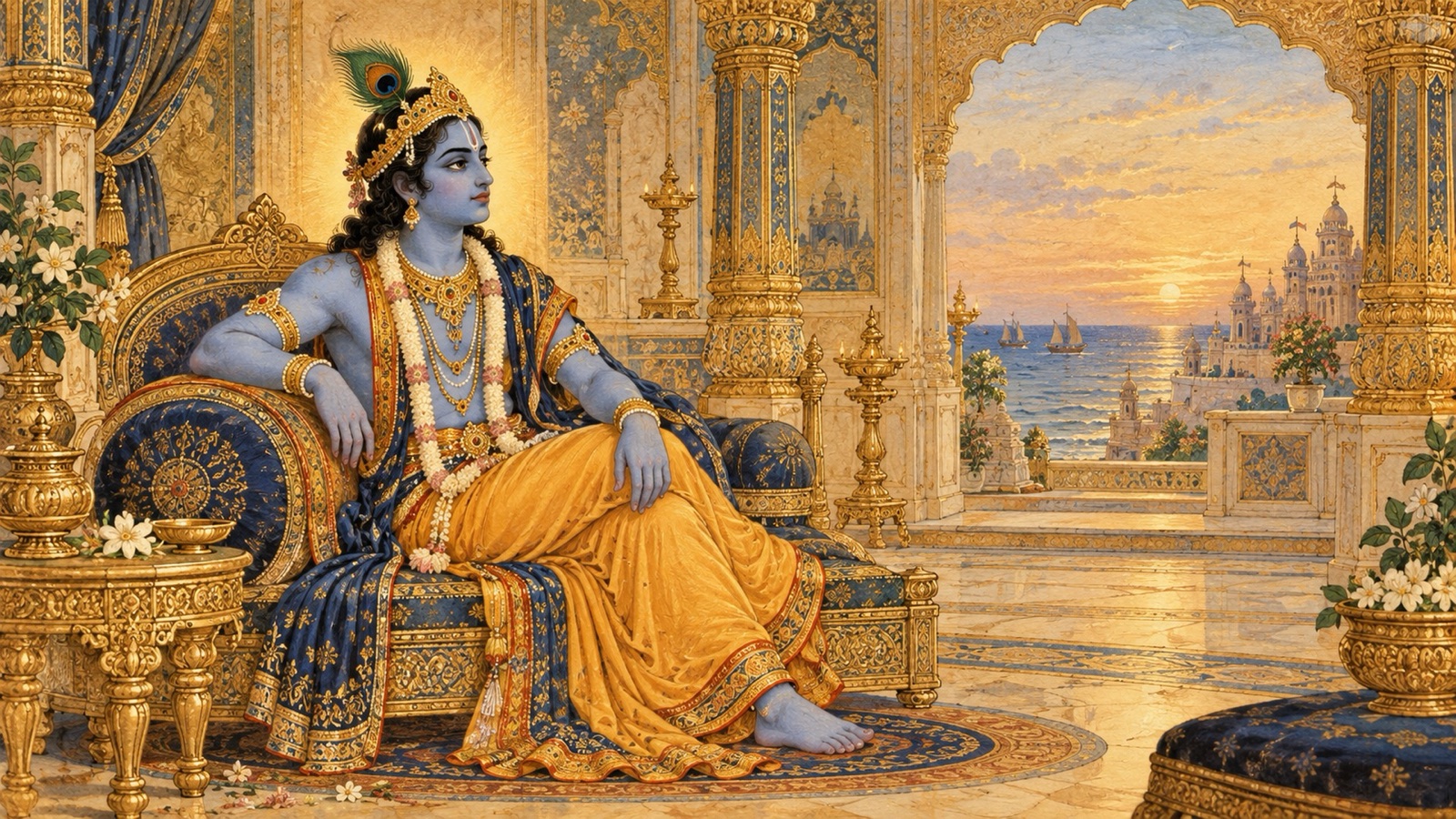
Book Eleven opens on a note both majestic and tender: the earth’s burden lifted at last, Lord Sri Krishna quietly resolves to withdraw His own radiant dynasty and return to His eternal abode — and He allows the words of the sages to become the instrument of that divine will.
Om Namo Bhagavate Vasudevaya.
Om Namo Bhagavate Vasudevaya.
Om Namo Bhagavate Vasudevaya.
Welcome to Srimad Bhagavatam Wisdom, a devotional journey through the sacred histories and teachings of the Srimad Bhagavat Mahapurana. With this chapter we enter Book Eleven, one of the most spiritually concentrated portions of the entire scripture — the Canto that will carry the Lord’s final teachings to His beloved friend Uddhava and, at its close, His own withdrawal from the world. But before the wisdom of the Uddhava Gita can unfold, Sukadeva Gosvami must first tell how the stage was set: how Lord Sri Krishna, His mission of relieving the earth complete, turned His attention to the last unfinished work — the peaceful dissolution of His own mighty race, the Yadus. This first discourse tells the strange and sobering story of the sages’ curse, the iron pestle, and the Lord’s own quiet approval of the destiny He had already resolved upon.
Chapter Information
- Scripture: Śrīmad Bhāgavata Mahāpurāṇa
- Canto: 11 (Book Eleven)
- Chapter: 1 (Discourse 1)
- Chapter title: The Curse upon the Yadu Dynasty
- Principal speaker: Sukadeva Gosvami, narrating to King Parikshit
- Principal listener: King Parikshit (who also asks two questions within the chapter)
- Main setting: Dwaraka and the nearby holy place of Pindaraka, near the close of the Lord’s earthly pastimes
- Central subject: The Lord’s resolve to withdraw the Yadu dynasty from the earth, and how the curse of the sages upon the mischievous Yadava youths became the appointed cause of that withdrawal
- Principal verse range: Canto 11, Chapter 1, verses 1–24
- Primary edition: Gita Press Śrīmad Bhāgavata Mahāpurāṇa
The Earth’s Burden Lifted
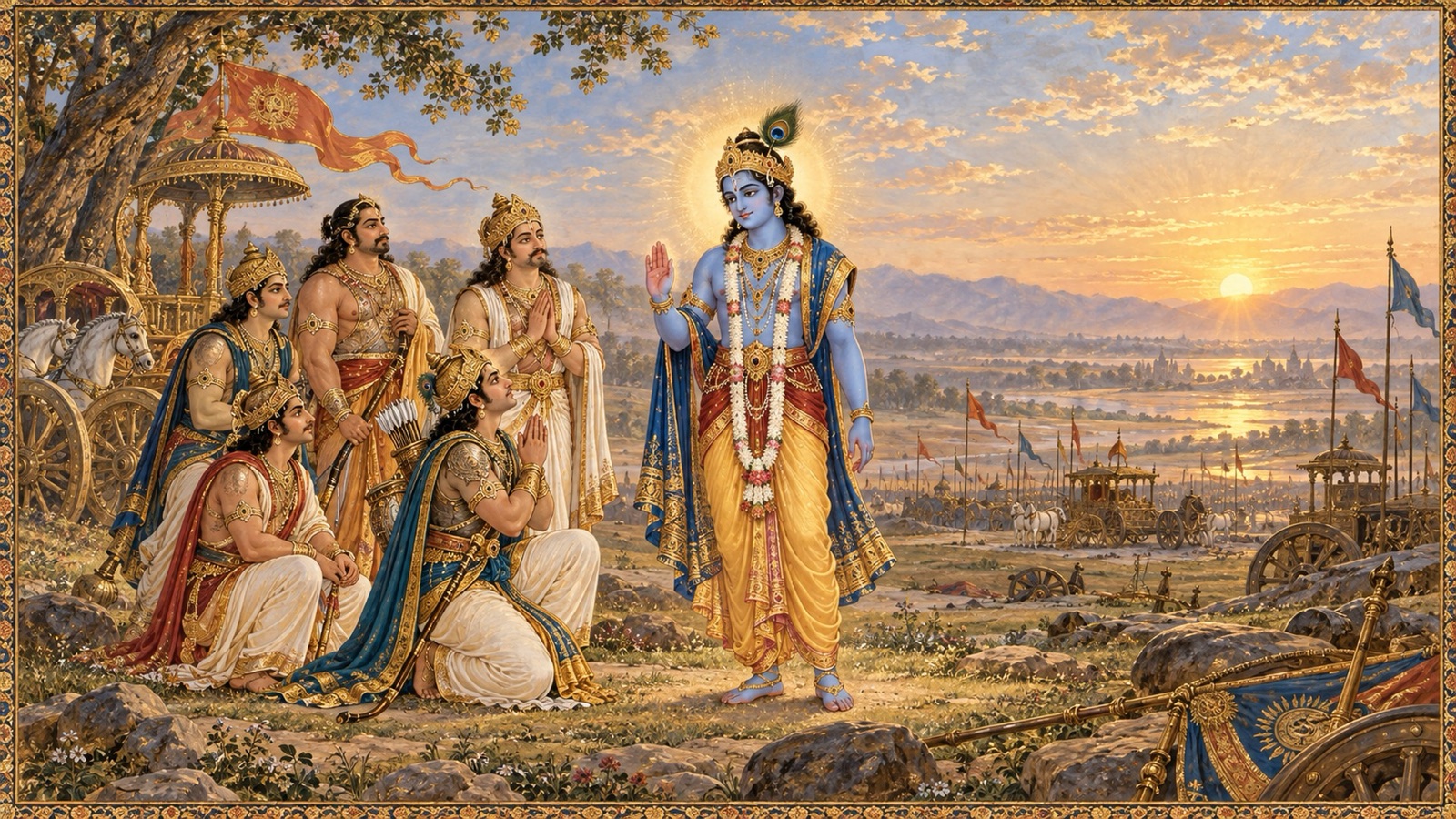
Sukadeva Gosvami resumes the great narration by drawing together the vast arc of Lord Sri Krishna’s earthly work. Attended by His brother Balarama and the assembled Yadavas, the Lord had destroyed the demons who oppressed the world; and, by allowing discord to ripen between the Pandavas and the Kauravas, He had brought about the removal of the earth’s heavy burden — the multitude of proud and unrighteous kings.
श्रीशुक उवाच कृत्वा दैत्यवधं कृष्ण: सरामो यदुभिर्वृत: । भुवोऽवतारयद् भारं जविष्ठं जनयन् कलिम् ॥ १ ॥
śrī-śuka uvāca kṛtvā daitya-vadhaṁ kṛṣṇaḥ sa-rāmo yadubhir vṛtaḥ bhuvo ‘vatārayad bhāraṁ javiṣṭhaṁ janayan kalim
Meaning: Sri Suka said: Attended by Balarama and the Yadavas, Sri Krishna destroyed the demons and, swiftly bringing about discord, relieved the earth of her burden. (Canto 11, Chapter 1, verse 1)
The Lord had made the Pandavas His instrument, Sukadeva explains — those righteous brothers whose anger had been provoked again and again by the Kauravas through deceitful gambling, humiliating insult, the dragging of Draupadi by her hair, and countless other wrongs. Through them the Lord caused the passing of the kings gathered upon both sides, and so the earth was unburdened.
The Lord’s Inward Resolve
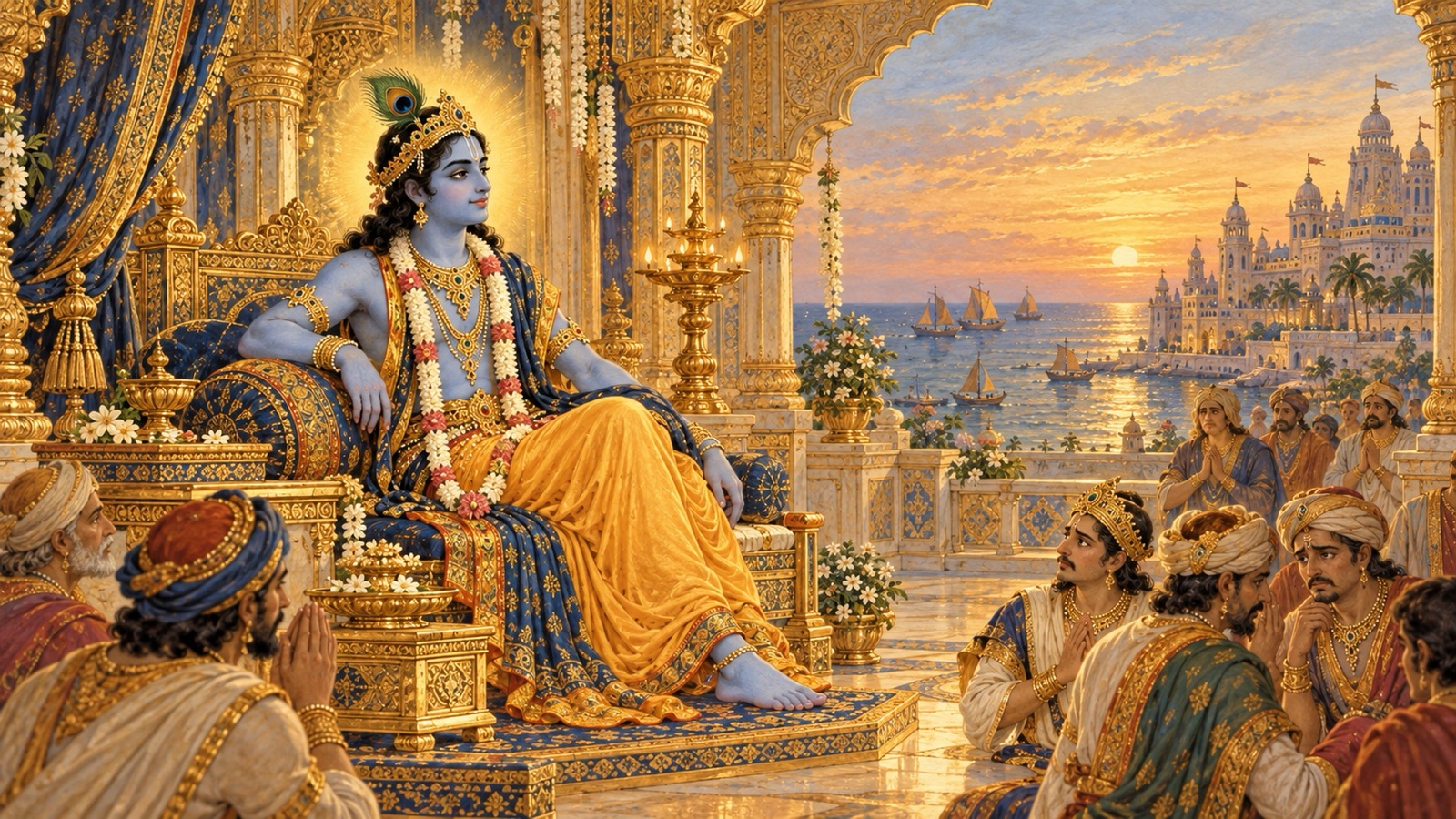
Yet even with the kings and their armies gone, the Lord of inscrutable ways reflected inwardly. Though the earth’s burden was removed, He did not consider His work wholly complete so long as His own unconquerable race, the Yadus, still flourished. This dynasty, always protected by His own arms and grown mighty through boundless prosperity, could never be subdued by any outside power — not even by the gods. Left in the world, such invincible strength would itself become a new kind of burden. And so the Lord resolved to bring about the dissolution of His own race from within, as gently and inevitably as a bamboo grove is consumed by a fire born of the friction of its own stems.
नैवान्यत: परिभवोऽस्य भवेत् कथञ्चिन् मत्संश्रयस्य विभवोन्नहनस्य नित्यम् । अन्त:कलिं यदुकुलस्य विधाय वेणु- स्तम्बस्य वह्निमिव शान्तिमुपैमि धाम ॥ ४ ॥
naivānyataḥ paribhavo ‘sya bhavet kathañcin mat-saṁśrayasya vibhavonnahanasya nityam antaḥ kaliṁ yadu-kulasya vidhāya veṇu- stambasya vahnim iva śāntim upaimi dhāma
Meaning: This race of Yadu, ever sheltered by Me and swollen with prosperity, can never be overcome by any outside power; therefore, having brought about discord within the house of Yadu — as a fire consumes a grove of bamboo — I shall, in peace, return to My own abode. (Canto 11, Chapter 1, verse 4)
Having thus resolved, the Lord of unfailing will brought about the withdrawal of His own dynasty, using the curse of the Brahmanas as its outward cause. Then Sukadeva pauses to remember the very manner of the Lord’s presence in the world: how He had captivated the eyes of all by a beauty that put every other loveliness to shame, and captivated the hearts of all who remembered His words; how the very sight of His footprints stilled the restless activity of those who beheld them; and how, His fame now spread through the world and sung in charming verse, He knew that whoever heard or sang of Him would easily rise out of the darkness of ignorance. Having accomplished all this, the Lord prepared to return to His realm.
King Parikshit’s Question
Hearing that the destruction of the Yadus came about through a curse, King Parikshit is moved to ask. How, he wonders, could the curse of Brahmanas ever fall upon the Vrishnis — a people devoted to the Brahmanas, generous and liberal, ever respectful of their elders, and whose minds were wholly given in love to Sri Krishna? What was the occasion of such a curse, and what was its nature? And how could any real discord arise among a people so united in heart? Sukadeva, pleased by the earnestness of the question, begins the story from its root.
The Sages at Pindaraka
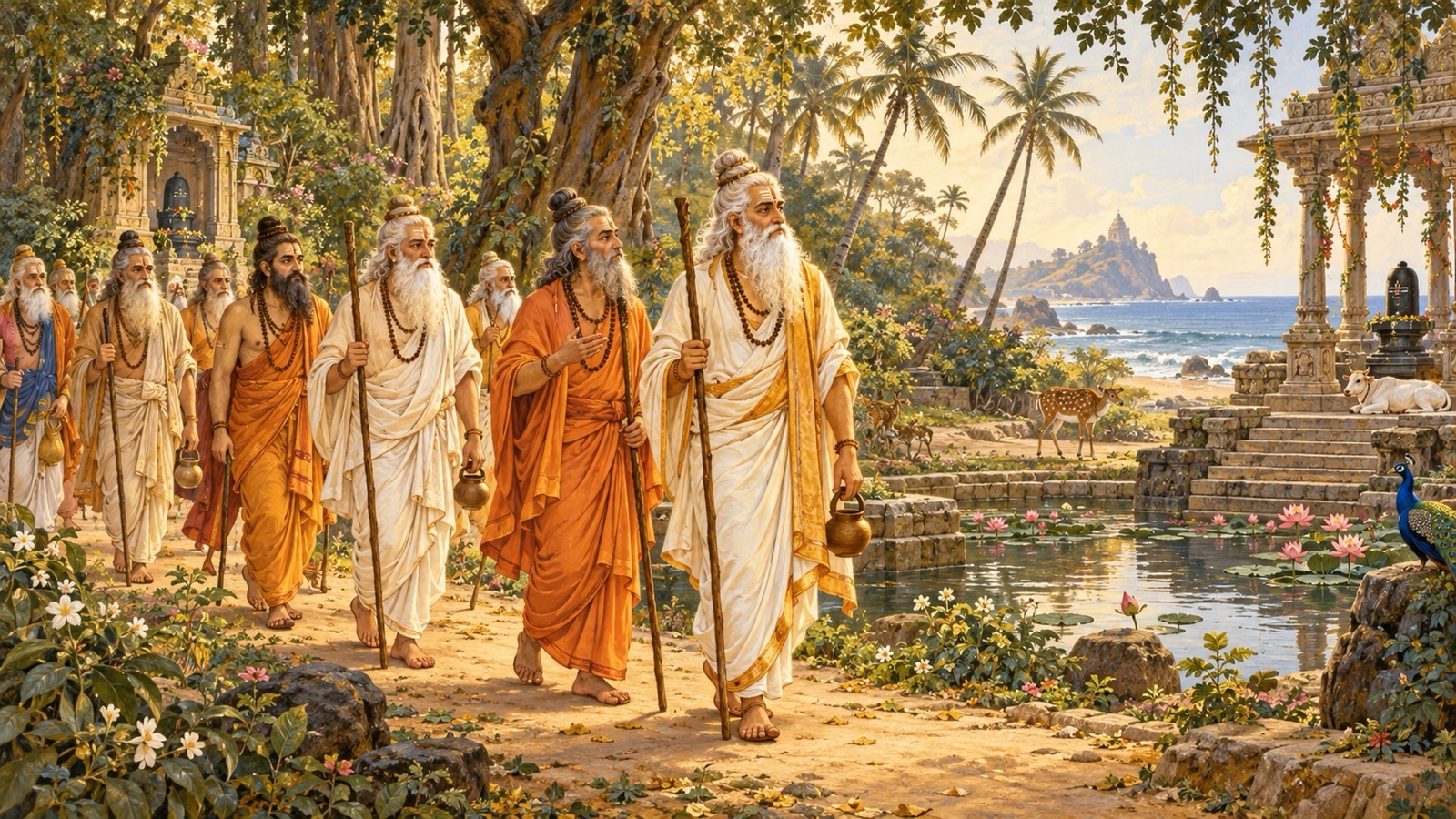
The Lord, Sukadeva says, having displayed a form embodying every grace, having performed the most auspicious of deeds with all His desires ever fulfilled, and having enjoyed His pastimes in His own city of Dwaraka, now turned to the one work that remained — the withdrawal of His race. In this frame of mind He bade a gracious farewell to a great gathering of sages who had come to visit Him: Vishwamitra, Asita, Kanva, Durvasa, Bhrigu, Angira, Kashyapa, Vamadeva, Atri, Vasishtha, Narada and others. Taking their leave, these sages traveled to the nearby holy place of Pindaraka.
The Prank and the Curse
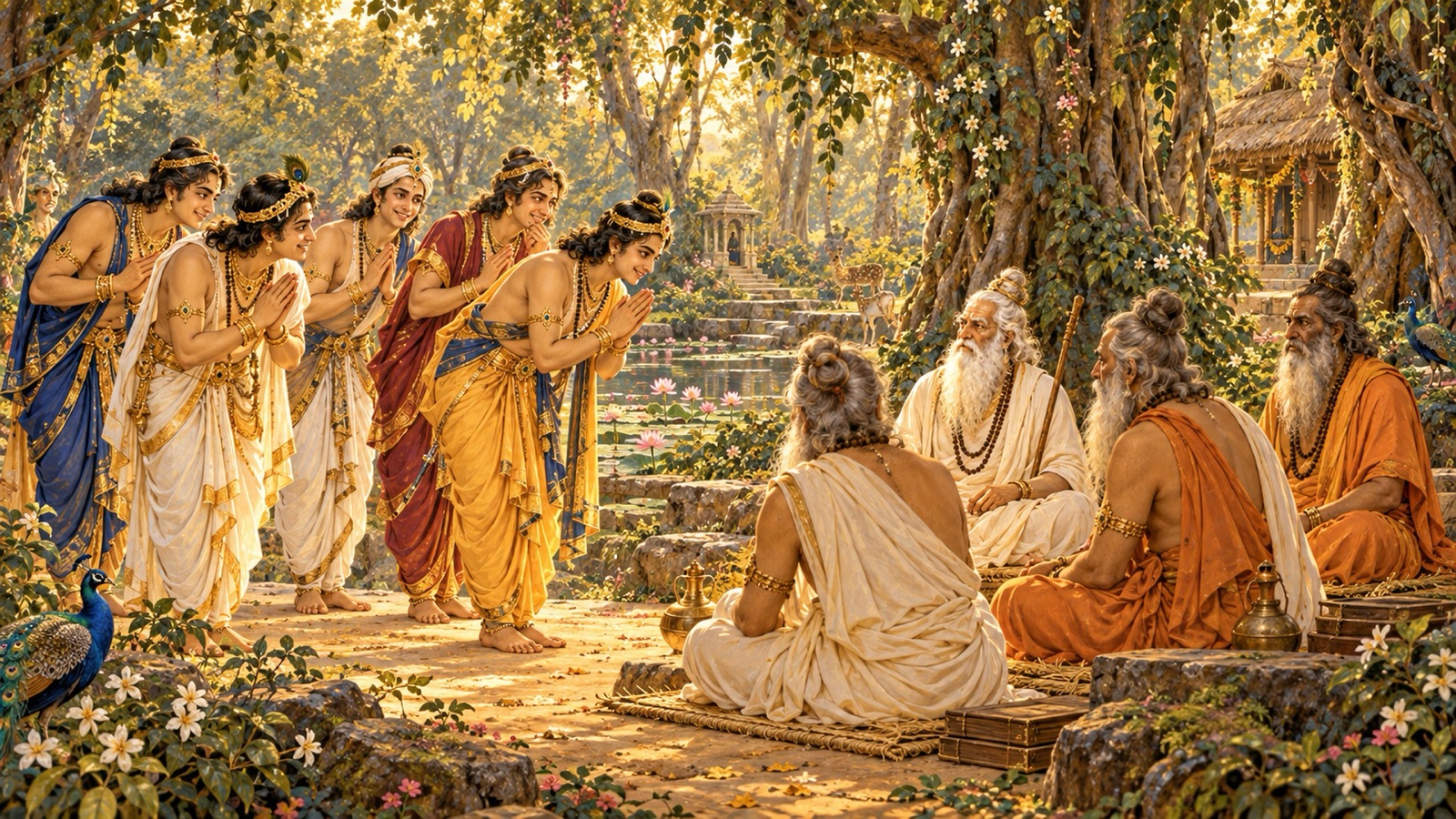
It was there that a group of Yadava youths, high-spirited and heedless, came upon the assembled sages. With a show of mock humility they clasped the sages’ feet, and then, in a spirit of impudent play, they attempted to make sport of these holy men. Dressing Samba — the son of Jambavati — as a pregnant woman, they presented “her” to the sages and asked, with feigned shyness on the disguised youth’s behalf, whether the child to be born would be a son or a daughter.
The sages, whose vision never failed, saw through the deception at once — and, angered at being mocked, they pronounced words that could not be unsaid.
एवं प्रलब्धा मुनयस्तानूचु: कुपिता नृप । जनयिष्यति वो मन्दा मुषलं कुलनाशनम् ॥ १६ ॥
evaṁ pralabdhā munayas tān ūcuḥ kupitā nṛpa janayiṣyati vo mandā muṣalaṁ kula-nāśanam
Meaning: Thus mocked, the sages, filled with anger, said to them: O foolish ones, this one will bring forth an iron pestle that shall destroy your entire race. (Canto 11, Chapter 1, verse 16)
The Iron Pestle
Terrified by these words, the youths at once uncovered Samba’s belly — and there, astonishingly, they found a pestle of iron. Pale and stricken, crying out, “What have we, unfortunate fellows, done? What will people say of us?” they carried the pestle home. With downcast faces they brought it into the royal court and, in the presence of all the Yadavas, told the whole incident to their king, Ugrasena. Hearing of the sages’ unfailing curse and seeing the iron pestle before them, the people of Dwaraka were filled with wonder and struck with fear.
King Ugrasena had the pestle ground down to powder and cast into the sea, along with the last small piece of iron that could not be reduced. But the curse was already at work in its own quiet way: a fish swallowed the iron fragment, while the fine particles of powder were carried by the waves and deposited upon the shore, where in time they grew into a kind of sharp reed-grass called Eraka. The fish, in due course, was caught in a fisherman’s net, and the iron piece found within it was fixed by a hunter to the tip of his arrow.

The Lord’s Silent Approval
Here Sukadeva reveals the deepest truth of the whole episode. The Lord knew everything that would come of this — and, being almighty, He had full power to render the sages’ curse ineffective. Yet He chose not to nullify it. On the contrary, He quietly approved of it, for He was Himself the Destroyer, and this was the very outcome He had already resolved upon within His own heart.
भगवाञ्ज्ञातसर्वार्थ ईश्वरोऽपि तदन्यथा । कर्तुं नैच्छद् विप्रशापं कालरूप्यन्वमोदत ॥ २४ ॥
bhagavān jñāta-sarvārtha īśvaro ‘pi tad-anyathā kartuṁ naicchad vipra-śāpaṁ kāla-rūpy anvamodata
Meaning: The Lord, who knew the whole purpose of things and had the power to make it otherwise, did not wish to undo the Brahmanas’ curse; being the very form of Time, the Destroyer, He gave it His approval. (Canto 11, Chapter 1, verse 24)
Principal Teachings of This Chapter
1. The Lord’s descents accomplish a complete purpose. Krishna’s work was not only to protect the good and remove the wicked, but to withdraw even His own dynasty when its time was fulfilled — His mission is whole, with nothing left half-done (verses 1-4).
2. Even a curse serves the divine will. The Lord, fully able to cancel the sages’ words, instead honored them — showing that what seems like misfortune can be the very means by which a higher purpose is quietly fulfilled (verse 24).
3. Mockery of holy persons carries grave consequence. The Yadava youths’ prank against the sages set in motion an unstoppable destiny — a sober reminder that irreverence toward the saintly is never a light matter (verses 13-16).
4. Prosperity unguarded can become its own peril. The Yadu race, invincible and swollen with fortune, could be undone by nothing but its own internal discord — a caution that outward strength is no protection against inward disorder (verses 3-4).
5. The Lord acts without personal attachment. Krishna approves even the dissolution of His own family with perfect equanimity, teaching that the liberated act in the world without being bound by its gains or losses (verse 24).
A Devotional Reflection
There is a quiet solemnity in the way Book Eleven opens. We are used to hearing of the Lord protecting His devotees and vanquishing demons; here we watch Him gently, deliberately, dismantle His own beloved dynasty. It can seem harsh — until we notice how He does it. He does not strike; He simply allows. He lets the natural course of a foolish prank, a sage’s anger, an iron pestle, a fisherman’s net, and a hunter’s arrow unfold in their own time, approving from within what He has already resolved. This is the mystery of a will that never needs to force. For the devotee, the lesson is consoling rather than frightening: nothing in our lives, however strange or painful its outward shape, falls outside the Lord’s loving awareness. The same hand that could cancel the curse chose instead to let each small thread of destiny do its quiet work — because He saw the whole, and we see only the part. To trust that vision, even when the story turns toward dissolution, is the beginning of real surrender.
A Daily Devotional Practice
Today, bring to mind one situation in your life that feels like an unwelcome turn — a loss, a delay, a door that has closed. Rather than struggling against it, sit quietly for a few moments and offer it up, trusting that the Lord who sees the whole may be at work within it. As you do, gently repeat: “Om Namo Bhagavate Vasudevaya.” Let the remembrance soften your resistance into acceptance, as the Yadavas’ fear might have softened into faith had they understood what their Lord already knew.
Conclusion
The first discourse of Book Eleven sets a grand and sober stage. The earth’s burden lifted, the demons and unrighteous kings gone, Lord Sri Krishna turns to the last work of His descent: the peaceful withdrawal of His own radiant race and His return to His eternal abode. Through a youthful prank, a sage’s curse, and an iron pestle scattered into the sea, the machinery of that withdrawal is quietly set in motion — and the Lord Himself, able to prevent it all, gives it His silent blessing. Behind this strange and moving story lies a single truth that will illuminate the whole of the coming Canto: the Lord is the master of time and destiny, acting in the world with perfect freedom and perfect love. From this threshold, the Bhagavatam now moves toward the Lord’s parting gift to us all — the profound teachings He will soon impart to His devotee Uddhava.
May the divine wisdom of Srimad Bhagavatam awaken pure devotion within our hearts.
Om Namo Bhagavate Vasudevaya.
Jay Shree Madhav.
References and Attribution
- Primary edition: Gita Press, Śrīmad Bhāgavata Mahāpurāṇa (English, complete), Book Eleven, Discourse 1, pages 517–518.
- Series: Srimad Bhagavatam Wisdom · Biswa Sanatan Dharma Seva Trust.
- Presented following the spiritual guidance and recommendation of Pandit Dr. Shri Kashinath Mishra.
This is an original, faithful retelling in the writer’s own words, with brief quoted verses shown in Devanāgarī and transliteration and their meanings given as summaries. It is not a reproduction of any single publisher’s continuous translation or commentary. No affiliation with or endorsement by any publisher is implied.
Jay Shree Madhav