A thousand-armed king begs Lord Shiva for a foe worthy of his strength, and the answer arrives not on a battlefield but in a dream: his daughter Usha beholds a prince she has never met, and her friend Chitralekha carries him through the night sky from Dvaraka.
Om Namo Bhagavate Vasudevaya.
Om Namo Bhagavate Vasudevaya.
Om Namo Bhagavate Vasudevaya.
Welcome back to Srimad Bhagavatam Wisdom, our devotional journey through the sacred histories and teachings of the Srimad Bhagavat Mahapurana. In this sixty-second chapter of the Tenth Canto, Sukadeva begins to answer King Parikshit’s question about the war between Sri Krishna and Lord Shankara by tracing its hidden root in Banasura’s pride and in the dream of his daughter Usha.
Chapter Information
- Scripture: Śrīmad Bhāgavata Mahāpurāṇa
- Canto: 10 (Book Ten, Latter Half)
- Chapter: 62 (Discourse 62)
- Chapter title: The Meeting of Usha and Aniruddha
- Principal speaker: Sukadeva Gosvami (narrating to King Parikshit)
- Principal listener: King Parikshit
- Main setting: Shonitapura, the city of Banasura; the presence of Lord Shiva at Kailasa; Dvaraka
- Central subject: Banasura’s boon, boast and Shiva’s warning; Usha’s dream; Chitralekha’s portraits and yogic journey; Aniruddha’s capture
- Principal verse range: Canto 10, Chapter 62, verses 1–33
- Primary edition: Gita Press Śrīmad Bhāgavata Mahāpurāṇa (English, Book Ten, Latter Half)
Context From the Previous Chapter
In Chapter 61, Rukmi gave his granddaughter Rochana in marriage to Aniruddha, the son of Pradyumna, at Bhojakata; after cheating Balarama at dice and mocking Him, Rukmi was struck down in that assembly, and the Yadavas returned with the couple to Dvaraka. The present chapter turns to Aniruddha’s union with Bana’s daughter Usha.
Parikshit’s Question
King Parikshit had heard that Aniruddha, the jewel of the Yadu dynasty, married Usha, the daughter of Bana, and that this union led to a terrible battle between Sri Krishna and Lord Shankara Himself. Astonished, he begged the great yogi Sukadeva to recount the whole history in detail.
Banasura, the Devotee of Lord Shiva
Bana was the eldest of the hundred sons of the great-souled Bali — that same Bali who gave away the whole earth to the Lord when He came before him as the divine Dwarf, Vamana. Born of such a father, Bana too had a devout heart, ever delighting in the worship of Lord Shiva. He was honourable, generous, intelligent, true to his word and firm in his vows, and he ruled from the beautiful city of Shonitapura. By Shiva’s grace even the gods, themselves worthy of worship, waited upon him like servants. Endowed with a thousand arms, Bana had pleased Lord Shiva by playing on many instruments while the Lord performed His Tandava dance.
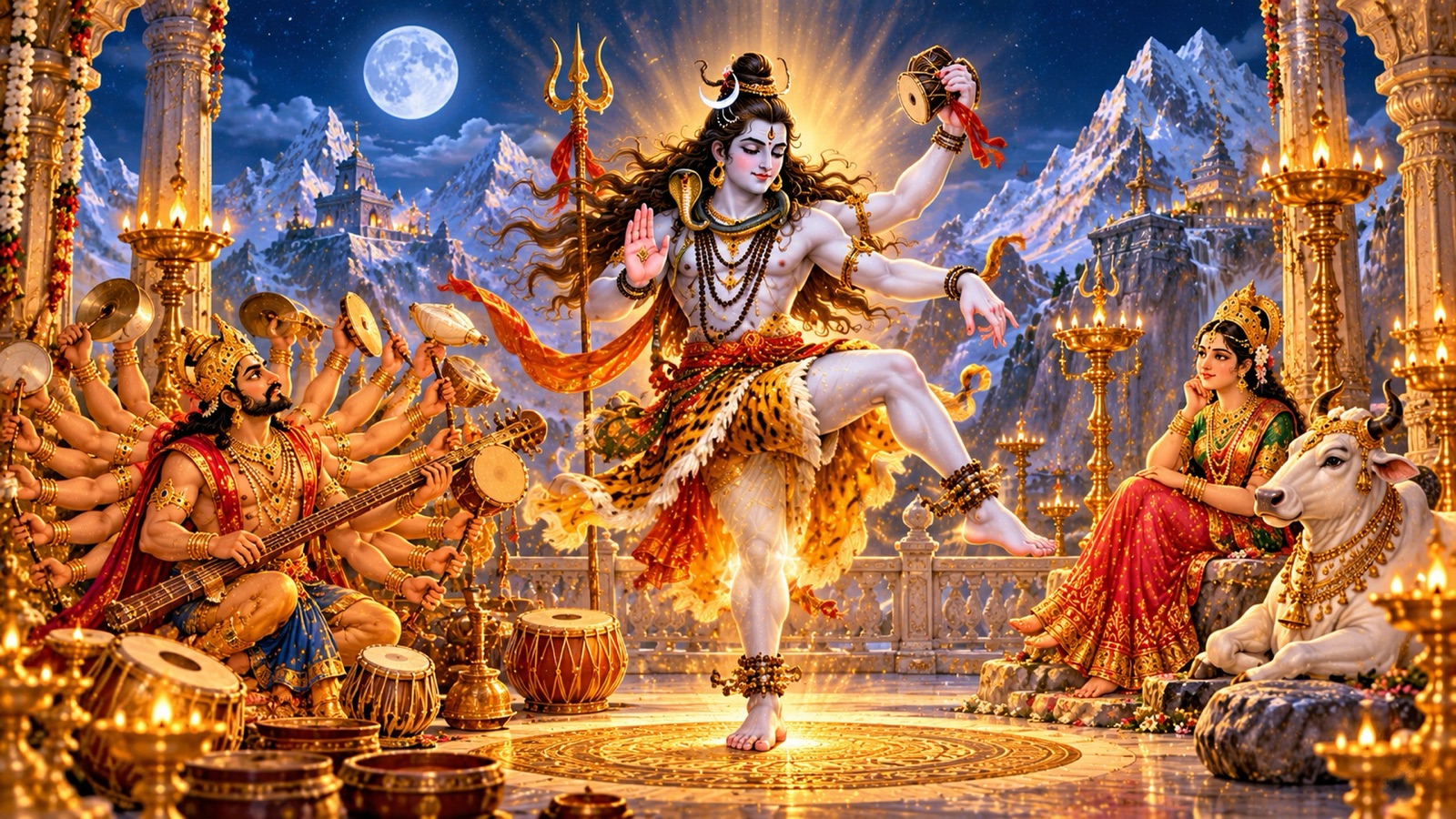
Delighted with him, Lord Shiva — the Master of all beings, the shelter of all, who is so fond of His devotees — invited Bana to choose whatever boon he wished. Bana asked that the Lord Himself remain as the guardian of his city, and Shiva granted it.
भगवान् सर्वभूतेश: शरण्यो भक्तवत्सल: ।
वरेणच्छन्दयामास स तं वव्रे पुराधिपम् ॥ ३ ॥
bhagavān sarva-bhūteśaḥ śaraṇyo bhakta-vatsalaḥ vareṇa cchandayām āsa sa taṁ vavre purādhipam
Meaning: The almighty Lord Shiva, ruler of every created being, the refuge of all and the lover of His devotees, offered him a boon of his choice; and Bana requested that Shiva Himself become the protector of his city. (Canto 10, Chapter 62, verse 3)
The Boast of a Thousand Arms and Shiva’s Warning
Such grace should have made Bana humble, yet his strength intoxicated him. One day, as Lord Shiva stood beside him, Bana touched the Lord’s lotus feet with his crown that shone like the sun and spoke. He first bowed reverently: “I bow to You, Mahadeva, the Preceptor and Ruler of all the worlds, the wish-fulfilling tree of heaven for those whose desires remain unsatisfied.” Then came the complaint of a restless warrior.
दो:सहस्रं त्वया दत्तं परं भाराय मेऽभवत् ।
त्रिलोक्यां प्रतियोद्धारं न लभे त्वदृते समम् ॥ ६ ॥
doḥ-sahasraṁ tvayā dattaṁ paraṁ bhārāya me ‘bhavat tri-lokyāṁ pratiyoddhāraṁ na labhe tvad ṛte samam
Meaning: The thousand arms You bestowed on me have become nothing but a burden, for in all the three worlds I can find no opponent equal to me, other than You. (Canto 10, Chapter 62, verse 6)
Bana went on: his arms itched for battle, and he had marched out against the elephants that guard the directions, crushing mountains to powder as he went — but even those mighty beasts had fled from him in fear. Hearing a devotee ask, in effect, for war with the Lord Himself, Shiva grew angry and pronounced the words that would shape all that followed.
तच्छ्रुत्वा भगवान् क्रुद्ध: केतुस्ते भज्यते यदा ।
त्वद्दर्पघ्नं भवेन्मूढ संयुगं मत्समेन ते ॥ ८ ॥
tac chrutvā bhagavān kruddhaḥ ketus te bhajyate yadā tvad-darpa-ghnaṁ bhaven mūḍha saṁyugaṁ mat-samena te
Meaning: Hearing this, the Lord was angered and said: “O fool, when your flag is broken, you will meet in battle one who is My equal, and that fight will destroy your pride.” (Canto 10, Chapter 62, verse 8)
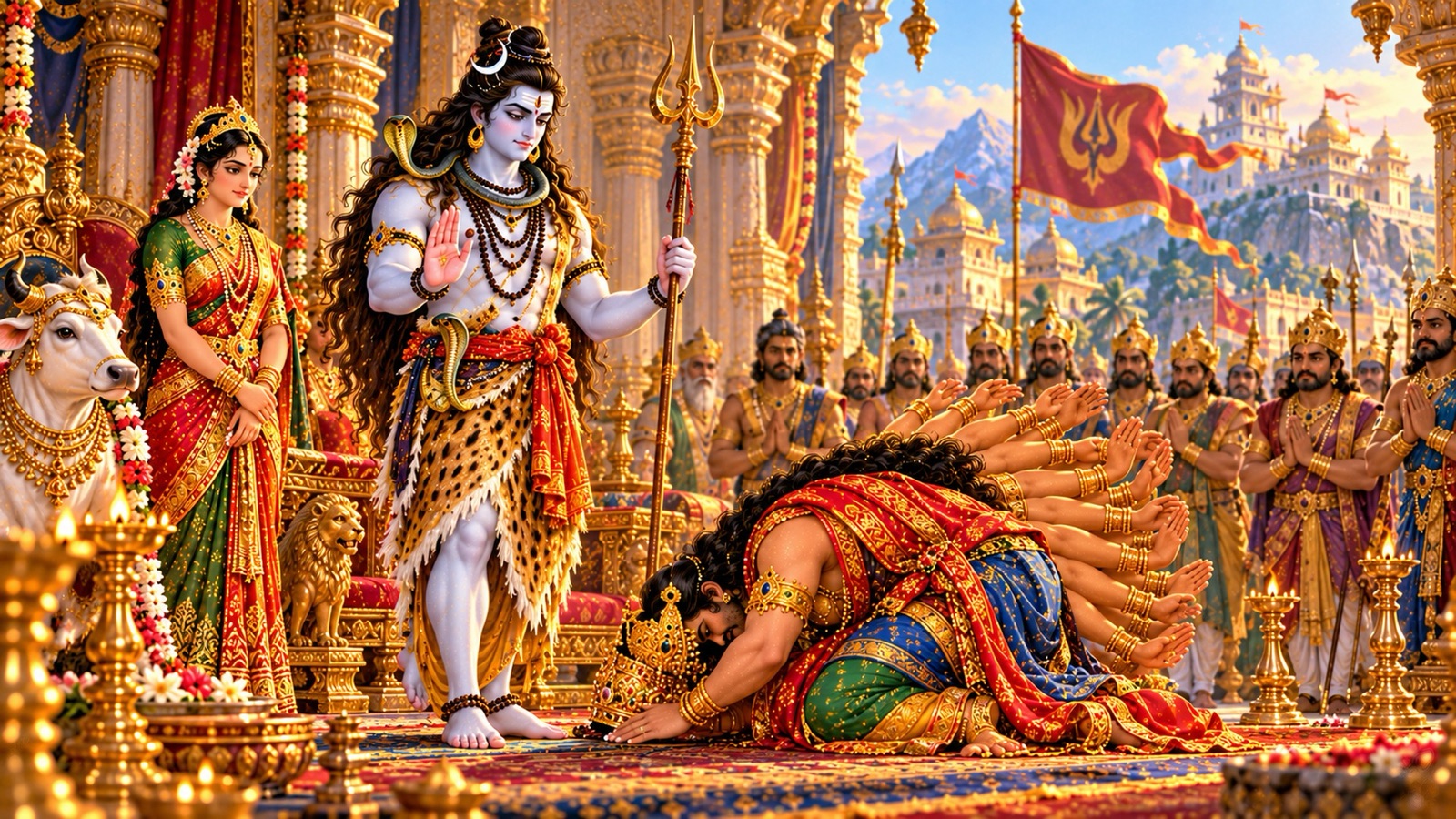
So strange is the working of pride that Bana, dull of understanding, went home rejoicing at these words. He began to wait eagerly for the fulfilment of Shiva’s prophecy, even though it foretold the ruin of his own might.
Usha’s Dream
Bana had a daughter named Usha. While still an unmarried maiden, she met in a dream a beloved she had never seen or heard of before — the son of Pradyumna — and her heart was given to him.
तस्योषा नाम दुहिता स्वप्ने प्राद्युम्निना रतिम् ।
कन्यालभत कान्तेन प्रागदृष्टश्रुतेन सा ॥ १० ॥
tasyoṣā nāma duhitā svapne prādyumninā ratim kanyālabhata kāntena prāg adṛṣṭa-śrutena sā
Meaning: Bana’s daughter Usha, though a maiden, found in a dream the love of Pradyumna’s son as her beloved, whom she had never before seen nor heard of. (Canto 10, Chapter 62, verse 10)
Waking and not finding him there, she rose in agitation among her companions, crying, “Where are you, my beloved?” — and then, realising where she was, felt deeply ashamed.
Among her friends was Chitralekha, daughter of Bana’s minister Kumbhanda. Full of curiosity, she asked the princess: “O lovely-browed one, whom are you searching for, and what is this longing of yours? Till today I have seen no one take your hand in marriage.” Usha confided to her friend what she had seen: a youth of dark complexion, with lotus eyes, long arms and yellow garments, who steals the hearts of women; he had won her heart and vanished she knew not where, leaving her, still yearning, in an ocean of sorrow.
Chitralekha’s Portraits
Chitralekha did not laugh at her friend’s grief. She made a remarkable promise.
चित्रलेखोवाच
व्यसनं तेऽपकर्षामि त्रिलोक्यां यदि भाव्यते ।
तमानेष्ये नरं यस्ते मनोहर्ता तमादिश ॥ १६ ॥
citralekhovāca vyasanaṁ te ‘pakarṣāmi tri-lokyāṁ yadi bhāvyate tam āneṣye naraṁ yas te mano-hartā tam ādiśa
Meaning: Chitralekha said: “I shall take away your distress. If he exists anywhere in the three worlds, I will bring you the man who has stolen your heart — only point him out to me.” (Canto 10, Chapter 62, verse 16)
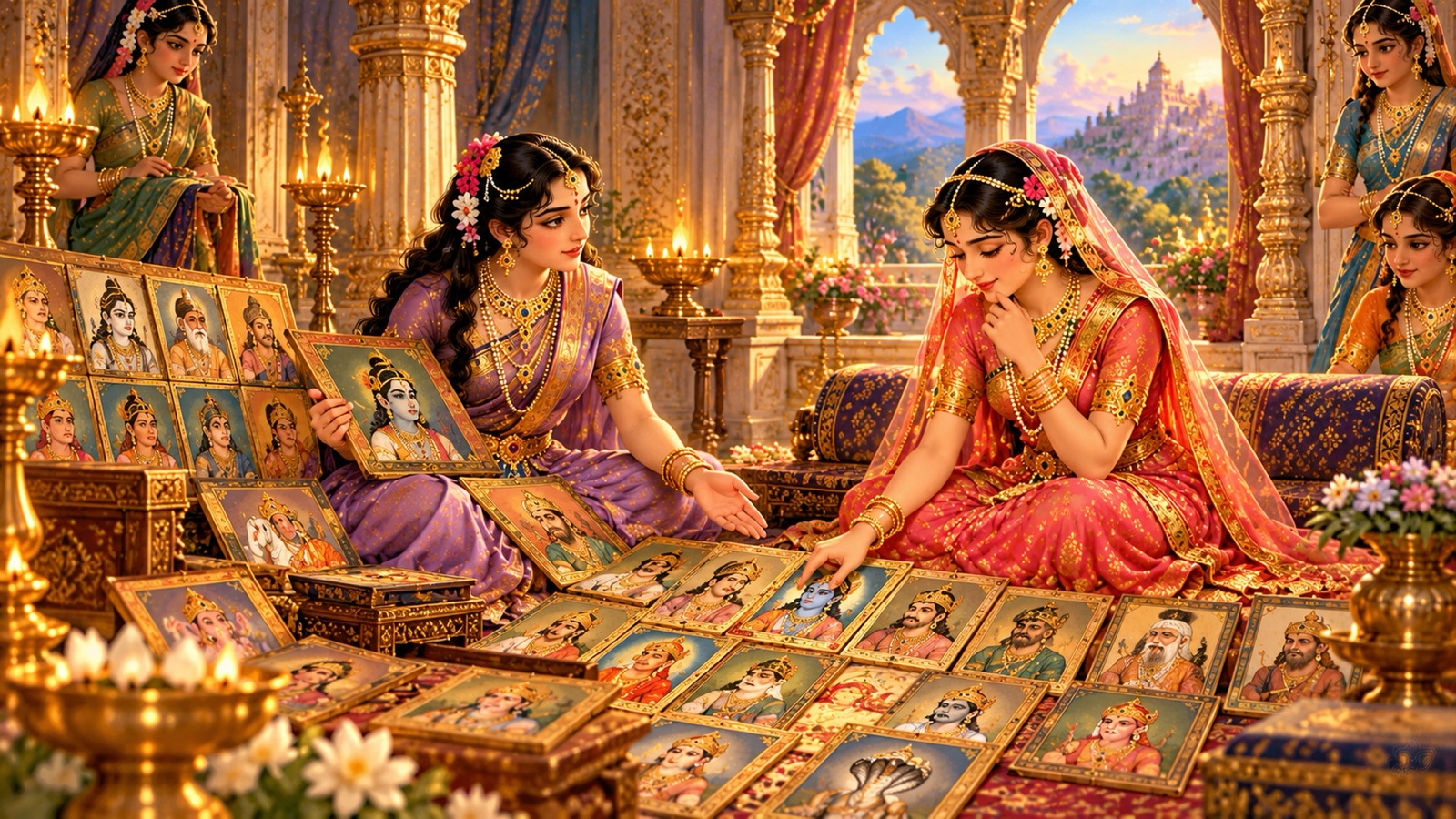
Saying this, she began to draw faithful likenesses of gods, Gandharvas, Siddhas, Charanas, Nagas, Daityas, Vidyadharas, Yakshas and human beings. Among men she portrayed the Vrishnis — Shura, Vasudeva, Balarama and Sri Krishna. When Usha saw Pradyumna’s picture, she blushed; and when she beheld the likeness of Aniruddha, she lowered her face in shyness and said with a smile, “It is he — it is he!”
The Flight to Dvaraka
Chitralekha now understood that the prince of her friend’s dream was none other than the grandson of Sri Krishna. Possessed of yogic power, she rose and travelled through the sky to Dvaraka.
चित्रलेखा तमाज्ञाय पौत्रं कृष्णस्य योगिनी ।
ययौ विहायसा राजन् द्वारकां कृष्णपालिताम् ॥ २० ॥
citralekhā tam ājñāya pautraṁ kṛṣṇasya yoginī yayau vihāyasā rājan dvārakāṁ kṛṣṇa-pālitām
Meaning: Recognising him as Krishna’s grandson, Chitralekha, who was a yogini, journeyed through the air, O king, to Dvaraka, the city guarded by Krishna. (Canto 10, Chapter 62, verse 20)

There she found Aniruddha asleep on a beautiful bed. Resorting to her yogic power, she carried him just as he was to Shonitapura and presented her friend with the one she loved.
Days Hidden in the Maidens’ Palace
Usha’s face shone with joy on seeing the handsomest of all men before her, and she welcomed him into her own apartments, where no man could easily look in. There she honoured him with the costliest garments, garlands, sandal paste, incense, lamps and fine seats, with drink and food of every kind, with sweet words and devoted service. Hidden in the maidens’ quarters, his heart captured by Usha, whose love for him grew without end, Aniruddha lost all count of the days that slipped by.
Bana Discovers Aniruddha
Yet what happens within a king’s palace cannot remain secret forever. The guards of the inner apartments noticed signs that could not be concealed that the princess had broken her maiden vow. They reported to Bana: “O king, we observe in your daughter conduct that stains the family. We have guarded her unceasingly in her own house, where no man can look upon her, and we cannot understand how this came about.”
Bana was deeply pained to hear of his daughter’s dishonour and hurried to the maidens’ quarters, where he saw before him the jewel of the Yadus and stood amazed. Here was the son of Pradyumna, who was Kamadeva himself, and so the most beautiful being in the three worlds: dark of hue, dressed in yellow, lotus-eyed and long-armed, his face lit by the lustre of his earrings and curling locks and his smiling glances. Wearing a garland of spring jasmine, Aniruddha sat before Usha, who was decked in festive ornaments, and the two were playing at dice.
Aniruddha Bound by the Serpent-Noose
When Aniruddha saw Bana enter surrounded by a detachment of armed warriors, he did not flinch. The scion of Madhu lifted a club of iron and stood firm, like Death himself with his rod of punishment. As the soldiers closed in on every side to seize him, he struck them down as the leader of a herd of boars scatters a pack of dogs. Broken and defeated, the warriors fled from the mansion.
Then the mighty Banasura, son of Bali, enraged to see his army destroyed, bound Aniruddha with the serpent-noose, the naga-pasha. When Usha heard that her beloved had been bound, she was overwhelmed with grief and despair and wept aloud, her eyes brimming with tears.
तं नागपाशैर्बलिनन्दनो बली
घ्नन्तं स्वसैन्यं कुपितो बबन्ध ह ।
ऊषा भृशं शोकविषादविह्वला
बद्धं निशम्याश्रुकलाक्ष्यरौदिषीत् ॥ ३३ ॥
taṁ nāga-pāśair bali-nandano balī ghnantaṁ sva-sainyaṁ kupito babandha ha ūṣā bhṛśaṁ śoka-viṣāda-vihvalā baddhaṁ niśamyāśru-kalākṣy arodiṣīt
Meaning: The powerful son of Bali, furious as Aniruddha slew his soldiers, fettered him with cords of serpents; and Usha, learning that he had been captured, was shaken by sorrow and despondency and cried out with tear-filled eyes. (Canto 10, Chapter 62, verse 33)
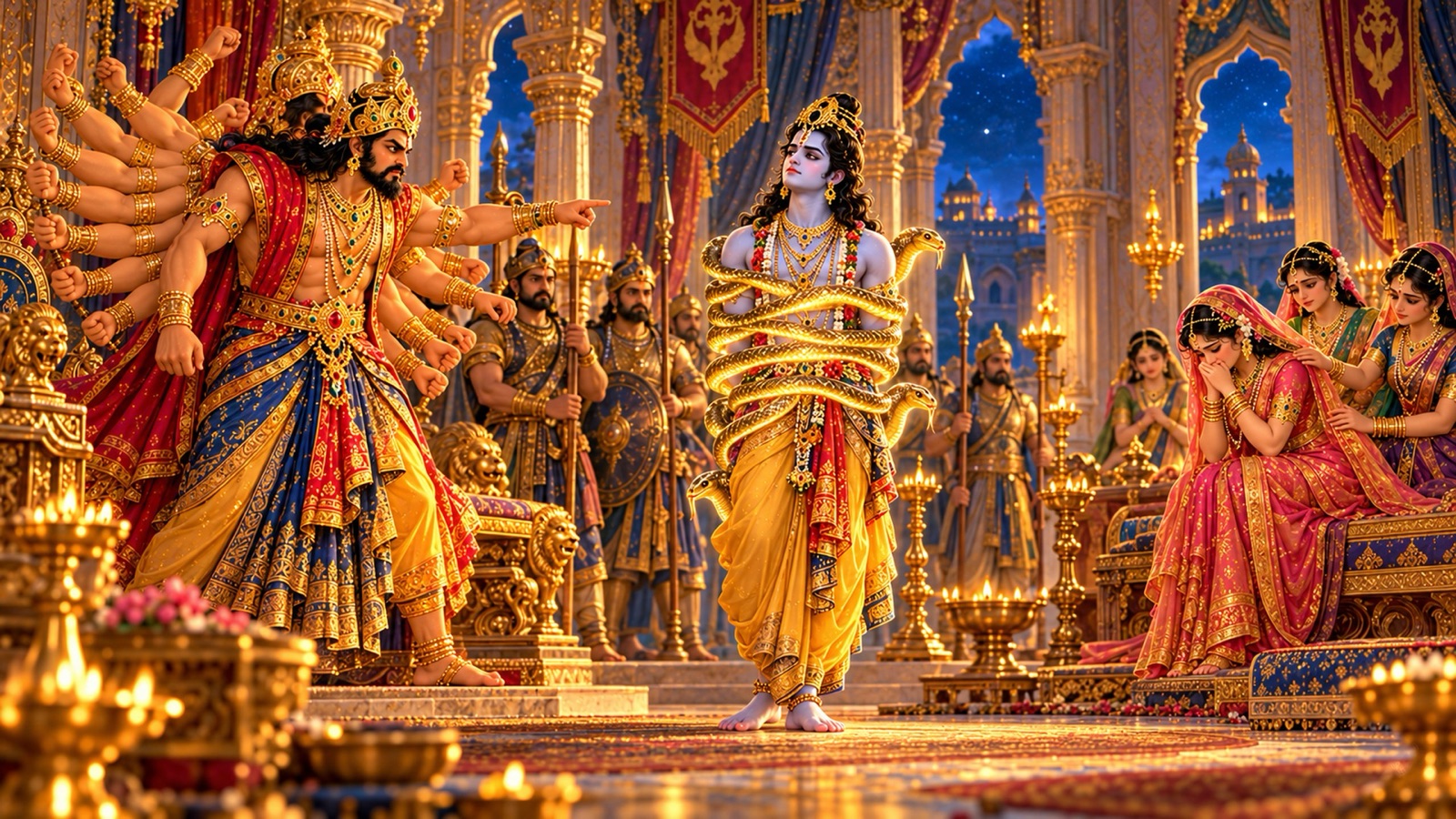
Here the chapter closes, with Aniruddha in chains and Usha in tears, and the stage set for the encounter between Sri Krishna and Lord Shiva that Parikshit had asked about.
Principal Teachings of This Chapter
1. The Lord is bhakta-vatsala, affectionate to His devotees. Lord Shiva, pleased by Bana’s service at His Tandava dance, offered a boon and personally undertook to guard his city, as verse 3 shows. Sincere devotion, even from a warrior of demonic lineage, draws the Lord’s protection.
2. Power without humility becomes a burden. Bana’s thousand arms, a gift of grace, became a weight he longed to throw into battle, as he confesses in verse 6. Strength that is not offered back in service turns into restlessness and pride.
3. The Lord’s rebuke is also His mercy. Shiva’s angry prophecy in verse 8 that a battle with His equal would crush Bana’s pride is not abandonment but correction. When the Lord humbles a devotee, He is removing what stands between the devotee and Himself.
4. The Lord’s plan works through the gentlest means. Bana waited for an army; instead the fulfilment of Shiva’s word began with a maiden’s dream and a friend’s loving skill. Verse 10 and verse 16 show how quietly providence moves toward its appointed end.
5. Faithful friendship serves love. Chitralekha neither mocked Usha’s longing nor left her in sorrow; she used her art and her yoga for her friend, as verse 20 records — a reminder that true companionship labours for another’s heart.
A Devotional Reflection
What moves a devotee most in this chapter is how Bana’s story and Usha’s story are woven into a single design. The father bows his sun-bright crown to Shiva’s feet yet cannot stop asking for a battle; the daughter, in the hush of sleep, is shown the Lord’s own grandson and asks only to find him again. Pride seeks a rival; love seeks a beloved. We may wonder how Chitralekha could pass into Dvaraka, kept by Krishna Himself, and carry off a sleeping prince. Surely nothing enters where Krishna keeps watch unless He permits it. The Lord who once received the whole earth from Bali’s folded hands was now drawing Bali’s son toward the humbling Shiva had foretold, with Usha’s innocent longing as His instrument. When our lives feel tangled by desires we did not choose and events we cannot control, this chapter invites us to trust that even these threads are held by hands that mean us well.
A Daily Devotional Practice
Today, notice one gift in your life that has begun to feel like a burden — a talent, a responsibility, a strength you are tempted to use merely to prove yourself. Offer it back to the Lord in a short prayer, asking that it serve Him rather than your pride, as Bana’s thousand arms were first meant to serve Shiva’s dance. Then remember Usha, and ask the Lord to let your longing rest in Him alone. Begin by chanting gently: Om Namo Bhagavate Vasudevaya.
Conclusion
The sixty-second chapter of the Tenth Canto opens the great history of Bana and Aniruddha: a devotee of Shiva grows restless in his might and is warned of a humbling to come, while far from his thoughts his daughter’s dream quietly sets that humbling in motion, until Krishna’s grandson stands bound in the serpent-noose and Usha weeps. The chapter teaches us that the Lord humbles whom He loves, and that His purposes arrive by paths no proud heart expects. May we hold our strength lightly and our love for Him firmly, trusting the hand that guides every turn of the story.
May the divine wisdom of Srimad Bhagavatam awaken pure devotion within our hearts.
Om Namo Bhagavate Vasudevaya.
Jay Shree Madhav.
References and Attribution
- Primary edition: Gita Press, Śrīmad Bhāgavata Mahāpurāṇa (English), Book Ten (Latter Half), Discourse 62, pages 382–385.
- Series: Srimad Bhagavatam Wisdom · Biswa Sanatan Dharma Seva Trust.
- Presented following the spiritual guidance and recommendation of Pandit Dr. Shri Kashinath Mishra.
This is an original, faithful retelling in the writer’s own words, with brief quoted verses shown in Devanāgarī and transliteration and their meanings given as summaries. It is not a reproduction of any single publisher’s continuous translation or commentary. No affiliation with or endorsement by any publisher is implied.
Jay Shree Madhav