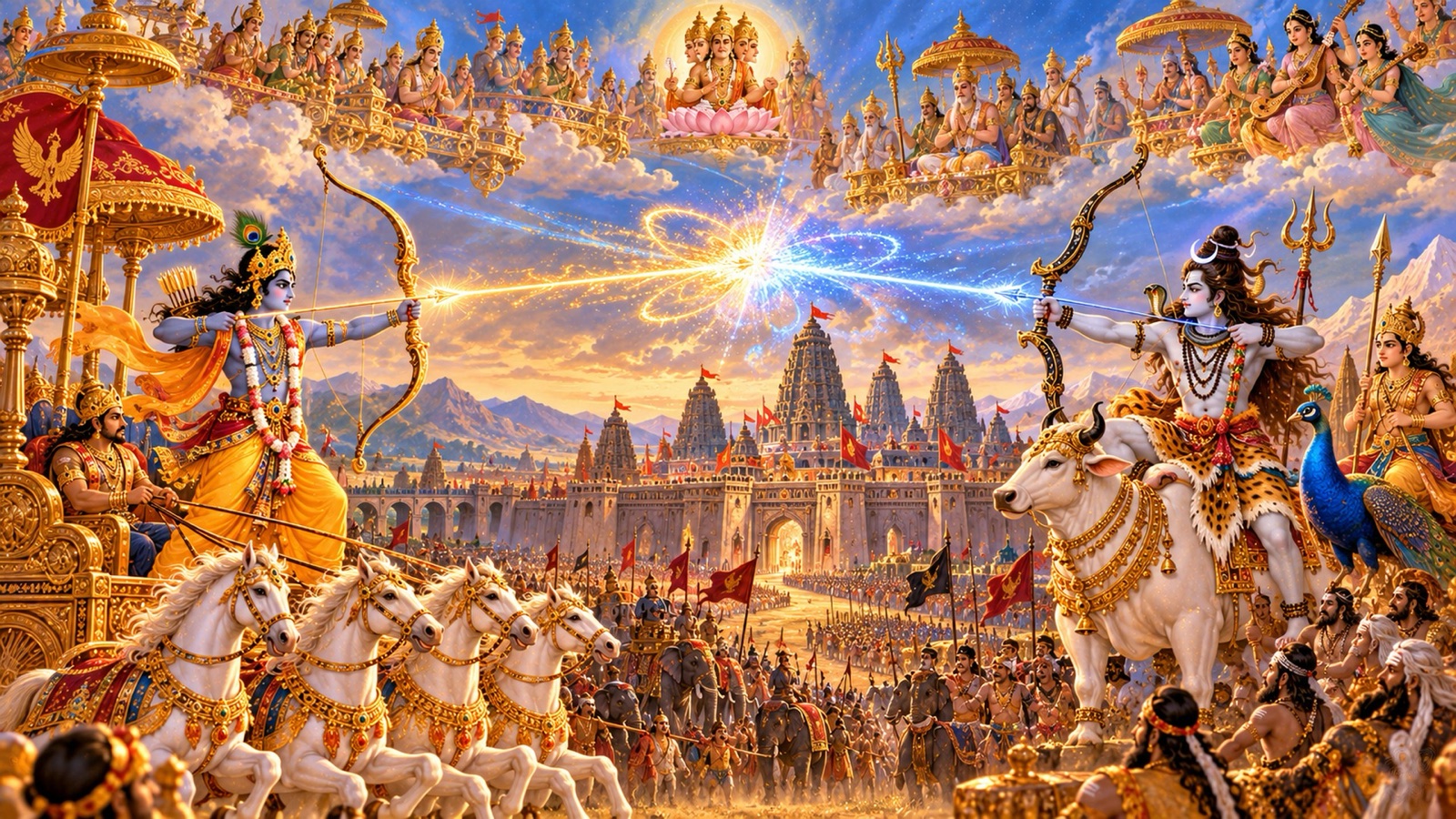
Before the walls of Shonitapura, Lord Shiva rides out on Nandi to shield his devotee Banasura, and Lord Krishna meets him in a battle that ends not in enmity but in a prayer, a boon, and a bridegroom carried home.
Om Namo Bhagavate Vasudevaya.
Om Namo Bhagavate Vasudevaya.
Om Namo Bhagavate Vasudevaya.
Welcome back to Srimad Bhagavatam Wisdom, our devotional journey through the Srimad Bhagavat Mahapurana. In this sixty-third chapter of the Tenth Canto the Yadus march to free Aniruddha, Krishna and Shiva meet on the field, two prayers rise from the dust of war, and the Lord explains why the thousand-armed asura was spared.
Chapter Information
- Scripture: Śrīmad Bhāgavata Mahāpurāṇa
- Canto: 10 (Book Ten, Latter Half)
- Chapter: 63 (Discourse 63)
- Chapter title: Lord Krishna Fights with Banasura
- Principal speaker: Sukadeva Gosvami
- Principal listener: King Parikshit
- Main setting: Śoṇitapura, the capital of Bāṇāsura; and Dvārakā
- Central subject: The siege of Shonitapura; Krishna’s battle with Shiva; the Fever’s prayer; Bana’s thousand arms; Shiva’s hymn and the Lord’s mercy; Aniruddha brought home
- Principal verse range: Canto 10, Chapter 63, verses 1–53
- Primary edition: Gita Press Śrīmad Bhāgavata Mahāpurāṇa (English, Part Two)
Context From the Previous Chapter
Usha, Banasura’s daughter, beheld Aniruddha in a dream, and her friend Chitralekha carried him by yogic power into her apartments at Shonitapura. When the guards reported it, Bana found the prince there; Aniruddha scattered the soldiers sent against him, but the asura bound him with serpent-cords, and Usha wept.
The Yadus March on Shonitapura
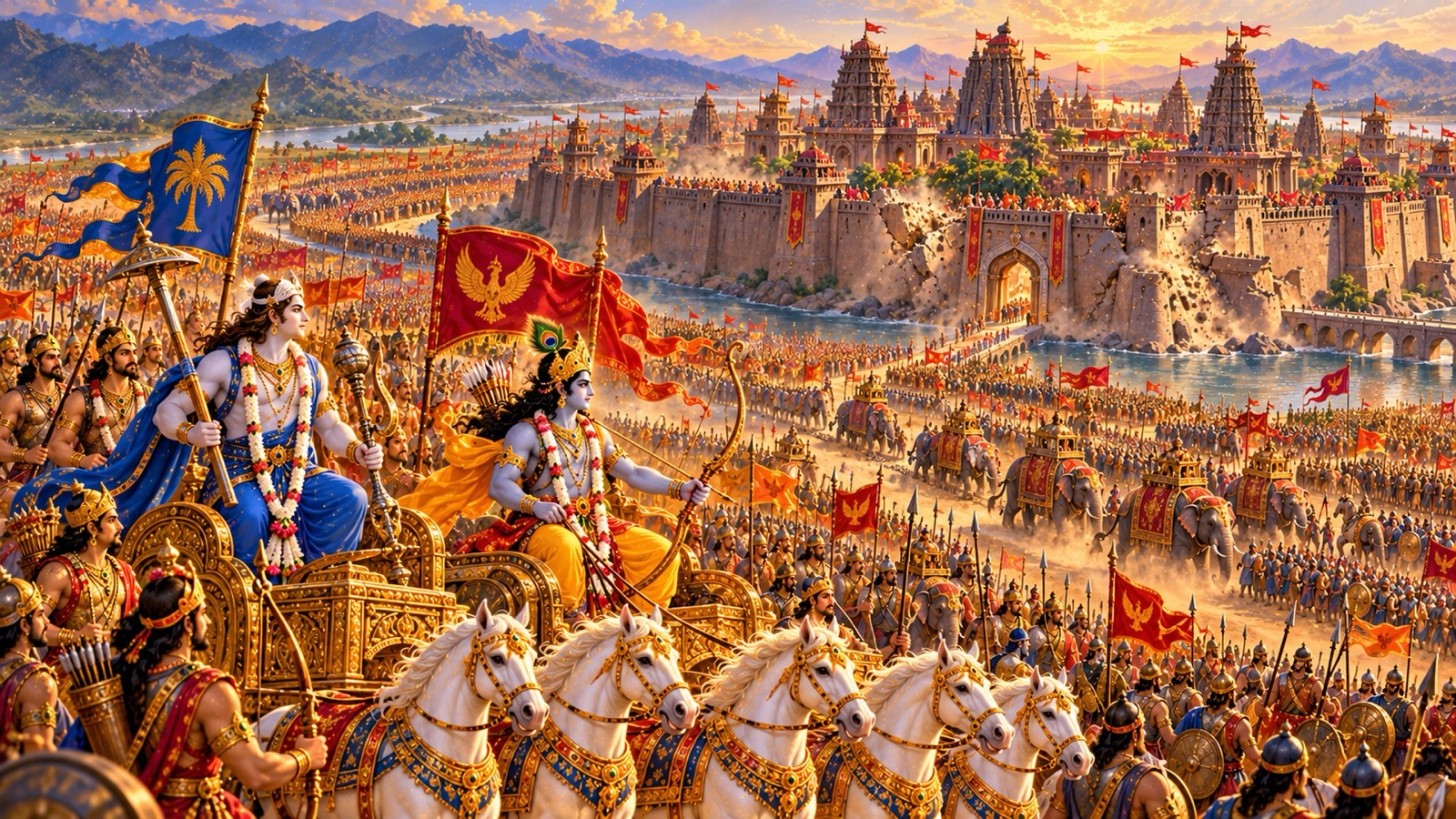
Sukadeva continued: the four months of the rains went by while Aniruddha’s kinsmen, seeing nothing of him, grieved. Then Narada came and told them how the prince had been taken captive after cutting down a whole contingent of Bana’s warriors. At once the Vrishnis, who worshipped Krishna as their deity, set out for Shonitapura. Twelve akshauhinis marched under Balarama and Krishna, with Pradyumna, Satyaki, Gada, Samba, Sarana, Nanda, Upananda, Bhadra and the other foremost Yadus, and encircled Bana’s capital. Watching his gardens, ramparts, watchtowers and gateways being shattered, Bana flew into a rage and sallied forth with an army of equal strength.
Lord Shiva Rides Out for His Devotee
Then the Lord of Kailasa himself entered the field for the asura who worshipped him. Astride Nandi, ringed by his Pramatha hosts, with Karttikeya at his side, Rudra took up arms against the two brothers.
बाणार्थे भगवान् रुद्रः ससुतः प्रमथैर्वृतः ।
आरुह्य नन्दिवृषभं युयुधे रामकृष्णयोः ॥ ६ ॥
bāṇārthe bhagavān rudraḥ sa-sutaḥ pramathair vṛtaḥ āruhya nandi-vṛṣabhaṁ yuyudhe rāma-kṛṣṇayoḥ
Meaning: For Bana’s sake Lord Rudra, accompanied by his son and surrounded by the Pramathas, mounted the bull Nandi and fought against Balarama and Krishna. (Canto 10, Chapter 63, verse 6)
A tumultuous, hair-raising battle followed: Krishna against Shankara, Pradyumna against Guha, Balarama against Kumbhanda and Kupakarna, Samba against Bana’s son, and Satyaki against Bana himself. Brahma, the rulers of the gods, sages, Siddhas, Charanas, Gandharvas, Apsaras and Yakshas gathered in aerial cars to watch. With arrows from His Sharnga bow the Lord scattered Shiva’s attendants — Bhutas, Pramathas, Guhyakas, Dakinis, Yatudhanas, Vetalas, Vinayakas, Pretas, Matrikas, Pishachas, Kushmandas and Brahma-rakshasas. Shiva loosed weapon after weapon from the Pinaka; the Lord, unperturbed, quenched each with its counter — Brahmastra against Brahmastra, the mountain-weapon against the wind-weapon, the rain-weapon against the fire-weapon, and against the Pashupatastra His own Narayanastra. Then, bewildering Shiva with the Jrimbhanastra so that he stood yawning, Krishna fell upon Bana’s army with sword, mace and arrows. Pradyumna’s arrows pressed Skanda until, bleeding from his limbs, he withdrew on his peacock; Kumbhanda and Kupakarna fell beneath Balarama’s pestle; and Bana’s leaderless troops fled in all directions.
Bana’s Five Hundred Bows
Seeing his forces scattered, Bana abandoned Satyaki and drove his chariot at Krishna in fury. Drawing five hundred bows at once, he set two arrows to each. The Lord split every bow in a single stroke, struck down charioteer, horses and chariot, and sounded His conch. Then Bana’s mother Kotara, unclothed and with hair unbound, placed herself before Krishna to save her son; the Lord, declining to look upon her, turned His face away, and in that moment Bana, without chariot or bow, retreated into the city.
The Fever of Shiva and the Fever of Vishnu
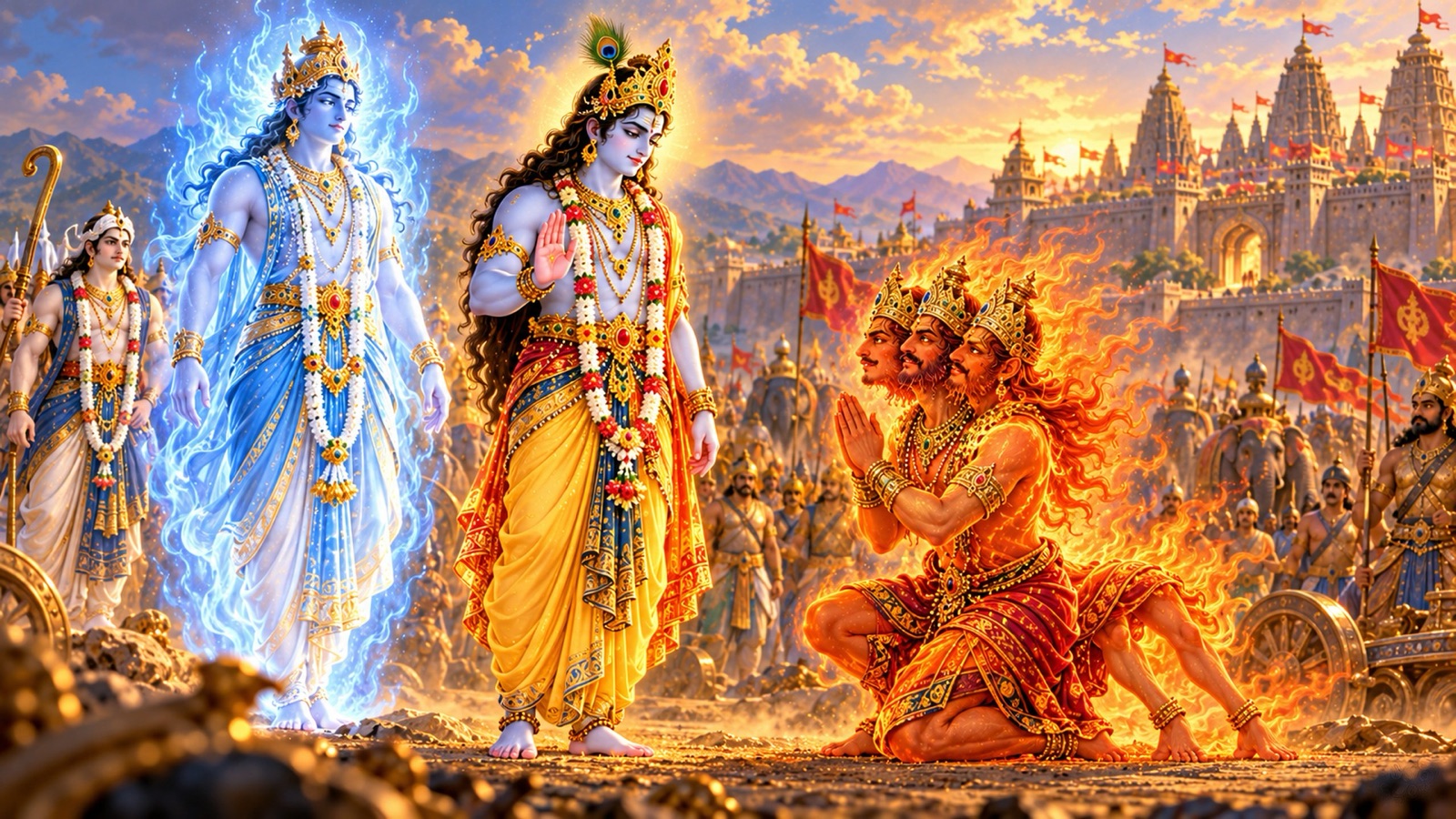
With the ghostly hosts driven off, the Jvara — the three-headed, three-footed Fever despatched by Shiva, now recovered from his stupor — rushed at Krishna as though to scorch the ten directions. Lord Narayana released His own Fever, and the two Fevers grappled. Overpowered and finding no refuge anywhere, Shiva’s Fever cried out in terror and, seeking shelter at the feet of Hrishikesha, praised Him with folded palms.
He bowed to the Lord of infinite power, the ruler of the gods, the Soul of all, pure consciousness, the cause of the world’s appearance, continuance and dissolution — the tranquil Brahman whom the Vedas can only indicate. Time, destiny, karma, the soul, matter, the body, the life-breath, the ego, the evolutes and the endless seed-and-sprout flow of the subtle body — all this, he said, is Your Maya, and I take refuge in You, in whom that Maya is negated. By forms assumed in sport You protect the gods and the pious, uphold dharma, and strike down the violent; this descent is to relieve the earth’s burden. Then he confessed:
तप्तोऽहं ते तेजसा दुःसहेन शान्तोग्रेणात्युल्बणेन ज्वरेण ।
तावत्तापो देहिनां तेऽङ्घ्रिमूलं नो सेवेरन् यावदाशानुबद्धाः ॥ २८ ॥
tapto ‘haṁ te tejasā duḥsahena śāntogreṇāty-ulbaṇena jvareṇa tāvat tāpo dehināṁ te ‘ṅghri-mūlaṁ no severan yāvad āśānubaddhāḥ
Meaning: I am burning in Your unbearable radiance, this fever that was once mild and has now grown so fierce. Embodied beings know torment only so long as they stay tied to desire and do not serve the soles of Your feet. (Canto 10, Chapter 63, verse 28)
The Lord replied:
त्रिशिरस्ते प्रसन्नोऽस्मि व्येतु ते मज्ज्वराद् भयम् ।
यो नौ स्मरति संवादं तस्य त्वन्न भवेद् भयम् ॥ २९ ॥
tri-śiras te prasanno ‘smi vyetu te maj-jvarād bhayam yo nau smarati saṁvādaṁ tasya tvan na bhaved bhayam
Meaning: O three-headed one, I am pleased with you; let your dread of My Fever depart. Whoever recalls this conversation between us shall have nothing to fear from you. (Canto 10, Chapter 63, verse 29)
Bowing to the infallible Lord, Shiva’s Fever went his way. Bana, meanwhile, mounted a fresh chariot and came back to fight Janardana.
The Thousand Arms Fall Like Branches
Wild with anger, the asura let fly arrows at the wielder of the discus from a thousand arms bearing every kind of weapon. As he hurled missile after missile, the Lord with His razor-rimmed Sudarshana lopped off those arms as one strips the boughs from a tree. While Bana’s arms were still falling, Lord Shiva — tender toward his devotee — approached the Lord and spoke.
Shiva’s Prayer
Rudra prayed: You are the supreme light, the Brahman hidden within the Vedic word, whom the pure-hearted behold as stainless as the sky. The firmament is Your navel, fire Your mouth, water Your seed, heaven Your head, the directions Your ears, the earth Your feet, the moon Your mind, the sun Your eye; I am Your ego, the ocean Your belly, Indra Your arms; herbs are Your body-hair, clouds Your locks, Brahma Your intellect, Prajapati Your organ of generation, Dharma Your heart. You are the Person of whom the worlds are limbs. O Lord of undimmed glory, this descent is for the guarding of dharma and the good of the world; empowered by You, we govern the seven realms. You are the one primeval Person, the Fourth beyond the three states, self-luminous, the uncaused cause; yet through Your Maya You appear in many forms so that the gunas may be displayed. As the sun, veiled by clouds that are its own shadow, still lights both the clouds and every form, so You, covered as it were by the ego born of You, illumine the gunas and all who bear them.
Deluded by Your Maya, Rudra went on, people cling to sons, wives and homes and rise and sink in an ocean of grief.
देवदत्तमिमं लब्ध्वा नृलोकमजितेन्द्रियः ।
यो नाद्रियेत त्वत्पादौ स शोच्यो ह्यात्मवञ्चकः ॥ ४१ ॥
deva-dattam imaṁ labdhvā nṛ-lokam ajitendriyaḥ yo nādriyeta tvat-pādau sa śocyo hy ātma-vañcakaḥ
Meaning: One who gains this human birth, granted by You, yet leaves his senses unconquered and pays no honour to Your feet, is truly pitiable — he is cheating his own self. (Canto 10, Chapter 63, verse 41)
यस्त्वां विसृजते मर्त्य आत्मानं प्रियमीश्वरम् ।
विपर्ययेन्द्रियार्थार्थं विषमत्त्यमृतं त्यजन् ॥ ४२ ॥
yas tvāṁ visṛjate martya ātmānaṁ priyam īśvaram viparyayendriyārthārthaṁ viṣam atty amṛtaṁ tyajan
Meaning: The mortal who forsakes You — his own Self, his beloved Lord — for the sake of sense objects that are Your very opposite, throws away nectar and eats poison. (Canto 10, Chapter 63, verse 42)
I, Brahma, the gods and the pure-hearted sages, he continued, have surrendered to You with our whole being, our dearest Self and Lord. You who bring about the world’s rise, continuance and end, equal to all, serene, the friend, deity and very Self of every creature, the one shelter of the worlds — we worship You for freedom from this round of birth. Then came his plea: “This Bana is my dear and devoted follower, and I have promised him fearlessness. Grant him Your favour, O Lord, as You once favoured Prahlada, the master of the Daityas.”
The Lord’s Mercy and His Reason
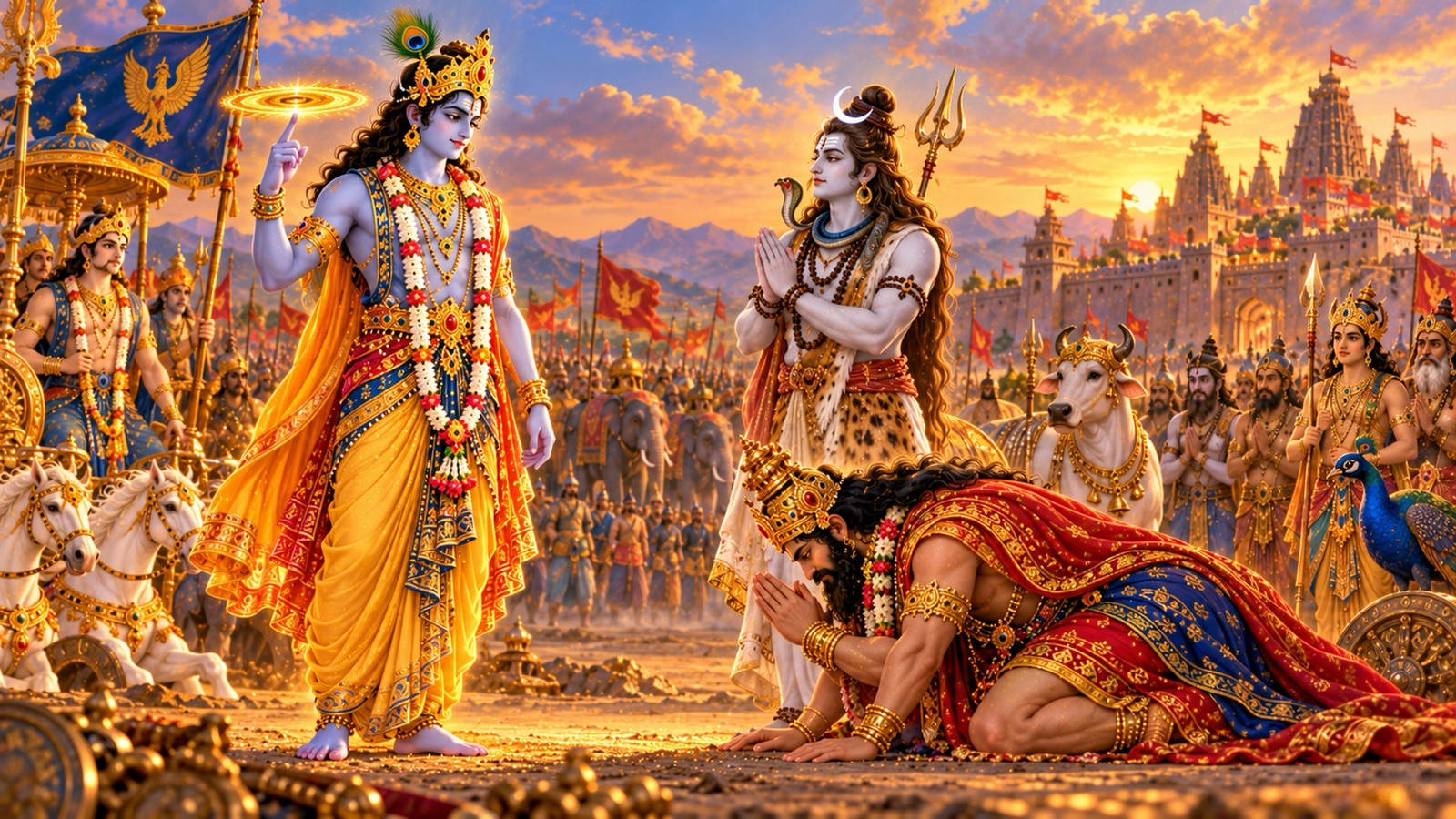
The Lord answered: “Worshipful one, We shall do as you say and as pleases you; what you have resolved I wholly approve. This asura, grandson of Virochana, cannot be slain by Me, for I gave Prahlada the boon that none of his line would fall by My hand.”
दर्पोपशमनायास्य प्रवृक्णा बाहवो मया ।
सूदितं च बलं भूरि यच्च भारायितं भुवः ॥ ४८ ॥
darpopaśamanāyāsya pravṛkṇā bāhavo mayā sūditaṁ ca balaṁ bhūri yac ca bhārāyitaṁ bhuvaḥ
Meaning: I have hewn off his arms only to quell his pride, and I destroyed his vast army because it had become a burden upon the earth. (Canto 10, Chapter 63, verse 48)
“Four arms remain to him,” the Lord went on; “he shall be free of old age and death, the foremost of your attendants, and though an asura he shall have nothing to fear from any quarter.”
Here the whole war discloses its purpose. The Lord had never set out to destroy Bana; a promise given to Prahlada still shielded his great-grandson, and the word of Shiva, who had pledged the asura protection, was honoured as the Lord’s own. What was cut away was pride alone, and what was crushed was only the army that burdened the earth. Everything else was given: agelessness, fearlessness, and a place at the head of Shiva’s retinue. Chastisement and grace are not two acts here but one, and the Lord keeps His word across generations and across the whole family of His devotees.
Aniruddha Brought Home
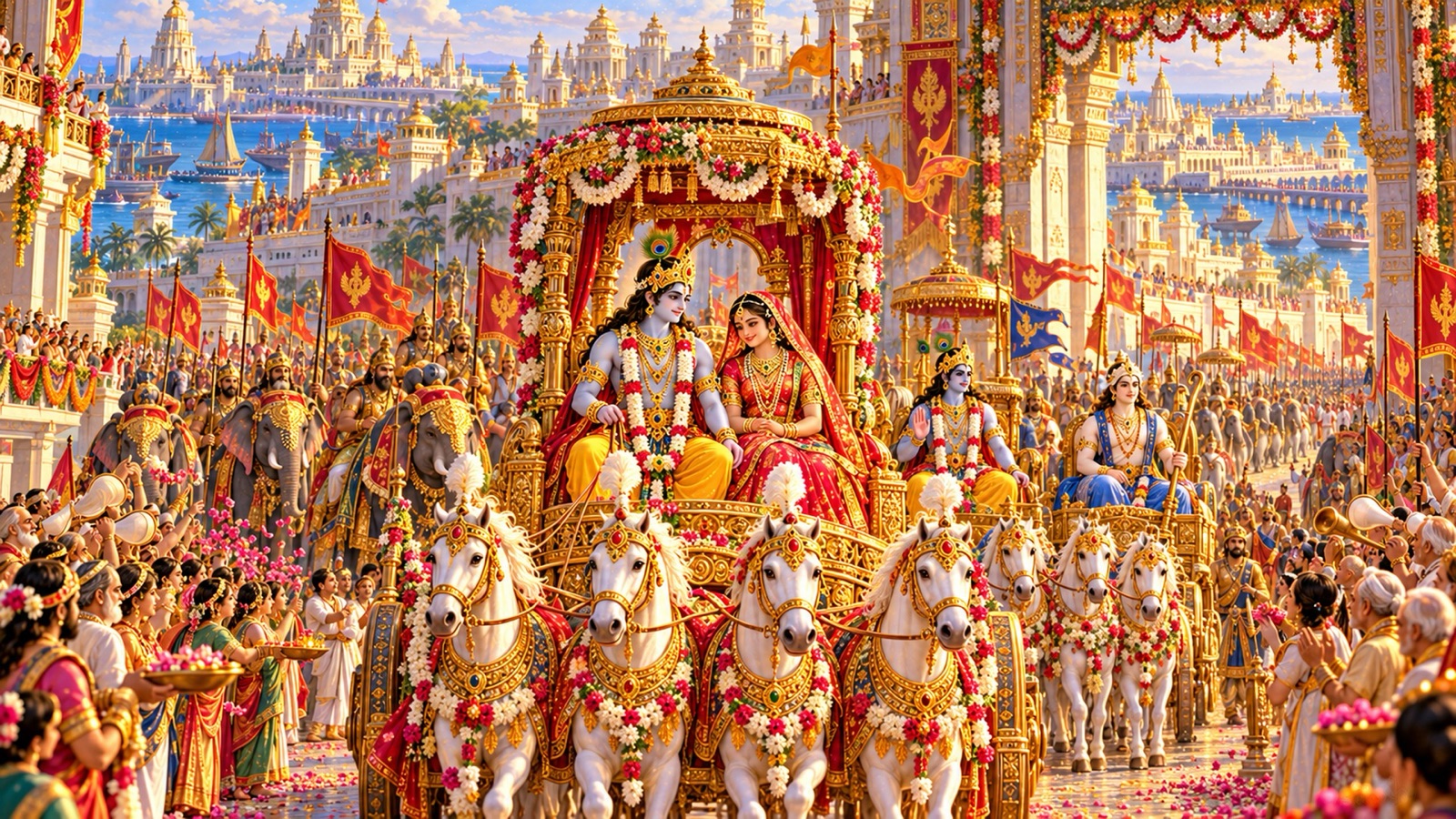
Thus assured, Bana bowed his head to Krishna, placed Aniruddha and his bride Usha upon a chariot and brought them before Him. With Shiva’s blessing the Lord set out, Aniruddha and Usha — richly dressed and adorned — at the head, escorted by an akshauhini. Dvaraka, decked with flags and arches, its streets sprinkled with water, received Him with conchs, drums and kettledrums as citizens, kinsmen and brahmanas came out to welcome Him.
Sukadeva closed with the chapter’s promise:
य एवं कृष्णविजयं शङ्करेण च संयुगम् ।
संस्मरेत् प्रातरुत्थाय न तस्य स्यात् पराजयः ॥ ५३ ॥
ya evaṁ kṛṣṇa-vijayaṁ śaṅkareṇa ca saṁyugam saṁsmaret prātar utthāya na tasya syāt parājayaḥ
Meaning: One who rises at dawn and remembers Krishna’s victory and His battle with Shankara shall never meet with defeat. (Canto 10, Chapter 63, verse 53)
Principal Teachings of This Chapter
1. Suffering lasts only as long as desire binds us. Shiva’s Fever confesses that embodied beings are tormented only while they remain tied to desire and away from the Lord’s feet. The cure for fever of every kind is service at those feet.
2. Remembrance is protection. Whoever recalls the Lord’s dialogue with the Fever is freed from fear of it, and whoever remembers at dawn His battle with Shankara is never defeated. Sacred memory is itself a shelter.
3. The human birth squandered is self-deception. Rudra calls the one who gains a human body yet neither restrains his senses nor honours the Lord’s feet an ātma-vañcaka, and names turning to sense-objects a choosing of poison over nectar.
4. The Lord keeps His word across generations. Bana lives because of a boon given to Prahlada, and because the Lord treats Shiva’s promise of protection as binding on Himself.
5. Chastisement and grace are one. The arms are removed only to quell pride; what remains is made ageless and fearless. When the Lord humbles, He is already lifting.
A Devotional Reflection
What stays with the heart after this chapter is not the clash of weapons but the two voices that rise out of it in praise. The first belongs to a Fever who, defeated, discovers that he was burning in the Lord’s own radiance all along, and that his pain was the measure of his distance from those feet. The second belongs to Shiva, the greatest of devotees, who fights for his servant with every weapon and then offers the finest weapon of all: a prayer that names the Lord Self, friend and deity of every being. Between them stands Bana, learning that the arms he was so proud of were never the point, and that to be stripped of them by Krishna is to be made truly safe. We too carry a thousand arms of pride and a fever of desire. May we lay them at those feet before they are taken from us, and find, like Bana, that what the Lord leaves us is enough.
A Daily Devotional Practice
Tomorrow morning, quietly recall this chapter: Shiva on Nandi, the Fever folding his palms, the arms falling like branches, and Krishna’s words that He cut them only to cure pride. Then ask what pride or craving you might lay down today. Begin by chanting gently: Om Namo Bhagavate Vasudevaya.
Conclusion
In this sixty-third chapter the rescue of Aniruddha becomes the setting for one of the Bhagavatam’s great meetings between Krishna and Shiva — a battle fought in earnest and resolved in devotion. Its heart is the Lord’s own explanation: Bana was spared for Prahlada’s sake and for Shiva’s, and what remained to him was blessed. May we remember each dawn how the Lord fought and forgave, and may that memory keep us from defeat.
May the divine wisdom of Srimad Bhagavatam awaken pure devotion within our hearts.
Om Namo Bhagavate Vasudevaya.
Jay Shree Madhav.
References and Attribution
- Primary edition: Gita Press, Śrīmad Bhāgavata Mahāpurāṇa (English, Part Two), Book Ten (Latter Half), Discourse 63.
- Series: Srimad Bhagavatam Wisdom · Biswa Sanatan Dharma Seva Trust.
- Presented following the spiritual guidance and recommendation of Pandit Dr. Shri Kashinath Mishra.
This is an original, faithful retelling in the writer’s own words, with brief quoted verses shown in Devanāgarī and transliteration and their meanings given as summaries. It is not a reproduction of any single publisher’s continuous translation or commentary. No affiliation with or endorsement by any publisher is implied.
Jay Shree Madhav