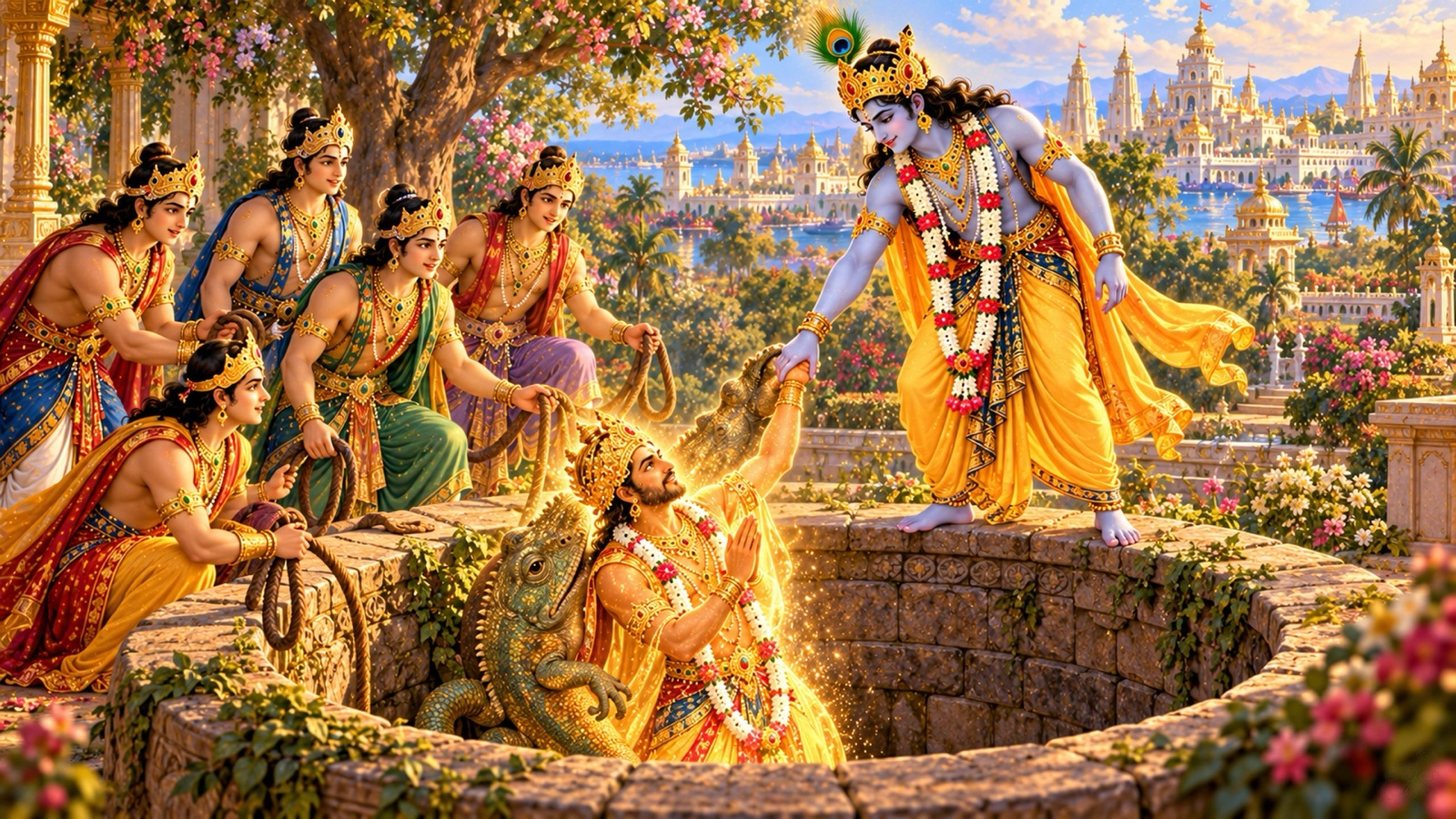
A giant chameleon lies trapped at the bottom of a dry well; one touch of Krishna’s hand raises it as a radiant king, whose tale of a cow given twice teaches all Dwaraka that what belongs to a brahmana must never be touched.
Om Namo Bhagavate Vasudevaya.
Om Namo Bhagavate Vasudevaya.
Om Namo Bhagavate Vasudevaya.
Welcome back to Srimad Bhagavatam Wisdom, our devotional journey through the Srimad Bhagavat Mahapurana. In this sixty-fourth chapter of the Tenth Canto, the Yadava princes find a strange creature in a well, and from its own mouth we hear how a charitable king fell through one unknowing fault — and how Krishna lifts him up.
Chapter Information
- Scripture: Śrīmad Bhāgavata Mahāpurāṇa
- Canto: 10 (Book Ten, Latter Half)
- Chapter: 64 (Discourse 64)
- Chapter title: The Deliverance of King Nriga
- Principal speaker: Sukadeva Gosvami; within the story, King Nriga and Lord Krishna
- Principal listener: King Parikshit; within the story, Lord Krishna and the Yadavas
- Main setting: A garden and dry well near Dvārakā; then the city itself
- Central subject: King Nriga, freed from a chameleon’s body by Krishna’s touch, tells how a cow given twice caused his fall; Krishna’s instruction on the sanctity of a brahmana’s property
- Principal verse range: Canto 10, Chapter 64, verses 1–44
- Primary edition: Gita Press Śrīmad Bhāgavata Mahāpurāṇa (English, Book Ten)
Context From the Previous Chapter
In Chapter 63, Krishna fought Banasura and Lord Shiva, cut away the demon’s many arms, and spared his life at Shiva’s prayer, then brought Aniruddha and his bride Usha home to Dvārakā amid conchs and drums. Our chapter opens on a quieter day in that city.
The Princes at the Dry Well
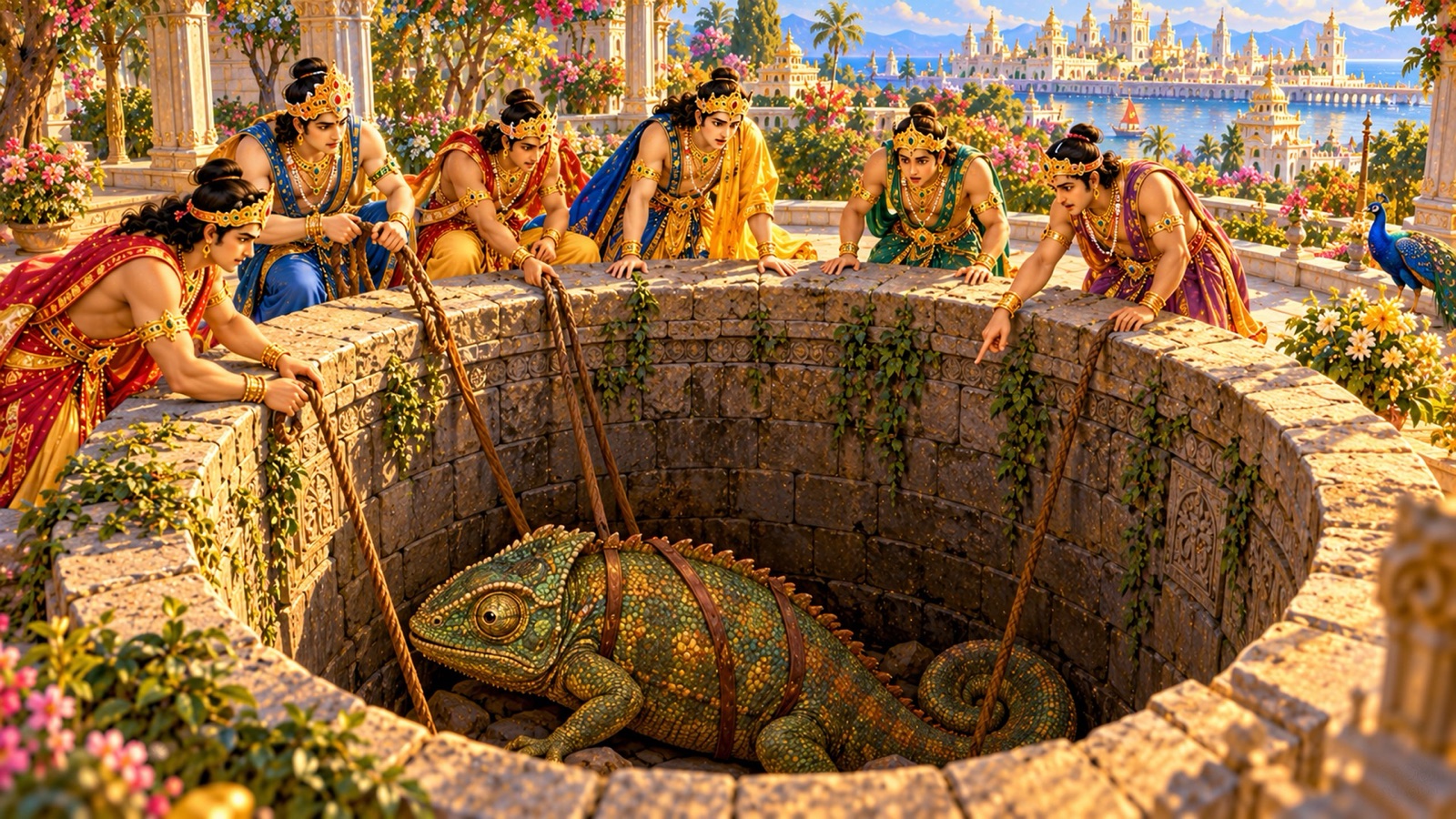
Sukadeva Gosvami continued his narration to King Parikshit. One day Samba, Pradyumna, Charu, Bhanu, Gada and other young Yadu princes went to a garden to play. After long hours of sport they grew thirsty and came upon a well. It was dry; but at its bottom lay a creature that stopped them in wonder — a chameleon as huge as a hill.
Moved with pity, they bound it with leather thongs and ropes of fibre and tried to haul it up, but could not. Full of curiosity, they ran to Krishna and told Him what they had found.
The Touch of the Lord’s Hand
The lotus-eyed Lord, the almighty sustainer of the universe, came to the well, looked at the creature, and lifted it out playfully with His left hand. The moment He touched it, the chameleon’s body fell away, and a shining celestial being stood in its place.
स उत्तमश्लोककराभिमृष्टो विहाय सद्य: कृकलासरूपम् ।
सन्तप्तचामीकरचारुवर्ण: स्वर्ग्यद्भुतालङ्करणाम्बरस्रक् ॥ ६ ॥
sa uttama-śloka-karābhimṛṣṭo vihāya sadyaḥ kṛkalāsa-rūpam santapta-cāmīkara-cāru-varṇaḥ svargy adbhutālaṅkaraṇāmbara-srak
Meaning: Touched by the hand of the Lord of excellent renown, he at once gave up the body of a chameleon and became a heavenly being, his lovely complexion like molten gold, adorned with wonderful ornaments, garments and garlands. (Canto 10, Chapter 64, verse 6)
Krishna, the giver of liberation, knew well why this soul had worn a chameleon’s form. Yet so that the people might learn, He asked: ‘O greatly fortunate one, who are you? Surely you are one of the gods. By what deed were you brought to such a state, which you hardly deserved? If you think it right, tell Us your history.’
King Nriga Reveals Himself
So questioned by the Lord of infinite forms, the king bowed before the husband of Lakshmi, his crown blazing like the sun, and spoke.
नृगो नाम नरेन्द्रोऽहमिक्ष्वाकुतनय: प्रभो ।
दानिष्वाख्यायमानेषु यदि ते कर्णमस्पृशम् ॥ १० ॥
nṛgo nāma narendro ‘ham ikṣvāku-tanayaḥ prabho dāniṣv ākhyāyamāneṣu yadi te karṇam aspṛśam
Meaning: Nriga said: O Lord, I am a king named Nriga, the son of Ikshvaku. If donors were ever recounted before You, perhaps my name has touched Your ear. (Canto 10, Chapter 64, verse 10)
Nothing, he added, is hidden from the Witness of all minds, whose sight time cannot obstruct; still, at the Lord’s command he would tell his story.
A Lifetime of Giving
Nriga had given cows to brahmanas as countless as the grains of sand, the stars of the sky, the drops of a rainfall — young milch cows, gentle and tawny, of fine breed, each with her calf, each bought with honest wealth, horns plated with gold and hooves with silver, decked with silks, garlands and ornaments.
Nor did he give carelessly. He chose young brahmanas of noble character and even mind, from families in want — truthful, austere, generous in teaching the Vedas — and honoured them with garments before giving the cows. He gave also lands, gold, houses, horses, elephants, silver, sesame, beds, clothes, jewels, household goods and chariots; he performed sacrifices and built works for the good of all.
One Cow Given Twice
Then came the fault. A cow belonging to a brahmana of austerity who never accepted gifts once strayed into the king’s herd. Not knowing this, Nriga gave her to another brahmana. As the new owner led her off, the first saw her and cried, ‘She is mine!’ The second answered, ‘No, she is mine — King Nriga gave her to me.’
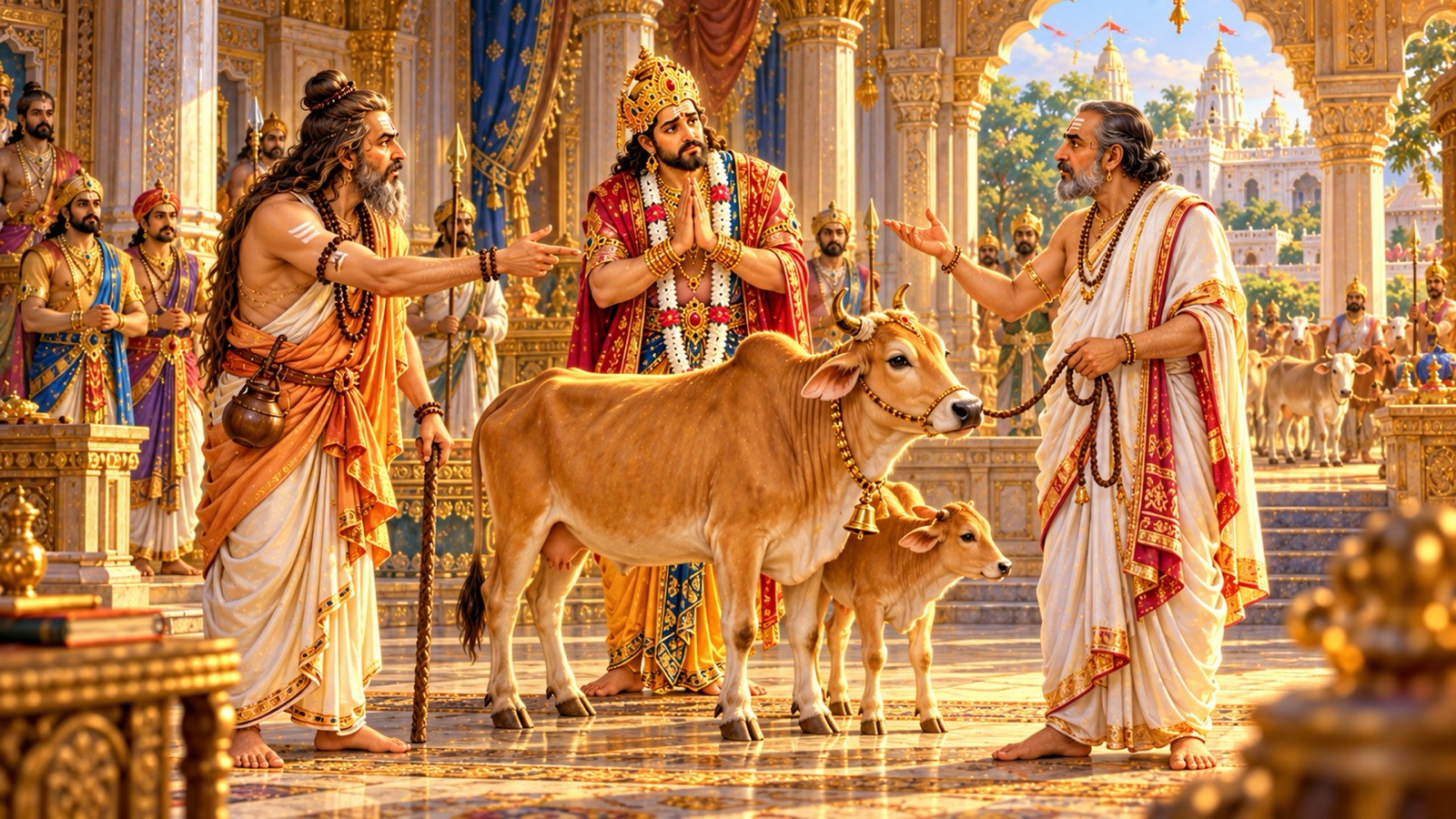
Both brought the quarrel to the king. One said, ‘You gave her to me.’ The other said, ‘If so, you are a thief of my cow.’ Bewildered, Nriga pleaded with both: ‘I will give a hundred thousand excellent cows in her place; only let me have this one. I am your servant. Forgive a wrong done unknowingly, and save me from this plight, which will drag me down to a foul hell.’
Neither would yield. The owner declared he would accept nothing in exchange, and left. The other said he would not take even ten thousand cows in her place, and departed. The matter stood unresolved — and the king’s life ran out.
Before the Court of Yama
Yama’s messengers carried the dead king to the lord of justice, who asked him: ‘O king, will you first undergo the result of your sin, or first enjoy the fruit of your merit? I see no end to your charities, nor to the shining worlds that await you for them.’
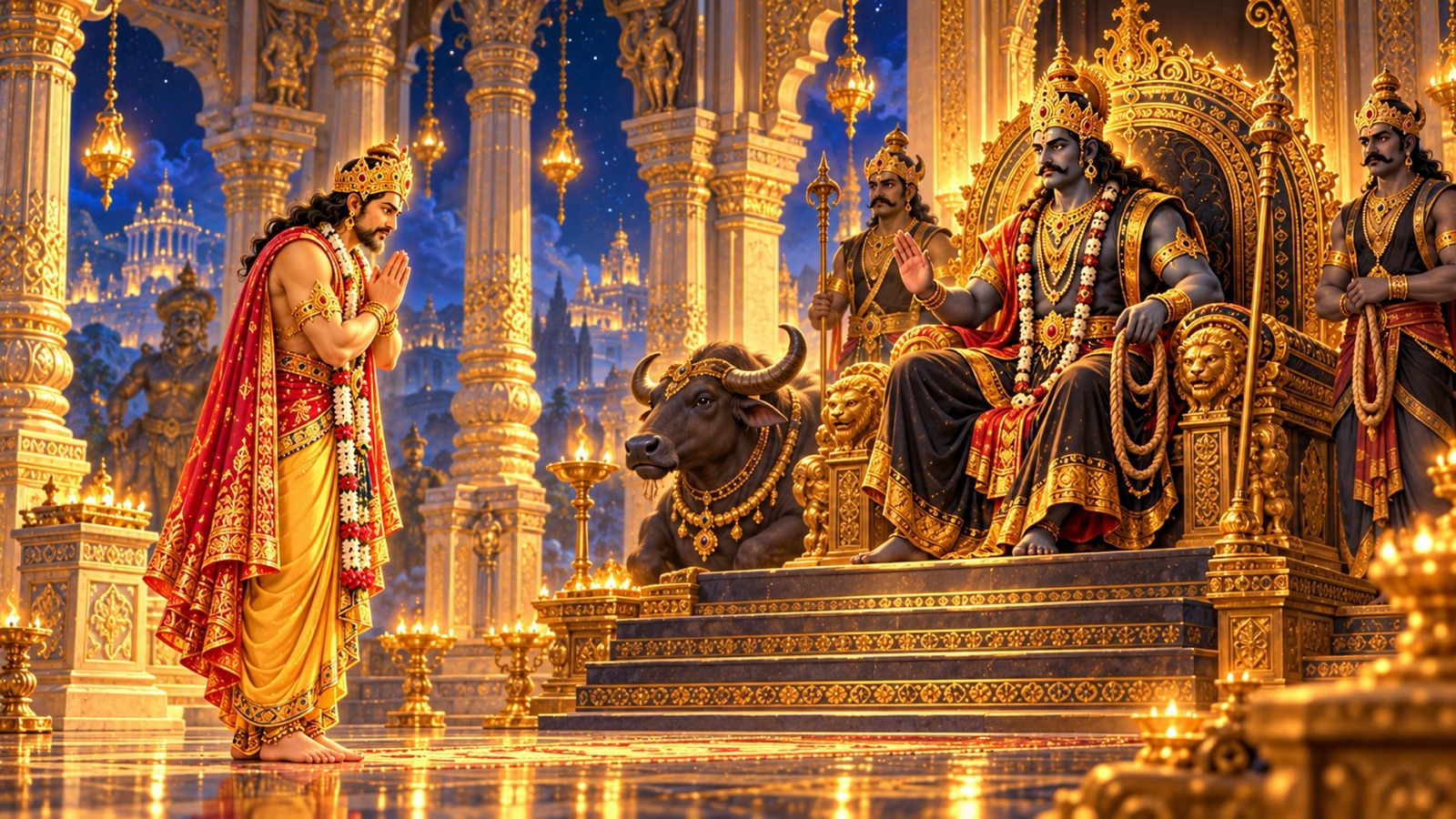
Nriga answered, ‘O lord, let me first suffer for my sin.’ At once Yama said, ‘Fall.’ And falling from that place, the king found himself a chameleon, and so had lain in the dark well all this long while.
Memory Kept by Devotion
Yet one thing had not been taken from him: through all those years in a lowly form, his memory of who he had been never left him.
ब्रह्मण्यस्य वदान्यस्य तव दासस्य केशव ।
स्मृतिर्नाद्यापि विध्वस्ता भवत्सन्दर्शनार्थिन: ॥ २५ ॥
brahmaṇyasya vadānyasya tava dāsasya keśava smṛtir nādyāpi vidhvastā bhavat-sandarśanārthinaḥ
Meaning: O Keshava, because I was a servant of Yours devoted to the brahmanas and generous in gifts, and because I longed for Your direct sight, my memory has not been destroyed even now. (Canto 10, Chapter 64, verse 25)
And he marvelled. The Lord whom masters of yoga behold in purified hearts through the eye of the Upanishads, who is beyond the senses — how had He come within the sight of one clouded by so many sufferings? Nriga knew the answer: the Lord becomes visible only to the soul whose release from birth and death is near.
Nriga’s Farewell Prayer
Then the king prayed, calling upon the Lord by His holy names.
देवदेव जगन्नाथ गोविन्द पुरुषोत्तम ।
नारायण हृषीकेश पुण्यश्लोकाच्युताव्यय ॥ २७ ॥
अनुजानीहि मां कृष्ण यान्तं देवगतिं प्रभो ।
यत्र क्वापि सतश्चेतो भूयान्मे त्वत्पदास्पदम् ॥ २८ ॥
deva-deva jagan-nātha govinda puruṣottama nārāyaṇa hṛṣīkeśa puṇya-ślokācyutāvyaya anujānīhi māṁ kṛṣṇa yāntaṁ deva-gatiṁ prabho yatra kvāpi sataś ceto bhūyān me tvat-padāspadam
Meaning: O God of gods, Lord of the universe, Govinda, Supreme Person, Narayana, Hrishikesha, Lord of holy renown, infallible and undecaying One — O Krishna, O Master, permit me as I depart to the destination of the gods; and wherever I may dwell, may my mind ever rest at Your feet. (Canto 10, Chapter 64, verses 27–28)
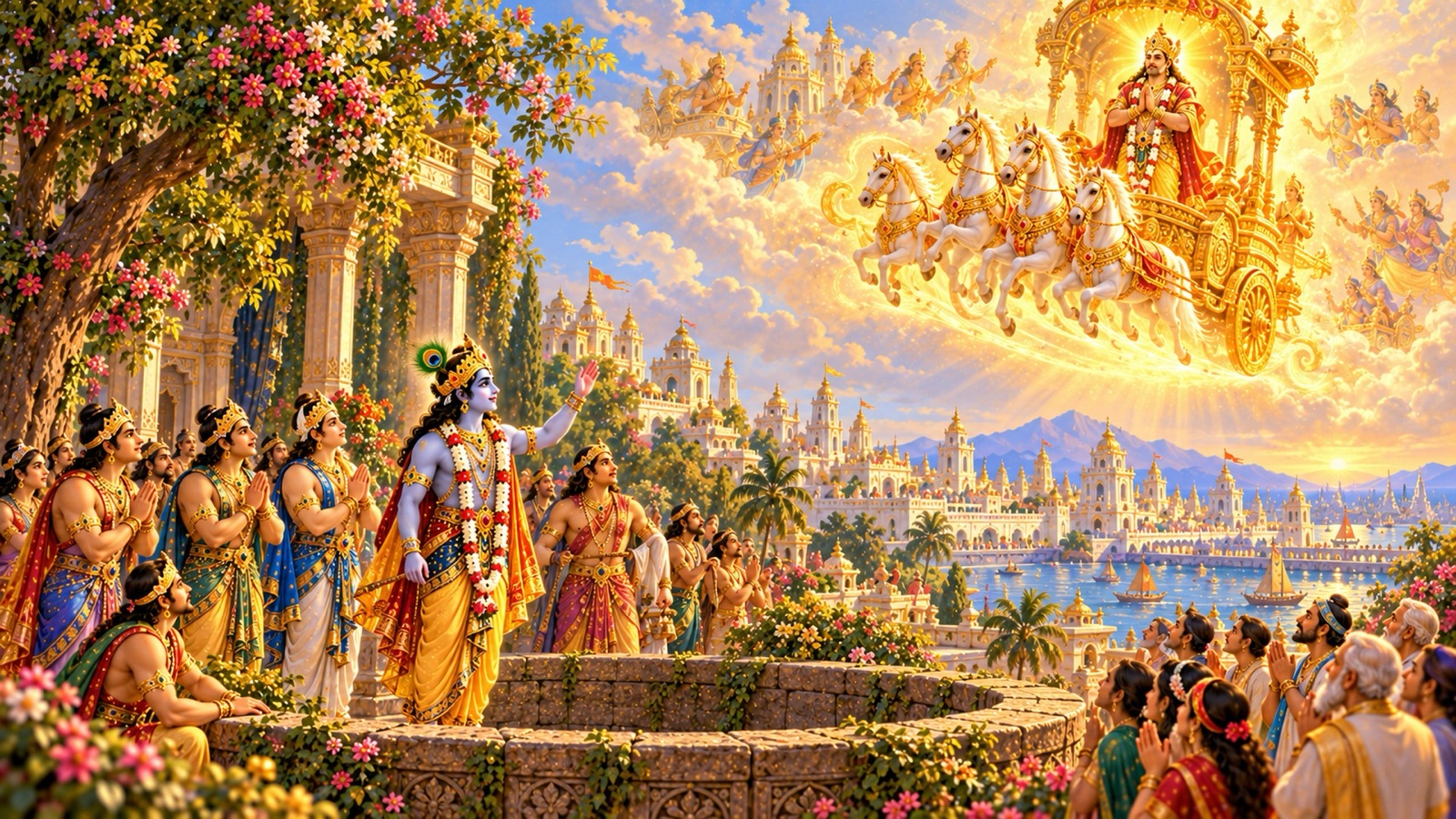
He bowed to the Creator of all, the changeless One of infinite power, to Krishna, Vasudeva, shelter of all beings and Lord of all yoga. Then Nriga circled the Lord in reverence, touched His feet with his head, and with His leave mounted a splendid celestial chariot while all the people watched him rise.
Krishna Instructs the Yadus
When the king had gone, Krishna, the son of Devaki — friend of the brahmanas and dharma itself in human form — turned to His own people, and for the sake of all who bear a king’s duty He spoke of what they had seen.
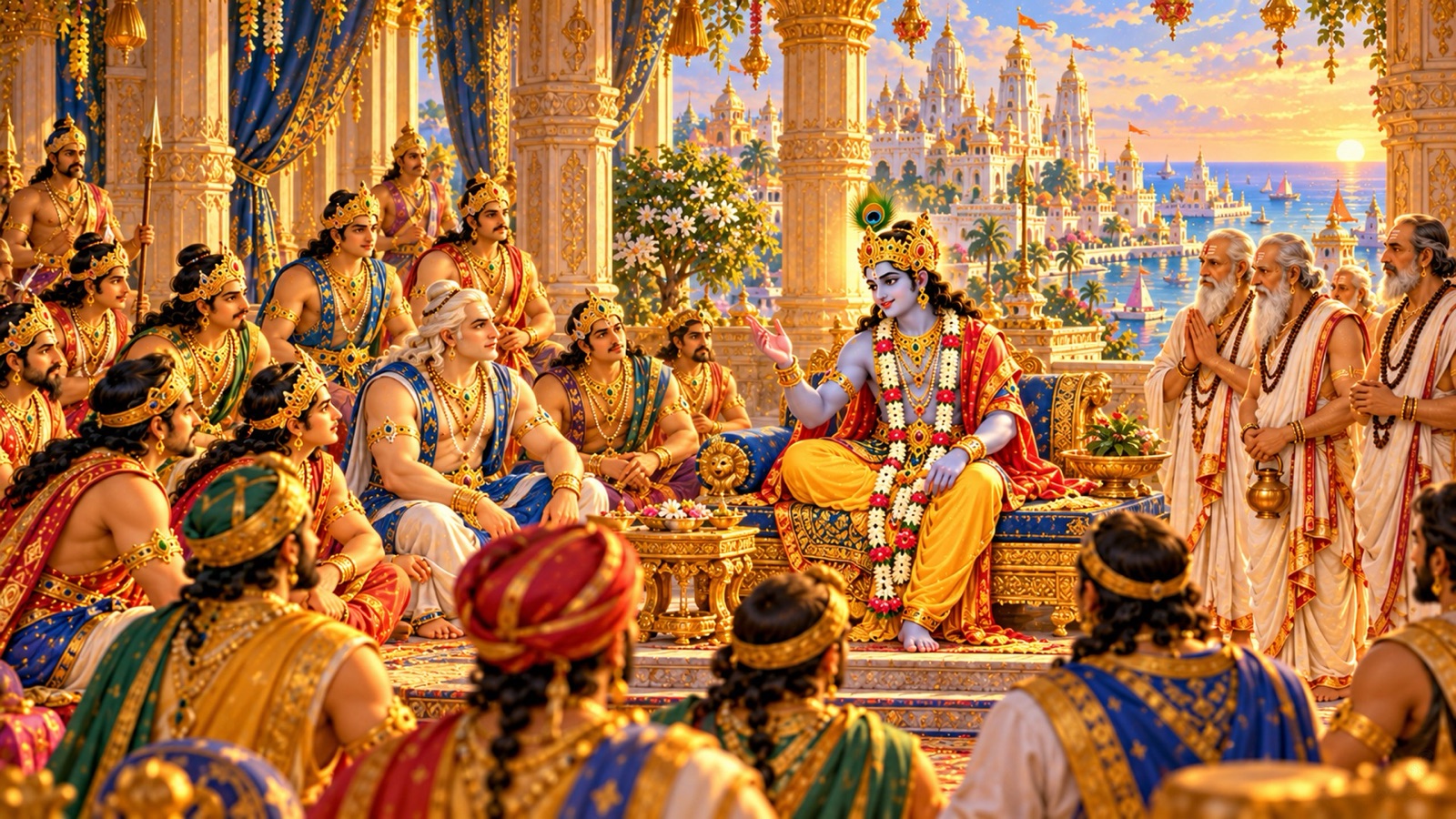
Even the smallest portion of a brahmana’s wealth, He said, if wrongly taken, cannot be digested by one as mighty as fire — how much less by a king who in vanity imagines himself a lord. Then He spoke the words that give this chapter its sting.
नाहं हालाहलं मन्ये विषं यस्य प्रतिक्रिया ।
ब्रह्मस्वं हि विषं प्रोक्तं नास्य प्रतिविधिर्भुवि ॥ ३३ ॥
nāhaṁ hālāhalaṁ manye viṣaṁ yasya pratikriyā brahma-svaṁ hi viṣaṁ proktaṁ nāsya pratividhir bhuvi
Meaning: I do not regard the halahala poison as true poison, for it has a remedy; it is a brahmana’s property that is called real poison, for in this world there is no cure for it. (Canto 10, Chapter 64, verse 33)
Poison, He went on, kills only the one who swallows it, and fire is put out with water; but the fire kindled from a brahmana’s stolen property burns a whole family to its roots. Property used without the owner’s leave ruins three generations; seized by force, it destroys ten before and ten after. Kings blinded by fortune covet brahmanas’ wealth and do not see the hellish depth into which they fall. Those who rob generous brahmanas with large families of their livelihood will boil with their descendants in the hell Kumbhipaka for as many years as there are grains of dust wetted by the victims’ tears. One who takes away a brahmana’s means of living — whether he or another had given it — is born a worm in filth for sixty thousand years.
Krishna then made His own resolve plain: no brahmana’s wealth would ever enter His treasury. Those who so much as covet it lose their span of life, are defeated by enemies, stripped of their kingdoms and reborn as terrible serpents.
Bow to the Brahmana
Then warning turned to a command of reverence.
विप्रं कृतागसमपि नैव द्रुह्यत मामका: ।
घ्नन्तं बहु शपन्तं वा नमस्कुरुत नित्यश: ॥ ४१ ॥
vipraṁ kṛtāgasam api naiva druhyata māmakāḥ ghnantaṁ bahu śapantaṁ vā namas-kuruta nityaśaḥ
Meaning: O My kinsmen, never do harm to a brahmana even when he has committed an offense; though he strike you or curse you again and again, offer him your obeisance always. (Canto 10, Chapter 64, verse 41)
‘Just as I bow to the brahmanas with care three times each day,’ He said, ‘so must you. Whoever acts otherwise will be punished by Me.’ And He sealed the lesson with the example before their eyes.
ब्राह्मणार्थो ह्यपहृतो हर्तारं पातयत्यध: ।
अजानन्तमपि ह्येनं नृगं ब्राह्मणगौरिव ॥ ४३ ॥
brāhmaṇārtho hy apahṛto hartāraṁ pātayaty adhaḥ ajānantam api hy enaṁ nṛgaṁ brāhmaṇa-gaur iva
Meaning: A brahmana’s property, when taken away, drags its taker down — as the brahmana’s cow dragged down this Nriga, even though he did not know. (Canto 10, Chapter 64, verse 43)
Having thus instructed the people of Dvārakā, Lord Mukunda, purifier of all the worlds, returned to His palace.
Principal Teachings of This Chapter
1. The Lord staged this deliverance as a lesson for kings. Krishna already knew why Nriga wore a chameleon’s body, yet He asked so that the people might hear it from the king’s own lips, and afterwards addressed the Yadus expressly to instruct those who rule. One devotee’s rescue became a teaching for every holder of power: wealth set apart for the Lord’s servants is not ours to touch.
2. A brahmana’s property is poison without remedy. Halahala has an antidote; misappropriated brahmana-wealth has none.
3. Ignorance does not undo consequence. Nriga sinned unknowingly, yet Krishna points to him as proof that even an unintended wrong against a brahmana bears fruit.
4. Choose to suffer first. Offered the choice by Yama, Nriga asked to bear his sin before enjoying his merit; the soul that accepts correction readily is purified quickly.
5. Devotion preserves memory. Through long ages as a chameleon, Nriga never forgot himself, because he had served the brahmanas and longed to see the Lord.
6. Honour the brahmana even when he errs. The Lord Himself bows to the brahmanas thrice daily and commands His kinsmen to do likewise, even toward one who strikes or abuses them.
A Devotional Reflection
What moves the heart here is not only the fall of a good king but the manner of his lifting. Nriga gave more cows than there are stars, and one stray cow undid him. We might call that harsh; Nriga does not. He asks to suffer first, keeps his memory through the long years in the well, and when the Lord’s hand touches him he speaks not of injustice but of wonder — that the One whom yogis strain to see has come to the bottom of a dry well for him. His prayer asks one thing only: that his mind may stay at Krishna’s feet. Perhaps we are meant to hold both lessons at once: handle the sacred with trembling care, and when we fail, let devotion keep our memory alive until the Lord Himself reaches down for us.
A Daily Devotional Practice
Today, before you use or keep anything that may not be fully yours — money, time, credit, another’s trust — ask whose it truly is, remembering the stray cow in Nriga’s herd. If something should be returned, return it today. Then offer a small act of honour to a person devoted to the Lord. Close by praying, as Nriga did, that wherever you are your mind may rest at the Lord’s feet, and chant softly: Om Namo Bhagavate Vasudevaya.
Conclusion
This chapter sets a king’s immense generosity beside the single unknowing fault that pulled him down, and lets the Lord Himself draw the lesson. Krishna’s hand restores Nriga, his devotion carries him to the heavens, and the Yadus — and all who read — receive a command both severe and tender: never touch what belongs to a brahmana, and bow to the Lord’s servants even when they wrong you. May this history keep us watchful and humble, and may our minds, like Nriga’s, rest at the feet of Krishna.
May the divine wisdom of Srimad Bhagavatam awaken pure devotion within our hearts.
Om Namo Bhagavate Vasudevaya.
Jay Shree Madhav.
References and Attribution
- Primary edition: Gita Press, Śrīmad Bhāgavata Mahāpurāṇa (English, Complete), Book Ten (Latter Half), Discourse 64.
- Series: Srimad Bhagavatam Wisdom · Biswa Sanatan Dharma Seva Trust.
- Presented following the spiritual guidance and recommendation of Pandit Dr. Shri Kashinath Mishra.
This is an original, faithful retelling in the writer’s own words, with brief quoted verses shown in Devanāgarī and transliteration and their meanings given as summaries. It is not a reproduction of any single publisher’s continuous translation or commentary. No affiliation with or endorsement by any publisher is implied.
Jay Shree Madhav