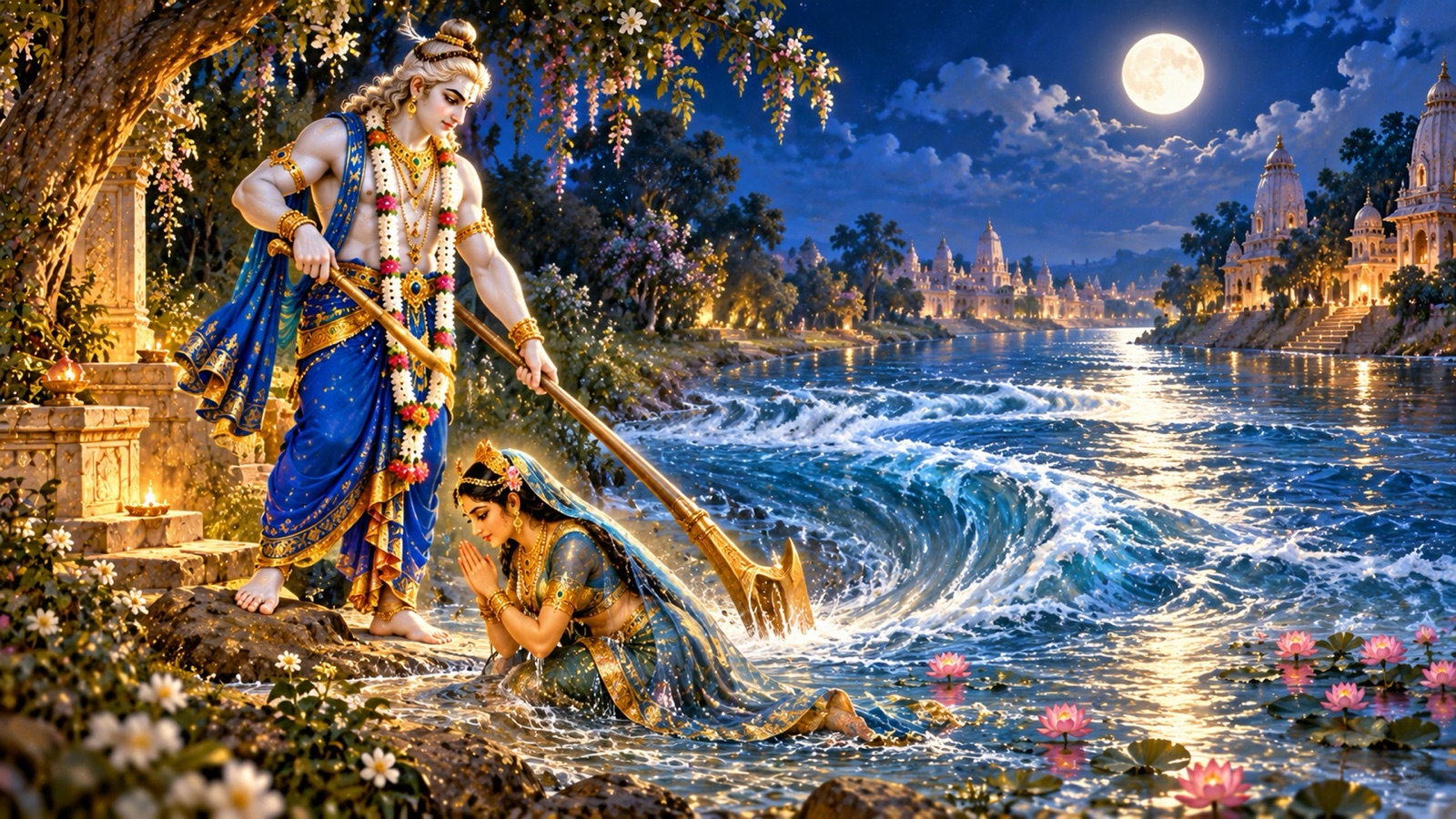
Longing for the companions of His childhood, Balarama rides back to Vraja, soothes the weeping gopis with Krishna’s own messages, and with the tip of His plough draws the proud Yamuna to His feet.
Om Namo Bhagavate Vasudevaya.
Om Namo Bhagavate Vasudevaya.
Om Namo Bhagavate Vasudevaya.
Welcome back to Srimad Bhagavatam Wisdom, our devotional journey through the sacred histories and teachings of the Srimad Bhagavat Mahapurana. In this sixty-fifth chapter of the Tenth Canto, Sukadeva follows Lord Balarama home to the pastures of Nanda, where every heart is waiting for news of Krishna, and where a sacred river learns, at the end of a plough, who her Lord truly is.
Chapter Information
- Scripture: Śrīmad Bhāgavata Mahāpurāṇa
- Canto: 10 (Book Ten, Latter Half)
- Chapter: 65 (Discourse 65)
- Chapter title: Lord Balarama Visits Vrindavana
- Principal speaker: Sukadeva Gosvami (narrating to King Parikshit)
- Principal listener: King Parikshit
- Main setting: Nanda’s Gokula in Vraja and the groves on the bank of the Yamunā near Vṛndāvana
- Central subject: Balarama’s visit to Vraja; the gopas’ and gopis’ questions about Krishna; His consolation of the gopis; the humbling of the Yamuna and her prayer of surrender
- Principal verse range: Canto 10, Chapter 65, verses 1–34
- Primary edition: Gita Press Śrīmad Bhāgavata Mahāpurāṇa (English, Book Ten)
Context From the Previous Chapter
In Chapter 64 Krishna freed King Nrga from the body of a lizard and heard how a single cow given in charity had unknowingly returned to his hands. Krishna then taught His kinsmen how grave the misuse of a brahmana’s property is. From that lesson in Dwaraka, Sukadeva now turns toward Vraja.
Balarama Returns to Vraja
Sukadeva told King Parikshit that a longing had grown in the heart of Lord Balabhadra to see once more the cowherds who had raised Him, the boys who had played with Him, and the forests and river of His childhood. So He mounted His chariot in Dwaraka and drove to the Gokula ruled by Nanda.
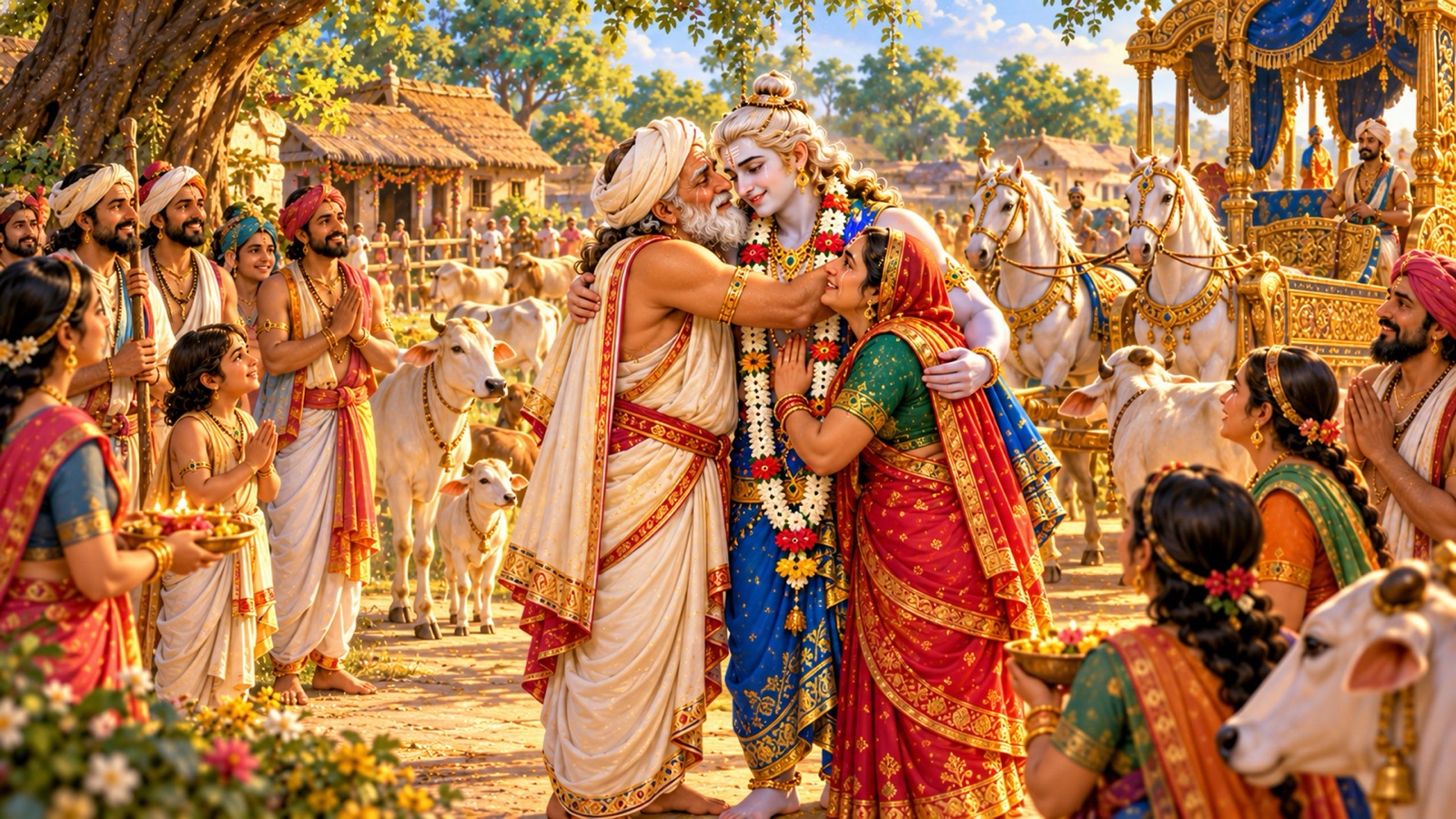
The people of Vraja had waited for Him a very long time. When the chariot appeared, the gopas and gopis ran to Him and held Him close. Balarama bowed to Nanda and Yasoda, and they blessed Him from the depth of their hearts: He was the Lord of the universe, they said, and He should protect them long, together with His younger brother. Then, as though He were still a small boy, they lifted Him onto their lap and wept over Him until He was wet with their tears.
चिरं न: पाहि दाशार्ह सानुजो जगदीश्वर: ।
इत्यारोप्याङ्कमालिङ्ग्य नेत्रै: सिषिचतुर्जलै: ॥ ३ ॥
ciraṁ naḥ pāhi dāśārha sānujo jagad-īśvaraḥ ity āropyāṅkam āliṅgya netraiḥ siṣicatur jalaiḥ
Meaning: “O Dasarha, You are the Lord of the universe; together with Your younger brother, guard us for many years to come.” Saying this, the two of them placed Him on their lap, embraced Him, and bathed Him with the water of their eyes. (Canto 10, Chapter 65, verse 3)
Among the Cowherds
Balarama greeted the elder gopas with due honour, and the younger ones bowed to Him in turn. Each man of Vraja He met as their bond required — with laughter for one, a clasp of the hand for another, according to age, friendship and kinship. When He had rested, the cowherds gathered round Him. Sukadeva describes these simple men in a phrase worth remembering: for the sake of lotus-eyed Krishna they had let go of every worldly gain, and of heaven and liberation besides. Balarama asked after their welfare, and in voices broken by love they asked after His.
Were all their kinsmen in Dwaraka well? Now that He and Krishna were married and had children, did They still think of Vraja? By good fortune the wicked Kamsa had been slain and their kinsmen freed; by good fortune the brothers had killed or defeated Their enemies and now lived safely in a fortified city. There was no complaint in their words — only joy at the Lord’s victories and a quiet hope of being remembered.
The Gopis Ask About Krishna
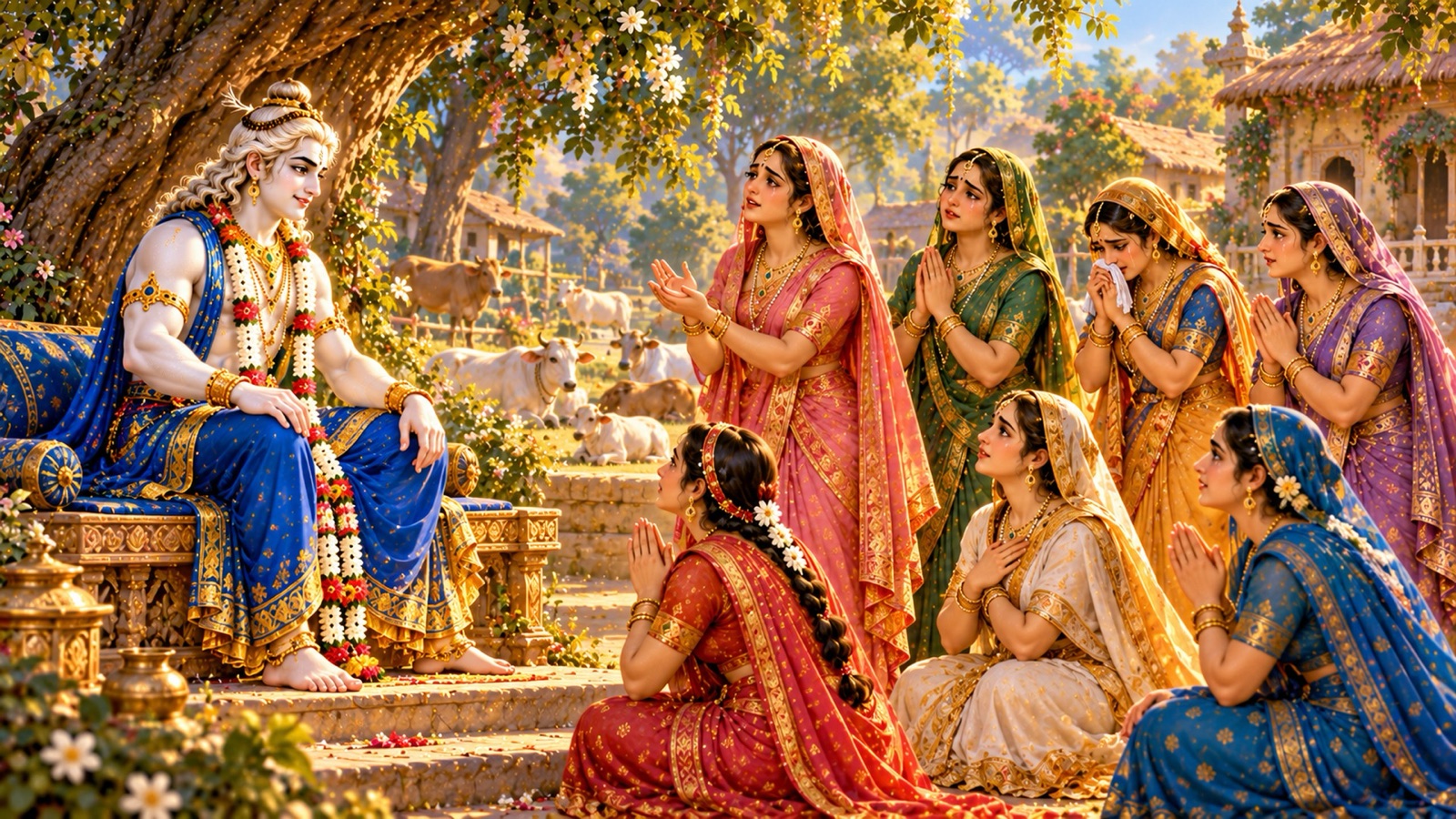
The gopis, too, felt honoured to see Balarama so near, and they came to Him smiling. But their questions went straight to the one name they could not stop speaking. Was Krishna, now the darling of the city women, happy? Did He ever think of His relatives and friends, of His father, of His mother? Would He come even once to see Yasoda? And did the mighty-armed one remember, even a little, how faithfully they had served Him?
कच्चित् स्मरति वा बन्धून् पितरं मातरं च स: ।
अप्यसौ मातरं द्रष्टुं सकृदप्यागमिष्यति ।
अपि वा स्मरतेऽस्माकमनुसेवां महाभुज: ॥ १० ॥
kaccit smarati vā bandhūn pitaraṁ mātaraṁ ca saḥ apy asau mātaraṁ draṣṭuṁ sakṛd apy āgamiṣyati api vā smarate ’smākam anusevāṁ mahā-bhujaḥ
Meaning: Does He remember His kinsmen, His father and His mother at all? Will He ever return, if only once, to see His mother? And does that hero of long arms recall the constant devotion with which we served Him? (Canto 10, Chapter 65, verse 10)
Then the grief beneath the questions broke through. For Krishna’s sake, they said, they had given up mother and father, brothers, husbands, sons and sisters — bonds so hard to let go. Yet He had left them in a single moment and cut every tie of affection. How could women not have trusted such sweet words as His?
One gopi answered bitterly that the clever women of Mathura would never believe so fickle and ungrateful a heart. Another replied that Krishna was a master of charming talk, and that His smile and glances must have kindled such longing in those women that they believed Him just as the gopis once had. A third said: why speak of Him at all? If He can pass His days without us, we shall pass ours without Him. But even as they said it, they remembered His laughter, His conversation, His lovely glances, His gait and His loving embraces, and the women of Vraja wept.
Balarama Consoles the Gopis
Lord Sankarshana did not reason with their grief; He had brought something better. He carried messages from Krishna Himself, and He knew every art of gentle persuasion. With those words He comforted them.
सङ्कर्षणस्ता: कृष्णस्य सन्देशैर्हृदयङ्गमै: ।
सान्त्वयामास भगवान् नानानुनयकोविद: ॥ १६ ॥
saṅkarṣaṇas tāḥ kṛṣṇasya sandeśair hṛdayaṅgamaiḥ sāntvayām āsa bhagavān nānānunaya-kovidaḥ
Meaning: Lord Sankarshana, expert in every method of conciliation, pacified those gopis with the messages of Krishna, which touched their very hearts. (Canto 10, Chapter 65, verse 16)
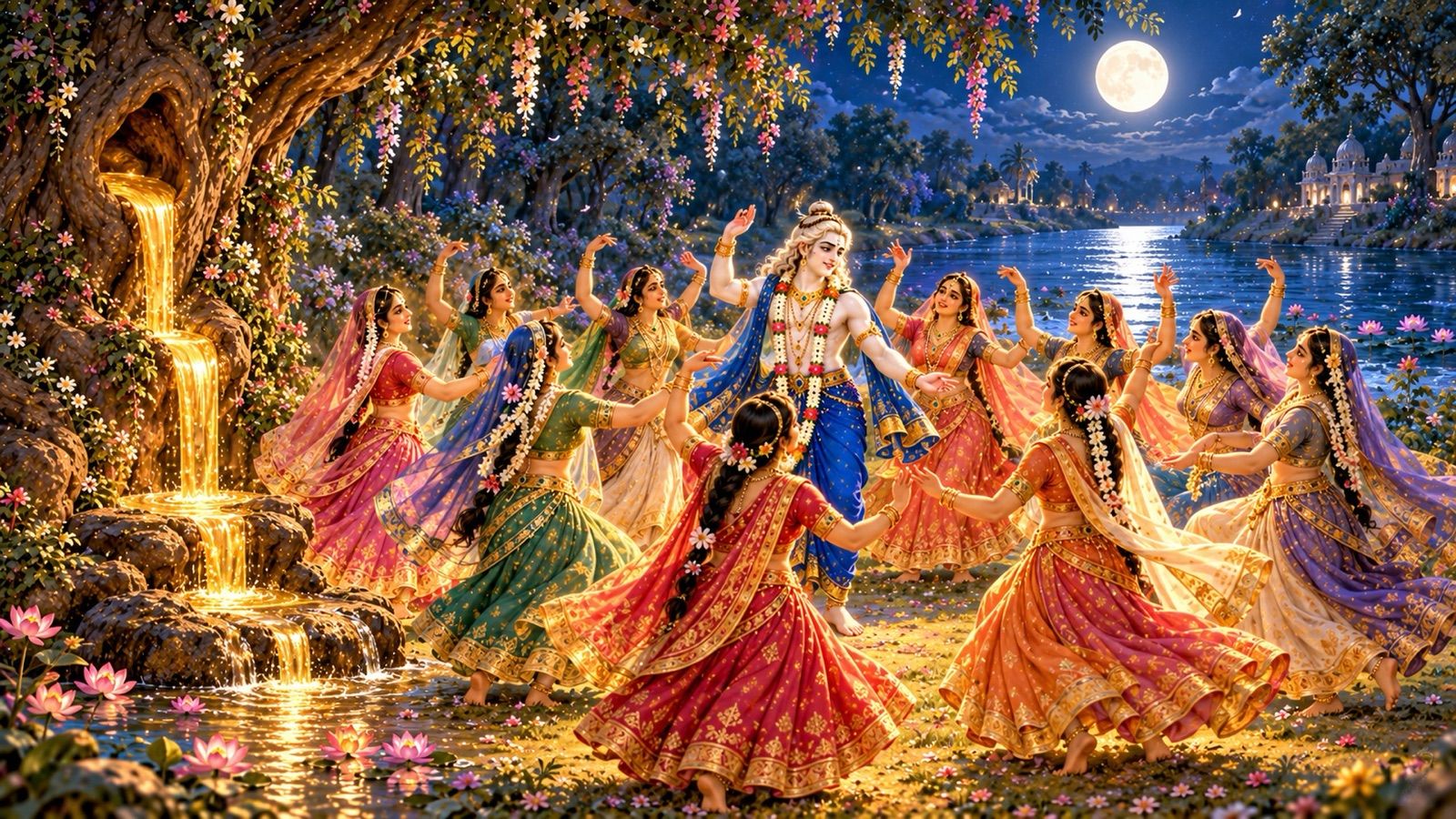
Balarama stayed in Vraja for the two spring months of Caitra and Vaisakha, and night after night He gave the gopis the joy of His company. The groves along the Yamuna were washed in full moonlight, a soft wind carried the fragrance of night-blooming lotuses, and there, surrounded by the women of Vraja, the Lord enjoyed His pastimes.
The Fragrance of Varuni
In those nights Varuna, the lord of the waters, sent the divine drink Varuni; it flowed from the hollow of a tree and filled the whole wood with its scent. The wind carried the smell of that stream of honey to Balarama, who followed it to the tree and drank of it with the women beside Him. Then, while the gopis sang of His exploits, He roamed the forests with His eyes rolling in the sweet intoxication of that nectar.
Balarama Summons the Yamuna
The Lord was adorned with a wreath of forest flowers and the garland called Vaijayanti, a single earring shining at one ear, His lotus face bright with smiles and dewed with perspiration. In that mood He called the Yamuna to come to Him, so that He might sport in her waters. But the goddess of the river took His words for a drunkard’s and paid them no heed; she did not come. Then Balarama grew angry. Catching the river with the point of His plough, He began to drag her toward Him, and He rebuked her: “Sinful one, you scorn Me and refuse to come when I call you. You flow wherever you please — now with the tip of My plough I shall split you into a hundred streams.”
The Prayer of the Yamuna
Threatened in this way, the frightened goddess fell at the feet of the Lord, the delight of the Yadus, and trembling, she spoke.
राम राम महाबाहो न जाने तव विक्रमम् ।
यस्यैकांशेन विधृता जगती जगत: पते ॥ २८ ॥
rāma rāma mahā-bāho na jāne tava vikramam yasyaikāṁśena vidhṛtā jagatī jagataḥ pate
Meaning: “Rama, O Rama of mighty arms! I did not know Your prowess, O master of the world — You by a single portion of whom the whole earth is upheld.” (Canto 10, Chapter 65, verse 28)
परं भावं भगवतो भगवन् मामजानतीम् ।
मोक्तुमर्हसि विश्वात्मन् प्रपन्नां भक्तवत्सल ॥ २९ ॥
paraṁ bhāvaṁ bhagavato bhagavan mām ajānatīm moktum arhasi viśvātman prapannāṁ bhakta-vatsala
Meaning: “O Lord, I was ignorant of the supreme nature of the Supreme Person. O Soul of the universe, O You who are so tender toward Your devotees, I have surrendered to You; be pleased to set me free.” (Canto 10, Chapter 65, verse 29)
Here lies the heart of the chapter. The Yamuna is a goddess, the very river in whose waters Krishna had danced upon Kaliya. Yet seeing Balarama with flushed face and unsteady eyes, she judged Him by His appearance and treated His command as a drunkard’s babble. Her prayer names her mistake exactly: she did not know His vikrama, His prowess, nor the paraṁ bhāvam, the transcendent nature of the Lord — the Being by a mere portion of whom, Sesa of the thousand hoods, the earth is held in place. The plough was not a tipsy cowherd’s rage but the Lord’s hand correcting a servant who had forgotten whom she served; and the moment she remembered, calling Him bhakta-vatsala and offering herself as prapannā, the anger ended. The Lord who seems to play like a man is never less than the Lord.
Sporting in the River, and the Gift of Kanti
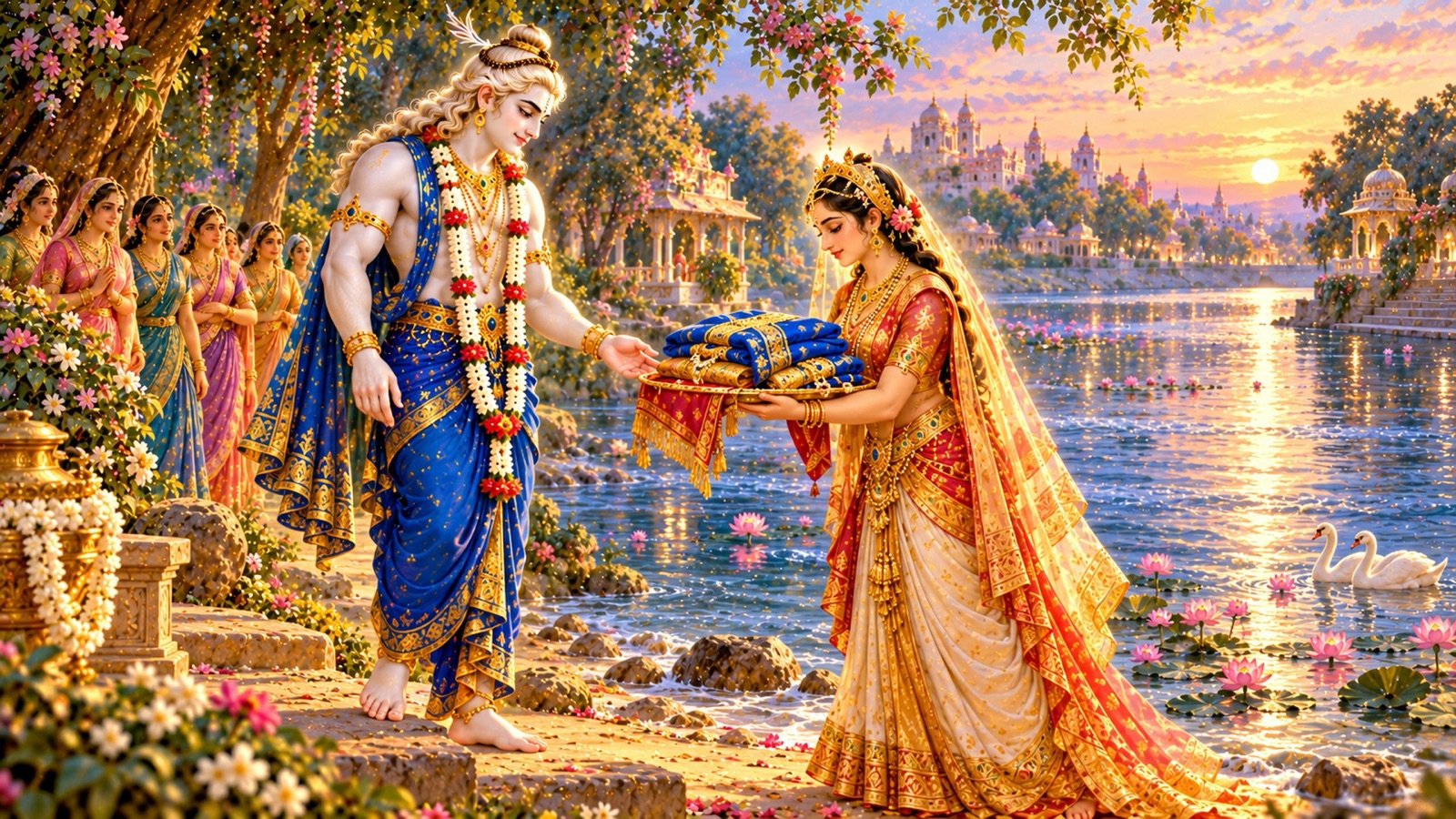
Entreated by her, Lord Balarama released the Yamuna and entered her waters with the gopis, as a lordly elephant enters a river with his mates. When He had sported to His heart’s content and climbed onto the bank, Kanti — the goddess who is the very radiance of Lakshmi — presented Him with two garments of blue, priceless ornaments and a shining golden necklace. Dressed in the blue garments and the necklace, decked with the ornaments and anointed with sandal-paste, He shone like Airavata, the great white elephant of Indra.
The Mark That Remains
Sukadeva then pointed his royal listener to a sign any pilgrim may still see.
अद्यापि दृश्यते राजन् यमुनाकृष्टवर्त्मना ।
बलस्यानन्तवीर्यस्य वीर्यं सूचयतीव हि ॥ ३३ ॥
adyāpi dṛśyate rājan yamunākṛṣṭa-vartmanā balasyānanta-vīryasya vīryaṁ sūcayatīva hi
Meaning: Even today, O King, the Yamuna is seen flowing along the course to which she was dragged, as if proclaiming the strength of Balarama, whose might knows no limit. (Canto 10, Chapter 65, verse 33)
Captivated by the sweetness of the women of Vraja, Balarama lost all count of time, and all the nights of His stay passed as if they had been a single night. So the chapter closes — Krishna’s elder brother held, like every lover of Vraja, by the love of the land that raised Him.
Principal Teachings of This Chapter
1. The Lord does not forget those who raised Him. Balarama’s journey begins in longing for Vraja. The Lord who rules Dwaraka still climbs onto the lap of Nanda and Yasoda; no devotee who has loved Him is left behind in His heart.
2. Everything given up for Krishna is counted. The cowherds had set aside worldly gain, heaven and even liberation for lotus-eyed Krishna; the gopis had left their nearest kin. This renunciation is not loss but the measure of their love.
3. Krishna’s word is the only true consolation. Balarama neither argues with the gopis nor explains Krishna’s absence; He delivers Krishna’s own messages, and those alone heal them.
4. Never judge the Lord by appearances. The Yamuna saw a flushed face and unsteady eyes and ignored the command. Her confession teaches us to hold to the Lord’s supreme nature even when His play seems most human.
5. Surrender ends the Lord’s anger at once. As soon as the river called Him the lover of His devotees and offered herself as surrendered, He let her go. His discipline exists only to bring the forgetful back to His feet.
A Devotional Reflection
What stays with me in this chapter is how often love takes the form of a question. “Do You remember us?” the cowherds ask. “Does He remember His mother? Does He remember our service?” the gopis ask. Nobody in Vraja asks for wealth or safety; they ask only whether they are still held in His memory. That is the whole anxiety of a devotee’s heart, and Balarama’s answer is Krishna’s own words: the Lord remembers. Then the chapter shows us what forgetting really looks like — a sacred goddess who for one moment forgot who was calling her. The gopis feared they had been forgotten and were wrong; the Yamuna forgot and had to be drawn back by the plough. Our fear should never be that He has forgotten us, but that we may forget Him — and even then His plough is mercy, pulling us until we fall at His feet and remember.
A Daily Devotional Practice
Today, set aside a few quiet minutes and turn the gopis’ question around: have I remembered Him today? Recall one thing the Lord has done for you and offer it back with a simple prayer: “O Lord who loves Your devotees, I take shelter in You.” Let the Yamuna’s words become your own whenever pride or forgetfulness pulls you from His feet. Begin by chanting gently: Om Namo Bhagavate Vasudevaya.
Conclusion
The sixty-fifth chapter of the Tenth Canto brings Lord Balarama home to Vraja, where Nanda and Yasoda weep over Him, the cowherds and gopis pour out their longing for Krishna, and He heals that longing with His brother’s own messages. Two moonlit months follow beside the Yamuna, until the river herself, mistaking divine play for ordinary intoxication, is dragged to His feet. Her confession carries the chapter’s one central truth: the Lord may seem to behave like a man, yet He remains the Supreme Person who upholds the earth, and whoever surrenders to Him is freed in a moment. May we keep His memory as Vraja did, and never need the plough to bring us back to His feet.
May the divine wisdom of Srimad Bhagavatam awaken pure devotion within our hearts.
Om Namo Bhagavate Vasudevaya.
Jay Shree Madhav.
References and Attribution
- Primary edition: Gita Press, Śrīmad Bhāgavata Mahāpurāṇa (English), Book Ten (Latter Half), Discourse 65.
- Series: Srimad Bhagavatam Wisdom · Biswa Sanatan Dharma Seva Trust.
- Presented following the spiritual guidance and recommendation of Pandit Dr. Shri Kashinath Mishra.
This is an original, faithful retelling in the writer’s own words, with brief quoted verses shown in Devanāgarī and transliteration and their meanings given as summaries. It is not a reproduction of any single publisher’s continuous translation or commentary. No affiliation with or endorsement by any publisher is implied.
Jay Shree Madhav