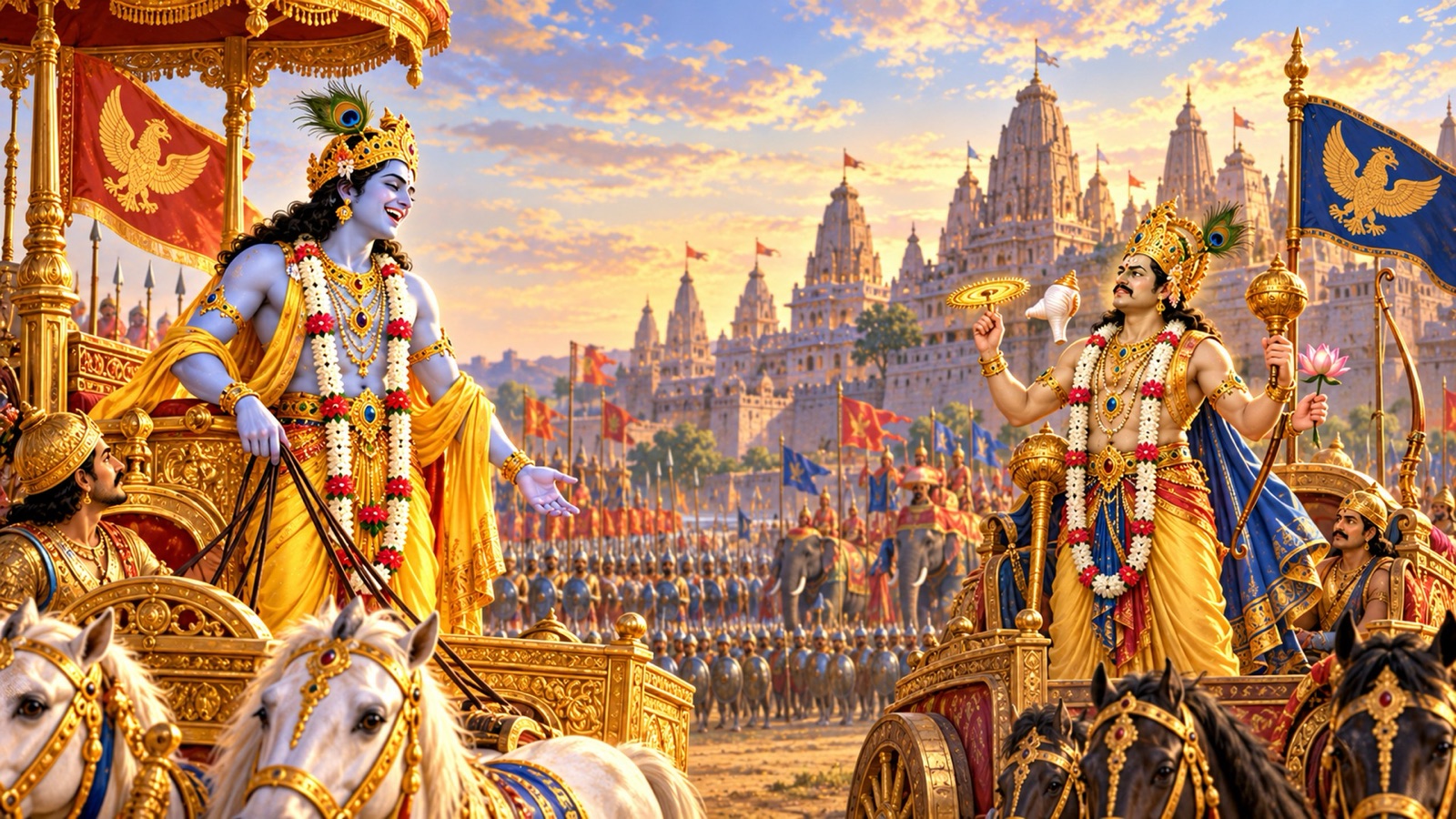
A king of Karusha dresses himself in a counterfeit of the Lord’s own emblems and sends word to Dwaraka that he alone is Vasudeva; Krishna answers the impostor with laughter, with Sudarshana, and in the end with an unexpected mercy.
Om Namo Bhagavate Vasudevaya.
Om Namo Bhagavate Vasudevaya.
Om Namo Bhagavate Vasudevaya.
Welcome back to Srimad Bhagavatam Wisdom, our devotional journey through the sacred histories and teachings of the Srimad Bhagavat Mahapurana. In this sixty-sixth chapter of the Tenth Canto, Sukadeva tells King Parikshit of a ruler so swollen by flattery that he believed himself the Supreme Lord. Hidden in the pastime is one of the Bhagavatam’s quiet wonders: how a man who mimicked the Lord was lifted into His likeness.
Chapter Information
- Scripture: Śrīmad Bhāgavata Mahāpurāṇa
- Canto: 10 (Book Ten, Latter Half)
- Chapter: 66 (Discourse 66)
- Chapter title: Paundraka, the False Vasudeva
- Principal speaker: Sukadeva Gosvami (narrating to King Parikshit)
- Principal listener: King Parikshit
- Main setting: Dvārakā; the battlefield before Kāśī (Vārāṇasī); the city of Kāśī
- Central subject: Paundraka’s false claim and defeat; his attainment of the Lord’s form; Sudakshina’s fire of sorcery destroyed by Sudarshana
- Principal verse range: Canto 10, Chapter 66, verses 1–43
- Primary edition: Gita Press Śrīmad Bhāgavata Mahāpurāṇa (English, Complete Edition)
Context From the Previous Chapter
In Chapter 65, Balarama visited Nanda’s Vraja, consoled the gopis with Krishna’s messages, and stayed through the spring. One moonlit night He summoned the Yamuna and, when she did not come, drew her near with His plough until she begged His pardon. This chapter opens during His absence.
A Messenger Who Calls His Master Vasudeva
Sukadeva began: while Balarama was in Vraja, O King, Paundraka, the ruler of Karusha, sent a messenger to Krishna with the astonishing announcement, “I am Vasudeva.” Flatterers had long hailed him as the glorious Lord Vasudeva descended to earth, and the ignorant king, like a child whom other children have crowned in play, had taken their flattery for truth. Ignorant of Krishna’s inscrutable nature, he despatched his envoy to Dwaraka.
The messenger stood before the lotus-eyed Lord in the royal assembly and recited his master’s words. “Vasudeva has descended, and it is I — there is no second. Out of mercy for the creatures of the world I have come down. The title you wear is a lie; lay it aside.”
वासुदेवोऽवतीर्णोऽहमेक एव न चापर: ।
भूतानामनुकम्पार्थं त्वं तु मिथ्याभिधां त्यज ॥ ५ ॥
vāsudevo ’vatīrṇo ’ham eka eva na cāparaḥ bhūtānām anukampārthaṁ tvaṁ tu mithyābhidhāṁ tyaja
Meaning: I alone am Vasudeva, descended to earth, and there is none other; it is for compassion toward all beings that I have come. You, therefore, give up that false name. (Canto 10, Chapter 66, verse 5)
The message ended with a demand: the scion of the Satvatas must abandon the emblems he carried out of folly and come to Paundraka for refuge — or else give him battle.
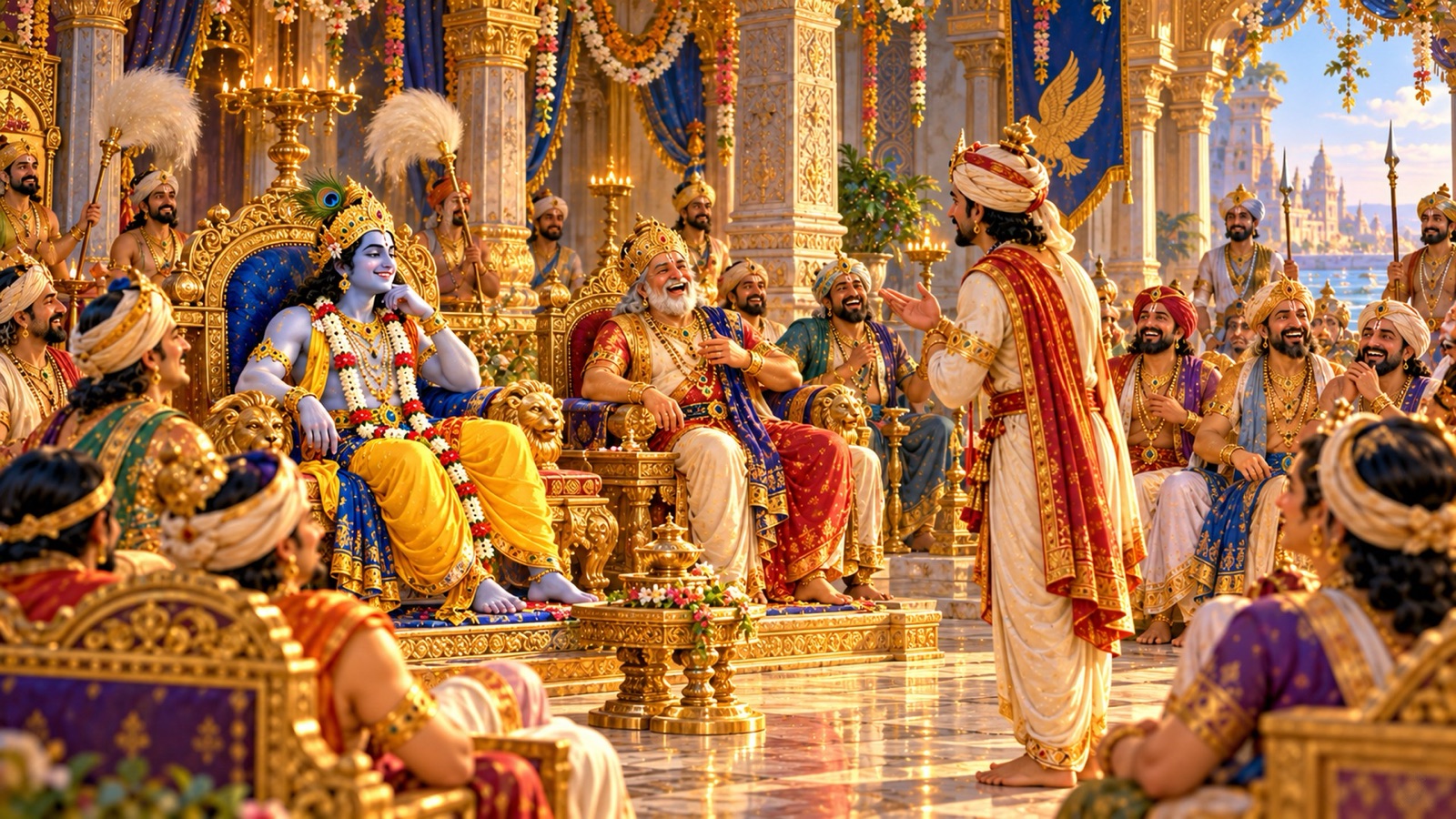
Laughter in the Assembly
When this boast of the dull-witted Paundraka was heard, King Ugrasena and the whole assembly burst into loud laughter. Then the Lord replied through the envoy. “Fool, I shall indeed release upon you the insignia you brag about, and upon the companions who have puffed you up. With that boastful mouth covered, you will lie slain upon the field, ringed by herons, vultures and carrion birds — and instead of giving Me shelter, you will become the shelter of dogs.”
The messenger carried every word back. Krishna, for His part, mounted His chariot and set out for Kashi, where the king of Karusha was staying with his ally.
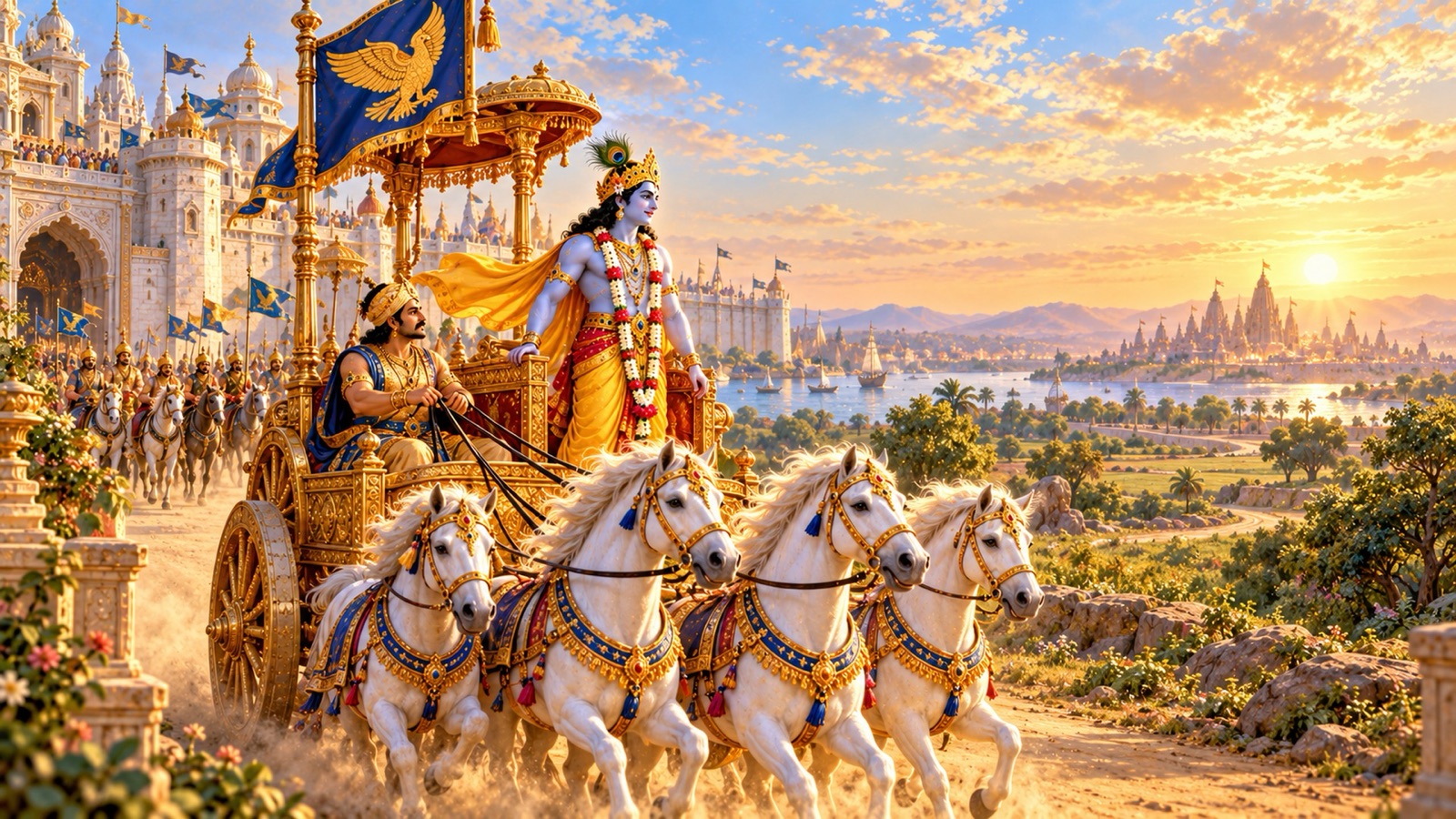
An Actor on the Stage of Battle
Learning of Krishna’s approach, Paundraka, a mighty chariot-warrior, hurried out with two akshauhini divisions, and behind him as rearguard marched the king of Kashi with three more. Then Hari beheld Paundraka. He displayed a conch, a discus, a sword and a mace, a bow in the fashion of Sharnga, the Srivatsa mark upon his chest, a jewel imitating the Kaustubha, and a garland of forest flowers. He wore two yellow silken garments, a priceless crown and gleaming makara-shaped earrings, and his banner bore the device of Garuda.
The whole display was so contrived that Paundraka seemed a player strutting beneath stage lamps, and the Lord, beholding this painted copy of His own form, broke into open laughter.
दृष्ट्वा तमात्मनस्तुल्यं वेषं कृत्रिममास्थितम् ।
यथा नटं रङ्गगतं विजहास भृशं हरि: ॥ १५ ॥
dṛṣṭvā tam ātmanas tulyaṁ veṣaṁ kṛtrimam āsthitam yathā naṭaṁ raṅga-gataṁ vijahāsa bhṛśaṁ hariḥ
Meaning: Seeing him dressed in an artificial costume made to look like His own, like an actor who has come onto the stage, Hari laughed heartily. (Canto 10, Chapter 66, verse 15)
The enemy then fell upon Him with tridents, maces, iron bars, lances, darts, swords and arrows. Krishna met the combined host of elephants, chariots, horses and foot-soldiers with mace, sword, discus and shaft, and crushed it as the fire at the end of an age consumes each class of creatures in turn. The field, strewn with the wreckage of chariots, horses, elephants and men, looked as terrible as the dancing-ground of Bhutapati, the lord of spirits; yet to the brave it brought delight.
The Lord Keeps His Word
Now Krishna addressed Paundraka himself. “Ho, Paundraka! You wished Me to drop My insignia — here, I release them upon you. You bade Me surrender My name — it is you who will be made to part with it. And since you invited Me to shelter beneath you, I would gladly do so this very day, had I no appetite for a fight.”
त्याजयिष्येऽभिधानं मे यत्त्वयाज्ञ मृषा धृतम् ।
व्रजामि शरणं तेऽद्य यदि नेच्छामि संयुगम् ॥ २० ॥
tyājayiṣye ’bhidhānaṁ me yat tvayājña mṛṣā dhṛtam vrajāmi śaraṇaṁ te ’dya yadi necchāmi saṁyugam
Meaning: I shall make you give up My name, which you, O ignorant one, have falsely borne. And as for your demand, I would indeed take refuge in you today — if I did not wish for battle. (Canto 10, Chapter 66, verse 20)
Having thus taunted him, the Lord shattered Paundraka’s chariot with sharp arrows and with the discus struck off his head, as Indra with his thunderbolt once clipped the wings of mountains. Likewise He severed the head of the king of Kashi with His arrows and sent it flying into Kashi itself, as the wind carries off a lotus-bud. Having disposed of the envious Paundraka and his ally, Krishna re-entered Dwaraka while the Siddhas sang the nectar of His deeds.
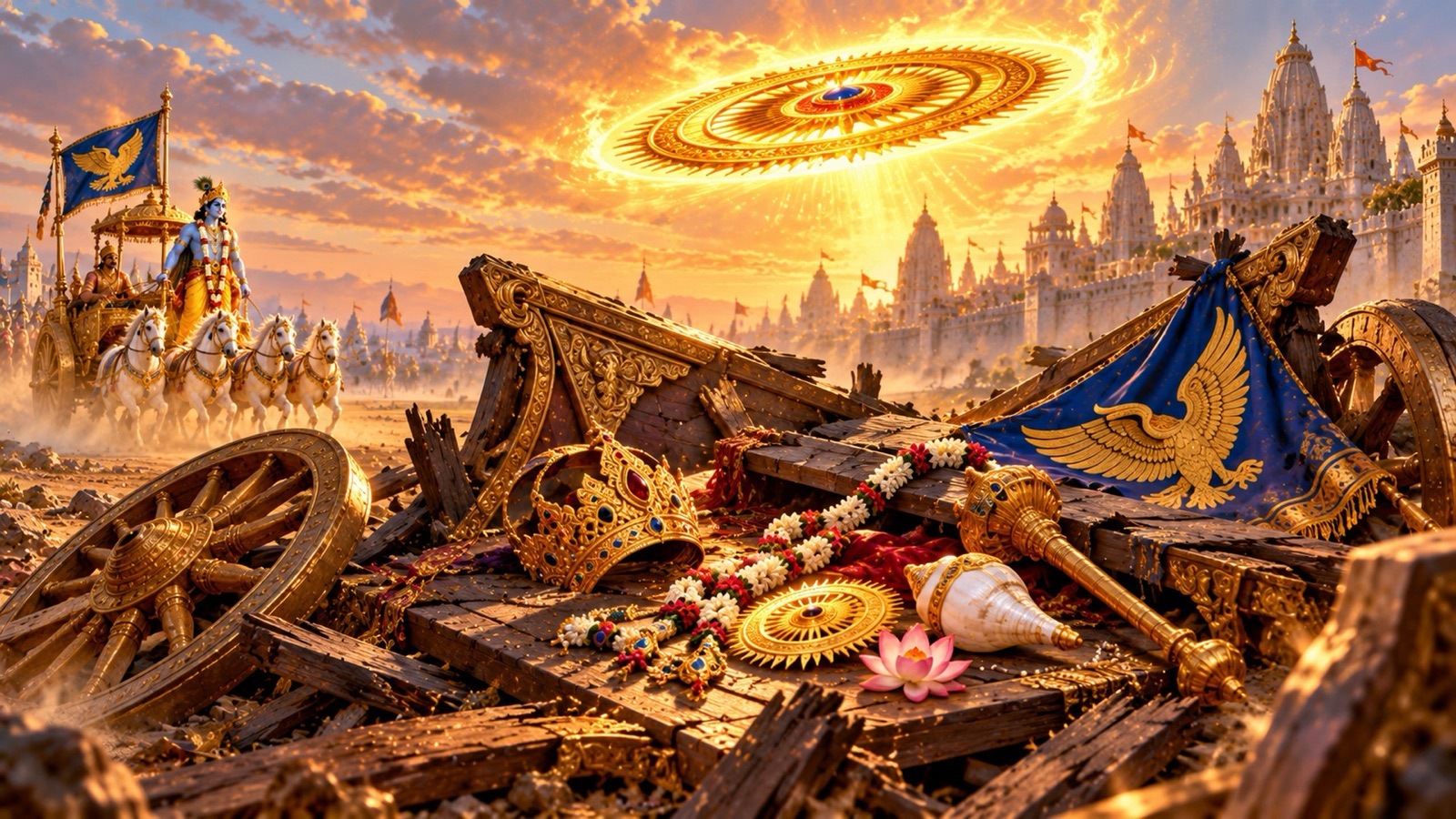
The Secret Grace in Paundraka’s End
Here Sukadeva tells Parikshit something no battlefield could reveal. Paundraka had worn the Lord’s emblems in arrogance, yet to wear them he had fixed his mind on the Lord’s form day after day. That ceaseless thinking, however wrongly motivated, burned away every knot of his karma — and because the form before his mind was Hari’s own, at death he was absorbed into it.
स नित्यं भगवद्ध्यानप्रध्वस्ताखिलबन्धन: ।
बिभ्राणश्च हरे राजन् स्वरूपं तन्मयोऽभवत् ॥ २४ ॥
sa nityaṁ bhagavad-dhyāna- pradhvastākhila-bandhanaḥ bibhrāṇaś ca hare rājan svarūpaṁ tan-mayo ’bhavat
Meaning: O King, by constantly meditating upon the Supreme Lord, Paundraka had every bond shattered; and because he bore the very form of Hari, he became absorbed into Him. (Canto 10, Chapter 66, verse 24)
This is the theological heart of the chapter. The Lord’s mercy answers remembrance itself, not only the motive behind it. Krishna did not strike off Paundraka’s head to punish a rival — there can be no rival to the Self of all. He cut away the false name and the false claim, the only things standing between a mind saturated with His form and the form itself. If a mind that merely mimicked the Lord gained His likeness, what awaits a mind that remembers Him in love?
Grief in Kashi and the Vow of Sudakshina
Meanwhile a head adorned with earrings had fallen at the gate of the royal palace in Kashi. People wondered whose it was and how it had come. When they recognised their king, his queens, sons, kinsmen and citizens wailed, “Alas, O lord, O master, O King — we are destroyed!”
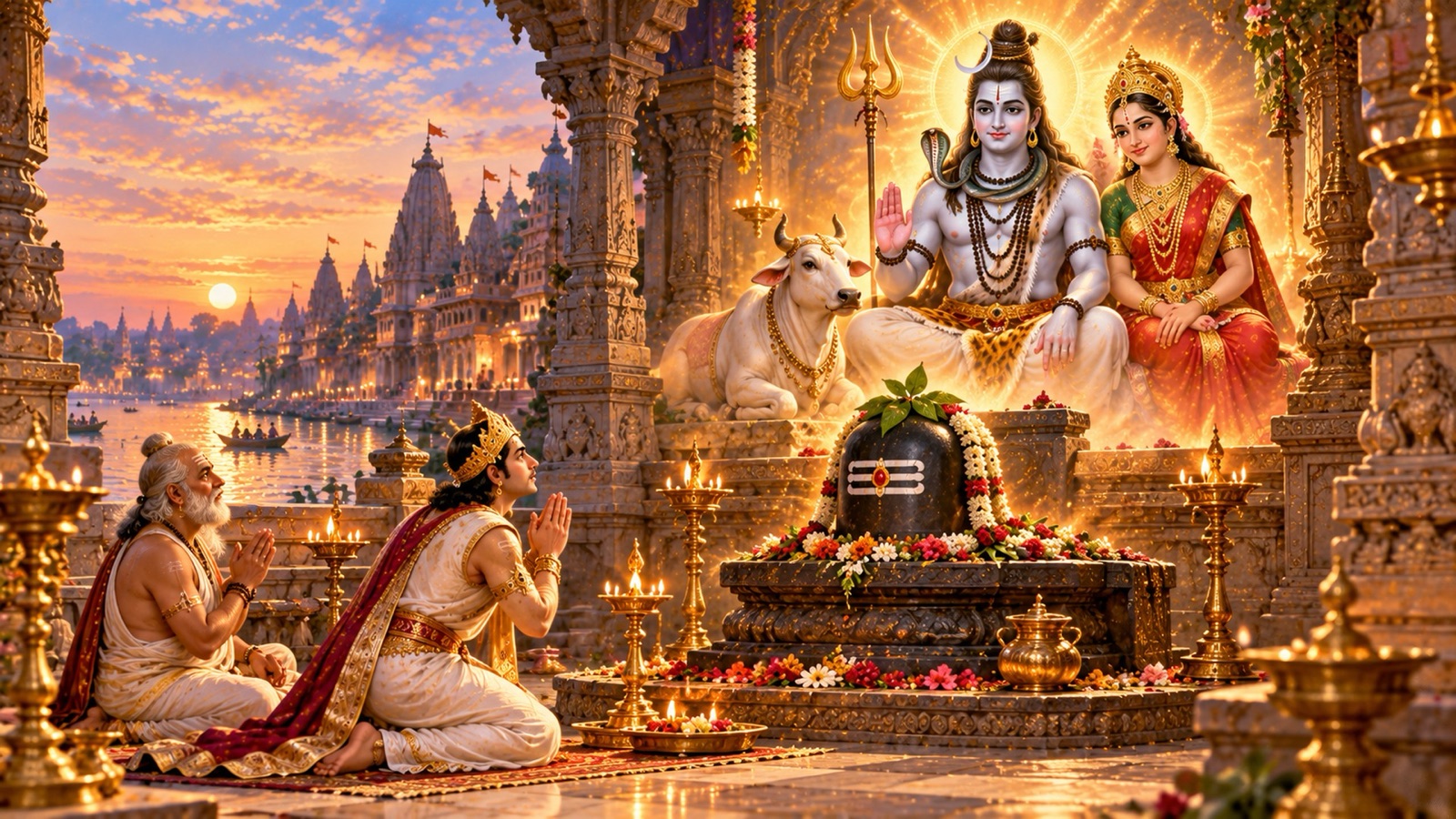
The king’s son, Sudakshina, performed his father’s funeral rites and resolved to repay his debt to his father by slaying the slayer. With his family priest he worshipped Maheshvara, the great Lord Shiva, in deepest concentration, and Shiva, pleased with him at Avimukta, the holy ground of Kashi, offered a boon. “Tell me the means by which I may kill the one who killed my father,” Sudakshina asked. “That is the only boon I desire.”
Shiva answered: “With brahmanas, serve the southern sacrificial fire by the rite of abhichara, the method used for destructive ends. Attended by the Pramathas, that fire will accomplish your purpose against anyone who is not devoted to the brahmanas.” So instructed, Sudakshina kept the vow and aimed his dark rite at Krishna.
A Fire of Sorcery Marches on Dwaraka
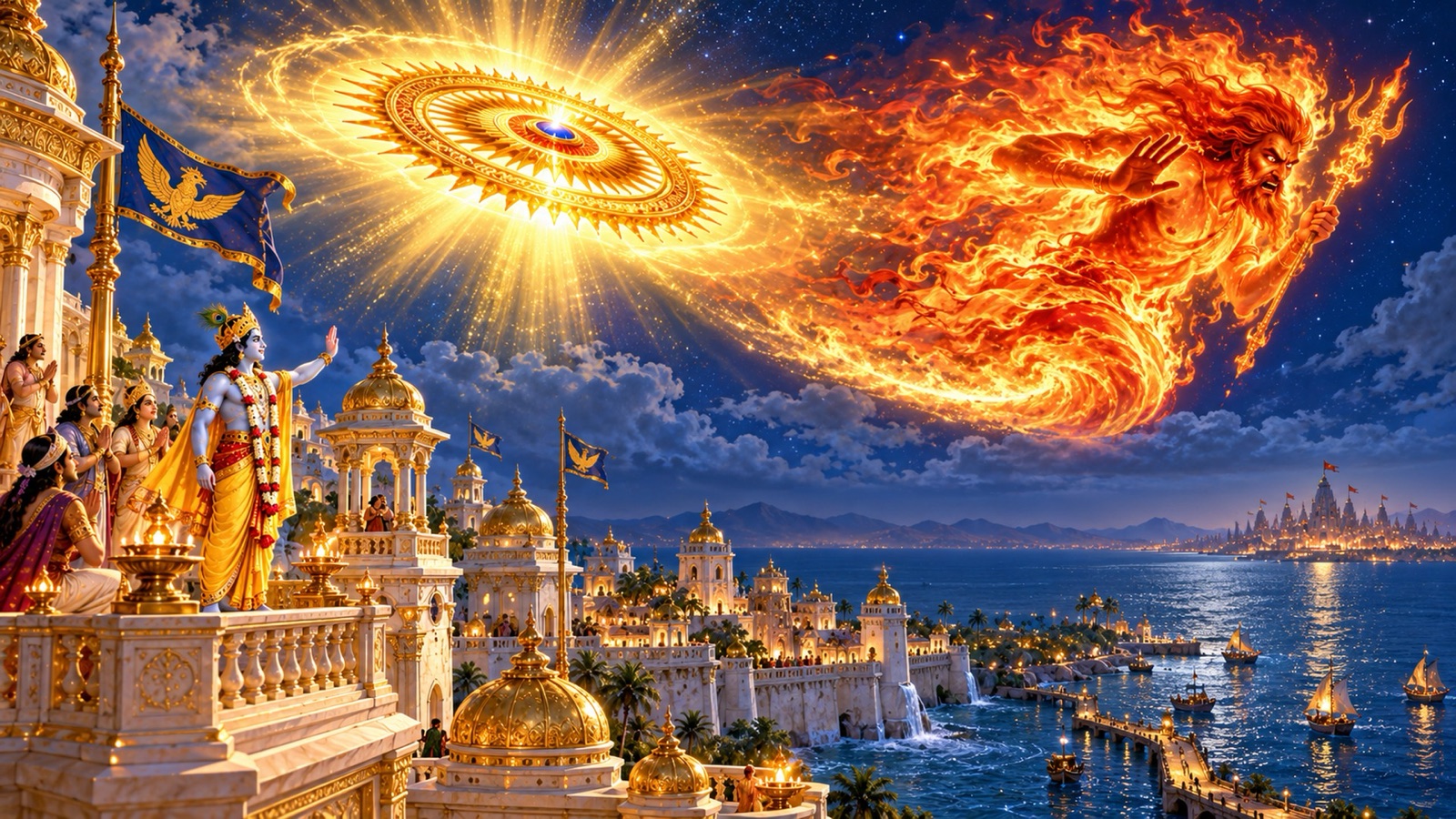
As the rite concluded, a fire rose bodily from the pit in a form of extreme terror. Its hair, beard and whiskers glowed like molten copper; its eyes spat embers; fangs and scowling brows made its face savage; its naked body streamed flame, and it brandished a blazing trident. Shaking the earth under legs as tall as palm trees, scorching the quarters and followed by spirits, it rushed toward Dwaraka.
The people of Dwaraka, seeing that fire of abhichara bearing down on them, were as terrified as deer before a forest blaze. They ran to the Lord, who was playing dice in His hall, and cried, “Save us, save us, O Lord of the three worlds, from this fire about to burn the city!” Krishna, hearing their alarm and seeing the fear of His own, laughed aloud and said, “Do not be afraid; I shall protect you.”
Sudarshana Sends the Flame Home
The all-pervading Lord, witness of all that passes within and without every creature, knew at once that this was a kritya — a destructive power born of Shiva’s rite — and ordered the discus at His side to destroy it. Sudarshana rose, bright as a crore of suns, flaming like the fire of universal dissolution, filled sky, quarters, heaven and earth with its effulgence, and fell upon the sorcerer’s flame.
तत् सूर्यकोटिप्रतिमं सुदर्शनं जाज्वल्यमानं प्रलयानलप्रभम् ।
स्वतेजसा खं ककुभोऽथ रोदसी चक्रं मुकुन्दास्त्रमथाग्निमार्दयत् ॥ ३९ ॥
tat sūrya-koṭi-pratimaṁ sudarśanaṁ jājvalyamānaṁ pralayānala-prabham sva-tejasā khaṁ kakubho ’tha rodasī cakraṁ mukundāstram athāgnim ārdayat
Meaning: That Sudarshana, the weapon of Mukunda, equal to ten million suns, blazing like the fire of universal dissolution, lit up the sky, the quarters, heaven and earth with its own effulgence, and then crushed the fire. (Canto 10, Chapter 66, verse 39)
Beaten back by the discus-bearer’s weapon, the kritya turned with its face broken and retreated to Varanasi, where it burned Sudakshina and all his officiating priests — the very men who had kindled it. Sudarshana followed it into the city and reduced the whole of Varanasi, with its towers, halls, markets and treasuries, to ashes. Then Vishnu’s discus returned to Dwaraka and stood once more beside Krishna, whose every deed is accomplished without effort.
The Fruit of Hearing
The chapter closes with its promise to the listener.
य एनं श्रावयेन्मर्त्य उत्तम:श्लोकविक्रमम् ।
समाहितो वा शृणुयात् सर्वपापै: प्रमुच्यते ॥ ४३ ॥
ya enaṁ śrāvayen martya uttamaḥ-śloka-vikramam samāhito vā śṛṇuyāt sarva-pāpaiḥ pramucyate
Meaning: Any mortal who recites this exploit of the Lord of excellent fame, or who hears it with a concentrated mind, is released from all sins. (Canto 10, Chapter 66, verse 43)
Principal Teachings of This Chapter
1. Flattery can make a man forget what he is. Paundraka’s delusion began in the courtiers who hailed him as God until he believed them. The devotee distrusts praise that inflates the ego.
2. The Lord’s emblems cannot be borrowed. Conch, discus, mace and Srivatsa belong to the One whose nature they express. Worn without that nature they make a man an actor on a stage.
3. The Lord honours every word spoken to Him, even a fool’s. Krishna hurled the weapons He was told to give up, made Paundraka part with the name instead, and declared He would have accepted shelter had He not preferred battle.
4. Remembrance of the Lord purifies regardless of its motive. Paundraka’s constant meditation on the Lord’s form, undertaken in pride, still destroyed his bonds and gave him the Lord’s likeness.
5. Harm aimed at the Lord’s own returns to its sender. The kritya kindled against Krishna could not touch Dwaraka and consumed Sudakshina and his priests instead.
A Devotional Reflection
What stays with the heart after this chapter is a strange tenderness hidden inside a story of impostors and fire. Paundraka wanted to be Vasudeva, and everything in the tale seems to mock him for it — the laughing assembly, the actor’s costume, the head knocked off like a mountain’s wing. Yet Sukadeva reveals that the fraud had been, without knowing it, a meditator: to wear the Lord’s emblems he had to keep the Lord’s form before his mind, and the Lord kept that thinking and discarded only the lie. It humbles us, because our own devotion is so often mixed with vanity and distraction. The Lord does not wait for our motives to be pure before He begins to purify us; He receives what little of Himself He finds in us and works with it. The fire aimed at Him flew back to its sender, but the attention aimed at Him, even a pretender’s, flew home to Him and was kept forever.
A Daily Devotional Practice
Today, set aside a few minutes to look closely — in a picture, a murti, or simply in the mind — at the Lord’s form: the dark complexion, the yellow garments, the Srivatsa, the conch, the discus, the mace and the lotus. Let the mind rest there without asking for anything, then chant softly: Om Namo Bhagavate Vasudevaya.
Conclusion
In this chapter Sukadeva shows the Lord dealing completely with the most absurd of enemies — a man who claimed to be Him. The boast was laughed out of the Sudharma hall, the costume laughed at on the field, the false name stripped away with the head that bore it, and the sorcery raised in revenge consumed its own makers. Yet the truth the chapter asks us to carry home is the gentlest: the pretender who kept the Lord’s form always before his eyes was gathered into that form. May we keep it before our eyes in love.
May the divine wisdom of Srimad Bhagavatam awaken pure devotion within our hearts.
Om Namo Bhagavate Vasudevaya.
Jay Shree Madhav.
References and Attribution
- Primary edition: Gita Press, Śrīmad Bhāgavata Mahāpurāṇa (English, Complete Edition), Book Ten (Latter Half), Discourse 66.
- Series: Srimad Bhagavatam Wisdom · Biswa Sanatan Dharma Seva Trust.
- Presented following the spiritual guidance and recommendation of Pandit Dr. Shri Kashinath Mishra.
This is an original, faithful retelling in the writer’s own words, with brief quoted verses shown in Devanāgarī and transliteration and their meanings given as summaries. It is not a reproduction of any single publisher’s continuous translation or commentary. No affiliation with or endorsement by any publisher is implied.
Jay Shree Madhav