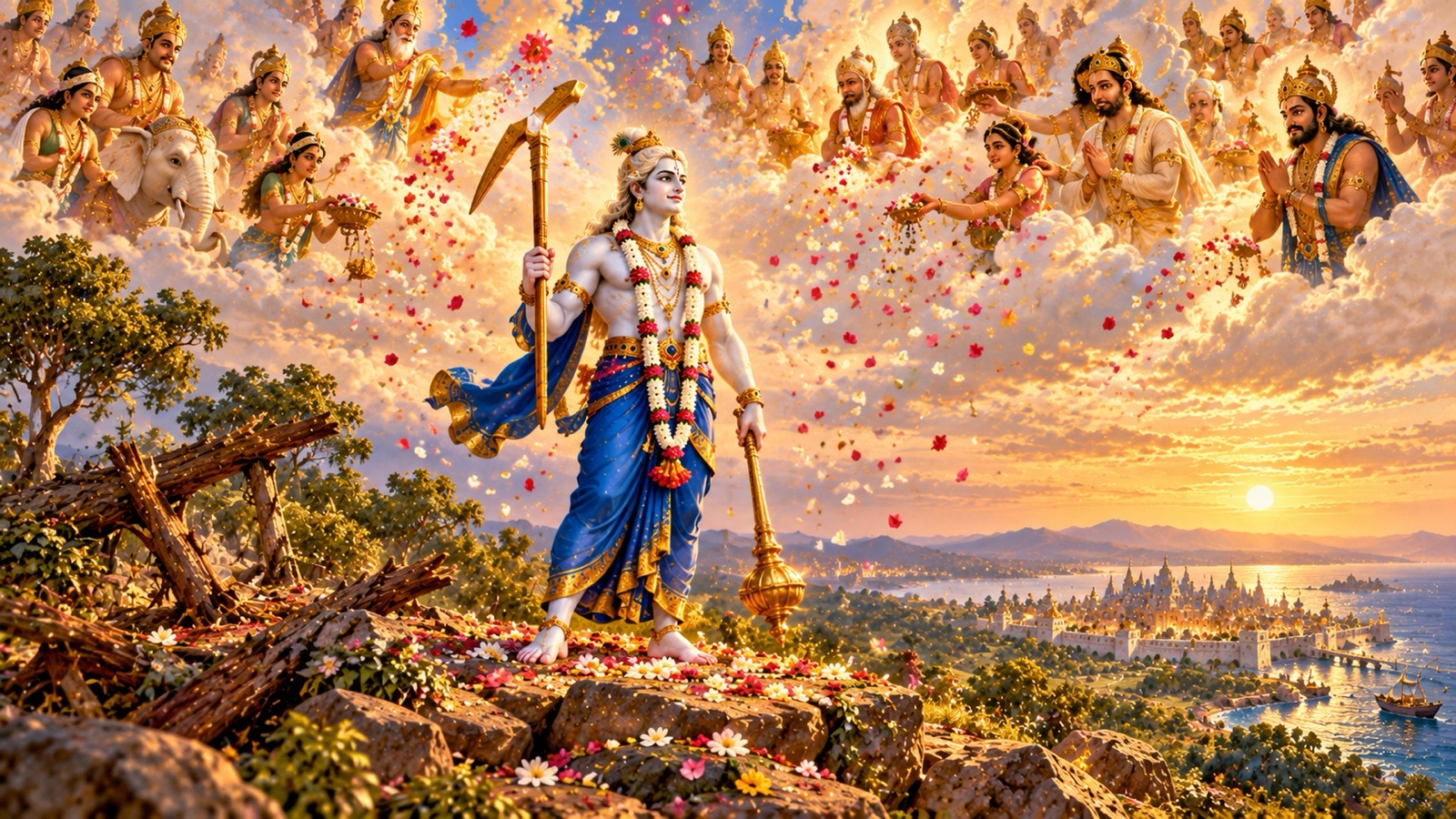
On the slopes of Raivataka a monkey swollen with the strength of ten thousand elephants dares to mock the Lord of the Yadus — and learns that the pestle and plough of Balarama bring every proud destroyer of the earth to the dust.
Om Namo Bhagavate Vasudevaya.
Om Namo Bhagavate Vasudevaya.
Om Namo Bhagavate Vasudevaya.
Welcome back to Srimad Bhagavatam Wisdom, our devotional journey through the sacred histories and teachings of the Srimad Bhagavat Mahapurana. In this sixty-seventh chapter of the Tenth Canto, King Parikshit asks to hear more of the wonderful deeds of Balarama, and Sukadeva answers with the history of Dvivida — a mighty ape who, to avenge his slain friend Naraka, laid waste the land, insulted sages and women alike, and at last came to Raivataka hill to mock Balarama Himself. There, while the maidens around Him laughed without a trace of fear, the elder brother of Krishna put an end to him.
Chapter Information
- Scripture: Śrīmad Bhāgavata Mahāpurāṇa
- Canto: 10 (Book Ten, Latter Half)
- Chapter: 67 (Discourse 67)
- Chapter title: Lord Balarama Slays Dvivida Gorilla
- Principal speaker: Sukadeva Gosvami (narrating to King Parikshit)
- Principal listener: King Parikshit
- Main setting: The ravaged lands of Ānarta and the Raivataka hill near Dvārakā
- Central subject: The havoc wrought by the ape Dvivida; his insolence before Balarama and the maidens on Raivataka; the battle of trees, stones and fists; Dvivida’s fall; and Balarama’s triumphant return to Dvārakā
- Principal verse range: Canto 10, Chapter 67, verses 1–28
- Primary edition: Gita Press Śrīmad Bhāgavata Mahāpurāṇa (English, Book Ten, Discourse 67)
Context From the Previous Chapter
In Chapter 66, the impostor Paundraka, who claimed to be Vasudeva, and his ally the king of Kashi were slain by Krishna. When the son of the Kashi king unleashed a fierce sorcerous fire against Dvaraka, the Lord’s Sudarshana discus turned it back upon its makers and reduced Kashi to ashes. Having heard these deeds of Krishna, Parikshit now turns his heart toward Krishna’s elder brother.
Parikshit Longs to Hear More of Balarama
The king who sat fasting on the bank of the Ganga could not have enough of Balarama. He had already heard how the Lord of the plough dragged the Yamuna and sported in Vrindavana; now he begged Sukadeva to tell him what other feats that infinite and immeasurable Lord had performed.
भूयोऽहं श्रोतुमिच्छामि रामस्याद्भुतकर्मणः ।
अनन्तस्याप्रमेयस्य यदन्यत् कृतवान् प्रभुः ॥ १ ॥
bhūyo ’haṁ śrotum icchāmi rāmasyādbhuta-karmaṇaḥ anantasyāprameyasya yad anyat kṛtavān prabhuḥ
Meaning: King Parikshit said: I wish to hear still more about Balarama, whose deeds are wondrous, who is infinite and beyond measure — what else did that almighty Lord accomplish? (Canto 10, Chapter 67, verse 1)
The Ape Dvivida and the Havoc He Wrought
Sukadeva began. There lived a certain monkey named Dvivida, a friend of the demon Naraka, a minister of the monkey-king Sugriva, and the powerful brother of Mainda. When Krishna slew Naraka, Dvivida resolved to repay what he owed his friend by taking vengeance on the friend’s slayer. So he set fire to the land — cities, villages, mines and cowherd settlements went up in flames wherever he passed.
सख्युः सोऽपचितिं कुर्वन् वानरो राष्ट्रविप्लवम् ।
पुरग्रामाकरान् घोषानदहद् वह्निमुत्सृजन् ॥ ३ ॥
sakhyuḥ so ’pacitiṁ kurvan vānaro rāṣṭra-viplavam pura-grāmākarān ghoṣān adahad vahnim utsṛjan
Meaning: To clear his debt to his friend, that monkey brought ruin upon the kingdom, releasing fire and burning down towns, villages, mines and the stations of the cowherds. (Canto 10, Chapter 67, verse 3)
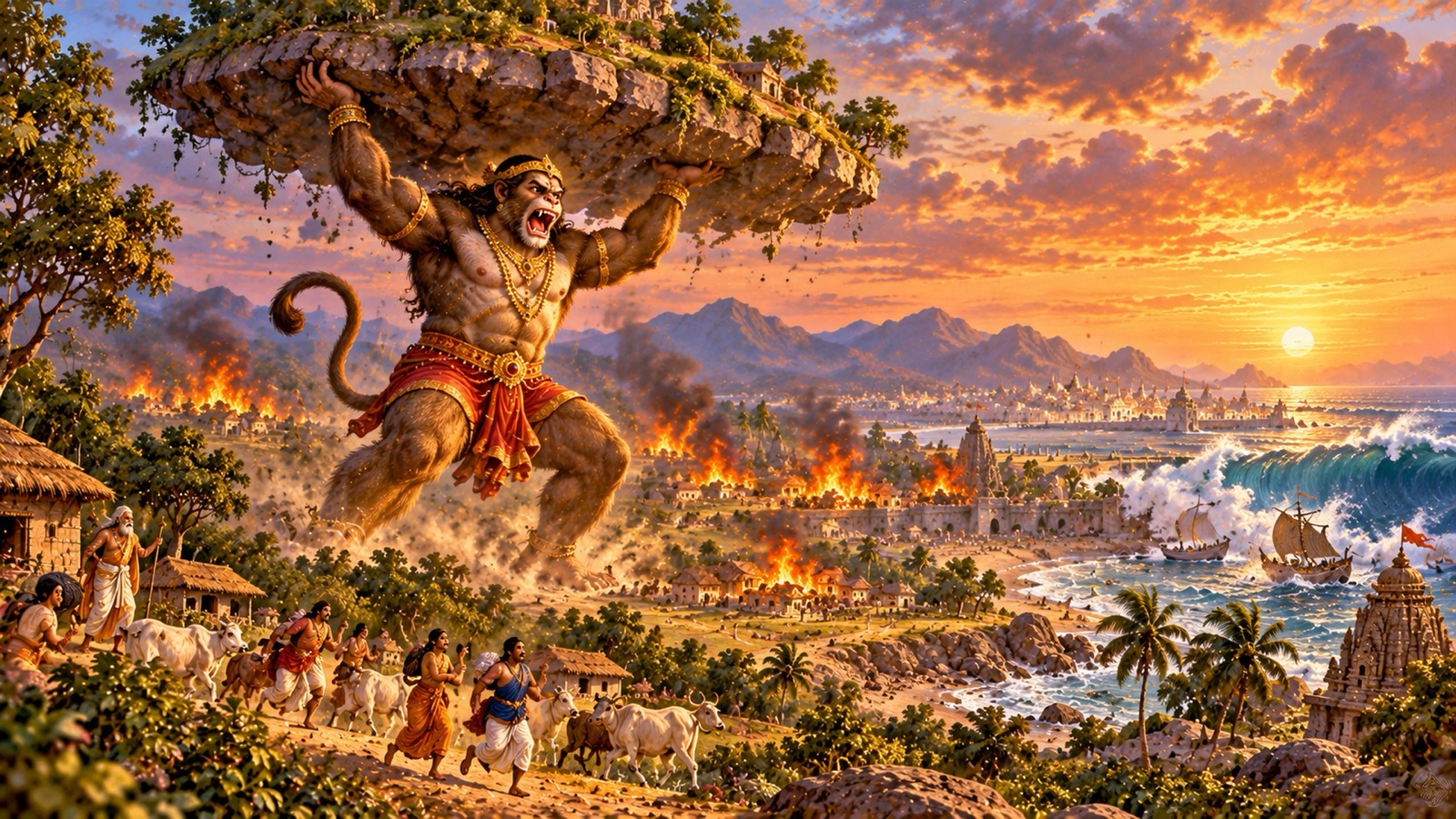
His malice did not stop at fire. At times he tore up whole hills and smashed entire territories with them, above all the land of Anarta, where dwelt Krishna, the slayer of his friend. Possessing the might of ten thousand elephants, he would stand in the middle of the ocean and fling up such masses of water with his arms that the coastal regions were drowned. In the hermitages of great sages he snapped the trees and polluted the sacred sacrificial fires with his own filth. Drunk with power, he seized men and women, hurled them into the ravines and caves of mountains, and sealed the openings with huge rocks, as a wasp shuts a grub inside its nest. In this way he tormented the whole land, and even dishonoured women of noble families.
Then one day, hearing the sound of exquisitely sweet singing, the ape made his way to the Raivataka hill.
Balarama Among the Maidens of Raivataka
What Dvivida found on that hill was the Lord of the Yadus at His ease. Balarama stood in the midst of a company of young women, a garland of lotuses upon His chest, every limb of His body a delight to behold.
तत्रापश्यद् यदुपतिं रामं पुष्करमालिनम् ।
सुदर्शनीयसर्वाङ्गं ललनायूथमध्यगम् ॥ ९ ॥
tatrāpaśyad yadu-patiṁ rāmaṁ puṣkara-mālinam sudarśanīya-sarvāṅgaṁ lalanā-yūtha-madhya-gam
Meaning: There he saw Balarama, master of the Yadus, wearing a garland of lotuses, beautiful in all His limbs, standing among a group of young women. (Canto 10, Chapter 67, verse 9)
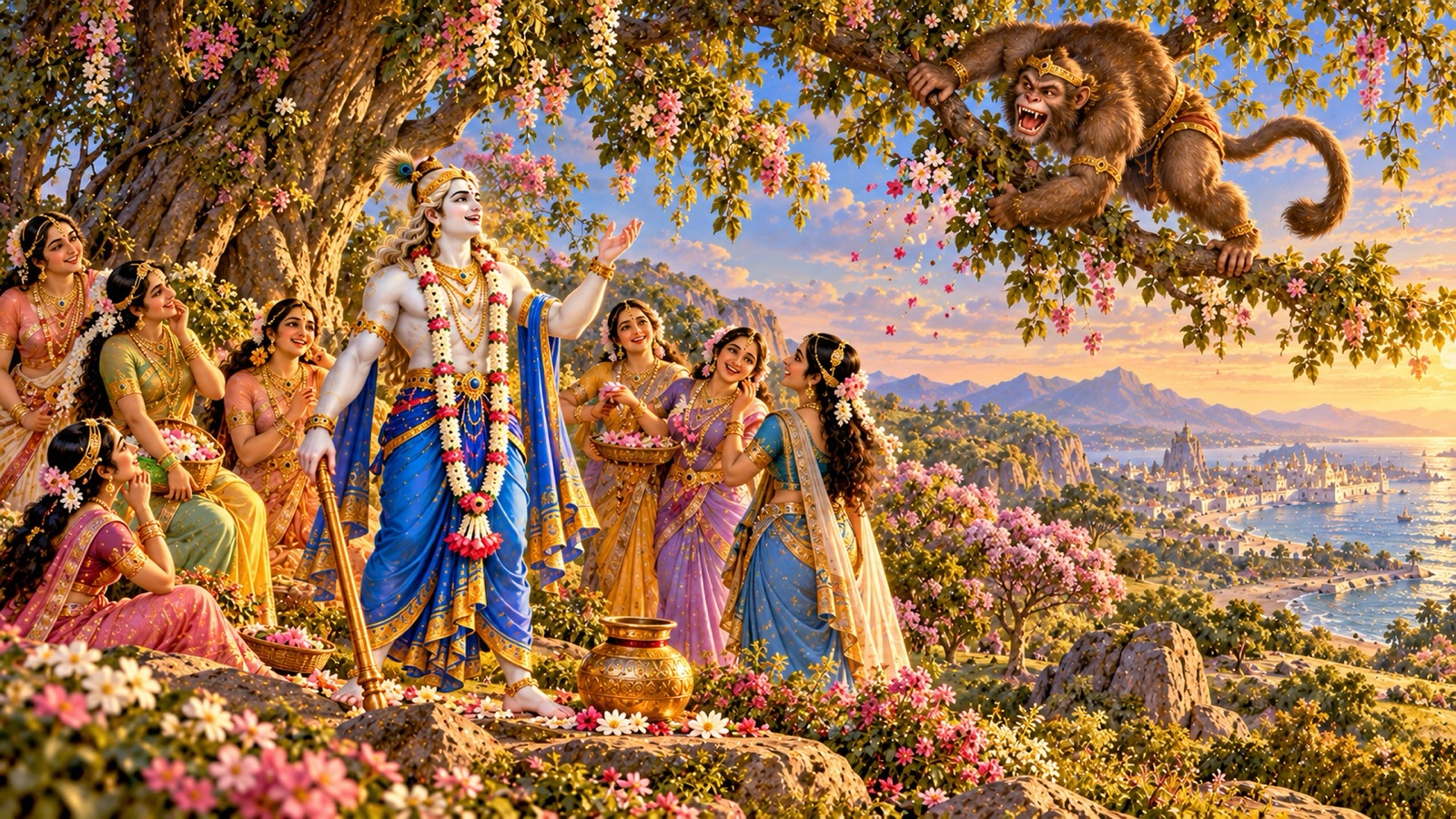
Having drunk the Varuni beverage, Balarama was singing, His eyes rolling in sweet intoxication, and His radiant form shone like a great elephant in rut. The wicked monkey, true to his tree-dwelling nature, climbed into the branches, set the trees shaking and let out shrill chattering cries to draw attention to himself. The young women, playful by nature and fond of laughter, saw his impudence and laughed aloud; sheltered as they were by Balarama, they felt no fear at all. Emboldened, the ape began to mock them — twitching his eyebrows, pulling faces before them, and making obscene gestures with his body — and he did all this under the very gaze of Balarama.
The Lord’s Patience Comes to an End
Angered, Balarama, the best of fighters, flung a stone at him. The crafty monkey dodged it, came down, and snatched up the pot of Varuni. He grinned at the Lord, taunting and provoking Him; then the villain smashed the pot, tore at the garments of the women, and treated Balarama Himself with open contempt, intoxicated with his own strength.
Balarama now beheld two things together: the monkey’s insolence before Him, and the countries this same creature had laid waste. For both reasons at once He took up His weapons.
तं तस्याविनयं दृष्ट्वा देशांश्च तदुपद्रुतान् ।
क्रुद्धो मुषलमादत्त हलं चारिजिघांसया ॥ १६ ॥
taṁ tasyāvinayaṁ dṛṣṭvā deśāṁś ca tad-upadrutān kruddho muṣalam ādatta halaṁ cāri-jighāṁsayā
Meaning: Seeing that ape’s impudence and the lands he had devastated, the Lord grew wrathful and took up His club and plough, intending to kill the foe. (Canto 10, Chapter 67, verse 16)
The Battle on the Mountain
Dvivida too was immensely strong. He uprooted a sal tree with one hand, rushed forward with great speed, and brought it down upon Balarama’s head. But the Lord did not so much as sway.
तं तु सङ्कर्षणो मूर्ध्नि पतन्तमचलो यथा ।
प्रतिजग्राह बलवान् सुनन्देनाहनच्च तम् ॥ १८ ॥
taṁ tu saṅkarṣaṇo mūrdhni patantam acalo yathā pratijagrāha balavān sunandenāhanac ca tam
Meaning: Yet mighty Sankarsana, steady as a mountain, caught that tree as it fell toward His head and struck the monkey with His pestle Sunanda. (Canto 10, Chapter 67, verse 18)
Struck on the skull by the pestle, Dvivida stood streaming red, like a mountain whose face is stained with crimson ochre. Yet he paid the blow no heed. In mounting fury he wrenched out another tree, stripped it bare of leaves, and swung it with all his force; Balarama splintered it into a hundred fragments. He seized yet another and struck again in rage; that one too the Lord broke into a hundred pieces. So the fight went on. Each time his weapon was smashed, the ape dragged out a fresh tree, until he had pulled up every tree around them and left the forest bare on every side.
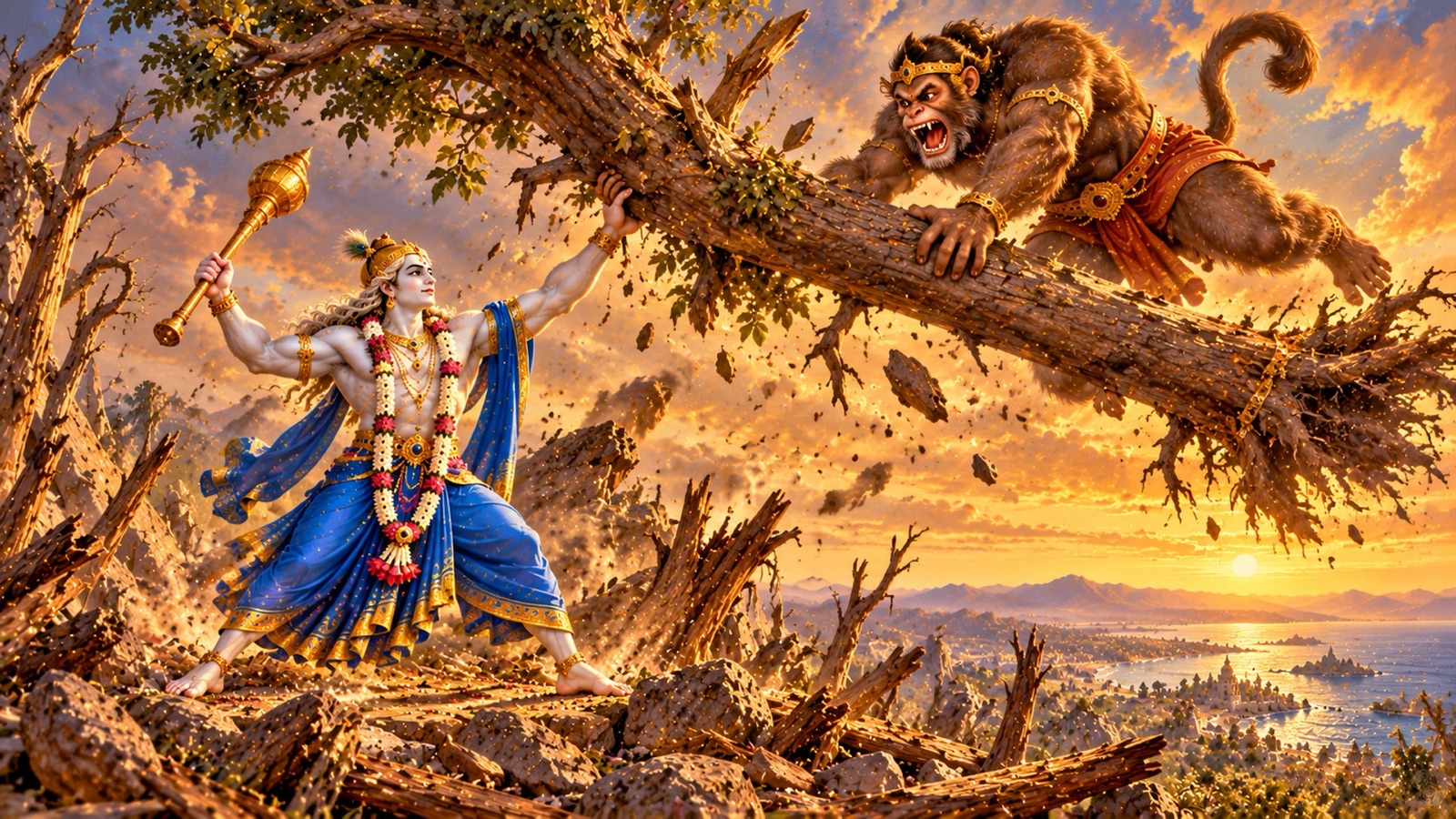
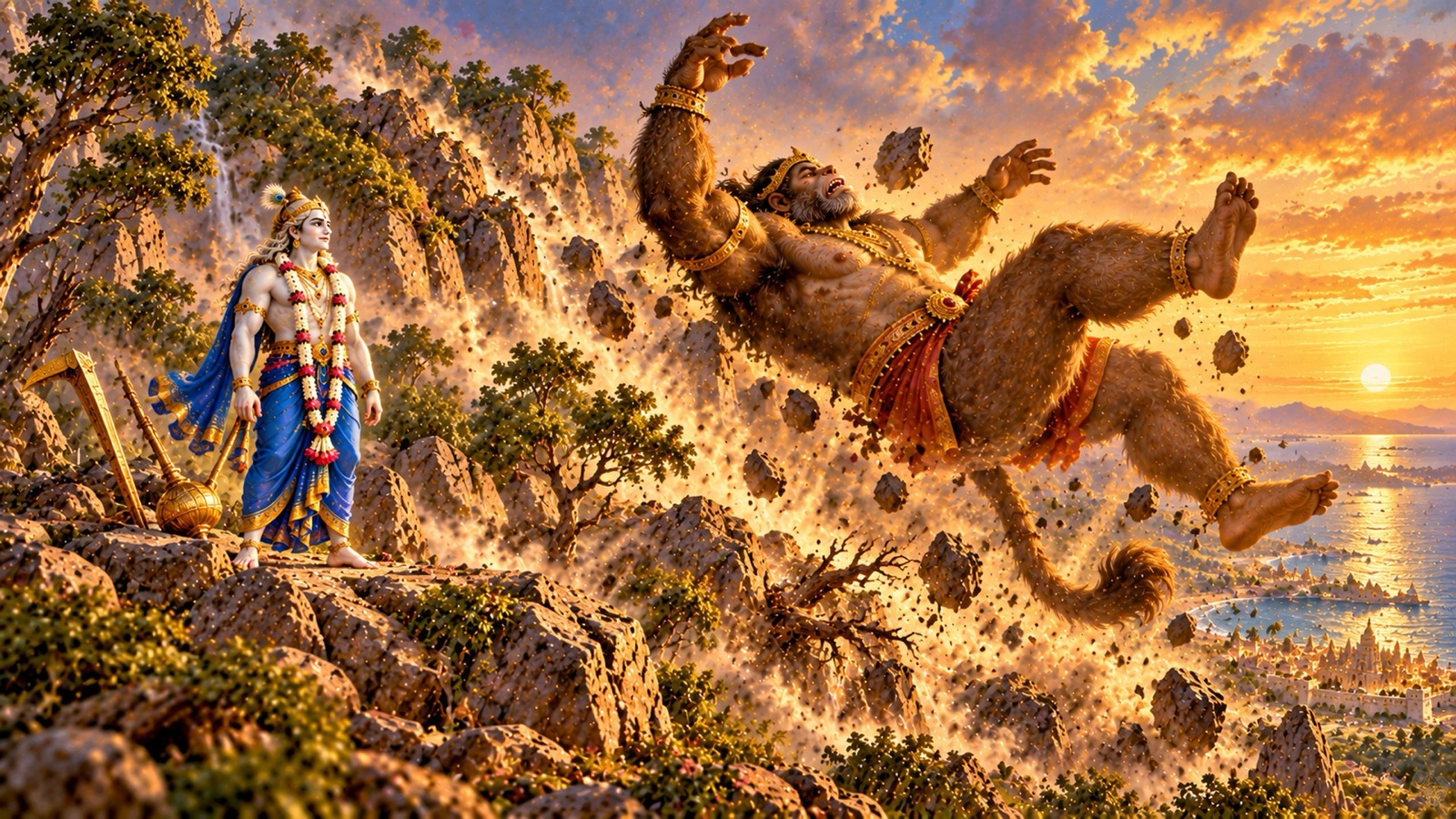
Enraged, Dvivida then let loose a rain of boulders upon Balarama; and all of them the wielder of the pestle ground to powder, as if in play. At last the lord of the monkeys clenched his two arms, long as palm trunks, into fists, closed with the son of Rohini and pounded Him on the chest with both. Thereupon the Lord of the Yadavas set His pestle and plough aside, and in anger struck him with His bare hands upon the collarbone. Dvivida fell, vomiting blood, and did not rise.
The Mountain Trembles and the Heavens Rejoice
So vast was the body that fell that the whole of Raivataka shook with it.
चकम्पे तेन पतता सटङ्कः सवनस्पतिः ।
पर्वतः कुरुशार्दूल वायुना नौरिवाम्भसि ॥ २६ ॥
cakampe tena patatā sa-ṭaṅkaḥ sa-vanaspatiḥ parvataḥ kuru-śārdūla vāyunā naur ivāmbhasi
Meaning: O tiger of the Kurus, as he came crashing down, the mountain with its peaks and its trees trembled, like a boat tossed on the water by the wind. (Canto 10, Chapter 67, verse 26)
From the sky came another sound — not of crashing but of celebration. The gods raised cries of victory, the Siddhas offered their salutations, and the foremost sages called out their praise, while all of them together rained flowers down upon Balarama.
जयशब्दो नमःशब्दः साधु साध्विति चाम्बरे ।
सुरसिद्धमुनीन्द्राणामासीत् कुसुमवर्षिणाम् ॥ २७ ॥
jaya-śabdo namaḥ-śabdaḥ sādhu sādhv iti cāmbare sura-siddha-munīndrāṇām āsīt kusuma-varṣiṇām
Meaning: In the heavens rose the shouts “Victory!” and “Obeisances!” and “Well done, well done!” from the gods, the Siddhas and the great sages, who showered down blossoms. (Canto 10, Chapter 67, verse 27)
The Return to Dvaraka
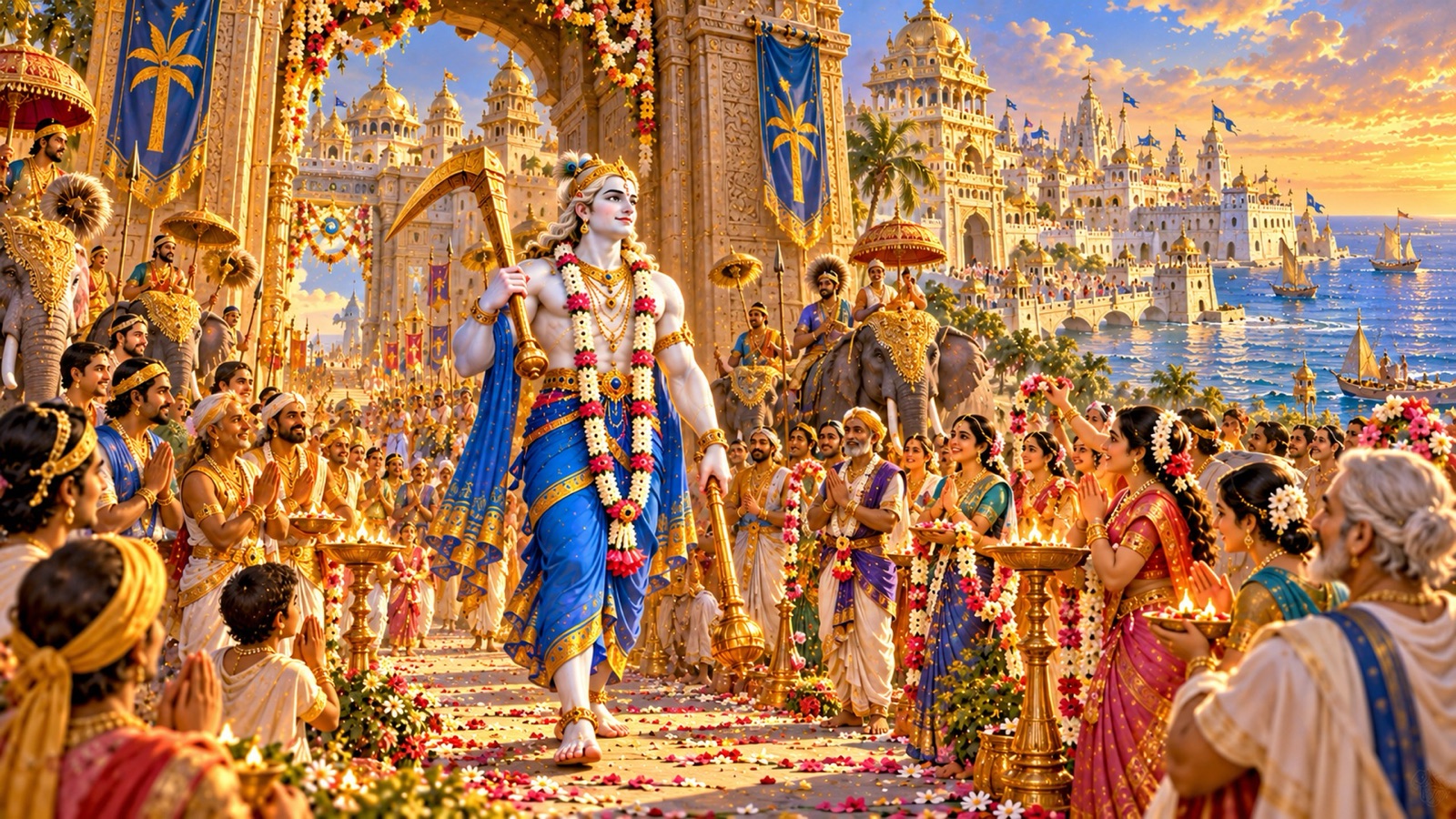
The one who had set the whole world in turmoil was gone. Sukadeva closes the chapter with the Lord walking home.
एवं निहत्य द्विविदं जगद्व्यतिकरावहम् ।
संस्तूयमानो भगवान् जनैः स्वपुरमाविशत् ॥ २८ ॥
evaṁ nihatya dvividaṁ jagad-vyatikarāvaham saṁstūyamāno bhagavān janaiḥ sva-puram āviśat
Meaning: Having thus slain Dvivida, who had brought disorder upon the world, the Lord entered His own city while the people sang His glories. (Canto 10, Chapter 67, verse 28)
Principal Teachings of This Chapter
1. The devotee’s thirst to hear is never quenched. Parikshit has already heard many pastimes, yet he asks for “still more” of Balarama (verse 1). Hearing of the Lord does not satiate; it deepens hunger. This is the mark of true bhakti — the more we hear, the more we long to hear.
2. Might without dharma turns against the world. Dvivida was a minister of Sugriva and a brother of the hero Mainda, yet loyalty to a wicked friend turned his enormous strength into a scourge (verse 3). Power unanchored in righteousness does not remain neutral; it burns villages, pollutes altars and oppresses the weak.
3. The Lord’s anger is compassion for the earth. Here lies the heart of the chapter. Balarama endured the shaking of trees, the chattering, the mockery of His companions, even the shattering of His cup — all of it personal. The verse that finally places the weapons in His hands names two causes together: the monkey’s insolence and the lands he had devastated (verse 16). The Lord does not kill merely because He was insulted; He kills because the one standing before Him is the same one who buried men and women alive in caves and defiled the fires of sages. His wrath is the earth’s long cry for relief finally answered, and the gods’ shower of flowers confirms that what looked like anger was in truth protection.
4. Those under the Lord’s shelter know no fear. The young women laughed at the ape’s antics because, protected by Balarama, they had nothing to dread. Surrender places the soul where fear cannot reach.
5. Heaven rejoices when adharma falls. Gods, Siddhas and sages alike cried “Well done!” and rained flowers (verse 27). The removal of a tyrant is not a grim necessity but a cause of celestial celebration, because it restores the order the Lord Himself upholds.
A Devotional Reflection
It is easy to read this chapter only as a tale of strength — trees shattered, boulders powdered, a giant brought down with bare hands. But the devotee notices something quieter. Balarama waits. He is mocked in front of His companions, His drink is snatched and smashed, the women beside Him are shamed, and still He throws only a single stone. What finally moves Him is not the sting to His own dignity but the memory of the burning villages and the sealed caves. The Lord’s forbearance toward offences against Himself is vast; His tolerance for cruelty toward His creatures has an end.
There is a lesson here about our own anger. We flare at slights to ourselves and stay silent before injustice to others. Balarama reverses the order. And when He does act, heaven itself applauds — not because violence is beautiful, but because a world freed from a tormentor can breathe again. To love the Lord is to learn His priorities: patience with our own wounds, firmness in defence of the helpless, and gratitude when the burden of the earth is lifted.
A Daily Devotional Practice
Today, when something offends your pride, pause before reacting and remember Balarama standing unmoved on Raivataka as the ape mocked Him. Then ask yourself whether there is someone weaker nearby — a person, a creature, a sacred thing — who actually needs your protection more than your pride needs defending. Offer that act of protection, however small, as service to the Lord of the plough. Begin by chanting gently: Om Namo Bhagavate Vasudevaya.
Conclusion
The sixty-seventh chapter of the Tenth Canto shows us Balarama as the guardian of the earth. A monkey named Dvivida, avenging the demon Naraka, torched cities, drowned coasts, polluted the hermitages of sages and imprisoned the innocent in mountain caves; then he came to Raivataka to taunt the Lord Himself. Balarama bore the mockery long, but when He remembered the ravaged lands He took up His pestle and plough, broke every tree and stone the ape hurled, and finally felled him with His own two hands, so that the mountain shook and the gods showered flowers. May we, remembering how the Lord’s patience ended only for the sake of the suffering world, learn to carry His compassion and His courage together.
May the divine wisdom of Srimad Bhagavatam awaken pure devotion within our hearts.
Om Namo Bhagavate Vasudevaya.
Jay Shree Madhav.
References and Attribution
- Primary edition: Gita Press, Śrīmad Bhāgavata Mahāpurāṇa (English), Book Ten (Latter Half), Discourse 67, pages 402–404.
- Series: Srimad Bhagavatam Wisdom · Biswa Sanatan Dharma Seva Trust.
- Presented following the spiritual guidance and recommendation of Pandit Dr. Shri Kashinath Mishra.
This is an original, faithful retelling in the writer’s own words, with brief quoted verses shown in Devanāgarī and transliteration and their meanings given as summaries. It is not a reproduction of any single publisher’s continuous translation or commentary. No affiliation with or endorsement by any publisher is implied.
Jay Shree Madhav