
When the proud Kurus imprison young Samba and sneer that the Yadus are sandals presuming to climb upon a crowned head, Balarama sets His plough beneath Hastinapura itself and hauls the city toward the Ganga.
Om Namo Bhagavate Vasudevaya.
Om Namo Bhagavate Vasudevaya.
Om Namo Bhagavate Vasudevaya.
Welcome back to Srimad Bhagavatam Wisdom, our devotional journey through the sacred histories and teachings of the Srimad Bhagavat Mahapurana. In this sixty-eighth chapter of the Tenth Canto, Sukadeva Gosvami tells King Parikshit how a marriage became the occasion for one of Lord Balarama’s most astonishing pastimes, when the Lord who came only to make peace was answered with contempt.
Chapter Information
- Scripture: Śrīmad Bhāgavata Mahāpurāṇa
- Canto: 10 (Book Ten, Latter Half)
- Chapter: 68 (Discourse 68)
- Chapter title: The Marriage of Samba
- Principal speaker: Sukadeva Gosvami (narrating to King Parikshit)
- Principal listener: King Parikshit
- Main setting: Hastināpura (Gajāhvaya), the Kuru capital on the Gaṅgā; and Dvārakā
- Central subject: Samba’s abduction of Lakshmana and capture by the Kurus; Balarama’s peace mission and the Kurus’ insult; the dragging of Hastinapura; the Kurus’ surrender and prayer; the homecoming to Dvaraka
- Principal verse range: Canto 10, Chapter 68, verses 1–54
- Primary edition: Gita Press Śrīmad Bhāgavata Mahāpurāṇa (English, Book Ten)
Context From the Previous Chapter
In Chapter 67, Lord Balarama slew the mighty ape Dvivida, who had been laying waste to the land, and returned to Dvaraka amid the praises of gods and men. Now Sukadeva turns from the Lord’s might in battle to His patience — and its limits.
Samba Carries Away Lakshmana
Sukadeva began: Parikshit, Samba, the son of Krishna and Jambavati, was a warrior ever victorious in battle. Duryodhana’s daughter Lakshmana had been placed in a svayamvara, an assembly of kings gathered so that the princess might choose her own husband; and from the midst of that assembly Samba carried her away.
The Kurus burned with anger. “This ill-mannered boy has set us at naught,” they said. “He has taken by force a girl who never sought him. Bind the unruly child. What can the Vrishnis do? They rule a land we gave them, which has flourished only by our favour. If, hearing that their son is captive, they dare to come here, their pride will be broken and they will fall quiet, like the senses once thoroughly subdued.” With the approval of the Kuru elders, Karna, Shala, Bhurishrava, Yajnaketu and Duryodhana set out to seize him.
One Lion Against Six Chariots
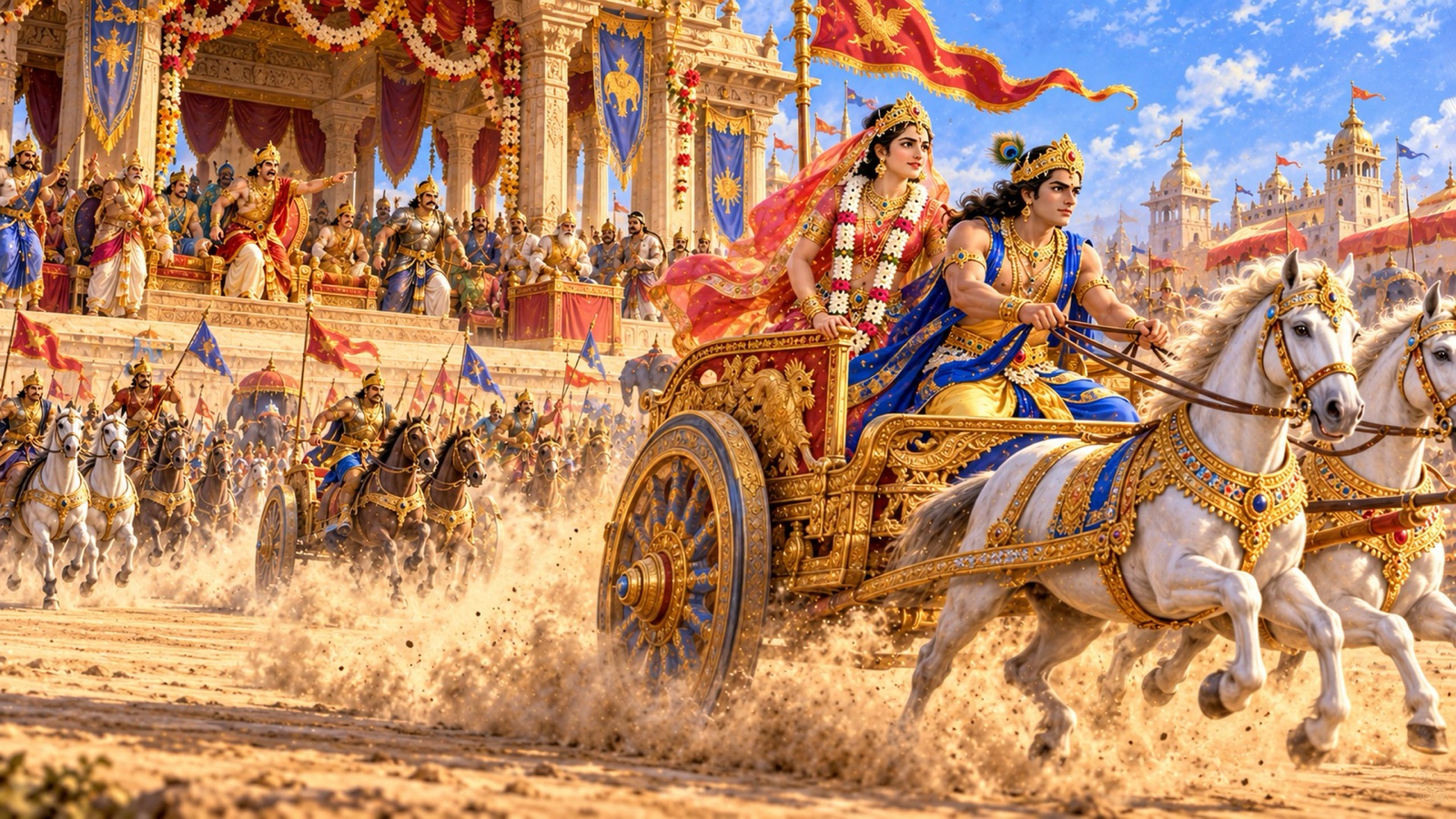
Seeing the sons of Dhritarashtra pursuing him, Samba, a great chariot-warrior, took up his splendid bow and stood alone to face them like a lion. The Kuru bowmen, Karna at their head, rushed at him crying “Stand! Stand!” and covered him with arrows. Though still a boy, Samba was the son of the inconceivable Lord, and he no more bore this unjust attack than a lion bears the harrying of small animals.
Twanging his bow, he struck all six chariot-warriors at once, each with six arrows: four for the horses, one for the charioteer, one for the warrior himself. Even his enemies applauded. But then the six fell upon him together: four slew his horses, one killed his charioteer, and one cut his bow in two. Having unhorsed him, the Kurus bound Samba with great difficulty and entered their city in triumph with the young prince and their own princess.
Balarama Chooses the Path of Peace
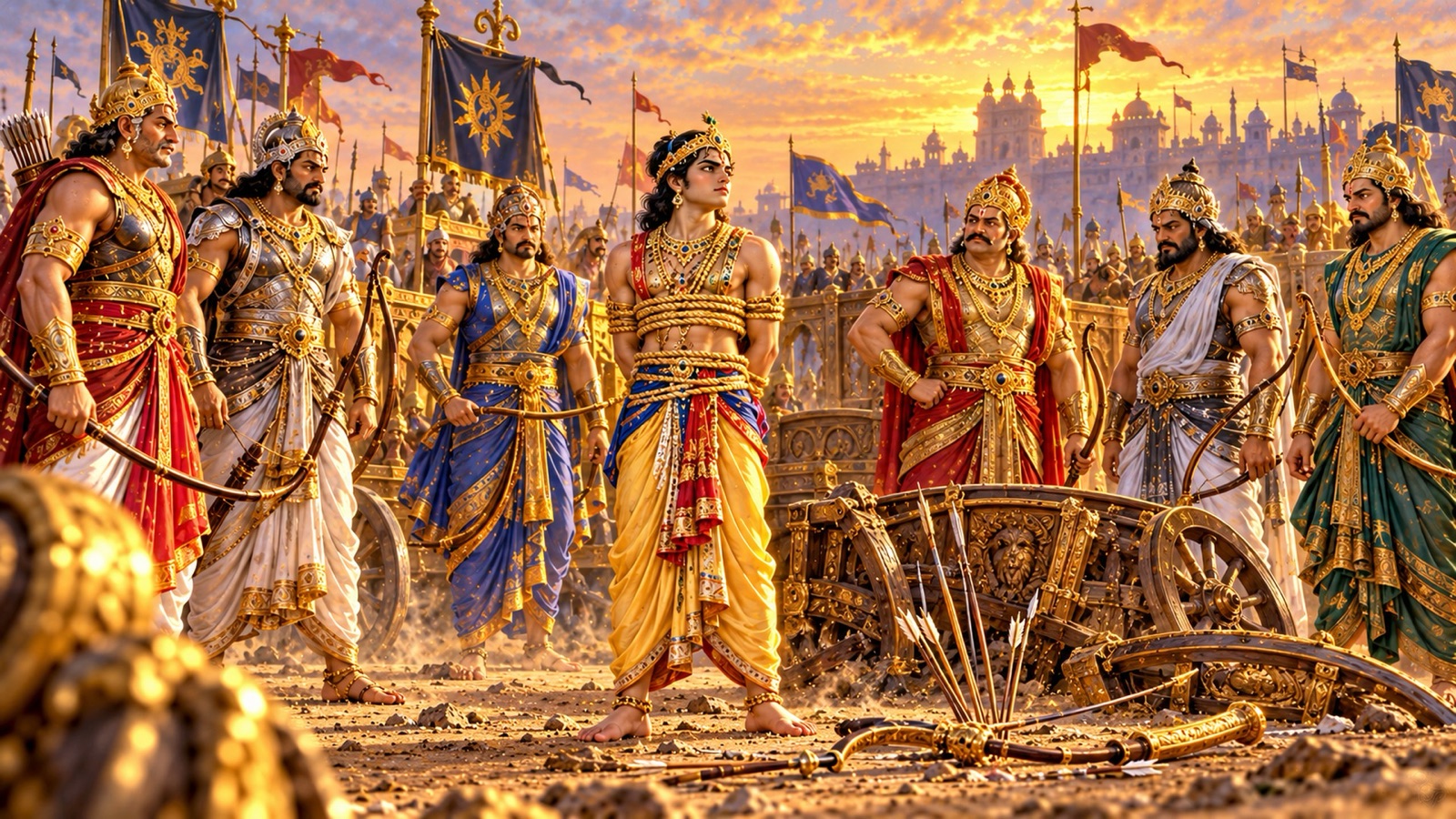
When the Yadus heard of this from the celestial sage Narada, their anger blazed, and at King Ugrasena’s command they prepared to march against the Kurus. But Lord Balarama, the remover of the impurities of the age of Kali, did not want a war between Kurus and Yadus. Gently He calmed the Vrishni heroes who already stood armed, and Himself set out for Hastinapura in a chariot radiant as the sun, surrounded by brahmanas and family elders like the moon amid the planets.
Halting in a garden outside the city, Balarama sent Uddhava to Dhritarashtra to learn the mind of the Kurus. Uddhava duly saluted Dhritarashtra, Bhishma, Drona, Bahlika and Duryodhana, and announced the Lord’s arrival. Delighted that their dearest well-wisher had come, the Kurus honoured Uddhava and went out with auspicious gifts in their hands to receive Balarama, welcoming Him according to custom with a cow and arghya water; those who knew His greatness bowed their heads to Him.
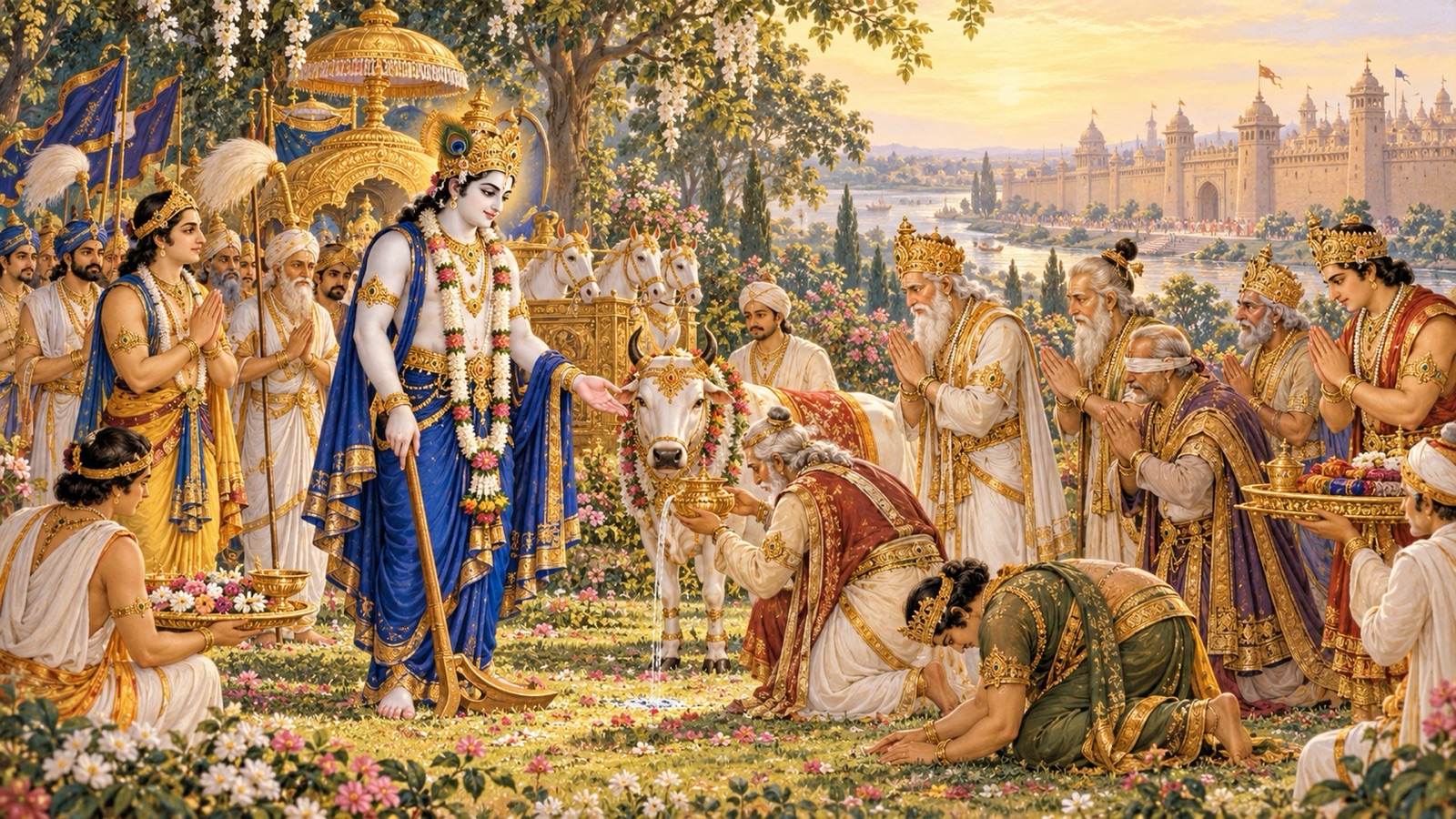
When both sides had asked after each other’s welfare, Balarama spoke plainly. “Hear attentively what King Ugrasena, lord of the kings of the earth, has commanded, and carry it out without delay. He says: you were many, and by unrighteous means you overcame and bound a single warrior who fought by the rules of war. I have borne this for the sake of unity among kinsmen.” The message asked only that Samba come home with his newly wedded wife.
The Kurus’ Haughty Reply
Balarama’s words, full of valour and befitting His power, inflamed the Kurus, who answered: “Ah, what a great wonder this is! By the irresistible course of Time, the sandal now wishes to climb upon the head that wears the crown.”
अहो महच्चित्रमिदं कालगत्या दुरत्यया ।
आरुरुक्षत्युपानद् वै शिरो मुकुटसेवितम् ॥ २४ ॥
aho mahac citram idaṁ kāla-gatyā duratyayā ārurukṣaty upānad vai śiro mukuṭa-sevitam
Meaning: Oh, how astonishing! Through the unstoppable movement of Time, a shoe is now trying to mount the very head that is adorned with the royal crown. (Canto 10, Chapter 68, verse 24)
“These Vrishnis,” they went on, “bound to us by marriage, share our beds, seats and food; we gave them a royal throne and so raised them to equality with us. Chowrie and fan, conch, white umbrella, crown, throne and royal couch — they enjoy all these only because we overlook it. Enough of royal insignia for the Yadus! These gifts have turned against the giver, like nectar fed to serpents. Grown fat on our favour, they have lost all shame and presume to command us. Could even Indra enjoy what Bhishma, Drona, Arjuna and the other Kurus have not granted him, any more than a ram could seize a lion’s prey?”
The Indignation of Balarama
Swollen with the pride of their birth, their kinsmen and their fortune, the Kurus cast courtesy aside and, having let Balarama hear these intolerable words, went back into their city. The infallible Lord had watched their ill behaviour and heard their abuse. Overcome with anger, terrible to look upon, laughing again and again in His wrath, He declared that the only remedy left for such men was the rod.
नूनं नानामदोन्नद्धाः शान्तिं नेच्छन्त्यसाधवः ।
तेषां हि प्रशमो दण्डः पशूनां लगुडो यथा ॥ ३१ ॥
nūnaṁ nānā-madonnaddhāḥ śāntiṁ necchanty asādhavaḥ teṣāṁ hi praśamo daṇḍaḥ paśūnāṁ laguḍo yathā
Meaning: Surely the unrighteous, intoxicated with many kinds of arrogance, do not desire conciliation; for them chastisement alone brings quiet, just as the rod does for animals. (Canto 10, Chapter 68, verse 31)
“Slowly I pacified the seething Yadus, and Krishna Himself in His rage, and came here wishing for peace. But these dull-witted, quarrelsome rogues have scorned Me and heaped abuse on Me in their conceit. So Ugrasena — whose orders Indra and the guardians of the worlds obey — is no sovereign, but a mere chief of Bhojas, Vrishnis and Andhakas! Krishna, who presides over the Sudharma hall and brought the celestial Parijata from heaven, does not deserve a royal seat! He whose feet Lakshmi Herself worships is unfit for the trappings of kings!”
यस्याङ्घ्रिपङ्कजरजोऽखिललोकपालैर्मौल्युत्तमैर्धृतमुपासिततीर्थतीर्थम् ।
ब्रह्मा भवोऽहमपि यस्य कलाः कलायाः श्रीश्चोद्वहेम चिरमस्य नृपासनं क्व ॥ ३७ ॥
yasyāṅghri-paṅkaja-rajo ’khila-loka-pālair mauly-uttamair dhṛtam upāsita-tīrtha-tīrtham brahmā bhavo ’ham api yasya kalāḥ kalāyāḥ śrīś codvahema ciram asya nṛpāsanaṁ kva
Meaning: The dust of His lotus feet, which makes holy the very places of pilgrimage that the saintly frequent, is carried on their crowned heads by all the guardians of the worlds; Brahma, Shiva, Lakshmi and I Myself, who are but portions of His portions, have borne that dust forever — and for Him a king’s throne is supposedly too much? (Canto 10, Chapter 68, verse 37)
In the heat of His anger Balarama utters the truth on which the whole chapter turns. The Kurus imagine kingship to be a favour they conferred and may withdraw; but every emblem of sovereignty exists only by the grace of the One whose foot-dust Brahma, Shiva and Lakshmi hold upon their heads. Rank, land and honour are never ours to bestow — they are His, lent to all alike — and the Kurus’ claim to be the “giver” is the very delusion the chapter exposes. Hence His irony: “So the Yadus enjoy a strip of land bestowed by the Kurus! We are the sandals, and the Kurus the head! Who with the power to punish them could endure the ravings of men drunk on their wealth as the mad are drunk?”
Hastinapura Dragged Toward the Ganga
“Today I shall rid the earth of the Kurus!” With these words Balarama rose in fury and took hold of His plough, as though He would set the three worlds ablaze.
लाङ्गलाग्रेण नगरमुद्विदार्य गजाह्वयम् ।
विचकर्ष स गङ्गायां प्रहरिष्यन्नमर्षितः ॥ ४१ ॥
lāṅgalāgreṇa nagaram udvidārya gajāhvayam vicakarṣa sa gaṅgāyāṁ prahariṣyann amarṣitaḥ
Meaning: With the tip of His plough He prised up the city of Gajahvaya and, meaning to cast it into the Ganga, the enraged Lord dragged it along. (Canto 10, Chapter 68, verse 41)
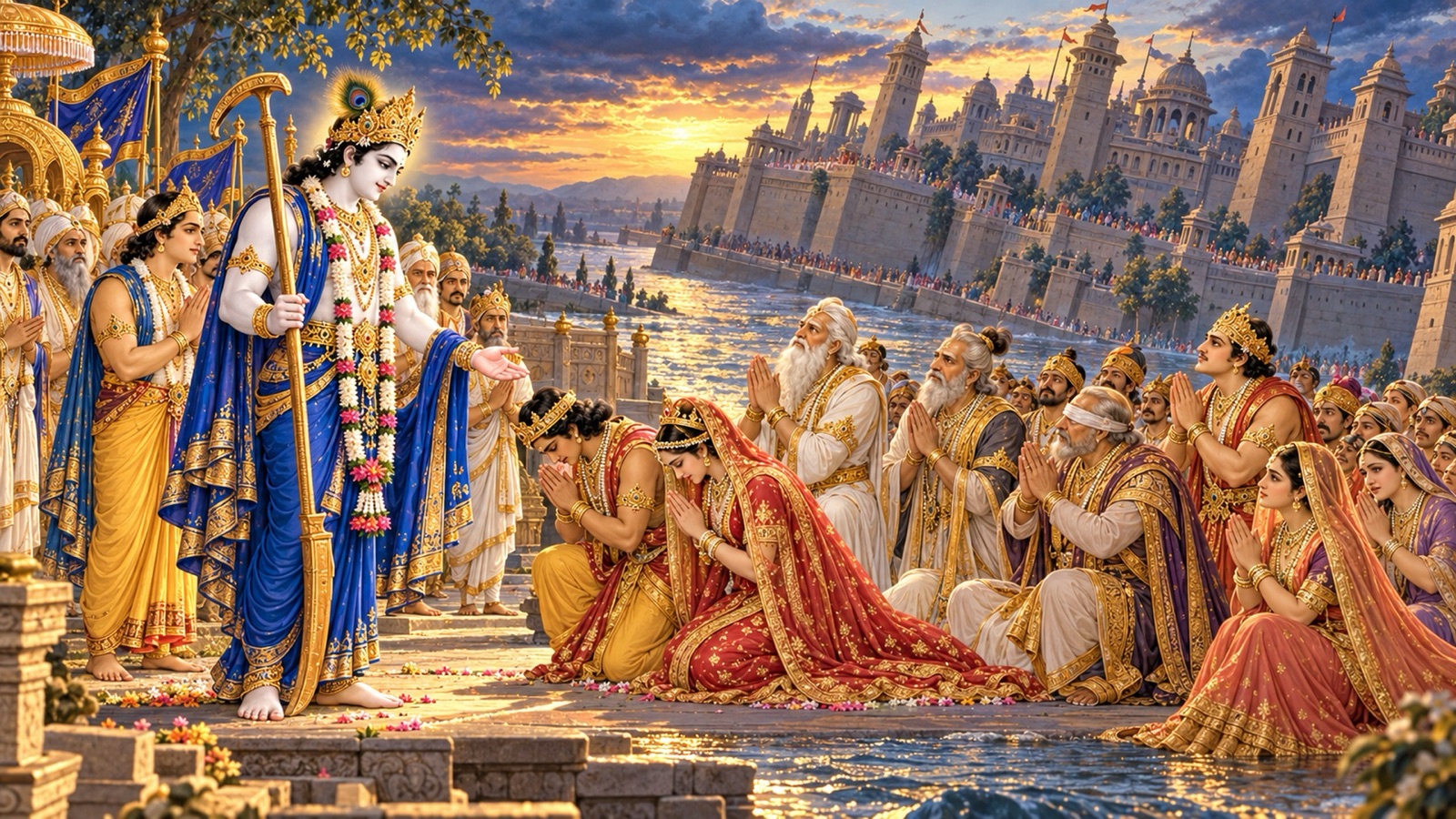
Hastinapura lurched and rolled like a boat tossed on water. When the Kurus saw their city sliding toward the river, panic seized them. Wanting only to live, they gathered their families, placed Samba and Lakshmana at their head, and with folded palms came to the almighty Balarama for shelter.
The Prayer of the Kurus
“O Rama, Rama, support of all!” they cried. “We did not know Your power. Forgive the offence of fools whose understanding is perverse. You alone, resting on nothing but Yourself, cause the creation, maintenance and dissolution of the universe; the sages say the worlds are Your playthings and You the Player. O thousand-headed One of infinite strength, You effortlessly bear this earth upon a single head, and at the end You draw all into Yourself and lie alone, the one who remains.” Then they named the heart of the matter.
कोपस्तेऽखिलशिक्षार्थं न द्वेषान्न च मत्सरात् ।
बिभ्रतो भगवन् सत्त्वं स्थितिपालनतत्परः ॥ ४७ ॥
kopas te ’khila-śikṣārthaṁ na dveṣān na ca matsarāt bibhrato bhagavan sattvaṁ sthiti-pālana-tatparaḥ
Meaning: O Lord, who maintain the mode of goodness and are devoted to preserving the world, Your anger arises for the instruction of everyone, not from enmity nor from malice. (Canto 10, Chapter 68, verse 47)
“Obeisance to You, Soul of all beings, imperishable wielder of every power, maker of the universe. Obeisance to You again and again; we have taken refuge in You.”
Balarama’s Grace and the Homecoming
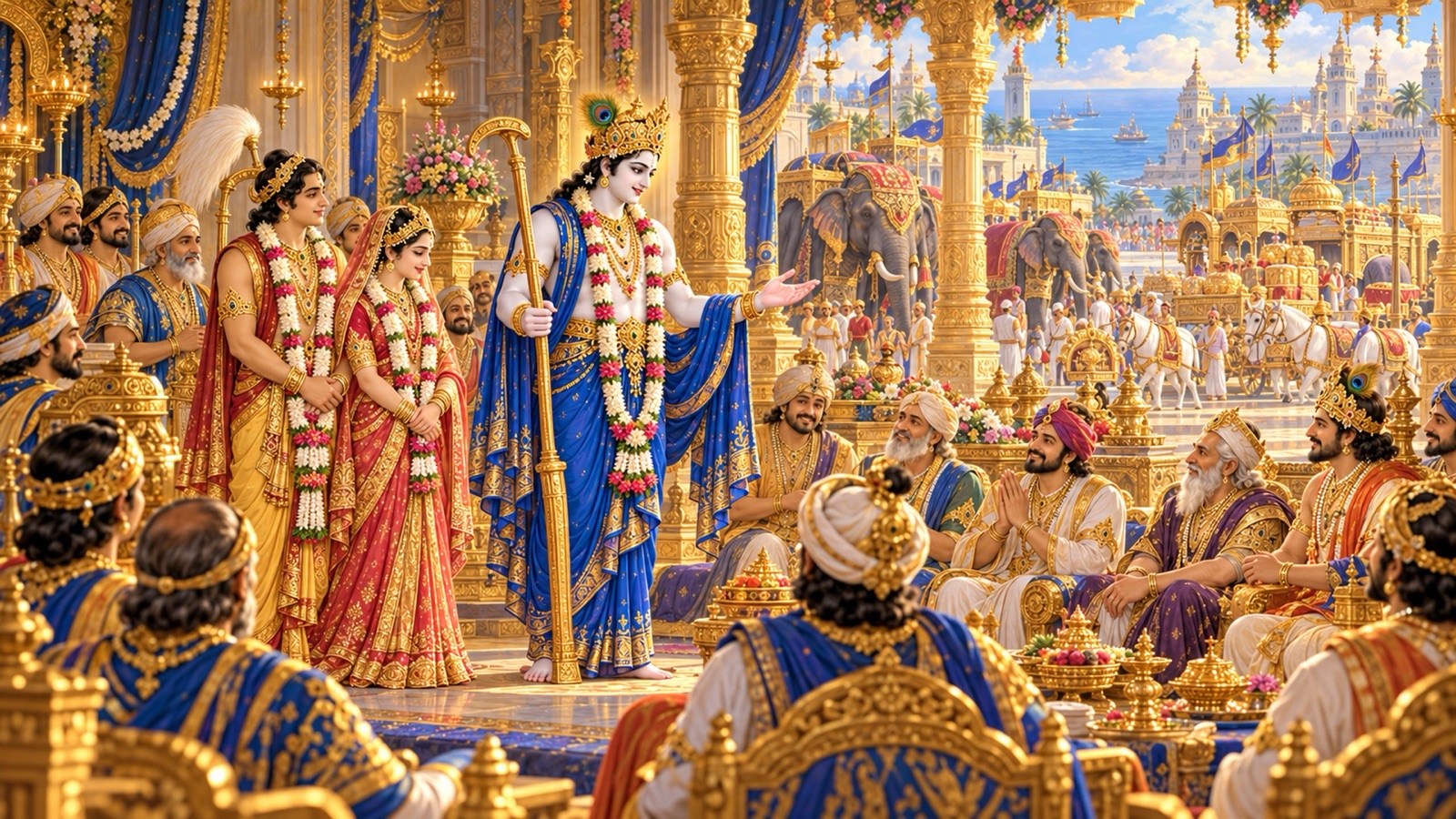
Thus propitiated by the Kurus, who had surrendered in alarm while their city trembled, Balarama was greatly pleased. “Do not fear,” He said, and granted them safety. Duryodhana, who dearly loved his daughter, gave as her wedding present twelve hundred elephants each sixty years old, ten thousand horses, six thousand golden chariots shining like the sun, and a thousand maidservants adorned with golden necklaces. Balarama accepted it all and, blessed by His well-wishers, departed with His nephew and the bride. Entering Dvaraka, the wielder of the plough met His loving kinsmen and, in the assembly of the Yadu chiefs, related all that He had done among the Kurus.
अद्यापि च पुरं ह्येतत् सूचयद् रामविक्रमम् ।
समुन्नतं दक्षिणतो गङ्गायामनुदृश्यते ॥ ५४ ॥
adyāpi ca puraṁ hy etat sūcayad rāma-vikramam samunnataṁ dakṣiṇato gaṅgāyām anudṛśyate
Meaning: Even today this city is seen to stand raised on its southern side and sloping down toward the Ganga, proclaiming the prowess of Balarama. (Canto 10, Chapter 68, verse 54)
Principal Teachings of This Chapter
1. Pride of birth, kinsmen and wealth blinds the heart. Sukadeva names exactly what had swollen the Kurus: pedigree, mighty relatives and fortune. Whatever we are proud of can keep us from recognizing the Lord standing before us.
2. Peace is always the Lord’s first offer. Balarama calmed an army ready to march and travelled with brahmanas and elders, not soldiers. The devotee spends patience generously before anything else.
3. For those who refuse peace, chastisement is mercy. The Lord’s punishment is not the opposite of His kindness but its last and most serious form.
4. All sovereignty is borrowed from the Lord. No one truly “gives” a kingdom; we only hold what is His.
5. Surrender turns the Lord’s rod into His shelter. His wrath springs from care for the world, not hatred; the instant the Kurus surrender, it becomes “Do not fear.”
A Devotional Reflection
The deeper movement of this chapter is quieter than its drama. The Lord came as a guest, spoke gently, asked for one boy’s release — and only when every door to peace was shut did He lift the plough. Even then His anger did not destroy. The city tilted, no one perished, and the Kurus were given exactly as much fear as was needed to make them look up and see who stood before them. How often the hardest turns in our lives are precisely this: the ground lurching beneath us until we finally fold our hands. Balarama granted protection the instant it was asked; He had wanted to give it all along. The slope of Hastinapura remains as a sign of how little force He needed to bring a proud city to His feet, and how quickly He forgave once it came.
A Daily Devotional Practice
Today, notice one place where you have been standing on the “head” — some advantage of birth, position or possession that quietly makes you look down on another. Offer it back to the Lord in a short prayer, remembering whose foot-dust the greatest of gods carry on their crowns. Then, if a quarrel is simmering in your life, take Balarama’s first road and offer peace before anything else. Begin by chanting gently: Om Namo Bhagavate Vasudevaya.
Conclusion
The sixty-eighth chapter of the Tenth Canto moves from a svayamvara to a city hanging over a river, and its single lesson is that every honour we hold is on loan from the Lord. The Kurus mistook His grace for their own generosity; Balarama offered peace to the last, chastised only when peace was refused, and forgave the moment He was asked. May we never mistake what the Lord has lent us for what we have given, and may we fold our hands before the plough is lifted.
May the divine wisdom of Srimad Bhagavatam awaken pure devotion within our hearts.
Om Namo Bhagavate Vasudevaya.
Jay Shree Madhav.
References and Attribution
- Primary edition: Gita Press, Śrīmad Bhāgavata Mahāpurāṇa (English), Book Ten (Latter Half), Discourse 68.
- Series: Srimad Bhagavatam Wisdom · Biswa Sanatan Dharma Seva Trust.
- Presented following the spiritual guidance and recommendation of Pandit Dr. Shri Kashinath Mishra.
This is an original, faithful retelling in the writer’s own words, with brief quoted verses shown in Devanāgarī and transliteration and their meanings given as summaries. It is not a reproduction of any single publisher’s continuous translation or commentary. No affiliation with or endorsement by any publisher is implied.
Jay Shree Madhav