
Curious to see how one Lord could live with sixteen thousand queens at once, the sage Narada walks into Dvaraka — and finds Krishna fully present in every single home.
Om Namo Bhagavate Vasudevaya.
Om Namo Bhagavate Vasudevaya.
Om Namo Bhagavate Vasudevaya.
Welcome back to Srimad Bhagavatam Wisdom, our devotional journey through the sacred histories and teachings of the Srimad Bhagavat Mahapurana. In this sixty-ninth chapter of the Tenth Canto we walk beside the divine sage Narada through the jewelled palaces of Dvaraka, where a wonder beyond human measure unfolds and the Lord Himself explains why He lives as He does.
Chapter Information
- Scripture: Śrīmad Bhāgavata Mahāpurāṇa
- Canto: 10 (Book Ten, Latter Half)
- Chapter: 69 (Discourse 69)
- Chapter title: Narada Muni Visits Lord Krishna’s Palaces in Dvaraka
- Principal speaker: Sukadeva Gosvami (narrating to King Parikshit); within the story, Narada Muni and Lord Krishna
- Principal listener: King Parikshit
- Main setting: Dvārakā, the inner city of Lord Krishna’s sixteen thousand palaces
- Central subject: Narada’s visit to the Lord’s palaces; Krishna’s humble worship of the sage; the one Lord present in every palace as a householder; Narada’s prayer and the Lord’s reply
- Principal verse range: Canto 10, Chapter 69, verses 1–45
- Primary edition: Gita Press Śrīmad Bhāgavata Mahāpurāṇa (English, Part II)
Context From the Previous Chapter
In Chapter 68, Krishna’s son Samba carried away Duryodhana’s daughter Lakshmana and was captured by the Kurus. Balarama went to free him, was insulted by the proud Kurus, and in anger began dragging Hastinapura toward the Ganga with His plough until they surrendered and begged forgiveness. He returned to Dvaraka with Samba and his bride.
Narada’s Wonder and the Splendour of Dvaraka
Sukadeva now turns to a quieter wonder. Word had spread that Krishna had slain the demon Naraka and had, alone, married the thousands of princesses that demon had held captive. When the divine sage Narada heard this, a longing rose in his heart to see for himself how the Lord lived with them all. He marvelled at the very thought.
चित्रं बतैतदेकेन वपुषा युगपत् पृथक् ।
गृहेषु द्व्यष्टसाहस्रं स्त्रिय एक उदावहत् ॥ २ ॥
citraṁ bataitad ekena vapuṣā yugapat pṛthak gṛheṣu dvy-aṣṭa-sāhasraṁ striya eka udāvahat
Meaning: How astonishing it is that one Person, in a single body, has taken sixteen thousand brides at the same moment, each in her own separate house! (Canto 10, Chapter 69, verse 2)
Eager with this curiosity, Narada came to Dvaraka. The city greeted him with gardens in blossom, loud with birdsong and bees; its lakes were carpeted with lotuses and lilies of every colour, where swans and cranes called. Nine hundred thousand mansions of crystal and silver stood there, inlaid with emerald and furnished with gold and gems. Its roads, squares, markets, assembly halls and temples were laid out in order, the streets sprinkled with water, and fluttering banners kept off the sun.
In the heart of that city rose the inner quarter of Lord Krishna’s palaces, honoured by the guardians of every direction, where Visvakarma, the divine architect, had poured out all his skill. It held sixteen thousand mansions, the homes of the Lord’s queens. Narada chose one great palace among them and went in.
In the Palace of Rukmini: The Lord Bows to the Sage
Within, the sage found a dwelling beyond earthly imagining: pillars of coral, panels of cat’s-eye gem, walls and floor of sapphire whose lustre never dimmed; pearl-hung canopies made by Visvakarma, and couches of ivory set with jewels. Maidservants with golden necklaces and men in tunics and turbans attended the house. Lamps of gems drove away every shadow, and on the painted eaves the peacocks, seeing aloe-smoke drift from the lattices, cried out and danced, taking it for clouds.
There Narada beheld the Lord of the Satvatas seated with the mistress of that house, Rukmini. Though attended at every moment by a thousand maidservants equal to her in virtue, beauty, youth and dress, she herself was fanning her Lord with a golden-handled yak-tail whisk.
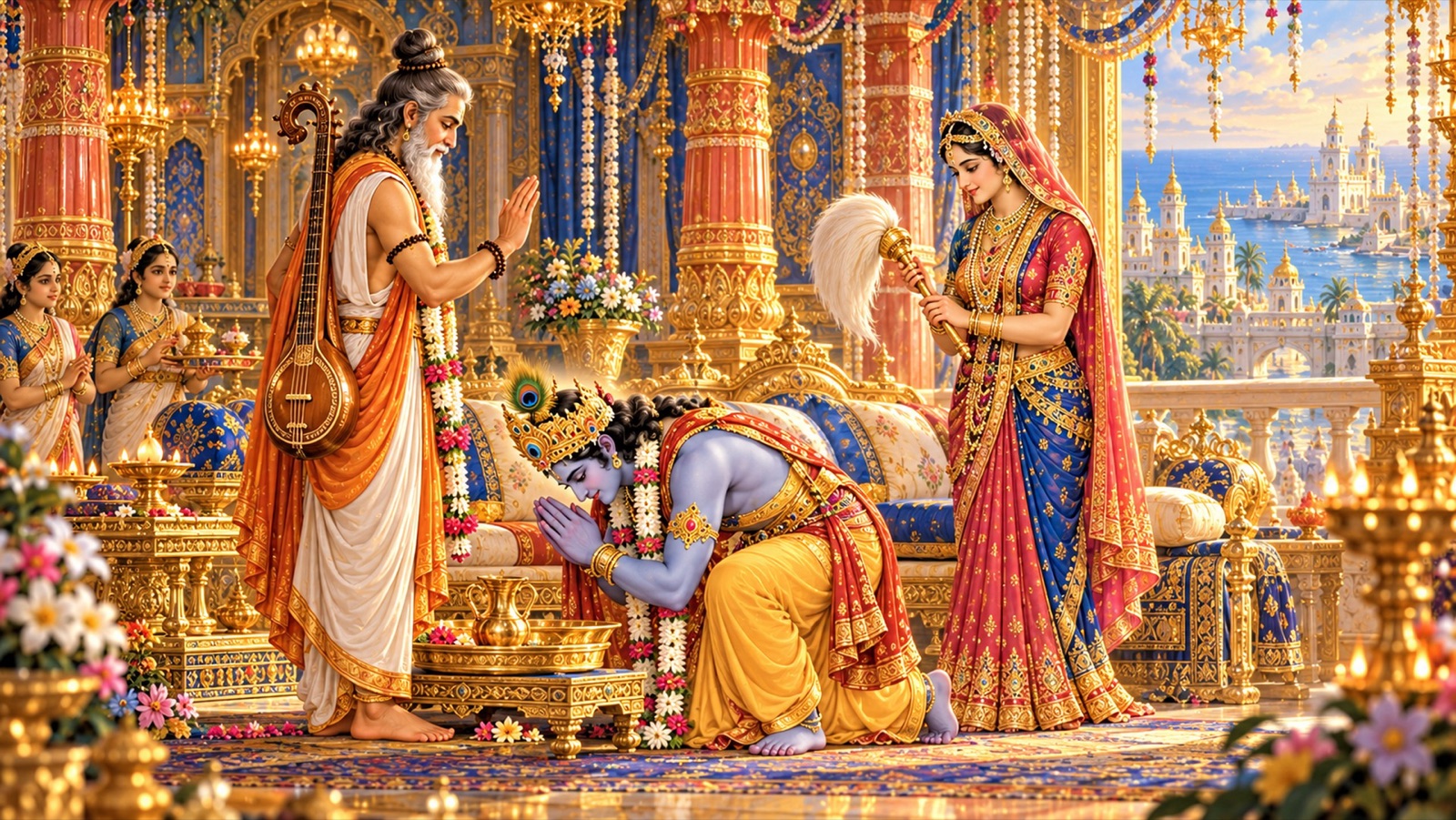
The moment the Lord saw the sage, He rose from the couch of Sri. He, the foremost of all who uphold dharma, bowed His crowned head to Narada’s feet and with joined palms seated him upon His own seat. Then He washed His guest’s feet and placed that water upon His head — He whose own foot-water, the Ganga, makes the whole world pure.
तस्यावनिज्य चरणौ तदप: स्वमूर्ध्ना
बिभ्रज्जगद्गुरुतमोऽपि सतां पतिर्हि ।
ब्रह्मण्यदेव इति यद्गुणनाम युक्तं
तस्यैव यच्चरणशौचमशेषतीर्थम् ॥ १५ ॥
tasyāvanijya caraṇau tad-apaḥ sva-mūrdhnā bibhraj jagad-gurutamo ‘pi satāṁ patir hi brahmaṇya-deva iti yad guṇa-nāma yuktaṁ tasyaiva yac-caraṇa-śaucam aśeṣa-tīrtham
Meaning: Although He is the highest teacher of the universe and the master of the saintly, He bathed the sage’s feet and bore that water upon His head; rightly does He carry the name Brahmanya-deva, the Lord devoted to the brahmanas — He whose own foot-washing water contains every holy place. (Canto 10, Chapter 69, verse 15)
Then the Lord — none other than the ancient sage Narayana, companion of Nara — worshipped the best of divine sages with the prescribed rites, and in measured words sweet as nectar asked humbly: “My lord, what may We do for you?”
Narada’s Prayer
The sage answered that nothing done by the Lord of all the worlds could surprise him: that Krishna should befriend all beings and curb the wicked was only natural, for He had descended by His own will for the welfare and protection of the world. Then Narada spoke of what he himself had gained that day.
दृष्टं तवाङ्घ्रियुगलं जनतापवर्गं
ब्रह्मादिभिर्हृदि विचिन्त्यमगाधबोधै: ।
संसारकूपपतितोत्तरणावलम्बं
ध्यायंश्चराम्यनुगृहाण यथा स्मृति: स्यात् ॥ १८ ॥
dṛṣṭaṁ tavāṅghri-yugalaṁ janatāpavargaṁ brahmādibhir hṛdi vicintyam agādha-bodhaiḥ saṁsāra-kūpa-patitottaraṇāvalambaṁ dhyāyaṁś carāmy anugṛhāṇa yathā smṛtiḥ syāt
Meaning: I have beheld Your two feet, which bestow liberation upon humanity, which Brahma and the other sages of fathomless wisdom meditate upon in their hearts, and which are the rope by which those fallen into the well of worldly life climb out. Grant me Your grace, that I may wander remembering them and their memory may never leave me. (Canto 10, Chapter 69, verse 18)
This is the only boon the sage asks: not wealth, not power, not even release, but unbroken remembrance of the Lord’s feet.
The Game of Dice and a Question That Astonished the Sage
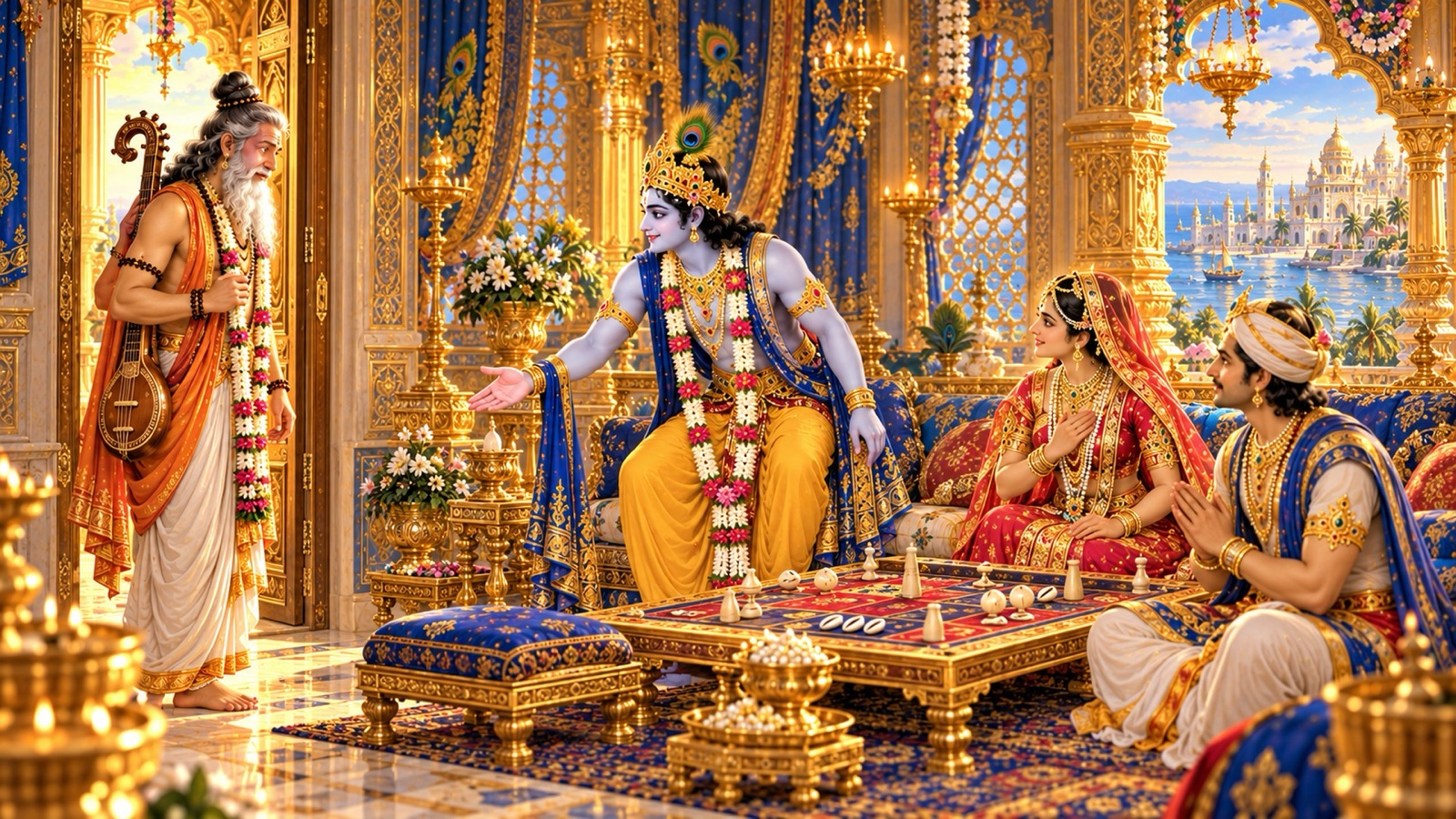
Wishing to understand the Yogamaya of the Lord of yoga’s masters, Narada then entered another queen’s mansion. There he saw Krishna playing dice with His beloved consort and Uddhava. Here too the Lord rose at once, offered him a seat and worshipped him with supreme devotion.
पृष्टश्चाविदुषेवासौ कदायातो भवानिति ।
क्रियते किं नु पूर्णानामपूर्णैरस्मदादिभि: ॥ २१ ॥
pṛṣṭaś cāviduṣevāsau kadāyāto bhavān iti kriyate kiṁ nu pūrṇānām apūrṇair asmad-ādibhiḥ
Meaning: As though unaware that the sage had already come, the Lord asked him, “When did you arrive? And what service can incomplete beings like Us render to those who are complete in themselves?” (Canto 10, Chapter 69, verse 21)
“Even so, O brahmana,” Krishna added, “command Us, and make this birth of Ours auspicious.” The Lord who had just worshipped him in Rukmini’s palace now greeted him as a newly arrived guest. Amazed, Narada rose without a word and passed on to another house.
One Lord in Sixteen Thousand Homes
In that house Govinda was caressing His little sons. In the next He was preparing for His bath. And so it went on, mansion after mansion: here the Lord poured oblations into the sacrificial fires, there performed the five daily sacrifices; in one place He fed brahmanas, in another ate what they had left. Here He sat at His evening prayers, there He silently repeated the Gayatri. In one palace the elder brother of Gada practised with sword and shield; in another He rode horses, elephants and chariots; elsewhere He rested on His couch while bards sang His praises.
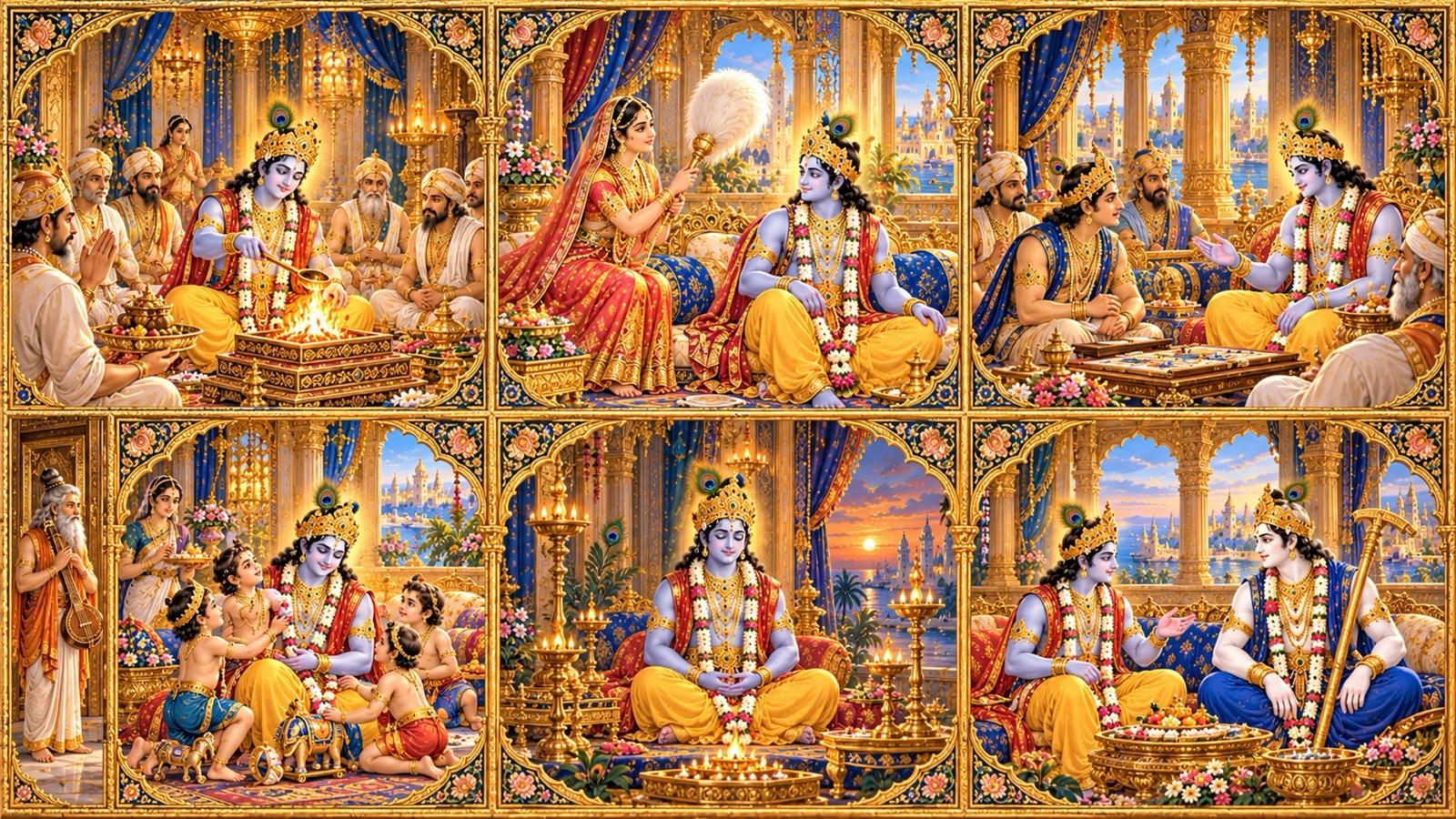
In one hall He took counsel with Uddhava and His ministers; in another He sported in the water, attended by the court’s dancing-women. Somewhere He gave adorned cows to brahmanas and listened to auspicious histories and Puranas. In one home He laughed over light talk with a beloved queen; elsewhere He was absorbed in religious observance, in the lawful pursuit of wealth, or in a householder’s permitted pleasures. Here He sat alone meditating on the Supreme Person beyond material nature; there He served His elders with the gifts and worship they desired. In one place He planned war against foes, in another concluded peace. Here, with Balarama, He deliberated on the welfare of the virtuous; there He celebrated with splendour the weddings of His sons and daughters, and the people marvelled at the festivals with which He sent His daughters to their husbands’ homes and welcomed them back. Somewhere He worshipped all the gods with mighty sacrifices; somewhere He built wells, gardens and monasteries for the public good. Here He rode a Sindhu horse to the hunt with the Yadu chiefs, taking animals fit for sacrifice; there He moved unrecognised through the inner quarters and the city, to learn the true feelings of His people.
In every home the Lord was wholly present — never divided, never hurried.
Narada Speaks and the Lord Replies
Having watched Yogamaya unfold in One who walked the path of a human being, Narada turned to Hrishikesha and spoke, almost laughing with delight. “O Master of yoga, we know these mystic powers of Yours, hard to see even for wielders of maya like Brahma; they have been revealed to us through service at Your feet. Now permit me to go, O Lord, that I may wander through the worlds flooded with Your fame, loudly singing Your pastimes that purify the universe.”
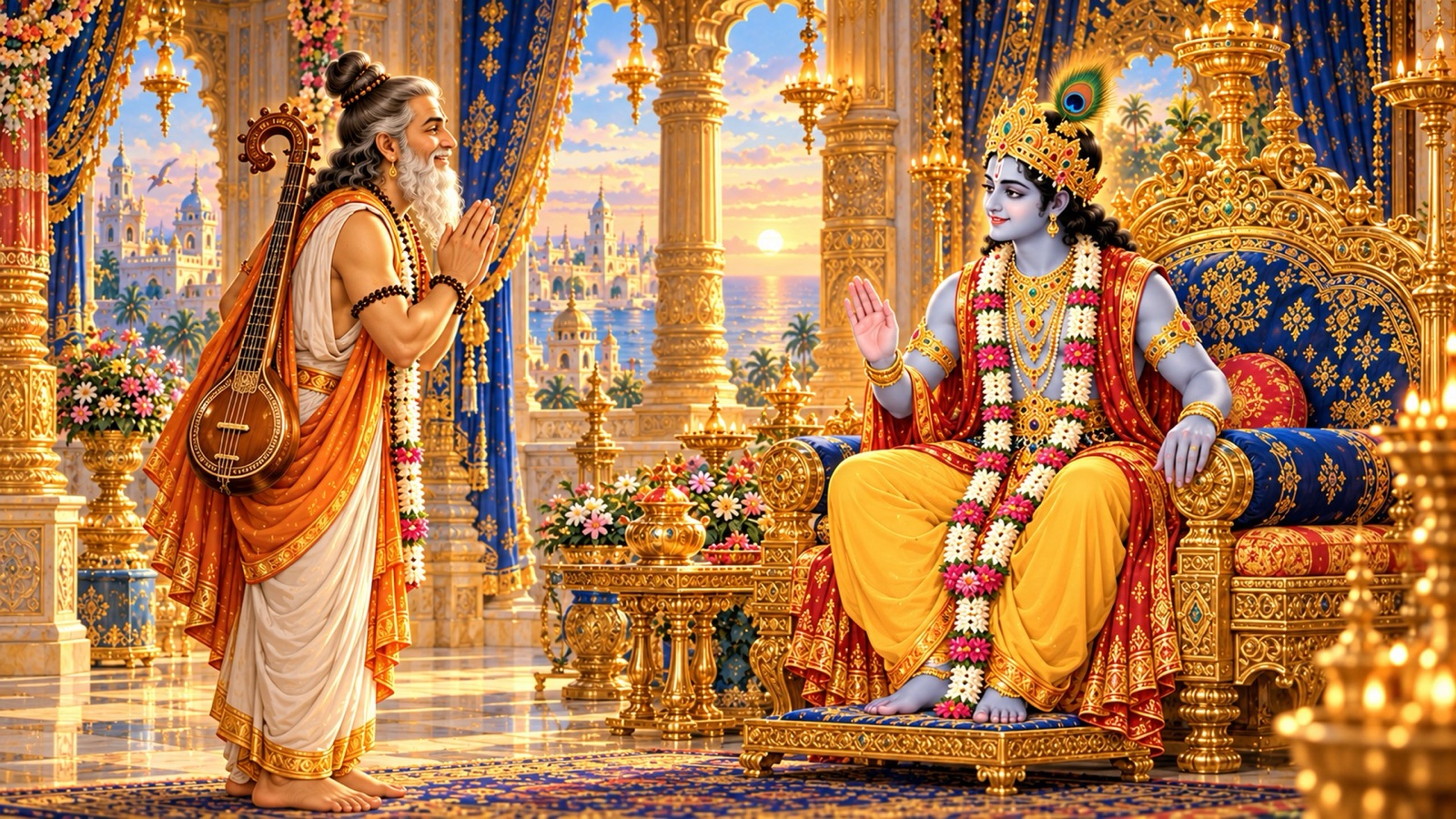
Then the Supreme Lord gave the sage the chapter’s deepest word.
ब्रह्मन् धर्मस्य वक्ताहं कर्ता तदनुमोदिता ।
तच्छिक्षयन् लोकमिममास्थित: पुत्र मा खिद: ॥ ४० ॥
brahman dharmasya vaktāhaṁ kartā tad-anumoditā tac chikṣayan lokam imam āsthitaḥ putra mā khidaḥ
Meaning: O brahmana, I am the speaker of dharma, its performer, and the one who sanctions it in others; to teach this world I Myself follow it. Do not be perplexed, My son. (Canto 10, Chapter 69, verse 40)
Here lies the heart of the chapter. Why does the Lord of all, who needs nothing, rise for a sage, wash his feet, keep the daily worship, feed brahmanas and serve His elders? Because the world learns dharma by watching those it reveres. If the Lord Himself honours saints and lives as a faithful householder, no one can claim such duties are beneath a great soul. The sixteen thousand homes are sixteen thousand lessons in how a human life should be lived, taught at once by the One who alone can be everywhere.
The Sage Departs Remembering Him
So the sage saw that it was one and the same Krishna, present in every house, carrying out the pure and sanctifying duties of a householder. Beholding again and again this vast unfolding of the Yogamaya of the Lord of limitless prowess, Narada was filled with astonishment and fresh curiosity. Honoured by Krishna, who showed such reverence for dharma, wealth and lawful pleasure, he went away delighted, remembering Him alone.
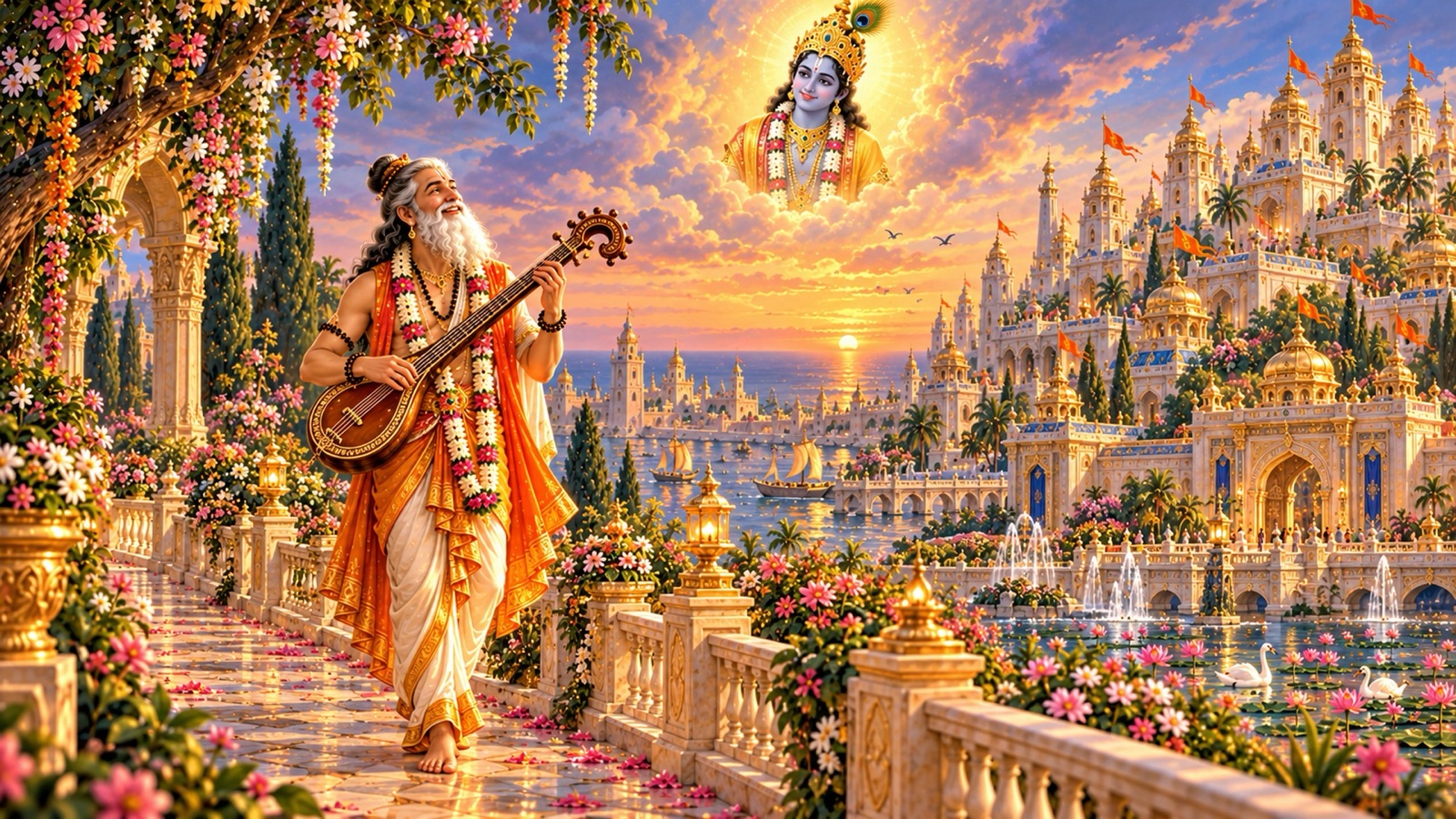
Sukadeva closes by reminding Parikshit that Narayana, taking up His inconceivable power for the good of the whole world, lived in this way as a man among men, greeted by the shy, affectionate glances and smiles of sixteen thousand noble queens. And he adds the blessing that waits upon every hearer of these pastimes.
यानीह विश्वविलयोद्भववृत्तिहेतु:
कर्माण्यनन्यविषयाणि हरिश्चकार ।
यस्त्वङ्ग गायति शृणोत्यनुमोदते वा
भक्तिर्भवेद् भगवति ह्यपवर्गमार्गे ॥ ४५ ॥
yānīha viśva-vilayodbhava-vṛtti-hetuḥ karmāṇy ananya-viṣayāṇi hariś cakāra yas tv aṅga gāyati śṛṇoty anumodate vā bhaktir bhaved bhagavati hy apavarga-mārge
Meaning: O dear one, whoever sings, hears, or rejoices in these deeds that Hari — the cause of the universe’s creation, maintenance and dissolution — performed in this world, deeds possible for none but Him, gains devotion to the Lord, who is Himself the way to liberation. (Canto 10, Chapter 69, verse 45)
Principal Teachings of This Chapter
1. The Lord honours His devotees first. In each palace Krishna rises, bows His crowned head and bears the sage’s foot-water on His own head. The Supreme Person treats humble worship as His own privilege, not a favour granted.
2. The one prayer worth making is remembrance. Narada, who could ask for anything, asks only that the Lord’s feet never leave his thoughts. Such remembrance is the devotee’s highest wealth.
3. The Lord lives dharma in order to teach it. He speaks dharma, practises it and approves it, so that the world may learn by His example. Sacred duty is never beneath greatness.
4. One Lord, everywhere, undivided. Narada finds the same complete Krishna in every home at once. Divine presence is not shared out in portions; wherever the Lord is, He is wholly there.
5. Hearing these pastimes awakens devotion. Singing, hearing or simply rejoicing in these unique deeds of Hari leads to bhakti, and bhakti to liberation.
A Devotional Reflection
We often imagine that spiritual life begins where ordinary life ends — that work, family and duty must be escaped before the sacred can be reached. Narada’s walk through Dvaraka gently overturns that idea. He does not find the Lord withdrawn in a hidden sanctuary; he finds Him bathing, playing with His children, feeding guests, serving His elders, sitting at evening prayer — every ordinary act lit from within by the same Presence. And the sage leaves not dazzled by palaces but remembering the Lord alone. Our homes are not of coral and sapphire, and we cannot be in two rooms at once; but we can meet the Lord in the single task before us and do it with full attention and reverence.
A Daily Devotional Practice
Today, choose one ordinary household duty — preparing a meal, welcoming a guest, caring for a child or an elder — and perform it as Krishna performed His duties in Dvaraka: unhurried, fully present, offered as a lesson of love. Before you begin, recall Narada’s single request, and ask that the thought of the Lord’s feet may stay with you through the task. Begin by chanting gently: Om Namo Bhagavate Vasudevaya.
Conclusion
This sixty-ninth chapter of the Tenth Canto answers Narada’s wonder not with a doctrine but with a vision: the Lord, one and undivided, living with equal fullness in every one of His homes, and explaining in a single verse that He does so to teach the world how dharma is lived. May we take from it the sage’s own treasure — the remembrance of Krishna’s feet in the midst of all our days.
May the divine wisdom of Srimad Bhagavatam awaken pure devotion within our hearts.
Om Namo Bhagavate Vasudevaya.
Jay Shree Madhav.
References and Attribution
- Primary edition: Gita Press, Śrīmad Bhāgavata Mahāpurāṇa (English, Part II), Book Ten (Latter Half), Discourse 69.
- Series: Srimad Bhagavatam Wisdom · Biswa Sanatan Dharma Seva Trust.
- Presented following the spiritual guidance and recommendation of Pandit Dr. Shri Kashinath Mishra.
This is an original, faithful retelling in the writer’s own words, with brief quoted verses shown in Devanāgarī and transliteration and their meanings given as summaries. It is not a reproduction of any single publisher’s continuous translation or commentary. No affiliation with or endorsement by any publisher is implied.
Jay Shree Madhav