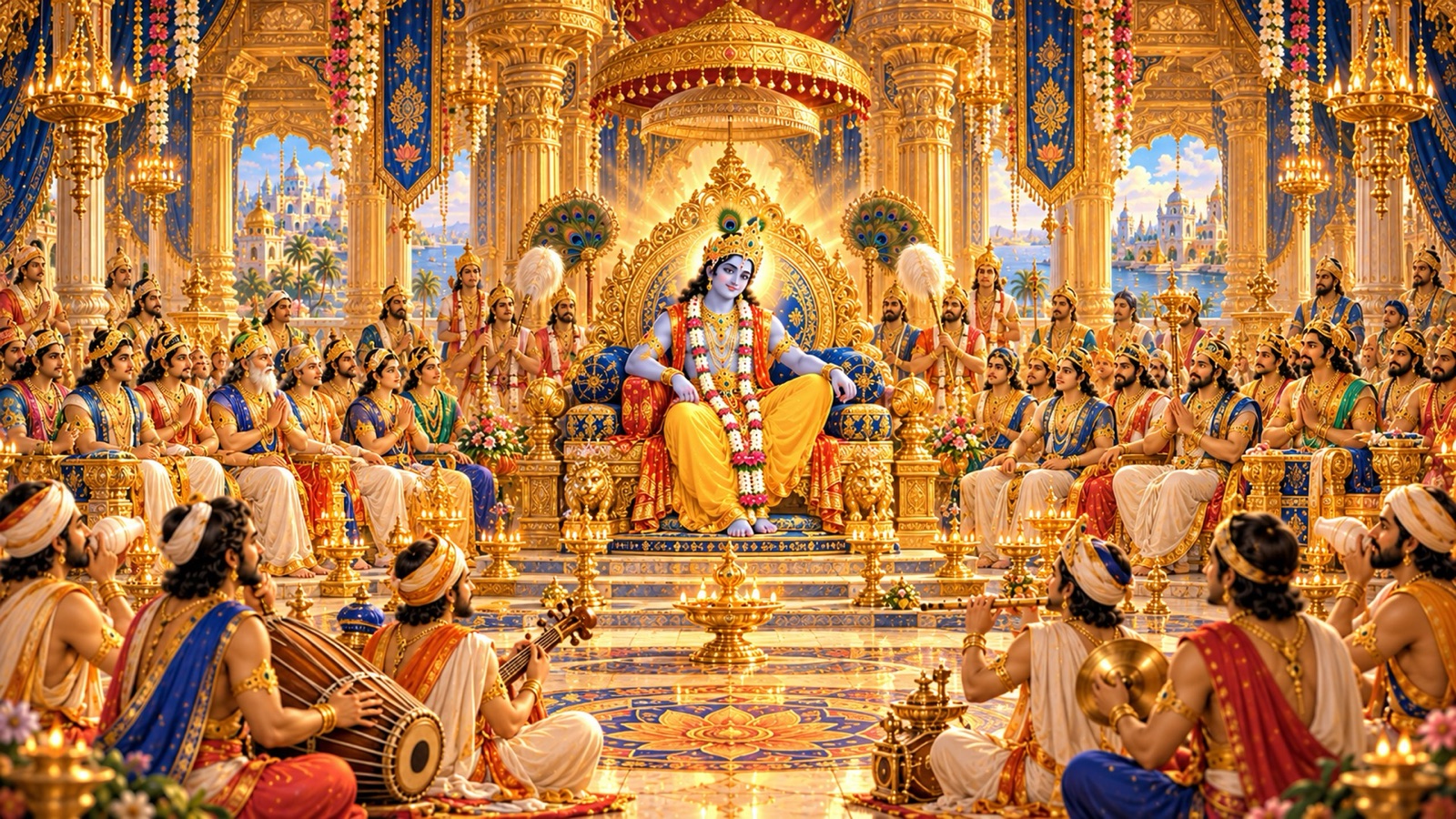
Each morning in Dvaraka the Lord of the universe rises before dawn, meditates, worships and takes His seat in the Sudharma hall — until a stranger’s plea and a sage’s tidings set a far greater history in motion.
Om Namo Bhagavate Vasudevaya.
Om Namo Bhagavate Vasudevaya.
Om Namo Bhagavate Vasudevaya.
Welcome back to Srimad Bhagavatam Wisdom, our devotional journey through the sacred histories and teachings of the Srimad Bhagavat Mahapurana. In this seventieth chapter of the Tenth Canto, Sukadeva lets us walk beside Krishna through one day in Dvaraka — a day visited by a messenger from the kings held captive by Jarasandha, and by Narada with word of Yudhishthira’s Rajasuya.
Chapter Information
- Scripture: Śrīmad Bhāgavata Mahāpurāṇa
- Canto: 10 (Book Ten, Latter Half)
- Chapter: 70 (Discourse 70)
- Chapter title: Lord Krishna’s Daily Activities
- Principal speaker: Sukadeva Gosvami (narrating to King Parikshit)
- Principal listener: King Parikshit
- Main setting: Dvārakā — the Lord’s palaces and the Sudharma assembly hall
- Central subject: The Lord’s daily worship; the captive kings’ plea; Narada’s news of the Rajasuya; Krishna’s question to Uddhava
- Principal verse range: Canto 10, Chapter 70, verses 1–47
- Primary edition: Gita Press Śrīmad Bhāgavata Mahāpurāṇa (English)
Context From the Previous Chapter
In Chapter 69 Narada came to Dvaraka to see how Krishna lived with His sixteen thousand queens, and found the one Lord present in every palace at once, performing the pious duties of a householder. Having witnessed this wonder of Yogamaya, the sage departed with the Lord ever in his heart.
Dawn in Dvaraka
As night thinned toward morning, the queens of Dvaraka, each resting with her arms about her husband’s neck, would scold the crowing cocks, for dawn meant parting from Him. Birds roused by the breeze from the Mandara groves sang out like court bards urging Krishna awake. Rukmini, held close in His embrace, could not welcome that beautiful hour, so unwilling was she to be loosed from His arms.
The Lord’s Morning Worship
Krishna would rise in the brāhma-muhūrta, the sacred hour well before sunrise, touch water to cleanse Himself, and with a tranquil heart meditate upon His own Self — the one self-luminous, imperishable reality beyond darkness, forever untouched by ignorance, known as Brahman.
ब्राह्मे मुहूर्त उत्थाय वार्युपस्पृश्य माधवः ।
दध्यौ प्रसन्नकरण आत्मानं तमसः परम् ॥ ४ ॥
brāhme muhūrta utthāya vāry upaspṛśya mādhavaḥ dadhyau prasanna-karaṇa ātmānaṁ tamasaḥ param
Meaning: Rising in the brāhma-muhūrta and sipping water for purification, Madhava, His senses serene, meditated on the Self that lies beyond all darkness. (Canto 10, Chapter 70, verse 4)
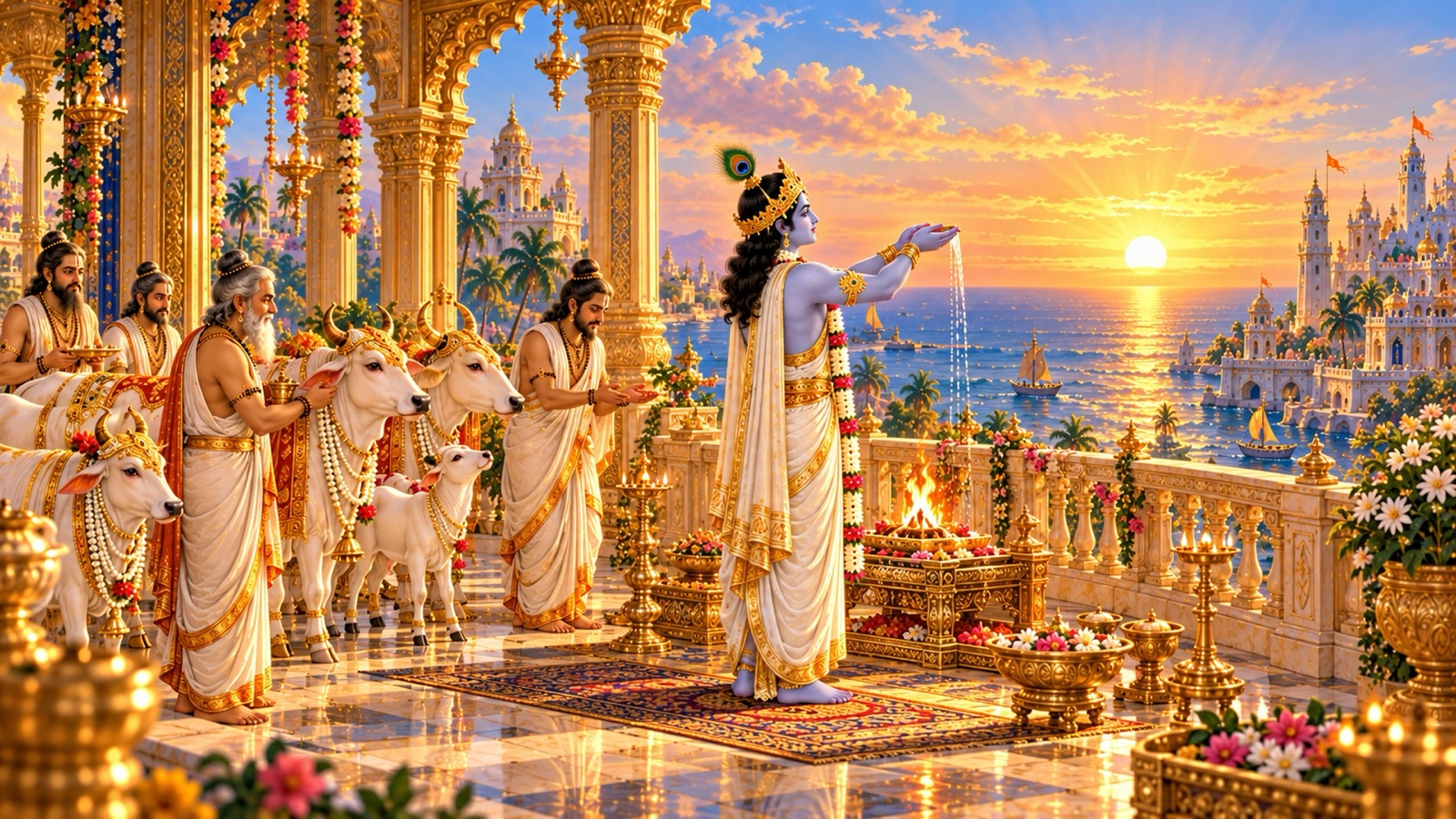
Then He would bathe, put on two fresh garments, perform the sandhya and other prescribed rites, offer oblations into the sacred fire and silently repeat the Gayatri. Standing before the rising sun He worshipped it, and offered water to the gods, sages and forefathers — all of them rays of His own being. He honoured His elders and the brahmanas, and every day gave to well-adorned brahmanas, with silk, deerskins and sesame, thirteen thousand and eighty-four gentle milch cows, newly calved, their horns sheathed in gold and hooves in silver, pearls at their necks and calves beside them.
Then He bowed to the cows, the brahmanas, the gods, the elders and the preceptors, and to every living being — for all are manifestations of His own Self — and touched articles of good omen.
गोविप्रदेवतावृद्धगुरून् भूतानि सर्वशः ।
नमस्कृत्यात्मसम्भूतीर्मङ्गलानि समस्पृशत् ॥ १० ॥
go-vipra-devatā-vṛddha- gurūn bhūtāni sarvaśaḥ namaskṛtyātma-sambhūtīr maṅgalāni samaspṛśat
Meaning: Having offered obeisance to the cows, the brahmanas, the deities, the elders and the teachers, and to all creatures everywhere, who are born of His own Self, He touched auspicious things. (Canto 10, Chapter 70, verse 10)
Adorning Himself and Setting Out
Krishna, Himself the ornament of the human world, would next adorn His form with His own garments and jewels, celestial garlands and fragrant pastes. He gazed into clarified butter and a mirror, looked upon cows, bulls, brahmanas and the images of the gods, and delighted in granting the wishes of citizens of every order and of the inner palace. Garlands, betel and sandal He gave first to the brahmanas, then to friends, kinsmen, ministers and queens, and only afterwards took His own share.
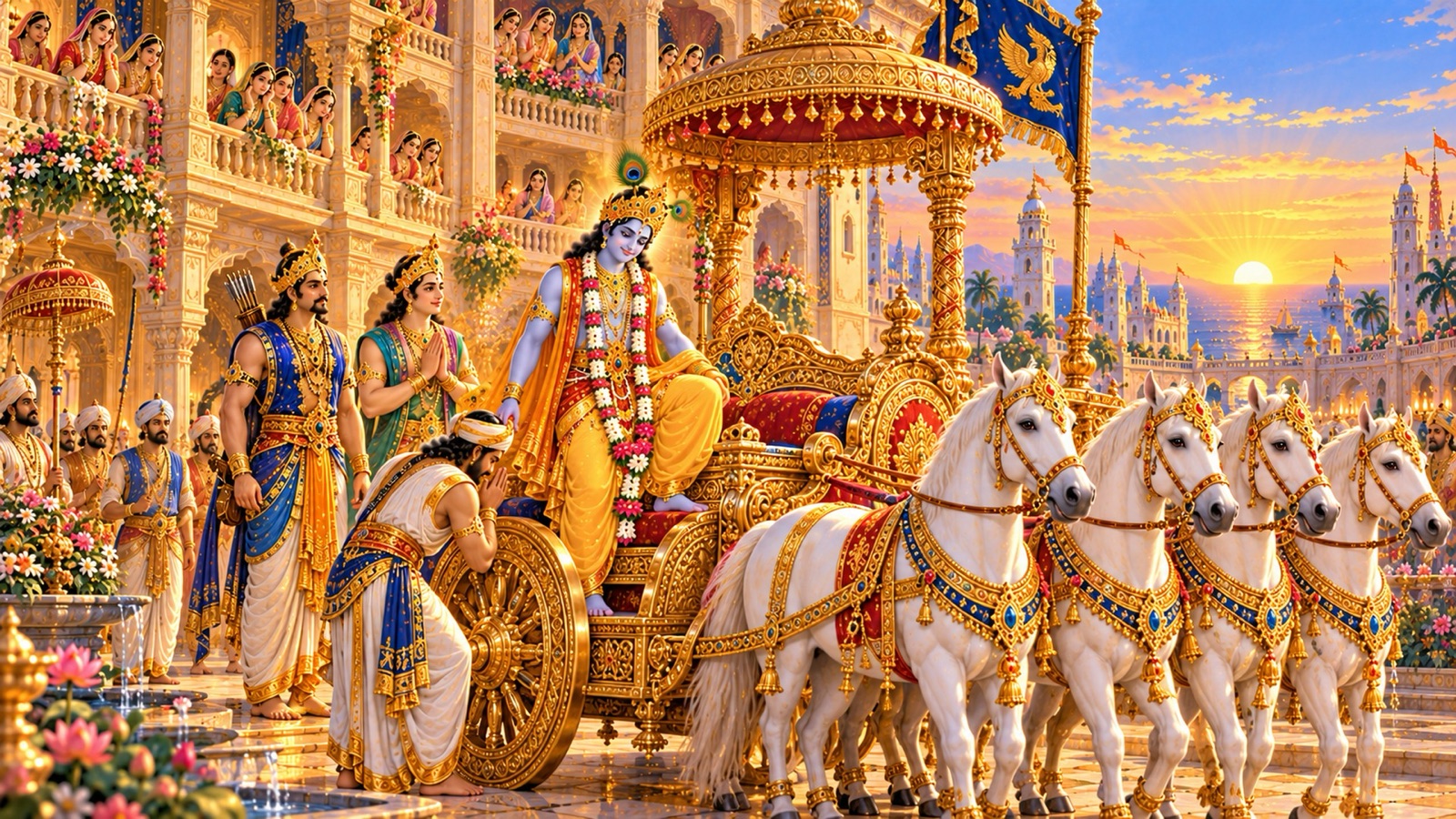
By then the charioteer had brought His marvellous chariot, yoked with Sugriva and the other horses, and stood bowing before Him. Taking the charioteer’s hands in His own, Krishna mounted with Satyaki and Uddhava beside Him, as the sun climbs the eastern mountain. The women of the inner palace watched Him go with shy, loving glances, releasing Him only with difficulty; smiling at them, He stole their hearts and set out.
The Sudharma Assembly
Surrounded by all the Vrishnis, the Lord would enter the hall named Sudharma, where none felt the six waves of existence — hunger and thirst, grief and delusion, old age and death. Seated upon His exalted throne, lighting every quarter with His own radiance, encircled by the lion-like heroes of the Yadu race, He shone like the moon among the stars. Jesters amused Him with their wit; dancers displayed their art; and to the sound of mridangas, vinas, flutes, cymbals and conches, the Sutas, Magadhas and Vandis danced, sang and recited His praise. Brahmanas expounded the Vedas, and others recounted the histories of ancient, holy kings.
The Messenger of the Captive Kings
One day, O King, a man never seen before arrived at the hall; announced by the doorkeepers, he was brought before the Lord. Bowing with joined palms to Krishna, he described the suffering of the kings imprisoned by Jarasandha — some twenty thousand rulers who had refused to bow to him during his conquest of the quarters, seized by force and confined at Girivraja.
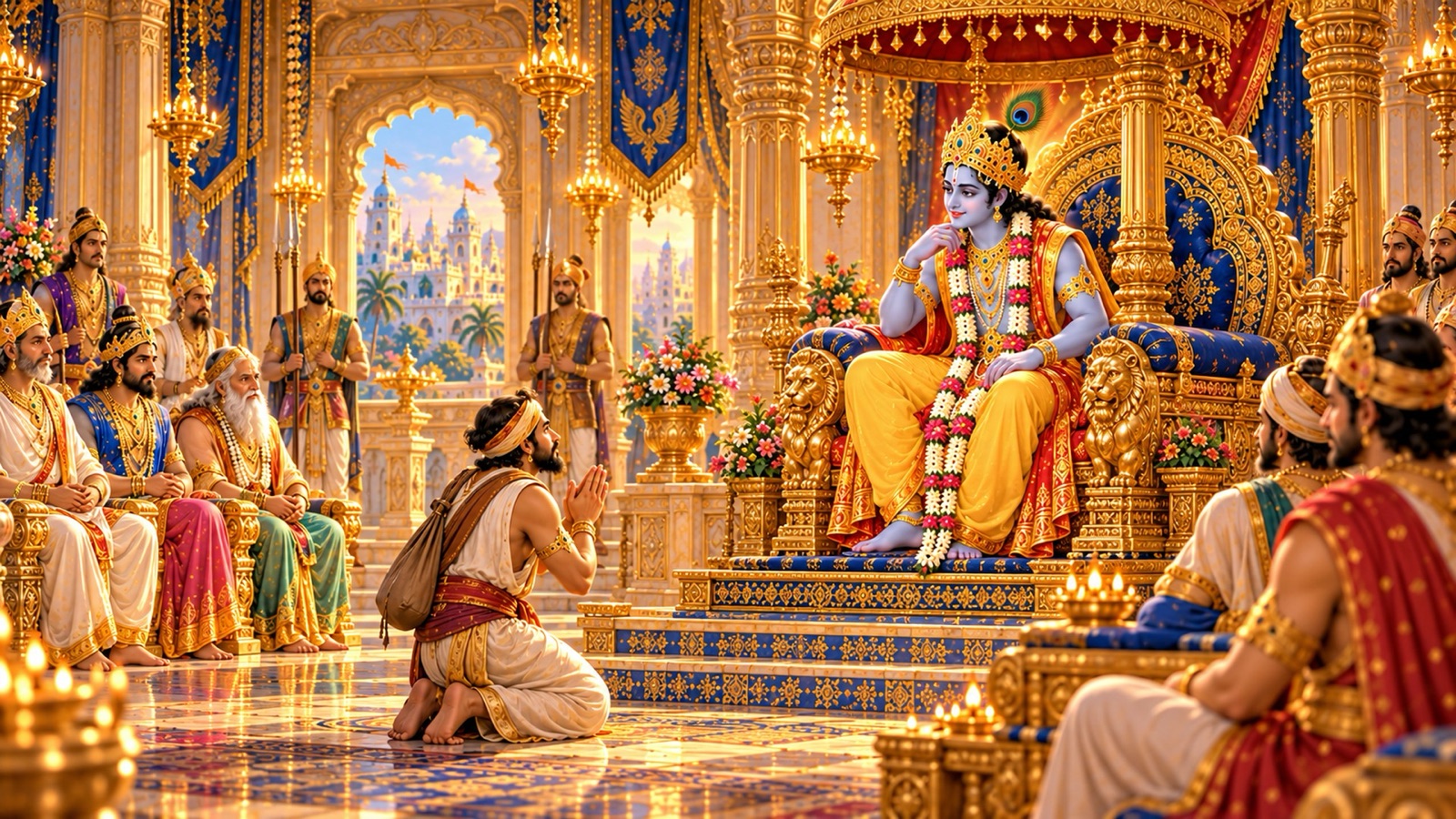
The messenger delivered their words. ‘Krishna, O Krishna of immeasurable Self, destroyer of the fear of those who surrender! Frightened of this worldly existence, still seeing ourselves as separate from You, we take refuge in You. People here pursue forbidden deeds and neglect the one auspicious duty You have ordained — Your worship; yet as mighty Time You abruptly cut off their hope of life. We bow to that unblinking Lord. You have descended with Your plenary portion to protect the righteous and curb the wicked; we cannot understand how anyone could defy Your command, nor how those who have taken refuge in You still reap the fruit of their past deeds.’
Their prayer deepened into confession.
स्वप्नायितं नृपसुखं परतन्त्रमीश
शश्वद्भयेन मृतकेन धुरं वहामः ।
हित्वा तदात्मनि सुखं त्वदनीहलभ्यं
क्लिश्यामहेऽतिकृपणास्तव माययेह ॥ २८ ॥
svapnāyitaṁ nṛpa-sukhaṁ para-tantram īśa śaśvad-bhayena mṛtakena dhuraṁ vahāmaḥ hitvā tad ātmani sukhaṁ tvad-anīha-labhyaṁ kliśyāmahe ‘ti-kṛpaṇās tava māyayeha
Meaning: O Lord, a king’s happiness is like a dream and depends upon others; with this corpse of a body, forever afraid, we carry its burden. Having forsaken the inner happiness that comes from You to those free of selfish striving, we wretched souls suffer here, deluded by Your Maya. (Canto 10, Chapter 70, verse 28)
तन्नो भवान् प्रणतशोकहराङ्घ्रियुग्मो
बद्धान् वियुङ्क्ष्व मगधाह्वयकर्मपाशात् ।
यो भूभुजोऽयुतमतङ्गजवीर्यमेको
बिभ्रद् रुरोध भवने मृगराडिवावीः ॥ २९ ॥
tan no bhavān praṇata-śoka-harāṅghri-yugmo baddhān viyuṅkṣva magadhāhvaya-karma-pāśāt yo bhū-bhujo ‘yuta-mataṅgaja-vīryam eko bibhrad rurodha bhavane mṛga-rāḍ ivāvīḥ
Meaning: Therefore, O Lord whose two feet dispel the sorrow of all who bow to them, release us who are bound by the rope of karma that bears the name Magadha — he who, alone wielding the might of ten thousand elephants, has penned us kings within his palace as a lion pens sheep. (Canto 10, Chapter 70, verse 29)
The kings continued: ‘O wielder of the discus, eighteen times You met Jarasandha in battle and crushed him; only once, playing the part of a man, did You let him prevail, and that single victory has swollen his pride; now he torments us, Your subjects. O unconquerable Lord, do now whatever You see fit.’ The messenger added his own plea: ‘Thus speak the kings imprisoned by Magadha’s ruler; longing for Your sight, they have surrendered at Your feet. Bless these afflicted souls.’
The Arrival of Devarshi Narada
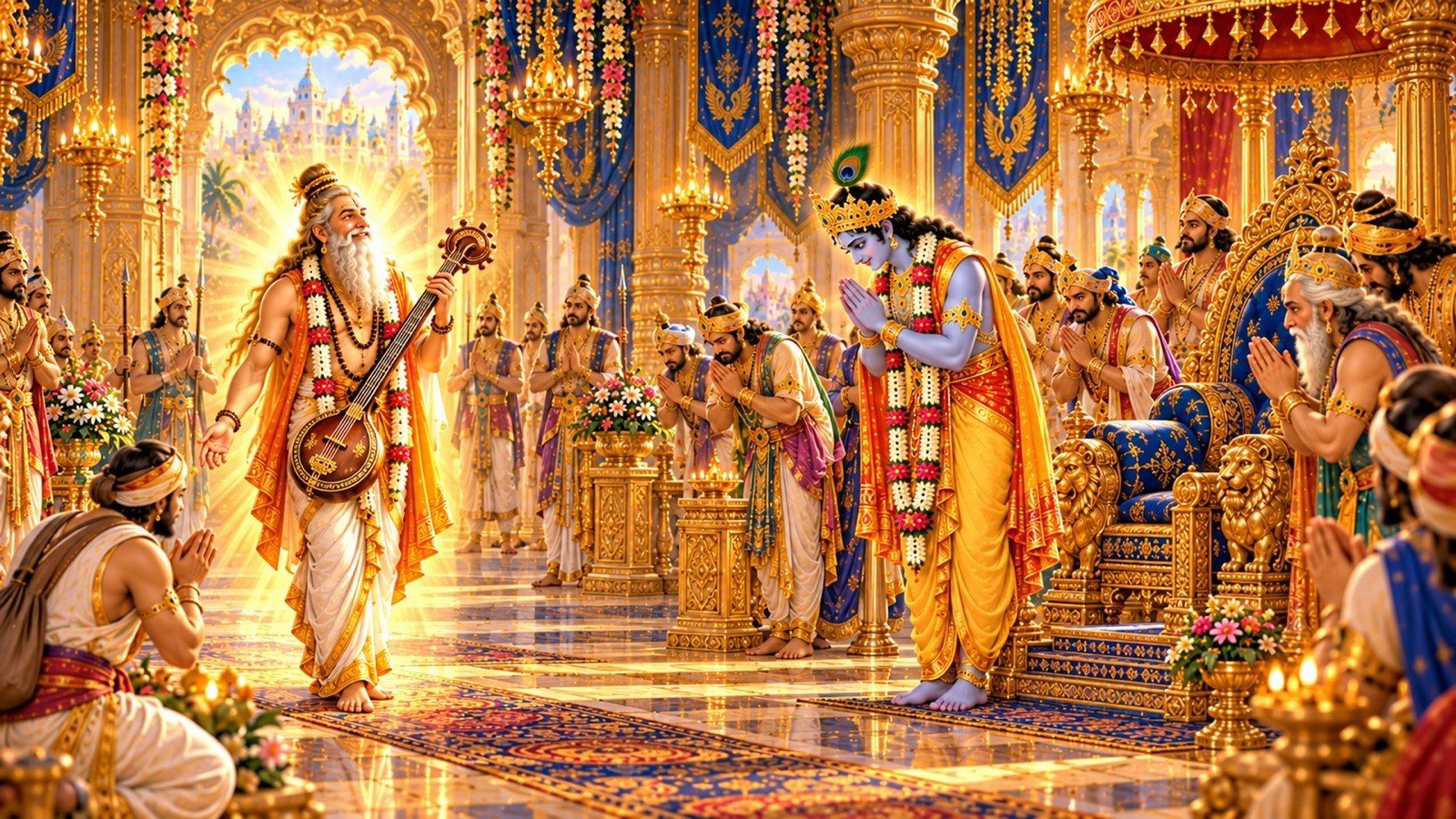
While the envoy was still speaking, the celestial sage Narada appeared, bearing his mass of golden matted locks and shining like the sun. Seeing him, Krishna, Lord of all the lords of the worlds, rose at once with His councillors and attendants and joyfully bowed His head. When Narada had taken his seat, the Lord worshipped him with due rites and said in sweet, truthful words: ‘Sage, is all fearless today in the three worlds? Your wandering through them is a great blessing to us, for nothing in creation is hidden from you. So we ask: what do the Pandavas intend to do?’
Narada Speaks of the Rajasuya
Narada replied: ‘O all-pervading Lord, many times I have beheld Your Maya, which even Brahma cannot pierce. You dwell within all beings through Your energies, as fire lies hidden in wood; so Your question about the Pandavas does not astonish me. By Your Maya You create and withdraw this universe, and by it the world appears to exist. Who can know Your purpose? I bow to You, whose nature is beyond compare.’
जीवस्य यः संसरतो विमोक्षणं
न जानतोऽनर्थवहाच्छरीरतः ।
लीलावतारैः स्वयशःप्रदीपकं
प्राज्वालयत्त्वा तमहं प्रपद्ये ॥ ३९ ॥
jīvasya yaḥ saṁsarato vimokṣaṇaṁ na jānato ‘nartha-vahāc charīrataḥ līlāvatāraiḥ sva-yaśaḥ-pradīpakaṁ prājvālayat tvā tam ahaṁ prapadye
Meaning: For the wandering soul who does not know how to be freed from the body, that bearer of every misfortune, You have lit the lamp of Your own glory through Your pastime-incarnations; to You I surrender. (Canto 10, Chapter 70, verse 39)
‘Nevertheless,’ Narada went on, ‘since You, the Supreme Brahman, imitate the ways of men, I shall tell You what Your cousin, the devoted King Yudhishthira, wishes. Though he already enjoys on earth the opulence of Brahma’s realm and desires nothing, he would worship You through the greatest of sacrifices, the Rajasuya. May You consent. To that rite the gods and the illustrious kings will come, eager to see You.’
श्रवणात् कीर्तनाद् ध्यानात् पूयन्तेऽन्तेवसायिनः ।
तव ब्रह्ममयस्येश किमुतेक्षाभिमर्शिनः ॥ ४३ ॥
śravaṇāt kīrtanād dhyānāt pūyante ‘nte-vasāyinaḥ tava brahma-mayasyeśa kim utekṣābhimarśinaḥ
Meaning: O Lord, even those of the lowest birth are purified by hearing of You, singing of You and meditating on You, who are Brahman itself — what then of those who see You and touch You? (Canto 10, Chapter 70, verse 43)
‘O blessing of the worlds,’ Narada concluded, ‘Your spotless fame spreads like a canopy over heaven, earth and the realms below, just as the water that washed Your feet sanctifies the universe as the Mandakini in heaven, the Bhogavati below and the Ganga on earth.’
The Lord Turns to Uddhava
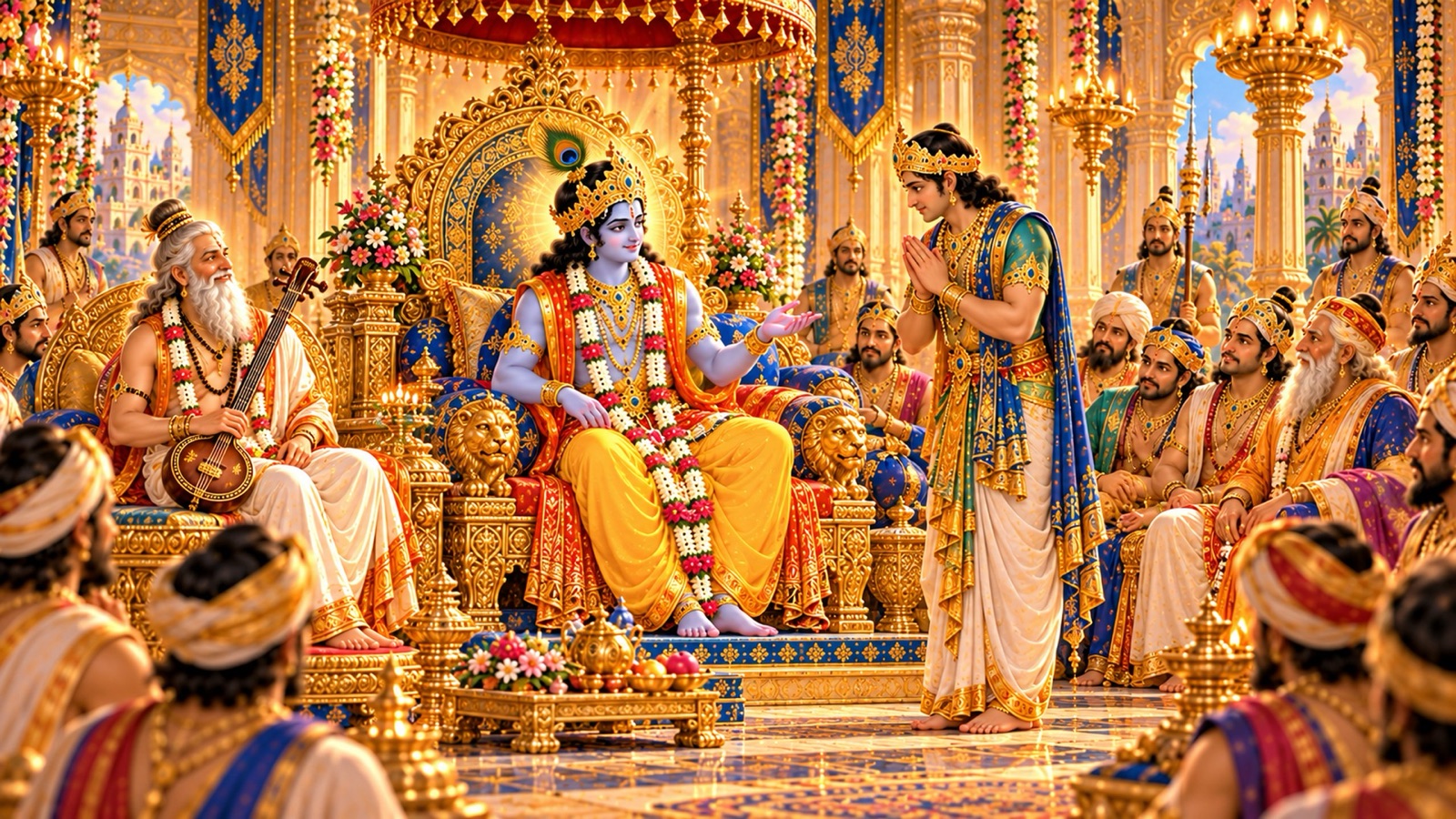
The Lord’s kinsmen in the hall, eager to conquer Jarasandha, did not welcome the sage’s proposal. Then Keshava, smiling, spoke graciously to His devoted servant Uddhava.
त्वं हि नः परमं चक्षुः सुहृन्मन्त्रार्थतत्त्ववित् ।
अथात्र ब्रूह्यनुष्ठेयं श्रद्दध्मः करवाम तत् ॥ ४६ ॥
tvaṁ hi naḥ paramaṁ cakṣuḥ suhṛn mantrārtha-tattva-vit athātra brūhy anuṣṭheyaṁ śraddadhmaḥ karavāma tat
Meaning: You are indeed Our supreme eye, Our well-wisher who knows the real import of counsel. Tell Us, then, what ought to be done here; We trust you and shall act accordingly. (Canto 10, Chapter 70, verse 46)
So addressed by his Master — who, though all-knowing, behaved as if He did not know — Uddhava placed the command upon his head and began to reply.
Principal Teachings of This Chapter
1. The Lord teaches by living the daily discipline. Krishna, who needs nothing, rises in the brāhma-muhūrta, meditates, performs sandhya and repeats the Gayatri (verse 4). Devotion is meant to shape the first hour of every day.
2. Worship offered to anyone reaches the Self of all. Krishna bows to cows, brahmanas, elders and all creatures as manifestations of His own Self (verse 10). Reverence toward every being is reverence toward Him.
3. Royal pleasure is a dream; only His feet untie karma’s rope. The kings confess that a ruler’s happiness depends on others and that they suffer because they have turned from the inner joy the Lord grants to the desireless (verse 28); they name Jarasandha the rope of their own karma and ask the Lord whose feet remove the grief of the surrendered to loosen it (verse 29). Deliverance begins with refuge.
4. The Lord’s descent kindles a lamp for the lost soul. Through His pastime-incarnations He lights the lamp of His glory for the wandering soul (verse 39), and hearing, singing and remembering Him purify even the lowliest (verse 43). This is why the Bhagavatam itself is sung.
5. Why the omniscient Lord asks His devotee. He who is the eye of all calls Uddhava His supreme eye and submits to his counsel (verse 46) while knowing everything. Narada names the reason: the Lord takes on the ways of the human world so that mortals may learn from Him. By consulting His devotee and bowing to all beings, the self-sufficient Lord teaches humility, honours those who love Him, and makes His devotees partners in His plan — from this hall will flow the Rajasuya, the fall of Jarasandha and the freedom of the kings.
A Devotional Reflection
Before any great deed in this chapter there is simply a morning: water touched to the lips, a mind resting in its own light, a fire fed, cows led gently to brahmanas. The One whom the Vedas seek bows to a cow and to an elder. If He treats the dawn so, how carelessly do we spend ours? Then a stranger weeps in the hall and a sage arrives like the sun, and we see that His routine was never a withdrawal from the world but a readiness for it. The kings do not merely ask for an army; they admit that their chains are their own karma, and that honesty is the beginning of their freedom.
A Daily Devotional Practice
Tomorrow, rise a little before your usual hour. Touch water, sit quietly for a few breaths, and remember the Lord as the self-luminous Self within. Then bow inwardly to the beings you will meet during the day — family, strangers, animals — as bearers of His presence. Begin by chanting gently: Om Namo Bhagavate Vasudevaya.
Conclusion
The seventieth chapter of the Tenth Canto places the Lord’s whole greatness inside a single day — dawn prayers, the radiant assembly, the captive kings’ plea, Narada’s tidings and the question put to Uddhava. The Supreme Lord sanctifies ordinary hours by living them in devotion, refuge in Him loosens the rope of karma, and He delights in making His devotees His own eyes. May we carry His dawn into ours.
May the divine wisdom of Srimad Bhagavatam awaken pure devotion within our hearts.
Om Namo Bhagavate Vasudevaya.
Jay Shree Madhav.
References and Attribution
- Primary edition: Gita Press, Śrīmad Bhāgavata Mahāpurāṇa (English), Book Ten (Latter Half), Discourse 70.
- Series: Srimad Bhagavatam Wisdom · Biswa Sanatan Dharma Seva Trust.
- Presented following the spiritual guidance and recommendation of Pandit Dr. Shri Kashinath Mishra.
This is an original, faithful retelling in the writer’s own words, with brief quoted verses shown in Devanāgarī and transliteration and their meanings given as summaries. It is not a reproduction of any single publisher’s continuous translation or commentary. No affiliation with or endorsement by any publisher is implied.
Jay Shree Madhav