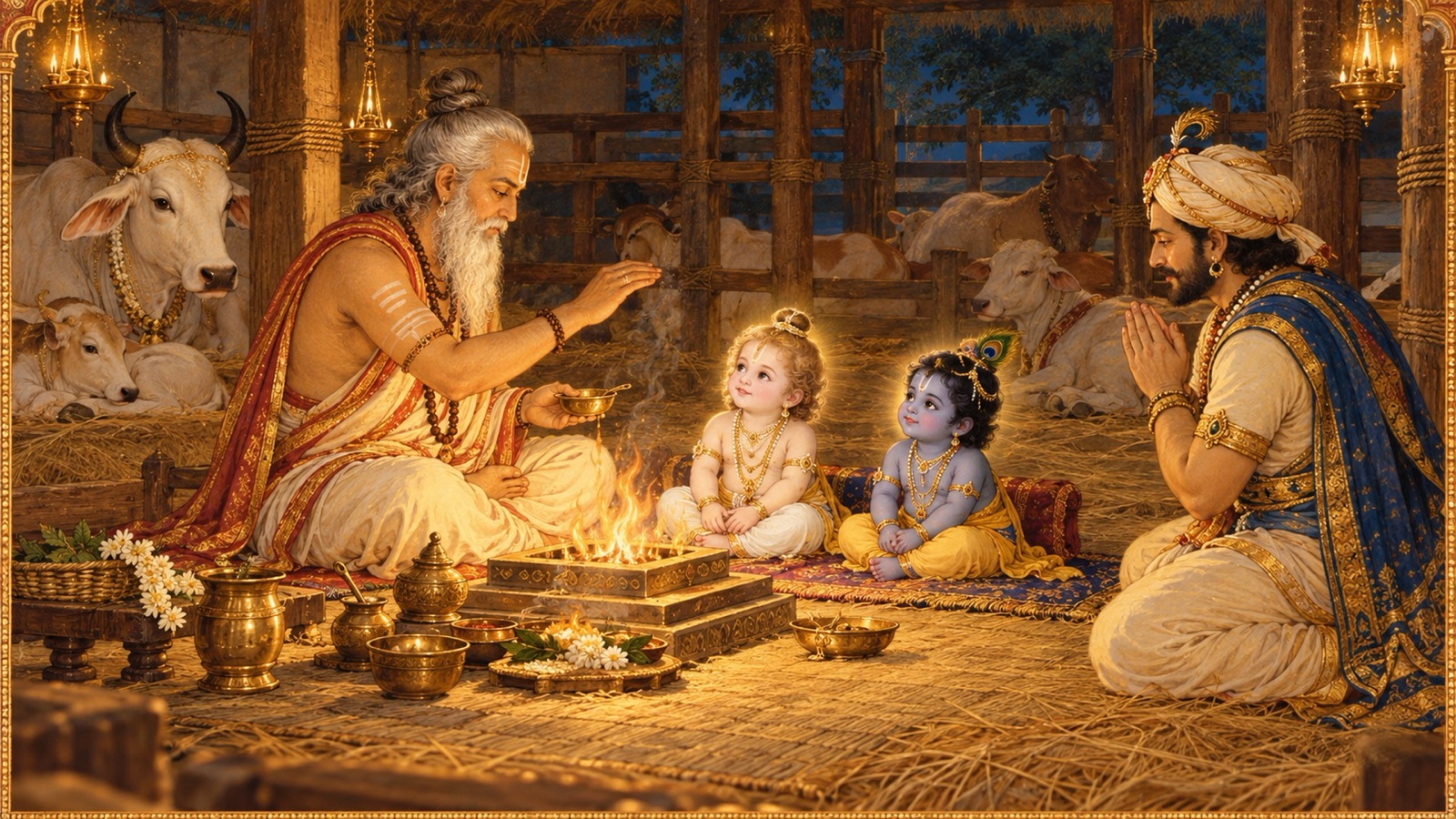
In the secrecy of the cow-pen, the sage Garga performs the naming ceremony of Nanda’s two boys, revealing the many names and hidden glory of the dark-hued child of Yasoda.
Om Namo Bhagavate Vasudevaya.
Om Namo Bhagavate Vasudevaya.
Om Namo Bhagavate Vasudevaya.
Welcome back to Srimad Bhagavatam Wisdom, our devotional journey through the sacred histories and teachings of the Srimad Bhagavat Mahapurana. In the previous chapter the infant Krishna overturned a cart, delivered the whirlwind-demon Trinavarta, and showed His mother a first glimpse of the universe within His mouth. This eighth chapter turns from danger to sweetness. The learned sage Garga, family priest of the Yadus, comes quietly to Vraja and performs the naming ceremony of Balarama and Krishna, unveiling the boy’s many names and secret glory. Then Sukadeva paints the tender pastimes of the two Boys — crawling in the mud, following passers-by, stealing butter and curd from the homes of Vraja — until the gopis come laughing and complaining to Yasoda. And at last, when the child is accused of eating earth and opens His mouth for His mother to see, Yasoda beholds the whole cosmos within it, and for one trembling moment understands who her son truly is.
Chapter Information
- Scripture: Śrīmad Bhāgavata Mahāpurāṇa
- Canto: 10 (Book Ten, First Half)
- Chapter: 8 (Discourse 8)
- Chapter title: The Naming Ceremony and Infant Pastimes
- Principal speaker: Sukadeva Gosvami (narrating to King Parikshit); related in turn by Suta Gosvami to the sages at Naimisharanya
- Principal listener: King Parikshit (within Sukadeva’s narration); the sages assembled at Naimisharanya
- Main setting: The cowherd village of Gokula in Vraja
- Central subject: Garga’s secret naming ceremony for Balarama and Krishna; the crawling and childhood pastimes of the two Boys; the butter-theft complaints of the gopis; and Yasoda’s vision of the universe within the mouth of the child who was accused of eating earth
- Principal verse range: Canto 10, Chapter 8, verses 1–52
- Primary edition: Gita Press Śrīmad Bhāgavata Mahāpurāṇa
Context From the Previous Chapter
In Chapter 7, King Parikshit begged Sukadeva for more of the Lord’s childhood, and heard how the infant Krishna toppled a heavy cart with a kick of His foot, how the demon Trinavarta swept Him into the sky as a whirlwind only to fall dead while the child returned unharmed, and how Yasoda beheld the universe within her son’s yawning mouth. This chapter continues those infant years, beginning with the coming of the sage Garga to Vraja.
The Coming of Garga and the Secret Naming
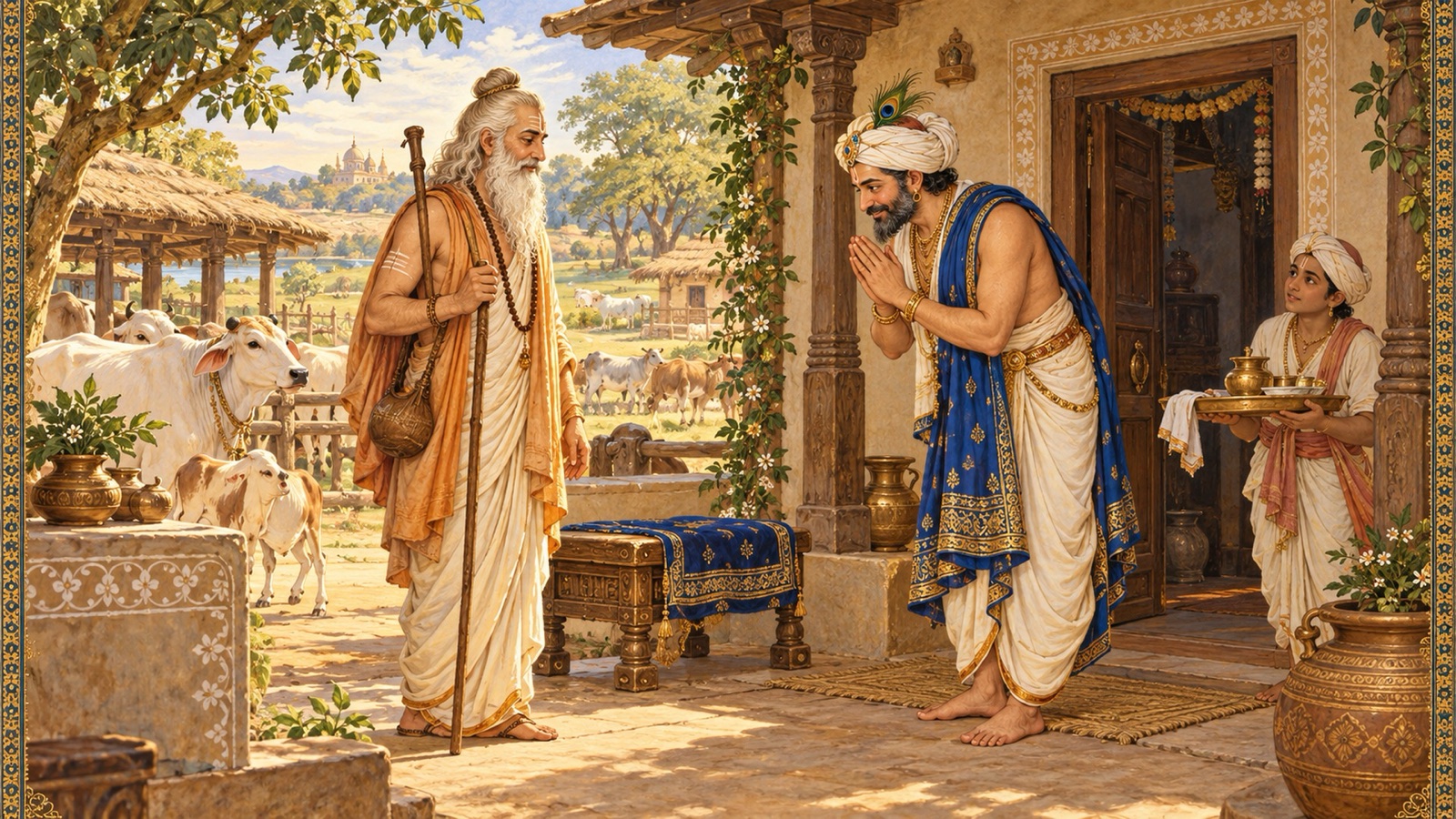
At Vasudeva’s request, Garga — the family priest of the Yadus and a great ascetic — came quietly to Nanda’s Vraja. Overjoyed, Nanda rose with folded palms to welcome him, honouring him as one would honour Lord Vishnu Himself, and after offering hospitality asked what service he might render. Garga, however, warned that if he, the well-known priest of the Yadus, were to openly consecrate the boys, the suspicious Kamsa might conclude that this was Devaki’s eighth child and seek to harm him. Nanda therefore requested that the naming rite be performed in secret, within the cow-pen, unnoticed even by his own people. Consenting, Garga quietly performed the naming ceremony for the two sons of Rohini and Yasoda.
श्रीगर्ग उवाच
अयं हि रोहिणीपुत्रो रमयन् सुहृदो गुणै: ।
आख्यास्यते राम इति बलाधिक्याद्बलं विदु: ।
यदूनामपृथग्भावात् सङ्कर्षणमुशन्त्यपि ॥ १२ ॥
śrī-garga uvāca ayaṁ hi rohiṇī-putro ramayan suhṛdo guṇaiḥ ākhyāsyate rāma iti balādhikyād balaṁ viduḥ yadūnām apṛthag-bhāvāt saṅkarṣaṇam uśanty api
Meaning: Garga said: This son of Rohini, delighting His loved ones by His qualities, will be called Rama; for His surpassing strength people will know Him as Bala; and because He unites the Yadus without distinction, He will also be called Sankarshana. (Canto 10, Chapter 8, verse 12)
Of Yasoda’s son, Garga revealed more. In every age this child assumes a form and a colour — white, red, and yellow in ages past, and now a beautiful dark hue. Once, He was born in the house of Vasudeva, and so the wise would call Him Vasudeva. His names and forms, said the sage, are countless, matching His qualities and deeds. This boy would be the delight of all Gokula and the good fortune of Nanda’s house; through Him they would cross every difficulty, and those who loved him could never be overpowered by their enemies, for he was, in his excellences and glory, the very equal of Lord Narayana. Having instructed Nanda, Garga returned to his home, and Nanda felt himself blessed beyond measure.
The Crawling Pastimes of the Two Boys
Not long afterward, Balarama and Krishna began to crawl about Gokula on their hands and knees. Dragging their little feet through the mud of Vraja, the tinkling bells at their waists and ankles delighting their own ears, they would follow a passer-by a little way and then, discovering a stranger, hurry back in innocent alarm to their mothers. Rohini and Yasoda, their breasts flowing with milk from sheer affection, would gather up their mud-smeared sons and nurse them, gazing in ecstasy at the small teeth and winning smiles of the little ones at their breasts.
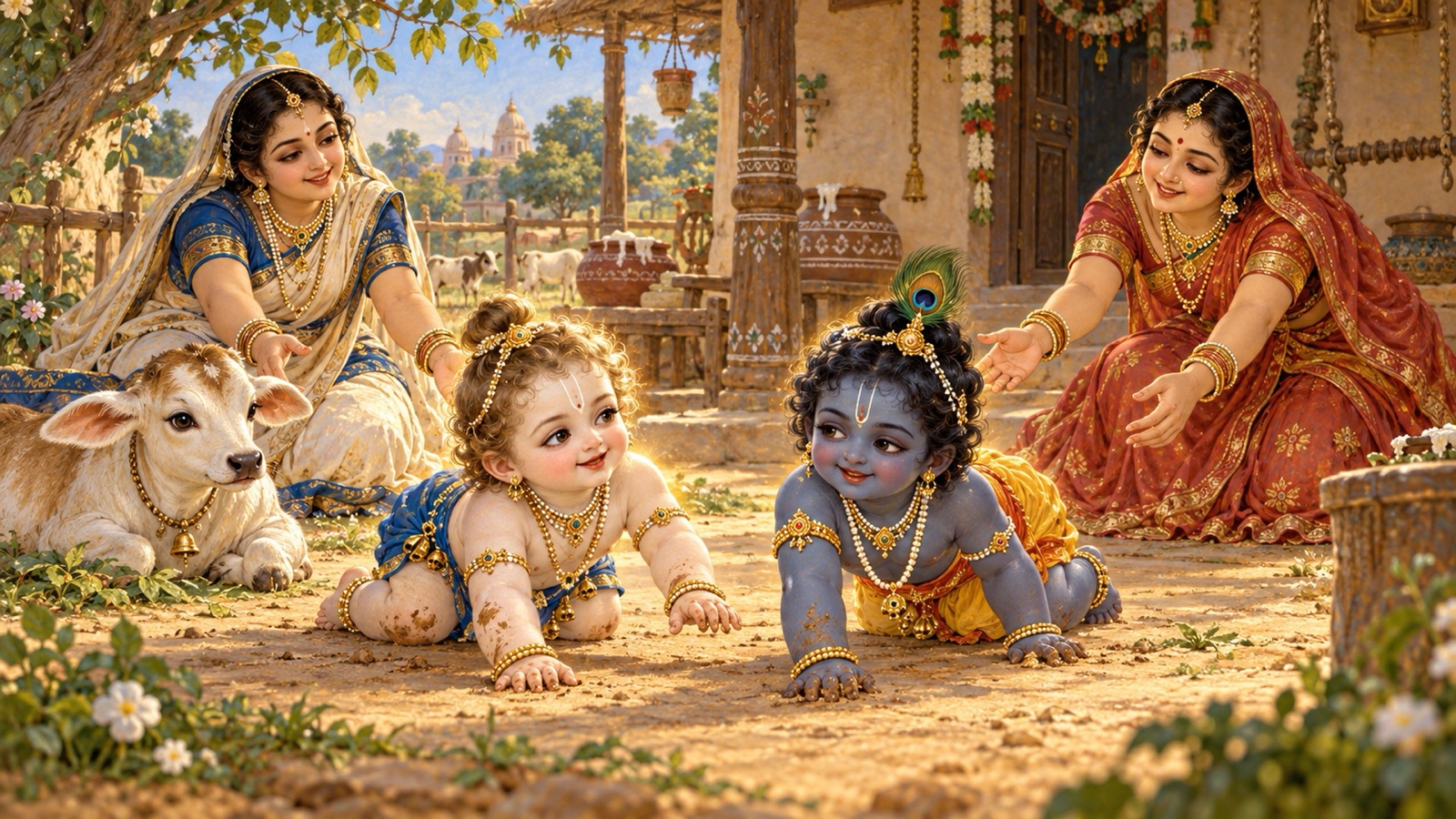
As the Boys grew a little older they played among the calves, seizing their tails and being dragged about, to the laughter and delight of the women of Vraja, who left their household work to watch. So restless were the children, and so drawn to horned animals, fire, water, and thorns, that their mothers could scarcely keep them from harm or attend to their own duties, and their minds were full of a sweet distraction.
The Butter-Thief of Vraja
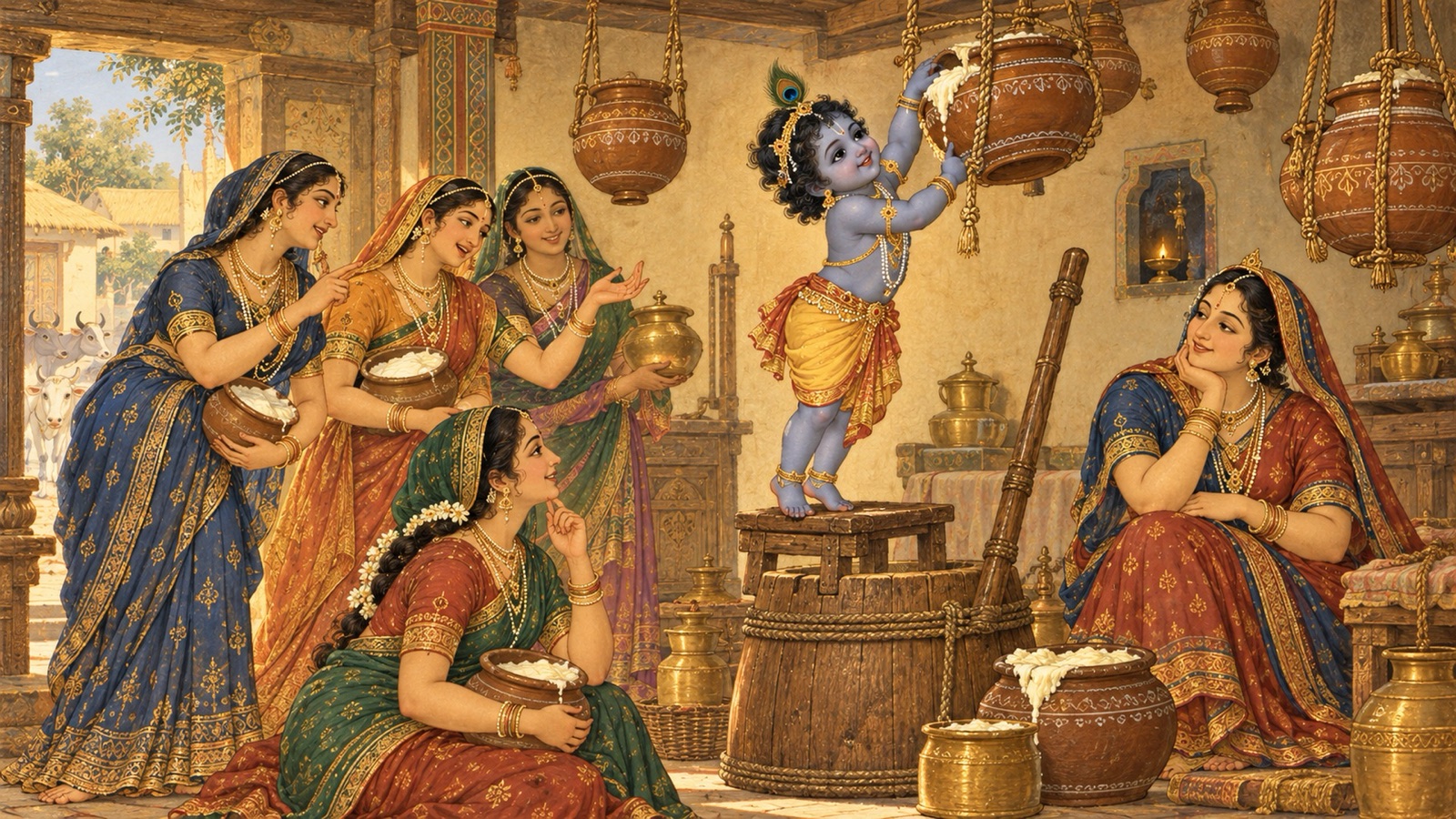
In time Krishna, with Balarama, began to play with the cowherd boys of His own age, and the charm of His mischief drew the gopis in a body to Yasoda’s door. They came to complain — though their faces betrayed how much they adored Him. He unties our calves before milking time, they said; He steals our curds and milk and shares them out to the monkeys; when there is nothing left to eat He breaks the pots in anger and sets the babies crying, and then sits beside you looking utterly innocent.
हस्ताग्राह्ये रचयति विधिं पीठकोलूखलाद्यै-
श्छिद्रं ह्यन्तर्निहितवयुन: शिक्यभाण्डेषु तद्वित् ।
ध्वान्तागारे धृतमणिगणं स्वाङ्गमर्थप्रदीपं
काले गोप्यो यर्हि गृहकृत्येषु सुव्यग्रचित्ता: ॥ ३० ॥
hastāgrāhye racayati vidhiṁ pīṭhakolūkhalādyaiś chidraṁ hy antar-nihita-vayunaḥ śikya-bhāṇḍeṣu tad-vit dhvāntāgāre dhṛta-maṇi-gaṇaṁ svāṅgam artha-pradīpaṁ kāle gopyo yarhi gṛha-kṛtyeṣu suvyagra-cittāḥ
Meaning: When the pots hang out of reach, He stacks up seats and grinding-mortars to climb to them; knowing well what they hold, He bores holes in the hanging pots; and in a dark storeroom He turns His own jewel-bright body into a lamp to find the butter — all at the times when the cowherd women are fully absorbed in their household chores. (Canto 10, Chapter 8, verse 30)
Hearing all this recounted at length, and watching Krishna gaze back at her with wide, frightened eyes and a face too charming to scold, Yasoda could not bring herself to rebuke Him, and only stood with a laughing face.
Yasoda Beholds the Universe in the Mouth of Her Son
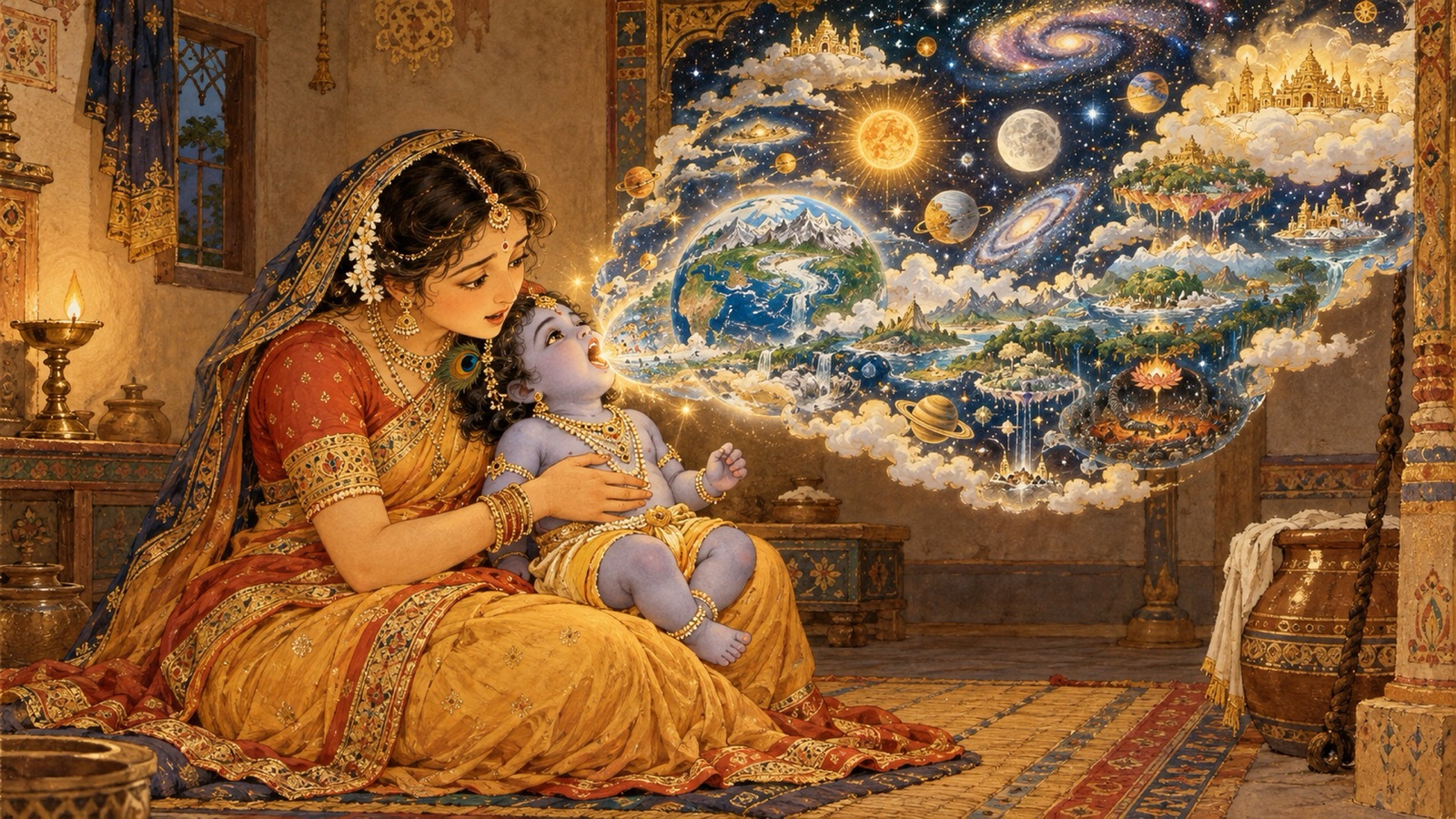
One day, while at play, the cowherd boys led by Balarama told Yasoda that Krishna had been eating earth. Taking her son by the hand and gently chiding Him — for she sought only His welfare — Yasoda asked why He had secretly eaten dirt, as His playmates and even His elder brother reported. “I never ate earth, mother,” the Lord replied. “They are all telling untruths. If you think they are truthful, then look into My mouth yourself.” “Open your mouth, then,” she said. And the Lord Sri Hari, who in play had taken the form of a human child, opened His mouth.
सा तत्र ददृशे विश्वं जगत्स्थास्नु च खं दिश: ।
साद्रिद्वीपाब्धिभूगोलं सवाय्वग्नीन्दुतारकम् ॥ ३७ ॥
ज्योतिश्चक्रं जलं तेजो नभस्वान्वियदेव च ।
वैकारिकाणीन्द्रियाणि मनो मात्रा गुणास्त्रय: ॥ ३८ ॥
एतद् विचित्रं सहजीवकाल-
स्वभावकर्माशयलिङ्गभेदम् ।
सूनोस्तनौ वीक्ष्य विदारितास्ये
व्रजं सहात्मानमवाप शङ्काम् ॥ ३९ ॥
sā tatra dadṛśe viśvaṁ jagat sthāsnu ca khaṁ diśaḥ sādri-dvīpābdhi-bhūgolaṁ sa-vāyv-agnīndu-tārakam jyotiś-cakraṁ jalaṁ tejo nabhasvān viyad eva ca vaikārikāṇīndriyāṇi mano mātrā guṇās trayaḥ etad vicitraṁ saha-jīva-kāla- svabhāva-karmāśaya-liṅga-bhedam sūnos tanau vīkṣya vidāritāsye vrajaṁ sahātmānam avāpa śaṅkām
Meaning: Within His mouth she saw the whole universe — the moving and the unmoving, the sky and the directions, the earth with its mountains, islands, and oceans, the wind, fire, moon, and stars, the wheel of the planets, water, light, and space, the senses and the mind, the objects of sense and the three modes of nature. Beholding this wondrous universe with all its diversity of living beings, time, nature, and action within the small body and open mouth of her son — and beholding Vraja itself, and her own self, within it — Yasoda was seized with amazement. (Canto 10, Chapter 8, verses 37-39)
Was this a dream, she wondered, or the Lord’s illusion, or some delusion of her own mind — or the very glory of her wondrous child? Bowing within her heart to that ungraspable Truth which is the ground of all, she recognized for one clear moment the divine Maya by which she took herself to be Nanda’s wife and mistress of his fortune, this child to be her son, and the cowherds and cattle to be her own.
अहं ममासौ पतिरेष मे सुतो
व्रजेश्वरस्याखिलवित्तपा सती ।
गोप्यश्च गोपा: सहगोधनाश्च मे
यन्माययेत्थं कुमति: स मे गति: ॥ ४२ ॥
ahaṁ mamāsau patir eṣa me suto vrajeśvarasyākhila-vittapā satī gopyaś ca gopāḥ saha-godhanāś ca me yan-māyayetthaṁ kumatiḥ sa me gatiḥ
Meaning: “By whose Maya I think, ‘I am the chaste mistress of all the lord of Vraja’s wealth; this is my husband, this my son; the cowherd men and women and the cattle are mine’ — that Lord alone is my refuge.” (Canto 10, Chapter 8, verse 42)
Then the almighty Lord, seeing His mother’s realization, cast over her once more His divine charm in the form of maternal love. The vision vanished in an instant; Yasoda drew her son into her lap, her heart flooded with tenderness as before, and again regarded the Lord whose glory the Vedas, the Upanishads, and the great schools of wisdom forever celebrate — simply as her own dear child.
Parikshit’s Wonder at the Fortune of Vraja
Hearing this, King Parikshit was moved to ask the question that lingers in every devotee’s heart.
श्रीराजोवाच
नन्द: किमकरोद् ब्रह्मन्श्रेय एवं महोदयम् ।
यशोदा च महाभागा पपौ यस्या: स्तनं हरि: ॥ ४६ ॥
śrī-rājovāca nandaḥ kim akarod brahman śreya evaṁ mahodayam yaśodā ca mahā-bhāgā papau yasyāḥ stanaṁ hariḥ
Meaning: The King said: O sage, what meritorious act did Nanda perform to earn such great fortune, and what did the greatly blessed Yasoda do, whose breast the Lord Sri Hari Himself drank? (Canto 10, Chapter 8, verse 46)
Even Vasudeva and Devaki, he marvelled, did not get to behold these charming infant pastimes that sages glorify to this day and that wipe away the sins of the world. With this loving question, Sukadeva prepares to reveal the deep good fortune of Nanda and Yasoda — a fortune born, as the chapter’s closing verses tell, of great souls blessed long ago to receive the Supreme Lord as their own child.
Principal Teachings of This Chapter
1. The Lord bears endless names, all pointing to one truth. Garga reveals that the child has countless names and forms suited to His qualities and deeds (verse 12). Each holy name is a doorway to the same infinite Lord.
2. God delights to hide within intimacy. The Supreme Person crawls in the mud, steals butter, and plays like any child (verses 21-31). His greatness is veiled precisely so that love, not awe, may draw near Him.
3. Even the Lord’s mischief is His mercy. The gopis’ complaints are half-laughter; Krishna’s “thefts” bind all of Vraja to Him in affection. The Lord steals hearts before He steals butter.
4. The whole universe rests within the Lord. In Yasoda’s vision, the cosmos, Vraja, and Yasoda herself are seen within the child’s mouth (verses 37-39). He is not in the world; the world is in Him.
5. Divine love is sustained by divine grace. When Yasoda glimpses the truth, the Lord Himself restores her motherly love (verse 42-43), teaching that pure devotion is not our achievement but His gift.
A Devotional Reflection
There is a profound gentleness in this chapter. Yasoda is shown the entire universe within her child — and then, mercifully, allowed to forget it, so that she may go on loving Him as her little boy. The Bhagavatam seems to tell us that the Lord does not want to overwhelm us with His greatness; He wants to be loved. The vision is real, but so is the love, and it is the love that He chooses to preserve. For those of us who long to know God, this is a quiet correction: the goal is not merely to comprehend the infinite, which even Yasoda could not hold for more than a moment, but to love the One who holds the infinite, and to let ourselves be loved in return. The butter-thief who bores holes in our pots is only trying to steal something far dearer than butter — our hearts.
A Daily Devotional Practice
Today, call upon the Lord by one of His many names, as Garga revealed that the one Lord answers to countless names. Choose a name of Krishna that is dear to you — Rama, Govinda, Damodara, Vasudeva — and repeat it gently through your day, letting each utterance draw you a little nearer to Him. As you begin, chant: “Om Namo Bhagavate Vasudevaya.”
Conclusion
The eighth chapter of the Tenth Canto is a garland of sweetness strung between two glimpses of infinity. Garga unveils the boy’s hidden names and glory; the two Boys crawl and play and steal their way into the heart of all Vraja; and when Yasoda opens her son’s mouth she finds within it the whole of creation, herself included. Yet the chapter does not end in awe but in love — the Lord gently returning His mother to her tender illusion so that the pastimes may continue. Parikshit’s closing question, wondering what Nanda and Yasoda did to deserve so great a fortune, invites us into the same longing: to be counted, however humbly, among those who love the child of Vraja. May we, hearing of His names and His sports, find our own hearts quietly stolen by the butter-thief of Gokula.
May the divine wisdom of Srimad Bhagavatam awaken pure devotion within our hearts.
Om Namo Bhagavate Vasudevaya.
Jay Shree Madhav.
References and Attribution
- Primary edition: Gita Press, Śrīmad Bhāgavata Mahāpurāṇa (English, complete), Book Ten (First Half), Discourse 8.
- Series: Srimad Bhagavatam Wisdom · Biswa Sanatan Dharma Seva Trust.
- Presented following the spiritual guidance and recommendation of Pandit Dr. Shri Kashinath Mishra.
This is an original, faithful retelling in the writer’s own words, with brief quoted verses shown in Devanāgarī and transliteration and their meanings given as summaries. It is not a reproduction of any single publisher’s continuous translation or commentary. No affiliation with or endorsement by any publisher is implied.
Jay Shree Madhav