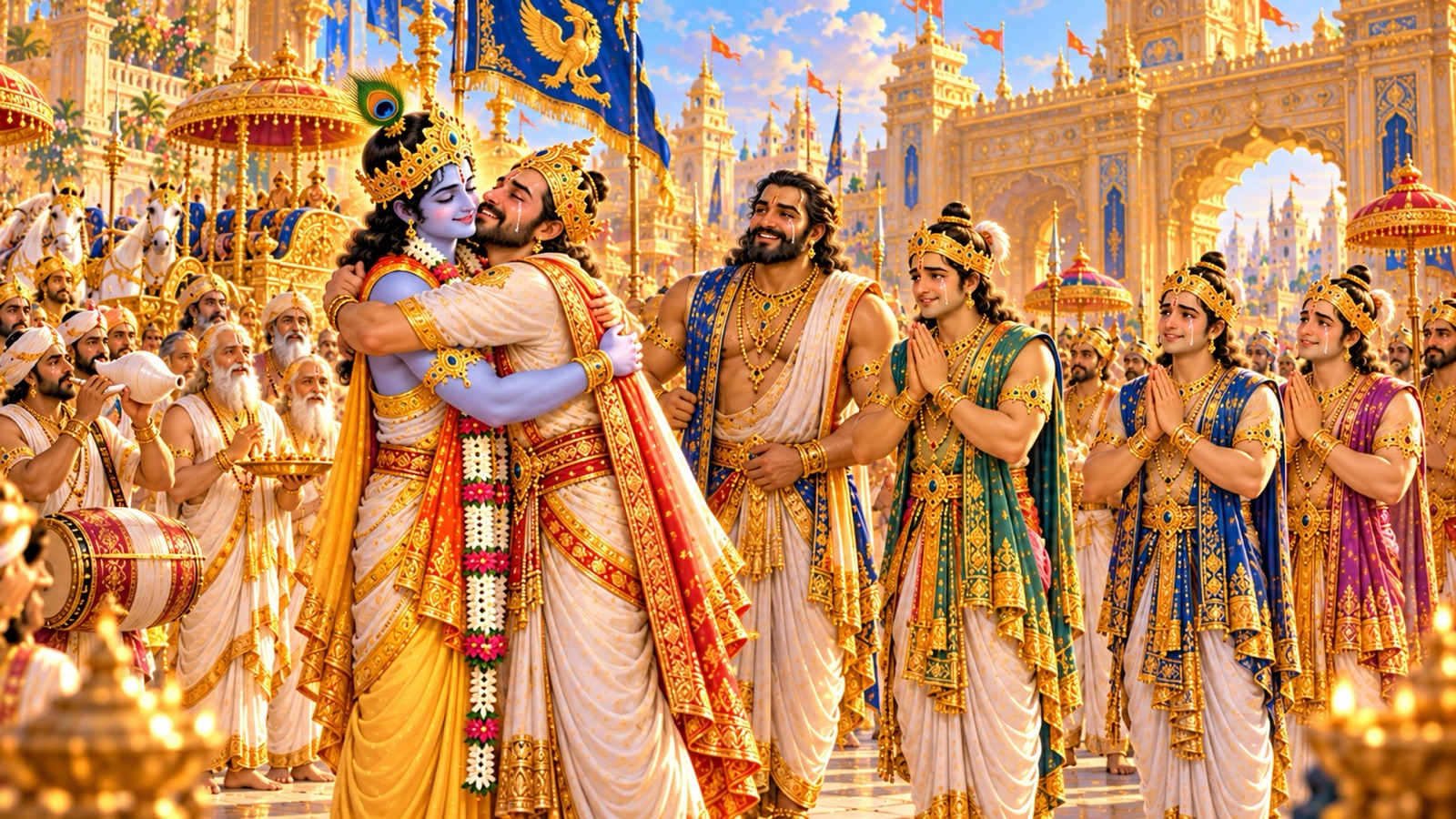
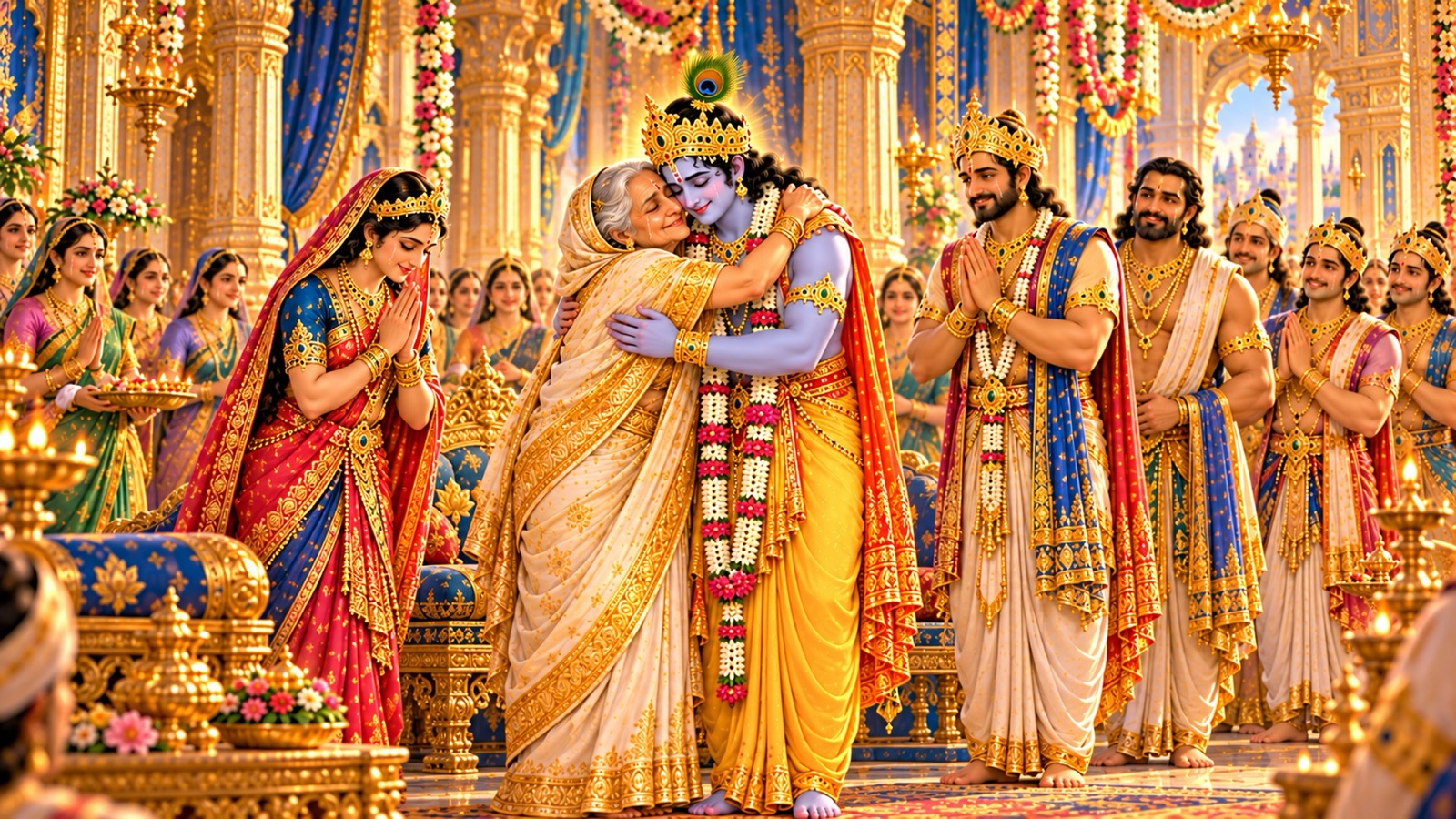
At the gates of Indraprastha, King Yudhishthira folds the Lord of the three worlds into his arms — and in that single embrace every sorrow of the world falls silent.
Om Namo Bhagavate Vasudevaya.
Om Namo Bhagavate Vasudevaya.
Om Namo Bhagavate Vasudevaya.
Welcome back to Srimad Bhagavatam Wisdom, our devotional journey through the sacred histories and teachings of the Srimad Bhagavat Mahapurana. In this seventy-first chapter of the Tenth Canto, Sukadeva Gosvami tells King Parikshit how Uddhava answered Krishna’s question, and then follows the Lord out of Dwaraka with His queens and army to a city whose every street and heart had been made ready for Him.
Chapter Information
- Scripture: Śrīmad Bhāgavata Mahāpurāṇa
- Canto: 10 (Book Ten, Latter Half)
- Chapter: 71 (Discourse 71)
- Chapter title: The Lord Travels to Indraprastha
- Principal speaker: Sukadeva Gosvami (narrating to King Parikshit); within the narrative, Uddhava counsels Sri Krishna
- Principal listener: King Parikshit
- Main setting: The royal assembly at Dvārakā; the road through Ānarta, Kurukṣetra and Pāñcāla; Indraprastha
- Central subject: Uddhava’s counsel; the Lord’s journey with His queens and army; the reunion at Indraprastha
- Principal verse range: Canto 10, Chapter 71, verses 1–45
- Primary edition: Gita Press Śrīmad Bhāgavata Mahāpurāṇa (English, Book Ten, Latter Half)
Context From the Previous Chapter
In Chapter 70, a messenger from the kings imprisoned by Jarasandha arrived at Dwaraka pleading for rescue, and almost at once the sage Narada came with news that Yudhishthira wished to perform the Rajasuya sacrifice and longed for Krishna’s presence. Torn between two calls, the Lord turned smilingly to Uddhava and asked him, as the “eye” of the Yadavas, what should be done.
Uddhava Weighs Two Calls
Hearing the Lord’s words, Uddhava, whose mind was vast and clear, weighed the message of the celestial sage Narada, the mood of the councillors and the wish of Krishna Himself, and then he spoke. The Lord should surely help His cousin Yudhishthira with the great sacrifice, he began, and at the same time protect the kings who had sought His shelter. For a Rajasuya belongs only to a sovereign whom the kings of every direction have acknowledged — and Jarasandha of Magadha stood squarely in the way.
यष्टव्यं राजसूयेन दिक्चक्रजयिना विभो ।
अतो जरासुतजय उभयार्थो मतो मम ॥ ३ ॥
yaṣṭavyaṁ rājasūyena dik-cakra-jayinā vibho ato jarā-suta-jaya ubhayārtho mato mama
Meaning: O almighty one, the Rajasuya may be offered only by a king who has triumphed over the whole circle of directions; therefore, in my judgement, victory over the son of Jara will accomplish both purposes at once. (Canto 10, Chapter 71, verse 3)
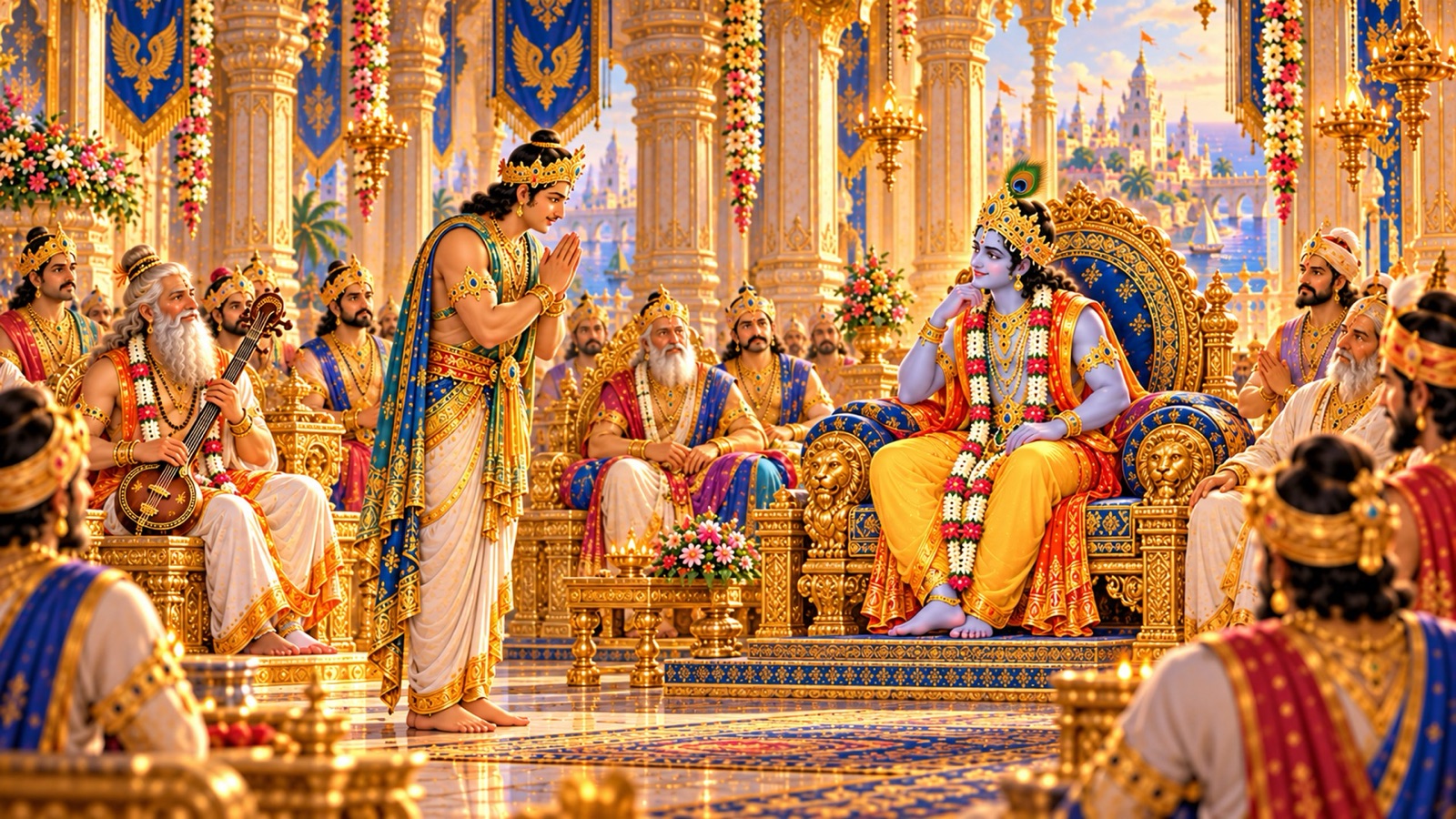
This one deed, Uddhava continued, would bring great gain to the Yadavas, and freeing the imprisoned kings would spread Govinda’s fame. Yet Jarasandha was no easy foe: he had the strength of ten thousand elephants, and none among the mighty could withstand him save Bhima, his equal in power. He could be overcome only in single combat, never while his hundred akshauhinis stood around him. But he honoured brahmanas and never refused their request — so let Bhima go to him dressed as a brahmana and beg the boon of a duel; in the Lord’s presence Bhima would surely slay him.
Then Uddhava lifted his counsel from strategy to truth, acknowledging whose will truly governed the outcome.
निमित्तं परमीशस्य विश्वसर्गनिरोधयो: ।
हिरण्यगर्भ: शर्वश्च कालस्यारूपिणस्तव ॥ ८ ॥
nimittaṁ param īśasya viśva-sarga-nirodhayoḥ hiraṇyagarbhaḥ śarvaś ca kālasyārūpiṇas tava
Meaning: You are the Supreme Lord, Time without form; of the universe’s creation and dissolution You alone are the cause, and Hiranyagarbha and Sharva serve merely as Your instruments. (Canto 10, Chapter 71, verse 8)
Once the tyrant fell, Uddhava said, the queens of the freed kings would sing in their homes of this glorious deed, just as the gopis sing of their rescue, the sages of the deliverance of the king of elephants and of Sita, and we Yadavas of the release of Your parents. The slaying of Jarasandha would thus serve many ends at once; the merits of the kings and the sins of their captor were ripe for fruit, and the sacrifice itself was dear to the Lord.
The Lord Accepts the Counsel
Sukadeva told Parikshit that Uddhava’s counsel was wholesome in every respect, and that the celestial sage, the Yadava elders and Krishna Himself all honoured it. The One whom Uddhava had just called formless Time did not announce a decree; He asked His devotee, listened, and accepted the advice. The Lord who needs no counsellor chooses to be counselled, so that His servant’s wisdom may be glorified and the whole assembly drawn into the work. The deed, moreover, was shaped so that one journey would free the captive kings, crown Yudhishthira’s sacrifice, and fill countless homes with songs of His mercy. Every step the Lord takes becomes a gift to many, and He takes it in the company of those who love Him.
Then Lord Krishna, the son of Devaki, with the leave of His elders, ordered His servants Daruka, Jaitra and the rest to prepare for the journey. Taking permission from Balarama and King Ugrasena, He sent His queens and children ahead with their retinue, and mounted the chariot Daruka brought, flying the banner of Garuda. The sage Narada, his heart filled with the sight of Mukunda, was honoured by the Lord of the Yadus, bowed, and departed through the sky holding the Lord’s form within his heart.
The Procession Leaves Dwaraka
The Lord set out surrounded by His formidable army — chariots, elephants, cavalry and foot soldiers under their commanders — while mridangas, kettledrums, conches and horns filled every direction with their thunder. Behind Him followed His devoted queens, Rukmini and the others, with their children, adorned with ornaments, sandal paste and garlands, riding in palanquins and golden litters under the close guard of swordsmen. Then came the households of the servants, their tents and belongings loaded on oxen, buffaloes, donkeys and mules, the women travelling in carts or on camels and elephants. Under the sun that great host, with its tall flags, parasols, whisks, weapons, crowns and armour, roared and glittered like an ocean stirred by its waves and leviathans.
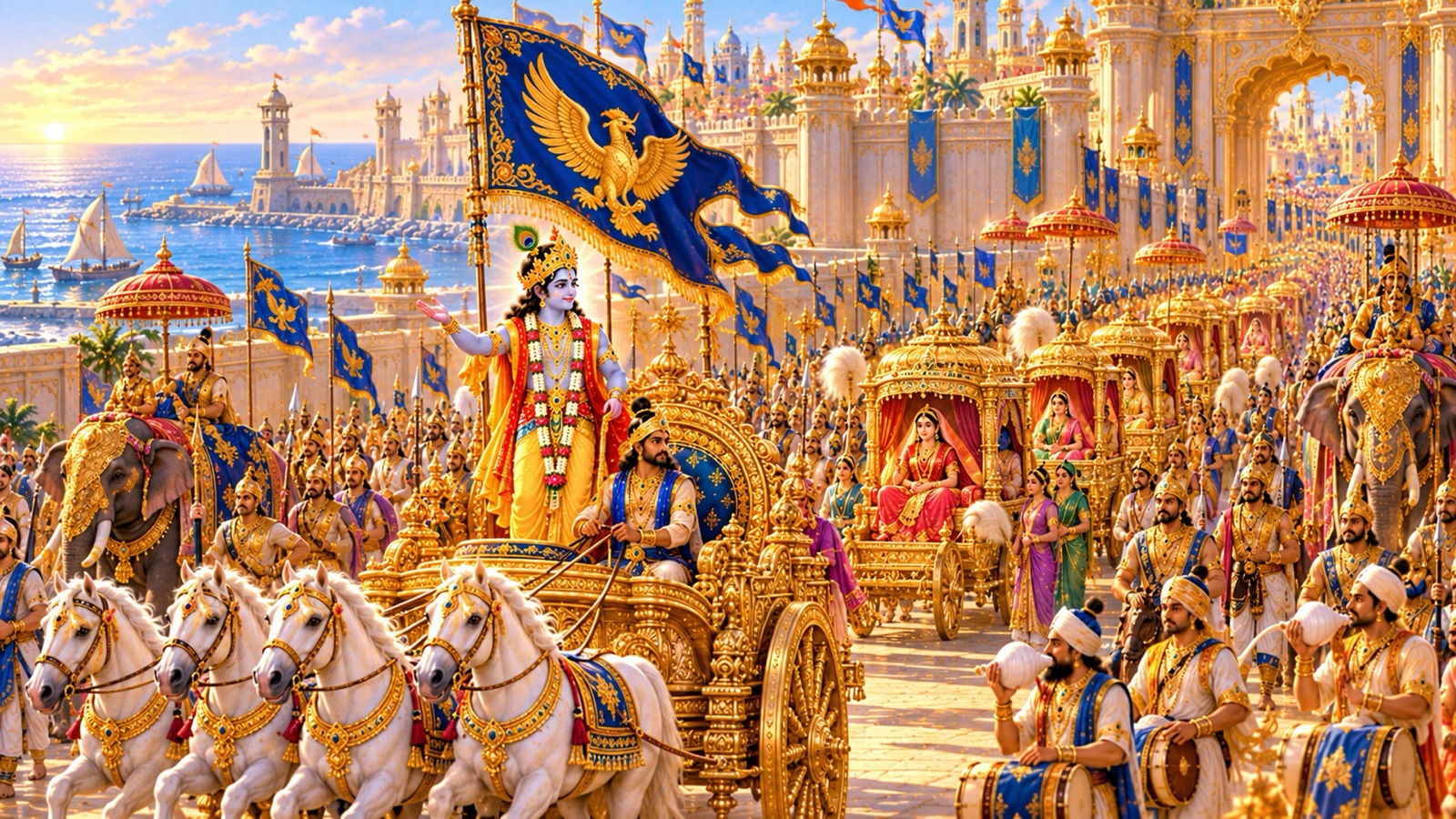
Before leaving, the Lord turned to the messenger of the imprisoned kings and comforted him with gentle words: “Fear no more, messenger; may all be well with you. I shall bring about the death of the king of Magadha.” The envoy departed and faithfully carried this promise to the kings, who, longing for release, waited eagerly to behold Sri Krishna.
Across Rivers and Kingdoms
The Lord passed through Anarta, Sauvira and the desert land of Maru, and through Vinashana in Kurukshetra, crossing many hills and rivers and leaving behind towns, villages, cowherd settlements and mines. Then, fording the Drishadvati and the Sarasvati, He traversed the lands of the Panchalas and the Matsyas and at last reached Indraprastha.
When Yudhishthira, who had no enemy, heard that the Lord — so rarely glimpsed by mortal eyes — had come, he was overjoyed, and went out of the city with his priests, friends and kinsmen to receive Him. Amid auspicious songs, the music of many instruments and the loud chanting of the Vedas, he hastened toward Hrishikesha as eagerly as the senses spring to life when the departed life-breath returns.
The Embrace at Indraprastha
Seeing Krishna after so long a parting, Yudhishthira’s heart melted with affection, and he embraced his dearest friend again and again. In that embrace every evil fell away from him; tears filled his eyes, his hair stood on end, and he forgot the world.
दोर्भ्यां परिष्वज्य रमामलालयं मुकुन्दगात्रं नृपतिर्हताशुभ: ।
लेभे परां निर्वृतिमश्रुलोचनो हृष्यत्तनुर्विस्मृतलोकविभ्रम: ॥ २६ ॥
dorbhyāṁ pariṣvajya ramāmalālayaṁ mukunda-gātraṁ nṛ-patir hatāśubhaḥ lebhe parāṁ nirvṛtim aśru-locano hṛṣyat-tanur vismṛta-loka-vibhramaḥ
Meaning: Clasping in both arms the form of Mukunda, the pure abode of Rama, the king was rid of all evil and attained supreme bliss; his eyes brimmed, his body thrilled, and the world’s bewilderment slipped from his mind. (Canto 10, Chapter 71, verse 26)
Bhima too, smiling broadly, embraced his cousin, his senses flooded with tears of love; and Arjuna and the twins, Nakula and Sahadeva, their eyes streaming with joy, held the infallible Lord, their best well-wisher, in their arms. Krishna in His turn bowed to the brahmanas and elders according to their station, and honoured the chiefs of the Kurus, Srinjayas and Kaikayas. Bards, chroniclers, Gandharvas and panegyrists sang and danced to mridangas, conches, vinas and drums, while the brahmanas chanted His praise; and thus, surrounded by loved ones, the crest-jewel of those of holy fame entered the decorated city.
The City Made Ready
Indraprastha’s roads had been sprinkled with perfumed water and the fragrant ichor of elephants; bright banners flew above golden archways, and brimming pots stood at every door. Bathed and anointed, the citizens shone in fresh silks, jewels and garlands. Lamps blazed before every house, incense curled from the lattice windows, and each roof was crowned with golden pitchers and silver turrets. Such was the Kuru capital that Krishna gazed upon as He passed.
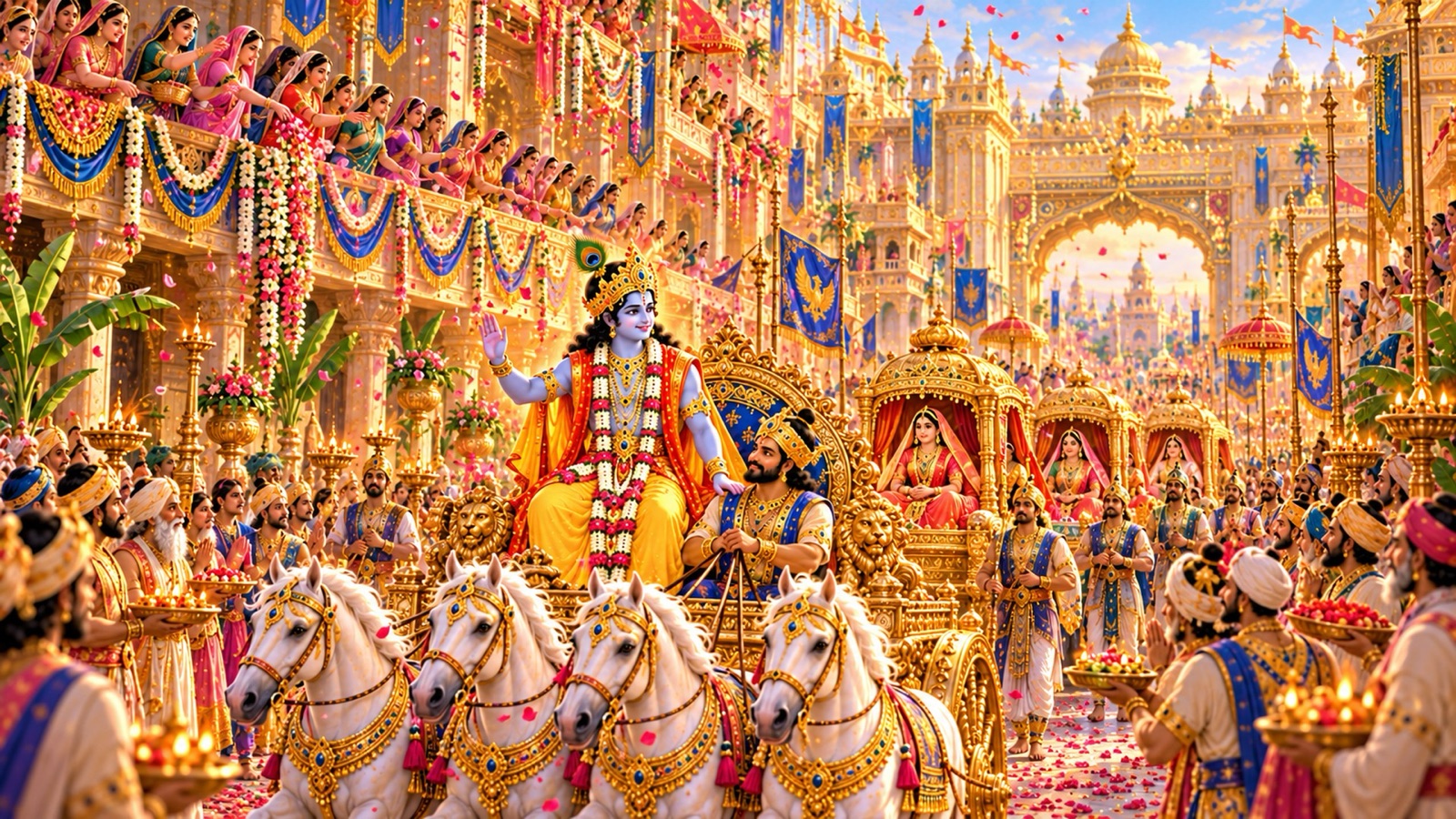
Hearing that the one true festival for human eyes had arrived, the young women of the city dropped their household tasks — even leaving their husbands on their couches — and hurried to the royal road. Because the streets were thronged with elephants, horses, chariots and people, they climbed to the rooftops, and from there, beholding Krishna with His queens, they showered flowers upon Him, embraced Him in their hearts and greeted Him with smiles.
ऊचु: स्त्रिय: पथि निरीक्ष्य मुकुन्दपत्नीस्तारा यथोडुपसहा: किमकार्यमूभि: ।
यच्चक्षुषां पुरुषमौलिरुदारहासलीलावलोककलयोत्सवमातनोति ॥ ३५ ॥
ūcuḥ striyaḥ pathi nirīkṣya mukunda-patnīs tārā yathoḍupa-sahāḥ kim akāry amūbhiḥ yac cakṣuṣāṁ puruṣa-maulir udāra-hāsa- līlāvaloka-kalayotsavam ātanoti
Meaning: Watching Mukunda’s wives upon the road, like stars accompanying the moon, the women exclaimed: “What austerities can these ladies have performed, that the crown of all men should spread such a festival for their eyes with His generous smile and the artistry of His playful glance?” (Canto 10, Chapter 71, verse 35)
At every turn the leading citizens and heads of the guilds, free of all sin, came forward with auspicious articles in their hands and worshipped the Lord.
Within the Palace of the Pandavas
Greeted by the women of the royal household with wide, joy-lit eyes and eager reverence, Mukunda entered the king’s palace. When Kunti — Pritha — saw her brother’s son, the Lord of the three worlds, her heart overflowed; she rose at once from her couch and, together with her daughter-in-law Draupadi, folded Him in her embrace.
गोविन्दं गृहमानीय देवदेवेशमादृत: ।
पूजायां नाविदत्कृत्यं प्रमोदोपहतो नृप: ॥ ३९ ॥
govindaṁ gṛham ānīya deva-deveśam ādṛtaḥ pūjāyāṁ nāvidat kṛtyaṁ pramodopahato nṛpaḥ
Meaning: Having led Govinda, the Lord of the lords of gods, into his own home, the reverent king was so overcome with rapture that he could not recall what act of worship to perform. (Canto 10, Chapter 71, verse 39)
Krishna offered His respects to His aunt and the other elder ladies, and was Himself greeted with reverence by Draupadi and His sister Subhadra. At her mother-in-law’s prompting, Draupadi honoured the Lord’s queens — Rukmini, Satyabhama, Bhadra, Jambavati, Kalindi, Mitravinda, Lakshmana, the chaste Satya and the others — with garments, garlands and adornments. The righteous king then lodged Janardana in comfort with His army, attendants, ministers and consorts, supplying fresh provisions day after day.
During that stay, in Arjuna’s company, the Lord satisfied Agni by offering him the Khandava forest, and saved the demon Maya, who in gratitude built a celestial assembly hall for the king. To please Yudhishthira the Lord remained in Indraprastha for several months, now and then riding out with Arjuna in His chariot among His warriors.
Principal Teachings of This Chapter
1. The Lord welcomes the counsel of His devotee. Though Uddhava himself declares Krishna to be Time, the cause of all (verse 8), the Lord asks for advice and honours it. Humility before those we love is not weakness in the divine; it is how the Lord shares His work.
2. One act of grace fulfils many purposes. Uddhava sees that defeating Jarasandha will serve the sacrifice and the captives together (verse 3). Whatever the Lord does for one devotee blesses many.
3. His promise is itself deliverance. “Fear no more,” He tells the envoy, and the kings’ long wait turns to hope. The Lord’s word to one who has taken shelter is as good as the deed.
4. Touching the Lord dissolves the world’s illusion. In Yudhishthira’s embrace all inauspiciousness is destroyed and worldly bewilderment forgotten (verse 26). Loving contact with Krishna undoes what years of struggle cannot.
5. Love forgets protocol. Yudhishthira, the master of dharma, cannot remember how to worship his Guest (verse 39). The Lord accepts that bewilderment as the highest offering.
A Devotional Reflection
What moves us most in this chapter is not the splendour of the march but the sight of the Supreme asking for guidance. He who holds Brahma and Shiva as His instruments bends His ear to Uddhava, and then follows the plan a friend has laid out. In that gesture the Lord shows how the divine chooses to work in this world: not by overriding His devotees but by enfolding them, so that their wisdom, strength and love become threads in His own design. Bhima will fight, the kings will go free — yet Uddhava has already told us that only Time Himself is truly acting. We too may offer our best thought and effort, then rest knowing the result belongs to Him. And when the long road ends, there is the embrace at the city gate, where a wise king found that nothing in his kingdom compared to holding the Lord in his arms. May our own journeys end there too.
A Daily Devotional Practice
Today, before any decision, pause as Uddhava did and ask the Lord inwardly what would serve both your duty and those who depend on you; then leave the fruit in His hands. In the evening, recall Yudhishthira hastening out to meet Krishna, and let your own mind rush toward the Lord as eagerly, repeating softly: Om Namo Bhagavate Vasudevaya.
Conclusion
This chapter carries the Lord from the council chamber of Dwaraka to the loving household of the Pandavas. Uddhava’s wise words show how the rescue of the kings and the sacrifice of Yudhishthira are one work, and Krishna, Time itself, gladly adopts the plan of His friend. Procession, promise and pilgrimage culminate in a reunion where tears replace ceremony and even the king of dharma forgets the rites of hospitality. Let us remember that the Lord who guides creation still delights in walking beside those who love Him.
May the divine wisdom of Srimad Bhagavatam awaken pure devotion within our hearts.
Om Namo Bhagavate Vasudevaya.
Jay Shree Madhav.
References and Attribution
- Primary edition: Gita Press, Śrīmad Bhāgavata Mahāpurāṇa (English), Book Ten (Latter Half), Discourse 71.
- Series: Srimad Bhagavatam Wisdom · Biswa Sanatan Dharma Seva Trust.
- Presented following the spiritual guidance and recommendation of Pandit Dr. Shri Kashinath Mishra.
This is an original, faithful retelling in the writer’s own words, with brief quoted verses shown in Devanāgarī and transliteration and their meanings given as summaries. It is not a reproduction of any single publisher’s continuous translation or commentary. No affiliation with or endorsement by any publisher is implied.
Jay Shree Madhav