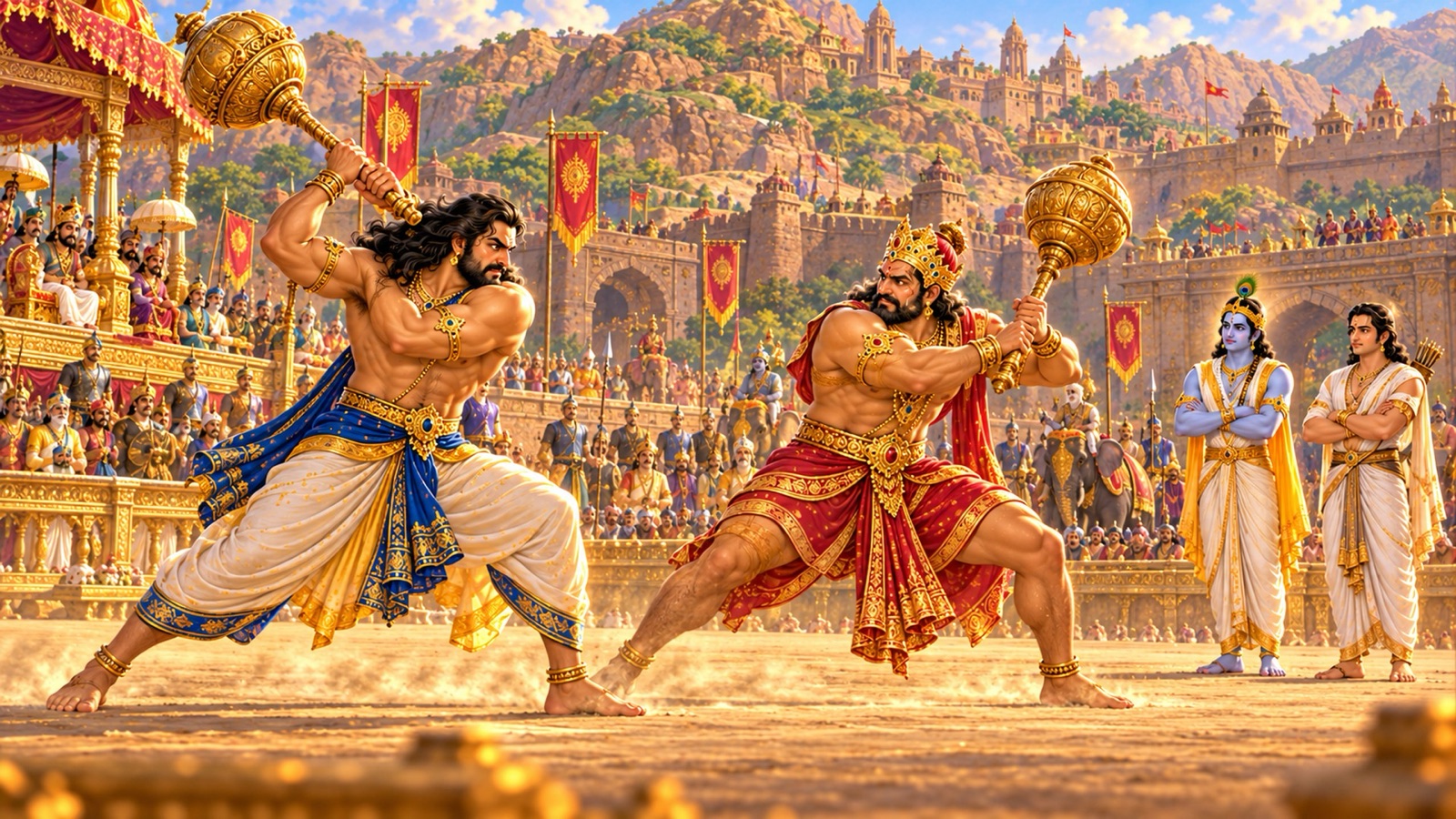
Three Kshatriyas come to Girivraja dressed as brahmanas, a proud king keeps his word and grants them battle, and a single twig split in Krishna’s hands decides the fate of Jarasandha.
Om Namo Bhagavate Vasudevaya.
Om Namo Bhagavate Vasudevaya.
Om Namo Bhagavate Vasudevaya.
Welcome back to Srimad Bhagavatam Wisdom, our devotional journey through the sacred histories and teachings of the Srimad Bhagavat Mahapurana. In this seventy-second chapter of the Tenth Canto, Yudhishthira opens his heart to Krishna about the Rajasuya sacrifice, and the Lord, blessing his resolve, leads the way to Girivraja and to the king who alone stands in its path.
Chapter Information
- Scripture: Śrīmad Bhāgavata Mahāpurāṇa
- Canto: 10 (Book Ten, Latter Half)
- Chapter: 72 (Discourse 72)
- Chapter title: The Slaying of the Demon Jarasandha
- Principal speaker: Sukadeva Gosvami (narrating to King Parikshit)
- Principal listener: King Parikshit
- Main setting: The royal assembly at Indraprastha; then Girivraja, the capital of Jarasandha in Magadha
- Central subject: Yudhishthira’s Rajasuya resolve; the Lord’s teaching on His devotee; the three disguised brahmanas before Jarasandha; the twenty-seven-day duel; Jarasandha’s end and the freeing of the kings
- Principal verse range: Canto 10, Chapter 72, verses 1–48
- Primary edition: Gita Press Śrīmad Bhāgavata Mahāpurāṇa (English, Book Ten)
Context From the Previous Chapter
In Chapter 71, Krishna travelled from Dvaraka to Indraprastha with His queens and army, was received with overflowing love by Yudhishthira, Kunti, Draupadi and the whole city, and stayed on for several months to please the king. Now, in the full assembly, Yudhishthira speaks the wish ripening in his heart.
Yudhishthira’s Prayer in the Assembly
One day, Sukadeva tells Parikshit, Yudhishthira sat in his court surrounded by sages, brahmanas, kshatriyas and vaishyas, by Bhima and his other brothers, by preceptors, elders of the race, clansmen and kinsmen. In the hearing of them all he turned to Krishna and spoke.
क्रतुराजेन गोविन्द राजसूयेन पावनीः ।
यक्ष्ये विभूतीर्भवतस्तत् सम्पादय नः प्रभो ॥ ३ ॥
kratu-rājena govinda rājasūyena pāvanīḥ yakṣye vibhūtīr bhavatas tat sampādaya naḥ prabho
Meaning: O Govinda, by the Rajasuya, the king of sacrifices, I wish to worship Your purifying manifestations, the gods who are Your own glories; O Lord, kindly bring this about for us. (Canto 10, Chapter 72, verse 3)
The king then praised the Lord’s wooden sandals, which destroy all that is inauspicious: the pure souls who serve, meditate on and sing of them are freed from the bondage of birth and death, and receive worldly blessings too if they ask, while others obtain neither. Let this world, he prayed, see with its own eyes the power of serving Your lotus feet; show the Kuru and Srinjaya chiefs what becomes of those who worship You and of those who do not. In You, the Self of all, who look on everything with an equal eye, there is no thought of ‘mine’ and ‘another’s’; like a wish-fulfilling tree, You grant Your grace in exact measure of each one’s service, and in this there is no partiality.
The Lord Blesses the Resolve
Krishna answered with warmth. Your resolve is excellent, O chastiser of enemies; by this sacrifice your blessed fame will spread through all the worlds. The sages, the forefathers, the gods, your friends and kinsmen, I Myself and indeed all living beings desire this king of sacrifices. Conquer all the kings, bring the earth under your sway, gather every requisite, and then perform the great sacrifice.
एते ते भ्रातरो राजन् लोकपालांशसम्भवाः ।
जितोऽस्म्यात्मवता तेऽहं दुर्जयो योऽकृतात्मभिः ॥ १० ॥
ete te bhrātaro rājan loka-pālāṁśa-sambhavāḥ jito ‘smy ātmavatā te ‘haṁ durjayo yo ‘kṛtātmabhiḥ
Meaning: O King, these brothers of yours are born as portions of the guardians of the worlds; and I, who cannot be conquered by those who have not mastered themselves, have been conquered by you, a man of self-control. (Canto 10, Chapter 72, verse 10)
न कश्चिन्मत्परं लोके तेजसा यशसा श्रिया ।
विभूतिभिर्वाभिभवेद् देवोऽपि किमु पार्थिवः ॥ ११ ॥
na kaścin mat-paraṁ loke tejasā yaśasā śriyā vibhūtibhir vābhibhaved devo ‘pi kim u pārthivaḥ
Meaning: No one in this world, not even a god, what to speak of an earthly king, can overpower one who is devoted to Me by means of his might, fame, wealth or opulences. (Canto 10, Chapter 72, verse 11)
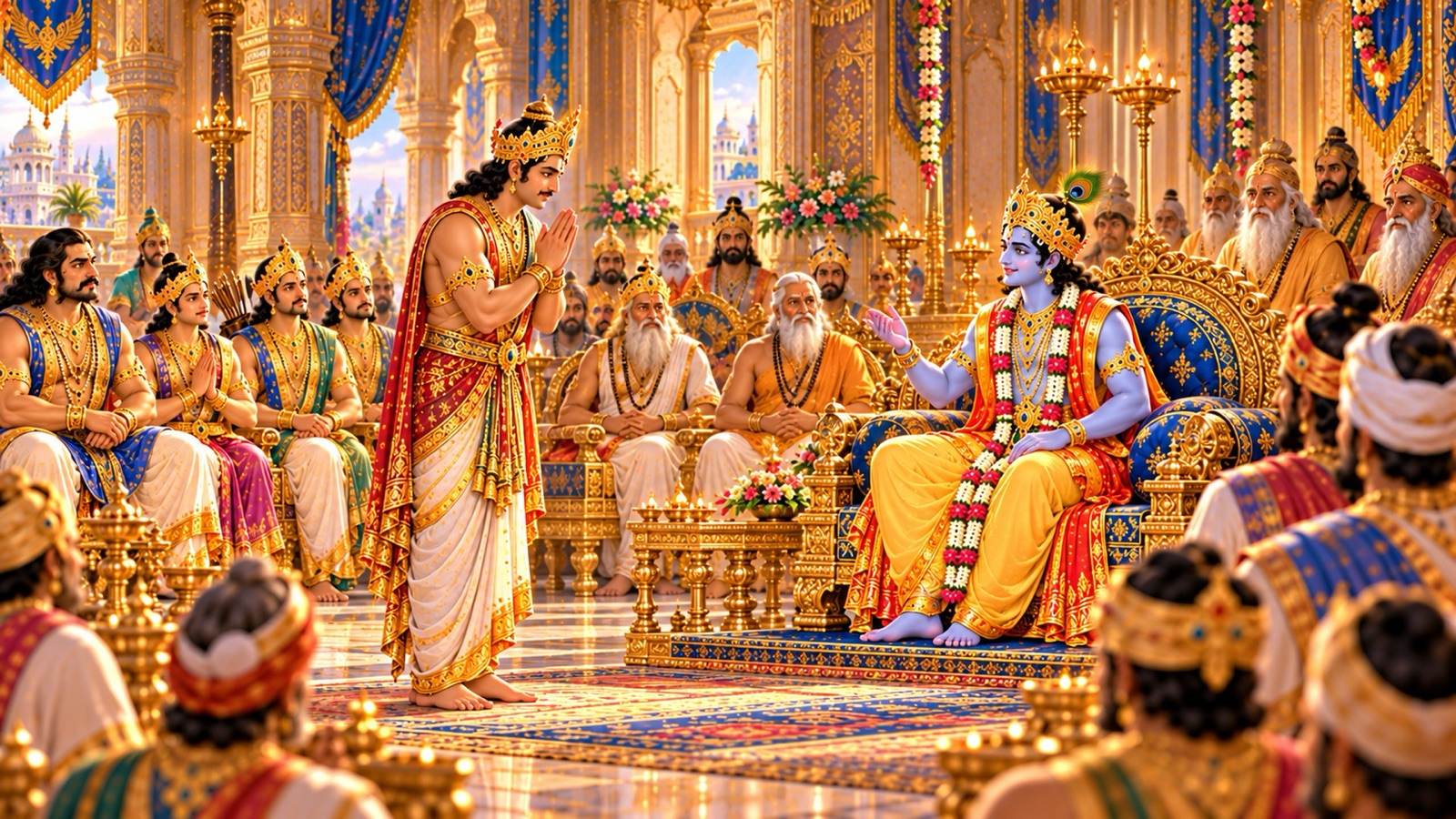
Here lies the heart of the chapter. Yudhishthira had asked the Lord to let the world see the fruit of serving His feet, and the Lord’s reply quietly explains everything that follows. He is won not by armies but by self-mastery, and the one who belongs to Him cannot be overcome by any power, however great. Jarasandha, for all his strength, is not finally defeated by Bhima’s arm but by the Lord who stands behind that arm. The Rajasuya is worship of Krishna through His manifestations, and so the Lord Himself removes its obstacle, working through His devotee so that the assembled chiefs may witness exactly what Yudhishthira prayed for: the destiny of those who serve Him and of those who set themselves against Him.
The Conquest of the Quarters
Hearing the Lord’s words, Yudhishthira was filled with joy and his face bloomed like a lotus. He appointed his brothers to conquer the directions, and Krishna poured His own energy into the Pandavas, making them invincible. Sahadeva went south with the Srinjayas, Nakula west with the Matsyas, Arjuna north with the Kekayas, and Bhima east with the Madras. Subduing the kings by their valour, they brought back abundant wealth from every quarter for the sacrifice.
Yet when Yudhishthira heard that Jarasandha remained unconquered, he grew anxious. Then Krishna laid before him the plan Uddhava had once proposed; and Bhimasena, Arjuna and Krishna, taking on the outward signs of brahmanas, set out for Girivraja, the city of the son of Brihadratha.
Three Guests at the Gate of Girivraja
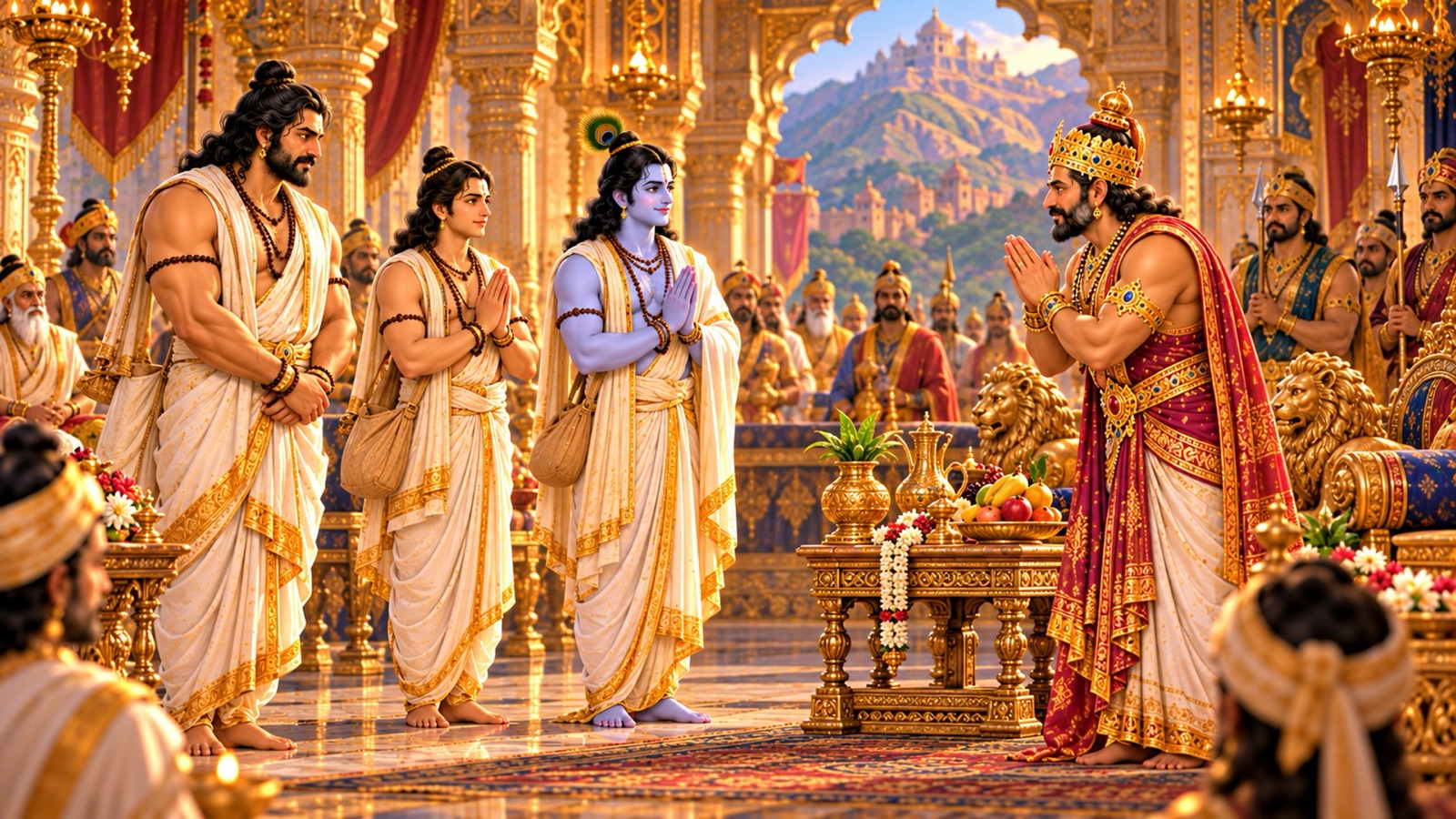
Jarasandha was devoted to the brahmanas and faithful to a householder’s duties. So the three kshatriyas came to his palace at the hour set aside for receiving guests and made their petition. O King, may all be well with you; know us to be guests come from afar with a purpose, and grant us what we desire.
किं दुर्मर्षं तितिक्षूणां किमकार्यमसाधुभिः ।
किं न देयं वदान्यानां कः परः समदर्शिनाम् ॥ १९ ॥
kiṁ durmarṣaṁ titikṣūṇāṁ kim akāryam asādhubhiḥ kiṁ na deyaṁ vadānyānāṁ kaḥ paraḥ sama-darśinām
Meaning: What is unbearable for the forbearing? What is forbidden to the wicked? What will the generous not give? And who is a stranger to one who sees all with an equal eye? (Canto 10, Chapter 72, verse 19)
They pressed their point. A capable man who does not use his perishable body to earn the lasting fame that the virtuous sing of deserves only pity and reproach. Harishchandra, Rantideva, Sibi and Bali, the sage Mudgala who lived on gleaned grain, the pigeon and the fowler of the old story, and many others gained the imperishable through what perishes.
Jarasandha’s Reflection and His Promise
From their voices, their bearing and the bowstring scars on their forearms, Jarasandha knew that these were no brahmanas but kshatriyas in disguise, and he felt he had seen them somewhere before. He reasoned within himself: since they have gone so far as to beg from me in a brahmana’s garb, I will give them even this body, hard as it is to give up. Did not Vishnu, as a brahmana, strip Bali of his sovereignty — and is not Bali’s spotless fame sung in every direction even so? Bali knew the dwarf had come to take his wealth for Indra, his preceptor Sukra forbade him, and still he gave away the earth. What use is a kshatriya’s life if, with a body that must fall one day, he does not strive for wide fame and live for the sake of the brahmanas?
इत्युदारमतिः प्राह कृष्णार्जुनवृकोदरान् ।
हे विप्रा व्रियतां कामो ददाम्यात्मशिरोऽपि वः ॥ २७ ॥
ity udāra-matiḥ prāha kṛṣṇārjuna-vṛkodarān he viprā vriyatāṁ kāmo dadāmy ātma-śiro ‘pi vaḥ
Meaning: Having reflected thus, that king of generous mind said to Krishna, Arjuna and Vrikodara: ‘O brahmanas, choose whatever you wish; I will give it to you, even my own head.’ (Canto 10, Chapter 72, verse 27)
The Challenge Revealed
Then the Lord spoke plainly. O great king, we are not brahmanas seeking food; we are kshatriyas who have come seeking battle. If you agree, grant us single combat. This is Bhima, the son of Kunti; this is his younger brother Arjuna; and know Me to be their cousin Krishna, your old enemy.
Jarasandha laughed aloud and replied in anger. If it is a fight you want, fools, you shall have it. But with You, Krishna, I will not fight; You are a coward whose courage fails in battle, who abandoned Mathura out of fear of me and took shelter in the sea. Arjuna is younger than I and lacks great strength; Bhima alone is my equal. With these words he handed a great mace to Bhimasena, took another himself, and went out beyond the city.
The Duel of Twenty-Seven Days
In the arena the two heroes, maddened for battle, closed and struck one another with maces hard as thunderbolts. Wheeling to left and right in intricate circles, they looked like two actors on a stage, and when the maces met the crash was like thunder, or like the tusks of fighting elephants. Hurled with full force against each other’s shoulders, hips, feet, hands, thighs and collarbones, the maces were ground to pieces, as arka branches are crushed between two furious elephants.
Their maces broken, the two fought on with fists hard as iron, the blows of their palms ringing out like thunderbolts. Equal in training, strength and vigour, neither slackening, they fought without any decision. Through the days they fought to the death; through the nights they lived together as friends; and so twenty-seven days passed.
Krishna’s Sign and the Fall of Jarasandha
On the twenty-eighth day Bhima said to his cousin, ‘Madhava, I cannot defeat Jarasandha in battle.’ Krishna knew the secret of His enemy’s birth and death — how the demoness Jara had joined the two halves of his body and given him life. Pondering this, He filled Bhima with His own strength.
सञ्चिन्त्यारिवधोपायं भीमस्यामोघदर्शनः ।
दर्शयामास विटपं पाटयन्निव संज्ञया ॥ ४३ ॥
sañcintyāri-vadhopāyaṁ bhīmasyāmogha-darśanaḥ darśayām āsa viṭapaṁ pāṭayann iva saṁjñayā
Meaning: Having considered the means of slaying the enemy, the Lord of unfailing vision gave Bhima a sign, taking a twig and tearing it in two before his eyes. (Canto 10, Chapter 72, verse 43)
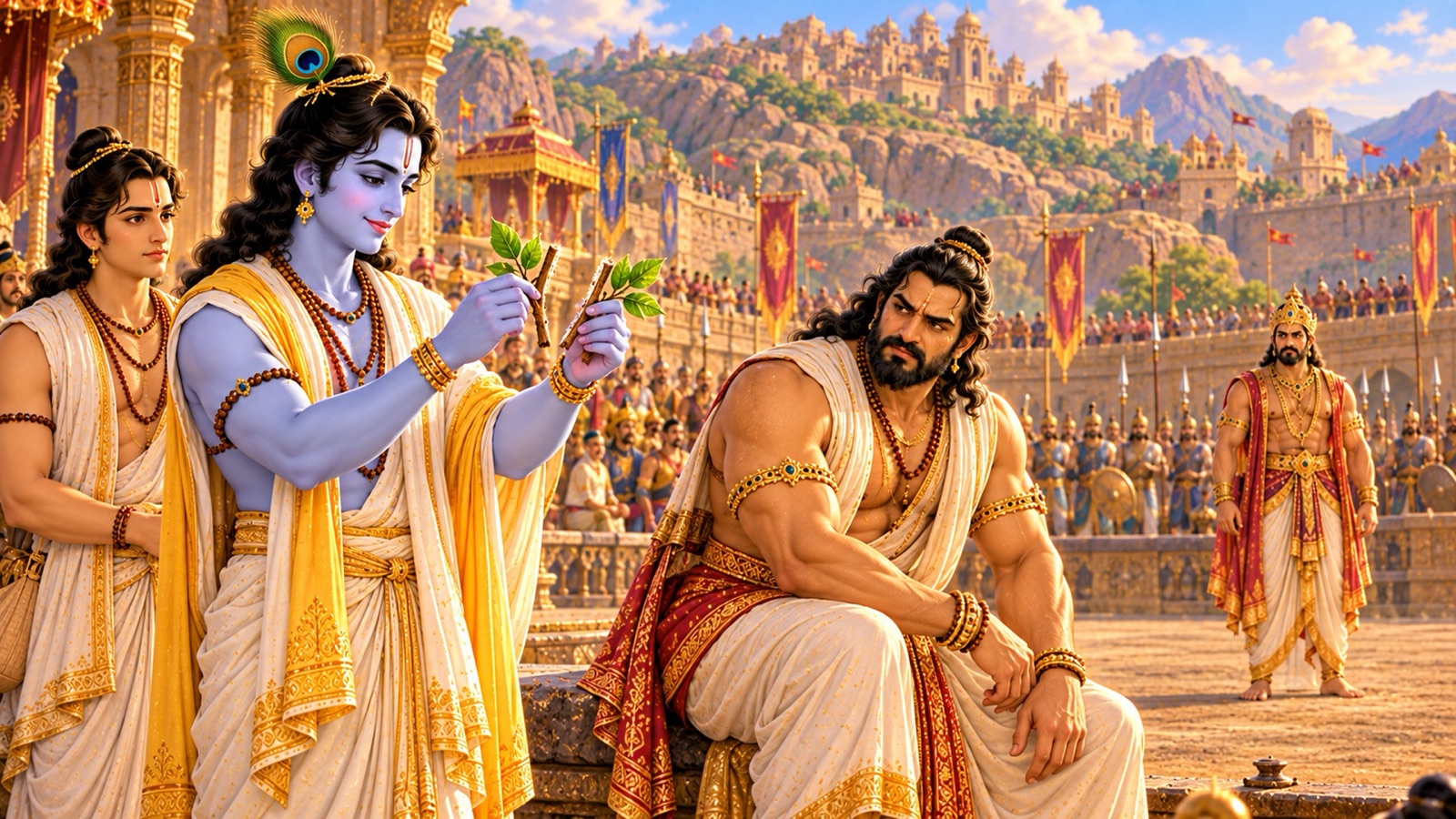
Bhima, mighty of spirit and foremost of fighters, understood at once. He seized Jarasandha by the feet and threw him down; pressing one foot with his own and gripping the other with both hands, he tore him in two as a great elephant splits a branch, and the people saw the two halves of their king.
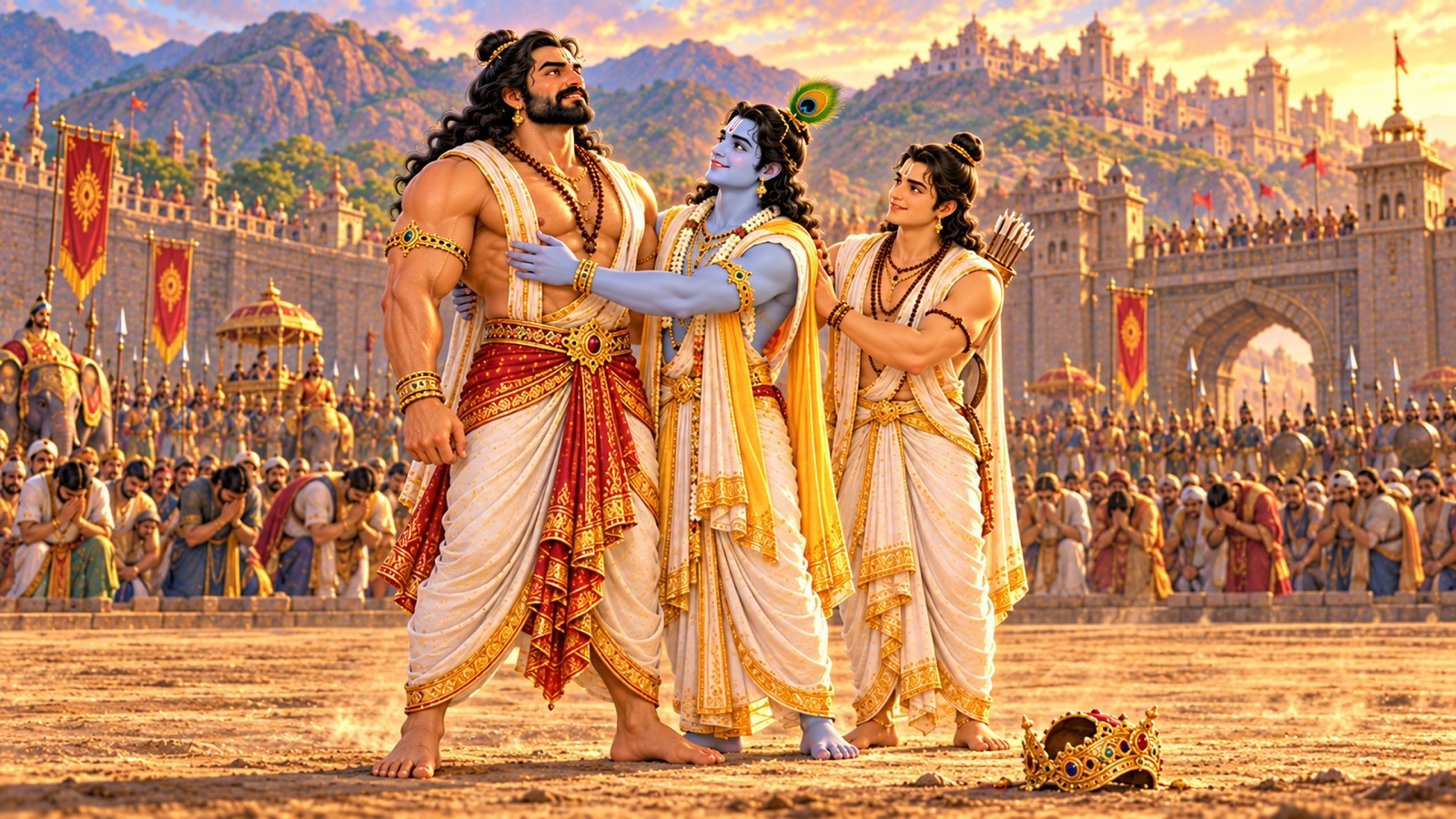
A great cry of grief rose from the subjects as the lord of Magadha fell. Krishna and Arjuna embraced Bhima and honoured him.
Sahadeva Enthroned and the Kings Set Free
Then the Lord did two things that revealed why He had come.
सहदेवं तत्तनयं भगवान् भूतभावनः ।
अभ्यषिञ्चदमेयात्मा मगधानां पतिं प्रभुः ।
मोचयामास राजन्यान् संरुद्धा मागधेन ये ॥ ४८ ॥
sahadevaṁ tat-tanayaṁ bhagavān bhūta-bhāvanaḥ abhyaṣiñcad ameyātmā magadhānāṁ patiṁ prabhuḥ mocayām āsa rājanyān saṁruddhā māgadhena ye
Meaning: The Lord, the source of all beings and of immeasurable Self, installed Jarasandha’s son Sahadeva as ruler of the Magadhas, and set free the kings whom the king of Magadha had held in confinement. (Canto 10, Chapter 72, verse 48)
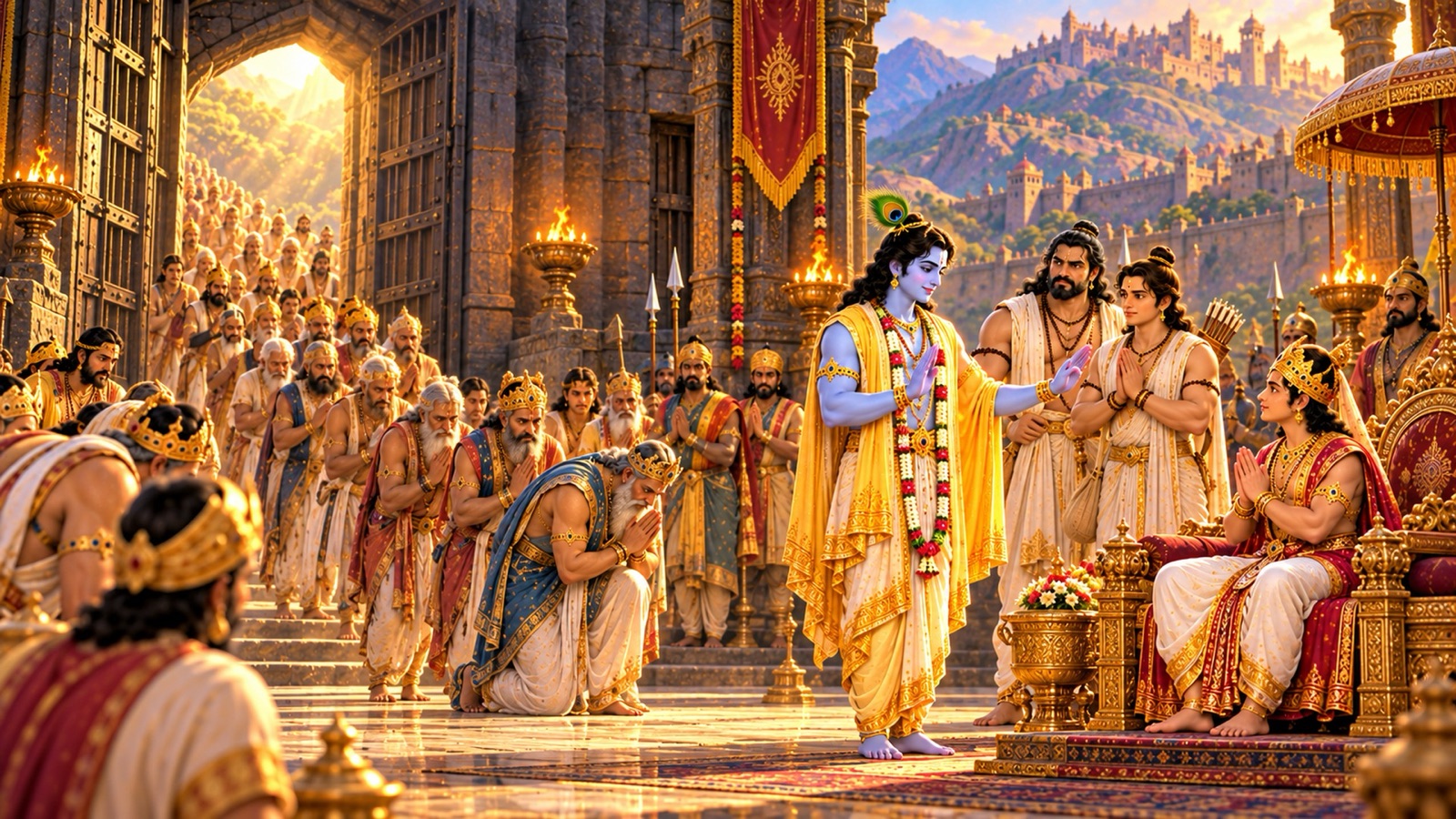
The enemy’s son was not cast down but anointed, and the gates of the mountain prison opened for the captive kings. With that, the one obstacle to Yudhishthira’s sacrifice was gone.
Principal Teachings of This Chapter
1. The Lord is conquered by self-mastery. Krishna tells Yudhishthira that He, unconquerable by the undisciplined, has been won by a king who rules himself (verse 10). Our real offering to Him is a controlled mind and senses, not outward grandeur.
2. No power can overcome His devotee. Neither a god nor an earthly king can defeat one who is devoted to the Lord by might, fame or wealth (verse 11). Jarasandha’s strength could not stand against the Lord working through His devotee.
3. Service is rewarded in exact measure. Yudhishthira compares the Lord to a wish-fulfilling tree whose grace answers each servant according to his service, without partiality. Whatever we sincerely give, He receives.
4. The perishable body can purchase the imperishable. The disguised guests remind Jarasandha of Harishchandra, Rantideva, Sibi and Bali, who turned a passing body into lasting good, and he resolves to give even his head (verse 27). The scripture honours this generosity even in the Lord’s adversary.
5. The Lord supplies what strength alone cannot. Bhima cannot finish the fight until Krishna fills him with His energy and shows him the twig (verse 43). Where our ability ends, His guidance carries us the rest of the way.
A Devotional Reflection
What moves the heart in this chapter is how gently the Lord deals with everyone in it. He blesses Yudhishthira’s wish, because it is worship of Him. He does not strike Jarasandha down Himself; He lets the proud king keep his promise and his honour, and lets Bhima, who had struggled so long, taste the victory. Even the man who called Him a coward is answered not with a curse but with a crown for his son. There is something here for our own devotion. We often fight like Bhima, with all our strength, and find that strength is not enough; and the Lord’s answer is a small sign, a twig split in two, if we are humble enough to look toward Him. He does not take the fight away from us. He stands at the edge of the arena and shows us how to finish it.
A Daily Devotional Practice
Today, choose one struggle in which you have been relying on your own strength alone. Pause, as Bhima paused on the twenty-eighth day, and tell the Lord honestly that you cannot win it by yourself; then watch through the day for His small sign and act on it. Begin by chanting gently: Om Namo Bhagavate Vasudevaya.
Conclusion
The seventy-second chapter of the Tenth Canto shows the Lord fulfilling a devotee’s prayer by removing, through that devotee’s own brothers, the one king who stood against it. Its single great point is spoken by Krishna Himself: He is won by the self-controlled, and the one who belongs to Him cannot be overpowered by anyone. May we hold that promise close, whatever Jarasandha we face.
May the divine wisdom of Srimad Bhagavatam awaken pure devotion within our hearts.
Om Namo Bhagavate Vasudevaya.
Jay Shree Madhav.
References and Attribution
- Primary edition: Gita Press, Śrīmad Bhāgavata Mahāpurāṇa (English), Book Ten (Latter Half), Discourse 72, pp. 423–427.
- Series: Srimad Bhagavatam Wisdom · Biswa Sanatan Dharma Seva Trust.
- Presented following the spiritual guidance and recommendation of Pandit Dr. Shri Kashinath Mishra.
This is an original, faithful retelling in the writer’s own words, with brief quoted verses shown in Devanāgarī and transliteration and their meanings given as summaries. It is not a reproduction of any single publisher’s continuous translation or commentary. No affiliation with or endorsement by any publisher is implied.
Jay Shree Madhav