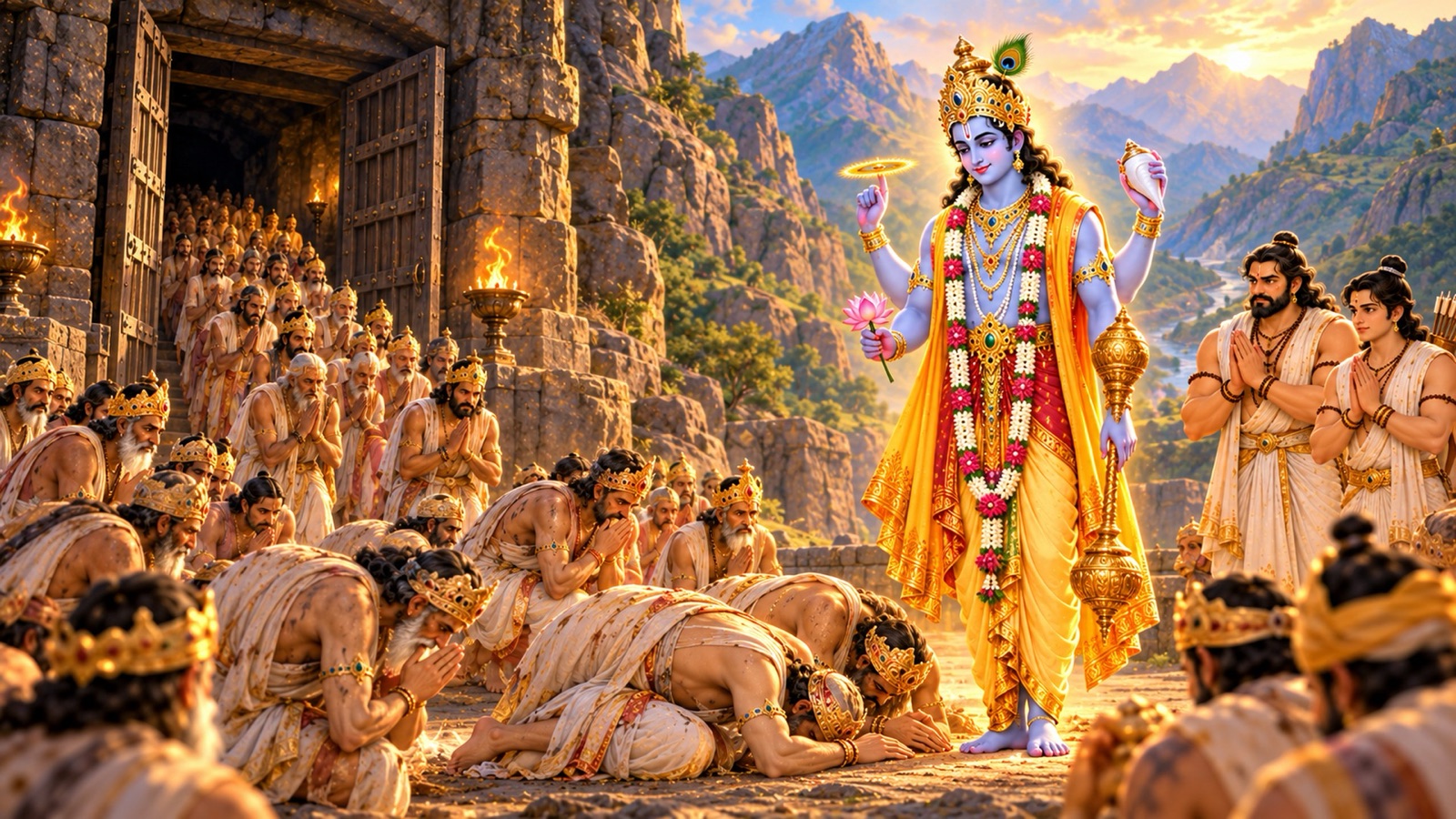
Twenty thousand eight hundred kings, starved and soiled by long captivity, step out of Jarasandha’s mountain prison and find the Lord Himself waiting at the gate; one look at Him washes away their sins, and they fall at His feet.
Om Namo Bhagavate Vasudevaya.
Om Namo Bhagavate Vasudevaya.
Om Namo Bhagavate Vasudevaya.
Welcome back to Srimad Bhagavatam Wisdom, our devotional journey through the sacred histories and teachings of the Srimad Bhagavat Mahapurana. In this seventy-third chapter of the Tenth Canto, the kings whom Jarasandha had held captive come out into the light, behold Sri Krishna, and pour out a prayer that asks for nothing but the memory of His feet; the Lord answers with tender counsel on how a ruler may live in the world with his heart fixed on Him, honours them as royalty once more, and then returns with Bhima and Arjuna to Indraprastha, where Yudhishthira weeps for joy.
Chapter Information
- Scripture: Śrīmad Bhāgavata Mahāpurāṇa
- Canto: 10 (Book Ten, Latter Half)
- Chapter: 73 (Discourse 73)
- Chapter title: Lord Krishna Blesses the Liberated Kings
- Principal speaker: Sukadeva Gosvami (narrating to King Parikshit); within the narration, the liberated kings and Lord Sri Krishna
- Principal listener: King Parikshit
- Main setting: Girivraja, the mountain-ringed capital of Magadha; then Indraprastha, the city of the Pandavas
- Central subject: The release of the imprisoned kings; their prayer of surrender; Krishna’s instruction on devotion, detachment and righteous rule; their honouring and return home; and the Lord’s return to Yudhishthira
- Principal verse range: Canto 10, Chapter 73, verses 1–35
- Primary edition: Gita Press Śrīmad Bhāgavata Mahāpurāṇa (English, Book Ten, Latter Half)
Context From the Previous Chapter
In Chapter 72, Yudhishthira resolved to perform the Rajasuya sacrifice, and Krishna, Bhima and Arjuna went in the guise of brahmanas to Girivraja to seek a duel with Jarasandha. After twenty-seven days of mace-fighting, Bhima, guided by Krishna’s silent sign of a split twig, tore the king of Magadha in two. Krishna then installed Jarasandha’s son Sahadeva on the throne and set free all the kings whom Jarasandha had imprisoned.
The Kings Come Out of the Mountain Prison
Sukadeva told Parikshit that Jarasandha had, with ease, defeated twenty thousand eight hundred princes in battle and shut them away in a valley hemmed in by mountains on every side. Now, released by Bhagavan Sri Krishna, they came out of that confinement — their bodies unwashed, their garments filthy, their frames wasted by hunger, their faces hollow, their strength drained by the long imprisonment.
And the first sight that met their eyes was the Lord Himself, standing before them. His complexion was dark as a rain-cloud; He was clothed in yellow silk and had four arms, holding a lotus in one hand and the mace, conch and discus in the others. The mark of Srivatsa shone on His chest, His eyes were reddish like the heart of a lotus, His face was lovely and serene, and alligator-shaped earrings flashed at His ears. He wore a crown, a necklace, bracelets, a girdle and armlets; the Kaustubha gem gleamed at His neck, and a garland of forest flowers hung upon His breast.
The kings stood spellbound. They seemed to drink Him in with their eyes, to taste Him with their tongues, to breathe Him in with their nostrils, to embrace Him with their arms. At His very sight every sin was washed from them, and they bowed low, touching His blessed feet with their heads. The joy of seeing Krishna dissolved all the weariness of their captivity, and with palms joined they began to praise Hrishikesha, the Lord of the senses.
The Prayer of the Liberated Kings
Their prayer opened with surrender and a plea for shelter.
नमस्ते देवदेवेश प्रपन्नार्तिहराव्यय ।
प्रपन्नान् पाहि न: कृष्ण निर्विण्णान्घोरसंसृते: ॥ ८ ॥
namas te deva-deveśa prapannārti-harāvyaya prapannān pāhi naḥ kṛṣṇa nirviṇṇān ghora-saṁsṛteḥ
Meaning: Salutations to You, O Lord of the lords of the gods, O imperishable one who removes the suffering of those who take refuge in You. We have come to You, Krishna, weary and disgusted with this dreadful cycle of birth and death — protect us, who have surrendered. (Canto 10, Chapter 73, verse 8)
Then came a confession as humble as it was astonishing. ‘Madhusudana,’ they said, ‘we bear no grudge against this king of Magadha. That we kings were cast down from our kingdoms was in truth Your own grace upon us.’ For a king swollen with the pride of sovereignty and wealth, they explained, never finds true good; bewildered by the Lord’s Maya, he takes fleeting riches to be permanent — just as the ignorant mistake a mirage for a lake, the unwise who are fastened to their senses take the ever-changing play of Maya for reality.
They did not spare themselves. In former days, blinded by the intoxication of fortune, each had vied with the other for mastery of the earth, had mercilessly slaughtered their own subjects in pursuit of conquest, and in their madness had paid no heed to the Lord, who stood before them all along as Death itself. Now the same arrogance lay shattered.
त एव कृष्णाद्य गभीररंहसा
दुरन्तवीर्येण विचालिता: श्रिय: ।
कालेन तन्वा भवतोऽनुकम्पया
विनष्टदर्पाश्चरणौ स्मराम ते ॥ १३ ॥
ta eva kṛṣṇādya gabhīra-raṁhasā duranta-vīryeṇa vicālitāḥ śriyaḥ kālena tanvā bhavato ’nukampayā vinaṣṭa-darpāś caraṇau smarāma te
Meaning: Those very kings, O Krishna, have today been shaken loose from their fortune by Time — Your own form, of unfathomable course and irresistible might. By Your compassion our pride has been destroyed, and now we remember Your feet. (Canto 10, Chapter 73, verse 13)
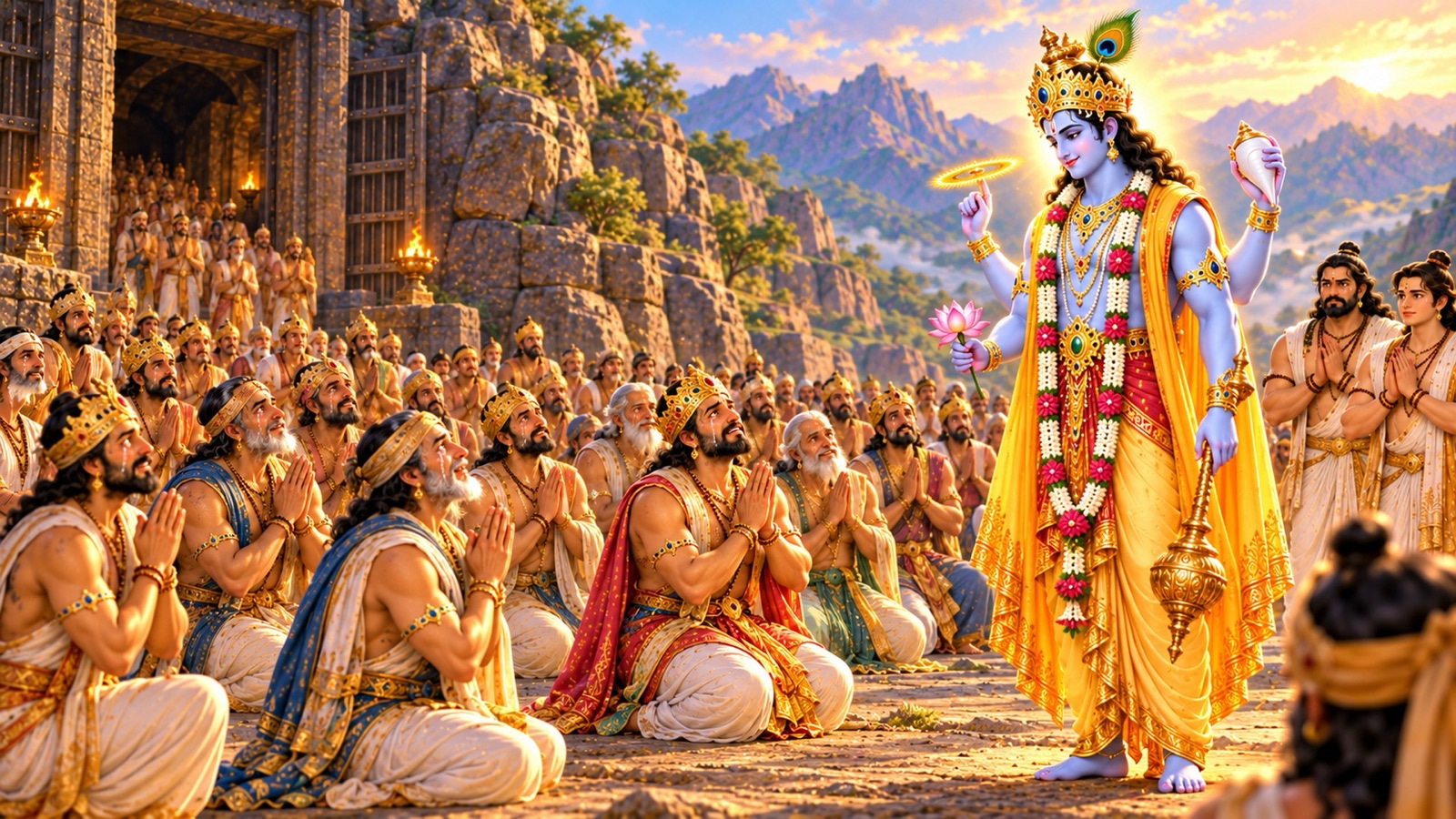
What, then, did these kings ask for? Not the thrones they had lost. Sovereignty, they said, is a mirage to be enjoyed through a body that is forever decaying and is the very soil of disease; nor did they crave the fruits of ritual promised after death, which only sound sweet to the ear. They begged for one thing alone: ‘Teach us the means by which the remembrance of Your lotus feet may never cease — even if we must wander through birth after birth in this world.’
They closed as they had begun, with obeisance.
कृष्णाय वासुदेवाय हरये परमात्मने ।
प्रणतक्लेशनाशाय गोविन्दाय नमो नम: ॥ १६ ॥
kṛṣṇāya vāsudevāya haraye paramātmane praṇata-kleśa-nāśāya govindāya namo namaḥ
Meaning: Obeisance again and again to Krishna, the son of Vasudeva; to Hari, the Supreme Self; to Govinda, who destroys the afflictions of all who bow before Him. (Canto 10, Chapter 73, verse 16)
The Lord’s Gentle Reply
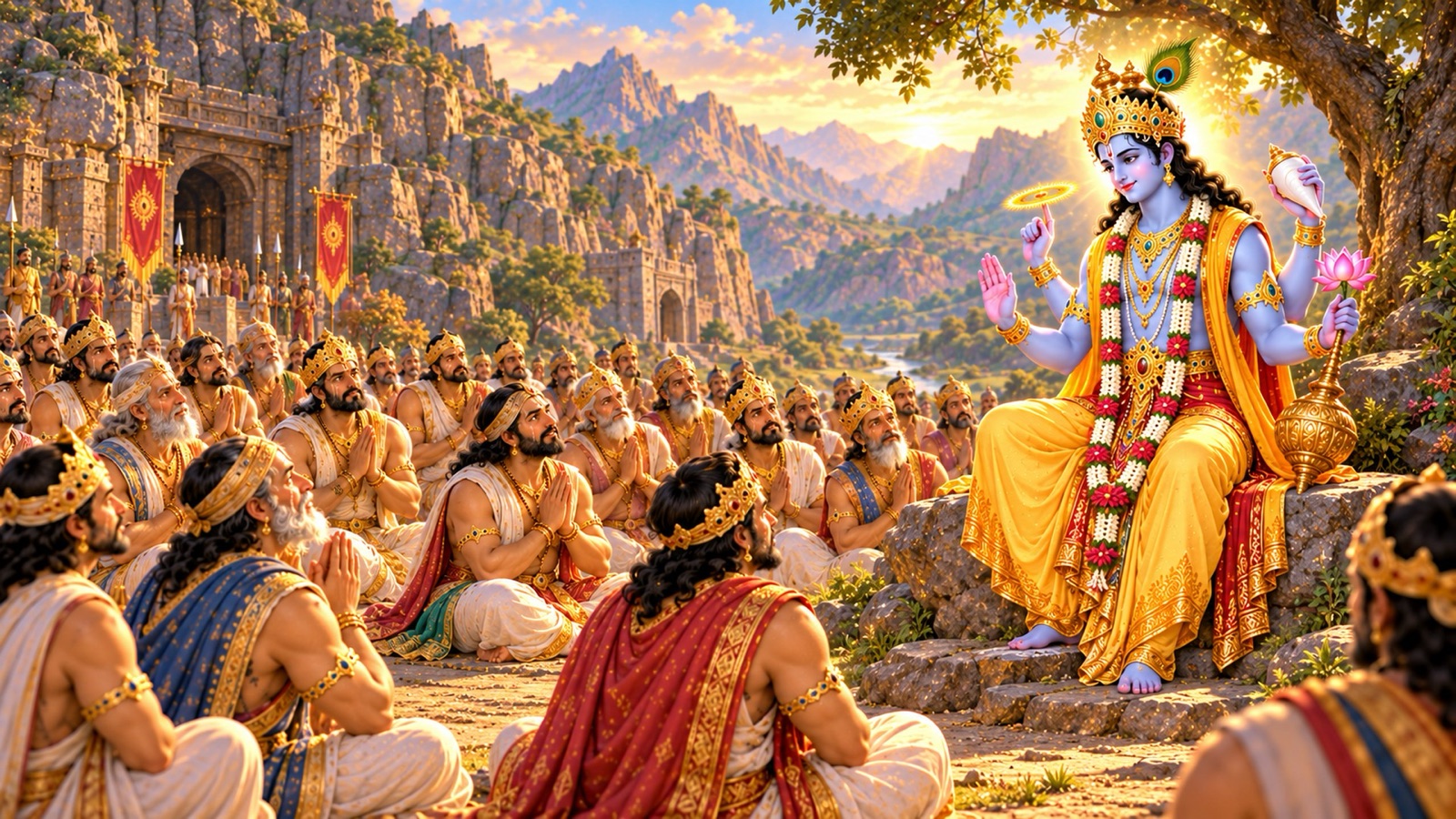
Thus praised by the kings whose fetters had just fallen away, the merciful Lord, the refuge of all who seek shelter, answered them in sweet and soothing words.
‘From this day forward, O kings,’ He said, ‘firm devotion to Me — the Self of all and the Lord of all — will indeed arise in you, exactly as you have desired.’ Then He praised the resolve they had reached.
दिष्ट्या व्यवसितं भूपा भवन्त ऋतभाषिण: ।
श्रियैश्वर्यमदोन्नाहं पश्य उन्मादकं नृणाम् ॥ १९ ॥
diṣṭyā vyavasitaṁ bhūpā bhavanta ṛta-bhāṣiṇaḥ śriyaiśvarya-madonnāhaṁ paśya unmādakaṁ nṛṇām
Meaning: How fortunate is the resolution you have made, O kings, and how truly you have spoken. I Myself see how the swelling pride of wealth and power drives people to madness. (Canto 10, Chapter 73, verse 19)
He reminded them of those who had fallen: Haihaya, Nahusha, Vena, Ravana, Naraka and many others — gods, demons and rulers of men alike — had all been toppled from their positions by the intoxication of fortune. Then He gave them the way to rule without being ruined.
भवन्त एतद् विज्ञाय देहाद्युत्पाद्यमन्तवत् ।
मां यजन्तोऽध्वरैर्युक्ता: प्रजा धर्मेण रक्ष्यथ ॥ २१ ॥
bhavanta etad vijñāya dehādy utpādyam anta-vat māṁ yajanto ’dhvarair yuktāḥ prajā dharmeṇa rakṣyatha
Meaning: Understanding that the body and all that belongs to it are born and therefore bound to end, remain disciplined in mind and senses, worship Me with sacrifices, and protect your subjects according to dharma. (Canto 10, Chapter 73, verse 21)
Continue your family lines by begetting children, He told them, and meet whatever comes — happiness and sorrow, birth and death, gain and loss — with an even mind, receiving each as it arrives, and so move through the world with your thoughts resting in Me.
उदासीनाश्च देहादावात्मारामा धृतव्रता: ।
मय्यावेश्य मन: सम्यङ्मामन्ते ब्रह्म यास्यथ ॥ २३ ॥
udāsīnāś ca dehādāv ātmārāmā dhṛta-vratāḥ mayy āveśya manaḥ samyaṅ mām ante brahma yāsyatha
Meaning: Indifferent to the body and its belongings, delighting in the Self, steadfast in your vows, and absorbing your mind fully in Me, you will in the end come to Me, the Supreme Brahman. (Canto 10, Chapter 73, verse 23)
Bathed, Adorned and Sent Home
Having instructed the kings in this way, Krishna, the Lord of the worlds, appointed men and women attendants to bathe them. Through Sahadeva, Jarasandha’s son, He had them honoured with garments, ornaments, garlands and sandal-paste befitting kings. Bathed and adorned, they were served the finest food and offered every royal comfort, down to betel leaves. So honoured by Mukunda and freed from their misery, the kings shone with their polished earrings like planets emerging bright at the end of the rainy season.
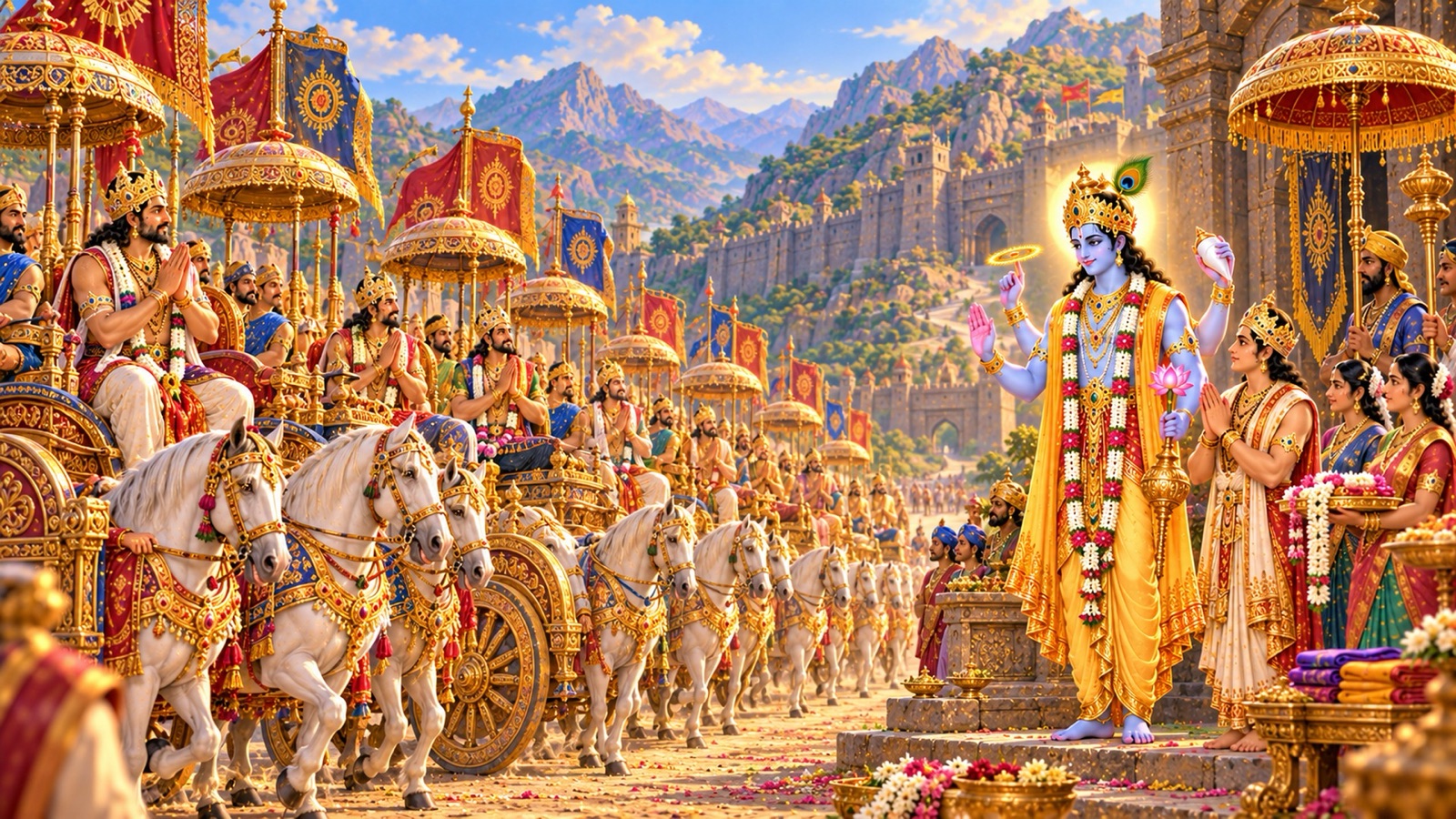
The Lord then seated them in chariots inlaid with jewels and gold and drawn by fine horses, gladdened them with kind and truthful words, and sent them home to their own lands. Delivered from their ordeal by the great-souled Krishna, the kings departed meditating on Him alone and on the deeds of the Lord of the universe. Reaching their kingdoms, they told their ministers and people of what the Supreme Person had done, and thereafter lived diligently by the commands He had given them.
The Return to Indraprastha
Having caused Jarasandha to be slain by Bhimasena and having been duly honoured by Sahadeva, Keshava set out with the two sons of Pritha. When the three victors reached Khandavaprastha, they blew their conches — a sound that delighted their friends and dismayed their foes. Hearing it, the people of Indraprastha rejoiced, for they understood at once that the king of Magadha had been silenced and that Yudhishthira’s purpose was all but fulfilled.
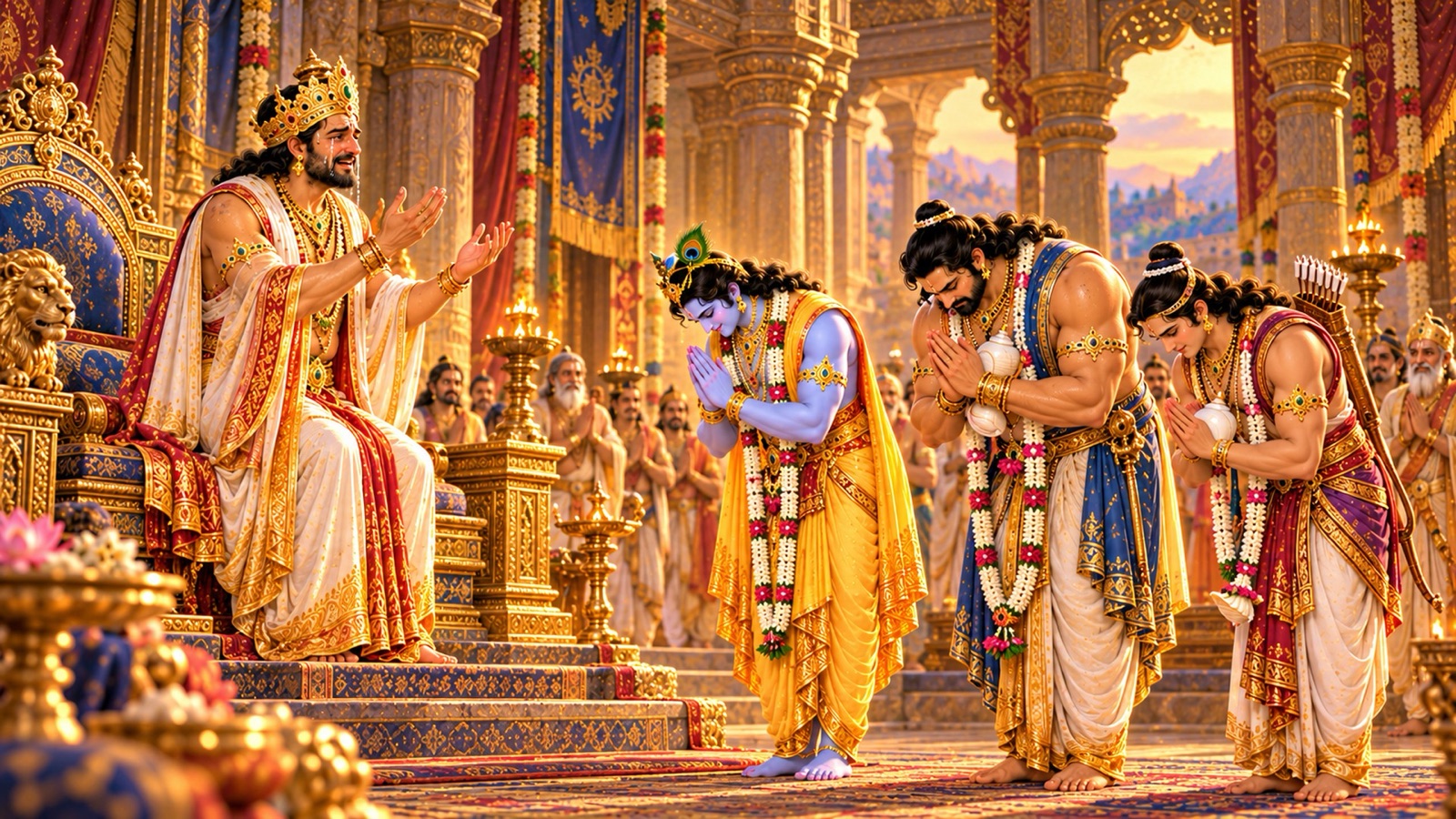
Bhima, Arjuna and Janardana bowed before the king and recounted to him everything they had accomplished. And Dharmaraja Yudhishthira, hearing of the extraordinary kindness Keshava had shown him, could find no words.
निशम्य धर्मराजस्तत् केशवेनानुकम्पितम् ।
आनन्दाश्रुकलां मुञ्चन् प्रेम्णा नोवाच किञ्चन ॥ ३५ ॥
niśamya dharma-rājas tat keśavenānukampitam ānandāśru-kalāṁ muñcan premṇā novāca kiñcana
Meaning: When the king of righteousness heard how Keshava had favoured him, drops of joyful tears fell from his eyes, and out of love he said nothing at all. (Canto 10, Chapter 73, verse 35)
Principal Teachings of This Chapter
1. Loss can be the Lord’s grace in disguise. The kings call their fall from power the Lord’s anugraha and bear no grudge against Jarasandha. This is the heart of the chapter: Krishna did not simply open a prison door. He had allowed proud rulers to be stripped of everything so that pride could die and remembrance could be born — and when they stood before Him, He did not hand back their crowns as a reward; He gave them bhakti and a dharma to live by. The whole episode shows the Lord as Time (verse 13), who removes what deludes us precisely so that we may turn to Him.
2. Pride of wealth and power is a madness. Krishna Himself affirms the kings’ diagnosis (verse 19) and names Haihaya, Nahusha, Vena, Ravana and Naraka as rulers destroyed by it. Prosperity is a test, not a proof of favour.
3. Ask for remembrance, not for things. The kings refuse both kingdom and heaven and beg only that the memory of His feet never leave them, even through many births. The highest prayer seeks the Lord Himself.
4. Devotion does not abolish duty. Krishna sends the kings back to rule: worship Me through sacrifice, protect your people by dharma, continue your lineage (verse 21). A devotee fulfils his responsibilities with the mind fixed on the Lord.
5. Equanimity is the devotee’s armour. Pleasure and pain, gain and loss, birth and death are to be met evenly, as they come; one who lives so, indifferent to the body and absorbed in Him, reaches Brahman at the end (verse 23).
6. Love overflows where words fail. Yudhishthira’s silent tears (verse 35) show that the deepest response to the Lord’s kindness is not speech but melted love.
A Devotional Reflection
There is something quietly overwhelming about the way these kings speak. Men who had lost their thrones, their comforts, their very dignity, and who had spent years in a mountain dungeon, come out blinking into the light — and the first thing they do is thank the Lord for the loss. We spend so much of our prayer asking to be returned to what we had. They ask to be kept from wanting it. They have understood, in the hard school of captivity, that it was not Jarasandha who held them but their own intoxication, and that the Lord’s compassion had used even a tyrant’s chains to loosen a far older bondage. And Krishna, who could have made every one of them an emperor, gives them instead the one thing they asked for: a heart that will not forget Him. Perhaps our own disappointments carry the same mercy. When something we leaned on is taken, we may ask whether Time, which is His own form, is not quietly turning our face toward His feet.
A Daily Devotional Practice
Today, call to mind one loss or reversal in your life that still stings. Instead of asking for it to be undone, borrow the kings’ prayer and ask only this: ‘Lord, let the memory of Your feet never leave me.’ Then take up one ordinary duty of the day and do it, as Krishna told the kings, with an even mind and your thoughts resting in Him. Begin by chanting gently: Om Namo Bhagavate Vasudevaya.
Conclusion
The seventy-third chapter of the Tenth Canto turns a scene of release into a lesson on what freedom truly is. Captives who might have demanded restitution instead bless the hand that humbled them, and seek nothing but unbroken remembrance of the Lord; Krishna grants that devotion and sends them home to rule as devotees, while Yudhishthira’s wordless tears close the chapter. May we learn from those kings to see His grace even in what is taken from us, and to hold fast to His feet through every turning of Time.
May the divine wisdom of Srimad Bhagavatam awaken pure devotion within our hearts.
Om Namo Bhagavate Vasudevaya.
Jay Shree Madhav.
References and Attribution
- Primary edition: Gita Press, Śrīmad Bhāgavata Mahāpurāṇa (English), Book Ten (Latter Half), Discourse 73, pages 427–430.
- Series: Srimad Bhagavatam Wisdom · Biswa Sanatan Dharma Seva Trust.
- Presented following the spiritual guidance and recommendation of Pandit Dr. Shri Kashinath Mishra.
This is an original, faithful retelling in the writer’s own words, with brief quoted verses shown in Devanāgarī and transliteration and their meanings given as summaries. It is not a reproduction of any single publisher’s continuous translation or commentary. No affiliation with or endorsement by any publisher is implied.
Jay Shree Madhav