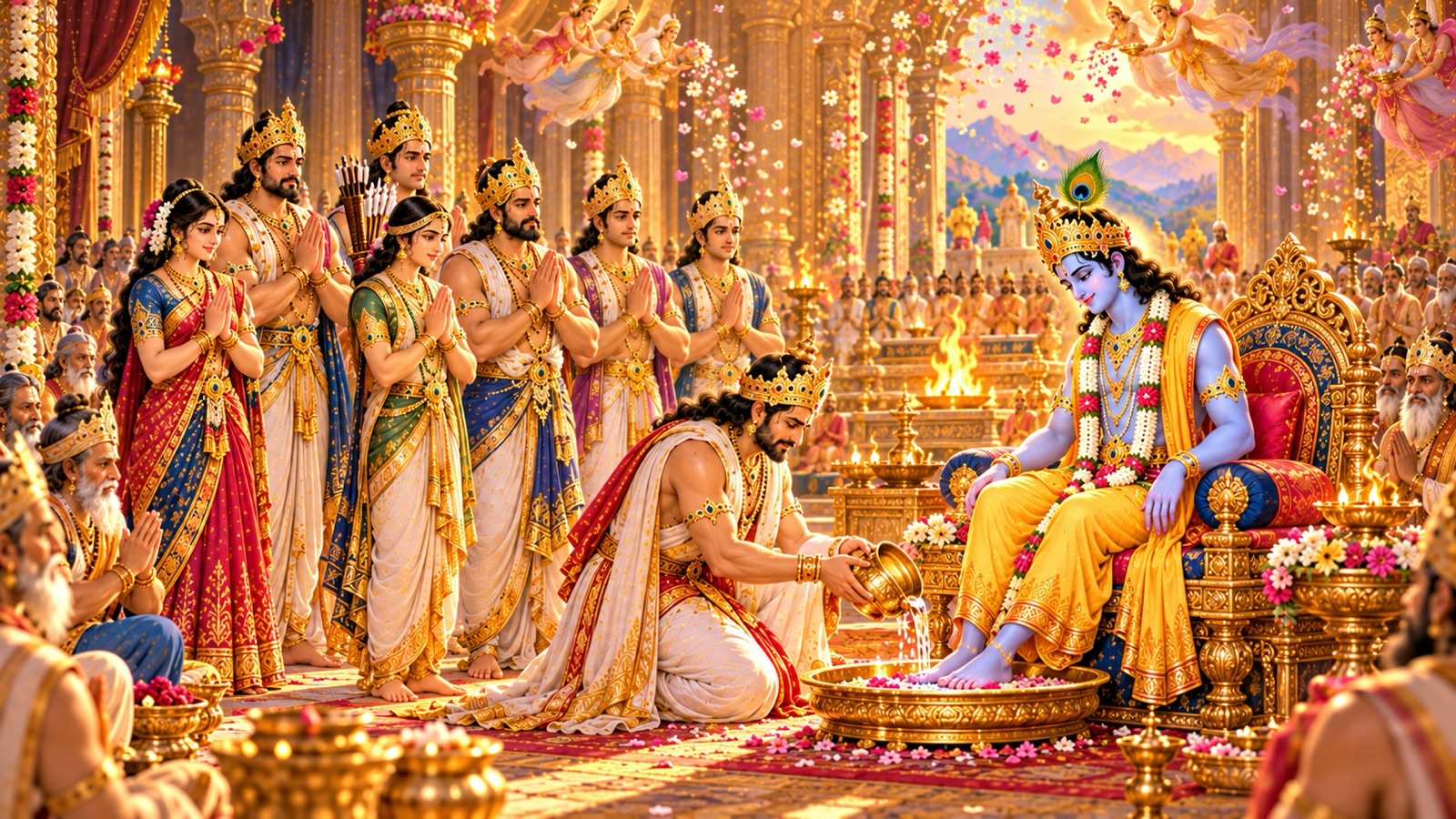
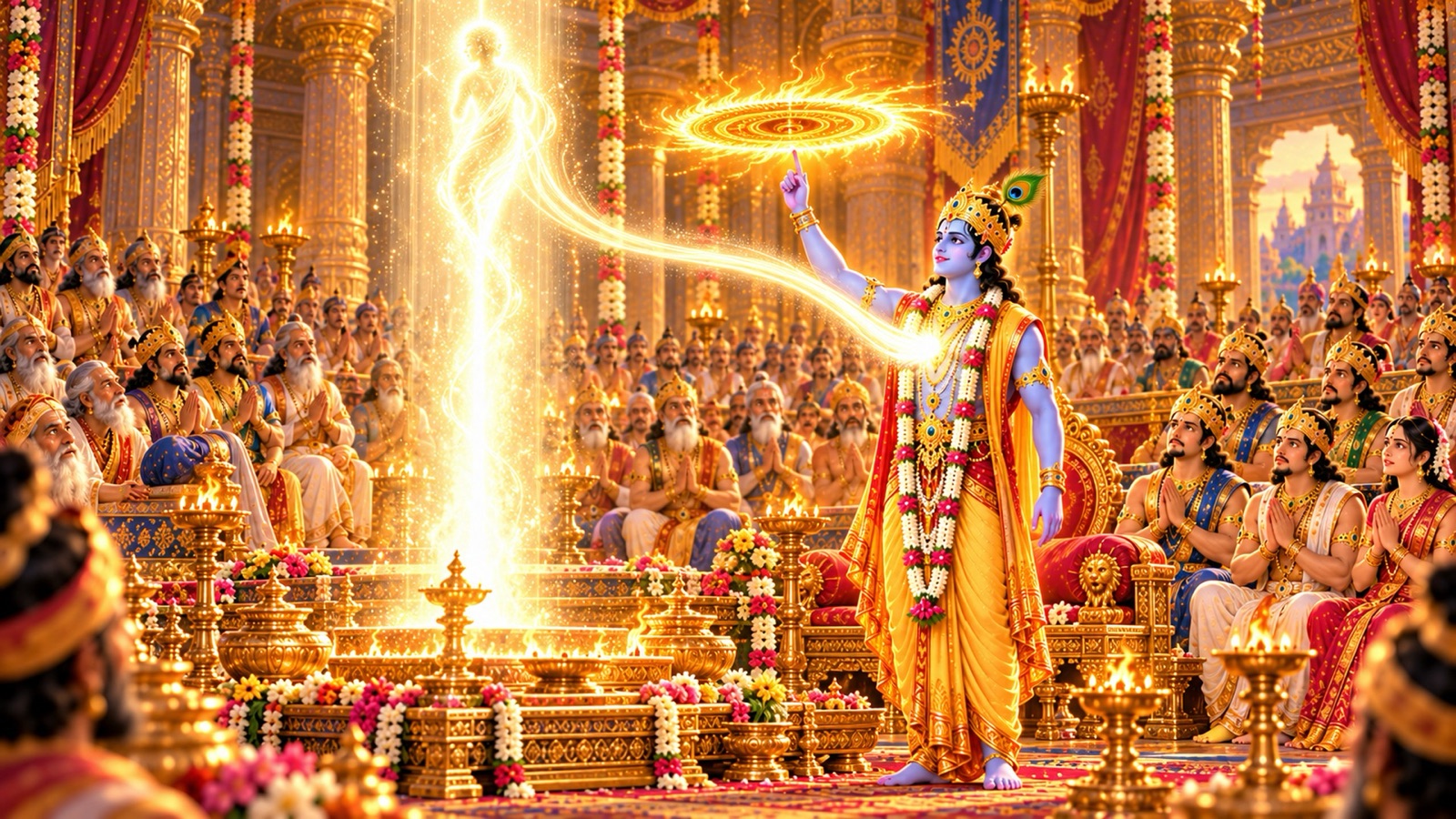
At Yudhishthira’s Rajasuya sacrifice, Sahadeva names Krishna alone worthy of the first worship; Shishupala rails against the Lord, and before the eyes of gods and kings a blaze of light rises from the Chedi king and vanishes into Krishna.
Om Namo Bhagavate Vasudevaya.
Om Namo Bhagavate Vasudevaya.
Om Namo Bhagavate Vasudevaya.
Welcome back to Srimad Bhagavatam Wisdom, our devotional journey through the sacred histories and teachings of the Srimad Bhagavat Mahapurana. The seventy-fourth chapter of the Tenth Canto takes us to Yudhishthira’s Rajasuya sacrifice, where young Sahadeva settles who shall receive the first honour and Shishupala’s long enmity ends in the Lord’s presence.
Chapter Information
- Scripture: Śrīmad Bhāgavata Mahāpurāṇa
- Canto: 10 (Book Ten, Latter Half)
- Chapter: 74 (Discourse 74)
- Chapter title: The Deliverance of Shishupala at the Rajasuya Sacrifice
- Principal speaker: Sukadeva Gosvami (narrating to King Parikshit); within the chapter Yudhishthira, Sahadeva and Shishupala also speak
- Principal listener: King Parikshit
- Main setting: Indraprastha, the sacrificial enclosure of the Rājasūya
- Central subject: The Rajasuya assembly; Sahadeva’s proposal of the first worship for Krishna; Shishupala’s abuse and liberation; the closing bath and Duryodhana’s envy
- Principal verse range: Canto 10, Chapter 74, verses 1–54
- Primary edition: Gita Press Śrīmad Bhāgavata Mahāpurāṇa (English, Book Ten, Discourse 74)
Context From the Previous Chapter
In Chapter 73, Krishna consoled the kings freed by Bhima’s victory over Jarasandha, taught them devotion and detachment, and sent them home. Honoured by Jarasandha’s son Sahadeva, He returned with Bhima and Arjuna to Indraprastha, where Yudhishthira wept for joy at His kindness.
Yudhishthira’s Words of Gratitude
When he heard how Jarasandha had fallen and how glorious was the might of Bhagavan Sri Krishna, Yudhishthira turned to the Lord with a heart full of wonder. Brahma, Shankara and world-guardians such as Indra, he said, count it a rare blessing to receive Your command; yet You, O infinite one, carry out the orders of men like us, who are poor and wretched and still fancy ourselves rulers. O lotus-eyed Lord, this can only be Your playful imitation of human ways. As the sun’s brilliance is neither increased by its rising nor lessened by its setting, so Your deeds neither add to Your glory nor diminish it, for You are the one Supreme Spirit without a second. The crooked notion of “I and mine, you and yours” lives only among the ignorant; it has no place in Your devotees, far less in You. Whatever You do is simply Your sport.
The Great Assembly Gathers
With Krishna’s approval, Yudhishthira chose a favourable hour and invited brahmanas learned in the Vedas to serve as priests: Krishna Dvaipayana Vyasa, Bharadvaja, Sumantu, Gautama, Asita, Vasishtha, Chyavana, Kanva, Maitreya, Kavasha, Trita, Vishvamitra, Vamadeva, Sumati, Jaimini, Kratu, Paila, Parashara, Garga, Vaishampayana, Atharva, Kashyapa, Dhaumya, Parashurama, Shukracharya, Asuri, Vitihotra, Madhucchanda, Virasena and Akritavrana. He also called Drona, Bhishma, Kripa, Dhritarashtra with all his sons and the noble Vidura to help conduct the rite, and to witness it came kings with their ministers and people of all four orders from every quarter.
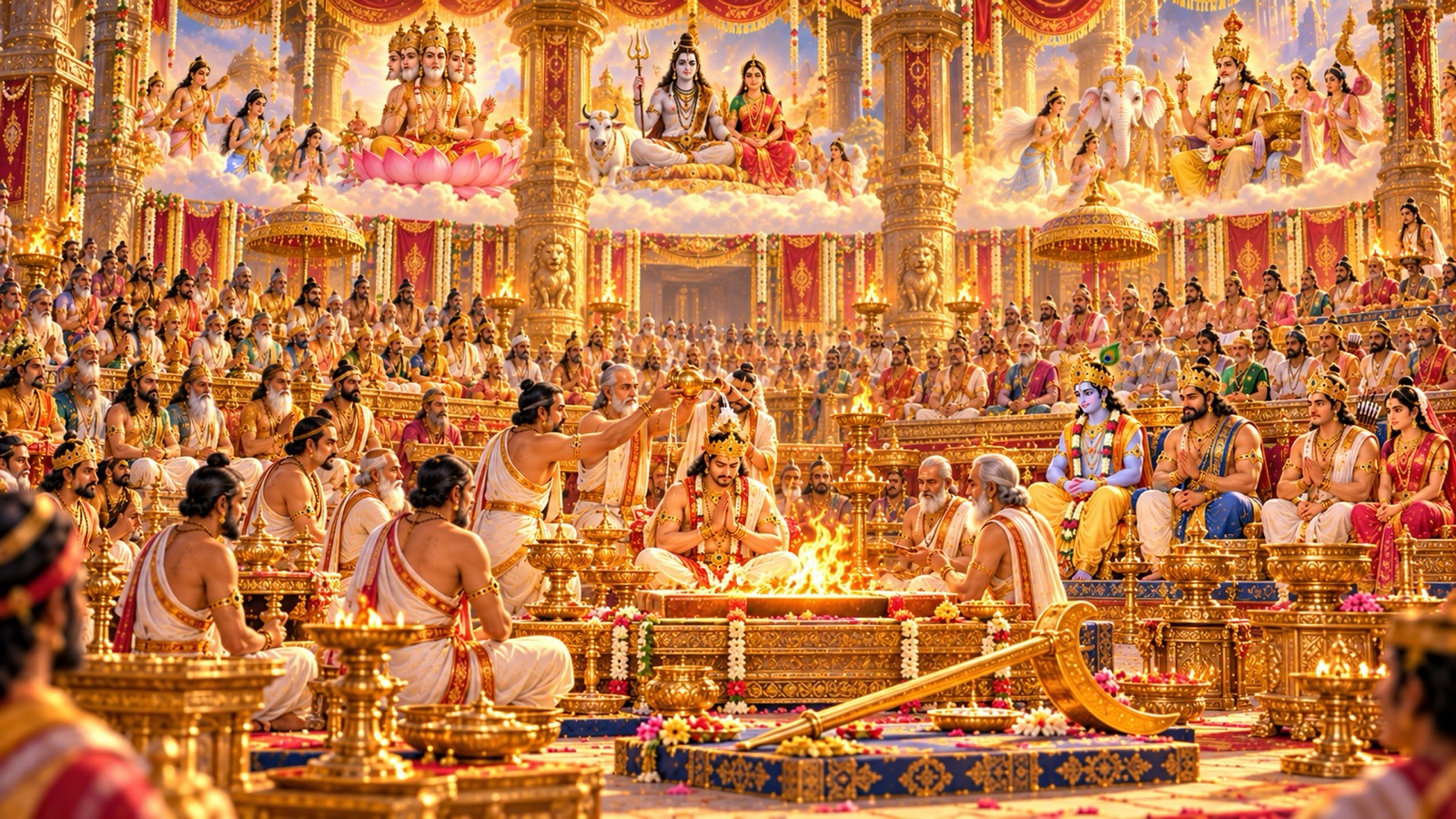
The priests ploughed the sacrificial ground with ploughs of gold and initiated Yudhishthira as the sacrificer according to scripture. Every vessel was of gold, as in the ancient sacrifice of Varuna. Brahma, Shankara, Indra and the other world-guardians; Siddhas, Gandharvas, Vidyadharas and Nagas; sages, Yakshas, Rakshasas, birds, Kinnaras and Charanas; and mighty kings with their queens — all answered the son of Pandu’s invitation. None doubted he was worthy, for to a devotee of Krishna nothing is beyond reach. The priests, radiant as gods, performed the Rajasuya as the gods had once performed it for Varuna, and on the Soma-pressing day Yudhishthira honoured the priests and elders with every attention.
Sahadeva Proposes the First Worship
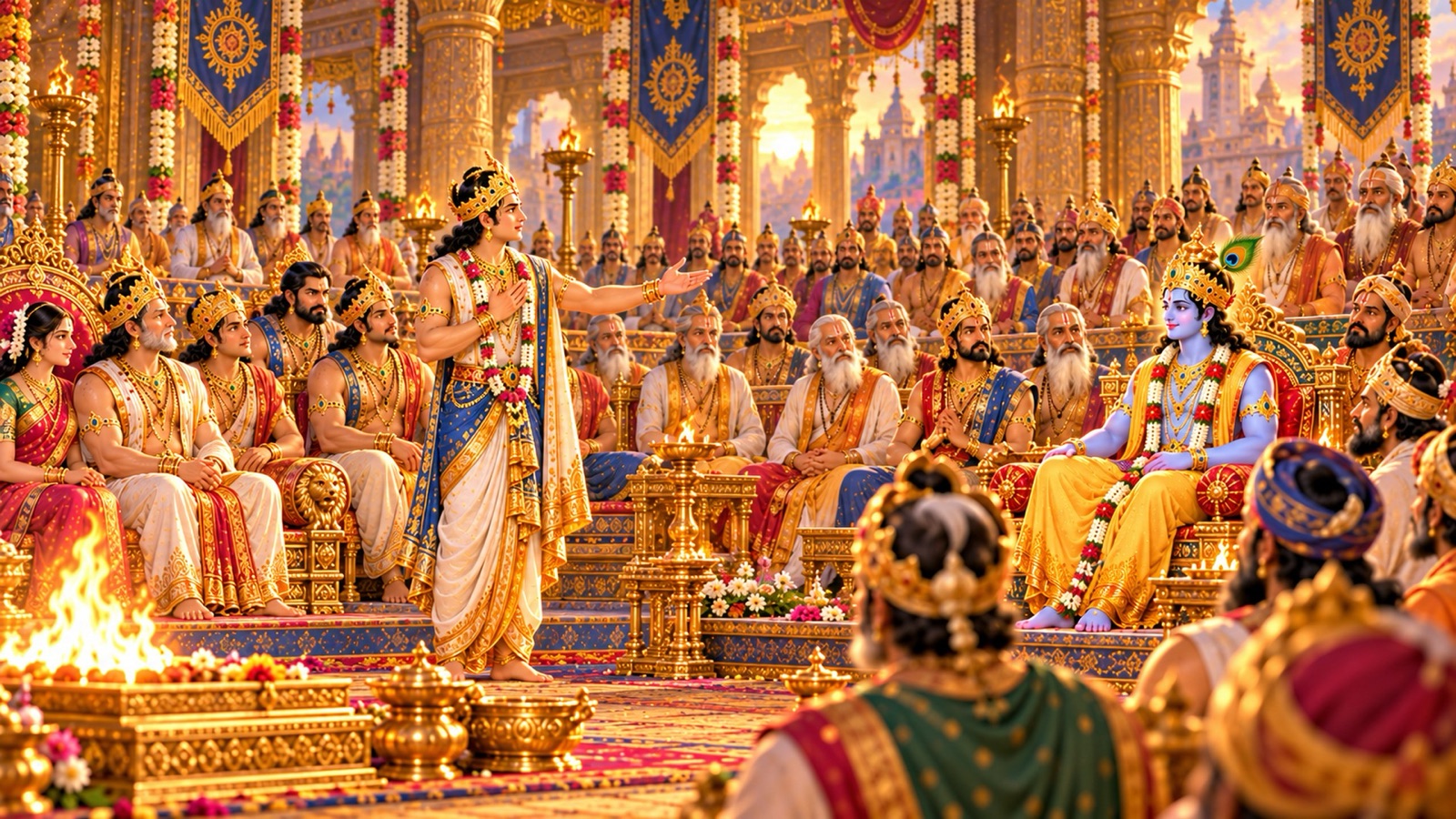
Now the assembly debated who should receive the agra-puja, the foremost honour of the sacrifice, and could not agree. Then Sahadeva, the youngest Pandava, rose and spoke.
अर्हति ह्यच्युतः श्रैष्ठ्यं भगवान् सात्वतां पतिः ।
एष वै देवताः सर्वा देशकालधनादयः ॥ १९ ॥
arhati hy acyutaḥ śraiṣṭhyaṁ bhagavān sātvatāṁ patiḥ eṣa vai devatāḥ sarvā deśa-kāla-dhanādayaḥ
Meaning: Achyuta, the Lord of the Satvatas, surely deserves the highest honour, for He Himself is all the gods, and He is time, place, wealth and everything else. (Canto 10, Chapter 74, verse 19)
The whole universe, Sahadeva went on, is His manifestation. He is the sacrifice, the fire, the oblation and the mantras; the paths of knowledge and action both lead to Him. He is the one Absolute without a second, the universe His body; unborn and self-dependent, by His will He creates, protects and dissolves it, and by His grace people pursue dharma, artha, kama and moksha. Let the first worship, then, go to Krishna, the greatest of the great — for in honouring Him, we honour every being and our own self.
सर्वभूतात्मभूताय कृष्णायानन्यदर्शिने ।
देयं शान्ताय पूर्णाय दत्तस्यानन्त्यमिच्छता ॥ २४ ॥
sarva-bhūtātma-bhūtāya kṛṣṇāyānanya-darśine deyaṁ śāntāya pūrṇāya dattasyānantyam icchatā
Meaning: Whoever wishes his gift to bear infinite fruit should offer it to Krishna, who is the very Self of all beings, who sees none as other than Himself, who is perfectly peaceful and complete in every way. (Canto 10, Chapter 74, verse 24)
Knowing the Lord’s greatness, Sahadeva said no more. The good people present were delighted and cried, “Well said! Well said!”
Yudhishthira Worships the Lord
Hearing the brahmanas’ approval and reading the mind of the assembly, King Yudhishthira, overcome with love, offered Hrishikesha the worship due to the first of all. He washed the feet of Krishna, and with Draupadi, his brothers, ministers and household he carried on his head the drops of that world-purifying water.
तत्पादाववनिज्यापः शिरसा लोकपावनीः ।
सभार्यः सानुजामात्यः सकुटुम्बो वहन्मुदा ॥ २७ ॥
tat-pādāv avanijyāpaḥ śirasā loka-pāvanīḥ sa-bhāryaḥ sānujāmātyaḥ sa-kuṭumbo vahan mudā
Meaning: Having washed His two feet, the king, together with his wife, younger brothers, ministers and family, joyfully bore upon his head that water which sanctifies the worlds. (Canto 10, Chapter 74, verse 27)
He then presented the Lord with robes of yellow silk and costly ornaments; but tears so filled his eyes that he could not see the form before him. Seeing Krishna so honoured, everyone in the hall folded their palms and cried “Namo namah!” and “Jaya, jaya!”, and showers of flowers fell from the sky.
Shishupala’s Outburst
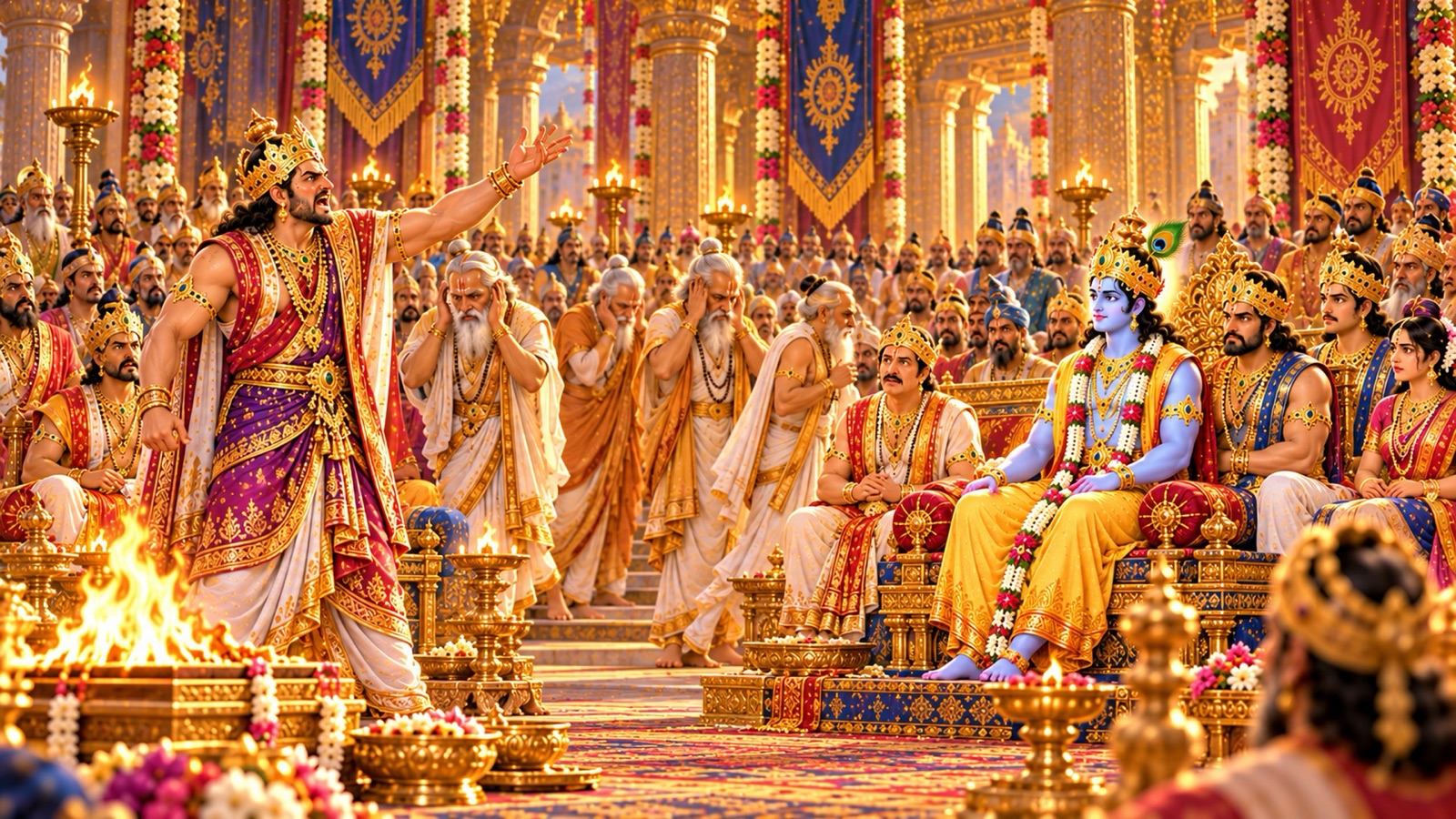
Shishupala, the son of Damaghosha, heard all this from his seat and burned at the glorification of Krishna. He rose, arm raised, and fearlessly spoke harsh words against the Lord. Time is indeed God, he declared, as the Vedas say — for here the judgement of wise elders has been bent by the prattling of a boy. You leaders are the judges of the first place; do not accept Sahadeva’s childish talk. Here sit sages of austerity and vows, established in Brahman and honoured by the gods themselves; passing them over, how can this cowherd, a disgrace to his family, be fit for such honour? Does a crow deserve the sacrificial cake? He has no varna, no ashrama, no noble birth; he stands outside every dharma and acts at whim against Veda and custom. His clan lies under Yayati’s curse, is shunned by the good and given to drink; abandoning Mathura and the lands of the sages, they hide in a sea-fortress without brahmanas and sally out like pirates to torment all creatures.
Such were the inauspicious things Shishupala said, for his merit was spent; and the Lord said nothing at all, as a lion pays no heed to the howling of a jackal. The assembly, however, could not endure such abuse. Some covered their ears and walked out in anger, condemning the king of Chedi — and with good reason, Sukadeva told Parikshit.
निन्दां भगवतः शृण्वंस्तत्परस्य जनस्य वा ।
ततो नापैति यः सोऽपि यात्यधः सुकृताच्च्युतः ॥ ४० ॥
nindāṁ bhagavataḥ śṛṇvaṁs tat-parasya janasya vā tato nāpaiti yaḥ so ’pi yāty adhaḥ sukṛtāc cyutaḥ
Meaning: One who hears blasphemy of the Lord or of those devoted to Him and does not leave that place falls from his merit and goes downward. (Canto 10, Chapter 74, verse 40)
The Deliverance of Shishupala
The Pandavas, Matsyas, Kaikayas and Srinjayas now sprang up in fury with weapons raised, resolved to put an end to Shishupala. Undaunted, he seized sword and shield and reviled the kings who sided with Krishna. At this Bhagavan rose, restrained His own supporters, and when Shishupala swooped upon Him, with a show of anger He severed His assailant’s head with the razor-sharp edge of His discus.
A great tumult filled the hall as the king of Chedi fell, and the princes who had followed him fled for their lives. Then, as all looked on, a light rose from Shishupala’s body and entered Vasudeva, like a meteor falling from the sky into the earth.
चैद्यदेहोत्थितं ज्योतिर्वासुदेवमुपाविशत् ।
पश्यतां सर्वभूतानामुल्केव भुवि खाच्च्युता ॥ ४५ ॥
caidya-dehotthitaṁ jyotir vāsudevam upāviśat paśyatāṁ sarva-bhūtānām ulkeva bhuvi khāc cyutā
Meaning: Before the eyes of every creature present, the light that arose from the body of the Chedi king entered Vasudeva, as a meteor fallen from the heavens sinks into the ground. (Canto 10, Chapter 74, verse 45)
Through three successive births Shishupala had fixed his mind on the Lord with an enmity that only deepened, and by that unbroken meditation he attained oneness with Him, regaining his former standing as the Lord’s attendant. Truly, the state of one’s heart determines what one becomes.
जन्मत्रयानुगुणितवैरसंरब्धया धिया ।
ध्यायंस्तन्मयतां यातो भावो हि भवकारणम् ॥ ४६ ॥
janma-trayānuguṇita- vaira-saṁrabdhayā dhiyā dhyāyaṁs tan-mayatāṁ yāto bhāvo hi bhava-kāraṇam
Meaning: Absorbed in the Lord with a mind inflamed by hostility multiplied over three lifetimes, he became one with Him; for it is one’s inner disposition that causes one’s future existence. (Canto 10, Chapter 74, verse 46)
The Completion of the Sacrifice
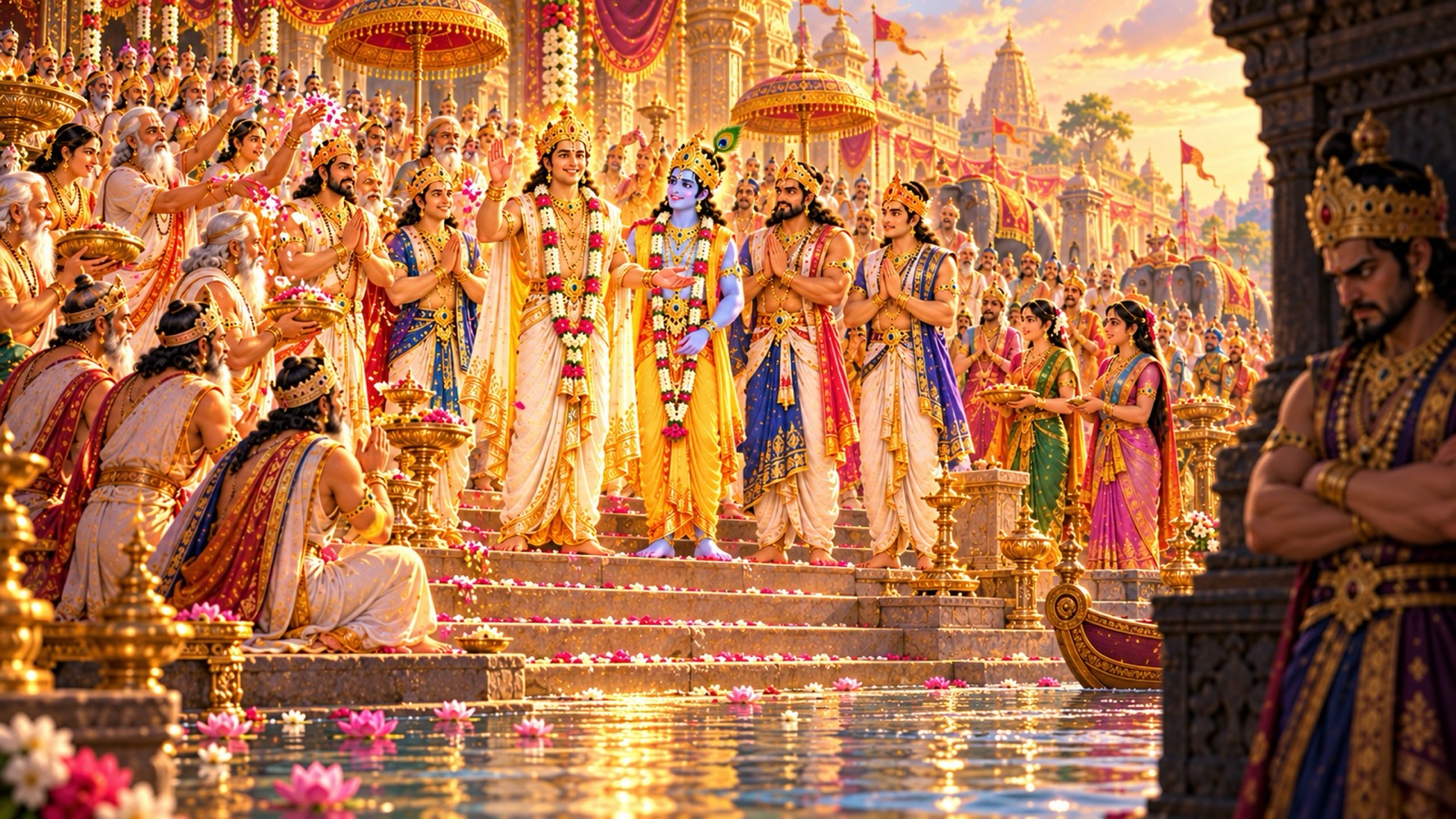
Emperor Yudhishthira then gave generous fees to the priests and supervising elders, honoured all who had come, and performed the avabhritha, the bath that closes a sacrifice, as scripture prescribes. Bhagavan Sri Krishna, Lord of all masters of yoga, stayed at Indraprastha some months at the request of His friends and kinsmen; then, taking leave of a Yudhishthira most unwilling to part with Him, He departed for Dwaraka with His queens and ministers. Sukadeva recalled having already told Parikshit how Jaya and Vijaya, the Lord’s two attendants in Vaikuntha, had been made by the curse of Sanaka and his brothers to take birth again and again on earth.
Bathed at the close of the Rajasuya, Yudhishthira shone like Indra among the brahmanas and kshatriyas. Honoured by him, the gods, men and sky-dwellers returned gladly to their homes, praising Krishna and the king’s sacrifice. Duryodhana alone could not bear to look upon the vast fortune and royal splendour of the Pandavas, for he was sinful and quarrelsome by nature, a disease in the body of the Kuru race, born for its ruin.
Sukadeva closed with the blessing that attends this history: whoever recites these deeds of Vishnu — the slaying of the Chedi king, the release of the captive kings and the great sacrifice — is freed from all sins.
Principal Teachings of This Chapter
1. The Lord’s obedience to His devotees is His play. Yudhishthira marvels that the One whom Brahma and Shiva obey carries out the wishes of mortal kings. As sunrise and sunset leave the sun untouched, Krishna’s deeds neither raise nor lower Him; His submission to those who love Him is pure grace.
2. Honour offered to Krishna reaches all beings. Sahadeva’s reasoning (verse 19 and verse 24) is that the Lord is Himself all the gods, time, place and wealth, and the Self of every creature; a gift placed in His hands becomes infinite. The first worship is not a ranking of guests but a recognition of who alone contains them all.
3. Leave the place where the Lord is reviled. Verse 40 is the plainest instruction here: to hear blasphemy of the Lord or His devotee and remain costs one’s hard-won merit. The sages who covered their ears and departed showed the right response.
4. Silence before abuse is the Lord’s dignity. Krishna answers Shishupala’s tirade with no word, as a lion ignores a jackal; not every insult deserves a reply.
5. Why the Lord delivered His reviler at His own worship. Two events stand deliberately side by side: Krishna is honoured as the Self of all beings, and then the very man who denied this is drawn into Him as light (verse 45). Sukadeva unlocks the mystery through verse 46 and the reminder of Jaya and Vijaya: Shishupala’s enmity was the Lord’s own arrangement, the last birth of a cursed servant of Vaikuntha, and three lifetimes of hate-filled remembrance could not keep him from the One he remembered. If hatred fixed on the Lord carries a soul back to Him, how much more surely does love. Bhāva, the inner disposition, is the seed of destiny.
A Devotional Reflection
What moves me most in this chapter is not the fall of Shishupala but the tears of Yudhishthira. He has conquered the earth and gathered gods and sages, yet when the water from Krishna’s feet touches his head he cannot see the Lord for weeping. Moments later a man who hated Krishna so steadily that he could think of nothing else is taken back into Him as a streak of light. Between the devotee blinded by tears and the enemy dissolved in light stands the whole teaching of bhakti: our thoughts are not idle; they are shaping where we will go. So may we guard what we listen to, and fill our remembrance with the One who is worth remembering.
A Daily Devotional Practice
Today, when you sit for your prayer, picture the water from the Lord’s feet placed upon your head as Yudhishthira’s family received it, and give Him the first place in your day. If you hear the Lord, the scriptures or a sincere devotee mocked, follow the sages — do not linger, do not join in, and quietly return your mind to His name. Begin with the mantra: Om Namo Bhagavate Vasudevaya.
Conclusion
The seventy-fourth chapter of the Tenth Canto gathers heaven and earth into Yudhishthira’s sacrificial hall to reveal one truth: the Lord of the Satvatas is the Self of every being, worthy of the first worship, and the final refuge even of those who revile Him. Shishupala’s hatred ends in light, Yudhishthira’s devotion in tears of joy, while Duryodhana’s envy waits to bear its fruit. May the memory of that hall teach us to honour Krishna first, to turn from blasphemy without hesitation, and to let no thought of ours rest anywhere but in Him.
May the divine wisdom of Srimad Bhagavatam awaken pure devotion within our hearts.
Om Namo Bhagavate Vasudevaya.
Jay Shree Madhav.
References and Attribution
- Primary edition: Gita Press, Śrīmad Bhāgavata Mahāpurāṇa (English, Complete), Book Ten (Latter Half), Discourse 74, pp. 430–435.
- Series: Srimad Bhagavatam Wisdom · Biswa Sanatan Dharma Seva Trust.
- Presented following the spiritual guidance and recommendation of Pandit Dr. Shri Kashinath Mishra.
This is an original, faithful retelling in the writer’s own words, with brief quoted verses shown in Devanāgarī and transliteration and their meanings given as summaries. It is not a reproduction of any single publisher’s continuous translation or commentary. No affiliation with or endorsement by any publisher is implied.
Jay Shree Madhav