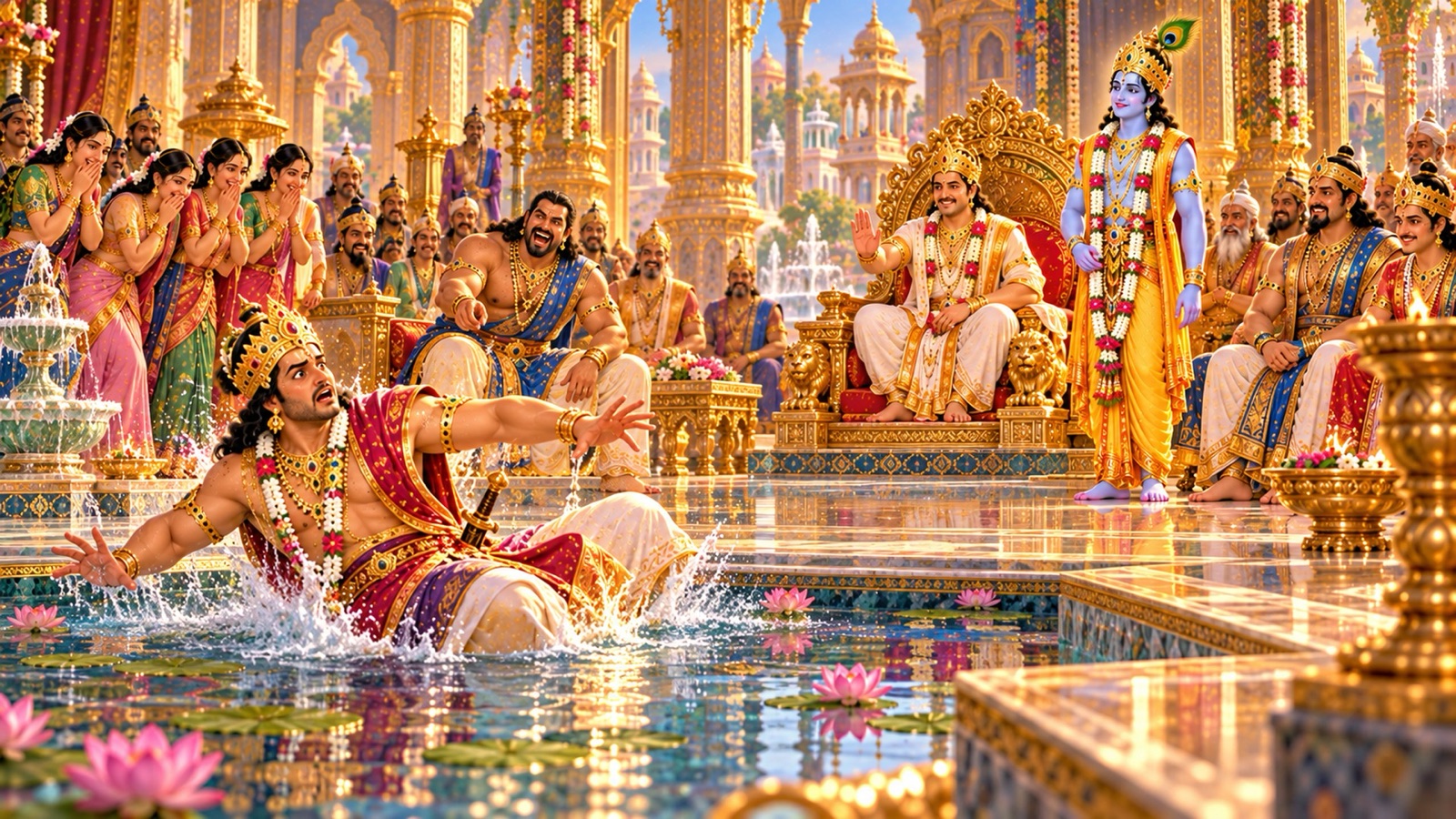
Every king, sage and god who came to Yudhishthira’s Rajasuya went home rejoicing — except one. In the hall built by Maya, Duryodhana mistakes a pool for a floor, and a single glance of the Lord turns his pride into the burning envy that will one day lighten the burden of the earth.
Om Namo Bhagavate Vasudevaya.
Om Namo Bhagavate Vasudevaya.
Om Namo Bhagavate Vasudevaya.
Welcome back to Srimad Bhagavatam Wisdom, our devotional journey through the sacred histories and teachings of the Srimad Bhagavat Mahapurana. In this seventy-fifth chapter of the Tenth Canto, Sukadeva answers a question waiting in Parikshit’s heart: why, when the whole world was glad at the Rajasuya, did Duryodhana alone go away in sorrow? The sage first shows us the sacrifice in its fullness, and only then the quiet scene in Maya’s hall where envy received its wound.
Chapter Information
- Scripture: Śrīmad Bhāgavata Mahāpurāṇa
- Canto: 10 (Book Ten, Latter Half)
- Chapter: 75 (Discourse 75)
- Chapter title: Duryodhana Humiliated
- Principal speaker: Sukadeva Gosvami (narrating to King Parikshit)
- Principal listener: King Parikshit
- Main setting: Indraprastha — the sacrificial grounds, the bank of the Ganga, and the assembly hall built by Maya Danava
- Central subject: The concluding rites of Yudhishthira’s Rajasuya, the departure of the guests, and Duryodhana’s humiliation in Maya’s hall
- Principal verse range: Canto 10, Chapter 75, verses 1–40
- Primary edition: Gita Press Śrīmad Bhāgavata Mahāpurāṇa (English, Book Ten, Latter Half)
Context From the Previous Chapter
In Chapter 74, Sisupala reviled Krishna at the Rajasuya and was slain by the Lord’s discus, his soul merging into Him. Every guest then departed praising Krishna and Yudhishthira — but Duryodhana, sinful and quarrelsome by nature, could not bear the sight of the Pandavas’ fortune.
Parikshit’s Question
That last detail prompted Parikshit’s question. ‘Holy sage,’ he said, ‘you have just told me that all the kings, sages and gods gathered at the great Rajasuya of Ajatasatru rejoiced at its success, and that Duryodhana alone was the exception. O worshipful one, please tell me the reason.’
Kinsmen Bound by Love
Sukadeva began with the spirit of the sacrifice. Yudhishthira, Parikshit’s grandfather, was a great soul, and every relative who came to Indraprastha was so bound to him by affection that each took up some duty in the sacrifice, not as a command but as an offering of love.
श्रीबादरायणिरुवाच
पितामहस्य ते यज्ञे राजसूये महात्मन: ।
बान्धवा: परिचर्यायां तस्यासन्प्रेमबन्धना: ॥ ३ ॥
śrī-bādarāyaṇir uvāca pitāmahasya te yajñe rājasūye mahātmanaḥ bāndhavāḥ paricaryāyāṁ tasyāsan prema-bandhanāḥ
Meaning: Sri Sukadeva said: At the Rajasuya sacrifice of your grandfather, that great soul, his kinsmen, tied to him by bonds of love, engaged themselves in his service. (Canto 10, Chapter 75, verse 3)
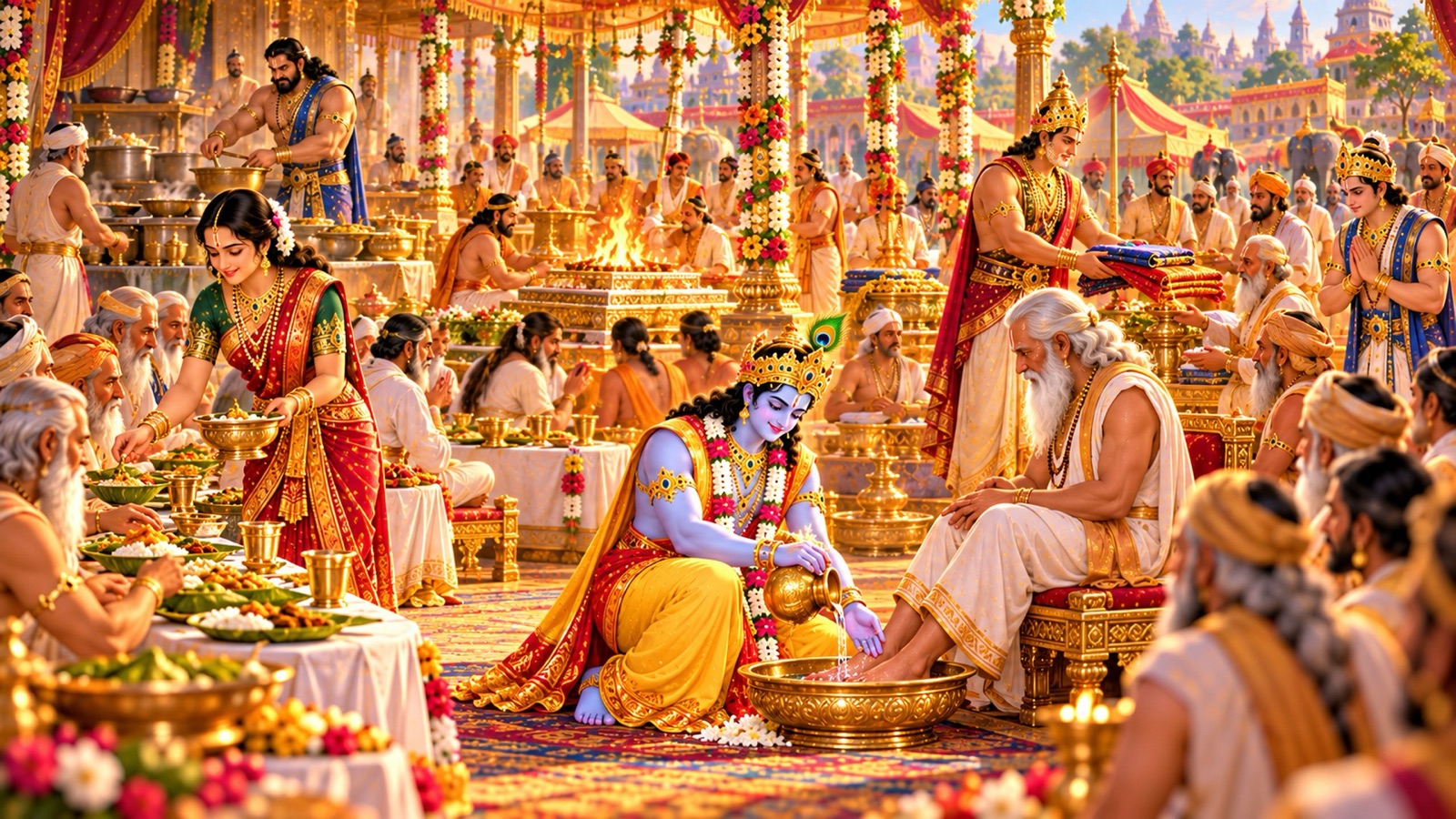
The duties were shared among the greatest men of the age. Bhima presided over the kitchen; Duryodhana kept the treasury; Sahadeva received and honoured the guests; Nakula gathered the supplies. Arjuna waited upon the elders, and the Lord Himself, Sri Krishna, took up the humblest task of all — washing the feet of those who came. Draupadi served the food, the generous Karna gave the gifts, and Satyaki, Vikarna, Hardikya, Vidura, Bhurisrava and the other sons of Bahlika, Santardana and others each carried some charge, all eager to please the king.
गुरुशुश्रूषणे जिष्णु: कृष्ण: पादावनेजने ।
परिवेषणे द्रुपदजा कर्णो दाने महामना: ॥ ५ ॥
guru-śuśrūṣaṇe jiṣṇuḥ kṛṣṇaḥ pādāvanejane pariveṣaṇe drupada-jā karṇo dāne mahā-manāḥ
Meaning: Arjuna attended on the elders, Krishna washed the feet of the guests, the daughter of Drupada distributed the food, and the magnanimous Karna gave away the gifts. (Canto 10, Chapter 75, verse 5)
The Procession to the Ganga
When the priests, the members of the assembly, the learned and the dear friends had been honoured with sweet words, rich presents and sacrificial fees, and Sisupala had entered the feet of the Lord of the Satvatas, Yudhishthira set out for the Ganga to perform the avabhritha, the bath that completes a sacrifice. Mridangas, conches, panavas, kettledrums, anakas and gomukha horns sounded together; dancers danced in joy, singers sang in troops, and the music of vina, flute and cymbals rose to the heavens.
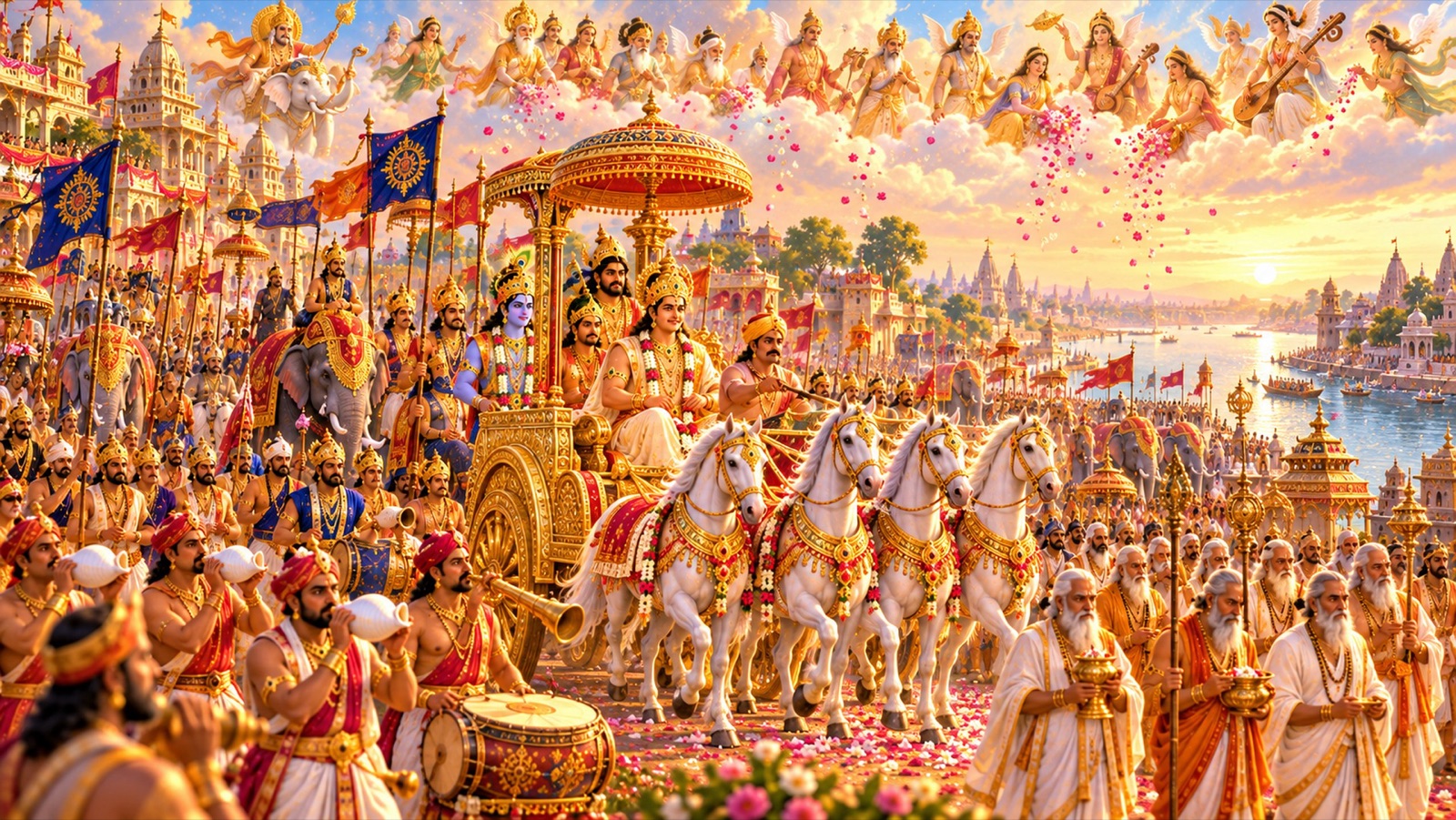
Behind the sacrificer marched the kings — Yadus, Srinjayas, Kambojas, Kurus, Kekayas and Kosalas — in golden necklaces, their banners streaming, their elephants, chariots, horses and armed soldiers making the earth tremble. The priests and foremost brahmanas went ahead reciting the Vedas aloud, while gods, sages, forefathers and Gandharvas sang Yudhishthira’s praise and rained flowers from the sky.
The Festival of Colours
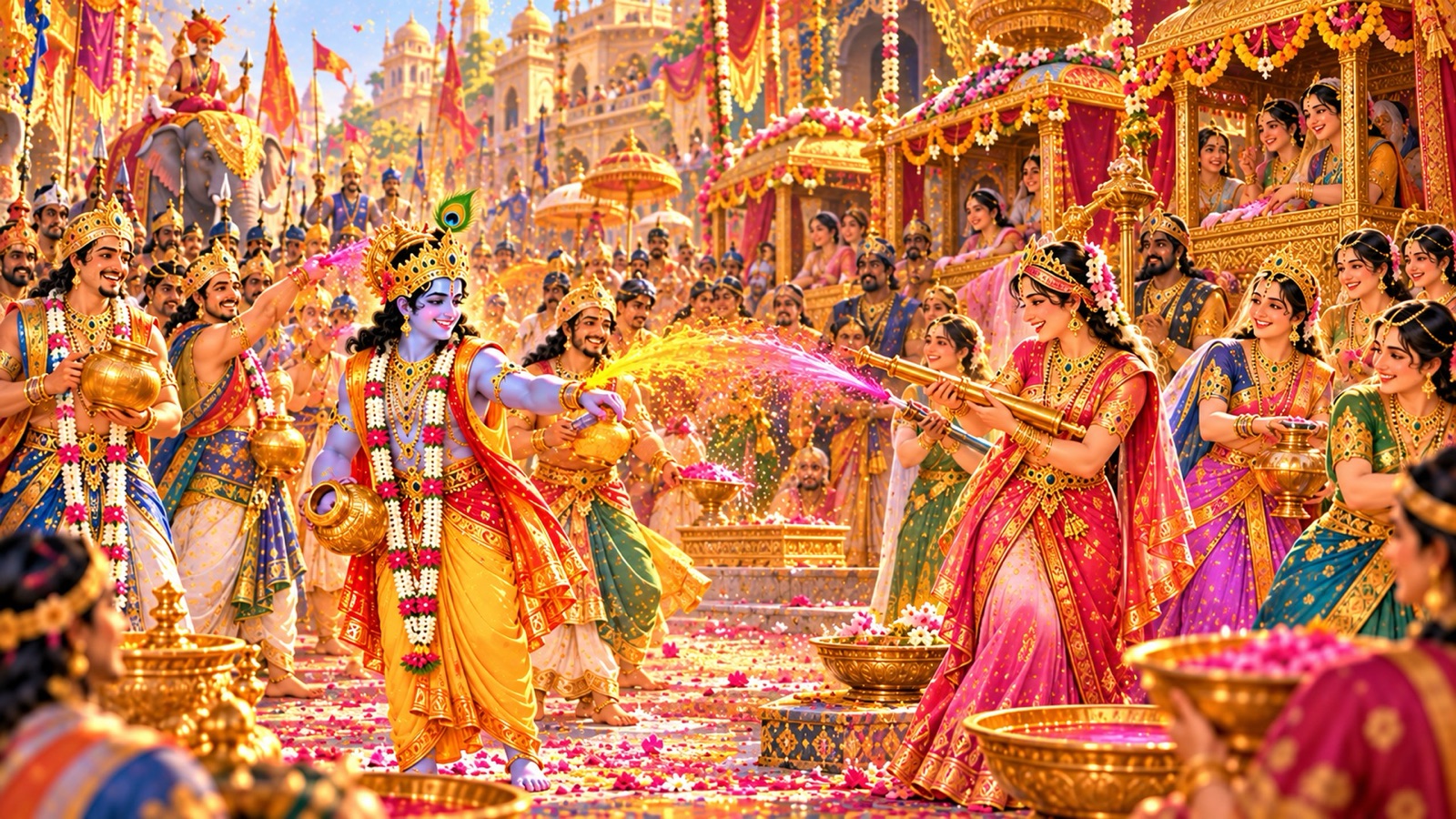
The whole city joined the celebration. Men and women adorned with fragrant pastes, garlands, ornaments and fine clothes played in the streets, anointing and sprinkling one another with liquids of many kinds; the courtesans smeared the men with oil, milk, scented water, turmeric and thick saffron, and were covered in turn with the same.
The ladies of the royal house, curious to watch, came out guarded by soldiers, as the goddesses of heaven look down from their aerial cars. Sri Krishna and His companions sprinkled coloured water on them, and their faces blossomed with shy laughter. The queens answered with water-syringes, drenching their brothers-in-law and friends; their garments clung wet about them, their braids loosened and the flowers slipped from their hair. Sukadeva adds a quiet warning: this innocent sport stirred impure thoughts only in those whose hearts were already impure.
The Sacred Bath and the Honouring of All
In his chariot of fine horses and golden necklaces, Yudhishthira with his queens shone like the Rajasuya itself with all its rites in human form. After the Patni-samyaja and the avabhritha rites, the priests had him sip water and bathed him in the Ganga together with Draupadi. The drums of the gods thundered along with the drums of men, and gods, sages, forefathers and mortals showered flowers. Then the people of every varna and every stage of life plunged into the river after their king, for a bath taken there at that moment freed even the gravest sinner from his sins at once.
Yudhishthira then put on new silken garments and ornaments and honoured the priests, the members of the assembly and the brahmanas with clothes and jewels. A king devoted wholly to Narayana, he saw the Lord in everyone, and so he honoured his kinsmen, fellow kings, friends and well-wishers, and the common people too, again and again. In their jewelled earrings, garlands, turbans, silks and pearl necklaces the men looked like gods walking on earth, and the women were radiant with earrings, curling locks and girdles of gold.
The Guests Depart, the Lord Remains
Then the noble priests, the Vedic scholars of the assembly, people of all four orders, the kings who had gathered, the gods, sages, forefathers and other beings, and the guardians of the world with their followers all took leave of Yudhishthira with due honour and returned to their abodes, unable as they went to stop praising what they had seen.
हरिदासस्य राजर्षे राजसूयमहोदयम् ।
नैवातृप्यन्प्रशंसन्त: पिबन्मर्त्योऽमृतं यथा ॥ २७ ॥
hari-dāsasya rājarṣe rājasūya-mahodayam naivātṛpyan praśaṁsantaḥ piban martyo ’mṛtaṁ yathā
Meaning: Glorifying the grand success of the Rajasuya of the saintly king, the servant of Hari, they never had their fill — just as a mortal drinking nectar is never satisfied. (Canto 10, Chapter 75, verse 27)
Yudhishthira could not bear the thought of parting, and out of love he held back his friends and kinsmen — and Sri Krishna too. The Lord, eager to please His devotee, sent Samba and the other Yadu heroes home to Dwaraka and stayed on Himself. Thus the son of Dharma, who had longed for this sacrifice as one longs to cross a vast ocean, found his wish fulfilled through Krishna and was at last free of all anxiety.
The Splendour That Burned Duryodhana
One day Duryodhana, moving through the inner palace, looked upon the wealth of Yudhishthira and the greatness this devotee of the infallible Lord had won through the Rajasuya, and he burned within. The palace held the combined opulences of the kings of men, of the daityas and of the gods, gathered there by the craft of Maya, its builder; and with those riches Draupadi waited upon her husbands. It was above all his attachment to her that made the Kuru prince writhe with envy. More than a thousand queens of Krishna also graced the palace then, walking gently to the music of their anklets, their pearl necklaces tinged by saffron, their faces framed by swaying earrings and flowing locks.
In the Hall Built by Maya
In the assembly hall that Maya had fashioned, Emperor Yudhishthira sat one day upon a golden throne, surrounded by his attendants and kinsmen and by Sri Krishna, who was his very eye. Endowed with the splendour of Brahma’s own realm and praised by bards, he looked like Indra.
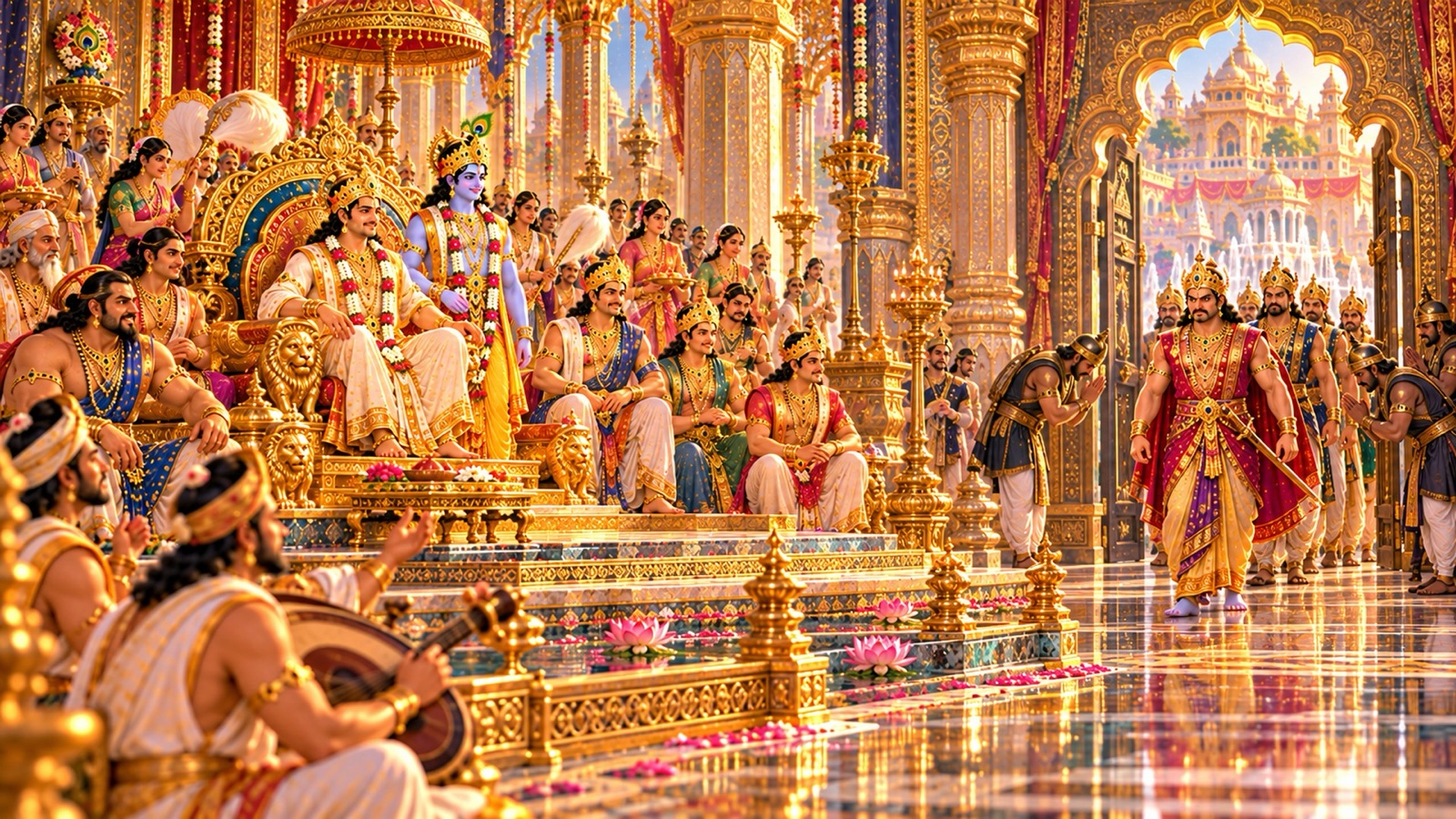
Into that hall came proud Duryodhana with his brothers, crowned, garlanded and sword in hand, rebuking the doorkeepers in anger as he entered. But the hall was wrought with the wizardry of Maya, and the arrogant prince could not read it.
स्थलेऽभ्यगृह्णाद् वस्त्रान्तं जलं मत्वा स्थलेऽपतत् ।
जले च स्थलवद् भ्रान्त्या मयमायाविमोहित: ॥ ३७ ॥
sthale ’bhyagṛhṇād vastrāntaṁ jalaṁ matvā sthale ’patat jale ca sthala-vad bhrāntyā maya-māyā-vimohitaḥ
Meaning: Bewildered by the illusion created by Maya, he lifted the hem of his garment on dry ground, taking it for water, and then fell into water, mistaking it for dry ground. (Canto 10, Chapter 75, verse 37)
Seeing him tumble, Bhima laughed aloud, and the women and the other kings laughed with him. Yudhishthira tried to restrain them, but a gesture of approval from Sri Krishna encouraged their laughter.
The Silent Glance of the Lord
Shame and fury drove Duryodhana from the hall that very moment, and he rode for Hastinapura without a word. The good people present cried out in dismay, and Yudhishthira was troubled as if his own heart had been struck. But the Lord said nothing — for it was His own glance that had confused Duryodhana, and the earth’s burden was waiting to be lifted.
स व्रीडितोऽवाग्वदनो रुषा ज्वलन् निष्क्रम्य तूष्णीं प्रययौ गजाह्वयम् ।
हाहेति शब्द: सुमहानभूत् सतामजातशत्रुर्विमना इवाभवत् ।
बभूव तूष्णीं भगवान् भुवो भरं समुज्जिहीर्षुर्भ्रमति स्म यद् दृशा ॥ ३९ ॥
sa vrīḍito ’vāg-vadano ruṣā jvalan niṣkramya tūṣṇīṁ prayayau gajāhvayam hā-heti śabdaḥ su-mahān abhūt satām ajāta-śatrur vimanā ivābhavat babhūva tūṣṇīṁ bhagavān bhuvo bharaṁ samujjihīrṣur bhramati sma yad-dṛśā
Meaning: Humiliated, with lowered face and burning with rage, Duryodhana went out in silence and departed for Hastinapura. A loud cry of dismay arose from the righteous, and Ajatasatru seemed dejected; but the Lord, who wished to remove the earth’s burden and by whose look Duryodhana had been deluded, remained silent. (Canto 10, Chapter 75, verse 39)
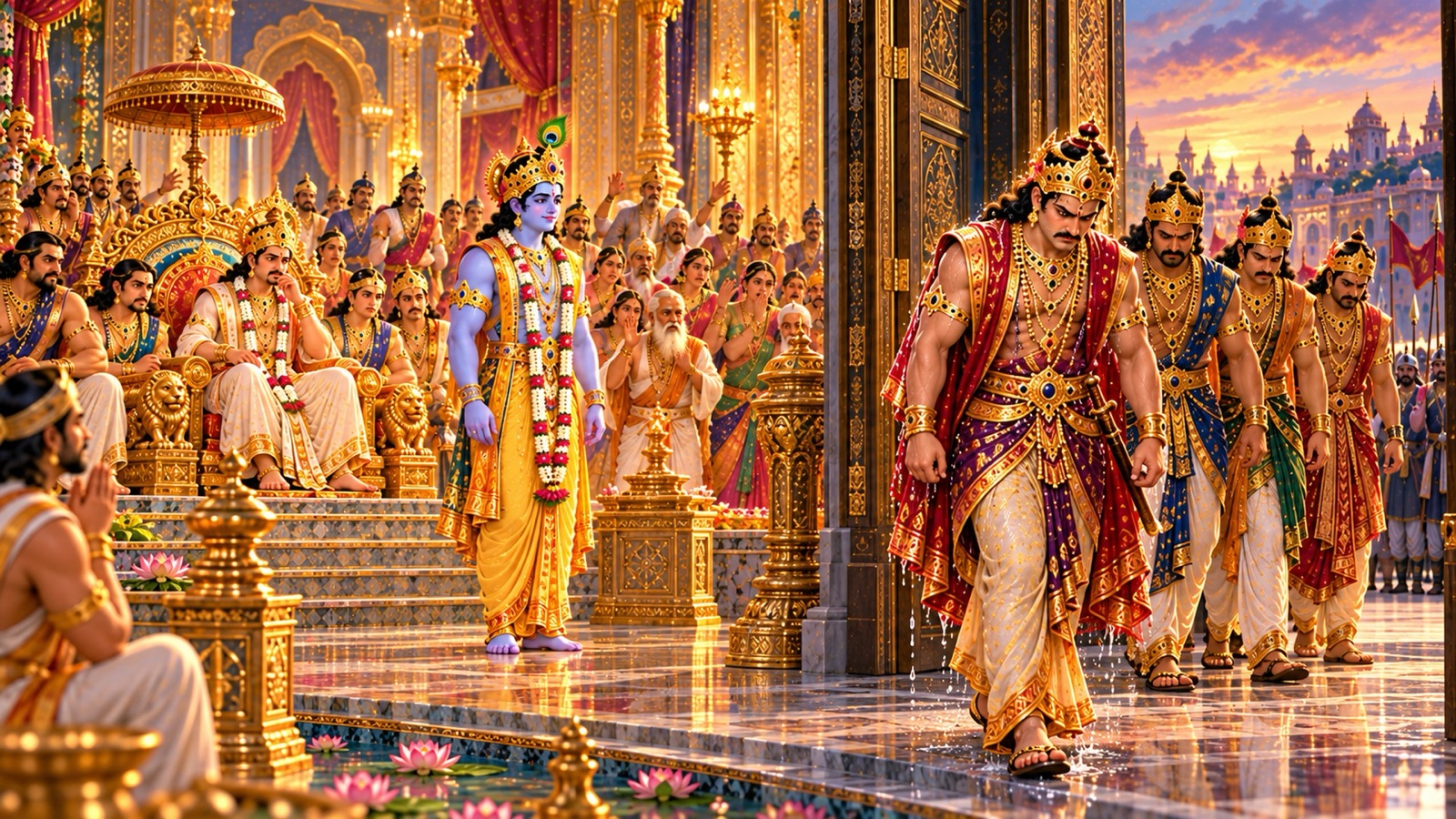
Sukadeva then closed his answer: ‘O King, you asked me how, at the great Rajasuya sacrifice, Duryodhana’s malice toward the Pandavas was born. This is what I have told you.’
Principal Teachings of This Chapter
1. Service offered in love is the heart of sacrifice. The kinsmen served because affection tied them to Yudhishthira (verse 3). What makes an act sacred is not its grandeur but the love that binds the servant to the one he serves.
2. The Lord chooses the lowest seat. Among all the offices of the sacrifice, Krishna took the washing of feet (verse 5). Humility is not beneath God; it is His own nature, and the ornament of every devotee.
3. A devotee’s good fortune sanctifies all who touch it. The bath after Yudhishthira’s sacrifice cleansed even the gravest sinner, and the guests praised the sacrifice as men drink nectar (verse 27). The success of a servant of Hari is a blessing to the whole world, and his ambition, pursued with Krishna, ends in peace rather than fever.
4. Envy sees water as land and land as water. Duryodhana, deluded by Maya’s illusion, could not tell floor from pool (verse 37). The envious heart misjudges everything before it, and its own pride becomes the trap into which it falls.
5. The Lord’s silence is itself His will. Krishna neither laughed nor consoled, yet it was His glance that bewildered Duryodhana (verse 39). This is the chapter’s deepest point: the humiliation was not an accident of a clever floor but the Lord’s own arrangement. Having descended to relieve the earth of her burden, He let envy ripen in Duryodhana so that the Kuru arrogance oppressing the world would one day gather at Kurukshetra and be removed. The devotee grieves at the insult; the Lord, who sees the end from the beginning, keeps still. Nothing in the hall that day lay outside His plan — nor do the sorrows that visit our own lives.
A Devotional Reflection
Two men stand at the centre of this chapter, and both are given wealth to hold. Krishna, the owner of everything, takes up a basin of water and washes the feet of the guests. Duryodhana, keeper of the treasury, counts the gold of a kingdom and goes home poorer than he came. The Lord looked at every guest as someone to be served; the Kuru prince looked at every jewel as something he lacked, and Maya’s hall only revealed what envy had already done inside him. How often do we walk into another’s blessing and feel only the sting of our own want? The chapter asks us to stand instead with Yudhishthira, who saw Narayana in everyone he honoured, and with the guests who went home drinking praise like nectar. Rejoicing in a devotee’s good fortune is itself a form of worship; and when we are the ones humbled, the Lord’s silence is not absence but care.
A Daily Devotional Practice
Today, when you see another’s success or blessing, offer it to the Lord with gladness, as the guests of the Rajasuya praised Yudhishthira’s fortune. If envy pricks you, remember Krishna washing the feet of the guests, and do one small, humble service for someone near you before the day ends. Begin by chanting gently: Om Namo Bhagavate Vasudevaya.
Conclusion
Sukadeva has shown Parikshit two faces of the same festival: the kinsmen who served out of love, the Lord who washed feet and the king who honoured everyone as Narayana on one side; on the other, a single prince whose envy turned the Pandavas’ joy into his own torment until Maya’s hall and the Lord’s glance brought him down before all. From that fall was born the malice that would shape the fate of the Kurus, and the Lord let it be so. May we serve as the kinsmen served, rejoice as the guests rejoiced, and trust that even our humblings rest in His silent, all-seeing care.
May the divine wisdom of Srimad Bhagavatam awaken pure devotion within our hearts.
Om Namo Bhagavate Vasudevaya.
Jay Shree Madhav.
References and Attribution
- Primary edition: Gita Press, Śrīmad Bhāgavata Mahāpurāṇa (English), Book Ten (Latter Half), Discourse 75.
- Series: Srimad Bhagavatam Wisdom · Biswa Sanatan Dharma Seva Trust.
- Presented following the spiritual guidance and recommendation of Pandit Dr. Shri Kashinath Mishra.
This is an original, faithful retelling in the writer’s own words, with brief quoted verses shown in Devanāgarī and transliteration and their meanings given as summaries. It is not a reproduction of any single publisher’s continuous translation or commentary. No affiliation with or endorsement by any publisher is implied.
Jay Shree Madhav