Nursing an old humiliation, Shalva wins from Lord Shiva a flying city of iron and turns it against Dvaraka — and in the heart of that terror a wounded prince is taught by his own charioteer what the dharma of the battlefield truly asks.
Om Namo Bhagavate Vasudevaya.
Om Namo Bhagavate Vasudevaya.
Om Namo Bhagavate Vasudevaya.
Welcome back to Srimad Bhagavatam Wisdom, our devotional journey through the sacred histories and teachings of the Srimad Bhagavat Mahapurana. In this seventy-sixth chapter of the Tenth Canto, Sukadeva begins the story of Shalva, who swore to empty the earth of the Yadavas and received from Shiva the aerial city Saubha. While Krishna is away at Indraprastha, Shalva besieges Dvaraka, and the young hero Pradyumna leads the Yadu warriors against him.
Chapter Information
- Scripture: Śrīmad Bhāgavata Mahāpurāṇa
- Canto: 10 (Book Ten, Latter Half)
- Chapter: 76 (Discourse 76)
- Chapter title: The Battle Between Shalva and the Vrishnis
- Principal speaker: Sukadeva Gosvami (narrating to King Parikshit); within the story, Pradyumna and his charioteer, the son of Daruka
- Principal listener: King Parikshit
- Main setting: The city of Dvārakā and the battlefield before its walls
- Central subject: Shalva’s vow and his worship of Shiva; the aerial city Saubha; the siege of Dvaraka; Pradyumna’s valour and his removal from the field; the charioteer’s explanation of a warrior’s dharma
- Principal verse range: Canto 10, Chapter 76, verses 1–33
- Primary edition: Gita Press Śrīmad Bhāgavata Mahāpurāṇa (English, Part II)
Context From the Previous Chapter
Chapter 75 completed the Rajasuya sacrifice of Yudhishthira at Indraprastha. Duryodhana, envious of the Pandavas’ glory, stumbled in the hall built by the demon Maya, mistaking water for floor and floor for water; Bhima and the ladies laughed, and he left in silent fury for Hastinapura. Krishna, intent on lightening the earth’s burden, allowed it all to unfold.
Sukadeva Takes Up a New Wonder
Having told of Duryodhana’s humiliation, Sukadeva invites Parikshit to hear another astonishing deed of Krishna, the Lord who for His own sport had taken on a human body — the deed by which the master of the aerial city Saubha met his end. The outcome is announced before the story begins, so that the listener may follow every turn of the battle knowing in whose hands it rests.
श्रीशुक उवाच
अथान्यदपि कृष्णस्य शृणु कर्माद्भुतं नृप ।
क्रीडानरशरीरस्य यथा सौभपतिर्हतः ॥ १ ॥
śrī-śuka uvāca athānyad api kṛṣṇasya śṛṇu karmādbhutaṁ nṛpa krīḍā-nara-śarīrasya yathā saubha-patir hataḥ
Meaning: Sri Suka said: O King, hear now yet another wonderful exploit of Krishna, who for His pastimes bore a human form — how the master of Saubha was slain. (Canto 10, Chapter 76, verse 1)
This Shalva, Sukadeva recalls, had been a friend of Shishupala. He had come as a member of the groom’s party when Shishupala expected to marry Rukmini, and on that day he, Jarasandha and the other kings had been thoroughly defeated in battle by the Yadus.
Shalva’s Vow and His Worship of Shiva
Stung by that defeat, Shalva made a vow in the hearing of all the assembled kings: he would make the earth empty of Yadavas, and they would see his manhood for themselves.
शाल्वः प्रतिज्ञामकरोच्छृण्वतां सर्वभूभुजाम् ।
अयादवां क्ष्मां करिष्ये पौरुषं मम पश्यत ॥ ३ ॥
śālvaḥ pratijñām akaroc chṛṇvatāṁ sarva-bhūbhujām ayādavāṁ kṣmāṁ kariṣye pauruṣaṁ mama paśyata
Meaning: As every king on earth listened, Shalva swore an oath: “I shall rid the world of the Yadavas — behold my prowess!” (Canto 10, Chapter 76, verse 3)
Having pledged himself so foolishly, the king set about worshipping Lord Pashupati, the god of gods, taking as his only food a single handful of dust once each day. At the end of a year the almighty Lord of Uma, who is quickly pleased, appeared before the one who had taken shelter of him and offered a boon. Shalva asked for a vehicle that would go wherever he wished; that gods, demons, men, Gandharvas, serpents and Rakshasas could not break; and that would strike fear into the Vrishnis.
Maya Builds the Saubha
“So be it,” said Shiva, and by his command the demon Maya, conqueror of enemy cities, built for Shalva a city made of iron and named it Saubha. It was not a mere chariot but a whole city that flew.
तथेति गिरिशादिष्टो मयः परपुरंजयः ।
पुरं निर्माय शाल्वाय प्रादात्सौभमयस्मयम् ॥ ७ ॥
tatheti giriśādiṣṭo mayaḥ para-puraṁ-jayaḥ puraṁ nirmāya śālvāya prādāt saubham ayas-mayam
Meaning: Saying “So be it,” Maya, the subduer of hostile cities, was directed by Girisha to construct a city of iron; he built it and gave it to Shalva — the Saubha. (Canto 10, Chapter 76, verse 7)
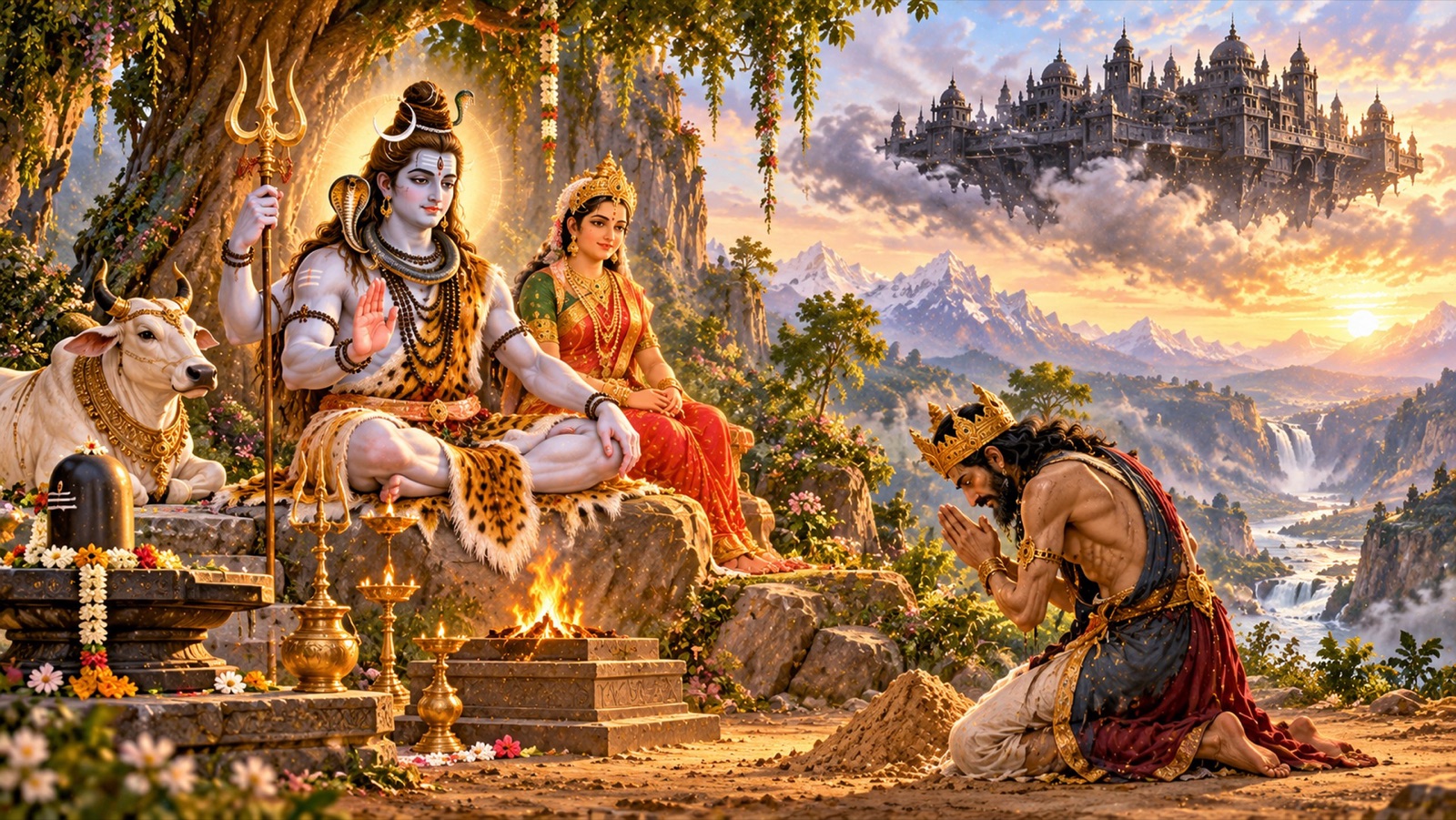
Dark within and impossible for others to approach, the Saubha went wherever its master willed. With this vehicle in his hands, and the old grudge against the Vrishnis burning in his memory, Shalva set out for Dvaraka.
The Siege of Dvaraka
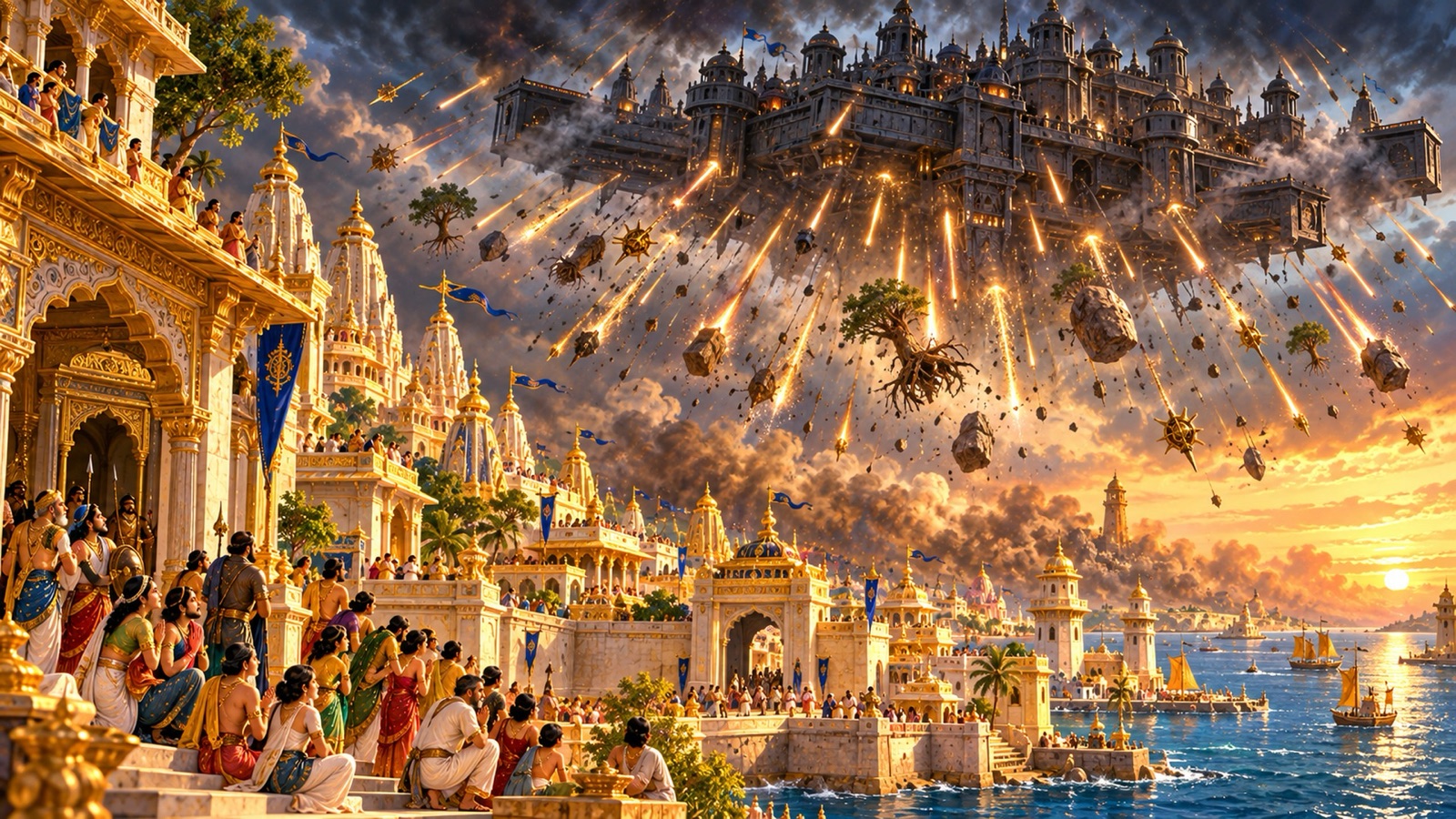
Shalva surrounded the city with a vast army and set about destroying it on every side: its groves and pleasure-gardens, its gateways with their lofty towers, its mansions with their upper storeys, its watchtowers and ramparts, its places of rest and recreation. From the great flying city came torrents of weapons — boulders, uprooted trees, thunderbolts, serpents and hailstones — and a violent whirlwind arose until every direction was blanketed in dust. Tormented so by the Saubha, the city of Krishna found no peace, like the earth of old when the demon Tripura tyrannized it.
Pradyumna Rides Out
Seeing his own people harassed, the glorious Pradyumna, himself a lordly hero, mounted his chariot and called out to them, “Do not be afraid!”
प्रद्युम्नो भगवान् वीक्ष्य बाध्यमाना निजाः प्रजाः ।
मा भैष्टेत्यभ्यधाद् वीरो रथारूढो महायशाः ॥ १३ ॥
pradyumno bhagavān vīkṣya bādhyamānā nijāḥ prajāḥ mā bhaiṣṭety abhyadhād vīro rathārūḍho mahā-yaśāḥ
Meaning: Beholding his citizens under attack, the illustrious and heroic Pradyumna, of great renown, ascended his chariot and told them, “Fear not.” (Canto 10, Chapter 76, verse 13)
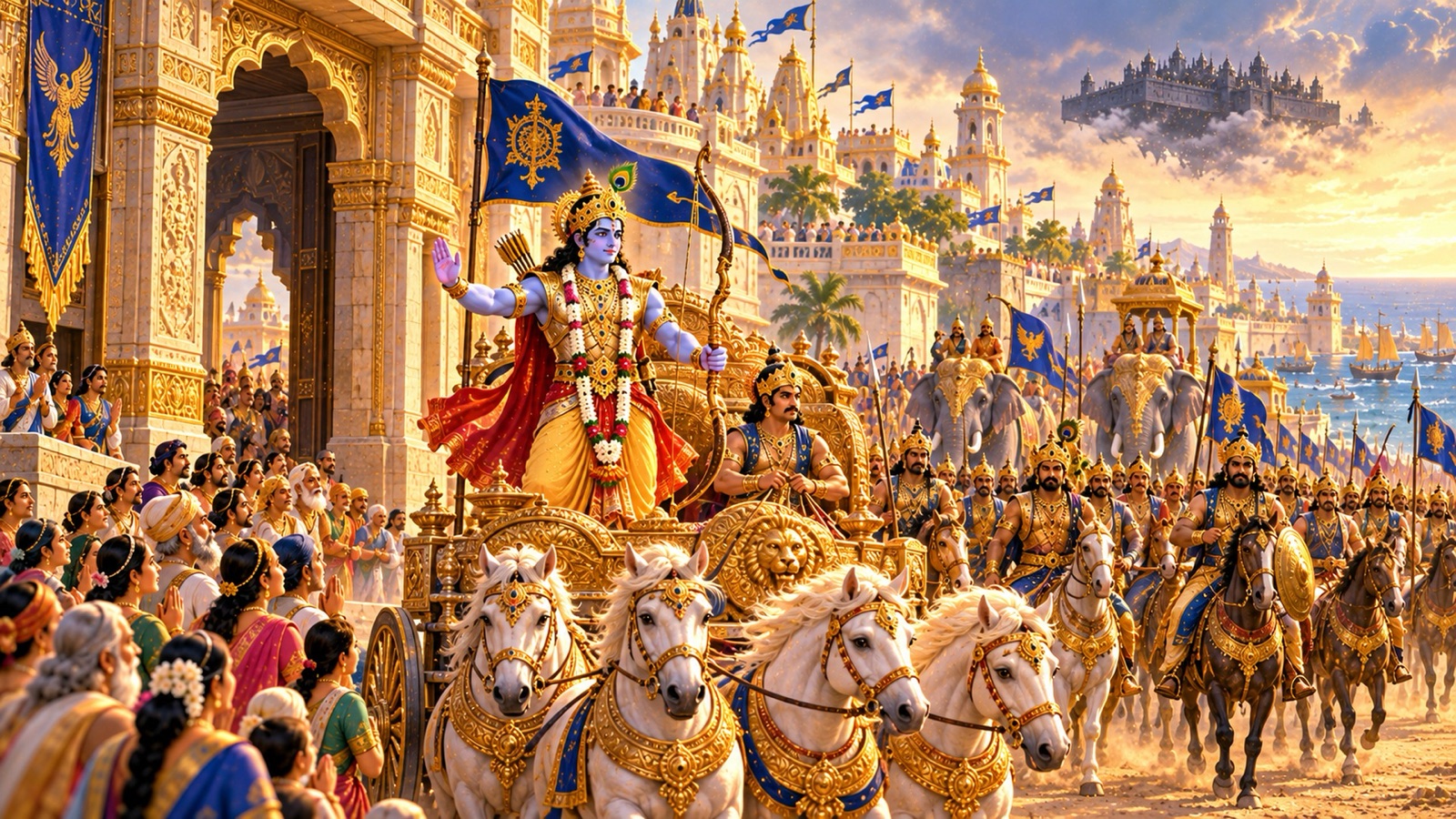
Behind him rode Satyaki, Charudeshna, Samba, Akrura with his younger brothers, Kritavarma the son of Hridika, Bhanuvinda, Gada, Shuka, Sarana and many other great bowmen, commanders of chariot divisions, all clad in armour and protected by chariots, elephants, horses and foot-soldiers. Then began a tumultuous, hair-raising battle between the men of Shalva and the Yadus, like the ancient war of the demons against the gods.
The Prince’s Celestial Weapons
With his divine weapons the son of Rukmini destroyed in an instant the magic of the lord of Saubha, as the hot-rayed sun dispels the darkness of night. He pierced the commander of Shalva’s army with twenty-five arrows, their shafts gold-feathered, their tips of iron, their joints smoothly polished. He struck Shalva himself with a hundred, and then dealt one arrow to each of his soldiers, ten to each of their leaders and three to each of their mounts. Seeing this great and marvellous feat of the high-souled Pradyumna, the warriors on both sides — his own and the enemy’s — honoured him.
The City That Was Many and One
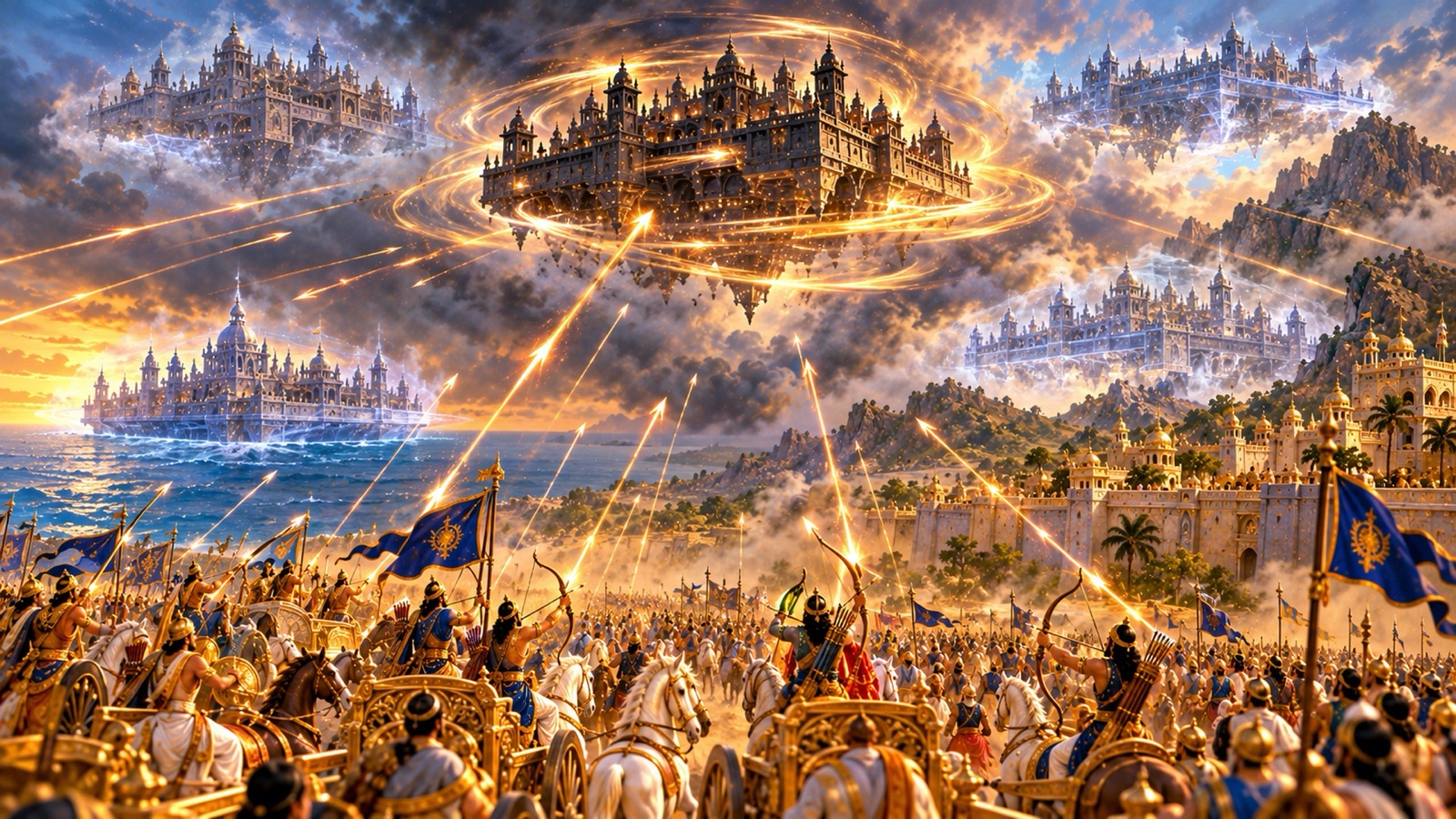
But the Saubha, built by Maya and woven of illusion, was hard for its enemies to fathom. Now it looked like many cities, now like one; now it was seen, now it vanished. At one moment it rested on the ground, at another in the sky, now on a mountain peak and now upon the water; it whirled about like a spinning firebrand and never stayed in one place. Wherever Shalva showed himself with his city and his soldiers, there the Yadava generals loosed their arrows. Those shafts touched like fire and sun and were as deadly as venomous snakes; under their blows Shalva’s city and army were sorely afflicted, and Shalva himself fainted.
The Vrishni Heroes Hold Their Ground
The Vrishni heroes were pressed equally hard by the floods of weapons hurled by Shalva’s commanders, yet not one of them left his post. They had set their hearts on winning both worlds — the heavenly reward of a warrior who dies at his station, or the glory on earth of the one who conquers.
शाल्वानीकपशस्त्रौघैर्वृष्णिवीरा भृशार्दिताः ।
न तत्यजू रणं स्वं स्वं लोकद्वयजिगीषवः ॥ २५ ॥
śālvānīkapa-śastraughair vṛṣṇi-vīrā bhṛśārditāḥ na tatyajū raṇaṁ svaṁ svaṁ loka-dvaya-jigīṣavaḥ
Meaning: Though greatly tormented by the torrents of weapons of Shalva’s generals, the Vrishni heroes did not abandon their respective positions in the fight, for they desired victory in this world and the next. (Canto 10, Chapter 76, verse 25)
Dyuman’s Mace and the Charioteer’s Choice
Among Shalva’s ministers was a mighty warrior named Dyuman, whom Pradyumna had earlier wounded severely. Now he rushed at Pradyumna, struck him with a mace of steel and let out a great roar. The blow shattered the prince’s chest. His charioteer, the son of Daruka, who knew the laws of warfare, at once carried the chastiser of foes away from the battle.
Pradyumna’s Shame
Within the hour Pradyumna came back to his senses, and his first words to his charioteer were bitter. “Alas, charioteer, you have done a wrong thing in carrying me away from the fight. Never has anyone born in the line of Yadu been heard to leave a battlefield — save me, through the fault of a faint-hearted driver.”
किं नु वक्ष्येऽभिसङ्गम्य पितरौ रामकेशवौ ।
युद्धात्सम्यगपक्रान्तः पृष्टस्तत्रात्मनः क्षमम् ॥ ३० ॥
kiṁ nu vakṣye ‘bhisaṅgamya pitarau rāma-keśavau yuddhāt samyag apakrāntaḥ pṛṣṭas tatrātmanaḥ kṣamam
Meaning: “When I meet my two fathers, Rama and Keshava, and they ask me, what fitting answer shall I give — I who have so neatly retreated from the battle?” (Canto 10, Chapter 76, verse 30)
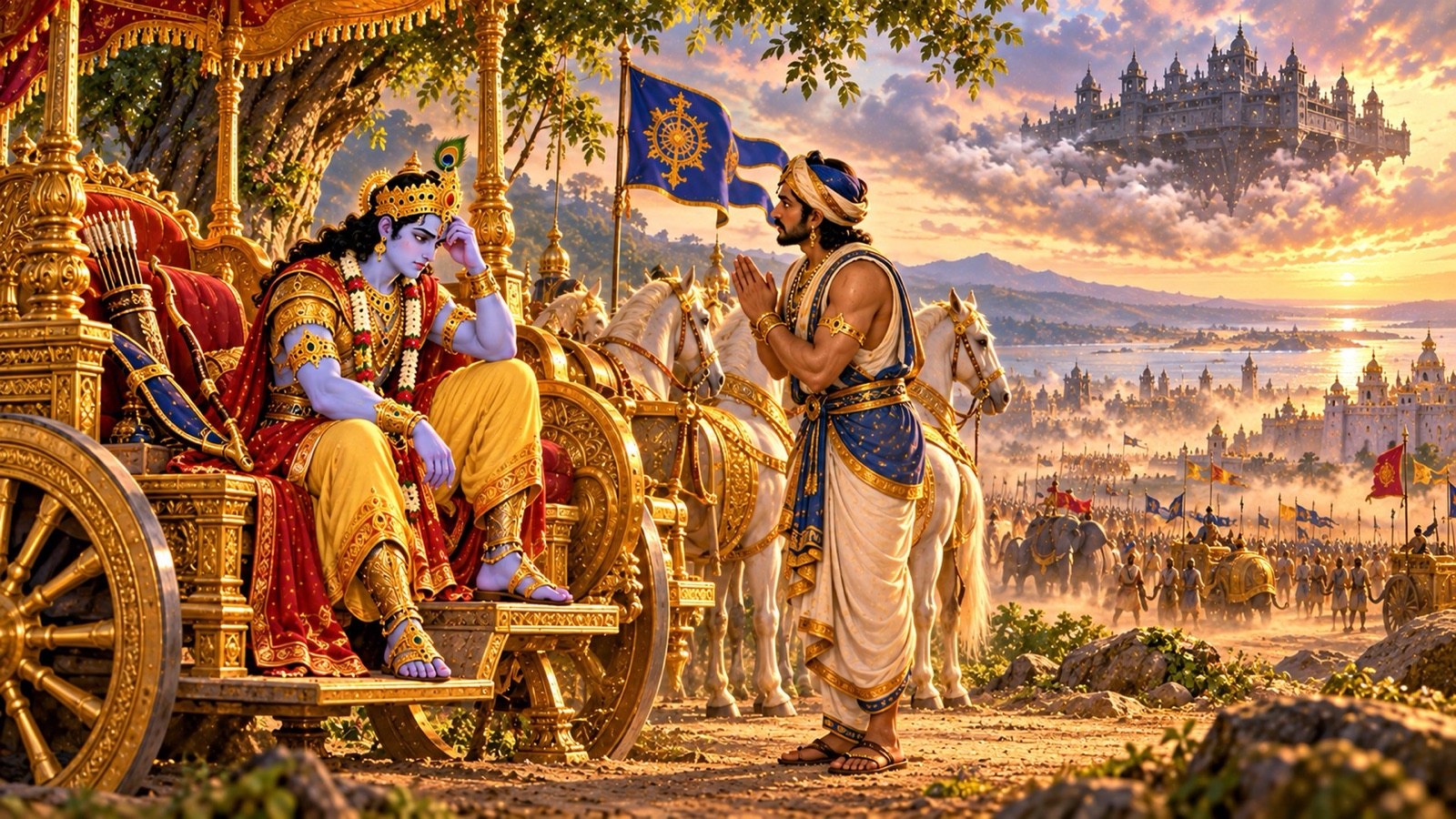
He thought of his uncle Balarama and his father Krishna, and found no words with which he could face their questions. Worse still, he pictured the wives of his brothers laughing at him and asking openly, “Tell us, hero, how did your manliness desert you in the fight with your enemy?”
The Charioteer’s Answer
The charioteer’s reply is quiet and firm. “O long-lived one, my lord, I did this knowing the dharma of my office. The rule of battle is this: a charioteer must protect his chariot-warrior when he is in danger, and the warrior must protect his charioteer in turn.”
सारथिरुवाच
धर्मं विजानतायुष्मन् कृतमेतन्मया विभो ।
सूतः कृच्छ्रगतं रक्षेद् रथिनं सारथिं रथी ॥ ३२ ॥
sārathir uvāca dharmaṁ vijānatāyuṣman kṛtam etan mayā vibho sūtaḥ kṛcchra-gataṁ rakṣed rathinaṁ sārathiṁ rathī
Meaning: The charioteer said: O long-lived one, O master, I acted with full knowledge of dharma; the driver should save his warrior when he falls into peril, and the warrior should likewise save his driver. (Canto 10, Chapter 76, verse 32)
Knowing this rule, he explained, he had borne Pradyumna away when he saw him struck senseless by the enemy’s mace and gravely hurt. The chapter closes on this exchange.
Principal Teachings of This Chapter
1. Every pastime belongs to the Lord, even when He seems absent. Sukadeva calls this whole episode a wonderful deed of Krishna (verse 1), though Krishna is far away at Indraprastha and the fighting falls to His son and kinsmen. The Lord, who sports in a human body, allows His own people to be tried so that their steadfastness and dharma may shine; and the outcome, declared at the very start, was never in doubt. Shalva’s boon, the iron city, the year of austerity — all of it unfolds within the Lord’s play. A devotee learns to see the Lord’s hand in the trial itself, not only in the rescue.
2. Austerity without surrender breeds only power. Shalva fasted a full year on a handful of dust, and Shiva, quick to be pleased, granted what he asked. Yet because his vow (verse 3) was born of wounded pride, his reward became an instrument of destruction. Tapasya aimed at harming the Lord’s devotees can win a boon but never blessing.
3. The brave stand at their post. The Vrishni heroes did not leave their positions though sorely pressed (verse 25). To hold one’s appointed place under pressure, trusting the fruit to the Lord, is itself a form of devotion.
4. Honour must bow to dharma. Pradyumna’s shame before his elders (verse 30) is sincere, but the charioteer shows him a higher law (verse 32): the duty to preserve the life entrusted to one. Devotion sometimes asks us to accept help we would rather refuse.
5. The humble servant can be the wiser teacher. It is a charioteer, not a prince, who speaks the chapter’s final word of dharma. The Lord places His instruction in unexpected mouths, and the devotee listens for it everywhere.
A Devotional Reflection
What stays with us from this chapter is not the flying city or the rain of arrows, but a conversation between a prince and his driver. Pradyumna, bred in the house of Krishna, measures himself by the honour of his line and is ashamed to have been rescued. The son of Daruka, who holds the reins, measures himself by his duty and is not ashamed at all. Both are right in their own sphere, and the Bhagavatam lets us hear them both without mocking either. How often our devotion carries a touch of Pradyumna’s pride — the wish to be seen standing firm, to need no help from anyone. And how often the Lord, through some humble instrument, simply carries us out of harm’s way before we understand why. Shalva’s year of austerity bought him an iron city and no peace; the charioteer’s quiet knowledge of dharma saved a life. Between the two the chapter quietly asks where our own strength is placed.
A Daily Devotional Practice
Today, when you are tempted to insist on managing a difficulty alone, pause and recall the charioteer’s words. Offer the situation to the Lord, accept the help He sends through others without resentment, and hold your own duties steadily, as the Vrishni heroes held their posts. Then close the day by chanting gently: Om Namo Bhagavate Vasudevaya.
Conclusion
The seventy-sixth chapter of the Tenth Canto opens the story of Shalva — his oath, his austerity, the iron city Saubha, and the siege of Dvaraka in Krishna’s absence. Pradyumna breaks the enemy’s illusions and is honoured by friend and foe, yet falls to Dyuman’s mace and is borne from the field, grieving over his honour until his charioteer reveals the dharma that governs them both. The thread will continue in the next chapter, where the Lord Himself returns. May we, remembering that even the siege of His own city was His pastime, meet our trials with the steadiness of the Vrishni heroes and the humility to be carried when we cannot stand.
May the divine wisdom of Srimad Bhagavatam awaken pure devotion within our hearts.
Om Namo Bhagavate Vasudevaya.
Jay Shree Madhav.
References and Attribution
- Primary edition: Gita Press, Śrīmad Bhāgavata Mahāpurāṇa (English, Part II), Book Ten (Latter Half), Discourse 76.
- Series: Srimad Bhagavatam Wisdom · Biswa Sanatan Dharma Seva Trust.
- Presented following the spiritual guidance and recommendation of Pandit Dr. Shri Kashinath Mishra.
This is an original, faithful retelling in the writer’s own words, with brief quoted verses shown in Devanāgarī and transliteration and their meanings given as summaries. It is not a reproduction of any single publisher’s continuous translation or commentary. No affiliation with or endorsement by any publisher is implied.
Jay Shree Madhav